
Sanskrit and Science: The Language Behind Ancient Innovations


Welcome to Ancient India History, where we delve into the fascinating tapestry of ancient Indian civilizations! Here, you'll uncover the profound Sanskrit contributions to science, a topic that unlocks the door to understanding how this ancient language served as a catalyst for groundbreaking innovations. Join us on this journey through history as we explore the intricate connections between language and scientific advancement, revealing the brilliance of minds from the Indus Valley to the Gupta Empire. Prepare to be inspired and intrigued—your exploration of ancient wisdom is just a click away!

Introduction to Sanskrit and Its Role in Ancient Indian Culture
Sanskrit, often hailed as the mother of many languages, is a classical language that has played a pivotal role in the cultural and intellectual landscape of ancient India. With its origins tracing back over 3,500 years, Sanskrit is not merely a means of communication but a vessel of knowledge that has shaped various aspects of Indian civilization, including religion, philosophy, and science.
The importance of Sanskrit contributions to science is profound, as it served as the medium through which ancient scholars articulated complex scientific concepts, documented innovations, and preserved wisdom for future generations. In this exploration, we will delve into the rich tapestry of Sanskrit's influence on scientific thought, highlighting its enduring legacy in the annals of history.
Overview of Sanskrit as an Ancient Language
Sanskrit is a highly inflected language belonging to the Indo-European family. It boasts a rich vocabulary and a sophisticated grammatical structure, enabling precise expression of complex ideas. This linguistic precision made it an ideal language for scientific discourse. Notably, texts such as the Vedas, Upanishads, and various philosophical treatises were composed in Sanskrit, establishing a foundation for various fields, including mathematics, astronomy, and medicine.
- Key Features of Sanskrit:
- Phonetics: Sanskrit has a systematic phonetic structure, which aids in clarity and articulation.
- Grammar: The language is characterized by its elaborate grammar, which includes eight cases, three genders, and numerous verb forms.
- Literary Tradition: The vast corpus of Sanskrit literature encompasses poetry, drama, and scientific texts, showcasing its versatility.
Significance of Sanskrit in Ancient Indian Civilization
The significance of Sanskrit in ancient Indian civilization transcends mere linguistic utility. It acted as a unifying force that brought together diverse thoughts, practices, and cultures across the subcontinent. Scholars and philosophers used Sanskrit to record their insights, leading to advancements in various disciplines.
- Cultural Impact:
- Religion and Spirituality: Sanskrit texts are foundational to Hinduism, Buddhism, and Jainism, influencing spiritual practices and beliefs.
- Philosophy and Logic: The language facilitated discussions in various philosophical schools, contributing to the richness of Indian thought.
Historical Context of Sanskrit Contributions to Science
Understanding the historical context of Sanskrit contributions to science requires an examination of the evolution of the language and its intersection with scientific inquiry. Ancient Indian scholars were not only linguists but also innovators who utilized Sanskrit to document their discoveries and theoretical frameworks.
The Evolution of Sanskrit Language
Sanskrit's evolution can be traced through different stages, from Vedic Sanskrit, utilized in the ancient scriptures, to Classical Sanskrit, which emerged around the 4th century BCE. This evolution reflects the adaptability of the language in accommodating new ideas and concepts. The standardization of Sanskrit, particularly through the work of Panini in his text Ashtadhyayi, established grammatical rules that further solidified its use in scholarly pursuits.
- Stages of Evolution:
- Vedic Sanskrit: Used in religious texts and rituals.
- Classical Sanskrit: Emphasized in literature and science, becoming the lingua franca of intellectual discourse.
Ancient Indian Innovations and Their Scientific Foundations
Ancient Indian civilization witnessed remarkable innovations that were rooted in a robust scientific tradition articulated through Sanskrit. Fields such as mathematics, astronomy, and medicine flourished, with notable figures like Aryabhata and Sushruta making significant contributions.
- Key Contributions:
- Mathematics: The concept of zero and the decimal system were articulated in Sanskrit texts.
- Astronomy: The works of Aryabhata included sophisticated calculations and theories about celestial bodies.
- Medicine: The Sushruta Samhita laid the groundwork for surgical techniques and medical practices.
Sanskrit's contributions to science represent a critical intersection of language and innovation, reflecting the depth of ancient Indian intellectual achievements. As we continue to explore these contributions, it becomes clear that Sanskrit is not just a language of the past but a lasting legacy that continues to inspire and inform modern scientific thought.
Key Areas of Science Influenced by Sanskrit
Sanskrit, as an ancient and highly developed language, has played a critical role in the advancement of various scientific fields in ancient India. Its rich vocabulary and precise grammar allowed scholars to articulate complex ideas, share knowledge, and document discoveries that significantly influenced not only Indian civilization but also the global scientific landscape. Here are some key areas where Sanskrit has made notable contributions:
- Mathematics: The precision of Sanskrit enabled the development of mathematical concepts and terminology that laid the groundwork for future advancements.
- Astronomy: Sanskrit texts documented celestial observations and theories, contributing to the understanding of planetary movements and calendars.
- Medicine: The language was instrumental in encoding the principles of Ayurveda, the traditional system of medicine, which emphasizes holistic healing.
- Architecture and Engineering: Sanskrit literature provided insights into architectural design, construction techniques, and the principles governing structural integrity.
Mathematics and Astronomy: Contributions of Sanskrit Texts
Sanskrit texts such as the Sulba Sutras are foundational to ancient Indian mathematics, detailing geometric principles and methods for constructing altars. These texts introduced concepts such as the Pythagorean theorem and approximations of π (pi), demonstrating advanced mathematical understanding long before similar discoveries in the West.
In the field of astronomy, the Aryabhatiya by Aryabhata is one of the most significant works, presenting calculations regarding the circumference of the Earth, the motions of the planets, and eclipses. Aryabhata's innovative approach to mathematics and astronomy illustrates how Sanskrit facilitated the scientific discourse of the time, leading to precise astronomical calculations that were crucial for agriculture and navigation.
Medicine and Ayurveda: The Role of Sanskrit in Ancient Healing Practices
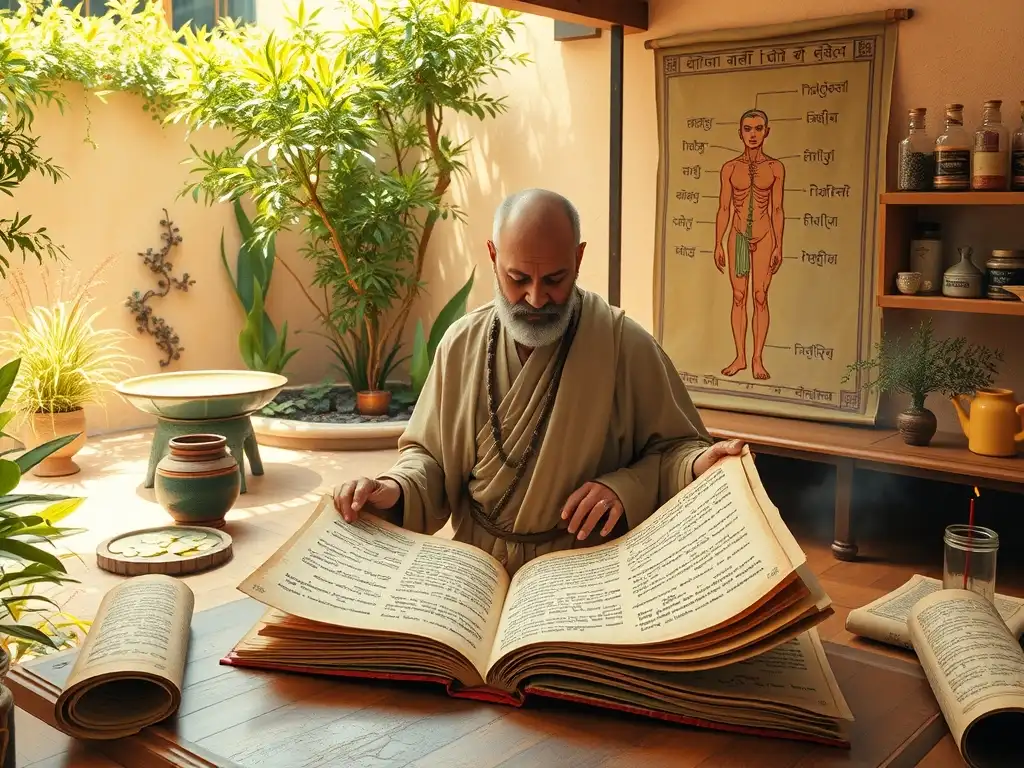
Sanskrit served as the foundational language for Ayurveda, the ancient Indian system of medicine that emphasizes balance in bodily systems. Texts like the Charaka Samhita and the Sushruta Samhita are pivotal in documenting medical knowledge, surgical techniques, and herbal treatments.
These texts not only provide detailed descriptions of diseases and their treatments but also emphasize the importance of diagnosis and prognosis. The terminology used in these texts is highly specialized, reflecting a sophisticated understanding of human anatomy, physiology, and the interconnectedness of body and mind. This rich medical literature continues to influence contemporary holistic practices and herbal medicine worldwide.
Architecture and Engineering: Sanskrit in Ancient Indian Innovations
Sanskrit literature has also been pivotal in the field of architecture and engineering. Works such as the Manasara and Mayamatam provide comprehensive guidelines on construction practices, including temple architecture and urban planning.
These texts encompass principles of design, geometry, and structural stability, highlighting the ancient Indians' knowledge of materials and their properties. Techniques derived from these texts can be observed in ancient structures that have withstood the test of time, showcasing the practical application of Sanskrit principles in engineering.
Prominent Sanskrit Texts and Their Scientific Relevance
Several Sanskrit texts have been instrumental in shaping scientific thought and practice in ancient India. These works not only demonstrate the linguistic richness of Sanskrit but also encapsulate the intellectual pursuits of their time.
Vedic Texts: Foundations of Scientific Thought
The Vedic texts, which include the Rigveda and the Atharvaveda, are among the earliest sources of knowledge in Sanskrit. They encompass hymns, rituals, and philosophical discussions that reveal early scientific thinking, particularly in areas such as cosmology and natural phenomena. The Taittiriya Samhita and the Yajurveda contain insights into the natural world, exploring concepts of time, space, and the elements, laying the groundwork for future scientific inquiry.
Sutras and Shastras: Scientific Principles in Sanskrit Literature
Sutras and Shastras, such as the Yoga Sutras and the Nyaya Shastra, present systematic frameworks for understanding various disciplines, including philosophy, logic, and ethics. These texts introduce principles of reasoning and inquiry that are foundational to the scientific method. The clarity and conciseness of the sutra format made complex ideas accessible and facilitated scholarly debate and exploration.
Contributions of Notable Scholars: Aryabhata, Charaka, and Others
Prominent scholars such as Aryabhata and Charaka exemplify the contributions of individuals who utilized Sanskrit to advance scientific knowledge. Aryabhata's works in mathematics and astronomy have had a lasting impact, while Charaka's writings on medicine established the principles of Ayurveda that continue to be relevant today.
Other notable figures include Brahmagupta, who made advances in algebra, and Bhaskara II, known for his work in calculus and astronomy. These scholars not only advanced their fields but also enriched the Sanskrit language, ensuring its place as a medium for scientific discourse and innovation.
The Interconnection Between Language and Scientific Thought

Language is not merely a means of communication; it shapes our understanding of the world and influences the way we think. In ancient India, Sanskrit served as a vehicle for scientific thought, interweaving mathematical concepts, medical knowledge, and philosophical inquiries into a cohesive framework. The precision of Sanskrit grammar allowed for the articulation of complex ideas, facilitating advancements in various scientific fields. Scholars like Aryabhata and Charaka utilized the language to document their findings, creating a legacy that would influence countless generations.
Moreover, the structure of Sanskrit, with its rich vocabulary and ability to form compound words, enabled the expression of nuanced concepts. This interconnection between language and scientific thought underscores the importance of Sanskrit as not just a cultural artifact but as a crucial element in the development of ancient Indian science.
How Sanskrit Language Shapes Scientific Concepts
Sanskrit has a unique ability to convey abstract concepts through its grammatical structure and extensive lexicon. For example, terms like "Prakriti" (nature) and "Purusha" (consciousness) are foundational in Ayurveda and philosophical texts, reflecting a deep understanding of the relationship between the universe and human existence. This linguistic richness allowed ancient scholars to articulate complex scientific theories, such as those found in mathematics, astronomy, and medicine.
The use of precise terminology in Sanskrit enables clarity and consistency in scientific discourse. This is evident in works like "Siddhanta Shiromani" by Bhaskara II, where mathematical principles are expressed with such clarity that they remain relevant in modern discussions of calculus and algebra. Thus, the way Sanskrit constructs its scientific terminology not only aids in understanding but also drives the evolution of scientific thought.
Influence of Sanskrit on Modern Scientific Terminology
The contributions of Sanskrit to modern scientific terminology are profound. Many terms used in contemporary science have their roots in Sanskrit, highlighting the language's lasting impact. For instance, the word "zero" derives from the Sanskrit "shunya," meaning void or empty, which is foundational in mathematics.
Additionally, terminologies in fields such as medicine (Ayurveda), astronomy (Jyotisha), and mathematics continue to influence modern practices. As scientific disciplines evolve, the foundational concepts rooted in Sanskrit provide a framework for understanding complex theories. Furthermore, the integration of Sanskrit terms into modern scientific vocabulary serves as a bridge connecting ancient wisdom with contemporary knowledge, enriching the global scientific lexicon.
Preservation and Teaching of Sanskrit for Future Generations
The preservation of Sanskrit is essential for maintaining its contributions to science and culture. As a language that embodies a wealth of knowledge, efforts to teach and practice Sanskrit are crucial for ensuring that future generations can access its rich heritage. Educational institutions play a pivotal role in this endeavor, providing structured programs that emphasize the importance of Sanskrit in understanding ancient texts and scientific principles.
The Role of Educational Institutions in Sanskrit Studies
Educational institutions are at the forefront of Sanskrit studies, creating curricula that not only teach the language but also explore its scientific significance. Universities and colleges in India and abroad offer courses that delve into classical literature, philosophy, and science, fostering a renewed interest in Sanskrit.
These institutions often collaborate with scholars to create research programs that promote the study of ancient texts. By engaging students with the scientific contributions documented in Sanskrit, they encourage a deeper appreciation for the language and its relevance in modern scientific discourse. Workshops, seminars, and conferences further enhance this scholarly community, providing platforms for discussion and innovation.
Efforts to Revive Sanskrit in Contemporary Science
In recent years, there has been a resurgence of interest in reviving Sanskrit within contemporary scientific contexts. Various organizations and scholars are working to integrate Sanskrit into modern scientific education, recognizing its value in fostering critical thinking and innovation. This includes developing resources that highlight the scientific principles found in ancient texts and making them accessible to a broader audience.
Moreover, interdisciplinary approaches that combine Sanskrit studies with fields such as artificial intelligence, linguistics, and cognitive science are gaining traction. These efforts not only aim to preserve the language but also seek to demonstrate its applicability in today's scientific landscape. By bridging the ancient and modern, the revival of Sanskrit in science holds the potential to inspire new innovations and enrich our understanding of both past and future scientific endeavors.
Conclusion: The Lasting Impact of Sanskrit on Modern Science
The enduring legacy of Sanskrit, particularly in the realm of science, is a testament to the intellectual rigor and innovative spirit of ancient Indian civilizations. From its intricate grammar to its extensive vocabulary, Sanskrit has laid the groundwork for various scientific disciplines, including mathematics, astronomy, and medicine. The ancient texts, such as the Aryabhatiya by Aryabhata and the Sushruta Samhita by Sushruta, not only provided foundational knowledge but also influenced subsequent generations of scholars across the globe.
The precision in the language facilitated the expression of complex scientific concepts, enabling scholars to document their findings meticulously. Consequently, many modern scientific terminologies in the fields of mathematics and medicine can trace their roots back to Sanskrit. This connection amplifies the importance of recognizing Sanskrit not merely as a classical language but as a significant contributor to the evolution of scientific thought.
Reflection on Sanskrit Contributions to Science and Innovation

Sanskrit served as a medium through which ancient scholars articulated groundbreaking ideas, paving the way for future advancements in various scientific fields. The Sulba Sutras, for example, are among the earliest texts to discuss geometrical principles, including the Pythagorean theorem, long before it was acknowledged in Western literature. Similarly, the astrological calculations found in texts like the Surya Siddhanta reflect a sophisticated understanding of celestial movements, which has influenced both Eastern and Western astronomy.
Sanskrit's structure, characterized by its systematic grammar, made it particularly effective for conveying scientific concepts. This clarity and precision allowed for a more rigorous analysis of ideas, fostering an environment conducive to innovation. The contributions of ancient Indian scholars, expressed through Sanskrit, remain relevant today, underscoring the language's significant role in the history of science.
Future Prospects for Sanskrit in Scientific Discourse
As the world increasingly recognizes the value of interdisciplinary approaches in education and research, Sanskrit's relevance in scientific discourse is likely to grow. There is a resurgence of interest in ancient Indian knowledge systems, particularly in the context of sustainability, medicine, and holistic sciences. Institutions are beginning to explore how Sanskrit can contribute to modern scientific frameworks, especially in fields like Ayurveda and ecology.
Moreover, the integration of Sanskrit into contemporary education systems can inspire a new generation of scholars who appreciate the historical context of scientific innovations. By fostering research that combines traditional knowledge with modern scientific inquiry, the potential for Sanskrit to enrich contemporary discourse is immense. The challenge lies in creating platforms that facilitate this integration while promoting an appreciation of the language's rich heritage.
References and Further Reading on Sanskrit and Science
Suggested Literature on Ancient Indian Contributions to Science
-
"The History of Indian Science, Technology, and Culture" by D.P. Chattopadhyaya
This comprehensive text explores the intricate relationship between Indian culture and its scientific advancements, with a focus on the language of Sanskrit.
-
"Sanskrit and the Scientific Revolution" by R. N. Sharma
This work delves into how Sanskrit contributed to the scientific revolution in ancient India, highlighting key texts and their impact.
-
"Ayurveda: The Science of Self-Healing" by Dr. Vasant Lad
This book discusses the principles of Ayurveda, emphasizing the foundational role of Sanskrit in the development of medical knowledge.
Online Resources for Exploring Sanskrit Language and Science
-
Sanskrit Dictionary Online
A resource for students and enthusiasts to explore Sanskrit terms and their meanings, particularly in scientific contexts.
-
Digital Library of India
This online archive offers access to numerous ancient texts in Sanskrit, providing insight into the scientific contributions of ancient Indian scholars.
-
The Complete Works of Aryabhata
Available in various formats online, this collection includes translations and commentaries on Aryabhata’s contributions to mathematics and astronomy, showcasing the relevance of Sanskrit in these fields.
- Introduction to Sanskrit and Its Role in Ancient Indian Culture
- Historical Context of Sanskrit Contributions to Science
- Key Areas of Science Influenced by Sanskrit
- Mathematics and Astronomy: Contributions of Sanskrit Texts
- Medicine and Ayurveda: The Role of Sanskrit in Ancient Healing Practices
- Architecture and Engineering: Sanskrit in Ancient Indian Innovations
- Prominent Sanskrit Texts and Their Scientific Relevance
- The Interconnection Between Language and Scientific Thought
- Preservation and Teaching of Sanskrit for Future Generations
- Conclusion: The Lasting Impact of Sanskrit on Modern Science
- Reflection on Sanskrit Contributions to Science and Innovation
- Future Prospects for Sanskrit in Scientific Discourse
- References and Further Reading on Sanskrit and Science
- What is the significance of Sanskrit contributions to science in ancient India?
- How did ancient Indian scholars utilize Sanskrit in their scientific works?
- Can you name some notable texts that highlight Sanskrit's contributions to science?
- In what ways did Sanskrit influence other cultures or languages in terms of scientific terminology?
- Why is it important to study the Sanskrit contributions to science today?
Frequently Asked Questions
What is the significance of Sanskrit contributions to science in ancient India?
Sanskrit played a crucial role in documenting scientific knowledge, with many texts written in this language that covered fields such as mathematics, astronomy, and medicine.
How did ancient Indian scholars utilize Sanskrit in their scientific works?
Ancient Indian scholars used Sanskrit as a medium of expression to articulate complex scientific theories and principles, allowing for precise communication of innovative ideas.
Can you name some notable texts that highlight Sanskrit's contributions to science?
Key texts include the Aryabhatiya by Aryabhata, which addressed astronomy and mathematics, and the Sushruta Samhita, which is foundational in the field of surgery and medicine.
In what ways did Sanskrit influence other cultures or languages in terms of scientific terminology?
Sanskrit influenced many languages through the adoption of scientific terms, enriching fields like mathematics and medicine in cultures such as Arabic and Latin.
Why is it important to study the Sanskrit contributions to science today?
Studying these contributions helps us appreciate the historical roots of modern science and encourages a broader understanding of how ancient civilizations influenced contemporary knowledge.
Final Reflection: The Enduring Legacy of Sanskrit in Scientific Innovation
Sanskrit's contributions to science are not merely historical footnotes; they are the foundation upon which many modern scientific principles stand. As we navigate the complexities of contemporary science and technology, it becomes increasingly clear that the wisdom embedded in ancient texts continues to resonate today. The intricate relationship between language and knowledge is exemplified in Sanskrit, reminding us that the roots of innovation often lie in the past.
The influence of Sanskrit on the cultural and scientific landscape is profound and ongoing. From mathematics to medicine, the principles articulated in ancient Sanskrit texts have shaped the way we understand the world around us. As we delve deeper into the significance of these contributions, we recognize that they are not relics of a bygone era but rather living legacies that continue to inspire innovation. The greatest discoveries are often those that connect us to our past, illuminating the path forward.
As we reflect on the insights gained from exploring Sanskrit and its scientific contributions, I invite you to consider how this knowledge can inform your own journey. Embrace the lessons of the past and let them guide your pursuit of knowledge and innovation. Whether you are a student, a professional, or simply a curious mind, take a moment to explore the depths of ancient wisdom and see how it can enrich your understanding of the world today.
Unleash the Power of Sanskrit in Science!
Thank you for exploring the fascinating connection between Sanskrit and the innovations of ancient India! You've uncovered the remarkable impact this ancient language had on scientific thought and expression. Now, it's time to take that knowledge and apply it in inspiring ways.
Here are a few steps you can take to dive deeper into this captivating subject:
- Join a Sanskrit Workshop: Discover the beauty and intricacies of Sanskrit by participating in a local workshop or an online course—**enrich your understanding of its scientific applications! **
- Share Your Insights: Discuss this article with friends or on social media to spark conversations about how ancient languages influence modern science. **Your voice can inspire curiosity! **
- Explore Ancient Texts: Take your journey further by reading translations of classic Sanskrit texts that contributed to scientific discoveries. **You might uncover hidden gems! **
How has understanding the relationship between language and science changed your perspective on ancient innovations? **We invite you to share your thoughts below! **