
The Sankhya School: A Philosophical Foundation for Jainism and Buddhism

Welcome to Ancient India History, where we embark on a fascinating journey through time to uncover the rich tapestry of ancient Indian civilizations. In this exploration, we delve into the profound Sankhya philosophy in Jainism, a pivotal concept that not only shaped the spiritual landscape of its time but also laid the groundwork for subsequent philosophical movements, including Buddhism. Are you ready to unravel the mysteries of this ancient wisdom and discover how it continues to influence modern thought? Join us as we illuminate the connections between philosophy and culture in the vibrant history of India!
The Sankhya School of Thought stands as one of the most significant philosophical frameworks in ancient Indian philosophy, offering profound insights into the nature of reality, consciousness, and the human experience. Emerging around the same time as major religious movements, such as Jainism and Buddhism, the Sankhya philosophy has played a pivotal role in shaping the ideological foundations of these two traditions.
By exploring the concepts of dualism, the nature of the self, and the material world, Sankhya philosophy provides a rich tapestry of ideas that significantly influenced Jain and Buddhist thought. This article delves into the intricate connections between Sankhya philosophy and its contributions to Jainism and Buddhism, shedding light on how these philosophies intersect and diverge, as well as their enduring impact on Indian intellectual history.
Overview of Sankhya Philosophy
The Sankhya School, attributed to the sage Kapila, posits a dualistic approach that differentiates between Purusha (consciousness) and Prakriti (matter). This distinction lays the groundwork for understanding the nature of existence and personal liberation.
- Key Concepts:
- Purusha: Represents the eternal, unchanging self.
- Prakriti: The dynamic, material world that is subject to change and evolution.
- The Gunas: The three fundamental qualities (Sattva, Rajas, and Tamas) that influence human behavior and the state of the material world.
These concepts are crucial for understanding the spiritual goals of both Jainism and Buddhism, which emphasize the liberation of the self from the cycles of birth and rebirth.
Influence of Sankhya on Jainism
Jainism, with its emphasis on non-violence (Ahimsa) and asceticism, shows notable philosophical affinities with Sankhya. Both traditions advocate for a path of self-realization and liberation, albeit through different practices and beliefs.
- Shared Philosophical Elements:
- The concept of Karma: Both Jainism and Sankhya recognize the influence of karma on the soul's journey.
- Self-Realization: Similar aspirations for achieving a state of purity and liberation from worldly attachments.
Jain thinkers have integrated Sankhya concepts to elaborate on their own metaphysical views, enriching Jain philosophy with a more structured understanding of consciousness and reality.
Influence of Sankhya on Buddhism
Buddhism, while distinct in its approaches, also drew upon the foundational elements of Sankhya philosophy. The Buddhist concept of Anatta (no-self) can be viewed as a counterpoint to the Sankhya notion of Purusha, highlighting the unique interpretations that arose from these interactions.
- Philosophical Interactions:
- Impermanence (Anicca): Acknowledgment of the transient nature of the material world, which aligns with Sankhya's views on Prakriti.
- Path to Enlightenment: The Eightfold Path in Buddhism echoes the Sankhya focus on self-awareness and understanding the nature of existence.
These philosophical dialogues reflect how the Sankhya School not only contributed to the development of Jainism and Buddhism but also fostered a broader discourse on the nature of existence in ancient India.
Conclusion
The Sankhya School serves as a philosophical cornerstone for both Jainism and Buddhism, providing essential frameworks that influence their teachings and practices. By examining these interconnections, we can appreciate the rich and diverse tapestry of ancient Indian philosophy that continues to resonate in contemporary spiritual discussions. In the following sections, we will explore specific doctrines and texts that illustrate the profound legacy of Sankhya philosophy in the development of these influential traditions.
- Overview of Sankhya Philosophy
- Influence of Sankhya on Jainism
- Influence of Sankhya on Buddhism
- Conclusion
Introduction to Sankhya Philosophy
Sankhya philosophy, one of the six orthodox schools of Indian philosophy, provides a foundational framework that significantly influences various spiritual traditions, including Jainism and Buddhism. Rooted in ancient Indian thought, Sankhya is characterized by its dualistic approach to understanding the nature of reality, encompassing both the material and the spiritual. This philosophical system is distinguished by its analytical methodology, which categorizes the universe into distinct components, thus facilitating a profound exploration of existence and consciousness.
The relevance of Sankhya philosophy in Jainism and Buddhism lies in its systematic approach to metaphysics and epistemology, which serves as a basis for these religions' interpretations of reality, knowledge, and liberation. As we delve into the intricacies of Sankhya, we will uncover its definitions, origins, and historical context, enhancing our understanding of its impact on Jain and Buddhist thought.
Definition and Origins of Sankhya Philosophy
Sankhya, derived from the Sanskrit word "सङ्ख्या" (saṅkhyā), meaning "number" or "enumeration," emphasizes a systematic classification of the universe and its components. The core tenets of Sankhya philosophy revolve around the concepts of Purusha (spirit or consciousness) and Prakriti (matter or nature). Purusha represents the eternal, unchanging aspect of reality, while Prakriti encompasses all physical manifestations and the evolving universe.
The origins of Sankhya philosophy can be traced back to ancient texts, with the Sankhya Karika by Ishvara Krishna being one of the most influential works. Composed in the 4th century CE, this text articulates the foundational principles of Sankhya, detailing the enumeration of the twenty-five principles that constitute reality, which include:
- Purusha: The conscious observer.
- Prakriti: The material aspect of existence.
- Mahat: The great principle, or cosmic intelligence.
- Ahamkara: The ego or sense of individuality.
- Manas: The mind.
- Five Sensory Organs: The faculties of perception.
- Five Motor Organs: The faculties of action.
- Five Subtle Elements: The underlying essence of the elements.
- Five Gross Elements: The tangible aspects of the material world.
This systematic approach not only serves as a philosophical exploration but also lays the groundwork for understanding the nature of suffering and the path to liberation in Jainism and Buddhism.
Historical Context of Sankhya Thought in Ancient India
The historical context of Sankhya philosophy is intrinsically linked to the intellectual milieu of ancient India, particularly during the period of the early Upanishads (circa 800-200 BCE) and the subsequent rise of heterodox schools of thought, including Jainism and Buddhism. During this time, there was a significant philosophical exploration aimed at addressing the fundamental questions of existence, suffering, and the nature of the self.
Sankhya philosophy emerged as a response to the prevailing Vedic traditions, offering a more empirical and analytical approach to understanding reality. The dualistic framework of Sankhya provided a contrast to the Vedic emphasis on ritualistic practices and a singular divine authority. This philosophical shift allowed for a deeper investigation into the nature of the self and the cosmos, influencing not only Jain and Buddhist doctrines but also the development of other Indian philosophical systems.
The interactions between Sankhya and these emerging religious movements are evident in their shared concepts, such as the understanding of karma, rebirth, and the ultimate goal of liberation (moksha). Jainism, with its emphasis on non-violence (ahimsa) and ascetic practices, aligns with Sankhya's analytical nature by advocating for a deep understanding of the self and the material world. Similarly, Buddhism incorporates elements of Sankhya thought, particularly in its exploration of suffering (dukkha) and the nature of reality, further emphasizing the significance of Sankhya philosophy in shaping the spiritual landscape of ancient India.
The historical context of Sankhya philosophy illustrates its pivotal role in the development of Indian thought, providing a foundation for later philosophical and religious movements, including Jainism and Buddhism. Its analytical and dualistic approach continues to resonate within these traditions, highlighting the enduring legacy of Sankhya within the rich tapestry of ancient Indian philosophy.
The Core Principles of Sankhya Philosophy
Sankhya philosophy is one of the oldest philosophical systems in India, primarily attributed to the sage Kapila. It serves as a foundational framework for various Indian philosophies, including Jainism and Buddhism. At its core, Sankhya is a dualistic system that classifies reality into two fundamental categories: Purusha (consciousness) and Prakriti (matter). This distinction is crucial for understanding the nature of existence and the process of liberation.
Sankhya philosophy posits that the universe is composed of 25 principles (tattvas) that explain the evolution of the cosmos and the human experience. These principles range from the subtle elements of consciousness to the more gross aspects of physical existence. The ultimate goal of Sankhya is to attain liberation (moksha) through knowledge (jnana) and the realization of the true nature of the self (atman).
The Concept of Purusha and Prakriti
In Sankhya philosophy, Purusha represents the eternal, unchanging consciousness that exists beyond the physical realm. It is pure awareness, free from the influences of material existence. In contrast, Prakriti refers to the dynamic, ever-changing matter that constitutes the physical universe. This includes everything from the elements to emotions, thoughts, and perceptions.
Key Aspects of Purusha and Prakriti:
- Dual Nature: The dualism between Purusha and Prakriti is essential to understanding Sankhya. While Purusha remains unaffected, Prakriti is in a constant state of flux.
- Interaction: The interaction between Purusha and Prakriti leads to the manifestation of the universe. It is through this interplay that individual souls (Purusha) experience the material world (Prakriti).
- Liberation: Knowledge of the distinction between Purusha and Prakriti is vital for attaining liberation. By realizing that the self is separate from the material world, individuals can transcend suffering.
The Evolution of Consciousness in Sankhya
Sankhya philosophy outlines a systematic process for the evolution of consciousness, explaining how the individual soul (Purusha) interacts with the material world (Prakriti) to develop awareness and understanding.
- Tattva Evolution: The 25 tattvas, or principles, describe the gradual evolution from the unmanifested (avyakta) state of Prakriti to the manifest world. This progression includes:
- Mahat (Great Principle): The cosmic intelligence that arises from the interaction of Purusha and Prakriti.
- Ahamkara (Ego): The sense of individuality that emerges from Mahat, leading to personal identity.
- Manas (Mind): The faculties of thought and perception that arise from Ahamkara.
- Cognitive Development: As consciousness evolves, it becomes increasingly aware of its surroundings. This development is essential for understanding one’s place in the universe and the nature of reality.
- Path to Liberation: The journey of consciousness culminates in the realization of the true self. By recognizing the distinction between the eternal Purusha and the transient Prakriti, individuals can attain liberation from the cycle of birth and death.
The Role of Knowledge (Jnana) in Sankhya Philosophy
Knowledge (jnana) is the cornerstone of Sankhya philosophy, playing a crucial role in the process of attaining liberation. It is through the pursuit of knowledge that individuals can discern the difference between Purusha and Prakriti.
Essential Aspects of Jnana in Sankhya:
- Self-Realization: Jnana leads to self-realization, where individuals come to understand their true nature as Purusha, separate from the material world.
- Detachment: Knowledge fosters detachment from the fleeting experiences of Prakriti, allowing individuals to transcend suffering and ignorance.
- Practical Application: In both Jainism and Buddhism, the principles of Sankhya philosophy are applied to ethical living and mental discipline, emphasizing the importance of knowledge in spiritual practice.
By integrating the insights of Sankhya philosophy into their respective practices, Jainism and Buddhism offer unique perspectives on the nature of existence, consciousness, and the path to liberation. Understanding Sankhya philosophy in Jainism provides a deeper appreciation for the interconnectedness of these ancient traditions and their approaches to the fundamental questions of life.
The Influence of Sankhya Philosophy on Jainism
Key Tenets of Jainism Rooted in Sankhya Thought
Jainism, one of the ancient religions of India, is deeply influenced by various philosophical schools, including Sankhya. At its core, Jainism emphasizes the concepts of non-violence (Ahimsa), truth (Satya), and asceticism. The following key tenets highlight the intersection of Jainism and Sankhya philosophy:
- Dualism of Purusha and Prakriti:
- Purusha refers to the soul or consciousness, while Prakriti denotes the material world. Jainism, akin to Sankhya, recognizes these two fundamental realities.
- The liberation of the soul in Jainism is analogous to the Sankhya goal of realizing the distinction between Purusha and Prakriti.
- Karma and Its Impact on Liberation:
- Both philosophies acknowledge the concept of karma, which influences the cycle of birth and rebirth (samsara).
- In Jainism, karma is viewed as a tangible substance that attaches to the soul, while Sankhya presents it as a mechanism affecting spiritual evolution.
- Path to Liberation (Moksha):
- Jainism's rigorous ascetic practices resonate with Sankhya’s emphasis on knowledge (jnana) and self-realization.
- The Jain pursuit of liberation involves purging karmic attachments, paralleling Sankhya's focus on attaining knowledge to discern the true nature of reality.
The Interrelation of Sankhya and Jain Concepts
The interrelation between Sankhya philosophy and Jain concepts is profound, with both philosophies sharing similar terminologies and frameworks. Here are some of the key connections:
-
The Nature of Reality:
Jainism’s classification of reality into substance (dravya) and non-substance (paryaya) aligns with Sankhya’s classification of Purusha and Prakriti, providing a comprehensive understanding of existence.
-
Epistemology (Pramana):
Both schools emphasize the importance of valid knowledge as a means to liberation. Jain epistemology incorporates perception (pratyaksha), inference (anumana), and scriptural testimony (agama), mirroring the Sankhya focus on discernment through knowledge.
-
Ascetic Practices:
The ascetic practices in Jainism, which include fasting and meditation, are akin to the Sankhya approach to self-discipline and the pursuit of knowledge. Both philosophies regard intense self-discipline as essential for spiritual progress.
Case Studies: Jain Texts Influenced by Sankhya Philosophy
Several Jain texts exhibit the influence of Sankhya philosophy, showcasing the philosophical dialogues and adaptations that emerged over time. Here are notable examples:
- Tattvartha Sutra:
- Authored by Umaswati, this foundational text of Jain philosophy reflects Sankhya principles, especially in its treatment of categories of reality and the nature of the soul.
- It emphasizes the dualistic understanding of the soul and matter, drawing heavily on Sankhya’s metaphysical framework.
- Samayasara:
- Written by Acharya Kundakunda, this text discusses the nature of the soul and the material world, paralleling Sankhya’s exploration of Purusha and Prakriti.
- It provides insights into the process of self-realization, aligning with the Sankhya pursuit of knowledge.
- Kundakunda’s Niyamasara:
- This text emphasizes ethical conduct and self-discipline, showcasing the impact of Sankhya’s ethical framework on Jain practices.
- The text highlights how understanding the nature of the self is crucial for attaining liberation, a concept central to both philosophies.
The intricate relationship between Sankhya philosophy and Jainism reveals a rich tapestry of influence, where key tenets, interrelated concepts, and historical texts collectively underscore the philosophical foundation that Sankhya provides to Jain thought.
The Influence of Sankhya Philosophy on Buddhism
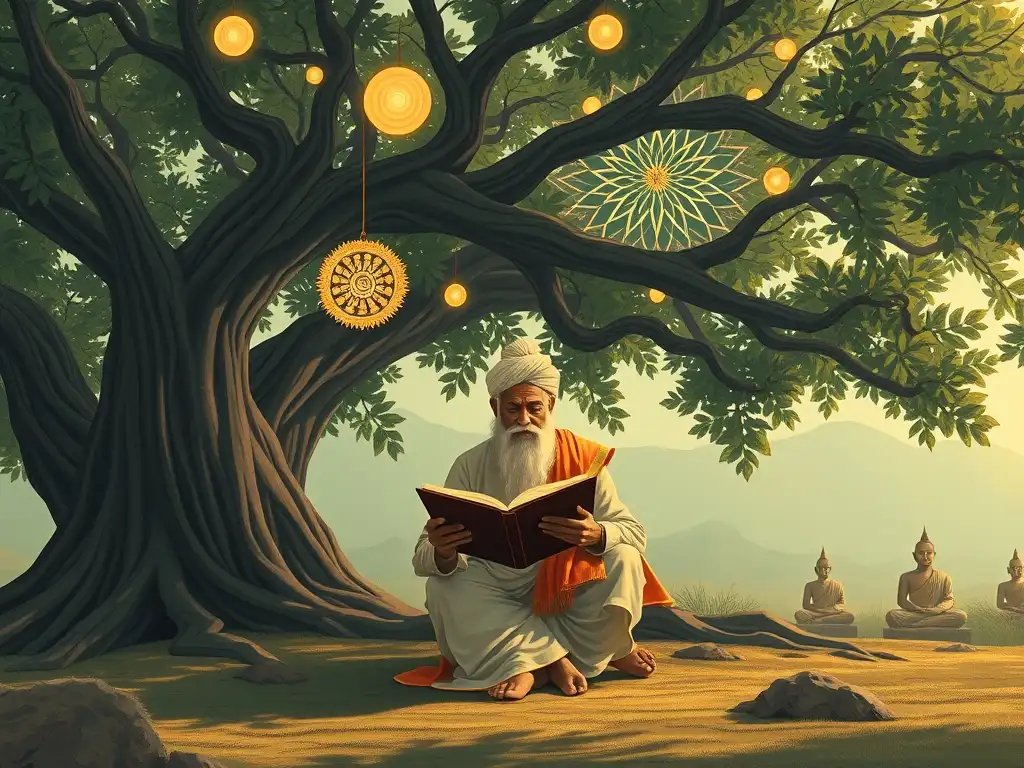
How Sankhya Thought Shaped Buddhist Philosophy
Sankhya philosophy, one of the six orthodox schools of Indian philosophy, has significantly influenced the development of Buddhist thought. Emerging around the same time as Buddhism, Sankhya introduced various metaphysical concepts that resonated within Buddhist teachings.
-
Dualism of Purusha and Prakriti:
At the core of Sankhya philosophy is the distinction between Purusha (consciousness) and Prakriti (matter). This dualistic framework provided a foundational structure for Buddhist concepts of mind and body. In Buddhism, while the terminology differs, the idea that consciousness (citta) interacts with the physical world is a recurrent theme.
-
Understanding of Suffering:
Both Sankhya and Buddhism agree on the existence of suffering ( dukkha) as an inherent aspect of the human experience. The Sankhya view posits that ignorance of the true nature of reality leads to suffering, a notion mirrored in the Four Noble Truths of Buddhism, which also emphasize the root causes of human suffering.
-
Karma and Rebirth:
The Sankhya philosophy's understanding of karma—the law that every action has consequences—aligns closely with Buddhist teachings. Both traditions maintain that karma influences the cycle of birth and rebirth ( samsara), shaping one's future experiences based on past actions. This interconnection highlights the philosophical grounding that Sankhya provided for later Buddhist doctrines.
Similarities and Differences between Sankhya and Buddhist Teachings
While Sankhya philosophy and Buddhism share several conceptual frameworks, they also diverge in significant ways:
-
Epistemology:
Both philosophies emphasize the importance of knowledge and understanding as means to escape the cycle of suffering. However, Sankhya relies heavily on intellectual analysis and categorization of knowledge, whereas Buddhism integrates experiential wisdom gained through meditation and mindfulness practices.
-
Nature of Reality:
Sankhya posits that ultimate reality is the interplay of Purusha and Prakriti. In contrast, Buddhism's view of reality is more nuanced, focusing on anatta (non-self) and emptiness ( śūnyatā), suggesting that all phenomena lack an inherent essence. This fundamental departure shapes their respective cosmologies.
-
Goal of Philosophy:
The ultimate goal in Sankhya is the realization of the distinction between Purusha and Prakriti, leading to liberation ( moksha). In Buddhism, the aim is to attain Nirvana—liberation from the cycles of birth, death, and rebirth—through the cessation of desire and ignorance.
| Aspect | Sankhya Philosophy | Buddhist Philosophy |
|---|---|---|
| Core Principle | Dualism of Purusha and Prakriti | Non-dualism and concept of Anatta |
| Path to Liberation | Knowledge of Purusha | Eightfold Path |
| View of Reality | Interplay of consciousness and matter | Emptiness and interdependence |
The Impact of Sankhya on Buddhist Concepts of Reality
The influence of Sankhya philosophy extends deeply into Buddhist metaphysical inquiries regarding the nature of reality.
-
Interconnectedness:
Sankhya's notion of the relationship between Purusha and Prakriti laid the groundwork for Buddhism's understanding of interdependence ( pratītyasamutpāda). Both philosophies acknowledge that nothing exists in isolation; rather, everything is part of a larger system of causes and conditions.
-
Phenomena and Perception:
The Sankhya perspective that reality consists of both physical and mental components informs the Buddhist analysis of phenomena. In Buddhism, the understanding that our perceptions shape our experiences echoes the Sankhya view of the importance of discerning the nature of reality to transcend suffering.
-
Non-attachment:
The Sankhya philosophy's emphasis on distinguishing between the eternal Purusha and the transient Prakriti mirrors the Buddhist teaching on non-attachment. Recognizing the impermanence of material existence fosters a mindset that is essential for achieving Nirvana.
The philosophical dialogue between Sankhya and Buddhism is a testament to the rich tapestry of thought in ancient India, illustrating how these schools of philosophy not only influenced one another but also contributed to a broader understanding of reality, existence, and the path to liberation.
The Legacy of Sankhya Philosophy in Jainism and Buddhism
Sankhya philosophy, one of the six classical schools of Indian philosophy, has left a profound impact on various religious and philosophical traditions, particularly Jainism and Buddhism. The core tenets of Sankhya, which emphasize the dualistic nature of reality—namely Purusha (consciousness) and Prakriti (matter)—have influenced the metaphysical frameworks of both Jain and Buddhist thought.
Modern Interpretations of Sankhya Philosophy in Jainism
The integration of Sankhya philosophy within Jainism is evident in its metaphysical discussions. Jain thinkers have adopted the dualistic framework of Sankhya to explore the nature of the soul (jiva) and non-soul (ajiva). In Jainism, the soul is considered eternal and distinct from the material world, which resonates with the Sankhya perspective of Purusha being separate from Prakriti.
-
Concept of Souls and Non-Souls:
- Jiva (Soul): Representing consciousness and sentience.
- Ajiva (Non-Soul): Includes matter and other non-sentient entities.
-
Karma and Liberation:
Jainism incorporates the Sankhya idea of evolution and devolution of souls through their relationship with karma. The Sankhya notion of liberation (moksha) parallels the Jain pursuit of freeing the soul from karmic bondage.
-
Philosophical Texts:
Jain scholars like Umasvati and Haribhadra have interpreted Sankhya concepts within their texts, reinforcing the idea of a dualistic existence and the path to liberation through self-realization.
Contemporary Relevance of Sankhya in Buddhist Practices
Buddhism, emerging around the same time as Jainism, also exemplifies the influence of Sankhya philosophy, albeit with distinct interpretations. The Buddhist tradition often reframes Sankhya's dualism, focusing instead on the interconnectedness of all phenomena.
-
Non-Self (Anatta) Doctrine:
While Sankhya posits a permanent self (Purusha), Buddhism introduces the concept of Anatta, or non-self, suggesting that what we consider the self is merely a composite of ever-changing aggregates (skandhas). This reinterpretation reflects a critical departure from traditional Sankhya thought.
-
Meditation and Insight:
Modern Buddhist practices often utilize insight meditation (vipassana), which echoes the Sankhya methodology of discernment between consciousness and materiality. Through this practice, practitioners can observe the impermanent nature of existence, aligning with the Sankhya aim of understanding the nature of reality.
-
Philosophical Discourse:
Contemporary scholars examine the dialogues between Sankhya and Buddhist teachings to draw parallels in metaphysical inquiry. This discourse enriches both traditions and fosters a deeper understanding of their philosophical foundations.
The Role of Sankhya in the Dialogue between Jainism and Buddhism
The interaction between Jainism and Buddhism has been greatly influenced by Sankhya philosophy, serving as a common ground for philosophical exploration and dialogue.
-
Shared Concepts:
Both traditions acknowledge the significance of duality—the distinction between sentient and non-sentient entities—though they diverge in interpretation. Such dialogues allow for a richer understanding of each tradition's views on the nature of existence.
-
Ethical Implications:
The ethical frameworks in both Jainism and Buddhism, particularly around concepts of ahimsa (non-violence) and karma, demonstrate how Sankhya's teachings have been interpreted to promote compassion and ethical living.
-
Historical Context:
The historical emergence of Jainism and Buddhism alongside Sankhya philosophy suggests a dynamic interplay of ideas. This interaction has led to the development of unique philosophical positions that continue to resonate in contemporary discussions on ethics, metaphysics, and spirituality.
The legacy of Sankhya philosophy in Jainism and Buddhism is a testament to its enduring impact on Indian philosophical thought, fostering a dialogue that continues to evolve and influence modern interpretations and practices.
Conclusion: The Enduring Impact of Sankhya Philosophy
The influence of Sankhya philosophy extends far beyond its roots in ancient Indian thought, having profoundly shaped various spiritual and philosophical systems, notably Jainism and Buddhism. As a dualistic framework, Sankhya has provided essential metaphysical concepts that resonate within the teachings of these two religions. Its emphasis on the distinction between purusha (consciousness) and prakriti (matter) offers a foundational understanding of existence, which has been instrumental in the development of ethical and metaphysical principles in Jainism.
Summary of Key Insights on Sankhya Philosophy in Jainism
Sankhya philosophy has notably enriched Jainism through several key insights:
- Dualism and the Nature of Reality
- Jainism embraces a dualistic view of reality, aligning with Sankhya’s separation of purusha and prakriti. This alignment emphasizes the importance of consciousness in understanding the soul's journey toward liberation ( moksha).
- Karma and Liberation
- The Sankhya concept of karma complements Jain teachings, where actions are seen as karmic seeds that affect future reincarnations. This relationship underscores the significance of ethical living and ascetic practices in both philosophies.
- Self-Realization and Knowledge
- The pursuit of knowledge is central in both schools. Jainism adopts Sankhya's emphasis on self-realization through introspection and meditation, enabling adherents to discern the true nature of reality and the self.
- Ethical Framework
- The Sankhya ethical framework, with its focus on non-attachment and the understanding of duality, has significantly influenced Jain moral principles, promoting non-violence ( ahimsa) and truthfulness ( satya).
- Ontology of the Soul
- The ontological distinctions made by Sankhya regarding the nature of the soul and its interaction with the material world have provided Jainism with a robust framework for discussing the soul's purity and the paths to liberation.
Future Directions for Research on Sankhya Thought
As scholars delve deeper into the intricate relationship between Sankhya philosophy and Jainism, several future research directions emerge:
-
Comparative Analysis
A comparative analysis of Sankhya and Jain texts can illuminate how philosophical concepts have evolved and interacted over time, revealing shared themes and unique adaptations.
-
Historical Contextualization
Investigating the historical context of the Sankhya school during the rise of Jainism will provide insights into the socio-political and cultural exchanges that shaped these philosophies.
-
Interdisciplinary Approaches
Employing interdisciplinary approaches that include psychology, ethics, and comparative religion can enhance our understanding of the practical applications of Sankhya thought within Jain practices.
-
Influence on Contemporary Thought
Examining how Sankhya philosophy continues to influence modern Jain thought and practice could uncover new interpretations that resonate with contemporary ethical and philosophical dilemmas.
-
Philosophical Dialogues
Encouraging dialogues between scholars of Sankhya, Jainism, and Buddhism can foster a richer understanding of how these traditions continue to inform and challenge each other in the quest for knowledge and truth.
The enduring impact of Sankhya philosophy in Jainism not only enriches our understanding of these ancient traditions but also invites ongoing exploration into their interconnectedness. The legacy of Sankhya remains a vital area of study for those interested in the philosophical foundations of one of the world’s oldest cultures.
References
Recommended Readings on Sankhya Philosophy in Jainism and Buddhism
To deepen your understanding of the intricate relationship between Sankhya philosophy, Jainism, and Buddhism, the following texts are highly recommended:
-
"Sankhya: A Dualist Tradition in Indian Philosophy" by Haribhadra
This book explores the dualistic nature of Sankhya philosophy and its implications within Jain and Buddhist frameworks. It provides a comparative analysis that highlights the philosophical overlaps and divergences.
-
"The Jain Philosophy of Non-violence" by Vasubandhu
This text delves into the principles of non-violence in Jainism, drawing parallels to Sankhya's metaphysical constructs. The author discusses how these philosophies influenced ethical considerations in Jain texts.
-
"Buddhism and Sankhya: A Study of the Philosophical Context" by G. C. Pandey
A critical examination of how Sankhya thought shaped early Buddhist philosophy, this book presents a thorough analysis of key concepts and their applications within both traditions.
-
"The Essence of Jainism: Philosophy and Practice" by Narayana
This work provides insights into Jain cosmology and ethics, offering perspectives on how Sankhya ideas permeate Jain doctrinal developments.
-
"Philosophical Foundations of Jainism" by M. N. Srinivas
A comprehensive overview of Jain philosophy, this book discusses the influence of Sankhya thought on Jain metaphysics and epistemology.
These readings will equip scholars and enthusiasts alike with a nuanced understanding of the philosophical dialogues and tensions between these ancient Indian traditions.
Notable Scholars and Texts in the Study of Sankhya Philosophy
The study of Sankhya philosophy, particularly in relation to Jainism and Buddhism, has been enriched by the contributions of various scholars and texts. Here are some notable figures and their works:
-
Kapila
Often regarded as the founder of Sankhya philosophy, Kapila's teachings provide the foundational framework for later interpretations within Jainism and Buddhism. His work emphasizes the duality of purusha (consciousness) and prakriti (matter).
-
Vyasa
The author of the "Sankhya Sutras," Vyasa's texts are crucial for understanding the evolution of Sankhya thought and its interconnections with other philosophical systems.
-
Umaswati
A significant figure in Jain philosophy, Umaswati's "Tattvartha Sutra" integrates Sankhya concepts into Jain metaphysical discourse, making it a pivotal text for scholars studying these correlations.
-
Nagarjuna
As a central figure in Mahayana Buddhism, Nagarjuna's work often critiques and dialogues with Sankhya philosophy, providing a contrasting view that enriches the study of these traditions.
-
Radhakrishnan
His comprehensive writings on Indian philosophy shed light on the intellectual milieu in which Sankhya developed, offering insights into its impact on Jain and Buddhist thought.
These scholars and their works exemplify the rich tapestry of philosophical inquiry surrounding Sankhya philosophy, demonstrating its profound influence on Jainism and Buddhism through centuries of intellectual discourse.
Frequently Asked Questions
What is Sankhya philosophy in Jainism?
Sankhya philosophy is a dualistic system that categorizes reality into two fundamental elements: purusha (consciousness) and prakriti (matter). Jainism incorporates these ideas to explain the nature of the soul and its liberation.
How does Sankhya philosophy influence Jain teachings?
Sankhya philosophy provides a framework for understanding the interconnection between the soul and the material world in Jain teachings, emphasizing the importance of self-realization and detachment from material possessions.
In what ways is Sankhya similar to Buddhism?
Both Sankhya and Buddhism share the concept of dualism and the impermanence of the material world. They also emphasize the need for spiritual liberation through understanding the nature of existence.
What are the key concepts of the Sankhya School?
The key concepts of the Sankhya School include the distinction between consciousness and matter, the principles of cause and effect, and the pursuit of knowledge as a means to achieve liberation.
How did the Sankhya School contribute to ancient Indian philosophy?
The Sankhya School laid the groundwork for various philosophical systems in ancient India, influencing not only Jainism and Buddhism but also later schools like Vedanta and Yoga by introducing key ideas about the nature of reality and the path to enlightenment.
Final Reflection: The Enduring Legacy of Sankhya Philosophy in Jainism and Buddhism
The relevance of Sankhya philosophy in Jainism and Buddhism is more significant today than ever before. As we navigate a world filled with complexity and uncertainty, the foundational principles of Sankhya offer profound insights into the nature of existence and the path to liberation. This ancient philosophy not only shapes the spiritual practices of millions but also provides a framework for understanding the interplay between the material and spiritual realms. In a time where mindfulness and self-awareness are increasingly sought after, the teachings of Sankhya resonate deeply with our contemporary quest for meaning.
Sankhya philosophy has profoundly influenced the cultural and social landscapes of both Jainism and Buddhism, shaping their ethical frameworks and spiritual practices. Its emphasis on dualism and the pursuit of knowledge encourages individuals to seek a deeper understanding of themselves and the world around them. As we reflect on this enduring influence, we are reminded of the words of the philosopher Adi Shankaracharya: The mind is everything. What you think you become.
This quote encapsulates the essence of Sankhya, urging us to recognize the power of our thoughts and beliefs in shaping our reality.
As we conclude our exploration of Sankhya philosophy, I invite you to reflect on how these ancient teachings can be integrated into your own life. Consider the ways in which understanding the duality of existence can lead to greater self-awareness and compassion towards others. Let the principles of Sankhya inspire you to embark on your own journey of self-discovery, fostering a deeper connection with both your inner self and the world around you. Embrace the wisdom of the past as a guiding light for your future, and allow it to empower you in your pursuit of truth and enlightenment.
Unveil the Depths of Sankhya Philosophy!
Thank you for exploring the fascinating world of the Sankhya School and its profound impact on Jainism and Buddhism. Your interest in this rich philosophical tradition is a crucial step towards understanding India's spiritual heritage. Now, it's time to take your journey further!
- Dive deeper into the philosophy: Consider picking up a comprehensive book on Sankhya or related philosophical texts. Dedicate time each week to reflect on their teachings and integrate them into your life.
- Join a discussion group: Connect with others who share your passion for ancient philosophies. Whether online or in your local community, exchanging insights and ideas can greatly enrich your understanding.
- Spread the knowledge: Share your newfound insights about Sankhya with friends or on social media. Inspiring others to engage with these vital philosophies can foster a deeper appreciation for this tradition.
How has your understanding of Sankhya influenced your perspective on life and spirituality? Let’s discuss!