
The Connection between Sankhya and the Bhagavad Gita: A Philosophical Dialogue


Welcome to Ancient India History, where we delve into the fascinating tapestry of India’s past! In this exploration, we invite you to uncover the profound Sankhya philosophy in the Bhagavad Gita, a cornerstone of ancient Indian thought that has shaped spiritual and philosophical discourse for centuries. What secrets lie within this philosophical dialogue, and how does it connect to the broader legacy of ancient Indian civilizations? Join us on this journey as we unravel the intricate layers of wisdom that the Bhagavad Gita offers, igniting your curiosity and deepening your understanding of a rich cultural heritage.

The relationship between Sankhya philosophy and the Bhagavad Gita is a profound exploration of ancient Indian thought, reflecting the intricate interplay between metaphysical concepts and practical ethics. Sankhya, one of the six orthodox schools of Hindu philosophy, provides a systematic framework to understand the universe and the self, emphasizing the duality between consciousness and matter. The Bhagavad Gita, a revered text within the Indian spiritual tradition, encapsulates these philosophical ideas while addressing the moral dilemmas faced by individuals in the context of duty and righteousness.
Together, they offer a rich dialogue that not only elucidates philosophical concepts but also guides personal and ethical decision-making. This article delves into the foundational aspects of Sankhya philosophy and its manifestation in the teachings of the Bhagavad Gita, seeking to illuminate their interconnectedness and relevance in understanding ancient Indian thought.
Introduction to Sankhya Philosophy
Overview of Sankhya Philosophy
Sankhya philosophy is fundamentally rooted in the enumeration and categorization of reality. It posits that there are two primary realities: Purusha (consciousness) and Prakriti (matter). This dualistic approach emphasizes the distinction between the eternal, unchanging soul and the transient material world. The primary goal of Sankhya is to attain liberation (moksha) through self-realization, achieved by understanding the nature of these two principles.
Key concepts in Sankhya include:
- Tattvas: The 25 principles that constitute reality, including the mind, senses, and elements.
- Karma: The law of cause and effect that governs the cycle of birth and rebirth.
- Moksha: The ultimate liberation from the cycle of reincarnation, attainable through knowledge and discernment.
Historical Context of Sankhya in Ancient India
Sankhya emerged during a transformative period in ancient Indian history, around the 6th century BCE, coinciding with the rise of various philosophical and religious movements. It is traditionally attributed to the sage Kapila, whose contributions laid the groundwork for later interpretations. The historical context of Sankhya is crucial, as it reflects the intellectual climate of the time, characterized by a quest for understanding the nature of existence and the self.
As a foundational philosophy, Sankhya influenced various schools of thought, including Yoga, Nyaya, and Vedanta. Its significance can be traced through ancient texts, and its principles continue to resonate in modern interpretations of Indian philosophy.
The Bhagavad Gita: An Overview
Historical Significance of the Bhagavad Gita
The Bhagavad Gita, composed around the 2nd century BCE, is a 700-verse dialogue that forms part of the Indian epic Mahabharata. It is set in the context of the Kurukshetra War, where the warrior Arjuna faces a moral crisis regarding his duty to fight. This text is not only a philosophical treatise but also a practical guide to living a righteous life amidst the complexities of human existence.
The Gita's historical significance lies in its synthesis of various philosophical ideas, including those from Sankhya, and its ability to address the ethical dilemmas faced by individuals in everyday life. It serves as a crucial link between ancient philosophical discourse and contemporary moral issues.
Key Themes in the Bhagavad Gita
The Bhagavad Gita encompasses several key themes that resonate deeply with the principles of Sankhya philosophy:
- Dharma (duty): The Gita emphasizes the importance of performing one's duty without attachment to the results, aligning with the Sankhya view of selfless action.
- Yoga: The text introduces various paths of yoga, including Karma Yoga (the yoga of action) and Jnana Yoga (the yoga of knowledge), which echo the Sankhya pursuit of self-realization.
- Detachment: A central tenet of the Gita is the practice of detachment from the fruits of actions, reflecting the Sankhya idea of transcending the material world.
Through these themes, the Bhagavad Gita not only elaborates on the philosophical foundations of Sankhya but also provides practical guidance for individuals navigating the moral complexities of life.
Core Principles of Sankhya Philosophy
Sankhya philosophy is one of the six orthodox schools of Indian philosophy, which is primarily concerned with the nature of reality, knowledge, and liberation. At its core, Sankhya posits a dualistic framework, distinguishing between two fundamental entities: Purusha (consciousness) and Prakriti (matter). This separation forms the basis for understanding the universe and the self.
The philosophy also introduces the concept of evolution of the universe, where Prakriti manifests into various forms, driven by the interplay of three fundamental qualities, known as gunas. These gunas— sattva (purity), rajas (activity), and tamas (inertia)—influence human behavior and psychological states. Sankhya emphasizes self-realization and knowledge as the paths to liberation (moksha), advocating for a disciplined life of inquiry, meditation, and ethical living. Understanding these core principles is essential for grasping how Sankhya philosophy intricately weaves into the teachings of the Bhagavad Gita.
Dualism in Sankhya: Purusha and Prakriti
The dualistic nature of Sankhya philosophy is articulated through the concepts of Purusha and Prakriti. Purusha represents the eternal, unchanging consciousness that observes and experiences the world, while Prakriti embodies the dynamic, ever-changing material reality.
- Purusha:
- Infinite and formless
- Represents pure awareness and is distinct from the physical body and mind
- The source of individual consciousness, often referred to as the true self (Atman)
- Prakriti:
- Composed of the three gunas
- The material cause of the universe, responsible for creation, preservation, and destruction
- Subject to change and evolution, leading to the manifestation of diverse forms
This dualistic framework sets the stage for understanding the relationship between the observer (Purusha) and the observed (Prakriti), highlighting the importance of recognizing one's true nature beyond the physical and mental constructs.
The Concept of Gunas in Sankhya Philosophy
The gunas are critical to Sankhya philosophy, as they describe the three fundamental qualities that govern the behavior of Prakriti and, by extension, influence human psychology and behavior.
- Sattva:
- Characterized by purity, harmony, and knowledge
- Promotes clarity, wisdom, and tranquility
- Associated with positive qualities such as compassion and self-control
- Rajas:
- Defined by activity, dynamism, and passion
- Drives ambition, desire, and restlessness
- Can lead to attachment and suffering when excessive
- Tamas:
- Marked by darkness, inertia, and ignorance
- Results in lethargy, confusion, and delusion
- Often seen as an obstacle to spiritual growth and understanding
The interplay of these gunas determines the nature of one's thoughts, actions, and overall life experiences. In Sankhya philosophy, achieving a balance among the gunas is essential for personal development and spiritual liberation.
The Influence of Sankhya on the Bhagavad Gita
The Bhagavad Gita, a philosophical dialogue set in the context of the Mahabharata, draws heavily from Sankhya philosophy, particularly in its exploration of the nature of the self and the path to liberation. The Gita’s teachings reflect the core tenets of Sankhya, providing a practical application of its philosophical concepts in the context of life’s dilemmas.
Integration of Sankhya Philosophy in the Bhagavad Gita
In the Bhagavad Gita, the integration of Sankhya philosophy is evident in several key teachings. Krishna introduces concepts such as the eternal nature of the soul (Atman) and the distinction between the physical body and the true self.
- The Gita emphasizes detachment from the fruits of actions, resonating with Sankhya’s advocacy for self-realization and knowledge as means to liberation.
- The text discusses the importance of understanding one's true nature (Purusha) and the transitory nature of the material world (Prakriti), mirroring the dualistic framework of Sankhya.
Through these teachings, the Gita not only elucidates the philosophical foundations of Sankhya but also provides a practical guide for living a life aligned with these principles.
The Role of Sankhya in Krishna's Teachings
Krishna’s teachings in the Bhagavad Gita reflect the essence of Sankhya philosophy, particularly in how he addresses Arjuna's moral and existential dilemmas on the battlefield.
- Knowledge of the Self: Krishna encourages Arjuna to understand his true self beyond the physical body, emphasizing that the soul is eternal and indestructible, aligning with the concept of Purusha.
- Detachment and Action: Krishna stresses performing one’s duty (dharma) without attachment to outcomes, a principle rooted in the Sankhya understanding of the interplay between action and the gunas.
- Transcending Gunas: Krishna teaches that to achieve liberation, one must rise above the influence of the gunas, embodying the essence of Sankhya philosophy’s approach to personal development.
In this way, the Bhagavad Gita serves as a bridge between philosophical thought and practical application, illustrating how Sankhya philosophy informs the spiritual and ethical dimensions of life.
Key Dialogues Reflecting Sankhya Philosophy in the Bhagavad Gita
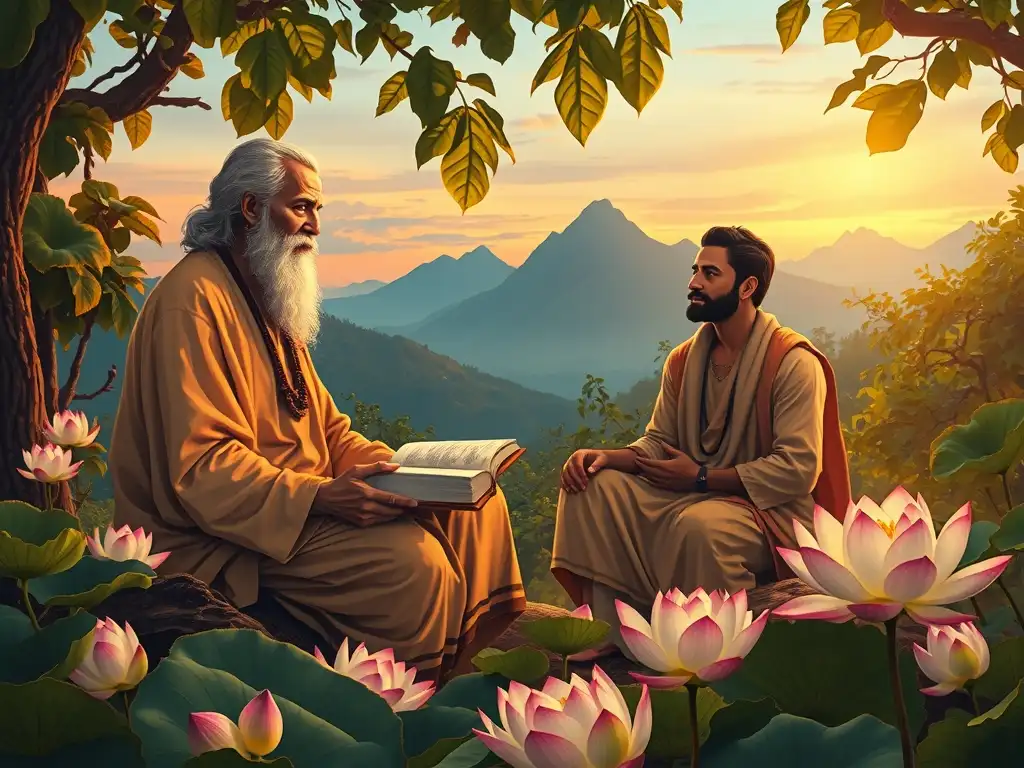
The Bhagavad Gita, a cornerstone of Indian philosophy, intricately weaves the principles of Sankhya philosophy throughout its verses. Key dialogues in the text illuminate the core tenets of Sankhya, particularly the distinction between the eternal self (Atman) and the transient body. For instance, in Chapter 2, Verse 47, Lord Krishna emphasizes the importance of performing one's duty without attachment to the results, encapsulating the Sankhya belief in the separation of action and consequence. This dialogue serves as a foundation for understanding the nature of existence, encouraging a perspective that transcends the material realm.
Another significant dialogue appears in Chapter 2, Verse 13, where Krishna speaks of the eternal nature of the soul, reinforcing the Sankhya idea that the true essence of individuals is beyond physical form. This philosophical exchange not only addresses the nature of reality but also sets the stage for deeper explorations into consciousness and existence. The Gita's dialogues serve as a philosophical dialogue that invites readers to contemplate the nature of reality, identity, and the interplay between the material and spiritual dimensions of life.
The Nature of the Self: Atman and Purusha
In Sankhya philosophy, the concepts of Atman (the individual soul) and Purusha (the cosmic consciousness) are central to understanding the self. The Bhagavad Gita articulates these ideas, particularly through the lens of distinguishing between the physical body and the eternal self. In Chapter 2, Verse 20, Krishna states that the soul is neither born nor dies, but rather exists perpetually, echoing the Sankhya assertion that Atman is immutable and eternal.
This distinction plays a crucial role in the Gita's teachings, emphasizing that understanding one's true nature leads to liberation (moksha). The dialogues encourage reflection on the transient nature of the body, which is subject to decay and destruction, while the self remains unchanged. This philosophical exploration not only aligns with Sankhya thought but also provides a framework for individuals to navigate their responsibilities and relationships without being ensnared by the impermanence of the material world.
The Concept of Detachment and Renunciation
Detachment and renunciation are pivotal themes in both Sankhya philosophy and the Bhagavad Gita. Krishna's teachings advocate for a life of detachment from the fruits of actions, encapsulated in the famous verse from Chapter 2, Verse 48, which advises individuals to perform their duty without attachment. This principle aligns closely with the Sankhya perspective, which posits that attachment to material desires leads to suffering and bondage.
The Gita encourages practitioners to engage in their responsibilities while maintaining a sense of detachment, thus fostering a mindset conducive to spiritual growth. This dual approach of action and renunciation provides a path for individuals to cultivate inner peace and clarity. By understanding and implementing these principles, followers of the Gita can achieve a harmonious balance between worldly obligations and spiritual aspirations, ultimately leading them toward liberation.
Comparative Analysis of Sankhya and Other Philosophical Systems
The Sankhya school of thought is often examined in relation to other philosophical traditions within Hinduism, particularly Advaita Vedanta and Yoga philosophy. These comparisons highlight the distinct yet interconnected nature of these systems, providing deeper insights into the broader landscape of Indian philosophy.
Sankhya vs. Advaita Vedanta
Sankhya and Advaita Vedanta, while sharing some foundational ideas, diverge significantly in their metaphysical outlook. Sankhya posits a dualistic framework where Prakriti (nature) and Purusha (consciousness) are separate entities. In contrast, Advaita Vedanta advocates for non-dualism, asserting that the individual soul (Atman) is fundamentally identical to the ultimate reality (Brahman).
This distinction leads to different practical implications for adherents. While Sankhya emphasizes knowledge and understanding of the dual nature of existence as a means to liberation, Advaita Vedanta encourages the realization of the non-duality of Atman and Brahman. This philosophical divergence shapes the spiritual practices and paths each tradition promotes, with Sankhya focusing on intellectual discernment and Advaita emphasizing meditative union with the absolute.
Sankhya vs. Yoga Philosophy
The relationship between Sankhya and Yoga philosophy is both complementary and contrasting. Yoga, particularly as outlined in the Yoga Sutras of Patanjali, incorporates aspects of Sankhya philosophy, especially regarding the nature of the self and the process of liberation. Both systems agree on the necessity of understanding the distinction between the self and the physical body, but they approach the path to liberation differently.
In Sankhya, liberation is achieved through knowledge and discernment, while Yoga emphasizes a more experiential approach through practices such as meditation and physical postures (asanas). Yoga integrates the Sankhya worldview into its practice, using the principles of Sankhya to inform its techniques for achieving mental clarity and spiritual insight. Ultimately, while both philosophies share common ground, they offer distinct methodologies and insights that enrich the spiritual journey of practitioners.
Conclusion: The Lasting Impact of Sankhya Philosophy in the Bhagavad Gita
The Sankhya philosophy has left an indelible mark on the Bhagavad Gita, serving as both a foundational framework and a philosophical dialogue partner throughout the text. This ancient school of thought, which emphasizes the distinction between the material and the spiritual, resonates deeply within the Gita's teachings on duty (dharma), the self (atman), and the nature of reality. The Gita's engagement with Sankhya invites readers to explore the complexities of life, encouraging a deeper understanding of existence and the human condition.
Moreover, the integration of Sankhya philosophy into the Gita has contributed to its enduring relevance across centuries. The concepts of dualism, the nature of suffering, and the pursuit of liberation through knowledge have become essential themes not only in Indian philosophy but also in global philosophical discourse. Thus, the Bhagavad Gita stands as a testament to the timelessness of Sankhya thought, affirming its significance in the quest for knowledge and spiritual enlightenment.
Relevance of Sankhya Philosophy in Contemporary Thought
In contemporary philosophical discussions, Sankhya philosophy continues to be relevant, particularly in areas such as ethics, metaphysics, and psychology. Its dualistic framework, which differentiates between purusha (consciousness) and prakriti (matter), offers a unique perspective on human existence and the nature of reality. This distinction is echoed in modern debates surrounding the mind-body problem, where the interplay between consciousness and physical matter remains a central theme.
Furthermore, the ethical implications of Sankhya philosophy encourage discussions about personal responsibility and the nature of actions. The Gita's teachings on selfless action (karma yoga) and the pursuit of knowledge resonate with contemporary movements advocating for mindfulness and ethical living. As individuals grapple with the complexities of modern life, the insights of Sankhya philosophy provide a valuable lens through which to navigate existential questions.
Future Directions for Research on Sankhya and the Bhagavad Gita
Future research on the relationship between Sankhya philosophy and the Bhagavad Gita holds significant promise for deepening our understanding of both texts. Scholars may explore the nuances of how Sankhya's metaphysical concepts inform the Gita's teachings on self-realization and liberation. Comparative studies with other philosophical traditions, such as Western existentialism or Eastern Buddhism, could yield valuable insights into the universality of these themes.
Additionally, interdisciplinary approaches that incorporate psychology, cognitive science, and literary analysis could illuminate how Sankhya influences contemporary interpretations of the Gita. By examining the text through various lenses, researchers can uncover layers of meaning that reflect both ancient wisdom and modern existential concerns, enriching the broader discourse on philosophy and spirituality.
References and Further Reading
For those interested in delving deeper into Sankhya philosophy and its connection to the Bhagavad Gita, the following resources provide a comprehensive foundation for study:
Essential Texts on Sankhya Philosophy
- Sankhya Karika by Ishvara Krishna: This foundational text lays out the principles of Sankhya philosophy, offering insights into its metaphysical framework.
- Yoga Sutras of Patanjali: While primarily a text on yoga, it incorporates elements of Sankhya thought, particularly in its discussions of the mind and consciousness.
Recommended Commentaries on the Bhagavad Gita
- Bhagavad Gita: As It Is: by A.C. Bhaktivedanta Swami Prabhupada: This commentary provides an accessible interpretation of the Gita, integrating Sankhya perspectives.
- The Bhagavad Gita: A New Translation: by Stephen Mitchell: A contemporary translation that highlights the philosophical dimensions of the Gita, including its relationship with Sankhya philosophy.
- The Essence of the Bhagavad Gita: Explained by Paramhansa Yogananda: This work elucidates the Gita's teachings through the lens of Sankhya, focusing on self-realization and spiritual growth.
These texts serve as valuable resources for anyone seeking to understand the depth and richness of Sankhya philosophy within the context of the Bhagavad Gita.
- Introduction to Sankhya Philosophy
- The Bhagavad Gita: An Overview
- Core Principles of Sankhya Philosophy
- The Influence of Sankhya on the Bhagavad Gita
- Key Dialogues Reflecting Sankhya Philosophy in the Bhagavad Gita
- Comparative Analysis of Sankhya and Other Philosophical Systems
- Conclusion: The Lasting Impact of Sankhya Philosophy in the Bhagavad Gita
- References and Further Reading
Frequently Asked Questions
What is Sankhya philosophy?
Sankhya is one of the six orthodox schools of Hindu philosophy, focusing on the enumeration of principles that govern reality. It emphasizes the distinction between consciousness and matter.
How does the Bhagavad Gita relate to Sankhya philosophy?
The Bhagavad Gita incorporates Sankhya philosophy by discussing the nature of the self and the universe. It presents a dialogue between Krishna and Arjuna, illustrating the principles of Sankhya in the context of duty and action.
What are the key teachings of Sankhya in the Bhagavad Gita?
Key teachings include the understanding of the eternal self (Atman), the transient nature of the body, and the importance of detached action. This aligns with the core principles of Sankhya philosophy.
Why is Sankhya considered important in Indian philosophy?
Sankhya is foundational for many other philosophical systems in India, influencing schools like Yoga and Vedanta. Its methods of analysis and classification of reality provide a structured approach to understanding existence.
How can one study the concepts of Sankhya in the Bhagavad Gita?
Studying the Bhagavad Gita alongside commentaries on Sankhya philosophy can enhance understanding. Focusing on chapters that discuss knowledge, action, and detachment will reveal deeper insights into this philosophical dialogue.
Final Reflection: The Enduring Wisdom of Sankhya Philosophy in the Bhagavad Gita
The exploration of Sankhya philosophy within the Bhagavad Gita reveals a profound connection that remains relevant in today's fast-paced world. As we navigate the complexities of modern life, the teachings of Sankhya offer timeless insights into the nature of reality, the self, and the pursuit of knowledge. This philosophical dialogue not only enriches our understanding of the Gita but also invites us to reflect on our own existence and the choices we make.
Sankhya philosophy has significantly shaped our cultural and social landscape, encouraging a deeper examination of our thoughts and actions. The principles of dualism and the distinction between the eternal self and the transient material world resonate with many contemporary issues, prompting individuals to seek clarity amidst chaos. The mind is everything. What you think you become.
This quote encapsulates the essence of Sankhya, reminding us that our perceptions and beliefs shape our reality, a lesson that remains crucial in our daily lives.
As we conclude this exploration, I invite you to reflect on how the teachings of Sankhya can be integrated into your own life. Consider the ways in which understanding the nature of the self and the world can empower you to make more conscious choices. Embrace the wisdom of the Bhagavad Gita and Sankhya philosophy, allowing it to guide you on your journey toward self-awareness and fulfillment. The dialogue between these philosophies is not just an academic pursuit; it is a call to live with intention and purpose in a world that often distracts us from our true selves.
Unveil Deeper Insights into Sankhya and the Gita!
Thank you for exploring the fascinating connection between Sankhya and the Bhagavad Gita with us! By delving into these profound philosophies, you've taken a significant step toward understanding the essence of self and purpose. Now, let’s transform this knowledge into action!
Here are some powerful next steps you can take:
- Engage with the Text: Read a chapter of the Bhagavad Gita today and reflect on how its teachings relate to the principles of Sankhya.
- Join a Forum: Participate in online discussions or local groups focused on Sankhya and the Bhagavad Gita to exchange ideas with fellow enthusiasts.
- Practice Mindfulness: Incorporate mindfulness meditation inspired by the concepts of Sankhya to deepen your inner awareness and understanding of the self.
What insights are you hoping to uncover next from these ancient teachings, and how do you plan to integrate them into your daily life?