
Ancient Indian Mathematics: The Foundations of Modern Numerical Systems

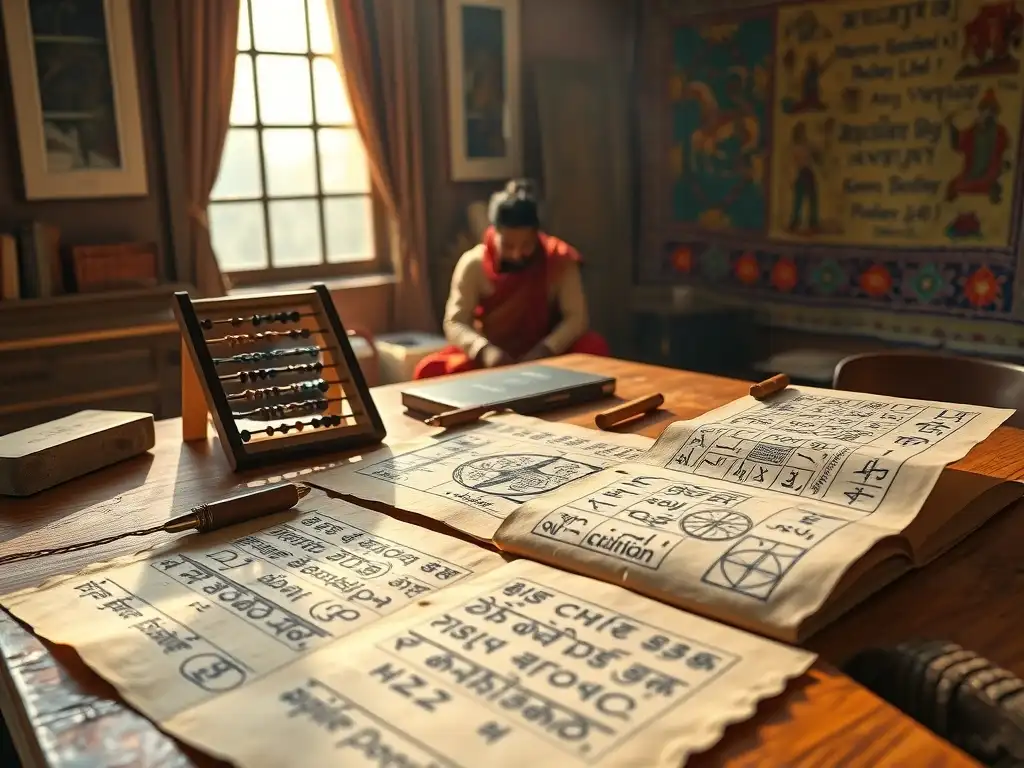
Welcome to Ancient India History, where we embark on a captivating journey through the rich tapestry of ancient Indian civilizations. Prepare to be amazed as we delve into the intriguing world of Ancient Indian mathematical contributions, uncovering the remarkable innovations that laid the groundwork for modern numerical systems. From the enigmatic Indus Valley to the flourishing Gupta Empire, each era reveals a treasure trove of knowledge waiting to be explored.
Are you ready to discover how ancient thinkers shaped the way we understand numbers today? Dive deeper with us and unlock the secrets of a civilization that has profoundly influenced our world.

Introduction to Ancient Indian Mathematics
Ancient Indian mathematics represents a remarkable chapter in the history of numerical systems and mathematical thought. From the sophisticated calculations of the Indus Valley Civilization to the advanced theories developed during the Gupta Empire, the contributions of ancient Indian mathematicians laid the groundwork for many modern mathematical concepts.
This article delves into the rich heritage of ancient Indian mathematical contributions, exploring how they influenced not only regional practices but also the global mathematical landscape. By understanding these foundations, we gain insights into the innovative spirit and intellectual prowess of ancient Indian scholars, whose work continues to resonate in contemporary mathematics.
Overview of Ancient Indian Mathematical Contributions
The legacy of ancient Indian mathematics is vast and varied, encompassing a range of topics including arithmetic, geometry, algebra, and even early forms of calculus. Key figures such as Aryabhata, Brahmagupta, and Bhaskara made significant advancements that would later inform and shape mathematical thought worldwide. Notably, the place value system and the concept of zero are among the most transformative contributions, providing a framework for mathematical operations that is still in use today.
- Key Contributions:
- The Concept of Zero: Revolutionized mathematical calculations.
- Place Value System: Enabled complex calculations and record-keeping.
- Trigonometry: Early trigonometric functions and their applications in astronomy.
These innovations not only facilitated advancements in mathematics but also played a critical role in fields such as astronomy and architecture, shaping the scientific discourse of the time.
Importance of Ancient Indian Mathematics in Modern Context
Understanding ancient Indian mathematical contributions is crucial in appreciating the evolution of mathematics as a discipline. The methods and ideas developed by ancient mathematicians have permeated various aspects of modern mathematics and science. For instance, the use of algorithms, largely attributed to Indian mathematicians, forms the backbone of computer science today. Furthermore, the philosophical approach to mathematics in ancient India, particularly the emphasis on practical applications and problem-solving, continues to influence contemporary mathematical education and research.
Historical Context of Mathematics in Ancient India
Early Civilizations and Their Numerical Systems
The journey of mathematics in ancient India traces back to the early civilizations, particularly the Indus Valley Civilization, where evidence of advanced urban planning and measurement systems suggests a strong foundation in mathematical practices. Artifacts such as weights, measures, and seals indicate a sophisticated understanding of geometry and arithmetic.
- Indus Valley Civilization (c. 3300–1300 BCE):
- Developed early forms of measurement.
- Utilized geometric designs in urban planning.
As civilization progressed, the Vedic texts (c. 1500–500 BCE) introduced more abstract mathematical concepts, including the Siddhantas, which outlined rules for arithmetic and astronomy. This evolution marked a significant transition from practical mathematics to a more theoretical framework.
The Role of Mathematics in Ancient Indian Society
Mathematics played a multifaceted role in ancient Indian society, influencing various domains including astronomy, architecture, and trade. The need for accurate calculations for agricultural practices, trade transactions, and astronomical observations drove the development of mathematical techniques.
- Key Functions:
- Astronomical Calculations: Used for calendar systems and predicting celestial events.
- Architecture: Mathematics was integral in constructing monumental structures, as evidenced by ancient temples and cities.
- Trade and Commerce: Facilitated accurate measurements and calculations for trade, enhancing economic activities.
The mathematical contributions of ancient India not only shaped their own society but also laid the groundwork for future innovations in mathematics and science globally. Understanding this rich history offers valuable insights into the development of modern numerical systems and the profound impact of ancient scholars.
Key Figures in Ancient Indian Mathematics
Ancient Indian mathematics is marked by the contributions of several brilliant mathematicians whose work laid the groundwork for significant advancements in both mathematics and astronomy. These key figures not only influenced Indian mathematics but also had a lasting impact on the global mathematical landscape. Their works encompass a variety of mathematical concepts, techniques, and innovations that continue to be relevant today.
Aryabhata: The Pioneer of Indian Mathematics
Aryabhata, who lived in the 5th century CE, is often regarded as the pioneer of Indian mathematics. His seminal work, the Aryabhatiya, covered a wide array of topics including arithmetic, algebra, and trigonometry. Aryabhata introduced the concept of place value and the representation of numbers in a numeral system, which was a significant leap from previous systems.
One of Aryabhata's major contributions was the approximation of π (pi) as 3.1416, showcasing his advanced understanding of geometry. Additionally, he provided methods to solve quadratic equations and calculated the areas of various geometrical shapes. His work on astronomy included calculations of eclipses and the circumference of the Earth, further emphasizing the interconnectedness of mathematics and astronomy in his studies.
Brahmagupta: Contributions to Algebra and Zero
Brahmagupta, a 7th-century mathematician and astronomer, made significant strides in the field of algebra. His most notable work, Brahmasphutasiddhanta, introduced rules for arithmetic operations involving both positive and negative numbers. Brahmagupta is particularly famous for formalizing the concept of zero as a number, which was revolutionary at the time.
In his text, he provided guidelines for calculations involving zero, including how to handle divisions by zero and the importance of zero in maintaining the integrity of the numeral system. Brahmagupta's work laid the foundation for future explorations in algebra and arithmetic, influencing subsequent generations of mathematicians both in India and around the world.
Bhaskara II: Advancements in Calculus and Astronomy
Bhaskara II, also known as Bhaskara the Great, lived in the 12th century and is renowned for his contributions to calculus and astronomy. His work, Lilavati, presents a variety of mathematical problems and solutions that explore arithmetic, geometry, and algebra in a practical context.
Bhaskara's advancements in mathematics included concepts that would later be recognized as derivatives and rates of change, illustrating an early understanding of calculus. He also made significant contributions to the field of astronomy, including the computation of planetary positions and the timing of eclipses. His innovative approach combined theoretical mathematics with practical applications, showcasing the depth of ancient Indian mathematical knowledge.
Major Concepts and Innovations in Ancient Indian Mathematics
Ancient Indian mathematics is characterized by several major concepts and innovations that facilitated advancements in numerical systems and mathematical theory. These concepts not only influenced later mathematicians but also played a crucial role in the development of mathematics as a whole.
The Concept of Zero and Its Significance
The concept of zero is perhaps one of the most profound contributions of ancient Indian mathematics. Before the formalization of zero, the idea of a placeholder was non-existent, which complicated calculations and number representation. Ancient Indian mathematicians, particularly Brahmagupta, recognized zero as a number in its own right, thereby enabling a more sophisticated understanding of arithmetic and algebra.
Zero's significance extends beyond mathematics; it revolutionized the way calculations were performed, allowing for the development of complex mathematical concepts and facilitating advancements in science and technology. The introduction of zero into the numeral system paved the way for the modern mathematical framework we use today.
Place Value System in Ancient Indian Numerals
The place value system developed in ancient India was another groundbreaking innovation. This system allowed for numbers to be represented efficiently by assigning values based on their positions. For example, in the number 205, the digit 2 represents two hundreds, while the digit 5 represents five units.
This clear organization of numbers not only simplified arithmetic operations but also enhanced the ability to perform complex calculations. The place value system was instrumental in the overall growth of mathematics, providing a foundation for future developments in both arithmetic and algebra.
Development of Algebra and Arithmetic Techniques
Ancient Indian mathematicians made substantial contributions to the field of algebra, introducing various algebraic techniques that are still taught today. They developed methods for solving linear and quadratic equations, as well as an understanding of mathematical operations involving unknown variables.
Brahmagupta's work in algebra laid the groundwork for modern algebraic concepts, while Bhaskara II's practical approach in his writings made the subject accessible. The techniques developed during this period not only enhanced mathematical understanding but also influenced the teaching and application of mathematics in subsequent cultures, ultimately shaping the course of mathematical history.
Ancient Indian Texts on Mathematics

Ancient Indian mathematics is richly documented in various texts that have survived through the centuries, providing a glimpse into the advanced mathematical concepts and practices of the time. These texts not only reflect the mathematical prowess of ancient Indian scholars but also illustrate the cultural and philosophical contexts in which these ideas were developed. Key works such as the Aryabhatiya, Brahmasphutasiddhanta, and Lilavati serve as cornerstones of this intellectual heritage, each contributing uniquely to the evolution of mathematics.
The Aryabhatiya: A Landmark in Mathematical Literature
Composed by the mathematician and astronomer Aryabhata in the 5th century CE, the Aryabhatiya is one of the earliest and most significant texts in Indian mathematics. This work is divided into four sections: Gitika, Ganitaka, Kalakriya, and Goladhyaya. The Ganitaka section focuses on arithmetic, algebra, and geometry, laying the groundwork for many mathematical principles. Aryabhata introduced the concept of zero as a placeholder, which was revolutionary and essential for the development of the decimal system. His work also includes methods for calculating the area of a triangle and the circumference of a circle, showcasing his understanding of geometry.
Aryabhata's influence extends beyond mathematics; he also made significant contributions to astronomy, proposing a heliocentric model of the solar system and calculating the length of the solar year with remarkable accuracy. His innovative approach and systematic treatment of mathematics have inspired generations of mathematicians and astronomers both in India and abroad.
Brahmagupta's Brahmasphutasiddhanta: Key Mathematical Treatise
Written in the 7th century CE, Brahmagupta's Brahmasphutasiddhanta is another seminal work that advanced mathematical thought in ancient India. This treatise is notable for its comprehensive treatment of arithmetic, algebra, and the rules governing the operations involving zero and negative numbers. Brahmagupta is credited with formalizing rules for solving quadratic equations and offering methods for calculating the area of cyclic quadrilaterals.
One of the most remarkable aspects of the Brahmasphutasiddhanta is its discussion on the concept of zero, where Brahmagupta defined it as a number and established its arithmetic properties. He also provided practical applications of mathematics in areas such as land measurement and taxation, underscoring the practical relevance of mathematical knowledge in societal contexts.
Brahmagupta's work had a lasting impact on both Indian and Islamic mathematics, influencing scholars such as Al-Khwarizmi, who later introduced many of these concepts to the Western world.
The Lilavati: Teaching Mathematics through Poetry
The Lilavati, attributed to the 11th-century mathematician Bhaskara II, is a unique mathematical text that combines poetry with practical mathematics. The text is named after Bhaskara's daughter, Lilavati, and is crafted as a series of riddles and problems posed as verses. This engaging format makes mathematical concepts accessible and enjoyable, serving as an educational tool for students.
The Lilavati covers a wide range of topics, including arithmetic, geometry, and algebra, presenting problems related to everyday life, such as calculating the number of flowers in a garden or the time taken for a journey. Bhaskara's use of poetic language not only illustrates mathematical principles but also demonstrates the aesthetic beauty of mathematics.
The text remains a significant educational resource in India and has been translated into several languages, continuing to inspire students with its innovative approach to teaching mathematics.
Influence of Ancient Indian Mathematics on Global Mathematical Thought
The contributions of ancient Indian mathematicians have left an indelible mark on the development of mathematics worldwide. The dissemination of Indian mathematical concepts during different historical periods has played a crucial role in shaping global mathematical thought.
Exchange of Knowledge: India and the Islamic Golden Age
During the Islamic Golden Age, a period marked by significant advancements in science and mathematics, scholars from the Islamic world engaged with ancient Indian texts, translating and expanding upon their mathematical ideas. The works of Aryabhata and Brahmagupta were particularly influential, as they introduced concepts such as zero and the decimal system, which were vital in the development of algebra and arithmetic in the Islamic tradition.
This exchange facilitated the transfer of knowledge across cultures, as Islamic mathematicians built upon Indian concepts and later transmitted them to Europe. Notable figures such as Al-Khwarizmi, who is often referred to as the "father of algebra," were directly influenced by the mathematical principles established in ancient India.
The Spread of Indian Numerals to Europe
The transmission of Indian numerals to Europe occurred primarily through translations of Arabic texts in the late Middle Ages. The numeral system we use today, often referred to as "Hindu-Arabic numerals," originated from ancient Indian numeral systems. The adoption of these numerals in Europe revolutionized arithmetic, making calculations simpler and more efficient compared to the Roman numeral system.
Prominent mathematicians like Fibonacci played a key role in introducing these numerals to a wider European audience through his work Liber Abaci in the 13th century. This marked a turning point in European mathematics, leading to widespread adoption and the eventual establishment of the decimal system.
Impact on Modern Mathematical Practices
The mathematical frameworks established by ancient Indian scholars continue to influence modern mathematical practices. Concepts such as the use of zero, algebraic formulations, and arithmetic operations are foundational to contemporary mathematics. The principles outlined in texts like the Aryabhatiya and Brahmasphutasiddhanta are still taught in mathematics curricula worldwide.
Moreover, the philosophical approach to mathematics in ancient India, which emphasized both practical applications and theoretical exploration, resonates in modern mathematical research and education. As we delve deeper into the history of mathematics, the contributions of ancient Indian mathematicians remind us of the rich tapestry of knowledge that has shaped our understanding of mathematics today.
Conclusion: Legacy of Ancient Indian Mathematical Contributions
The legacy of ancient Indian mathematical contributions is vast and far-reaching, shaping not only the mathematics we understand today but also influencing various fields such as astronomy, engineering, and commerce. The contributions of ancient Indian mathematicians, such as Aryabhata, Brahmagupta, and Bhaskara, laid the groundwork for the concepts of zero, negative numbers, and the decimal system, which are essential to modern mathematics. Their innovative approaches to problem-solving and methods of calculation continue to resonate in contemporary mathematical practices, highlighting the ingenuity and depth of ancient Indian scholarship.
The mathematical principles developed in ancient India were not merely theoretical; they found applications in real-world scenarios, from land measurement and architecture to astronomical calculations. This practical orientation distinguished Indian mathematics from its contemporaries. As we explore the historical and cultural contexts of these contributions, it becomes clear that ancient Indian mathematics is not just a chapter in history but a foundational element of the global mathematical narrative.
The Enduring Influence on Contemporary Mathematics
The influence of ancient Indian mathematics can be seen in several key areas of contemporary mathematics. For instance, the concept of zero, which revolutionized computation, has become a cornerstone of modern mathematical systems worldwide. The positional decimal system, developed in ancient India, is the basis for arithmetic operations today. This system allows for efficient calculations and has been adopted globally, demonstrating the lasting impact of Indian mathematicians on mathematical practices.
Moreover, the advancements in algebra and trigonometry made by ancient Indian scholars have paved the way for later developments in these fields. The mathematical texts produced during this period, such as the "Aryabhatiya" and "Brahmasphutasiddhanta," are not only historical documents but also serve as references for modern mathematicians and educators seeking to understand the foundations of mathematical thought. The principles outlined in these texts continue to be relevant, as they provide insights into problem-solving methods that can still be applied today.
Future Perspectives on Studying Ancient Indian Mathematics
As we continue to delve into the study of ancient Indian mathematics, there lies immense potential for new discoveries and insights. Future research could focus on the comparative analysis of ancient Indian mathematical texts with those from other cultures, revealing cross-cultural influences and exchanges that shaped global mathematics. Additionally, interdisciplinary approaches that integrate history, philosophy, and mathematics can enrich our understanding of the context in which these mathematical concepts emerged and evolved.
Furthermore, the increasing interest in traditional knowledge systems presents an opportunity to reassess the value of ancient Indian mathematics in contemporary education. By incorporating these teachings into modern curricula, educators can provide students with a more comprehensive view of the history of mathematics, highlighting the contributions of diverse cultures. This perspective not only enriches the mathematical education landscape but also fosters a greater appreciation for the global heritage of mathematical thought.
References for Further Reading on Ancient Indian Mathematics
Recommended Books and Articles
-
"A History of Mathematics: An Introduction" by Roger L. Cooke
This book provides a comprehensive overview of the history of mathematics, including significant contributions from ancient India.
-
"Indian Mathematics: A Concise History" by Kim Plofker
A detailed exploration of the development of mathematics in ancient India, discussing key figures and their contributions.
-
"The Mathematics of India" by Ranjan Das
This article discusses various mathematical concepts developed in ancient India, emphasizing their significance and applications.
Online Resources and Academic Journals
-
Indian Academy of Sciences
Offers access to various journals and articles focused on the history of science, including mathematics in ancient India.
-
The Journal of Indian Philosophy
Features scholarly articles that delve into the philosophical implications of mathematical concepts in ancient Indian texts.
-
Digital Library of India
A valuable resource that provides access to ancient texts and manuscripts related to Indian mathematics.
By engaging with these resources, readers can deepen their understanding of ancient Indian mathematical contributions and their lasting impact on the world today.
- Introduction to Ancient Indian Mathematics
- Historical Context of Mathematics in Ancient India
- Key Figures in Ancient Indian Mathematics
- Major Concepts and Innovations in Ancient Indian Mathematics
- Ancient Indian Texts on Mathematics
- Influence of Ancient Indian Mathematics on Global Mathematical Thought
- Conclusion: Legacy of Ancient Indian Mathematical Contributions
- References for Further Reading on Ancient Indian Mathematics
- What are some key contributions of ancient Indian mathematics?
- How did ancient Indian mathematicians influence modern mathematics?
- Who are some notable figures in ancient Indian mathematics?
- What role did the Indus Valley Civilization play in the development of mathematics?
- How did the Gupta Empire contribute to the field of mathematics?
Frequently Asked Questions
What are some key contributions of ancient Indian mathematics?
Ancient Indian mathematics is known for its innovative concepts, including the decimal system, the concept of zero, and advancements in algebra and geometry.
How did ancient Indian mathematicians influence modern mathematics?
Ancient Indian mathematicians laid the foundations for modern numerical systems, particularly through their development of the Hindu-Arabic numeral system, which is widely used today.
Who are some notable figures in ancient Indian mathematics?
Prominent mathematicians include Aryabhata, who introduced trigonometry and calculated the value of π, and Brahmagupta, known for his work in algebra and the rules for handling negative numbers.
What role did the Indus Valley Civilization play in the development of mathematics?
The Indus Valley Civilization contributed to early mathematical practices, evident from their use of measuring systems and trade-related calculations, laying groundwork for future developments.
How did the Gupta Empire contribute to the field of mathematics?
During the Gupta Empire, there was significant progress in mathematics and astronomy, leading to the formulation of concepts such as calculus and the establishment of mathematical texts that influenced future generations.
Final Reflection: Embracing the Legacy of Ancient Indian Mathematical Contributions
The profound impact of ancient Indian mathematical contributions continues to resonate in our modern numerical systems, reminding us that the foundations of mathematics are deeply rooted in history. As we navigate a world increasingly driven by technology and data, it is essential to recognize the brilliance of those who came before us, whose innovations laid the groundwork for our current understanding of mathematics. The legacy of ancient Indian mathematicians is not just a tale of the past; it is a beacon guiding our future.
The influence of these mathematical advancements is woven into the very fabric of our daily lives, shaping everything from the algorithms that power our devices to the financial systems that govern our economies. The significance of this heritage cannot be overstated. As the mathematician Carl Friedrich Gauss once said, “Mathematics is the queen of the sciences.” This statement rings true as we explore how ancient Indian contributions have enriched our scientific endeavors and fostered a global appreciation for mathematics.
As we reflect on the lessons from ancient Indian mathematics, let us challenge ourselves to honor this legacy by fostering a deeper understanding of the subject in our communities. Take a moment to consider how you can incorporate the principles of innovation and inquiry that these early mathematicians embodied into your own life. Whether through education, mentorship, or simply sharing knowledge, you have the power to inspire others and keep the spirit of ancient Indian mathematical contributions alive for generations to come.
Unlock the Secrets of Ancient Math Today!
Thank you for exploring the fascinating world of Ancient Indian Mathematics with us! We hope you’ve gained valuable insights into how these early numerical systems laid the groundwork for modern mathematics. Now, it’s time to put this knowledge into action!
- Dive deeper: Explore further by delving into the lives and contributions of renowned mathematicians like Aryabhata and Brahmagupta.
- Share your knowledge: Engage in discussions about your discoveries with friends or join online communities to continue the conversation.
- Practice your skills: Tackle ancient mathematical problems or recreate historical calculation methods for an interactive learning experience!
What insights will you uncover about the mathematics that shaped our world? We invite you to share your thoughts or experiences below!