
Mathematical Puzzles of Ancient India: Challenge Your Mind with Historical Problems

Welcome to Ancient India History, where we invite you on a fascinating journey through the rich tapestry of ancient Indian civilizations. Today, we dive into the intriguing world of ancient Indian mathematical puzzles, unlocking the secrets of knowledge that have shaped intellectual thought for centuries.
Are you ready to challenge your mind and explore historical problems that not only reflect the ingenuity of the past but also inspire modern problem-solving? Join us as we unravel these captivating puzzles that lie at the intersection of science and culture, and prepare to discover just how profound the contributions of ancient India truly are!
- Introduction to Ancient Indian Mathematical Puzzles
- Origins of Mathematical Puzzles in Ancient India
- Types of Ancient Indian Mathematical Puzzles
- Famous Ancient Indian Mathematical Puzzles
- Solving Ancient Indian Mathematical Puzzles
- The Role of Mathematical Puzzles in Education
- Conclusion: The Legacy of Ancient Indian Mathematical Puzzles
- Resources for Further Exploration
- Frequently Asked Questions
- Final Reflection: Embracing the Wisdom of Ancient Indian Mathematical Puzzles
- Challenge Your Mind and Explore Ancient Wisdom!
Introduction to Ancient Indian Mathematical Puzzles
Mathematics in ancient India is a fascinating subject that reveals the ingenuity and intellectual prowess of one of the world's oldest civilizations. The contributions of ancient Indian mathematicians not only shaped the course of mathematics but also laid the groundwork for various fields, including astronomy, engineering, and architecture. This article delves into the ancient Indian mathematical puzzles that challenge the mind and highlight the rich mathematical heritage of the subcontinent. By exploring these puzzles, we not only engage with the logical and problem-solving skills of ancient thinkers but also appreciate the cultural context in which these mathematical ideas flourished.
Significance of Mathematics in Ancient Indian Culture
Mathematics in ancient India was not merely a theoretical pursuit; it was deeply intertwined with daily life, religious practices, and scientific exploration. The ancient Indians developed a sophisticated understanding of numbers, geometry, and algebra, which was reflected in various texts, such as the Sulbasutras and Aryabhatiya.
- Practical Applications: Ancient Indian mathematicians applied their knowledge to architecture, astronomy, and agriculture, making mathematics a practical tool for problem-solving.
- Cultural Integration: Mathematical concepts were often integrated into religious rituals and cosmological beliefs, showcasing the significance of numbers in understanding the universe.
- Legacy of Knowledge: The mathematical techniques developed in ancient India influenced later scholars and civilizations, contributing to the global mathematical canon.
Ancient Indian mathematicians like Brahmagupta and Bhaskara II not only solved complex problems but also presented them in the form of engaging puzzles that still intrigue scholars today.
Overview of Historical Context and Development
The historical context of ancient Indian mathematics is marked by significant milestones that highlight the evolution of mathematical thought. This journey can be traced through various periods, each contributing uniquely to the development of mathematical concepts.
- Indus Valley Civilization: The earliest evidence of mathematical activity can be found in the seals and artifacts of the Indus Valley Civilization (c. 2600-1900 BCE), where standardized weights and measures indicate an understanding of arithmetic and geometry.
- Vedic Period: During the Vedic period (c. 1500-500 BCE), the Sulbasutras emerged, providing rules for constructing altars with precise measurements, reflecting advanced geometric knowledge.
- Classical Period: The period from 400 CE to 1200 CE saw the rise of prominent mathematicians such as Aryabhata, who introduced the concept of zero and positional notation, and Brahmagupta, who made significant contributions to algebra.
- Gupta Empire: The Gupta Empire (c. 240-550 CE) is often referred to as the "Golden Age" of India, where mathematics flourished. The works of mathematicians during this period laid the foundation for many modern mathematical principles.
The historical development of mathematics in ancient India is a rich tapestry woven with cultural significance, practical applications, and profound intellectual achievements. As we explore the mathematical puzzles of ancient India, we invite readers to challenge their minds and appreciate the legacy of this remarkable civilization.
Origins of Mathematical Puzzles in Ancient India
Early Texts and Contributions
Ancient Indian mathematical puzzles can be traced back to several key texts that have significantly influenced the field. One of the earliest known works is the Sulba Sutras, dating from around 800 BCE to 500 BCE. These texts primarily focused on geometry and were instrumental in providing methods for constructing altars and fire pits, but they also included mathematical problems that can be categorized as puzzles.
In addition, the Aryabhatiya, authored by Aryabhata in the 5th century CE, presents a range of mathematical concepts, including arithmetic, algebra, and trigonometry, all interwoven with intriguing problems that challenge the reader. Aryabhata’s innovative approach to mathematics included the use of zero and place value, which laid the groundwork for puzzles that involve complex calculations.
Another important text is the Bakhshali Manuscript, an ancient Indian mathematical treatise that dates back to the 7th century CE. This manuscript contains numerous mathematical problems and solutions, some of which are presented as puzzles. For example, it discusses methods for solving linear equations and finding square roots, often in the form of engaging challenges that stimulate critical thinking.
These ancient texts were not merely instructional; they were designed to engage the intellect of students and scholars, fostering a culture where mathematical puzzles were appreciated as a form of mental exercise.
Influence of Indian Mathematicians on Puzzle Creation
The legacy of ancient Indian mathematicians extends far beyond their contributions to arithmetic and geometry; they also played a pivotal role in shaping the art of mathematical puzzles. Mathematicians like Brahmagupta and Bhaskara II contributed significantly to the development of puzzles that incorporated innovative problem-solving techniques.
Brahmagupta, who lived in the 7th century CE, is well-known for his work Brahmasphutasiddhanta, where he addressed various mathematical problems, including those related to zero and negative numbers. His formulations often included puzzles that required creative thinking and logical reasoning. For instance, he presented problems involving the calculation of areas and volumes that were formulated as challenges for students.
Similarly, Bhaskara II, in the 12th century CE, expanded upon previous mathematical knowledge and introduced a variety of puzzles in his work Lilavati. This book is particularly famous for its engaging and playful approach to mathematics, presenting problems in a narrative format that not only entertained but also educated. Bhaskara II’s puzzles often revolved around practical scenarios, such as calculating distances, time, and even the age of individuals based on given conditions.
The influence of these mathematicians can be seen in the way puzzles were integrated into educational practices in ancient India, encouraging students to think critically and apply mathematical concepts in innovative ways. The tradition of creating and solving mathematical puzzles continued throughout the centuries, leaving a rich legacy that still inspires mathematicians today.
By examining the origins and influences of mathematical puzzles in ancient India, it becomes evident that this rich tradition was not merely about numbers—it was a profound cultural and intellectual pursuit that fostered a deep appreciation for mathematics as both an art and a science.
Types of Ancient Indian Mathematical Puzzles
Ancient Indian mathematical puzzles represent a fascinating intersection of creativity and analytical thinking, showcasing the intellectual prowess of civilizations that flourished millennia ago. These puzzles not only served as entertainment but also as educational tools that enhanced mathematical understanding. Below, we explore the various types of ancient Indian mathematical puzzles, including arithmetic puzzles, geometric challenges, and combinatorial problems.
Arithmetic Puzzles
Arithmetic puzzles in ancient India often involved basic operations such as addition, subtraction, multiplication, and division. These puzzles were designed to develop numerical intuition and problem-solving skills.
- Word Problems: Many arithmetic puzzles were presented as word problems, requiring the solver to extract numerical relationships from textual descriptions. For example, a common puzzle might involve calculating the cost of different items based on given quantities and prices.
- Classic Examples: One notable arithmetic puzzle is attributed to the mathematician Brahmagupta, who posed problems regarding the division of inheritance among heirs. These problems often required knowledge of fractions and ratios, pushing the boundaries of contemporary numerical understanding.
- Mental Math: These puzzles often encouraged mental calculations, fostering speed and accuracy. An example would be calculating the total cost of buying multiple items, where the solver must quickly multiply the quantity by the price.
Geometric Challenges
Geometric challenges were integral to ancient Indian mathematics and often involved visualizing shapes and understanding spatial relationships.
- Area and Volume Puzzles: Many puzzles focused on finding the areas of various geometric shapes, such as circles, triangles, and squares. A classic problem might ask for the area of a circular garden given its diameter, leading to the use of π in calculations.
- Construction Problems: These puzzles sometimes required the construction of geometric shapes using given measurements. For instance, a challenge might involve constructing a square with an area equal to a given rectangle, leading to discussions on the properties of squares and rectangles.
- Applications: Geometric challenges were not just academic; they often had practical applications in architecture and land surveying, demonstrating the integration of mathematics into daily life.
Combinatorial Problems
Combinatorial problems in ancient Indian mathematics involved counting and arranging objects, laying the groundwork for more complex theories in combinatorics.
- Permutations and Combinations: Ancient texts often included problems that required arranging a set of items in different orders. For example, a problem might ask how many different ways a group of friends can sit around a table, introducing the concepts of permutations.
- Partitioning Numbers: Another fascinating area was the partitioning of numbers into different sums. A well-known ancient Indian problem is dividing a certain number of items among a group of people, where the goal is to find all possible distributions.
- Real-World Applications: Combinatorial puzzles were not just theoretical; they were used in various contexts, including organizing military formations and distributing resources, reflecting the practical importance of these mathematical concepts.
Ancient Indian mathematical puzzles encompass a rich tapestry of problems that challenged the intellect and fostered mathematical skills. From arithmetic to geometry and combinatorics, these puzzles reflect the advanced understanding of mathematics in ancient Indian civilizations, paving the way for future developments in the field.
Famous Ancient Indian Mathematical Puzzles
The Puzzle of the Seven Cows
One of the intriguing mathematical puzzles from ancient India is the Puzzle of the Seven Cows, which showcases the cleverness of Indian mathematicians in working with numbers and logical reasoning. This puzzle is often presented in the form of a riddle, asking participants to determine how to distribute a herd of seven cows among three sons, each with different needs.
The classic version goes as follows:
Three brothers inherit seven cows. The first brother wants twice as many cows as the second brother, and the second brother wants twice as many cows as the third brother. How many cows does each brother receive?
To solve this puzzle, we can set up a system of equations based on the clues given. Let:
- \( x \) = number of cows the third brother receives
- \( 2x \) = number of cows the second brother receives
- \( 4x \) = number of cows the first brother receives
The total number of cows can be expressed as:
\[
x + 2x + 4x = 7
\]
Solving this, we find:
\[
7x = 7 \implies x = 1
\]
Thus, the distribution becomes:
- Third Brother: 1 Cow
- Second Brother: 2 Cows
- First Brother: 4 Cows
This puzzle not only tests arithmetic skills but also encourages logical thinking and the ability to translate a word problem into mathematical equations.
The Magic Square of Rājarāja
The Magic Square of Rājarāja is a fascinating mathematical creation attributed to the South Indian king Rājarāja Chola I. This magic square is a \( 3 \times 3 \) grid filled with numbers such that the sum of each row, column, and diagonal is the same.
The most renowned magic square from Rājarāja's time includes the following arrangement:
| 8 | 1 | 6 |
|---|---|---|
| 3 | 5 | 7 |
| 4 | 9 | 2 |
In this configuration, the sum of every row, column, and diagonal equals 15. The magic square not only serves as a mathematical puzzle but also has cultural significance, symbolizing harmony and balance in ancient Indian thought.
This puzzle exemplifies the advanced understanding of combinatorics and number theory in ancient Indian mathematics, revealing the intellectual depth of its scholars. Moreover, the magic square has implications in astrology and architecture, illustrating the interconnectedness of mathematics with other fields in ancient Indian civilization.
The Problem of the Missing Square
The Problem of the Missing Square presents a thought-provoking challenge that has piqued the interest of mathematicians for centuries. This puzzle involves visualizing shapes and understanding geometric properties. The puzzle is often illustrated with a right triangle and two different arrangements of squares constructed from it, leading to an apparent paradox.
Consider a large square made by arranging two right triangles and a small square. The challenge arises when one attempts to rearrange these shapes to show that the area of the large square remains constant despite the apparent loss of a square area in the rearrangement.
The central question is:
Where has the area of the missing square gone?
The solution lies in the understanding of how areas and dimensions interact. The illusion is created by the misalignment of shapes, which leads to the conclusion that the area seems to disappear.
This puzzle emphasizes the importance of spatial reasoning and challenges our perception of geometry, revealing the sophistication of ancient Indian mathematical thought. It serves as a reminder of the complexities that can arise from seemingly simple arrangements and the need for careful analysis in mathematical problem-solving.
Solving Ancient Indian Mathematical Puzzles
Techniques Used in Ancient Problem Solving
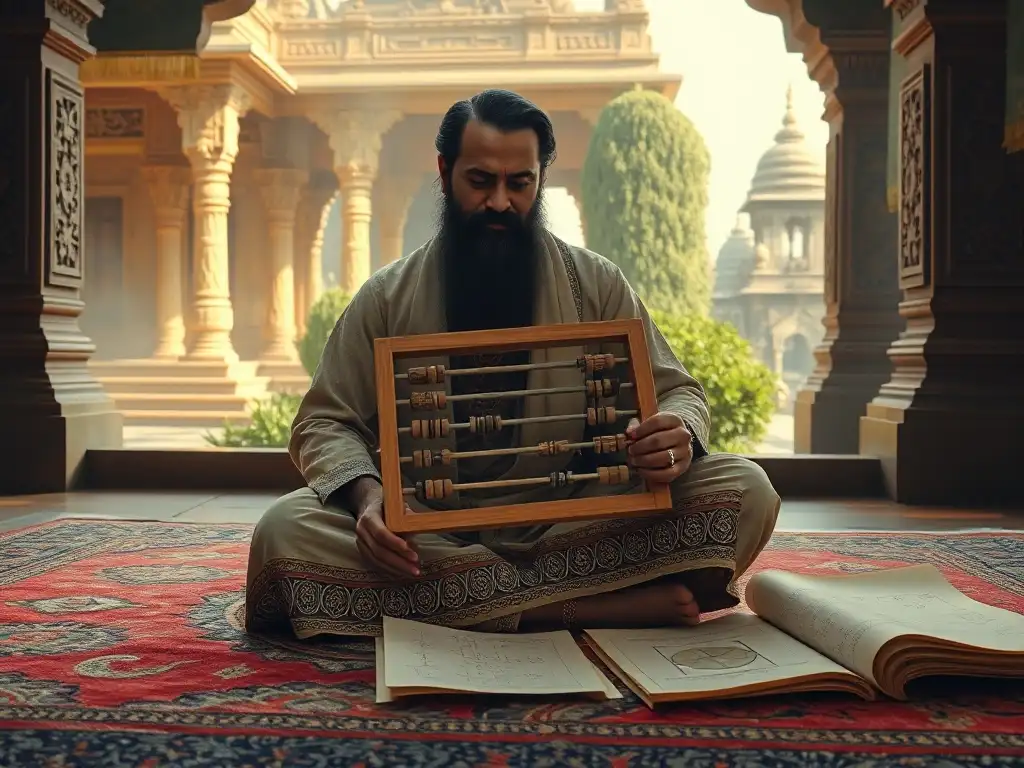
Ancient Indian mathematicians employed a variety of techniques that showcased their ingenuity and understanding of mathematical principles. Here are some prominent methods and concepts they utilized:
- Arithmetic and Algebra:
- Ancient texts reveal the use of arithmetic operations such as addition, subtraction, multiplication, and division. They also included algebraic concepts, where unknowns were represented by specific symbols, allowing for the formulation of equations to solve complex problems.
- Geometric Visualization:
- Many puzzles involved geometric shapes and figures. Mathematicians often visualized problems geometrically to derive solutions, such as calculating areas and volumes using diagrams to represent relationships between figures.
- Recursion and Induction:
- Some problems required recursive thinking, where solutions to a problem depended on solutions to smaller instances of the same problem. Induction was also used to prove general cases based on specific examples.
- Use of Base Systems:
- Ancient Indian mathematicians employed various base systems, including the decimal system, which facilitated the representation and manipulation of large numbers. The concept of zero was also crucial in simplifying computations.
- Rhetorical Algebra:
- Problems were often presented in a narrative form, requiring solvers to decipher the underlying mathematical principles. This technique not only engaged the solver but also preserved the cultural context of the puzzles.
Step-by-Step Solutions to Notable Puzzles
The following notable mathematical puzzles from ancient India highlight the techniques used in their resolution. Each puzzle is presented alongside a step-by-step solution to illustrate the methods employed.
- The Merchant's Problem:
- Puzzle Statement: A merchant had a certain amount of goods, and after selling a portion, he was left with 200 units. If he had sold 60% of his goods, how many goods did he originally have?
- Solution Steps:
-
Let \( x \) be the original quantity of goods.
-
The merchant sold 60% of \( x \), which means he has 40% left.
-
Therefore, \( 0.4x = 200 \).
-
Solving for \( x \):
\[
x = \frac{200}{0.4} = 500
\] -
Conclusion: The merchant originally had 500 goods.
-
- The River Crossing Puzzle:
- Puzzle Statement: A farmer needs to cross a river with a wolf, a goat, and a cabbage. He can only take one at a time. If left alone, the wolf will eat the goat, and the goat will eat the cabbage. How can he cross the river safely?
- Solution Steps:
- First Trip: Take the goat across the river.
- Second Trip: Return alone to the original side.
- Third Trip: Take the wolf across the river.
- Fourth Trip: Bring the goat back to the original side.
- Fifth Trip: Take the cabbage across the river.
- Final Trip: Return alone and take the goat across.
- Conclusion: All three (wolf, goat, cabbage) cross the river safely.
- The Age Puzzle:
- Puzzle Statement: A father is three times as old as his son. In 15 years, he will be twice the age of his son. What are their current ages?
- Solution Steps:
-
Let \( s \) be the current age of the son, then the father's age is \( 3s \).
-
In 15 years, the son's age will be \( s + 15 \) and the father's age will be \( 3s + 15 \).
-
Set up the equation:
\[
3s + 15 = 2(s + 15)
\] -
Simplifying gives:
\[
3s + 15 = 2s + 30 \implies s = 15
\] -
Therefore, the father’s current age is \( 3 \times 15 = 45 \).
-
Conclusion: The son is 15 years old, and the father is 45 years old.
-
These puzzles not only reflect the mathematical skills of ancient Indian civilizations but also illustrate the logical reasoning and creativity that were essential in problem-solving during that era. The ancient Indian mathematical puzzles continue to challenge and inspire modern thinkers and learners alike.
The Role of Mathematical Puzzles in Education
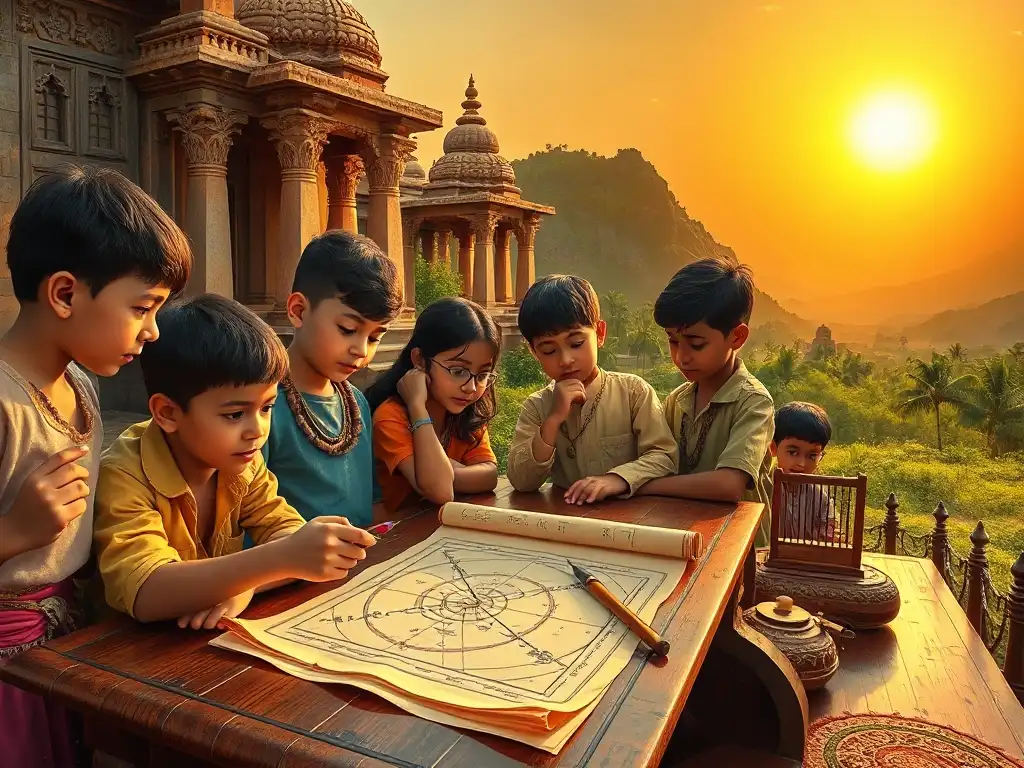
Mathematical puzzles have played a crucial role in the educational frameworks of ancient Indian civilizations. They were not merely recreational activities but served as essential tools for cultivating logical reasoning, problem-solving skills, and a deeper understanding of mathematical concepts. The incorporation of puzzles into education reflects a broader cultural appreciation for inquiry and exploration in mathematics, which was highly valued in ancient Indian society.
Educational Techniques in Ancient India
Ancient India employed various educational techniques that integrated mathematical puzzles into the learning process. Key methods included:
- Oral Tradition: Knowledge was often transmitted orally, with teachers posing puzzles and problems to students, encouraging active participation and critical thinking.
- Mathematical Texts: Works such as the Bakhshali Manuscript and Lilavati by Bhaskara II included numerous mathematical puzzles that were designed to challenge students and foster a love for mathematics.
- Real-World Applications: Puzzles often related to everyday life, including trade, astronomy, and agriculture, making mathematics relevant and practical for students. For example, problems involving the measurement of land or the calculation of interest on loans were common.
- Group Learning: Collaborative problem-solving was encouraged, allowing students to learn from each other while tackling complex puzzles. This method not only honed their mathematical skills but also developed teamwork and communication abilities.
These educational techniques highlight how ancient Indian societies prioritized mathematical understanding through engaging and thought-provoking methods. The emphasis on puzzles fostered a culture of inquiry that transcended generations, laying the groundwork for later developments in mathematics.
Impact on Modern Mathematical Education
The influence of ancient Indian mathematical puzzles can still be observed in modern educational practices. Key impacts include:
- Problem-Based Learning: Today’s educational systems emphasize problem-solving as a core component of mathematics education. This approach mirrors ancient practices where puzzles were used to engage students actively.
- Cultural Relevance: Incorporating historical puzzles into modern curriculums helps students appreciate the evolution of mathematics and its cultural significance, promoting a more inclusive understanding of the subject.
- Development of Critical Thinking: Engaging with mathematical puzzles encourages students to think critically and creatively, skills that are essential in various fields. This approach aligns with ancient methods that valued logical reasoning.
- Innovative Teaching Tools: Modern educators utilize puzzles and games as effective teaching tools, drawing inspiration from the methods used in ancient India. This not only makes learning enjoyable but also reinforces mathematical concepts in an interactive manner.
The legacy of ancient Indian mathematical puzzles continues to inspire educational practices today, demonstrating the timeless value of engaging students through challenging and thought-provoking problems. As we explore these historical puzzles, we not only celebrate their mathematical ingenuity but also recognize their enduring impact on the way mathematics is taught and learned in contemporary society.
Conclusion: The Legacy of Ancient Indian Mathematical Puzzles
The legacy of ancient Indian mathematical puzzles is not only a testament to the ingenuity of early mathematicians but also an enduring source of inspiration for contemporary scholars and enthusiasts. From the intricate riddles of the Sulbasutras to the engaging problems posed by Bhaskara II, these puzzles reflect a deep understanding of mathematical concepts and problem-solving techniques. Their historical significance is evident in how they laid the groundwork for modern mathematics, particularly in fields such as algebra and geometry.
Continuing Relevance in Today’s Mathematics
Ancient Indian mathematical puzzles continue to hold relevance in today’s mathematical discourse. Many of these puzzles, rooted in practical applications like architecture, astronomy, and commerce, showcase the sophisticated mathematical knowledge of their time. For instance, the famous Chaturanga (four parts) puzzle highlights the strategic thinking that underlies not just mathematics but also game theory, a field that has gained immense popularity in recent years.
Moreover, the problem-solving strategies employed in these ancient puzzles are mirrored in modern mathematics education. Many educators are reintroducing these historical problems into the classroom to enrich students' learning experiences. This approach not only engages students but also fosters critical thinking and analytical skills essential for mastering contemporary mathematical concepts.
Consider the following table highlighting some ancient Indian mathematical puzzles and their modern applications:
| Ancient Puzzle | Description | Modern Application |
|---|---|---|
| Sulba Sutras | Construction problems related to altars | Geometry in architecture |
| Kuttaka | A problem involving the solution of linear equations | Algebraic problem-solving |
| Samasa | Word problems involving combinations | Combinatorics and set theory |
Encouraging a New Generation of Puzzle Enthusiasts
To foster an appreciation for ancient Indian mathematical puzzles among the younger generation, educators and enthusiasts can implement various strategies. Initiatives such as puzzle competitions, math clubs, and workshops can create a vibrant community centered around these historical challenges.
Additionally, incorporating storytelling into the presentation of these puzzles can enhance engagement. Sharing the cultural and historical context behind each puzzle adds depth and intrigue, making them more accessible and appealing to students.
Here are a few ideas to inspire young puzzle enthusiasts:
- Puzzle of the Week: Introduce a weekly ancient puzzle in classrooms, pairing it with discussions on its historical context and significance.
- Mathematics History Projects: Encourage students to research ancient mathematicians and present their findings alongside solving related puzzles.
- Online Forums and Social Media: Create platforms where students can share solutions, discuss strategies, and even propose their own puzzles inspired by ancient Indian mathematics.
By embracing the rich heritage of ancient Indian mathematical puzzles, we can inspire a new generation to appreciate and explore the fascinating world of mathematics, ensuring that these historical treasures continue to challenge and engage minds for years to come.
Resources for Further Exploration
Recommended Books on Ancient Indian Mathematics
Exploring the realm of ancient Indian mathematical puzzles is not only intellectually stimulating but also deeply enriching. Several books provide comprehensive insights into the mathematical achievements of ancient Indian civilizations, offering both historical context and practical problems to solve. Here are some notable recommendations:
- "Mathematics in Ancient India" by C. R. Rao
- This book delves into the significant contributions of Indian mathematicians from the Vedic period to the Gupta Empire. It provides a detailed analysis of mathematical concepts and includes various puzzles and problems that reflect the sophistication of ancient Indian mathematics.
- "The History of Mathematics: A Brief Course" by Roger L. Cooke
- While not exclusively focused on Indian mathematics, this book offers a global perspective and includes sections dedicated to the contributions of ancient Indian mathematicians, along with mathematical challenges derived from their work.
- "The Mathematics of India" by K. R. Nambiar
- A thorough exploration of mathematical methods and puzzles from ancient India, this book presents a variety of problems, including geometric solutions and arithmetic challenges, that will engage readers in the legacy of Indian mathematics.
- "The Hindu Mathematics: A Study of the Mathematical Works of the Hindus" by S. R. Ranganathan
- This book highlights key mathematical texts from ancient India, presenting puzzles and problems that illustrate the innovative techniques employed by Indian mathematicians.
- "Ancient Indian Mathematics and Astronomy" by K. S. Shukla
- Focusing on the intersection of mathematics and astronomy, this book covers puzzles related to celestial calculations and timekeeping, showcasing the practical applications of mathematical principles in ancient Indian society.
Online Platforms for Learning and Solving Puzzles
In today's digital age, numerous online platforms provide access to ancient Indian mathematical puzzles, along with resources for learning more about this fascinating subject. Here are some recommended platforms to explore:
- Brilliant.org
- This interactive learning platform offers courses in mathematics and problem-solving, including sections dedicated to historical puzzles. Users can engage with ancient Indian mathematical concepts through challenging exercises and community discussions.
- Khan Academy
- While primarily focused on modern mathematics, Khan Academy includes content on the history of mathematics. Users can find links to ancient mathematical concepts and puzzles, enabling them to explore the evolution of mathematical thought.
- Project Gutenberg
- A vast repository of free eBooks, Project Gutenberg houses several texts on ancient Indian mathematics. Users can access original works, translations, and commentaries that may include mathematical puzzles and problems from the ancient era.
- Coursera
- Offering courses on mathematics and its history, Coursera features classes that touch on ancient Indian mathematics. Participants can engage with puzzles and problems as part of a broader learning experience.
- Mathematical Puzzles Websites
- Websites like Art of Problem Solving and Mathisfun often include sections dedicated to historical puzzles, including those from ancient cultures. These platforms offer a community for puzzle enthusiasts to share solutions, insights, and historical context.
By utilizing these resources, readers can deepen their understanding of ancient Indian mathematical puzzles and appreciate the rich legacy of mathematical thought that has influenced generations. Happy puzzling!
Frequently Asked Questions
What are ancient Indian mathematical puzzles?
Ancient Indian mathematical puzzles are challenges and problems that originated in India, showcasing the country's rich mathematical heritage. They often involve practical applications and have historical significance.
How did ancient Indian mathematicians contribute to mathematics?
Ancient Indian mathematicians made significant contributions to concepts such as zero, algebra, and geometry. Their work laid the foundation for many modern mathematical principles.
Are there any famous ancient Indian mathematical texts?
Yes, texts like the "Aryabhatiya" by Aryabhata and "Brahmasphutasiddhanta" by Brahmagupta are notable for containing various mathematical puzzles and theories that influenced future generations.
How can I practice solving ancient Indian mathematical puzzles?
You can find collections of ancient Indian mathematical puzzles in books, online resources, or academic publications. Engaging with these puzzles will enhance your problem-solving skills.
Why are these puzzles important today?
These puzzles highlight the intellectual legacy of ancient India and encourage critical thinking. They also provide insight into the cultural and historical context of mathematics in India.
Final Reflection: Embracing the Wisdom of Ancient Indian Mathematical Puzzles
The exploration of ancient Indian mathematical puzzles reveals not only the ingenuity of past civilizations but also their enduring relevance in our modern world. These puzzles challenge our minds and encourage critical thinking, reminding us that the quest for knowledge transcends time. In an age dominated by technology and instant gratification, engaging with these historical problems can foster a deeper appreciation for the intellectual heritage that shapes our understanding of mathematics today.
The influence of ancient Indian mathematical puzzles extends far beyond the classroom; they serve as a bridge connecting us to a rich cultural legacy. These puzzles have inspired generations of mathematicians and enthusiasts alike, fostering a sense of curiosity and exploration. As we engage with these timeless challenges, we are reminded of the words of the great mathematician Srinivasa Ramanujan: An equation for me has no meaning unless it represents a thought of God.
This perspective encourages us to see mathematics not just as numbers and formulas but as a profound expression of human creativity and understanding.
As you reflect on the lessons embedded within these ancient puzzles, I invite you to embrace the challenge they present. Take the time to engage with these historical problems, allowing them to inspire your own thinking and problem-solving skills. Let the wisdom of ancient India guide you as you navigate the complexities of modern life, fostering a mindset that values curiosity, perseverance, and a deeper connection to the world around you. In doing so, you not only honor the legacy of those who came before us but also enrich your own intellectual journey.
Challenge Your Mind and Explore Ancient Wisdom!
Thank you for diving into the fascinating world of mathematical puzzles from Ancient India! We hope you discovered intriguing insights that not only challenge your intellect but also connect you with the rich history of mathematical thought.
Now, let’s take your curiosity further with a few engaging activities:
- Dive Deeper: Solve a classic Ancient Indian problem by exploring the renowned Shulba Sutras and attempting their geometrical puzzles.
- Share the Challenge: Post your favorite puzzle on social media and challenge your friends to see who can solve it the quickest! Use #AncientMathChallenge to join the conversation.
- Join a Community: Connect with fellow enthusiasts on our forum where you can discuss your findings and share your solutions.
What’s one mathematical concept from ancient history that has surprised or inspired you the most? We invite you to share your thoughts in the comments!