
Language and Literature: Tracing Sanskrit's Impact on Southeast Asian Languages


Welcome to Ancient India History, where we embark on a fascinating journey through the rich tapestry of ancient Indian civilizations. In this exploration, we delve into the profound Sanskrit influence on Southeast Asia, a topic that reveals the intricate web of cultural exchanges that shaped languages and literature across regions. As you navigate through our content, prepare to uncover the remarkable ways in which this ancient language has left an indelible mark on Southeast Asian cultures. Join us as we trace the threads of history and discover how the echoes of Sanskrit continue to resonate today.

Introduction to Sanskrit Influence on Southeast Asia
The influence of Sanskrit on Southeast Asia represents a fascinating chapter in the narrative of cultural exchanges that have shaped the region's identity. Sanskrit, an ancient classical language of India, has left an indelible mark on the languages, literature, and cultural practices of several Southeast Asian nations.
From the inscriptions found in temples to the literary works that have survived through centuries, the impact of Sanskrit is profound and multifaceted. As we delve deeper into this subject, we will explore how Sanskrit served as a vehicle for transmitting ideas, religious beliefs, and artistic expressions across geographic boundaries, influencing local languages and cultures in remarkable ways.
Overview of Sanskrit as a Classical Language
Sanskrit, often referred to as the "language of the gods," has a rich heritage dating back over 3,500 years. It is the liturgical language of Hinduism, Buddhism, and Jainism, and has also been a key medium for a vast body of literature, including the Vedas, Upanishads, and epic poems like the Mahabharata and Ramayana.
- Characteristics of Sanskrit:
- Complex Grammar: The grammar of Sanskrit, codified by Panini in the 4th century BCE, is known for its sophistication and precision.
- Phonetic Richness: Sanskrit has a unique phonetic system that allows for a wide array of sounds, making it particularly expressive.
- Literary Depth: The language's vast vocabulary and stylistic versatility have facilitated the creation of diverse literary forms, ranging from poetry to prose.
Due to its prestige and the intellectual tradition surrounding it, Sanskrit became a crucial element in the cultural fabric of Southeast Asian societies, where it was often employed in royal courts, religious texts, and scholarly pursuits.
Importance of Language in Cultural Exchange
Language serves as a cornerstone for cultural exchange, acting as a bridge that connects different communities and facilitates the sharing of ideas, beliefs, and practices. In the case of Sanskrit's influence on Southeast Asia, several factors underscore its significance:
- Cultural Identity: Languages often embody the history and identity of a people. The adoption of Sanskrit by various Southeast Asian cultures highlights their historical connections to India.
- Religious Transmission: Sanskrit played a crucial role in the spread of Hinduism and Buddhism, as many religious texts were composed in this language, promoting the exchange of spiritual ideas.
- Literary Development: The infusion of Sanskrit into local literatures led to the emergence of unique literary traditions in Southeast Asia, enriching the cultural landscape of the region.
Historical Context of Sanskrit in Southeast Asia
Understanding the historical context of Sanskrit's spread in Southeast Asia is essential to appreciate its lasting impact. The interactions between Indian and Southeast Asian civilizations were facilitated by several factors, including trade, migration, and the establishment of political ties.
The Spread of Sanskrit Through Trade and Migration
The maritime trade routes that connected India to Southeast Asia have been pivotal in the dissemination of Sanskrit. Merchants, sailors, and travelers exchanged not only goods but also cultural and linguistic elements.
- Key Trade Routes:
- The Maritime Silk Road facilitated trade between India, Indonesia, and beyond.
- Indian traders settled in coastal towns, establishing cultural enclaves that became centers for the exchange of ideas.
Early Cultural Interactions Between India and Southeast Asia
The early interactions between Indian and Southeast Asian cultures laid the groundwork for a rich tapestry of shared knowledge and practices.
- Influential Kingdoms: The rise of Hindu-Buddhist kingdoms, such as the Srivijaya and Khmer Empires, prominently featured Sanskrit in administration and religious practices.
- Inscriptions and Texts: Numerous inscriptions in Sanskrit, found in temples and monuments across Southeast Asia, provide evidence of this cultural interchange, showcasing the language's role in governance and spirituality.
Through these historical lenses, we can begin to appreciate the profound influence of Sanskrit on the languages and cultures of Southeast Asia, a legacy that continues to resonate today.
Major Southeast Asian Languages Influenced by Sanskrit
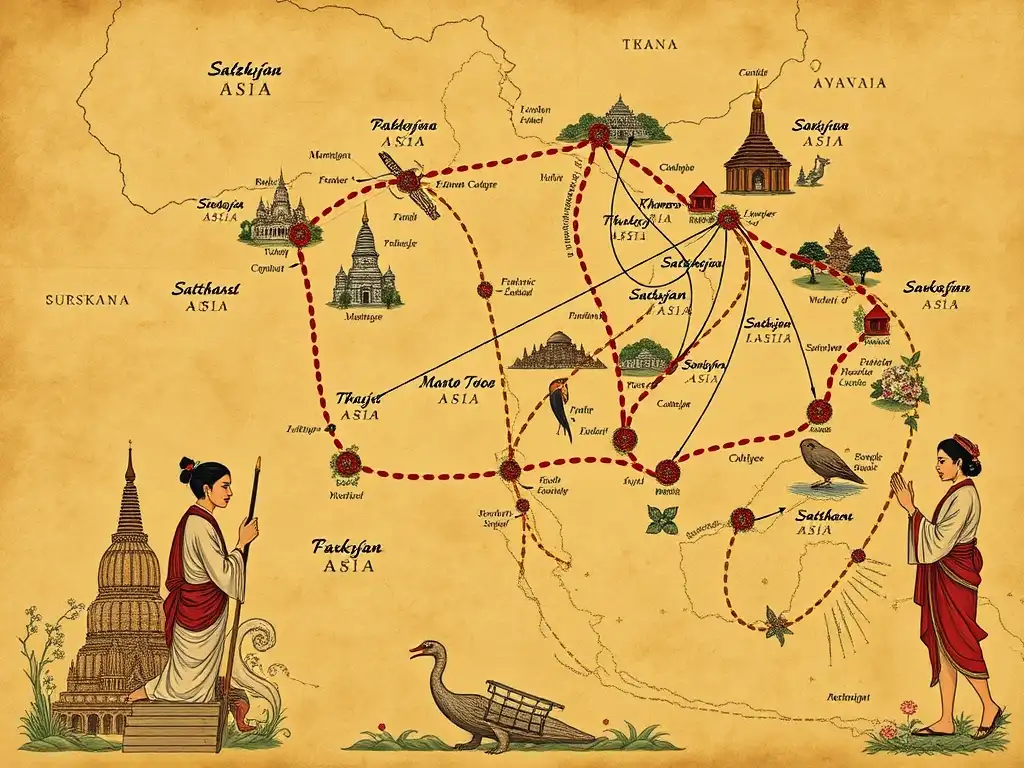
Sanskrit has significantly shaped various languages across Southeast Asia, leaving an indelible mark on their vocabulary, grammar, and phonetics. Prominent languages influenced by Sanskrit include:
- Indonesian: This language has absorbed numerous Sanskrit words, especially in terms related to administration, religion, and culture.
- Malay: Similar to Indonesian, Malay has incorporated a vast array of Sanskrit-derived terms, particularly in literature and traditional practices.
- Thai: Sanskrit influence is evident in Thai, especially in the context of Buddhist terminology and royal vocabulary.
- Burmese: The Burmese language has integrated Sanskrit elements, particularly in religious texts and formal speech.
- Khmer: The Khmer language exhibits a rich tapestry of Sanskrit vocabulary, especially in its historical and cultural narratives.
The interplay between Sanskrit and these languages underscores the historical trade routes and cultural exchanges that facilitated linguistic evolution and enrichment in Southeast Asia.
Overview of Languages Affected by Sanskrit
The influence of Sanskrit in Southeast Asian languages is primarily a result of historical interactions through trade, migration, and the spread of Hinduism and Buddhism. As Indian traders and scholars traveled to these regions, they brought not only goods but also linguistic and cultural elements. Over time, this resulted in the adoption of Sanskrit vocabulary and concepts, which became woven into the fabric of local languages.
For instance, in both Indonesian and Malay, the integration of Sanskrit vocabulary can be observed in terms related to governance (such as "raja" meaning king) and culture (like "sastra" meaning literature). Similarly, in Thai and Khmer, many words are derived from Sanskrit, reflecting the profound cultural exchanges established during the early centuries of trade and religious propagation.
Linguistic Features Borrowed from Sanskrit
The impact of Sanskrit on Southeast Asian languages transcends mere vocabulary; it extends into various linguistic features, including grammatical structures and phonetic elements. This cross-pollination has enriched these languages and contributed to their unique evolution while preserving a connection to ancient Indian civilization.
Vocabulary Borrowings: Common Terms and Their Usage
Sanskrit has contributed a wealth of vocabulary to Southeast Asian languages, particularly in domains such as religion, literature, and governance. Some common terms include:
- Raja (राजा): Meaning king, this term is widely used across languages such as Indonesian ("raja"), Malay ("raja"), and Thai ("rāja"), signifying royalty and governance.
- Dharma (धर्म): Referring to law or duty, "dharma" is prevalent in languages like Khmer and Thai, showcasing its significance in Buddhist and Hindu contexts.
- Sastra (शास्त्र): Meaning literature or scripture, this term is adopted in languages like Indonesian and Malay, indicating the cultural importance of literary works.
These borrowings reflect not only the linguistic influence but also the cultural ideologies that were transferred alongside the vocabulary.
Grammatical Structures Influenced by Sanskrit
Sanskrit's influence on the grammatical structures of Southeast Asian languages is evident in various aspects, such as the formation of compound words and the use of honorifics. For instance:
- Compound Words: Many Southeast Asian languages employ compound structures akin to those in Sanskrit, where two or more words combine to form a new meaning. This structural borrowing enhances the expressiveness of these languages.
- Honorifics and Politeness Levels: The intricate system of honorifics in Sanskrit has influenced similar systems in languages like Thai, where respect and social hierarchy are linguistically encoded.
These grammatical adaptations illustrate how Sanskrit has not only shaped vocabulary but also the very framework through which these languages communicate social and cultural nuances.
Phonetic Adaptations in Southeast Asian Languages
The phonetic influence of Sanskrit on Southeast Asian languages is notable, particularly in pronunciation and the incorporation of specific sounds. This adaptation can be observed in:
- Syllable Structure: Many Southeast Asian languages have adopted the open syllable structure common in Sanskrit, leading to a similar rhythm and flow in spoken language.
- Consonant Clusters: The presence of consonant clusters in Sanskrit has been mirrored in languages like Khmer and Thai, enhancing their phonetic complexity and richness.
These phonetic adaptations have contributed to the distinct sounds of Southeast Asian languages while preserving a connection to their Sanskrit roots, further illustrating the deep-seated influence of this ancient language on regional linguistic diversity.
The Role of Religion and Literature in Sanskrit Influence
The profound influence of Sanskrit on Southeast Asian languages is deeply intertwined with the region's religious and literary traditions. As Sanskrit spread through trade routes and cultural exchanges, it was not merely a language but a vehicle of religious thought and literary expression. This exchange facilitated the adoption of Sanskrit vocabulary, syntax, and literary forms into local languages, significantly shaping their development.
In Southeast Asia, Hinduism and Buddhism emerged as dominant religions, both of which utilized Sanskrit as a liturgical and scholarly language. This usage helped establish a cultural foundation that influenced not only religious practices but also local languages and literatures. The sacred texts, rituals, and teachings conveyed in Sanskrit often found their way into vernacular languages, enriching them and expanding their literary horizons.
Sanskrit in Southeast Asian Religious Texts
Sanskrit's role in the religious texts of Southeast Asia is pivotal, particularly in the context of Hindu and Buddhist scriptures. Many sacred texts, such as the Vedas, Puranas, and Mahabharata, were translated or adapted into local languages, often retaining significant portions of their original Sanskrit. This translation process allowed for the incorporation of complex philosophical concepts and religious narratives into Southeast Asian cultures.
For instance, the Ramayana, an epic originally composed in Sanskrit, was adapted in various Southeast Asian cultures, including the Ramayana Kakawin in Indonesia and the Ramayana in Thailand. The narratives were localized, yet the core Sanskrit elements provided a shared cultural reference that continues to resonate in contemporary Southeast Asian religious practices and literature.
Literary Traditions: Epics and Poetry Influenced by Sanskrit
The literary traditions of Southeast Asia owe much to the influence of Sanskrit epics and poetry. The structure, themes, and stylistic elements of Sanskrit literature have profoundly shaped the literary frameworks of various Southeast Asian languages. Local poets and writers often emulated the narrative techniques and poetic forms found in Sanskrit texts, resulting in a rich tapestry of literature that reflects both indigenous and Sanskritic influences.
For example, the use of meter and rhyme in Southeast Asian poetry frequently mirrors the sophisticated patterns found in classical Sanskrit poetry. This blend of influences has given rise to unique literary forms, such as the Kakawin in Java, which combines Sanskritic elements with local traditions, creating a distinctive literary voice that celebrates cultural hybridity.
Preservation of Sanskrit in Southeast Asian Literature
The preservation of Sanskrit within Southeast Asian literature is a testament to the language's enduring legacy. Many ancient manuscripts and inscriptions in Sanskrit have been discovered across the region, highlighting its role as a medium for knowledge, culture, and governance. These texts often serve as crucial historical documents that illuminate the interactions between indigenous cultures and Sanskrit-speaking communities.
In modern times, the study and revival of Sanskrit in academic and cultural contexts have contributed to the ongoing appreciation of its influence. Institutions and scholars in Southeast Asia continue to explore the rich heritage of Sanskrit literature, ensuring that its impact on local languages and cultures is recognized and preserved for future generations.
Case Studies of Sanskrit Influence on Specific Languages

Understanding the influence of Sanskrit on specific Southeast Asian languages provides valuable insights into the complexities of cultural exchange and linguistic evolution. Various case studies illustrate how Sanskrit has shaped the lexicon, structure, and literary traditions of these languages.
Case Study 1: Khmer Language Development
The Khmer language exhibits significant Sanskrit influence, particularly in its vocabulary and literary forms. Historical evidence suggests that during the Angkor period, Sanskrit became the language of administration, culture, and religion. As a result, many Sanskrit words related to governance, religion, and the arts were absorbed into Khmer.
Additionally, Khmer literature includes numerous works that draw upon Sanskrit epics and poetic techniques, enabling the Khmer literary tradition to flourish while maintaining its unique identity. The presence of Sanskrit inscriptions in temples and monuments further underscores the deep-rooted connection between the two languages.
Case Study 2: The Evolution of Javanese Literature
Javanese literature has been profoundly influenced by Sanskrit, especially during the Majapahit Empire. The incorporation of Sanskrit vocabulary and literary forms is evident in classical Javanese texts, such as the Serat Ramayana and Bharatayuddha.
These works illustrate the blending of Javanese and Sanskrit traditions, where local narratives are often interwoven with themes and stylistic elements derived from Sanskrit literature. The use of Sanskrit not only enriched the Javanese literary canon but also solidified its status as a significant cultural and artistic expression in the region.
Case Study 3: The Integration of Sanskrit in Thai Culture
In Thailand, the influence of Sanskrit is particularly prominent in the Thai language, especially in religious and formal contexts. Many Thai words, particularly those related to Buddhism and royal titles, are derived from Sanskrit. The incorporation of Sanskrit into Thai literature can be seen in traditional forms such as Khun Chang Khun Phaen, which showcases narrative structures influenced by Sanskrit epics.
Moreover, the adaptation of the Ramayana into the Thai cultural context, known as Ramakien, demonstrates how Sanskrit narratives have been integrated into local folklore and performance arts. This ongoing integration underscores the lasting impact of Sanskrit on Thai cultural identity and literary expression.
Modern Implications of Sanskrit Influence on Southeast Asian Languages
The influence of Sanskrit on Southeast Asian languages is profound and multifaceted, shaping not only linguistic structures but also cultural identities. As countries in this region continue to evolve, the legacy of Sanskrit remains integral, influencing various domains such as literature, religion, and law. This ongoing impact reflects the enduring connections established through historical trade routes and cultural exchanges, highlighting the significance of Sanskrit in the linguistic tapestry of Southeast Asia.
Modern languages, such as Indonesian, Malay, Thai, and Khmer, exhibit numerous Sanskrit loanwords, demonstrating the language's pervasive influence. This integration illustrates how Sanskrit has transcended time, embedding itself into the daily lives of millions. As these languages continue to develop, the foundational elements contributed by Sanskrit serve as a testament to the historical interactions that have shaped Southeast Asian civilizations.
Contemporary Language Use and Sanskrit Legacy
In contemporary Southeast Asia, the legacy of Sanskrit can be observed in various contexts, from religious ceremonies to everyday conversations. For instance, in Indonesia, many traditional terms related to governance and spirituality are derived from Sanskrit, showcasing its relevance in modern discourse. Similarly, in Thailand, royal and Buddhist texts often incorporate Sanskrit terminology, underpinning its significance in the cultural and religious fabric of the nation.
Furthermore, the influence of Sanskrit extends to artistic expressions such as dance and music, where traditional forms often invoke Sanskrit phrases or terminology. This linguistic heritage not only enriches the artistic landscape but also reinforces cultural identity, as communities express their historical ties through these art forms.
The Role of Sanskrit in Modern Southeast Asian Education
Sanskrit's role in education across Southeast Asia is noteworthy, reflecting its historical significance and contemporary relevance. Many educational institutions in countries like India, Indonesia, and Thailand include Sanskrit studies in their curricula, recognizing the language's contributions to philosophy, theology, and literature.
For instance, universities in Indonesia offer programs focusing on the study of ancient texts in Sanskrit, allowing students to delve into the rich literary tradition that has influenced their own languages and cultures. This academic pursuit fosters a greater appreciation for the historical and cultural exchanges that have shaped Southeast Asian societies.
Moreover, Sanskrit is often taught in the context of Hindu and Buddhist studies, where its philosophical texts are essential for understanding religious doctrines and practices. As such, the language serves as a bridge connecting contemporary learners with their cultural heritage.
Conclusion: The Enduring Legacy of Sanskrit in Southeast Asia
The enduring legacy of Sanskrit in Southeast Asia underscores the profound cultural exchanges that have occurred over centuries. As contemporary societies navigate their identities in a globalized world, the influence of Sanskrit remains a vital aspect of their linguistic and cultural landscapes.
Summary of Key Points on Sanskrit Influence
- Linguistic Integration: Sanskrit has contributed extensively to the vocabulary and grammatical structures of several Southeast Asian languages.
- Cultural Relevance: The language's presence in religious and artistic expressions highlights its ongoing significance in modern society.
- Educational Impact: Sanskrit studies in educational institutions ensure that the language's legacy is preserved and appreciated by future generations.
The Importance of Understanding Cultural Exchanges in History
Understanding the cultural exchanges that facilitated Sanskrit's influence is crucial for grasping the complexities of Southeast Asian history. These exchanges not only shaped languages but also fostered rich traditions in art, religion, and philosophy. Recognizing the interconnectedness of cultures allows for a deeper appreciation of the region's diverse heritage and the role that ancient languages like Sanskrit play in shaping contemporary identities. By studying these influences, we can better understand the historical narratives that continue to influence Southeast Asian societies today.
- Introduction to Sanskrit Influence on Southeast Asia
- Overview of Sanskrit as a Classical Language
- Importance of Language in Cultural Exchange
- Historical Context of Sanskrit in Southeast Asia
- Major Southeast Asian Languages Influenced by Sanskrit
- Linguistic Features Borrowed from Sanskrit
- The Role of Religion and Literature in Sanskrit Influence
- Case Studies of Sanskrit Influence on Specific Languages
- Modern Implications of Sanskrit Influence on Southeast Asian Languages
- Conclusion: The Enduring Legacy of Sanskrit in Southeast Asia
- What is the significance of Sanskrit in ancient Indian civilizations?
- How did Sanskrit spread to Southeast Asia?
- What are some examples of Sanskrit influence on Southeast Asian languages?
- How did Sanskrit literature contribute to the cultural development of Southeast Asia?
- What is the current status of Sanskrit in Southeast Asia?
Frequently Asked Questions
What is the significance of Sanskrit in ancient Indian civilizations?
Sanskrit served as a lingua franca in ancient India, influencing various aspects of culture, philosophy, and literature. Its structured grammar and rich vocabulary made it a foundational language for many texts and teachings.
How did Sanskrit spread to Southeast Asia?
The spread of Sanskrit to Southeast Asia occurred through trade, cultural exchanges, and the spread of Hinduism and Buddhism. This resulted in the adoption of Sanskrit vocabulary and concepts in local languages.
What are some examples of Sanskrit influence on Southeast Asian languages?
Languages such as Thai, Malay, and Javanese incorporate many Sanskrit words, particularly in areas related to religion, administration, and arts. This influence is evident in the vocabulary and literary traditions of these cultures.
How did Sanskrit literature contribute to the cultural development of Southeast Asia?
Sanskrit literature, including epics like the Ramayana and Mahabharata, provided cultural narratives and moral frameworks that shaped the social and political landscapes of various Southeast Asian societies.
What is the current status of Sanskrit in Southeast Asia?
While Sanskrit is no longer widely spoken, its legacy endures through religious texts, cultural practices, and the lexicon of many Southeast Asian languages, showcasing its lasting impact on the region.
Final Reflection: The Enduring Legacy of Sanskrit in Southeast Asia
The profound influence of Sanskrit on Southeast Asian languages is not merely a historical curiosity; it is a testament to the power of language as a vehicle for culture, identity, and connection. As we navigate an increasingly interconnected world, understanding the roots of our linguistic heritage becomes essential. The intricate tapestry woven by Sanskrit's impact on the languages of Southeast Asia reminds us that language is not static; it evolves, adapts, and shapes societies in ways that resonate through time.
Sanskrit's legacy continues to shape the cultural and social landscape of Southeast Asia, influencing everything from literature to religious practices. The echoes of ancient texts and the cadence of classical poetry still reverberate in contemporary expressions, creating a rich dialogue between past and present. Language is the road map of a culture. It tells you where its people come from and where they are going.
This quote encapsulates the journey of Sanskrit as it traveled across borders, leaving an indelible mark on the languages and cultures it touched.
As we reflect on the lessons drawn from the intricate relationship between Sanskrit and Southeast Asian languages, I invite you to consider your own linguistic journey. How has language shaped your identity, and how can you honor the diverse influences that have contributed to your own story? Embrace the richness of your linguistic heritage and recognize the interconnectedness of cultures. By doing so, we not only celebrate our past but also pave the way for a more inclusive and understanding future.
Unleash Your Curiosity: Dive Deeper into Sanskrit's Influence!
Thank you for exploring the fascinating interplay between Sanskrit and Southeast Asian languages with us! Your interest in this rich history not only broadens your knowledge but also highlights the cultural threads that connect us all. Now, let’s take a step further into this enlightening journey.
- Immerse Yourself: **Read a classic text or poem originally written in Sanskrit**, and discover how its nuances influence contemporary interpretations in various languages.
- Share Your Insights: **Engage in discussions with friends or participate in online forums**—everyone deserves to know how deeply intertwined our languages are!
- Explore Further: **Visit local libraries or browse online archives** to uncover more about how Sanskrit has shaped the literary landscapes across Southeast Asia.
What unique connections have you noticed between Sanskrit and the languages you speak or study? **We invite you to share your thoughts below! **