
How Ancient Indian Mathematicians Used Geometry in Architecture


Welcome to Ancient India History, where we embark on a fascinating journey through time, unveiling the rich tapestry of ancient Indian civilizations. Prepare to be captivated as we delve into the remarkable interplay of geometry and architecture—a testament to the ingenuity of ancient Indian mathematicians. In our featured article, “How Ancient Indian Mathematicians Used Geometry in Architecture,” you'll discover how these visionary minds laid the groundwork for architectural marvels that continue to inspire awe today.
Join us as we explore the intricate designs and mathematical principles that shaped a cultural legacy still celebrated across the globe. Your adventure into the wonders of ancient Indian geometry architecture starts here—let's dive deeper!
- Introduction to Ancient Indian Geometry in Architecture
- Historical Context of Geometry in Ancient India
- Significant Mathematicians and Their Contributions
- Principles of Ancient Indian Geometry
- Architectural Marvels Reflecting Ancient Indian Geometry
- The Role of Sacred Geometry in Ancient Indian Architecture
- Conclusion: Legacy of Ancient Indian Geometry in Architecture
- References and Further Reading
-
Frequently Asked Questions
- What is ancient Indian geometry architecture?
- How did ancient Indian mathematicians contribute to geometry?
- What are some examples of geometric designs in ancient Indian architecture?
- How did geometry influence temple construction in ancient India?
- Why is the study of ancient Indian geometry architecture important today?
- Final Reflection: The Enduring Legacy of Ancient Indian Geometry in Architecture
- Unveil the Secrets of Geometry: Take Action Today!
Introduction to Ancient Indian Geometry in Architecture
The intricate relationship between mathematics and architecture has been a hallmark of civilizations throughout history, but few have demonstrated this connection as profoundly as ancient India. The remarkable achievements of ancient Indian mathematicians in the realm of geometry not only laid the groundwork for various fields of mathematics but also played a pivotal role in the architectural marvels that still captivate the world today.
By exploring the evolution of ancient Indian geometry architecture, we can gain insight into how these mathematicians applied their knowledge to create structures that were not only aesthetically pleasing but also structurally sound and deeply symbolic. This article delves into the significant contributions made by ancient Indian mathematicians, their innovative use of geometric principles in architecture, and the lasting impact of these advancements on later civilizations.
Overview of Ancient Indian Contributions to Mathematics
Ancient India has a rich mathematical heritage that dates back thousands of years, characterized by profound concepts and groundbreaking discoveries. The contributions from this era include:
- The Concept of Zero: Perhaps one of the most significant inventions, the concept of zero as a numeral was revolutionary, allowing for the development of a positional number system.
- Decimal System: The use of a decimal system simplified calculations and laid the foundation for modern arithmetic.
- Advanced Geometry: Ancient texts, including the Sulba Sutras, detail geometric constructions, demonstrating the application of geometric principles in rituals and architecture.
- Trigonometry: The concepts of sine and cosine were explored, which later influenced various scientific fields.
These advancements illustrate how ancient Indian mathematicians not only contributed to theoretical mathematics but also applied their knowledge practically, especially in the construction of temples, palaces, and other monumental structures.
Importance of Geometry in Ancient Indian Architecture
Geometry served as the backbone of ancient Indian architecture, influencing everything from temple design to urban planning. The application of geometric principles allowed architects to achieve harmony, balance, and proportion in their structures, which were often imbued with spiritual significance. Key aspects include:
- Sacred Geometry: Many ancient Indian buildings were constructed using specific geometric ratios that were believed to enhance their spiritual essence and connection to the cosmos.
- Structural Stability: The understanding of geometrical shapes contributed to the creation of stable and enduring structures, utilizing techniques such as arch construction and load distribution.
- Aesthetic Appeal: The application of intricate patterns and designs, derived from geometric shapes, added to the beauty and intricacy of architectural works.
The integration of geometry into architecture not only showcased the mathematical prowess of ancient Indian civilizations but also reflected their cultural and philosophical beliefs, making their architectural contributions truly extraordinary.
Historical Context of Geometry in Ancient India

The Evolution of Mathematics in Ancient Indian Civilizations
The journey of mathematics in ancient India is marked by significant developments that laid the groundwork for various fields, including architecture. Mathematics was not merely a theoretical subject; it was intricately tied to the practicalities of daily life, trade, astronomy, and notably, architecture. Ancient Indian mathematicians employed geometry to solve real-world problems, leading to the creation of sophisticated architectural designs.
The earliest evidence of mathematical concepts in India can be traced back to the Indus Valley Civilization (c. 3300–1300 BCE), where the layout of cities like Harappa and Mohenjo-Daro exhibited remarkable spatial planning. The grid patterns and standardized weights and measures indicate a strong understanding of geometry, which was essential for urban planning and construction.
As we move into the Vedic period (c. 1500–500 BCE), mathematical thought continued to evolve. Texts like the Sulba Sutras introduced concepts of geometric constructions, especially in relation to altars and ritual sites. These texts provided rules for constructing various shapes, such as squares, rectangles, and circles, often emphasizing the importance of precise measurements in both spiritual and practical contexts.
The classical period (c. 500 BCE – 500 CE) saw the emergence of renowned mathematicians like Aryabhata and Brahmagupta, who made significant contributions to geometry and its applications in architecture. Aryabhata's treatise, Aryabhatiya, not only addressed arithmetic and astronomy but also detailed geometric calculations vital for constructing temples and other structures. Brahmagupta expanded upon these ideas, introducing formulas for calculating areas and volumes, which were essential for architectural design.
Key Periods Influencing Architectural Geometry
The use of geometry in ancient Indian architecture can be categorized into several key periods, each contributing unique insights and innovations.
- Indus Valley Civilization
- Urban Planning: Cities were meticulously planned with grid-like street patterns, indicating an early application of geometric principles.
- Water Management: The advanced drainage systems reflect a deep understanding of spatial relationships and geometry.
- Vedic Period
- Sulba Sutras: These texts provided geometrical rules for constructing fire altars, emphasizing accuracy and precision in measurements.
- Ritual Architecture: Geometry played a crucial role in the design of sacred spaces, aligning structures with cosmic principles.
- Maurya and Post-Maurya Periods
- Stupas and Pillars: Architectural marvels like the Sanchi Stupa showcased intricate geometric designs, with careful proportions and symmetry.
- Mathematical Texts: Works by mathematicians during this era continued to influence architectural practices, integrating geometry into temple construction.
- Gupta Period
- Temple Architecture: The Gupta Empire is known for its elaborate temples, where geometry was used to create harmonious proportions and intricate carvings.
- Innovations in Design: The introduction of the mandapa (pillared hall) and shikhara (tower) reflected advanced geometric understanding.
- Post-Gupta Period
- Regional Styles: As regional variations emerged, different architectural styles incorporated local geometric interpretations, enriching the landscape of ancient Indian architecture.
Conclusion
The historical context of geometry in ancient India reveals a rich tapestry of mathematical evolution, intertwined with architectural practices. As ancient Indian mathematicians harnessed geometric principles, they crafted structures that not only served functional purposes but also embodied cultural significance. The legacy of this architectural geometry continues to inspire and inform contemporary design, underscoring the profound contributions of ancient Indian civilizations to the world of mathematics and architecture.
Significant Mathematicians and Their Contributions

Aryabhata: Pioneering Geometric Concepts
Aryabhata, one of the earliest and most renowned mathematicians of ancient India, made significant contributions to geometry, which played a crucial role in architecture. Born in 476 CE, Aryabhata's seminal work, the Aryabhatiya, outlines various mathematical theories, including trigonometry and the use of geometric principles in practical applications.
Key Contributions:
- Circle and Sphere Geometry: Aryabhata's calculations of the area of a circle, given by the formula \( \pi r^2 \), were revolutionary. He approximated \(\pi\) as 3.1416, a remarkably accurate value for his time.
- Pythagorean Theorem: Aryabhata also discussed the relationship between the sides of a right triangle, laying the groundwork for what would later be known as the Pythagorean theorem. His geometric insights were essential for constructing temple foundations and designing buildings with precise angles and dimensions.
Aryabhata's geometric principles were not only theoretical but were also applied in the construction of temples like the Brahmeshwara Temple in Bhubaneshwar, showcasing the practical implications of his work in ancient Indian architecture.
Brahmagupta: Innovations in Architectural Mathematics
Brahmagupta, who lived during the 7th century CE, is celebrated for his groundbreaking work in mathematics and astronomy. His text, the Brahmasphutasiddhanta, provides an in-depth exploration of geometric concepts that directly influenced architectural design.
Key Contributions:
- Quadratic Equations: Brahmagupta introduced methods for solving quadratic equations that were applicable in determining structural loads in architectural frameworks. This innovation allowed architects to calculate dimensions accurately, ensuring the stability of their constructions.
- Geometric Properties of Shapes: He detailed the properties of cyclic quadrilaterals, which are crucial for calculating areas of trapezoidal structures often found in ancient Indian architecture. His formula for the area of a cyclic quadrilateral, \( \sqrt{(s-a)(s-b)(s-c)(s-d)} \) (where \(s\) is the semi-perimeter), was instrumental in designing arches and domes.
Brahmagupta's geometric methods provided architects with tools to optimize designs, leading to the construction of iconic structures such as the Sun Temple in Konark, where complex shapes and angles are seamlessly integrated.
Bhaskara II: Advancing Geometric Techniques in Design
Bhaskara II, also known as Bhaskara the Great, was a prominent mathematician and astronomer of the 12th century CE. His work, Siddhanta Shiromani, includes extensive discussions on geometry, which significantly influenced architectural practices.
Key Contributions:
- Circular and Spherical Geometry: Bhaskara II expanded upon Aryabhata's work by providing detailed calculations related to circular and spherical shapes, essential for designing domes and other architectural elements.
- Application of Geometry in Construction: He emphasized the importance of geometry in construction, explaining that understanding angles and proportions was vital for creating aesthetically pleasing and structurally sound buildings. His principles guided artisans in crafting intricate designs for temples and palaces.
The application of Bhaskara II's geometric techniques can be seen in the stunning architecture of the Hoysaleswara Temple in Halebidu, where precision in design reflects the advanced understanding of geometry during his time.
Principles of Ancient Indian Geometry

Ancient Indian geometry is a rich and intricate field that played a pivotal role in architecture throughout various civilizations. The mathematicians of ancient India developed geometric principles that were not only theoretical but also extremely practical, influencing the construction of temples, palaces, and urban planning. Understanding these principles is essential to appreciate how they shaped the architectural landscape of ancient India.
One of the foundational aspects of ancient Indian geometry is its emphasis on both practical application and spiritual symbolism. Architects and mathematicians recognized the importance of geometry in creating spaces that were not only functional but also aesthetically pleasing and aligned with cosmic principles. This led to the formulation of specific geometric rules that guided the construction of structures in harmony with nature and the universe.
Fundamental Geometric Shapes in Architecture
In ancient Indian architecture, several fundamental geometric shapes were predominant. These shapes served as the building blocks for various structures, each carrying its own significance:
- Squares: Representing stability and balance, squares were often used in the layout of temple complexes. The square layout, known as the "mandala," was integral in aligning structures with cardinal directions.
- Circles: Symbolizing the cosmos and eternity, circles were extensively utilized in the design of stupas and other circular structures. The circular form allowed for a dynamic flow of space, representing the cyclical nature of life.
- Triangles: Frequently employed in the design of roofs and sacred symbols, triangles represented the divine and were used to convey spiritual meanings in architectural elements.
- Rectangles: Often used in the planning of residential and public buildings, rectangles provided functional spaces while maintaining proportional aesthetics.
These shapes were not only chosen for their aesthetic appeal but also for their structural integrity, ensuring that buildings could withstand the test of time.
Use of Symmetry and Proportions in Design
Symmetry and proportion are crucial elements in ancient Indian architecture, reflecting a deep understanding of balance and harmony. Ancient Indian architects employed various techniques to achieve symmetry in their designs, which was believed to create a sense of harmony with the universe.
- Axial Symmetry: Many temples were designed with a central axis, where elements on either side of this axis mirrored each other. This approach facilitated a balanced visual and spiritual experience for worshippers.
- Golden Ratio: The ancient Indian architects often adhered to proportional relationships akin to the golden ratio, ensuring that dimensions were aesthetically pleasing. This mathematical relationship can be observed in the heights and widths of structures, columns, and doorways.
- Modular Design: Architects utilized modular systems based on geometric shapes to create proportions that were consistent across different elements of a structure. This method ensured that all parts of a building were in harmony, enhancing the overall aesthetic and structural integrity.
By integrating these principles of symmetry and proportion, ancient Indian architects were able to create monumental structures that resonated with both beauty and function.
Geometric Tools and Techniques Employed
The ancient Indian mathematicians and architects employed various geometric tools and techniques to realize their architectural visions. These tools were crucial for accurately measuring, drawing, and constructing complex designs:
- Chakra (Circle): A simple yet effective tool, the chakra was used to draw perfect circles, often serving as a basis for mandalas and circular structures.
- Gnomon: This tool, often a simple stick, was used for measuring shadows and angles, aiding in the precise placement of architectural elements according to solar alignments.
- Plumb Line and Level: Essential for ensuring vertical and horizontal alignments, these tools allowed builders to maintain structural integrity and aesthetic proportions.
- Geometric Theorems: Knowledge of geometric theorems, such as those related to triangles and circles, informed construction techniques. For instance, the Pythagorean theorem was utilized to achieve right angles in various structures.
The integration of these tools and techniques not only demonstrates the advanced mathematical understanding of ancient Indian civilizations but also highlights their commitment to creating enduring and meaningful architecture. This blend of geometry and artistry remains a hallmark of ancient Indian architecture, leaving a legacy that continues to inspire modern architects today.
Architectural Marvels Reflecting Ancient Indian Geometry

The Great Stupa at Sanchi: A Geometric Perspective
The Great Stupa at Sanchi, dating back to the 3rd century BCE, stands as a monumental testament to ancient Indian geometry architecture. This structure is not merely a religious edifice but also a masterclass in geometric design. The stupa is a hemispherical dome, symbolizing the universe and representing the cosmic sphere. Its diameter is about 36 meters, and its height is approximately 16.5 meters, showcasing a perfect ratio that emphasizes harmony in design.
The stupa's layout is based on the ancient Indian architectural principles that prioritize symmetry and proportion. The circular form of the stupa is complemented by a square railing, known as the harmika, which sits atop the dome. This square represents the earthly realm and is aligned perfectly with the cardinal directions, demonstrating an understanding of geometric alignment that reflects the cosmos.
In addition to the overall shape, the use of the golden ratio is evident in the proportions of the stupa’s elements. The careful calculations involved in the construction of the Great Stupa embody the advanced mathematical knowledge of ancient Indian mathematicians, who understood how geometry could create a spiritual experience through architectural design.
The Temples of Khajuraho: Architectural Geometry in Detail
The Khajuraho temples, built between 950 and 1050 CE, are renowned for their intricate sculptures and elaborate architectural geometry. These temples exhibit a rich variety of geometric shapes, including circles, squares, and triangles, which are harmoniously integrated into their overall design. The temples' layouts often follow a specific geometric pattern, with the central shrine surrounded by subsidiary shrines, forming a geometric arrangement that enhances their sacred significance.
One notable example is the Vishvanatha Temple, which features a towering shikhara (spire) that rises majestically above the sanctum. The shikhara's design incorporates a series of diminishing layers, creating a visually striking pyramid-like structure. This tapering effect not only serves aesthetic purposes but also reflects an understanding of vertical proportions in relation to horizontal space.
The temples also utilize intricate carvings that follow geometric patterns, which serve both decorative and symbolic functions. The interplay of light and shadow on these geometric forms further enhances the visual experience, showcasing how ancient Indian geometry architecture was not merely functional but also artistically profound.
The Sun Temple at Konark: Geometry in Design and Structure
The Sun Temple at Konark, built in the 13th century, is an extraordinary example of ancient Indian geometry architecture, designed to represent a colossal chariot of the sun god Surya. This temple is constructed in the shape of a chariot, complete with twelve pairs of wheels, each intricately carved with geometric patterns and motifs. These wheels are not only decorative but also serve to symbolize the passage of time, reflecting the mathematical understanding of cycles and angles.
The temple's layout adheres to strict geometric principles, with its main sanctum positioned to align with the sun’s rays. During the equinoxes, the first light of dawn illuminates the sanctum, creating a spectacular visual effect that embodies the integration of geometry and astronomy in ancient Indian architecture. The use of various geometric forms, such as squares, rectangles, and circles, in the temple’s design showcases the mathematicians' skill in creating structures that resonate with the cosmos.
Moreover, the intricate carvings on the temple's walls depict various aspects of life and nature, arranged in geometric compositions that convey deeper meanings. This synthesis of art, geometry, and spirituality exemplifies how ancient Indian architects utilized mathematical principles to inspire awe and reverence in their creations.
The architectural marvels of ancient India, as seen in these examples, reveal a profound understanding of geometry that transcended mere construction techniques, allowing for the expression of cultural and spiritual values through meticulously designed structures.
The Role of Sacred Geometry in Ancient Indian Architecture

The concept of sacred geometry holds a pivotal role in ancient Indian architecture, influencing not only the aesthetic appeal of various structures but also embodying spiritual and philosophical principles. This geometric approach reflects the belief that the universe is constructed based on geometric rules and patterns, which can be replicated in human-made environments to create harmony and balance.
Spiritual Significance of Geometric Patterns
In ancient India, geometric patterns were not merely decorative; they were imbued with profound spiritual meaning. The use of shapes such as circles, squares, and triangles was deeply intertwined with religious symbolism. For instance, the mandala, a geometric design representing the cosmos, is often found in temples and sacred spaces, serving as a visual representation of the universe's harmony.
- Circles symbolize eternity and the cycle of life, while squares represent stability and the earthly realm.
- Triangles are associated with the divine, often depicting the trinity of gods in Hinduism.
These geometric forms were meticulously integrated into temple designs, reflecting the underlying cosmological beliefs of ancient Indian society. The careful arrangement of these patterns was believed to attract positive energy, making spaces more conducive for worship and meditation.
The Influence of Vastu Shastra on Design Principles
Vastu Shastra, the ancient Indian science of architecture and design, emphasizes the importance of geometry in creating harmonious living spaces. This discipline is rooted in the belief that the layout, shape, and orientation of buildings can significantly affect the well-being of their inhabitants.
Key Principles of Vastu Shastra:
- Orientation: Structures are designed to align with cardinal directions, enhancing the flow of energy.
- Proportions: Specific ratios and dimensions are prescribed to ensure balance and harmony within a space. For instance, the Vastu Purusha Mandala serves as a guiding blueprint, showcasing the ideal proportions of a building.
- Sacred Geometry: Geometric shapes, particularly those of squares and rectangles, are used to define spaces, with each shape carrying its own significance and energy properties.
The application of Vastu Shastra in ancient Indian architecture is evident in structures like the Brihadeeswarar Temple and the Sun Temple at Konark, which exemplify the meticulous planning and geometric precision that characterize ancient Indian geometry architecture. The integration of these principles ensured that the buildings not only served functional purposes but also resonated with spiritual energy, reflecting the harmonious relationship between humanity and the cosmos.
The role of sacred geometry in ancient Indian architecture is a testament to the civilization's advanced understanding of mathematics, spirituality, and artistic expression. From geometric patterns rich in symbolism to the principles of Vastu Shastra that guided architectural practices, ancient Indian geometry architecture continues to inspire and intrigue scholars and enthusiasts alike.
Conclusion: Legacy of Ancient Indian Geometry in Architecture
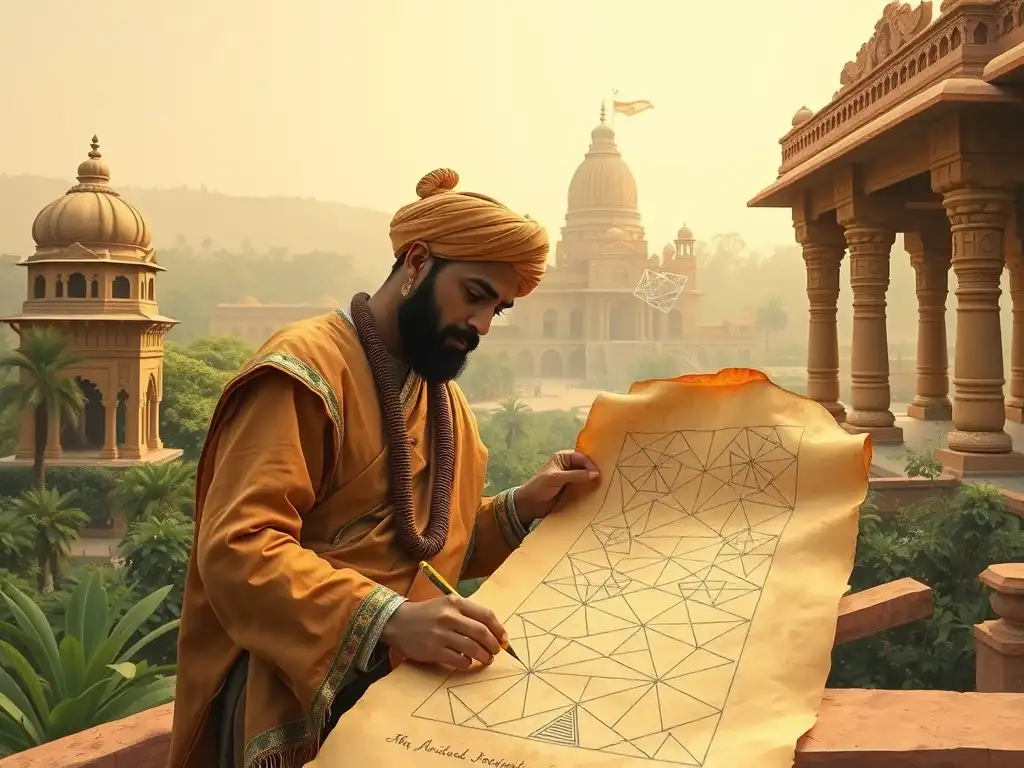
The legacy of ancient Indian geometry in architecture is both profound and enduring, showcasing the remarkable mathematical prowess of Indian mathematicians and architects. From the intricate designs of temples to the well-planned urban layouts of ancient cities, geometry played a pivotal role in shaping the architectural landscape of India. The meticulous application of geometric principles not only enhanced aesthetic appeal but also ensured structural stability, reflecting a deep understanding of both mathematics and engineering.
Ancient Indian texts, such as the Shilpa Shastras, serve as invaluable resources, documenting the rules and guidelines for the application of geometry in construction. These texts outline various geometric forms, proportions, and spatial arrangements that have influenced architectural practices for centuries. The precision in measurements and the use of symmetry are evident in structures like the Brihadeeswarar Temple and the Sun Temple at Konark, both of which exemplify the harmonious integration of geometry and spirituality.
The Impact of Ancient Indian Geometric Practices on Modern Architecture
The geometric practices established by ancient Indian mathematicians have had a significant impact on modern architecture, inspiring contemporary architects and designers around the globe. One of the primary influences is the use of symmetrical designs and proportionate layouts, which are foundational in architectural aesthetics today. Many modern buildings draw inspiration from the intricate patterns found in ancient Indian architecture, incorporating similar geometric motifs into their facades and interiors.
Furthermore, the principles of vastu shastra, which are rooted in ancient Indian architectural practices, continue to guide the design of homes and commercial spaces. Vastu emphasizes the importance of aligning structures with natural elements and cosmic principles using geometric configurations. This approach has gained recognition worldwide, as more architects seek to create spaces that are not only visually appealing but also harmonious with their surroundings.
| Geometric Element | Ancient Application | Modern Interpretation |
|---|---|---|
| Symmetry | Temple designs, urban layouts | Building facades, park designs |
| Proportion | Proportional relationships in temples | Space planning in contemporary architecture |
| Patterns | Decorative motifs in architecture | Textiles and surface designs |
Continuing Influence of Ancient Indian Geometry in Contemporary Design
The influence of ancient Indian geometry persists in contemporary design practices, reflecting a rich cultural heritage that continues to inspire creativity. Designers and architects are increasingly incorporating traditional geometric patterns into modern projects, celebrating the artistic legacy of ancient India. For instance, the use of intricate jali work (lattice screens) in building facades not only serves functional purposes, such as providing ventilation and privacy, but also adds a layer of aesthetic depth rooted in historical context.
Moreover, the principles of geometric visualization employed in ancient Indian architecture are being embraced in innovative ways. Techniques such as parametric design and computational geometry, used in modern architecture, echo the sophisticated understanding of geometry that ancient Indian mathematicians possessed. By leveraging these principles, contemporary architects can create dynamic structures that respond to environmental challenges while maintaining a connection to their historical roots.
The legacy of ancient Indian geometry in architecture is not merely a relic of the past; it is a living tradition that continues to influence architectural practices and design philosophies today. By understanding and appreciating this rich heritage, modern architects can draw inspiration from the profound mathematical insights of their predecessors, creating spaces that are both functional and imbued with cultural significance.
References and Further Reading
Recommended Books on Ancient Indian Mathematics and Architecture
- "The Mathematics of India: A Historical Overview" by Kim Plofker
- This book provides an extensive look into the mathematical contributions of ancient Indian mathematicians, including their innovative use of geometry in architecture. Plofker explores historical contexts and applications, making it a valuable resource for understanding ancient Indian geometry in architectural practices.
- "Indian Mathematics: A Historical Perspective" by C. B. Mamoria
- Mamoria's work delves into the evolution of mathematics in India, highlighting key mathematicians and their contributions. It covers topics such as the principles of geometry reflected in ancient Indian structures, offering insights into how these principles influenced architectural design.
- "The Architecture of Ancient India: Buddhist, Hindu, and Jain" by Catherine Asher and Cynthia Talbot
- This comprehensive guide illustrates the architectural styles of ancient India, showcasing how geometry was integral to design. The authors analyze various monuments, revealing the geometric principles that guided their construction.
- "Mathematics in India" by Kim Plofker
- Plofker's analysis not only covers mathematical theories but also emphasizes practical applications in architecture, detailing how ancient Indian geometry was employed in the design and construction of significant structures.
- "Geometry and Architecture in Ancient India" by John L. H. H. W. E. van der Molen
- This book specifically focuses on the intersection of geometry and architecture in ancient India, presenting case studies of notable structures and the geometric principles behind them.
Academic Journals and Articles for In-Depth Study
-
"Geometry in Ancient Indian Architecture"
This article, published in the Indian Journal of History of Science, explores various architectural marvels through the lens of geometry, detailing methodologies employed by ancient architects.
-
"The Role of Geometry in Hindu Temple Architecture"
Found in the Journal of Indian Philosophy, this paper discusses the significance of geometric designs in temple architecture, illustrating how these principles manifest in famous temples across India.
-
"Mathematics and Architecture in Ancient India"
An article from the International Journal of Architectural Heritage, this research highlights the contributions of mathematicians to architectural advancements, emphasizing specific examples of ancient structures.
-
"The Geometry of Indian Architecture: A Historical Survey"
Published in Studies in History and Philosophy of Science, this survey provides a comprehensive review of how geometric concepts were integrated into architectural practices throughout India's ancient history.
-
"Cultural Significance of Geometry in Ancient Indian Structures"
This paper, appearing in the Journal of the Indian Society of History of Mathematics, examines cultural implications and the symbolic meanings of geometric designs in various architectural forms.
These resources collectively offer a deeper understanding of the intricate relationship between ancient Indian geometry and architecture, enriching the study of this fascinating subject.
Frequently Asked Questions
What is ancient Indian geometry architecture?
Ancient Indian geometry architecture refers to the use of geometric principles in the design and construction of structures during ancient Indian civilizations, particularly seen in temples and public buildings.
How did ancient Indian mathematicians contribute to geometry?
Ancient Indian mathematicians made significant contributions through texts like "Brahmasphutasiddhanta" and "Aryabhatiya," where they explored geometric concepts that influenced architecture and engineering.
What are some examples of geometric designs in ancient Indian architecture?
Prominent examples include the symmetrical layouts of temples, intricate carvings, and the use of mandalas that reflect geometric harmony and balance in structures like the Khajuraho temples.
How did geometry influence temple construction in ancient India?
Geometry played a crucial role in ensuring structural stability, aesthetic appeal, and spiritual significance, with architects employing precise measurements and proportional designs to create sacred spaces.
Why is the study of ancient Indian geometry architecture important today?
Studying ancient Indian geometry architecture helps us understand the technological advancements of the time, cultural significance, and the influence of geometry on modern architectural practices.
Final Reflection: The Enduring Legacy of Ancient Indian Geometry in Architecture
The intricate relationship between ancient Indian geometry and architecture remains profoundly relevant today, as we continue to explore the mathematical principles that shape our built environment. The remarkable achievements of ancient Indian mathematicians not only laid the groundwork for architectural marvels but also serve as a testament to the ingenuity and creativity that can arise from the fusion of art and science. Their work challenges us to recognize the importance of geometry in our modern architectural practices and inspires us to innovate while honoring the wisdom of the past.
The influence of ancient Indian geometry extends far beyond historical significance; it continues to resonate in contemporary architectural design and cultural identity. By understanding and appreciating the mathematical principles that guided ancient architects, we can foster a deeper connection to our heritage and the spaces we inhabit. As the renowned architect Charles Correa once said, "> Architecture is not just about buildings; it's about the people who inhabit them." This perspective invites us to consider how geometry shapes not only structures but also the experiences and emotions of those who engage with them.
As we reflect on the lessons of ancient Indian geometry in architecture, I invite you to explore how these principles can inspire your own creative endeavors. Consider the spaces you design, inhabit, or interact with, and think about how geometry can enhance their beauty and functionality. Let the wisdom of ancient mathematicians guide you in your journey, encouraging you to blend tradition with innovation, and ultimately, to create environments that resonate with both history and the future.
Unveil the Secrets of Geometry: Take Action Today!
Thank you for exploring the fascinating connection between ancient Indian mathematics and architecture! You've just uncovered how geometric principles shaped stunning structures that have endured through the ages. Now, it’s your turn to delve deeper and apply this knowledge. Here’s how you can continue your journey:
- Explore local architectural styles influenced by ancient techniques. Document your findings and share your photos on social media with the hashtag #AncientGeometry.
- Visit a museum or historical site that showcases ancient Indian architecture; take detailed notes on the geometric patterns you observe and share your insights with friends or through a community group.
- Engage in an online discussion or forum about how ancient geometry can inspire modern architectural design—your unique ideas could spark new conversations!
Which architectural element do you believe best exemplifies the harmony between geometry and beauty in ancient Indian structures?