
The Mathematical Techniques of Ancient Indian Merchants: Trade Secrets


Welcome to Ancient India History, where we embark on an enlightening journey through the rich tapestry of ancient Indian civilizations. Here, we delve into the extraordinary contributions that shaped not only the subcontinent but also the world. In our featured article, "The Mathematical Techniques of Ancient Indian Merchants: Trade Secrets," we unveil the fascinating mathematical techniques employed by ancient Indian traders that revolutionized commerce and navigation. Discover how these innovative practices laid the groundwork for modern mathematics and piqued the curiosity of scholars across generations. Prepare to uncover secrets that have been hidden in the sands of time!
- Introduction to Ancient Indian Mathematical Techniques
- Historical Context of Ancient Indian Merchants
- Key Mathematical Techniques Used by Ancient Indian Merchants
- The Role of Notational Systems in Trade
- Case Studies of Prominent Ancient Indian Merchants
- Comparison of Ancient Indian Mathematical Techniques with Other Civilizations
- The Legacy of Ancient Indian Mathematical Techniques
- Conclusion: The Enduring Impact of Ancient Indian Mathematical Techniques on Trade
- Additional Resources for Further Exploration
-
Frequently Asked Questions
- What were the main mathematical techniques used by ancient Indian merchants?
- How did ancient Indian mathematics contribute to trade and commerce?
- What role did the Indus Valley Civilization play in the development of mathematics?
- Can you explain the significance of the Gupta Empire in the context of mathematics?
- How are ancient Indian mathematical techniques relevant today?
- Final Reflection: The Enduring Legacy of Ancient Indian Mathematical Techniques
- Unveil the Secrets of Ancient Trade!
Introduction to Ancient Indian Mathematical Techniques
Exploring the intricate tapestry of ancient Indian civilization reveals a profound connection between mathematics and trade. As merchants navigated the bustling markets of ancient India, they employed a variety of mathematical techniques that not only facilitated commerce but also contributed significantly to the broader field of mathematics. This article delves into the mathematical techniques utilized by ancient Indian merchants, shedding light on their innovative approaches and the impact of their work on trade and society. By understanding these techniques, we can appreciate the sophisticated mathematical knowledge that thrived in ancient India, often overshadowed by other historical narratives.
Overview of Ancient Indian Mathematics
Ancient Indian mathematics is characterized by its rich and diverse traditions, which emerged as early as the Indus Valley Civilization. The mathematical techniques developed during this period laid the groundwork for further advancements in mathematical thought and application. Some key aspects include:
- Numerical System: Ancient Indians are credited with the development of a decimal system, which included place value notation. This system was fundamental for calculations and trade practices.
- Zero and Infinity: The introduction of the concept of zero as a numeral, along with the notion of infinity, revolutionized mathematics and allowed for more complex calculations.
- Geometry and Measurement: Ancient texts reveal sophisticated knowledge of geometry, particularly in the fields of land measurement and architecture, which were essential for trade and urban planning.
These foundational principles not only influenced the merchants of the time but also laid the groundwork for future mathematicians and scientists.
Importance of Trade in Ancient India
Trade was a cornerstone of ancient Indian society, facilitating the exchange of goods, ideas, and cultural practices across vast regions. The significance of trade can be understood through several key points:
- Economic Growth: Trade routes, such as the Silk Road and maritime paths, connected India with other civilizations, enhancing economic growth and prosperity.
- Cultural Exchange: The interaction between merchants and traders from various regions promoted the exchange of mathematical knowledge and techniques, enriching the local practices.
- Development of Merchandising Techniques: The necessity for accurate measurements, pricing, and accounting in trade led to the refinement of mathematical techniques, which were vital for merchants to succeed.
Through these dynamics, trade not only shaped the economy but also acted as a catalyst for mathematical innovation in ancient India.
The Role of Merchants in Mathematical Development
Merchants played a pivotal role in the development and dissemination of mathematical techniques in ancient India. Their daily practices necessitated the use of mathematics for various purposes:
- Accounting: Merchants needed effective methods for recording transactions, which led to advancements in arithmetic and bookkeeping techniques.
- Pricing Strategies: Determining prices and negotiating costs required a solid understanding of ratios and proportions, prompting the development of mathematical strategies.
- Navigation and Logistics: As trade expanded, merchants relied on geometry and measurement to navigate trade routes and manage logistical challenges, fostering advancements in these areas.
Through their practical applications of mathematics, merchants not only contributed to the economic landscape but also became key figures in the evolution of mathematical thought in ancient India. Their legacy continues to influence modern mathematical practices and trade techniques today.
Historical Context of Ancient Indian Merchants

The ancient Indian merchants played a pivotal role in the development of trade and commerce in the region, significantly influencing the economy and cultural exchanges across Asia. Their operations were characterized by a complex understanding of mathematics, which enabled them to navigate trade effectively. The emergence of these merchants can be traced back to the Indus Valley Civilization (c. 3300–1300 BCE), where early evidence of trade practices demonstrated a sophisticated approach to commerce, including the use of weights and measures.
Trade Routes and Economic Networks
The trade routes established during ancient times were extensive, connecting India to various regions, including the Middle East, Southeast Asia, and beyond. The Silk Road and Maritime Spice Route were instrumental in facilitating the exchange of goods such as spices, textiles, and precious stones. These routes were not only vital for economic transactions but also served as conduits for cultural and mathematical exchange.
Merchants utilized various mathematical techniques to calculate distances, manage inventories, and assess the value of goods. The use of calculating devices like the abacus, alongside indigenous measuring systems, allowed merchants to perform complex transactions with remarkable accuracy. Key trade hubs like Taxila and Pataliputra became centers where mathematical knowledge was exchanged, leading to advancements that would benefit merchants and scholars alike.
The Influence of Geography on Trade Techniques
Geography played a crucial role in shaping the trading techniques of ancient Indian merchants. The subcontinent's diverse landscapes, ranging from the fertile plains of the Ganges to the mountainous terrains of the Himalayas, influenced the routes taken by traders and the types of goods exchanged.
- Topographical Challenges:
- Navigating through the rugged terrain required merchants to develop unique mathematical solutions to calculate routes and manage logistics effectively.
- The establishment of caravanserais along trade routes provided rest stops for traders, where they could employ mathematical techniques in managing supplies and calculating distances.
- Climate Considerations:
- Seasonal variations affected trade patterns, compelling merchants to use mathematical forecasting to predict the best times for trade.
- Techniques for measuring time and understanding celestial movements became essential, allowing merchants to plan journeys according to seasonal weather patterns.
Significant Civilizations and Their Contributions
Different ancient Indian civilizations made notable contributions to mathematical techniques used in trade.
- Indus Valley Civilization: The earliest known civilization that utilized sophisticated weights and measures, contributing to trade standardization.
- Maurya Empire: Under leaders like Chandragupta Maurya and Ashoka, trade flourished, and advancements in mathematics were documented. The use of zero as a numeral and the development of place value systems emerged during this time, enhancing trade calculations.
- Gupta Empire: Often referred to as the "Golden Age" of Indian mathematics, this period saw significant developments such as the introduction of numerals and the early forms of algebra. Merchants used these techniques to streamline trade practices, manage accounts, and perform complex calculations related to commerce.
The mathematical techniques of ancient Indian merchants were deeply intertwined with the historical, geographical, and cultural contexts of their time. Through their innovative approaches to trade, they not only contributed to the economic prosperity of their civilizations but also laid the groundwork for future advancements in mathematics.
Key Mathematical Techniques Used by Ancient Indian Merchants

Ancient Indian merchants employed a variety of mathematical techniques that were crucial for trade and commerce. These techniques were not only practical but also reflective of the advanced understanding of mathematics in ancient Indian civilization. The rich tapestry of these mathematical practices showcases how merchants navigated complex calculations, measurements, and accounting methods to facilitate trade across vast distances.
Arithmetic Skills and Calculations
The foundation of ancient Indian mathematical techniques can be attributed to their arithmetic skills. Merchants relied heavily on basic operations to conduct their business efficiently.
Basic Arithmetic Operations
Ancient Indian merchants utilized addition, subtraction, multiplication, and division to manage their transactions. The use of place value and the decimal system, which were prominent in ancient Indian mathematics, made calculations easier and more accurate. For instance, the Bakhshali Manuscript, dating back to the 2nd century CE, illustrates the use of these basic operations with practical examples relevant to trade, such as calculating profits and losses.
Examples of basic arithmetic operations include:
- Addition: Determining the total goods sold.
- Subtraction: Calculating remaining inventory after sales.
- Multiplication: Finding the total price of items sold in bulk.
- Division: Distributing profits among partners.
Techniques for Quick Calculations
To enhance efficiency, merchants employed various techniques for quick calculations. One such method was the Nikhilam Sutra, which facilitated rapid multiplication and division. This technique allowed merchants to perform calculations mentally, which was essential in bustling markets where quick decision-making was vital.
Another notable technique included:
- Vedic Mathematics: A set of techniques derived from ancient texts that emphasized speed and accuracy, allowing merchants to solve complex problems with ease.
Measurement Techniques in Trade
Measurement was another critical aspect of trade, as it ensured fairness and accuracy in transactions. Ancient Indian merchants developed sophisticated measurement techniques for weighing goods and measuring land.
Weighing Systems and Standards
Ancient Indian merchants established standardized weighing systems using units like ‘maund’ and ‘ser’. These units were vital for ensuring that both buyers and sellers had a clear understanding of the quantity being exchanged. The use of balance scales, often made of durable materials, allowed merchants to measure goods accurately.
Key features of these weighing systems included:
- Standardization: Establishing fixed weights to avoid disputes.
- Calibration: Regularly checking and adjusting scales to maintain accuracy.
Measurement of Land and Goods
The measurement of land was essential for agricultural trade, and ancient Indian merchants developed techniques to assess the area of land effectively. The Shulba Sutras, ancient texts, describe methods for calculating land area using geometric principles, which were crucial for determining the size of fields for cultivation.
Methods for land measurement included:
- Geometric Shapes: Utilizing shapes such as squares and rectangles to estimate land area.
- Surveying Techniques: Employing ropes and physical markers to outline property boundaries.
The mathematical techniques used by ancient Indian merchants were sophisticated and diverse. Their skills in arithmetic and measurement not only facilitated trade but also contributed significantly to the overall development of mathematics in ancient India, setting the foundation for future advancements in the field.
Use of Geometry in Trade Practices
Geometry played a crucial role in the trade practices of ancient Indian merchants, serving as a fundamental tool for various commercial activities. The ability to calculate areas and distances accurately was essential for effective land management, resource allocation, and transportation logistics. Merchants used geometric principles not only for practical purposes but also to enhance their negotiation strategies and optimize their trading routes.
Merchants often employed geometric shapes, particularly triangles and rectangles, to measure land plots and determine the best locations for trade. By understanding the properties of these shapes, they could maximize the use of available land, ensuring that their trading posts and warehouses were positioned for optimal accessibility. This knowledge was vital in bustling markets and trade centers where space was limited and competition was high.
Land Measurement and Plotting
Ancient Indian merchants utilized sophisticated land measurement techniques based on geometric principles to ensure accurate plotting and division of land. The practice involved the use of tools such as ropes, pegs, and measuring rods, allowing merchants to establish property boundaries and determine the size of land parcels effectively.
- Instruments Used: Merchants often used simple instruments like the measuring chain (known as "dhanush") and plumb lines to ensure straight lines and accurate angles.
- Methods of Measurement: Techniques such as the Pythagorean theorem were likely known in some form, enabling them to calculate distances and areas accurately. This skill was particularly important in establishing land ownership rights, which were critical for trade and agriculture.
The ability to measure land accurately not only facilitated trade but also played a significant role in taxation and land revenue systems, as rulers and local authorities relied on these measurements for collecting dues.
Architectural Applications in Trade Centers
The architectural designs of ancient Indian trade centers reflect the application of geometric techniques in their construction. These centers, which served as hubs for commerce, were strategically planned to accommodate large volumes of traders and goods.
- Design of Marketplaces: The layout of marketplaces often incorporated geometric principles, ensuring efficient movement and accessibility. Traders used symmetrical designs to create organized selling spaces, which increased foot traffic and sales potential.
- Storage Buildings: Structures were designed with precise geometric shapes to optimize storage capacity. For instance, warehouses were typically rectangular or square, maximizing floor area while minimizing construction costs.
Furthermore, the architectural techniques employed in the construction of temples and public buildings also showcased the advanced understanding of geometry. The intricate designs and proportions in these structures not only served aesthetic purposes but also symbolized the mathematical sophistication of the time, which undoubtedly influenced the merchants’ understanding and application of mathematical techniques in their trade practices.
The use of geometry in the land measurement and architectural design of trade centers highlights the integral role that mathematical techniques played in the success of ancient Indian merchants. Understanding these practices provides valuable insight into the advanced economic and cultural systems that flourished in ancient India.
The Role of Notational Systems in Trade
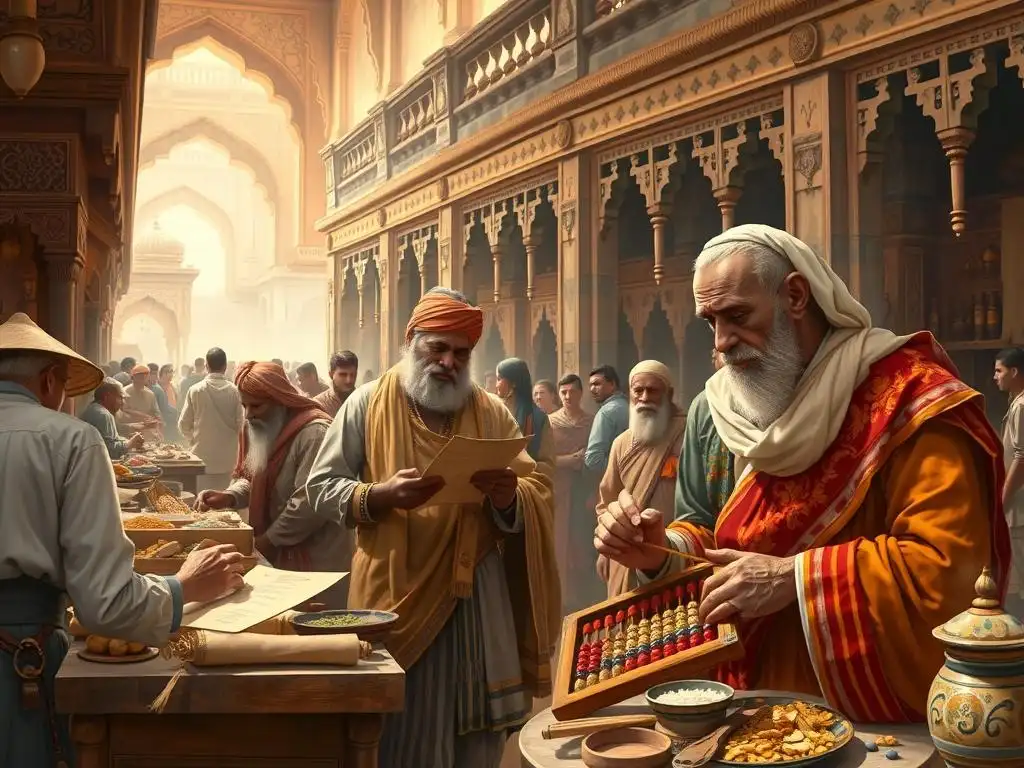
The significance of notational systems in ancient Indian trade cannot be overstated. These systems facilitated not only the communication of complex mathematical ideas but also played a crucial role in the efficiency and expansion of commerce across various regions. The evolution of these systems allowed merchants to engage in more sophisticated transactions, paving the way for the growth of trade networks that spanned vast distances.
Development of Numerals and Counting Systems
The ancient Indian numeral system, which is now recognized as the basis for the modern decimal system, emerged around the 6th century CE. This system introduced several key innovations that transformed trade practices:
- Place Value System: The introduction of a place value system allowed for the representation of large numbers efficiently, which was essential in trade dealings that involved substantial sums. For example, the numeral "305" conveys different values for each digit based on its position.
- Zero as a Placeholder: The concept of zero (0), developed in ancient India, was revolutionary. It not only served as a placeholder but also enabled calculations that were previously cumbersome or impossible. This innovation was crucial for merchants who needed to keep accurate accounts of goods and transactions.
- Sanskrit Numerals: The use of Sanskrit numerals allowed for a standardized method of recording numbers. Merchants used these numerals in various texts, making it easier to communicate prices and quantities in trade agreements.
The combination of these features allowed merchants to perform complex calculations quickly, enhancing their ability to engage in trade over long distances and with various cultures.
The Impact of Sanskrit Texts on Mathematical Techniques
The Sanskrit texts, particularly the Bakhshali Manuscript and Aryabhata's Aryabhatiya, played a significant role in shaping ancient Indian mathematical techniques. These texts provided foundational knowledge that influenced not only traders but also scholars and mathematicians of the time.
- Arithmetic and Algebra: Many Sanskrit texts explored arithmetic operations and introduced algebraic concepts. This knowledge was vital for merchants who needed to calculate profit margins, losses, and trade ratios. For instance, the methods for solving linear equations can be traced back to these ancient texts.
- Geometry in Trade: The application of geometric principles, as described in texts like the Siddhanta Shiromani, was essential for land measurement and the calculation of areas. Merchants engaged in trade related to land and property were particularly reliant on these techniques to evaluate their assets accurately.
- Mathematical Notations: The texts also provided insights into various notations used for trade purposes. This included not only numerical representations but also symbols for various commodities, which facilitated easier documentation of transactions.
The impact of Sanskrit texts on ancient Indian mathematical techniques significantly enhanced the capabilities of merchants. The incorporation of advanced mathematical concepts and notational systems streamlined trade practices, enabling merchants to navigate the complexities of commerce in an increasingly interconnected world. As a result, the legacy of ancient Indian mathematical techniques continues to influence mathematical thought and practices even today.
Case Studies of Prominent Ancient Indian Merchants

Merchant Families and Their Contributions
Ancient Indian merchants were not just traders; they were also pioneers in mathematical techniques that facilitated commerce and trade across vast territories. Prominent merchant families, such as the Shreshthas and the Bania, played crucial roles in the economic development of ancient India. These families were deeply involved in various aspects of trade, including agriculture, textiles, and spices, and their success was often attributed to their remarkable mathematical skills.
- Shreshthas: This elite class of merchants was known for their expertise in trade and finance. They utilized sophisticated mathematical techniques, such as:
- Arithmetic: Mastery over basic operations like addition, subtraction, multiplication, and division enabled them to calculate profits and losses swiftly.
- Geometry: Understanding geometric principles helped in determining quantities, especially in the textiles trade where fabric measurements were crucial.
- Bania: Another influential merchant community, the Banias were adept in using interest calculations and profit-sharing models. Their contributions included:
- Percentage Calculations: They developed methods to compute discounts and markups, essential for pricing strategies in trade.
- Bookkeeping Techniques: The use of ledger systems allowed for the meticulous tracking of transactions, ensuring transparency and accountability.
These merchant families laid the groundwork for sophisticated economic systems in ancient India, utilizing mathematical techniques that would influence trade practices for centuries.
Successful Trade Expeditions and Their Mathematical Strategies
Ancient Indian merchants embarked on numerous trade expeditions, often spanning thousands of miles, to connect with distant lands such as Rome, Greece, and Southeast Asia. The success of these expeditions was largely due to the application of various mathematical strategies, which can be categorized as follows:
- Navigation and Cartography:
- Merchants employed geometry and trigonometry to chart their courses. Knowledge of the Earth's curvature and celestial navigation allowed them to traverse vast oceans and reach far-off shores.
- Mathematical calculations of distances and travel times were vital for planning expeditions, ensuring that traders could estimate their arrival accurately.
- Weight and Measure Standardization:
- To facilitate trade, merchants established standardized measurements for weights and volumes, which necessitated the use of algebraic techniques. This ensured fair trade practices and minimized disputes.
- Ratio and Proportion were crucial in determining the equivalence of goods exchanged, allowing merchants to negotiate better deals.
- Risk Assessment and Financial Strategies:
- Merchants employed concepts akin to probability to assess risks associated with long-distance trade. This involved evaluating potential losses due to theft, piracy, or unfavorable weather conditions.
- They developed insurance-like agreements, where merchants would pool their resources to mitigate risks, demonstrating an early understanding of financial mathematics.
- Cultural Exchanges and Knowledge Transfer:
- Trade expeditions also facilitated cultural exchanges, where mathematical knowledge was shared among civilizations. This cross-pollination of ideas led to advancements in mathematical techniques and contributed to the global knowledge pool.
The mathematical techniques employed by ancient Indian merchants were integral to their success in trade. Their innovative approaches not only enhanced their trading capabilities but also contributed significantly to the development of mathematical knowledge in ancient India.
Comparison of Ancient Indian Mathematical Techniques with Other Civilizations
Similarities with Egyptian and Greek Mathematics
The mathematical techniques of ancient Indian merchants exhibit notable similarities with those of their contemporaries in Egypt and Greece. These similarities primarily revolve around the practical applications of mathematics in trade, commerce, and daily life.
- Numerical Systems:
- Both ancient Indian and Egyptian civilizations developed numerical systems that facilitated trade. For instance, the use of hieroglyphs in Egypt and the Brahmi numerals in India served similar purposes in commerce and record-keeping.
- The Greeks contributed to this numeric evolution with their own system, which included the use of letters to represent numbers.
- Geometric Principles:
- Ancient Indian merchants employed geometric techniques that can be traced back to Egyptian practices. For example, the use of geometry in land measurement is evident in both cultures.
- The Greeks, particularly Euclid, formalized these principles in a way that influenced later mathematical thought, including similar practices in India.
- Algebraic Concepts:
- The development of algebraic concepts can also be seen across these civilizations. Indian mathematicians like Aryabhata and Brahmagupta made significant advancements, paralleling the work of Greek mathematicians such as Diophantus, who is often referred to as the "father of algebra."
- The Egyptians utilized algebraic methods for taxation and resource allocation, which resonates with the calculations carried out by Indian merchants for trade purposes.
Unique Aspects of Indian Mathematical Practices
While there are similarities between ancient Indian mathematical techniques and those of other civilizations, several unique aspects set Indian practices apart, particularly in their application to trade and commerce.
- Decimal System:
- Ancient India is credited with the early development of the decimal system, which was revolutionary for trade. This positional notation allowed merchants to perform complex calculations with ease, setting a foundation for modern mathematics. The introduction of zero as a placeholder further enhanced this system, allowing for more significant numerical representation.
- Use of Algorithms:
- Indian merchants utilized algorithms that were often more sophisticated than those found in contemporary cultures. For instance, the techniques for calculating interest, profit, and loss were well-defined and often documented in texts like the "Arthashastra" by Kautilya. These algorithms were crucial for conducting trade over long distances.
- Innovative Measurement Techniques:
- The methods used for measuring land, capacity, and weight were uniquely developed in India. The concept of "shulka" (taxation based on measurements) highlights an advanced understanding of metrics that was tailored for trade efficiency. This practice was unique compared to the more rigid systems in neighboring civilizations.
- Cultural Integration of Mathematics:
- Mathematics in ancient India was not isolated but integrated into various aspects of life, including astronomy, architecture, and religious rituals. This holistic approach led to the development of techniques that were both practical and philosophical, influencing the way trade was conducted. Merchants were not just traders; they were also scholars who understood the mathematical principles behind their activities.
The ancient Indian mathematical techniques, while sharing commonalities with those of Egypt and Greece, displayed distinct characteristics that were crucial for the thriving trade practices of the time. The innovative applications of mathematics by Indian merchants laid the groundwork for future developments in the field.
The Legacy of Ancient Indian Mathematical Techniques

Ancient Indian mathematical techniques laid a foundational framework that deeply influenced not only local practices but also global mathematics. These techniques, developed through centuries of scholarly work and trade, facilitated complex calculations and problem-solving that were essential for commerce, astronomy, and architecture. Merchants and mathematicians harnessed these methods, ensuring their legacy persisted long after their original use.
Influence on Later Mathematical Developments
The mathematical techniques of ancient Indian merchants significantly shaped subsequent developments in mathematics across various cultures. Key contributions include:
- Decimal System: Ancient Indians were among the first to use a positional decimal system, which allowed for more efficient calculations. This system eventually spread to the Arab world and later to Europe, revolutionizing how numbers were represented and manipulated.
- Zero as a Concept: The introduction of zero as both a numeral and a concept was a groundbreaking advancement. It provided a crucial placeholder in the decimal system, which enhanced calculation efficiency. This idea was later transmitted to the Islamic world and, subsequently, to Europe, where it became a cornerstone of modern mathematics.
- Algebraic Techniques: The work of ancient Indian mathematicians, such as Aryabhata and Brahmagupta, included early forms of algebra. Their methods for solving quadratic equations and understanding the properties of numbers laid the groundwork for later algebraic developments in both the Islamic Golden Age and European mathematics.
- Trigonometry: The treatises of Indian mathematicians included significant advancements in trigonometry, including sine and cosine functions. These concepts were essential for astronomical calculations and influenced the development of trigonometric functions in Western mathematics.
The influence of these ancient Indian mathematical techniques can be observed in various fields, including astronomy, navigation, and even modern computer science, showcasing their far-reaching implications.
Preservation of Knowledge Through Texts and Oral Traditions
The preservation of ancient Indian mathematical techniques was achieved through a combination of written texts and oral traditions. This dual approach ensured that knowledge was transmitted across generations and geographical boundaries.
- Sanskrit Texts: Important texts, such as the "Aryabhatiya" by Aryabhata and "Brahmasphutasiddhanta" by Brahmagupta, served as comprehensive compilations of mathematical knowledge. These works included rules for arithmetic, geometry, and algebra, and were written in a systematic manner that made them accessible to scholars.
- Commentaries and Sub-commentaries: Scholars often wrote commentaries on these foundational texts, expanding on the original ideas and introducing new methods. This scholarly tradition not only preserved the mathematical techniques but also ensured their continuous evolution.
- Oral Transmission: In addition to written works, oral traditions played a vital role in the dissemination of mathematical knowledge. Merchants often shared techniques and calculations verbally, especially in trading communities. This practice helped maintain the relevance of ancient techniques in everyday commerce.
- Cultural Practices: Festivals and rituals often incorporated mathematical calculations, ensuring that techniques were not only preserved but actively used in cultural practices. This connection between mathematics and culture helped reinforce the importance of these techniques in society.
The combined efforts of written documentation and oral traditions have allowed the ancient Indian mathematical techniques to endure, influencing countless generations and evolving into the rich tapestry of mathematics we recognize today.
Conclusion: The Enduring Impact of Ancient Indian Mathematical Techniques on Trade

Summary of Key Contributions
Ancient Indian mathematical techniques played a pivotal role in shaping trade practices, enabling merchants to navigate complex transactions with precision and efficiency. The following are some of the key contributions made by ancient Indian mathematicians that facilitated trade:
- Decimal System: The introduction of the decimal system, including the concept of zero, revolutionized arithmetic calculations. This system allowed merchants to perform complex computations quickly, enhancing their ability to manage large-scale trade operations.
- Fractions and Ratios: Ancient Indian texts, such as the Aryabhatiya by Aryabhata, detailed methods for dealing with fractions and ratios. This was crucial for merchants in determining prices, sharing profits, and calculating discounts.
- Algebraic Techniques: The use of algebraic methods, as documented by mathematicians like Brahmagupta, enabled merchants to solve equations related to trade, such as profit and loss scenarios. This facilitated more informed decision-making in commerce.
- Measurement Systems: The development of standardized measurement systems, including weights and measures, was essential for fair trade practices. This ensured that transactions were conducted transparently, reducing disputes among merchants.
- Navigation and Astronomy: Techniques for calculating distances and understanding celestial patterns were vital for maritime trade. Ancient Indian astronomers developed methods that assisted merchants in navigating trade routes, particularly involving sea and land.
Reflection on the Importance of Ancient Knowledge in Modern Mathematics
The mathematical techniques developed by ancient Indian merchants are not merely historical artifacts; they continue to influence modern mathematics and trade practices. The principles established thousands of years ago serve as the foundation for contemporary mathematical concepts and commercial strategies.
- Continuity of Concepts: Many mathematical concepts from ancient India, such as the decimal system and algebra, are still in use today. This continuity highlights the profound impact of ancient knowledge on modern education and commerce.
- Cultural Heritage: The integration of ancient mathematical techniques into modern practices reflects the rich cultural heritage of India. As globalization increases, understanding these historical contributions fosters appreciation and respect for diverse mathematical traditions.
- Innovation and Application: The ability to apply ancient techniques to solve modern problems is a testament to their enduring relevance. For instance, algorithms based on ancient Indian arithmetic can still be used to optimize supply chains and improve efficiency in trade.
The mathematical techniques of ancient Indian merchants not only facilitated trade in their time but also laid the groundwork for future advancements in mathematics. Their legacy continues to inspire and inform modern practices, emphasizing the importance of preserving and studying ancient knowledge for contemporary applications.
Additional Resources for Further Exploration
Recommended Readings on Ancient Indian Mathematics
To delve deeper into the fascinating world of Ancient Indian mathematical techniques, several key texts serve as invaluable resources. These readings provide insights into the methodologies, historical context, and the mathematicians behind these techniques. Here are some recommended books:
-
"A History of Mathematics: An Introduction" by Roger L. Cooke
This comprehensive guide includes a section dedicated to ancient Indian mathematics, exploring its development and key figures.
-
"Mathematics in Ancient India" by Kim Plofker
Plofker's work is an essential resource that examines the mathematical practices and texts from ancient India, highlighting their significance in the broader context of global mathematics.
-
"The Mathematics of India: The Origins of Modern Mathematics" by C. K. Raju
This book discusses how ancient Indian mathematics laid the groundwork for modern mathematical practices, providing a narrative that combines history with mathematics.
-
"The Legacy of Indian Mathematics" by R. C. Gupta
Gupta investigates the contributions of ancient Indian mathematicians, focusing on their techniques and the impact on later mathematical developments.
By exploring these texts, readers can gain a comprehensive understanding of how ancient Indian mathematical techniques were pivotal in trade and commerce.
Online Resources and Archives for Historical Context
The digital age has made it easier to access valuable resources related to ancient Indian mathematical techniques. Below is a list of online platforms and archives where one can find a wealth of information:
-
Internet Archive
A vast online library that offers free access to numerous historical texts on mathematics, including works from ancient India. Users can search for specific titles or authors to find relevant materials.
-
India's National Digital Library
This resource includes a significant collection of texts on Indian mathematics, providing digitized versions of ancient manuscripts and contemporary analyses.
-
The Online Encyclopedia of Integer Sequences (OEIS)
While primarily focused on sequences, OEIS includes references to Indian contributions to number theory. It can serve as a gateway to understanding how ancient techniques influenced modern mathematics.
-
Project Gutenberg
An extensive digital library that offers free eBooks, including historical texts on mathematics from ancient civilizations, including India. Users can explore various volumes to find insights into ancient techniques.
-
Academia.edu
This platform allows researchers and scholars to share papers and publications. Many researchers in the field of mathematics have uploaded their work on ancient Indian techniques, providing valuable insights and discussions.
These resources enable enthusiasts and scholars alike to further explore the rich tapestry of ancient Indian mathematical techniques and their lasting impact on the world of mathematics.
Frequently Asked Questions
What were the main mathematical techniques used by ancient Indian merchants?
Ancient Indian merchants utilized sophisticated techniques such as geometry for land measurement and algebra for trade calculations. These methods facilitated efficient commerce and navigation.
How did ancient Indian mathematics contribute to trade and commerce?
The mathematical techniques developed by merchants improved calculations of profits, weights, and measures, making trade more reliable and efficient. This enhanced economic interactions both locally and internationally.
What role did the Indus Valley Civilization play in the development of mathematics?
The Indus Valley Civilization is noted for its advanced urban planning, which included precise measuring techniques. Their contributions laid the groundwork for future mathematical practices in ancient India.
Can you explain the significance of the Gupta Empire in the context of mathematics?
The Gupta Empire is often referred to as a golden age of mathematics in India, producing significant advancements such as the concept of zero and decimal systems, which were crucial for trade and scientific progress.
How are ancient Indian mathematical techniques relevant today?
Many ancient Indian mathematical techniques form the basis of modern mathematics and commerce practices. Their concepts continue to influence contemporary economic models and educational curricula worldwide.
Final Reflection: The Enduring Legacy of Ancient Indian Mathematical Techniques
The mathematical techniques developed by ancient Indian merchants are not just relics of the past; they are foundational elements that continue to shape our understanding of commerce and trade today. In an era where globalization and digital transactions dominate, the principles of calculation, measurement, and trade efficiency established by these early mathematicians resonate with modern economic practices. Their innovative approaches remind us that the roots of contemporary mathematics and commerce are deeply intertwined with the wisdom of ancient cultures.
The influence of these ancient techniques extends beyond mere calculations; they have woven themselves into the very fabric of our cultural and social landscapes. The ability to quantify, analyze, and strategize in trade has empowered countless generations, fostering a spirit of entrepreneurship and innovation. As we reflect on this legacy, we can appreciate the words of the mathematician Bhaskara II: Mathematics is the language of the universe.
This statement underscores the timeless relevance of mathematical principles, transcending geographical and temporal boundaries.
As we conclude, I invite you to reflect on the lessons embedded in the mathematical techniques of ancient Indian merchants. Consider how these principles can inspire your own approach to problem-solving and decision-making in today's fast-paced world. Embrace the spirit of innovation and adaptability that characterized these merchants, and let their legacy guide you in your personal and professional endeavors. The wisdom of the past can illuminate the path to a brighter future, reminding us that the art of trade and mathematics is a journey that continues to evolve.
Unveil the Secrets of Ancient Trade!
Thank you for diving into the fascinating world of ancient Indian merchants and their mathematical prowess! By exploring the trade techniques of the past, you’ve uncovered valuable insights into how commerce shaped societies and cultures. Now, it’s time to take action!
- Explore further! Delve into more articles on the mathematical methods used by ancient civilizations and discover their relevance in modern commerce.
- Share your discoveries! Discuss these trade secrets with friends or join a community focused on the practices and innovations of historical trade.
- Practice the techniques! Try applying an ancient calculation method in your daily life—perhaps by using bartering skills in your local market.
Which technique from ancient Indian trade methods do you find most intriguing, and how would you implement it in today’s world? Let’s spark a conversation in the comments!