
The Indus Valley and the Birth of Early Mathematical Concepts


Welcome to Ancient India History, where we embark on a fascinating journey through the rich tapestry of ancient Indian civilizations. Here, we delve deep into the Indus Valley early mathematics history, uncovering the groundbreaking concepts that laid the foundation for mathematical thought as we know it today. What secrets lie within the remnants of this ancient culture?
Join us as we explore how the innovations of the Indus Valley not only shaped their society but also influenced future generations. Prepare to be captivated by the remarkable contributions to mathematics that emerged from this cradle of civilization, and let your curiosity lead you further into our exploration!
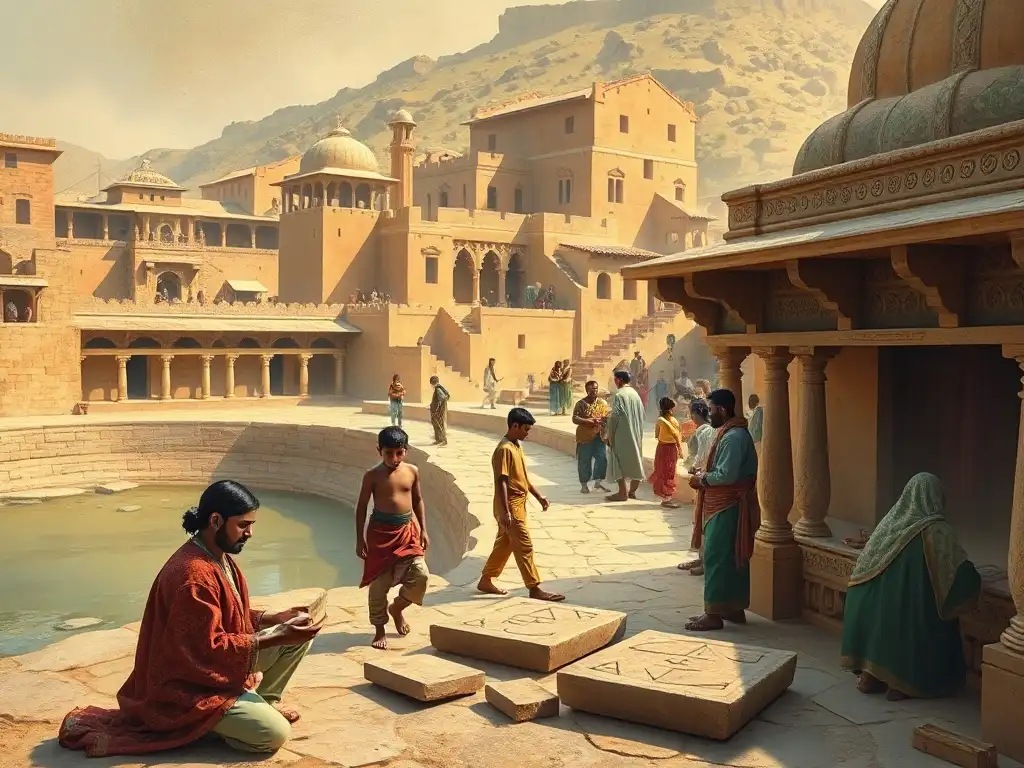
Introduction to Indus Valley Civilization
The Indus Valley Civilization, one of the world's oldest urban cultures, flourished around 2500 BCE in what is now Pakistan and northwest India. This civilization is renowned not only for its impressive cities such as Harappa and Mohenjo-Daro but also for its contributions to various fields, including early mathematics. The mathematical concepts developed during this era laid the groundwork for advanced calculations, trade, and urban planning, showcasing the intellectual prowess of its people. Understanding the Indus Valley early mathematics history offers crucial insights into the evolution of mathematical thought and its practical applications in ancient societies.
Overview of the Indus Valley Civilization
The Indus Valley Civilization extended over a vast area, covering approximately 1.25 million square kilometers. It was characterized by:
- Advanced Urban Planning: Cities were meticulously planned with grid layouts, sophisticated drainage systems, and standardized weights and measures.
- Trade Networks: The civilization engaged in extensive trade with neighboring regions, facilitating economic growth and cultural exchange.
- Agricultural Practices: The fertile plains of the Indus River supported agriculture, which was essential for sustaining the population and enabling trade.
Mathematics played a pivotal role in these aspects, providing the tools necessary for the administration and development of this complex society.
Significance of Early Mathematics in Ancient Cultures
Mathematics is often regarded as the language of science, and its origins can be traced back to ancient cultures, including the Indus Valley. The significance of early mathematics can be highlighted through:
- Measurement Techniques: Early civilizations relied on mathematics for land measurement, construction, and resource allocation.
- Trade Calculations: Accurate mathematical calculations were essential for trade, ensuring fair exchanges and the growth of commerce.
- Cultural Developments: Mathematical concepts influenced astronomy, agriculture, and architecture, showcasing the interconnectedness of knowledge in ancient cultures.
The developments in mathematics during the Indus Valley period not only reflect the sophistication of its society but also illustrate the foundational practices that would influence future civilizations.
The Role of Mathematics in Indus Valley Society
Mathematics was intricately woven into the fabric of daily life in the Indus Valley Civilization, impacting various aspects of society from trade to urban infrastructure.
Daily Life and Trade: Mathematical Applications
The application of mathematical concepts in daily life was evident in several areas:
- Weight and Measurement: Standardized weights were used in trade, suggesting a sophisticated understanding of measurement. Archaeological findings reveal stone weights that adhered to a binary system, indicating advanced mathematical principles.
- Accounting Systems: The use of seals and inscriptions for record-keeping showcases the need for arithmetic in managing resources and trade activities. This early accounting system highlights the importance of mathematics in economic transactions.
These practical applications underscore the necessity of mathematics for the functioning of the Indus Valley's economy and society.
Urban Planning and Geometry in the Indus Valley
The architectural brilliance of the Indus Valley Civilization can be attributed to its understanding of geometry and spatial organization:
- Grid City Layouts: The cities were planned on a grid system, demonstrating an advanced grasp of geometric principles. Streets were arranged at right angles, optimizing accessibility and traffic flow.
- Water Management Systems: Complex drainage and water supply systems were meticulously designed, requiring knowledge of geometry and hydraulics. This not only reflects mathematical ingenuity but also a commitment to public health and urban sustainability.
The role of mathematics in urban planning highlights the sophistication of the Indus Valley Civilization and its lasting influence on future societies.
By delving into the Indus Valley early mathematics history, we can appreciate the foundational concepts that contributed to the development of advanced mathematical practices in subsequent civilizations. The legacy of the Indus Valley in mathematics continues to resonate, illustrating the profound impact of ancient cultures on modern knowledge systems.
Key Mathematical Concepts Originating in the Indus Valley
The Indus Valley Civilization, flourishing from approximately 3300 to 1300 BCE, is renowned not just for its advanced urban planning and architecture but also for its significant contributions to early mathematics. The inhabitants of this civilization developed foundational mathematical concepts that laid the groundwork for later mathematical systems. Among these concepts, measurement, arithmetic, and geometry were particularly prominent, reflecting the civilization’s sophisticated understanding of numerical relationships.
Evidence suggests that the Indus Valley people utilized a decimal system, which is a pivotal advancement in mathematics. This system likely allowed for the efficient handling of trade, commerce, and construction projects, indicating a well-organized society with complex economic interactions. The mathematical practices of the Indus Valley have influenced subsequent civilizations, making their contributions integral to the history of mathematics.
Measurement Systems and Standardization
One of the most remarkable aspects of the Indus Valley Civilization is its early development of standardized measurement systems. Archaeological findings suggest that the people used precise units for measuring length, weight, and volume, enabling them to engage in trade and construction with remarkable accuracy.
- Length Measurement: The standard unit of length appears to have been based on a measurement of around 1.32 feet (approximately 40 cm), which was utilized in constructing urban infrastructure.
- Weight Measurement: The civilization employed weights made from stone, which were standardized to facilitate trade. This system likely included a range of weights for different commodities, suggesting a structured approach to commerce.
- Volume Measurement: Evidence of standardized measures for volume has also been found, indicating that the inhabitants of the Indus Valley had developed methods to quantify goods such as grains and liquids.
The adoption of these standard measurement systems not only facilitated economic transactions but also reflects a sophisticated understanding of mathematics as a tool for everyday life.
Early Evidence of Arithmetic and Geometry
In addition to measurement, the Indus Valley Civilization exhibited early evidence of arithmetic and geometry. The inhabitants demonstrated an understanding of basic arithmetic operations, including addition and subtraction, which were essential for trade and resource management.
- Arithmetic: Artefacts such as counting boards and tally marks found on seals suggest that arithmetic was used to keep records of trade transactions and inventory management. This early use of counting techniques indicates a developed numerical aptitude.
- Geometry: The planning of cities like Mohenjo-Daro and Harappa exhibits a clear understanding of geometric principles. The grid layout of these cities, with carefully plotted streets and buildings, showcases the application of geometry in urban design. Additionally, the use of right angles in construction signifies an early grasp of geometric concepts.
These mathematical practices not only highlight the advanced intellectual capabilities of the Indus Valley people but also serve as a precursor to more complex mathematical systems seen in later civilizations.
Archaeological discoveries continue to unveil the rich mathematical heritage of the Indus Valley Civilization. Several key findings provide insight into the mathematical practices of this ancient society, showcasing their innovative approaches to problem-solving and record-keeping.
Seals and Inscriptions: Mathematical Symbols
One of the most intriguing aspects of Indus Valley mathematics is the discovery of seals and inscriptions that feature various symbols, some of which may represent numerical values or mathematical concepts. These seals, often made from steatite, display intricate carvings, suggesting a formalized system of writing and record-keeping.
- Symbolic Representation: Certain seals exhibit symbols that could denote numerical values or specific quantities, indicating that the Indus Valley people may have employed a form of notation for mathematical concepts.
- Cultural Significance: The presence of these symbols on trade seals implies that mathematics played a role not only in everyday transactions but also in the broader cultural and economic systems of the civilization.
The study of these seals continues to provide valuable insights into the mathematical practices of the Indus Valley, highlighting the civilization's complexity and innovation.
Excavated Artifacts Illustrating Mathematical Usage
In addition to seals, numerous excavated artifacts provide evidence of mathematical usage in the Indus Valley. Items such as weights, measuring rods, and counting tools showcase the practical applications of mathematics in daily life.
- Weights and Balances: A variety of weights found in excavations indicates that the Indus Valley people engaged in sophisticated trade practices, using established weights for transactions. These artifacts reflect a developed understanding of mass and balance.
- Counting Tools: The discovery of clay tablets and other counting tools suggests that the inhabitants used these items to facilitate counting and record-keeping. This practical application of mathematics highlights the importance of numerical literacy in their society.
These artifacts not only serve as valuable historical evidence but also demonstrate the integral role of mathematics in the functioning of the Indus Valley Civilization, revealing a society that was both advanced and deeply engaged with mathematical concepts.
Influence of Indus Valley Mathematics on Subsequent Civilizations

The mathematical achievements of the Indus Valley Civilization (IVC), which flourished between 3300 and 1300 BCE, laid foundational concepts that significantly influenced later civilizations. The IVC was characterized by its advanced urban planning, trade networks, and intricate social structures, which necessitated the development of mathematical techniques for various practical applications, such as surveying land and managing trade. Evidence suggests that the Indus people utilized a decimal system and had a grasp of geometric principles, which were critical for architectural and infrastructural advancements.
Notably, the standardized weights and measures discovered at sites like Mohenjo-Daro demonstrate a sophisticated understanding of proportionality and measurement. This mathematical framework not only facilitated trade and commerce within the region but also served as a reference point for subsequent cultures, including the Vedic civilization that followed.
Connection to Ancient Indian Mathematics
The mathematical concepts originating from the Indus Valley directly contributed to the evolution of ancient Indian mathematics. The Vedic texts, composed around 1500 BCE, reflect a continuation of the mathematical practices established during the IVC. The decimal system, which is a core component of modern mathematics, can be traced back to the practices of the Indus Valley, suggesting that these early mathematicians employed similar numerical systems.
Moreover, the use of geometry for land measurement, evident in the layout of Indus cities, can be seen in later Vedic and classical texts. The systematic approach to mathematics found in the Sulbasutras, ancient Indian texts on geometry, echoes the mathematical ingenuity of the Indus Valley Civilization. This connection exemplifies how early mathematical principles transcended regional boundaries and influenced subsequent generations of mathematicians in India.
The Legacy of Indus Valley Concepts in Later Cultures
The legacy of the Indus Valley’s mathematical concepts extended beyond ancient India, impacting neighboring civilizations such as Mesopotamia and Persia. Trade routes established by the IVC facilitated cultural exchange, allowing mathematical knowledge to spread across regions. The use of standardized weights and measures likely influenced the economic practices of neighboring cultures, as mathematical precision became essential for trade and resource management.
Furthermore, the geometric principles developed during the Indus Valley period informed architectural practices in later cultures. The emphasis on symmetry and proportion in construction can be traced back to the advanced urban planning of the Indus Valley. This architectural heritage laid the groundwork for future civilizations, blending mathematics with artistry in a way that continues to resonate throughout history.
Conclusion: The Impact of Indus Valley on the History of Mathematics
The Indus Valley Civilization stands as a pivotal chapter in the history of mathematics, marking the emergence of systematic numerical concepts and practical applications. Its influence can be seen in various aspects of mathematics and culture in the Indian subcontinent and beyond.
Summary of Contributions to Early Mathematics
The contributions of the Indus Valley to early mathematics include the development of a decimal system, standardized measurements, and geometric principles. These foundational elements not only facilitated daily life in the IVC but also set a precedent for the mathematical advancements that followed in India and neighboring regions. The sophisticated understanding of mathematics during this era underscores the civilization's significant role in shaping the intellectual landscape of ancient cultures.
The Continuing Relevance of Indus Valley Mathematical Concepts
The mathematical concepts developed in the Indus Valley remain relevant today, influencing modern mathematics and its applications. The principles of measurement and geometry established during this time laid the groundwork for contemporary fields such as architecture, engineering, and economics. As scholars continue to explore the rich history of mathematics, the Indus Valley Civilization serves as a vital reminder of the interconnectedness of cultural heritage and intellectual progress in shaping our understanding of mathematics through the ages.
Further Reading on Indus Valley and Early Mathematics
To delve deeper into the fascinating world of early mathematics in the Indus Valley, several resources offer detailed insights into the mathematical concepts, practices, and their significance in ancient India. These readings will enhance your understanding of how the Indus Valley civilization laid the groundwork for future mathematical advancements.
Recommended Books and Articles
-
"Mathematics in Ancient India" by Kim Plofker
This comprehensive book explores the evolution of mathematical concepts in ancient India, including the contributions of the Indus Valley civilization. Plofker meticulously details the mathematical practices evident in archaeological findings and historical texts.
-
"The Indus Valley Civilization: A Historical Overview" by Jonathan Mark Kenoyer
This book provides a broad overview of the Indus Valley civilization, with specific chapters dedicated to the technological and mathematical innovations that characterized this ancient society. Kenoyer's work is crucial for understanding the context in which early mathematics flourished.
-
"The History of Mathematics: A Brief Course" by Roger L. Cooke
Cooke's work includes sections that highlight the contributions of various civilizations, including the Indus Valley, to the development of mathematical concepts. This book is beneficial for those seeking a comparative perspective.
-
"Ancient Indian Mathematics: A Comprehensive Study" by S. R. Sarma
This article provides a detailed analysis of mathematical techniques and principles used during the Indus Valley period, including their application in trade and engineering.
-
"The Mathematics of the Indus Valley Civilization" - Journal of Asian Studies
This peer-reviewed article examines the archaeological evidence of mathematical practices in the Indus Valley, discussing the implications of these findings for our understanding of early mathematical history.
Notable Researchers in Indus Valley Mathematics History
-
Kim Plofker
A renowned mathematician and historian, Plofker's research focuses on the development of mathematics in ancient India. Her work on the Indus Valley provides invaluable insights into the early mathematical concepts that emerged from this civilization.
-
Jonathan Mark Kenoyer
An esteemed archaeologist, Kenoyer's extensive research on the Indus Valley civilization includes studies on urban planning, trade, and technological advancements, emphasizing the role of mathematics in these areas.
-
S. R. Sarma
As a prominent scholar in the field of ancient Indian mathematics, Sarma has authored numerous articles exploring the mathematical techniques used in the Indus Valley, contributing significantly to the understanding of this subject.
-
C. J. Date
Date's investigations into ancient Indian scripts and inscriptions have revealed crucial information about the mathematical practices of the Indus Valley civilization. His interdisciplinary approach combines linguistics and mathematics to provide a holistic view of the region's contributions.
Through these recommended readings and notable researchers, you'll gain a richer perspective on the significance of early mathematics in the Indus Valley and its lasting impact on the history of mathematics.
- Introduction to Indus Valley Civilization
- The Role of Mathematics in Indus Valley Society
- Key Mathematical Concepts Originating in the Indus Valley
- Archaeological Discoveries Related to Indus Valley Mathematics
- Influence of Indus Valley Mathematics on Subsequent Civilizations
- Conclusion: The Impact of Indus Valley on the History of Mathematics
- Further Reading on Indus Valley and Early Mathematics
- What was the significance of the Indus Valley civilization in early mathematics?
- How did the Indus Valley influence later mathematical developments?
- What are some examples of mathematical artifacts found in the Indus Valley?
- How did the Gupta Empire build upon early mathematical concepts from the Indus Valley?
- What role did trade play in the development of early mathematics in the Indus Valley?
Frequently Asked Questions
What was the significance of the Indus Valley civilization in early mathematics?
The Indus Valley civilization is considered one of the earliest centers of mathematical thought, contributing to concepts like geometry and measurement which were essential for trade and urban planning.
How did the Indus Valley influence later mathematical developments?
The mathematical advancements made during the Indus Valley period laid the groundwork for subsequent civilizations, influencing geometry, arithmetic, and the use of standardized weights.
What are some examples of mathematical artifacts found in the Indus Valley?
Artifacts such as measuring tools, weights, and seals with geometric patterns provide evidence of the advanced mathematical skills of the Indus Valley inhabitants.
How did the Gupta Empire build upon early mathematical concepts from the Indus Valley?
The Gupta Empire further developed mathematical concepts established by the Indus Valley, leading to innovations like the decimal system and the concept of zero.
What role did trade play in the development of early mathematics in the Indus Valley?
Trade necessitated the need for accurate measurements and calculations, which spurred the development of early mathematical concepts among the Indus Valley merchants and craftsmen.
Final Reflection: The Enduring Legacy of Indus Valley Early Mathematics
The Indus Valley civilization's contributions to early mathematics are not just historical footnotes; they are foundational elements that continue to shape our understanding of mathematics today. As we delve into the intricate systems of measurement, trade, and urban planning that emerged from this ancient society, we recognize that these early mathematical concepts laid the groundwork for future innovations and discoveries. The brilliance of the Indus Valley people reminds us that the pursuit of knowledge is a timeless endeavor, echoing through the ages.
Culture and society are deeply intertwined with the evolution of mathematical thought, and the Indus Valley civilization serves as a poignant example of this relationship. The sophisticated methods of calculation and record-keeping developed by the Indus Valley people not only facilitated trade and governance but also fostered a sense of community and collaboration. Mathematics is the language in which God has written the universe.
– Galileo Galilei. This quote encapsulates the idea that the mathematical principles established by early civilizations like the Indus Valley are universal truths that transcend time and culture, influencing societies long after their decline.
As we reflect on the lessons from the Indus Valley's early mathematics, let us consider how these ancient concepts can inspire our own lives today. I invite you to explore the mathematical patterns in your surroundings, to appreciate the beauty of numbers, and to recognize the interconnectedness of knowledge across cultures and eras. By embracing the legacy of the Indus Valley, we can cultivate a deeper understanding of mathematics and its vital role in our world, encouraging future generations to continue this journey of discovery and innovation.
Unlock the Mysteries of Ancient Mathematics!
Thank you for exploring the fascinating world of the Indus Valley and its early mathematical concepts. Your interest in this rich history not only deepens your knowledge but also highlights the importance of mathematics in shaping civilizations. Now, take the next step to harness the insights you've gained!
- Dive deeper into the numbers: Explore more on this topic by researching the mathematical artifacts discovered in the Indus Valley. Understanding their significance can inspire modern applications!
- Share your newfound knowledge: Engage with friends or social media communities by sharing what you've learned. A simple post or conversation could inspire others to appreciate the roots of mathematics!
- Join a discussion group: Seek out online forums or local clubs focused on ancient history and mathematics. Connecting with others can lead to enriching discussions and exchanges of ideas!
What aspect of ancient mathematics inspires you the most, and how do you think it shapes our understanding of modern mathematics?