
The Influence of Buddhist Kings: Key Figures Who Supported the Faith


Welcome to Ancient India History, where we embark on a journey through the vibrant tapestry of India's past. Dive into the captivating world of Buddhist kings in ancient India, whose reigns not only shaped the political landscape but also profoundly influenced the spread of Buddhism across the subcontinent. In our featured article, The Influence of Buddhist Kings: Key Figures Who Supported the Faith, we uncover the stories of these remarkable leaders and their enduring legacy.
Prepare to be intrigued as we reveal how their patronage transformed spiritual practices and cultural developments, inviting you to explore the rich heritage that continues to inspire today. Join us on this enlightening adventure!
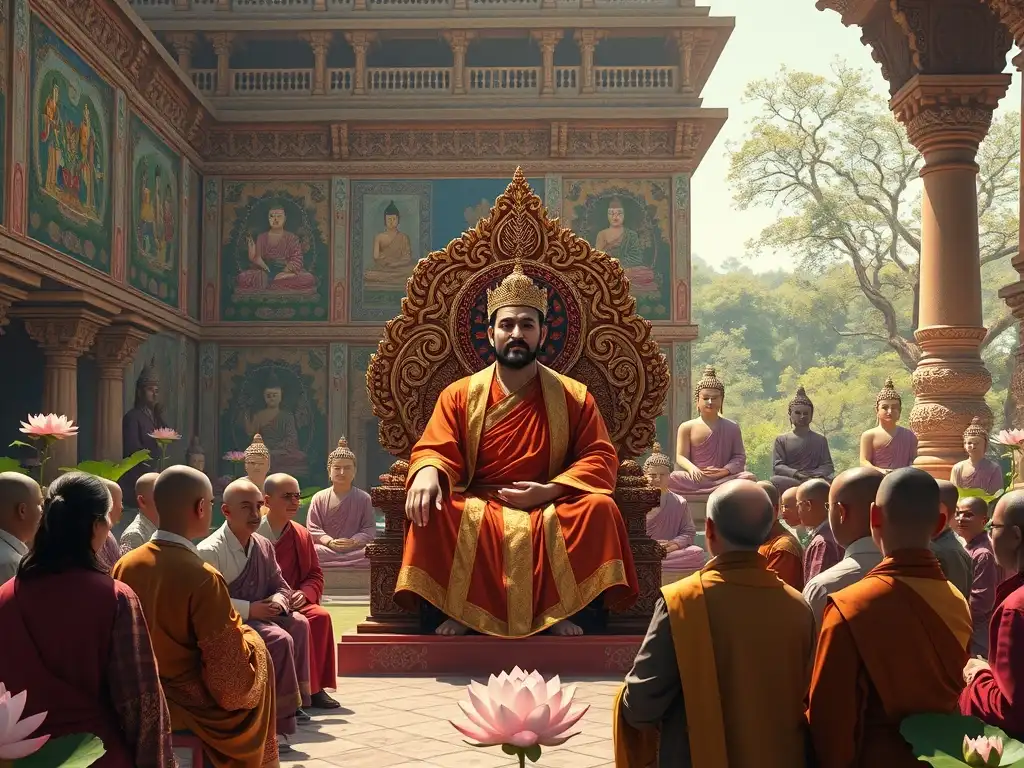
Introduction to Buddhist Kings in Ancient India
The history of ancient India is profoundly intertwined with the rise and spread of Buddhism, a faith that emerged in the 6th century BCE. Buddhist kings in ancient India played a pivotal role in this narrative, serving not only as protectors of the faith but also as influential figures who facilitated its growth through various means.
Their patronage was crucial in shaping the religious landscape, promoting Buddhist teachings and values across vast territories. This article delves into the significant contributions of these royal figures, exploring their impact on Buddhism and the intricate relationship between kingship and spirituality in ancient Indian society.
Overview of Buddhism’s Rise in Ancient India
Buddhism began with the teachings of Siddhartha Gautama, known as the Buddha, who rejected the prevailing Vedic traditions and proposed a path of enlightenment through the Four Noble Truths and the Eightfold Path. As his followers spread across the Indian subcontinent, the faith gained momentum, particularly during the period of the Maurya Empire. By the 3rd century BCE, Buddhism had established itself as a major religious force, appealing to diverse communities through its emphasis on compassion, ethical conduct, and the pursuit of knowledge.
- Key Milestones in Buddhism’s Growth:
- The First Buddhist Council (circa 483 BCE): Consolidation of Buddha’s teachings.
- Emperor Ashoka's Edicts (circa 250 BCE): Promotion and spread of Buddhism through inscriptions across his empire.
Importance of Royal Patronage in Buddhism
Royal patronage proved vital to the expansion of Buddhism, as it provided the necessary resources for the construction of monasteries, stupas, and educational institutions. Kings who embraced Buddhism often enacted policies that favored the faith, ensuring its integration into the cultural fabric of their realms. This support not only helped to legitimize Buddhism as a state religion but also attracted scholars and practitioners, fostering an environment conducive to philosophical discourse and spiritual growth.
Characteristics of Buddhist Kings in Ancient India
Buddhist kings were distinguished by their commitment to the principles of Buddhism, which influenced their governance and public life. Their reigns were characterized by a unique blend of political acumen and spiritual devotion.
Role of Kingship in Promoting Buddhism
The role of a king in ancient India transcended mere governance; it was often viewed as a divine mandate. Buddhist kings utilized their status to advocate for the faith, organizing and financing the construction of religious sites, supporting the monastic community, and sponsoring missionary activities. This engagement not only elevated their status among the followers of Buddhism but also encouraged the populace to adopt Buddhist practices.
- Notable Examples of Buddhist Kings:
- Ashoka the Great: His conversion to Buddhism and subsequent efforts to spread its teachings are legendary. He sent missionaries to distant lands and established numerous stupas.
- Kanishka the Great: Known for his role in the Kushan Empire, he supported the growth of Mahayana Buddhism and convened the Fourth Buddhist Council.
Integration of Buddhist Principles in Governance
Buddhist kings often incorporated the ethical teachings of Buddhism into their governance strategies. They emphasized virtues such as non-violence, compassion, and justice, which resonated with the populace and contributed to a more harmonious society. By aligning their rule with Buddhist ideals, these kings not only enhanced their legitimacy but also fostered a sense of unity among diverse communities.
The influence of Buddhist kings in ancient India was significant in shaping the trajectory of Buddhism, demonstrating how royal support could enhance the reach and impact of a faith that continues to resonate across the globe. Through their actions, these kings not only upheld their spiritual beliefs but also transformed the sociopolitical landscape of ancient India.
Key Figures: Notable Buddhist Kings
Throughout the history of ancient India, several kings played a pivotal role in the promotion and establishment of Buddhism as a significant religious force. These rulers not only supported the faith through their patronage but also contributed to the cultural and social landscape of their time. Their influence extended beyond mere political power; they were instrumental in the construction of monasteries, the dissemination of Buddhist teachings, and the integration of Buddhism into the fabric of society. Below are some of the most notable Buddhist kings whose impact resonates even today.
Ashoka the Great: The Most Influential Buddhist King
Ashoka, who reigned from 268 to 232 BCE, is often regarded as the most influential Buddhist king in ancient India. Following the brutal Kalinga War, Ashoka experienced a profound transformation that led him to embrace Buddhism wholeheartedly. His reign marked a significant shift in the Indian political landscape, where he adopted the principles of Dhamma (righteousness) as a guiding philosophy.
Ashoka's contributions to Buddhism are monumental. He established numerous stupas and monasteries, most notably the famous Sanchi Stupa, which became a significant pilgrimage site. Moreover, he sent missionaries across Asia, including to regions like Sri Lanka and Central Asia, facilitating the spread of Buddhism beyond India’s borders. The Edicts of Ashoka, inscribed on rocks and pillars, communicate his commitment to non-violence, moral governance, and the promotion of Buddhist values, making him a key figure in the global history of Buddhism.
Kanishka: The Emperor of the Kushan Dynasty
Kanishka, who ruled during the 1st and 2nd centuries CE, is another prominent figure in the annals of Buddhist kingship. As the emperor of the Kushan Dynasty, his reign was characterized by a flourishing of trade and cultural exchange, which facilitated the spread of Buddhism across the Silk Road. Kanishka is often credited with convening the Fourth Buddhist Council, which played a crucial role in the development of Mahayana Buddhism.
His patronage of the faith is evidenced by the construction of magnificent stupas, including the famed Kanishka Stupa in Peshawar, which served as a center for Buddhist learning and pilgrimage. Kanishka's rule marked a significant era where art and culture thrived, with Buddhist iconography and texts enjoying significant patronage. This period saw the fusion of Hellenistic and Indian styles, which enriched Buddhist art and contributed to the faith's aesthetic evolution.
Harshavardhana: The Patron of Learning and Religion
Harshavardhana, who ruled North India in the 7th century CE, is another notable Buddhist king who significantly influenced the religious landscape of his time. His reign was marked by a strong patronage of Buddhism, alongside a respect for Hindu traditions, showcasing a remarkable pluralism in religious practices.
Harsha is known for organizing large religious assemblies, including the famous Kumbha Mela, which brought together followers of various faiths. His court was a hub of learning and culture, attracting scholars and poets, including the renowned Chinese traveler Xuanzang. Harsha's support for Buddhist monasteries and scholars not only promoted the faith but also fostered a spirit of intellectual inquiry and cultural exchange that enriched the Indian subcontinent.
Regional Variations in Buddhist Kingship
The influence of Buddhism in ancient India varied significantly across different regions, leading to unique expressions of kingship and religious patronage. While some dynasties embraced Buddhism wholeheartedly, others exhibited a more complex relationship with the faith, integrating it into a broader religious framework that included Hinduism and other local beliefs.
Southern Indian Dynasties and Their Buddhist Influence
In Southern India, several dynasties, such as the Pallavas and the Cholas, displayed a noteworthy engagement with Buddhism. The Pallavas, in particular, were known for their support of Buddhist monastic institutions and the construction of rock-cut temples, like those found in Mahabalipuram. These temples served both as places of worship and centers of learning, contributing to the Buddhist discourse in the region.
The Cholas, while predominantly Hindu, also recognized the significance of Buddhism and maintained ties with Buddhist communities. This coexistence fostered a unique cultural milieu where Buddhist art and architecture flourished alongside Hindu traditions. The influence of Southern Indian dynasties showcases the adaptability of Buddhism and its capacity to coexist with other faiths in a vibrant religious landscape.
The Gupta Empire: A Complex Relationship with Buddhism
The Gupta Empire, which thrived from the 4th to the 6th centuries CE, presents a complex relationship with Buddhism. While the Guptas are often associated with a revival of Hinduism, they also patronized Buddhist institutions. Notable kings like Chandragupta II and Kumaragupta I supported Buddhist monasteries and contributed to the construction of significant stupas and temples.
However, the prevailing ethos of the Gupta period leaned towards Hinduism, leading to a gradual decline in Buddhist prominence. This shift reflected broader societal changes and the increasing consolidation of Hindu practices. Despite this, the Guptas' contributions to Buddhist art, particularly in the form of exquisite sculptures and manuscripts, remain invaluable to the heritage of ancient Indian Buddhism. This duality in patronage illustrates the dynamic interplay between Buddhism and Hinduism during a transformative period in Indian history.
The Legacy of Buddhist Kings in Ancient India
The legacy of Buddhist kings in ancient India is profound and multifaceted, shaping not only the landscape of religion but also the socio-political fabric of the time. Prominent figures such as Ashoka the Great, who reigned during the 3rd century BCE, played a pivotal role in establishing Buddhism as a dominant faith across the subcontinent. His conversion to Buddhism after the Kalinga War marked a significant turning point, leading to the propagation of Buddhist principles of non-violence, compassion, and ethical governance.
Buddhist kings, through their patronage, contributed immensely to the construction of stupas, monasteries, and educational institutions, which served as vital centers for the spread of Buddhist teachings. The inscriptions left by these monarchs, particularly those of Ashoka, provide crucial insights into the moral and ethical directives that guided their rule. Furthermore, the support from royal figures helped elevate Buddhism from a relatively localized faith to a major world religion, influencing various cultures and societies beyond India.
Lasting Impact on Indian Culture and Society
The impact of Buddhist kings on Indian culture and society is enduring. Their support fostered a climate of religious tolerance, allowing various belief systems to coexist. This environment encouraged intellectual pursuits, artistic expressions, and philosophical discussions, all of which flourished under the aegis of Buddhist kings.
The architectural contributions of these monarchs, particularly in the form of stupas and rock-cut caves, have left a lasting imprint on Indian heritage. Sites like Sanchi and Ajanta, constructed during the reign of Buddhist kings, are not only architectural wonders but also repositories of ancient art and culture. The intricate carvings and frescoes found in these sites narrate stories from the Jataka tales and other Buddhist scriptures, reflecting the rich tapestry of thought and creativity inspired by the faith.
Moreover, the promotion of education and literacy during this period helped in the dissemination of Buddhist texts, making them accessible to a broader audience. The establishment of monastic universities, such as Nalanda and Vikramashila, attracted scholars from various regions, further solidifying Buddhism's intellectual legacy in India.
The Role of Buddhist Kings in the Dissemination of Buddhism Beyond India
Buddhist kings were instrumental in the dissemination of Buddhism beyond the Indian subcontinent. Their diplomatic and trade relationships with neighboring regions, such as Southeast Asia, Central Asia, and even parts of the Mediterranean, facilitated the spread of Buddhist teachings and practices. Ashoka, in particular, is noted for sending missionaries to regions like Sri Lanka, where he established a firm foothold for Buddhism.
The establishment of trade routes, such as the Silk Road, also played a crucial role in the transmission of Buddhist ideas. Monks and traders traveled along these routes, sharing not only goods but also cultural and religious exchanges. As a result, Buddhism began to flourish in various forms across different cultures, adapting to local traditions while retaining its core teachings.
Additionally, the patronage of Buddhist kings in these regions led to the construction of temples and monasteries, which became hubs of religious activity and cultural dialogue. The influence of Indian art and philosophy can still be seen in the Buddhist practices and artistic expressions of countries like Thailand, Myanmar, and Japan, illustrating the far-reaching effects of royal support in ancient India.
Conclusion: The Enduring Influence of Buddhist Kings
The enduring influence of Buddhist kings in ancient India is a testament to their critical role in shaping the religious landscape of the time. Their legacy continues to resonate, not just within the context of Buddhism, but also in the broader spectrum of Indian history and culture.
Reflection on the Importance of Royal Support in Religious Development
The support of royal figures was paramount in the development and proliferation of Buddhism as a major religious force. Without the patronage of powerful kings, the faith may not have achieved the widespread recognition and acceptance it enjoys today. The interplay between politics and religion during this period illustrates how royal endorsement can catalyze significant cultural and spiritual movements.
This relationship between kingship and religion is a recurring theme throughout history, showcasing the potential for leaders to influence societal norms and values. The Buddhist kings of ancient India set a precedent for future rulers, emphasizing the importance of compassionate governance and ethical leadership.
The Continuing Relevance of Buddhist Kings in Modern Discussions on Religion and Politics
In contemporary discussions on religion and politics, the examples set by Buddhist kings offer valuable insights. Their approach to governance—characterized by principles of non-violence, tolerance, and social welfare—remains relevant in addressing modern issues such as communal harmony, ethical leadership, and interfaith dialogue.
Moreover, the historical narrative of Buddhist kings can serve as a framework for understanding the complexities of religion in the political sphere today. As societies grapple with the challenges of pluralism and cultural diversity, the lessons learned from the legacy of Buddhist kings in ancient India can guide current and future leaders in fostering a more inclusive and peaceful world.
- Introduction to Buddhist Kings in Ancient India
- Characteristics of Buddhist Kings in Ancient India
- Key Figures: Notable Buddhist Kings
- Regional Variations in Buddhist Kingship
- The Legacy of Buddhist Kings in Ancient India
- Conclusion: The Enduring Influence of Buddhist Kings
Frequently Asked Questions
What role did Buddhist kings play in ancient India?
Buddhist kings were instrumental in promoting and spreading Buddhism throughout ancient India, often supporting the construction of monasteries and stupas, and sponsoring Buddhist teachings.
Who were some key Buddhist kings in ancient India?
Notable Buddhist kings include Ashoka the Great, known for his vast support of Buddhism and the Edicts of Ashoka, which promoted moral governance and religious tolerance.
How did Buddhist kings influence Indian culture?
These kings greatly influenced Indian culture by integrating Buddhist principles into governance and promoting art and architecture that reflected Buddhist themes, leading to a rich cultural heritage.
What were the contributions of Buddhist kings to society?
Buddhist kings contributed to society by establishing hospitals, rest houses, and educational institutions, which facilitated the welfare of their people and the spread of Buddhist teachings.
How did the reign of Buddhist kings impact the political landscape of ancient India?
The reign of Buddhist kings often led to the unification of various regions under a common religious framework, promoting peace and stability, which allowed for economic and cultural development.
Final Reflection: The Enduring Legacy of Buddhist Kings in Ancient India
The influence of Buddhist kings in ancient India remains profoundly relevant today, as their commitment to the faith shaped not only the spiritual landscape of their time but also laid the groundwork for cultural and ethical values that resonate in modern society. The dedication of these rulers to Buddhism exemplifies how leadership can transcend mere governance, fostering a legacy of compassion, wisdom, and social responsibility that continues to inspire contemporary leaders and communities alike.
The impact of these Buddhist kings extends far beyond their reigns, as their patronage of the faith helped to weave Buddhism into the very fabric of Indian culture and society. Their contributions not only facilitated the spread of Buddhist teachings but also encouraged a spirit of inquiry and dialogue that enriched the intellectual landscape of their era. The greatest gift is not what we receive, but what we give to others.
This sentiment encapsulates the essence of the Buddhist kings' legacy, reminding us of the importance of altruism and the nurturing of community bonds.
As we reflect on the lessons imparted by these remarkable figures, let us consider how we can embody the values they championed in our own lives. Take a moment to contemplate how you can contribute to the well-being of those around you, fostering compassion and understanding in your community. By embracing the principles of kindness and social responsibility, we can honor the legacy of the Buddhist kings and ensure that their teachings continue to inspire future generations.
Embrace the Legacy: Connect with Buddhist Wisdom Today!
Thank you for exploring the pivotal role of Buddhist kings in shaping the history of faith and culture. You've uncovered the fascinating interplay between leadership and spirituality; now it’s time to take actionable steps towards deepening your connection to this rich legacy.
- Immerse yourself in Buddhist teachings: **Read a book or listen to a podcast** about Buddhism and its impact on society to further appreciate its modern relevance.
- Visit a local temple or meditation center to engage with the practices and philosophies firsthand, enriching your understanding of this ancient faith.
- Share your insights! Join a local community or online forum to discuss your thoughts on how these historical figures continue to inspire us today.
How do you envision incorporating the teachings of these influential Buddhist kings into your own life or community?