
Ancient Indian Legal Practices: From Theory to Everyday Life


Welcome to Ancient India History, where we embark on a fascinating journey through time to uncover the rich tapestry of ancient Indian legal practices. Did you know that the legal systems of ancient India were not just theoretical constructs but were deeply woven into the fabric of everyday life? From the sophisticated codes of the Indus Valley to the philosophical foundations laid during the Gupta Empire, these practices shaped societal norms and governance.
Prepare to delve into the intriguing world of law and order in ancient civilizations, and discover how these early legal frameworks continue to influence modern society. Join us as we unravel the complexities of ancient Indian law, and ignite your curiosity about the past!
- Introduction to Ancient Indian Legal Practices
- Historical Context of Ancient Indian Legal Practices
- Key Ancient Indian Legal Texts
- Core Principles of Ancient Indian Legal Practices
- Application of Legal Practices in Everyday Life
- The Influence of Ancient Indian Legal Practices on Modern Law
- Conclusion: The Legacy of Ancient Indian Legal Practices
- Frequently Asked Questions
- Final Reflection: The Enduring Legacy of Ancient Indian Legal Practices
- Uncover the Wisdom of Ancient Legal Practices Today!
Introduction to Ancient Indian Legal Practices
The legal practices of ancient India form a foundational aspect of the subcontinent's rich tapestry of history and culture. From the sophisticated legal frameworks established during the Indus Valley Civilization to the comprehensive codes outlined in texts like the Manu Smriti, these practices were not merely theoretical constructs but integral to the everyday lives of ancient Indians. Legal systems served to maintain order, resolve disputes, and uphold societal norms, reflecting the values and beliefs of the time.
This article delves into the evolution of ancient Indian legal practices, examining their theoretical underpinnings and their practical applications in daily life. By exploring these elements, we can gain insight into how ancient Indian societies navigated complex social interactions and maintained justice in their communities.
Overview of Ancient Indian Legal Systems
Ancient Indian legal systems were characterized by a rich diversity of codes and practices that evolved over centuries. Central to these systems were texts known as Dharma Shastras, which provided comprehensive guidelines on law, ethics, and morality.
Key features of these systems include:
- Codification of Laws: The ancient legal texts codified various aspects of law, covering civil, criminal, and family matters.
- Judicial Authority: Local chiefs and rulers often acted as judges, interpreting the texts and applying the laws to specific cases.
- Religious Influence: Many laws were intertwined with religious beliefs, emphasizing the moral and spiritual dimensions of legal obligations.
Some of the most significant texts include:
| Legal Text | Author/Period | Key Contributions |
|---|---|---|
| Manu Smriti | Manu (c. 200 BCE) | Outlined caste duties, family law, and ethical conduct. |
| Yajnavalkya Smriti | Yajnavalkya (c. 400 CE) | Addressed property rights and procedural law. |
| Narada Smriti | Narada (c. 500 CE) | Focused on criminal law and judicial procedures. |
These texts not only served as legal manuals but also as reflections of the socio-political climate of their times.
Importance of Legal Practices in Ancient Indian Society
Legal practices in ancient India were essential for maintaining social order and ensuring justice. They played a pivotal role in:
- Conflict Resolution: Legal systems provided mechanisms for dispute resolution, helping to avert violence and maintain social harmony.
- Social Structure: The laws often reinforced social hierarchies and roles, particularly concerning caste and gender, influencing everyday life and interactions.
- Cultural Continuity: Legal traditions contributed to the cultural identity of various communities, reflecting their values and beliefs across generations.
The integration of legal practices into the fabric of society highlights their significance not just as rules, but as vital components that shaped the way ancient Indians lived, interacted, and understood justice. The legacy of these practices continues to influence contemporary legal systems in India, making the study of ancient Indian legal practices both relevant and essential.
Historical Context of Ancient Indian Legal Practices

Evolution of Legal Thought in Ancient India
The evolution of legal thought in ancient India is a profound journey that reflects the changing socio-cultural landscape of the subcontinent. From the early communal norms to codified laws, ancient Indian legal practices evolved in response to the diverse needs of society. The foundation of these practices can be traced back to various texts, oral traditions, and customs that governed daily life.
- Codification and Tradition:
- The Manu Smriti, one of the earliest and most significant legal texts, emerged around 100 CE and provided a comprehensive framework for laws governing various aspects of life, including family, property, and criminal justice. It served as a guide that combined religious and secular laws.
- Other important texts include the Yajnavalkya Smriti and Narada Smriti, which further developed legal concepts and principles.
- Influence of Religion:
- Legal thought in ancient India was heavily influenced by religious doctrines. The concept of Dharma (moral law) played a crucial role in shaping legal practices, where laws were not just seen as societal rules but as divine commands.
- Courts were often presided over by religious leaders who had the authority to interpret laws according to religious texts.
- Local Variations:
- Ancient Indian legal practices were not monolithic; they varied significantly across regions. Local customs and practices were often integrated into the broader legal framework, allowing for a degree of flexibility in legal interpretations.
- This regional diversity is reflected in the different versions of the Dharmashastras, which adapted to local customs and conditions.
Influential Civilizations and Their Legal Contributions
The rich tapestry of ancient Indian civilizations contributed significantly to the development of legal practices. Each civilization left an indelible mark on the legal landscape, shaping its evolution over centuries.
The Indus Valley Civilization and Its Legal Framework
The Indus Valley Civilization (circa 3300–1300 BCE) is one of the earliest urban cultures in the world, and its legal framework laid the groundwork for the evolution of law in ancient India.
- Urban Planning and Regulation: The cities of Harappa and Mohenjo-Daro were meticulously planned, indicating a sophisticated understanding of urban governance. The existence of standardized weights and measures suggests a system of trade regulation.
- Seal Inscriptions: Archaeological findings, such as seals with inscriptions, point towards the existence of a legal system that governed transactions and social conduct. Although the script remains undeciphered, the seals likely served as a means of authenticating goods and establishing ownership.
- Social Hierarchy: Evidence suggests that a hierarchical society existed, with regulations likely governing social interactions and responsibilities, although specifics remain obscure due to limited textual evidence.
The Vedic Period and the Emergence of Dharmashastras
The Vedic period (circa 1500–500 BCE) marked a significant evolution in ancient Indian legal practices, particularly with the emergence of the Dharmashastras.
- Philosophical Underpinnings: The texts of this period, including the Rigveda and Atharvaveda, introduced concepts of Rta (cosmic order) and Dharma, which became central to legal thought. Law was seen as a reflection of the moral order of the universe.
- Emergence of Codified Laws: The Dharmashastras formalized rules and regulations governing various aspects of life, including marriage, inheritance, and social duties. The Manu Smriti is particularly noteworthy for its detailed prescriptions on social conduct and legal responsibilities.
- Judicial Procedures: The Vedic texts also hint at the existence of judicial procedures, with references to panchayats (village councils) that adjudicated disputes. This indicates an organized approach to justice, relying on local customs and community involvement.
Ancient Indian legal practices evolved through a complex interplay of cultural, religious, and social influences. The contributions of the Indus Valley Civilization and the Vedic period played essential roles in shaping a legal framework that would influence subsequent generations. As we delve deeper into these practices, it becomes clear that law in ancient India was not merely a system of rules; it was a reflection of the society's values and ethical principles.
Key Ancient Indian Legal Texts
Manu Smriti: The Foundation of Ancient Indian Law
The Manu Smriti, also known as the Manusmriti, stands as one of the most significant legal texts in ancient India. Compiled around the 2nd century BCE to the 2nd century CE, it serves as a comprehensive guide to dharma (moral law), reflecting the societal norms, values, and legal practices of the time. As a cornerstone of ancient Indian legal practices, the Manu Smriti established a framework that influenced various aspects of life, including social organization, family law, and criminal justice.
Structure and Content of Manu Smriti
The Manu Smriti is divided into twelve books, each addressing different facets of law and society. The structure is systematic, making it a vital reference for understanding ancient Indian legal practices.
- Books Overview:
- Book 1: Introduction to the concept of dharma and the role of the king.
- Book 2: Duties of individuals, including different castes and genders.
- Book 3: Laws pertaining to marriage, family, and inheritance.
- Book 4: Practices regarding penance and punishment.
- Book 5: Regulations regarding trade and commerce.
- Books 6-12: Detailed discussions on various social, economic, and legal issues.
The text not only outlines laws but also integrates philosophical reflections on justice, morality, and the ideal conduct of individuals within society.
Key Legal Principles in Manu Smriti
The Manu Smriti introduces several key legal principles that have far-reaching implications in ancient Indian legal practices:
- Varna System: The text categorizes society into four varnas (classes) – Brahmins, Kshatriyas, Vaishyas, and Shudras – each with specific duties and rights, which shaped social hierarchy and legal responsibilities.
- Dharma: Central to the Manu Smriti is the concept of dharma, which encompasses duty, righteousness, and the moral law guiding individuals in their actions.
- Punishments and Retributions: The text prescribes specific penalties for various offenses, emphasizing the importance of justice and societal order. For instance, theft might incur a loss of limb, while wrongful actions against Brahmins could lead to severe consequences.
- Gender Roles: The Manu Smriti delineates distinct roles for men and women, establishing legal norms around marriage, divorce, and property rights that reflect the gender dynamics of the time.
These principles not only governed individual behavior but also provided a legal framework that influenced subsequent texts and practices in ancient Indian society.
Other Significant Legal Texts
In addition to the Manu Smriti, several other ancient legal texts played important roles in shaping legal thought and practices in India. These texts contributed to the development of a diverse legal landscape, addressing various aspects of life and law.
Yajnavalkya Smriti and Its Contributions
The Yajnavalkya Smriti is another crucial legal text, believed to have been composed in the 3rd century CE. It serves as a significant compilation that builds upon earlier texts, including the Manu Smriti.
- Key Contributions:
- Rights and Duties: The Yajnavalkya Smriti elaborates on the rights and duties of individuals, particularly focusing on the nuances of family law, inheritance, and property ownership.
- Legal Procedures: It introduces procedural aspects of law, including evidence and the conduct of trials, laying the groundwork for judicial processes in ancient India.
- Flexibility in Law: Unlike the Manu Smriti, which is often seen as rigid, the Yajnavalkya Smriti allows for contextual interpretations of law, showing a more adaptable approach to justice.
Narada Smriti’s Role in Legal Thought
The Narada Smriti, attributed to the sage Narada, is an essential text that offers insights into legal principles and practices in ancient India.
- Influential Aspects:
- Legal Administration: The Narada Smriti provides a comprehensive view of legal administration and the roles of various legal authorities, including judges and witnesses.
- Emphasis on Justice: It underscores the importance of fairness and equity in legal proceedings, advocating for just treatment of individuals regardless of their social status.
- Integration of Ethics: The text intertwines ethical considerations with legal principles, reinforcing the idea that morality is foundational to effective governance and law enforcement.
These texts collectively illustrate the evolution of ancient Indian legal practices, emphasizing the interplay between law, ethics, and societal values throughout history.
Core Principles of Ancient Indian Legal Practices

The Concept of Dharma in Legal Context
The term Dharma is fundamental to understanding ancient Indian legal practices. Derived from the Sanskrit root "dhri," meaning to uphold or maintain, Dharma encompasses a wide range of meanings, including law, duty, morality, and righteousness. It serves as not only a guiding principle in legal frameworks but also a moral compass that influences individual behavior and societal norms.
In ancient texts, particularly the Manu Smriti, Dharma is elaborated upon in various contexts. It emphasizes the importance of the Varna system, which categorizes society into four primary groups—Brahmins, Kshatriyas, Vaishyas, and Shudras—each with specific duties and responsibilities. These societal roles were believed to be divinely ordained, reinforcing the notion that adherence to one's Dharma was essential for maintaining cosmic order (Rita).
Moreover, the concept of Dharma in legal practices is often juxtaposed with Artha (material prosperity) and Kama (desire), creating a triad that guides ethical and legal conduct. This triadic framework underscores that legal decisions should not only focus on punitive measures but also on the holistic well-being of individuals and society.
Justice and Equity in Ancient Indian Law
Justice in ancient Indian legal practices was deeply rooted in the idea of equity. Unlike rigid legal codes seen in various cultures, the application of justice in ancient India allowed for flexibility and consideration of individual circumstances. The Kautilya’s Arthashastra, a key text in ancient Indian political and legal philosophy, emphasizes the importance of fair governance and the role of the king as a protector of justice.
Legal adjudication was not merely a matter of enforcing laws; it was also about balancing the scales of justice. The Panchayat, or village council, played a crucial role in dispute resolution, often mediating conflicts based on customary laws and local traditions. This decentralized form of justice allowed local communities to address grievances in a manner that was culturally relevant and equitable.
Additionally, the notion of restorative justice was prevalent, where the emphasis was placed on reconciliation rather than punishment. Offenders were encouraged to make amends to the victims, fostering a sense of community and unity rather than division.
Rights and Responsibilities of Citizens
Ancient Indian legal practices also delineated rights and responsibilities for citizens, which were intrinsically tied to their social roles. The Manu Smriti outlines specific rights based on Varnas and Ashramas (stages of life), suggesting that one's rights were contingent upon fulfilling their duties. For instance, a Kshatriya had the right to protection but also bore the responsibility of defending the realm.
Moreover, women's rights in ancient texts reflect a complex picture. While women were often seen through the lens of familial roles, texts like the Arthashastra acknowledge their rights to property and inheritance, embodying a level of legal agency that was progressive for the time.
However, the legal system was not without its limitations. The implementation of laws often varied, with disparities arising based on caste and gender. This highlights that while ancient Indian legal practices were founded on principles of justice and equity, their application was influenced by the prevailing socio-cultural dynamics.
Ancient Indian legal practices were characterized by the intricate interplay of Dharma, justice, and the roles of citizens, creating a framework that aimed to maintain societal harmony while upholding individual responsibilities. Understanding these core principles provides invaluable insights into the sophisticated nature of ancient Indian legal systems.
Application of Legal Practices in Everyday Life

Legal Procedures and Dispute Resolution Mechanisms
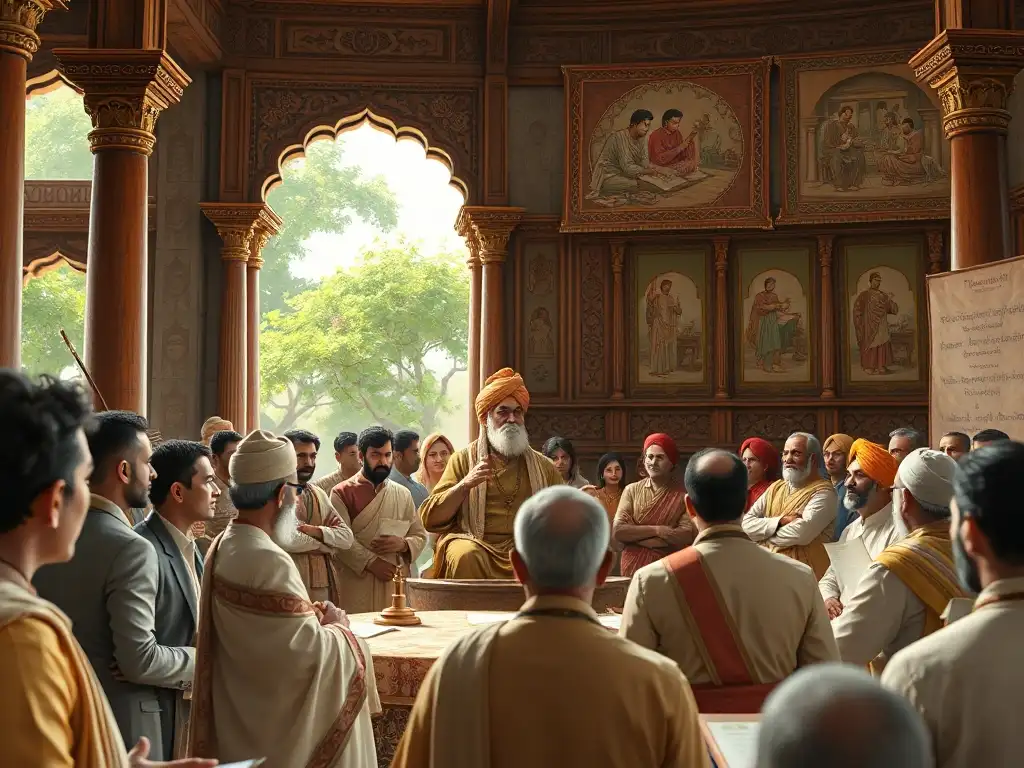
In ancient India, legal practices were intricately woven into the fabric of everyday life, facilitating the resolution of disputes and the enforcement of societal norms. The mechanisms for legal procedures were diverse, often reflecting the local customs and the socio-economic dynamics of the community. Key to these procedures were local assemblies and community leaders who played vital roles in maintaining justice.
Village Assemblies (Panchayats) and Their Functions
The Panchayat, or village assembly, served as the primary judicial body in rural areas. Comprised of respected community members, the Panchayat was responsible for resolving disputes among villagers. Its functions included:
- Mediation: The Panchayat aimed to mediate disputes before they escalated to formal proceedings.
- Judgment: If mediation failed, the Panchayat would hear cases and render judgments based on established customs and the principles laid out in legal texts like the Manu Smriti.
- Enforcement of Decisions: Following a judgment, the Panchayat ensured compliance, often relying on community support to enforce penalties.
The decisions made by the Panchayat were typically respected due to the communal nature of Indian villages, where maintaining social harmony was paramount.
Role of Elders in Legal Disputes
Elders held a significant position in the resolution of legal disputes. Revered for their wisdom and experience, they acted as mediators and advisors. Their role included:
- Advisory Capacity: Elders would offer guidance on the moral and ethical implications of disputes, influencing the decisions of the Panchayat.
- Conflict Resolution: Often, elders were called upon to resolve family disputes or issues related to inheritance, utilizing their knowledge of customs and traditions.
- Custodians of Tradition: They ensured that legal practices adhered to historical precedents, thereby maintaining a continuity of tradition.
This reliance on elders underscores the communal approach to justice in ancient Indian society, where relationships and social standing significantly influenced legal outcomes.
Penalties and Punishments in Ancient India
Penalties and punishments in ancient Indian legal practices were designed not only to deter wrongdoing but also to promote societal harmony. The rationale behind these penalties was often rooted in moral philosophy and the need for social order.
Types of Penalties and Their Justifications
Penalties varied widely, depending on the nature of the offense and the offender's social status. Common types of penalties included:
- Fines: Monetary penalties were frequently imposed for minor offenses, serving as a form of restitution to the victim.
- Physical Punishment: More severe crimes could result in corporal punishment, reflecting a society that often equated physical penalties with deterrence.
- Social Exile: In cases of egregious misconduct, offenders could be ostracized from their community, a punishment aimed at protecting societal values.
Justifications for these penalties were often based on Dharmic principles, which emphasized balance, justice, and the restoration of order within the community.
Rehabilitation vs. Punishment in Legal Practices
The ancient Indian legal system exhibited a dual focus on both rehabilitation and punishment. While punitive measures were common, there was also an underlying philosophy advocating for the reintegration of offenders into society. Key aspects included:
- Reformative Approaches: Certain texts suggest that offenders should undergo a process of moral and ethical education, emphasizing rehabilitation over mere punishment.
- Community Involvement: The community played a role in aiding the rehabilitation process, encouraging offenders to mend their ways and contribute positively.
- Restorative Justice: In many cases, the emphasis was on restoring the victim and the community rather than solely punishing the offender.
This holistic approach to justice reflects a nuanced understanding of human behavior and societal needs, highlighting the complexity of ancient Indian legal practices.
The Influence of Ancient Indian Legal Practices on Modern Law

The influence of ancient Indian legal practices on modern law is profound and multifaceted. Many principles and concepts from these ancient systems have persisted through time, adapting to the evolving social, cultural, and political contexts. The legal texts, particularly the Manu Smriti, provide a rich repository of legal thought that continues to resonate in contemporary legal frameworks.
One significant aspect of this influence is the emphasis on dharma, which refers to moral and ethical duties. In ancient India, legal practices were deeply intertwined with religious and moral considerations. This holistic view of law as a moral compass can be observed in various modern legal systems, particularly those influenced by religious laws. For instance, the principles of justice and equity rooted in ancient texts have found echoes in the legal doctrines of many countries, where laws are framed to ensure not just compliance but also moral rectitude.
Continuity and Change in Legal Principles
The evolution of legal principles from ancient Indian practices to modern law illustrates both continuity and change. Key concepts originating from ancient times, such as contract law, property rights, and family law, have undergone transformations while maintaining their foundational essence.
- Contract Law:
- In ancient India, contracts were governed by the principles outlined in texts like the Arthashastra, which emphasized mutual consent and fairness. Modern contract law retains these principles, focusing on the sanctity of agreements and the importance of consent.
- Property Rights:
- The notion of property and ownership has roots in ancient legal practices, with texts detailing inheritance laws and the rights of women. While modern laws have evolved to promote gender equality, the basic tenets regarding property ownership can trace their origins back to these ancient systems.
- Family Law:
- Ancient texts such as the Manu Smriti laid down guidelines for marriage, divorce, and inheritance. Today, while the frameworks may differ, the core issues surrounding family law—such as the welfare of children and rights of spouses—reflect concerns that were similarly addressed in ancient times.
This continuity highlights the enduring relevance of ancient legal principles, while the changes signify the adaptation of these principles to meet contemporary societal needs.
Comparative Analysis with Contemporary Legal Systems
When comparing ancient Indian legal practices with contemporary legal systems, several similarities and differences emerge, reflecting the unique cultural contexts from which each system arises.
- Similarities:
- Both ancient Indian law and modern legal systems emphasize justice, equity, and societal welfare. For instance, the ancient focus on restorative justice can be seen in contemporary legal systems that prioritize rehabilitation over punishment.
- The use of codified laws in ancient texts parallels modern legal codes, where laws are systematically organized and accessible to the public.
- Differences:
- One of the stark differences lies in the source of law. Ancient Indian legal practices relied heavily on religious texts and customary law, whereas modern legal systems often prioritize secular, statutory laws that evolve through democratic processes.
- Additionally, the role of the judiciary has transformed significantly. In ancient India, local leaders or village councils often resolved disputes, while contemporary systems have established formal judicial branches with defined powers and procedures.
| Aspect | Ancient Indian Legal Practices | Contemporary Legal Systems |
|---|---|---|
| Source of Law | Religious texts and customs | Statutory laws |
| Judicial Authority | Local leaders/village councils | Formal judiciary |
| Focus | Dharma and moral obligations | Justice and rights |
| Dispute Resolution | Informal mediation | Formal legal proceedings |
The legacy of ancient Indian legal practices informs and enriches modern legal systems, offering timeless principles that continue to shape our understanding of justice, fairness, and societal order. The dialogue between ancient and contemporary practices fosters a deeper appreciation of the evolution of legal thought and the cultural values embedded within these systems.
Conclusion: The Legacy of Ancient Indian Legal Practices

The legacy of ancient Indian legal practices is profound and continues to resonate in various facets of modern legal systems. These practices, rooted in a rich tapestry of cultural and philosophical traditions, have laid the foundation for many contemporary legal concepts. Ancient Indian legal texts, such as the Manu Smriti, not only served as guidelines for societal conduct but also reflected the moral and ethical values of their times.
One of the most significant contributions of ancient Indian legal practices is the emphasis on Dharma, or duty, which transcended mere legal compliance and encompassed ethical behavior. Legal obligations were intertwined with moral duties, creating a holistic approach to justice that sought to maintain societal harmony. This principle remains relevant, as modern legal systems also grapple with the interplay of law and morality.
Reflection on the Relevance of Ancient Legal Practices Today
In today's rapidly evolving legal landscape, the principles derived from ancient Indian legal practices offer valuable insights into contemporary issues. For instance, concepts such as restorative justice can be traced back to ancient practices that emphasized reconciliation over punitive measures. This perspective encourages a more humane approach to conflict resolution, focusing on the restoration of relationships rather than merely imposing penalties.
Furthermore, the ancient practice of community-based dispute resolution emphasizes the role of local customs and traditions in legal processes. This approach is increasingly relevant as many modern legal systems recognize the importance of cultural context and community involvement in administering justice. By integrating these principles, contemporary societies can foster a more inclusive and responsive legal framework that respects diverse cultural identities.
Final Thoughts on the Study of Ancient Indian Legal Texts and Practices
The study of ancient Indian legal texts and practices unveils a complex and nuanced understanding of law that extends beyond rigid statutes. These texts, including the Manu Smriti, provide a window into the social, economic, and political contexts of ancient India, highlighting the adaptability and evolution of legal thought over centuries.
As scholars and practitioners reflect on these ancient practices, it becomes evident that they are not merely historical artifacts but living legacies that continue to influence legal philosophy and practice today. The principles of justice, equity, and moral responsibility inherent in ancient Indian legal practices encourage ongoing dialogue about the nature of law, its purpose, and its role in society.
The exploration of ancient Indian legal practices offers both a pathway to understanding historical legal frameworks and a bridge to contemporary legal challenges. The rich tapestry of legal thought from ancient India remains a crucial part of the global legal heritage, inspiring future generations to seek justice in all its forms.
Frequently Asked Questions
What are ancient Indian legal practices?
Ancient Indian legal practices refer to the systematic rules and regulations that governed society in India, encompassing various aspects such as property rights, family law, and criminal justice.
How were laws enforced in ancient India?
Laws in ancient India were enforced through local authorities and community leaders, who played a crucial role in maintaining order and resolving disputes, often guided by traditional customs.
What texts outline ancient Indian legal practices?
Important texts such as the Manusmriti and the Dharmashastras provide foundational insights into ancient Indian legal practices, detailing concepts of justice, dharma, and societal duties.
Did ancient Indian legal practices influence modern law?
Yes, many principles from ancient Indian legal practices have influenced modern legal systems, especially in areas related to inheritance, marriage, and community governance.
How did ancient Indian legal practices reflect the culture of the time?
Ancient Indian legal practices were deeply intertwined with the cultural and religious beliefs of the society, reflecting values such as dharma (duty) and ahimsa (non-violence), shaping everyday life.
Final Reflection: The Enduring Legacy of Ancient Indian Legal Practices
The exploration of ancient Indian legal practices reveals their profound relevance in today's world, as they not only shaped the foundations of justice and governance but also continue to influence contemporary legal systems. The intricate balance between law and morality established by these ancient practices is a striking reminder of the timeless quest for justice that transcends generations.
The impact of ancient Indian legal practices on our cultural and social landscape is undeniable, as they have woven a rich tapestry of ethical principles that guide our understanding of justice today. These practices emphasize the importance of community, fairness, and the rule of law, resonating deeply in modern legal frameworks. As Mahatma Gandhi once said, "> An unjust law is itself a species of violence. Arrest for its breach is more so." This quote encapsulates the essence of how ancient legal philosophies continue to challenge and inspire our pursuit of justice in contemporary society.
As we reflect on the lessons learned from ancient Indian legal practices, I invite you to consider how these principles can be applied in your own life. Embrace the values of fairness, integrity, and community in your interactions and decisions. By doing so, you not only honor the legacy of those who came before us but also contribute to a more just and equitable society for future generations. Let us carry forward the wisdom of the past as we navigate the complexities of the present and shape a brighter future.
Uncover the Wisdom of Ancient Legal Practices Today!
Thank you for diving into the fascinating world of ancient Indian legal practices! Your exploration has revealed how these principles shaped everyday life and continue to offer valuable insights into our justice system. Now, it’s time to bring this knowledge into your own life.
- Start a conversation with friends or family about how ancient philosophies can inform modern justice.
- Read more about a specific legal practice that intrigued you and discover its relevance in today's society.
- Join our community by sharing your thoughts on your favorite aspect of ancient Indian law in the comments below!
Which ancient legal principle do you believe could inspire a better society today?