
The Role of Scribes and Record Keeping in Ancient Indian Courts

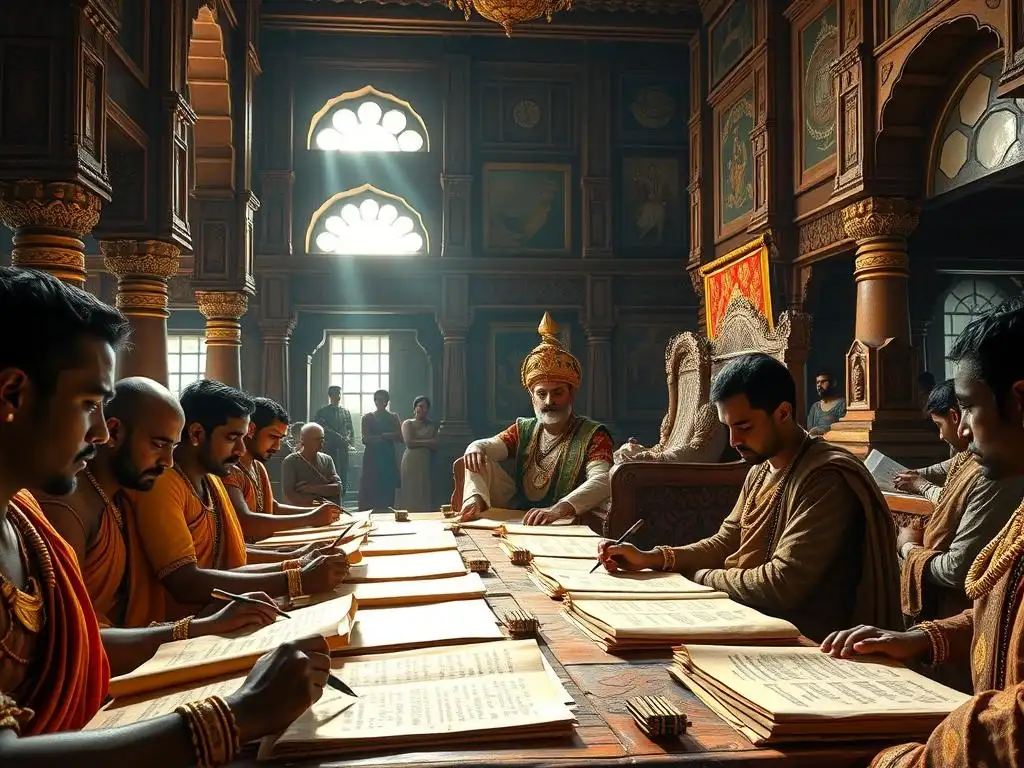
Welcome to Ancient India History, where we embark on a journey through the rich tapestry of civilizations that shaped the subcontinent. As we delve into the fascinating world of ancient Indian scribes and record keeping, you will uncover the pivotal role these skilled individuals played in the courts of ancient India. How did their meticulous documentation influence governance and law codes?
Join us as we explore the profound impact of these scribes on the preservation of culture and knowledge, igniting your curiosity about a legacy that still resonates today. Get ready to turn the pages of history and discover the secrets that lie within!

Introduction to Ancient Indian Scribes and Record Keeping
The history of ancient Indian civilizations is rich with intricate systems of governance, law, and cultural practices. Among these, the role of ancient Indian scribes and record keeping stands out as a pivotal element in the judicial processes of the time. Scribes were not merely writers; they were integral to the administration of justice, maintaining records that served as evidence in courts and ensuring the smooth functioning of legal systems. This article delves into the significance of scribes and their record-keeping practices, highlighting their contributions to the legal frameworks established in ancient India.
Overview of Scribes in Ancient India
Scribes in ancient India, known as lipikās, played a multifaceted role in society. They were responsible for documenting a wide array of information, including legal decrees, treaties, and even daily transactions. Their work was crucial in cultivating a culture of documentation and accountability, which was essential for the administration of justice.
Key responsibilities of ancient Indian scribes included:
- Transcribing Legal Documents: Scribes meticulously wrote down laws, regulations, and judgments that were essential for maintaining order.
- Maintaining Court Records: They kept detailed records of court proceedings, which were vital for future reference and ensuring transparency in judicial matters.
- Communicating Legal Information: Scribes often acted as intermediaries, conveying important legal information to the public.
Importance of Record Keeping in Judicial Practices
The importance of record keeping in ancient Indian courts cannot be overstated. Accurate and systematic documentation provided a foundation for legal proceedings, allowing for consistency and reliability in the justice system. Some of the key benefits of effective record keeping included:
- Preservation of Evidence: Documented records served as tangible evidence in disputes, aiding judges in making informed decisions.
- Facilitation of Appeals: Written records allowed for a clear understanding of previous judgments, enabling parties to appeal decisions based on documented facts.
- Promotion of Rule of Law: A well-documented legal framework helped establish trust in the judicial system, fostering a sense of order and fairness in society.
Historical Context of Scribes in Ancient Indian Courts
The role of scribes evolved significantly throughout India's history, reflecting the changes in governance and societal structures. Understanding this evolution provides insight into the broader legal landscape of ancient India.
Evolution of Scribes in Indian Civilization
Scribes emerged as a distinct profession during the early civilizations of India, particularly with the rise of urban centers like the Indus Valley Civilization. As societies became more complex, the need for documentation grew, leading to the establishment of formal systems of writing. Over time, scribes adapted to various administrative needs, including those of courts and legal systems.
- Indus Valley Civilization (c. 3300–1300 BCE): The earliest evidence of writing in India, although still undeciphered, indicates the significance of record keeping in trade and administration.
- Vedic Period (c. 1500–500 BCE): The oral tradition began to incorporate written texts, with scribes playing a key role in documenting religious and legal texts.
- Maurya and Gupta Empires (c. 322 BCE–550 CE): Scribes became essential in maintaining elaborate administrative systems, contributing to the codification of laws and legal practices.
Notable Civilizations and Their Record Keeping Practices
Various ancient Indian civilizations developed unique practices of record keeping, each contributing to the legal frameworks that governed their societies. Some notable examples include:
- Mauryan Empire: Known for its sophisticated bureaucracy, Mauryan scribes documented laws and edicts, including those of Emperor Ashoka, which were inscribed on pillars and rocks across the empire.
- Gupta Empire: This period saw the flourishing of literature and legal texts, with scribes responsible for recording court cases and legal codes, aiding in the establishment of a more structured legal system.
The role of ancient Indian scribes and their meticulous record-keeping practices were foundational to the judicial systems of their time, ensuring the integrity and continuity of legal proceedings. Their contributions not only shaped the legal landscape of ancient India but also laid the groundwork for future developments in governance and law.
Functions of Scribes in Ancient Indian Courts
Scribes played a crucial role in the functioning of ancient Indian courts, serving as the backbone of legal and administrative processes. Their responsibilities encompassed various aspects of documentation, record-keeping, and communication within the judicial system.
Documentation of Legal Proceedings
One of the primary functions of scribes was the meticulous documentation of legal proceedings. They recorded everything from initial complaints to witness testimonies, cross-examinations, and final arguments. This documentation served multiple purposes:
- Preservation of Evidence: By accurately transcribing the proceedings, scribes ensured that vital evidence was preserved for future reference.
- Legal Clarity: Detailed records provided a clear account of the case, helping judges and parties involved to understand the nuances of the proceedings.
- Accountability: Documentation held judges and litigants accountable for their statements and actions during the trial.
The ability to produce detailed and accurate records was essential for maintaining the integrity of the judicial process, making scribes indispensable in ancient Indian courts.
Recording Judicial Decisions and Verdicts
In addition to documenting legal proceedings, scribes were responsible for recording judicial decisions and verdicts. Their role in this aspect included:
- Final Judgments: Scribes would write down the final judgments pronounced by the judges, ensuring that there was a permanent record of the court’s decisions.
- Legal Precedents: The recorded decisions contributed to the development of legal precedents, which were vital for future cases and interpretations of the law.
- Public Access: By making these records accessible, scribes facilitated transparency in the judicial process, allowing the public to understand and learn from past verdicts.
This function of scribes not only supported the administration of justice but also contributed to the evolving legal traditions within ancient Indian society.
Role in Administrative Functions
The role of scribes extended beyond mere documentation; they were integral to various administrative functions within the court system. Their responsibilities included:
- Maintaining Court Records: Scribes were tasked with organizing and maintaining extensive records of court cases, decisions, and other legal documents, ensuring easy retrieval and reference.
- Communication: They acted as a bridge between different parties, transcribing messages and facilitating communication among judges, litigants, and witnesses.
- Statistical Reporting: Scribes often compiled statistical reports related to the number of cases, types of legal issues, and outcomes, aiding in the assessment of the court's efficiency and effectiveness.
Through these administrative functions, scribes contributed significantly to the smooth operation of ancient Indian courts, reinforcing the importance of structured legal processes.
Tools and Techniques Used by Ancient Indian Scribes

The effectiveness of scribes in ancient Indian courts was largely dependent on the tools and techniques they employed. These resources enabled them to perform their duties with precision and efficiency.
Writing Materials and Instruments
Scribes utilized a variety of writing materials and instruments that evolved over time. Key elements included:
- Palm Leaves and Birch Bark: Commonly used as writing surfaces, palm leaves were preferred for their availability and durability. Birch bark was also utilized, especially in regions where it was abundant.
- Ink and Dyes: Scribes crafted inks from natural sources such as plant extracts, minerals, and animal products. These inks varied in color and quality, with black and red being the most common.
- Writing Instruments: The primary writing instrument was a stylus, often made from metal or wood, used for inscribing text onto the writing surfaces. Brushes were also used, particularly for larger scripts.
These materials and instruments were vital in enabling scribes to create legible and long-lasting records.
Methods of Record Keeping and Preservation
To ensure the longevity and accessibility of records, ancient Indian scribes employed various methods of record-keeping and preservation:
- Organization: Scribes categorized records systematically, often using scrolls or bound collections to facilitate easy access and reference.
- Storage: Records were typically stored in secure locations, such as temple archives or royal libraries, to protect them from deterioration or loss.
- Copying: To preserve important documents, scribes would create copies. This practice not only safeguarded the original records but also allowed for the dissemination of legal knowledge across different regions.
Through these meticulous methods, scribes ensured that the legal records of ancient India remained intact for future generations, contributing to the continuity of legal traditions and practices.
The Impact of Scribes on Legal Systems in Ancient India
The role of scribes in ancient Indian courts was pivotal in shaping the legal systems of the time. Scribes were not merely functionaries; they were the custodians of knowledge and experts in the art of writing, which was essential for documenting legal transactions, decisions, and laws. Their influence extended beyond mere record-keeping; they contributed significantly to the formulation and evolution of law codes, ensuring that legal norms were accurately articulated and preserved.
Scribes facilitated communication between the judiciary and the populace, making legal information accessible. Their meticulous documentation practices helped standardize laws, thereby promoting consistency and fairness in judicial proceedings. As a result, the presence of scribes fostered a more organized and structured legal environment, laying the groundwork for future legal systems in India.
Scribes and the Development of Law Codes
The development of law codes in ancient India can be traced back to the contributions of scribes who played a crucial role in compiling, writing, and interpreting these laws. Texts such as the Manusmriti and the Arthashastra highlight the significance of scribes in articulating legal principles and societal norms. They were responsible for recording the laws dictated by rulers and scholars, ensuring that these codes were preserved for future generations.
Scribes also played a vital role in adapting these codes to local contexts, thus making them relevant to the diverse cultures and practices within ancient India. By doing so, they not only contributed to the stability of the legal system but also helped in the evolution of a more sophisticated legal framework that could address various societal issues, such as property rights, family law, and criminal justice.
Influence on Judicial Practices and Procedures
The influence of scribes on judicial practices and procedures was profound. They served as intermediaries between judges and litigants, ensuring that cases were accurately recorded and that the proceedings adhered to established protocols. The meticulous nature of scribes meant that every detail of a case was documented, from testimonies to rulings, thus fostering transparency in the judicial process.
Moreover, scribes were often responsible for the preparation of legal documents, such as contracts and agreements, which were essential for the enforcement of laws. Their expertise in language and writing not only elevated the standards of legal documentation but also ensured that legal proceedings were conducted with integrity and precision. This structured approach to judicial practices helped instill public confidence in the legal system, reinforcing the notion of justice in ancient Indian society.
Case Studies of Scribes in Prominent Ancient Indian Courts
The historical records of ancient Indian courts reveal numerous instances of scribes playing critical roles in governance and legal affairs. Two significant periods that exemplify this are the Mauryan Empire and the Gupta Period.
The Mauryan Empire: Scribes and Governance
During the Mauryan Empire, which flourished from the 4th to the 2nd century BCE, scribes were instrumental in the administration of justice and governance. They operated under the patronage of the emperor, assisting in drafting edicts and royal proclamations that were disseminated throughout the empire. The famous edicts of Ashoka, inscribed on pillars and rocks, serve as a testament to the impact of scribes in communicating the emperor's policies and legal principles.
Scribes not only documented laws but also maintained records of court proceedings, tax collections, and land ownership. Their ability to write in various scripts allowed for broader communication across the diverse linguistic landscape of the empire, making the legal system more inclusive. This era highlighted how scribes contributed to a centralized governance structure that relied heavily on written documentation.
Gupta Period: Advancements in Record Keeping
The Gupta Period (approximately 320 to 550 CE) is often regarded as a golden age in Indian history, marked by significant advancements in various fields, including literature, science, and administration. Scribes during this period further refined the practices of record keeping and documentation, leading to enhanced legal efficiency.
With the establishment of more formalized courts, scribes played a crucial role in maintaining court records, drafting legal documents, and ensuring that laws were consistently applied. The proliferation of educational institutions during the Gupta era also saw an increase in the training of scribes, who became adept at not only writing but also understanding complex legal concepts.
Moreover, the Gupta period witnessed the emergence of specialized texts that focused on legal procedures and judicial practices, many of which were authored or compiled by learned scribes. This advancement in record keeping not only improved the administration of justice but also laid the foundation for future legal systems in India, demonstrating the enduring legacy of ancient Indian scribes and their invaluable contributions to record keeping and governance.
Challenges Faced by Scribes in Ancient India

The role of scribes in ancient India was pivotal for maintaining records and facilitating communication within the judicial system. However, these scribes faced numerous challenges that impacted their work and the overall effectiveness of record keeping. Understanding these challenges offers valuable insights into the complexities of ancient Indian society and its legal frameworks.
Limitations of Materials and Resources
Ancient Indian scribes worked with a variety of materials, including palm leaves, birch bark, and clay tablets, which were often difficult to source and maintain. The limitations of these materials posed significant challenges:
- Durability Issues: Palm leaves and birch bark were prone to deterioration, especially in humid climates. This often resulted in the loss of important records over time.
- Accessibility: The availability of writing instruments, such as ink and styluses, was limited. Scribes often had to create their own tools, which could affect the quality of their work.
- Standardization: The lack of standardized scripts and languages across different regions made it challenging for scribes to communicate effectively. This inconsistency could lead to misinterpretations of legal documents.
Despite these limitations, scribes exhibited resourcefulness, developing innovative methods to preserve records and adapt to the materials at their disposal.
Socio-political Influences on Record Keeping
The socio-political landscape of ancient India significantly influenced the practices of record keeping. Several factors contributed to the challenges faced by scribes:
- Political Turmoil: Periods of conflict and instability often disrupted administrative functions, including record keeping. Scribes could find themselves in precarious positions, with their work becoming a target during regime changes.
- Caste Hierarchies: The caste system played a role in the scribes' social standing. While they held important roles within the courts, their status was still subordinate to the ruling class. This influenced their access to resources and the recognition of their work.
- Censorship and Control: Scribes often worked under the supervision of higher authorities, which could lead to the manipulation of records. Political leaders sometimes dictated the content and accuracy of documents to serve their interests, undermining the integrity of record keeping.
These socio-political influences not only challenged the scribes but also shaped the nature of justice and legal documentation in ancient India.
Conclusion: The Legacy of Scribes and Record Keeping in Ancient Indian Judicial Systems
The contributions of scribes in ancient India go beyond mere documentation; they played a crucial role in shaping the legal frameworks and practices of their time. Their legacy continues to resonate in contemporary legal systems.
Lasting Influence on Modern Legal Practices
The foundational principles established by ancient Indian scribes have had a lasting impact on modern legal practices. Key aspects include:
- Documentation Importance: The emphasis on accurate record keeping laid the groundwork for contemporary legal documentation practices. Modern courts still rely on meticulous records as a basis for legal proceedings.
- Legal Language Development: The evolution of legal language can be traced back to the scripts and terminologies developed by ancient scribes. This historical influence is evident in the terminologies used in today’s legal systems.
As a result, the role of scribes in ancient India can be seen as a precursor to the structured legal documentation we see in modern times.
Reflection on the Cultural Significance of Scribes
Scribes were not merely record keepers; they were integral to the cultural and intellectual life of ancient India. Their work reflected:
- Cultural Transmission: Scribes facilitated the preservation and transmission of knowledge, including legal codes, religious texts, and literary works. This role was essential in maintaining the cultural heritage of ancient Indian civilization.
- Social Status and Identity: The profession of a scribe often conferred a certain status within society, as literacy and the ability to produce written records were highly valued. This contributed to a sense of identity and belonging within the broader social fabric.
The legacy of ancient Indian scribes and their record keeping practices is profound, influencing both historical perspectives and contemporary legal frameworks while highlighting the rich cultural heritage of ancient India.
References and Further Reading on Ancient Indian Scribes and Record Keeping
For those interested in delving deeper into the vital role of scribes and record keeping in ancient Indian courts, a wealth of resources is available. This section outlines key texts, historical sources, and scholarly articles that provide valuable insights into the practices, tools, and significance of scribes in the ancient Indian legal system.
Key Texts and Historical Sources
-
Arthashastra by Kautilya (Chanakya)
This ancient treatise on statecraft, economic policy, and military strategy includes references to the administrative roles of scribes and the importance of record keeping in governance.
-
Manusmriti (Laws of Manu)
As one of the earliest legal texts in India, the Manusmriti outlines various aspects of law and justice, including the roles of scribes in documenting legal proceedings and maintaining records.
-
Ashokan Edicts
The inscriptions left by Emperor Ashoka provide insights into the bureaucratic procedures of his administration, showcasing how record keeping was essential for governance and judicial matters.
-
Brahmanical Texts and Puranas
These ancient texts often depict the procedures followed in courts and the significance of record keeping in maintaining societal order and justice.
-
Inscriptions and Epigraphs
Archaeological findings, including stone inscriptions and copper plates, reveal the administrative and judicial practices of ancient Indian states, highlighting the roles played by scribes.
Suggested Academic Journals and Articles
-
Journal of Indian History
This journal publishes a range of articles on various aspects of Indian history, including studies on administrative practices and the role of scribes in ancient records.
-
Indian Historical Review
A scholarly publication that features research on historical themes, often discussing the implications of record keeping and documentation in ancient Indian societies.
-
"The Role of Scribes in Ancient India" by R. N. Sharma
This article provides a comprehensive analysis of the functions of scribes in ancient India, shedding light on their significance in judicial contexts.
-
"Record Keeping in Ancient Civilizations: A Comparative Study"
This academic paper explores similarities and differences in record keeping practices across different ancient civilizations, including India, offering a broader perspective on the topic.
-
"Administration and Law in Ancient India" by S. P. Gupta
This work examines the legal and administrative frameworks of ancient Indian courts, emphasizing the crucial role of scribes in documenting legal proceedings.
By exploring these texts and journals, readers can gain a richer understanding of the intricate relationship between scribes, record keeping, and the judicial practices that characterized ancient Indian courts.
- Introduction to Ancient Indian Scribes and Record Keeping
- Historical Context of Scribes in Ancient Indian Courts
- Functions of Scribes in Ancient Indian Courts
- Tools and Techniques Used by Ancient Indian Scribes
- The Impact of Scribes on Legal Systems in Ancient India
- Case Studies of Scribes in Prominent Ancient Indian Courts
- Challenges Faced by Scribes in Ancient India
- Conclusion: The Legacy of Scribes and Record Keeping in Ancient Indian Judicial Systems
- References and Further Reading on Ancient Indian Scribes and Record Keeping
Frequently Asked Questions
What was the role of scribes in ancient Indian courts?
Scribes played a crucial role in record keeping, documenting legal matters, transactions, and administrative activities, ensuring the accuracy and efficiency of governance.
How did record keeping evolve in ancient India?
Record keeping evolved through various methods and materials, including inscriptions on stone, palm leaves, and later, paper, reflecting the technological advancements of the time.
What types of documents did ancient Indian scribes create?
Ancient Indian scribes created a range of documents including legal contracts, royal decrees, and literary works, which served as vital resources for historical and cultural understanding.
How did the education of scribes influence their work?
Scribes typically underwent extensive education in languages, writing systems, and administrative practices, which allowed them to maintain accurate records and adapt to changing governance needs.
What impact did ancient Indian scribes have on society?
The work of ancient Indian scribes significantly influenced administration, law, and culture, as their records helped preserve knowledge and traditions for future generations.
Final Reflection: The Enduring Legacy of Ancient Indian Scribes and Record Keeping
The intricate world of ancient Indian scribes and record keeping serves as a testament to the profound impact that documentation and literacy have had on civilization. In today's fast-paced digital age, where information is generated and consumed at an unprecedented rate, the foundational role of scribes in preserving knowledge and maintaining order remains strikingly relevant. Their meticulous work not only shaped the governance of ancient courts but also laid the groundwork for modern record-keeping practices, reminding us that the past continues to influence our present.
The influence of ancient Indian scribes extends beyond mere documentation; it has woven itself into the very fabric of our cultural and social landscape. The ability to record events, laws, and transactions has empowered societies to maintain continuity and accountability. As we navigate through our own complexities today, we can draw inspiration from the dedication of these scribes. Their commitment to accuracy and detail is encapsulated in the words of historian Romila Thapar: History is not just about the past; it is a narrative that shapes our identity and informs our future.
This perspective underscores the importance of understanding our historical roots as we forge ahead.
As we reflect on the lessons from ancient Indian scribes and their role in record keeping, I invite you to consider how you can apply these insights in your own life. Whether through journaling, documenting personal experiences, or engaging in community storytelling, each act of recording contributes to the tapestry of our shared history. Embrace the power of words and the importance of preserving your own narrative, for in doing so, you honor the legacy of those who came before us and ensure that their stories—and yours—continue to resonate through time.
Unleash Your Curiosity: Dive Deeper into Ancient Indian Record Keeping!
Thank you for exploring the intriguing world of scribes and record keeping in ancient Indian courts with us! You’ve gained valuable insights into how these skilled individuals played a pivotal role in maintaining historical accuracy and governance. Now, why not take the next steps to further enrich your understanding and connection to this fascinating topic?
- Start your exploration by visiting digitized archives of ancient documents and artifacts—there are many resources waiting for you to discover!
- Join a local history group or online community, where you can share your thoughts and learn from others who are equally passionate about ancient history.
- Consider written reflections or articles about what you learned—this can spark discussion and help preserve your newfound knowledge!
What are your thoughts on the importance of record keeping in today's world? How do you think it shapes our understanding of history? Let’s discuss in the comments!