
The Mathematical Genius of Brahmagupta: A Legacy Unveiled

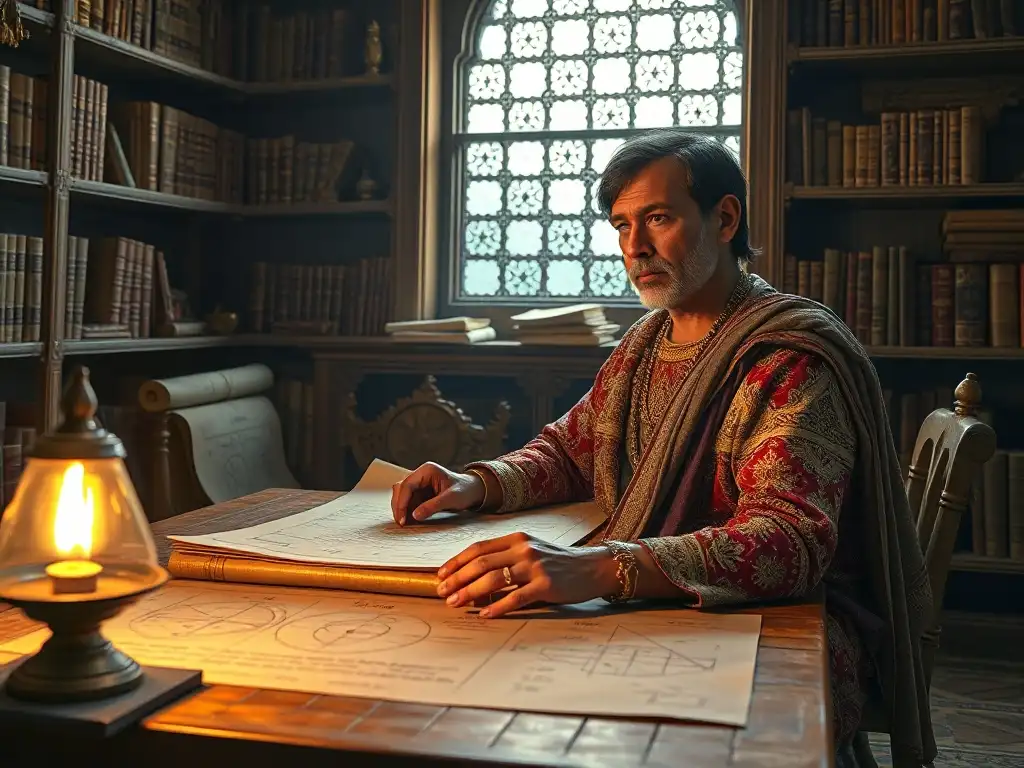
Welcome to Ancient India History, where we embark on a journey through time to uncover the rich tapestry of civilizations that shaped the Indian subcontinent. In this exploration, we delve into the extraordinary contributions of mathematicians who left an indelible mark on the world. This week, we shine a spotlight on Brahmagupta, a brilliant mind whose innovative ideas revolutionized mathematics as we know it.
Join us as we unveil the legacy of Brahmagupta's contributions to mathematics, a story that promises to intrigue and inspire. Are you ready to discover how his genius continues to influence our understanding of numbers today? Dive in and explore with us!

Brahmagupta, an eminent mathematician and astronomer from ancient India, made groundbreaking contributions that have significantly shaped the field of mathematics. Living during the 7th century CE, he is often regarded as one of the leading figures in the development of algebra and number theory.
His works not only advanced mathematical thought in India but also laid the foundation for future generations across the globe. In this article, we will delve into Brahmagupta's contributions to mathematics, exploring his life, the significance of his work, and the lasting impact of his innovations, particularly in the realms of arithmetic operations and the concept of zero.
Introduction to Brahmagupta's Contributions to Mathematics
Brahmagupta's legacy is characterized by his pioneering ideas and methodologies that transcended the limitations of his time. He authored the seminal text Brahmasphutasiddhanta, which serves as a key reference in the study of ancient Indian mathematics. This work not only covers astronomical calculations but also addresses various mathematical concepts, providing insight into the sophisticated understanding of numbers and operations in ancient India. His contributions are a testament to the rich intellectual tradition of the time, showcasing a blend of theoretical knowledge and practical application.
Overview of Brahmagupta's Life and Time
Born around 598 CE in the region of present-day Rajasthan, Brahmagupta lived during a period marked by significant advancements in science and philosophy. He was the head of an astronomical observatory and was deeply influenced by the works of earlier mathematicians, such as Aryabhata. His life spanned a time when India was a hub of intellectual activity, contributing to various fields including mathematics, astronomy, and philosophy. Brahmagupta's writings reflect not only his mathematical genius but also his engagement with the cultural and scientific discourses of his era.
Significance of Brahmagupta in Ancient Indian Mathematics
Brahmagupta's significance in ancient Indian mathematics lies in his systematic approach to mathematical problems and his ability to articulate complex concepts clearly. He is credited with formalizing the rules of arithmetic operations, which were crucial for the advancement of algebra. His contributions also bridged the gap between practical mathematics used in daily life and theoretical mathematics, thereby enhancing the educational standards of the time. The algorithms and methods he introduced continue to influence modern mathematical practices, showcasing the enduring relevance of his work.
Brahmagupta's Key Contributions to Mathematics
Brahmagupta's mathematical innovations include a variety of concepts that laid the groundwork for future developments in the field. His work encompasses several key areas that reflect his profound understanding of numbers and operations.
Development of Algebra: Concepts and Innovations
One of Brahmagupta's most notable contributions is in the realm of algebra. He introduced rules for solving quadratic equations and provided methods for dealing with both positive and negative numbers. In his text, he established specific procedures for solving equations, which were revolutionary for his time. His work not only advanced algebraic principles but also emphasized the importance of proof and logical reasoning, setting a precedent for future mathematicians.
Brahmagupta's Rules for Arithmetic Operations
Brahmagupta's Brahmasphutasiddhanta delineates rules for arithmetic operations that are remarkably modern in their formulation. He articulated methods for addition, subtraction, multiplication, and division, including operations involving negative numbers. His comprehensive approach to arithmetic established a framework that mathematicians would build upon for centuries.
Introduction of Zero: The Symbol and Its Importance
Perhaps one of Brahmagupta's most significant contributions is the formal introduction of zero as a number in its own right, rather than just a placeholder. He explored the arithmetic of zero, providing rules for its use in calculations. This revolutionary concept not only transformed mathematics in India but also had profound implications for mathematics globally, influencing the way numbers are understood and used in calculations today. Brahmagupta's insights into zero highlight his forward-thinking approach and underscore the importance of this seemingly simple symbol in the history of mathematics.
The Influence of Brahmagupta's Work on Future Mathematics
Brahmagupta, an eminent mathematician and astronomer of ancient India, made significant contributions that would shape the course of mathematics for centuries. His work not only advanced mathematical knowledge in his time but also laid a foundation for future developments in various mathematical fields. His innovative approaches to arithmetic, algebra, and geometry had lasting effects, influencing both Indian and global mathematical traditions.
One of the most notable aspects of Brahmagupta's influence is his introduction of the concept of zero as a number. This radical idea transformed mathematical calculations and theoretical frameworks. The formalization of zero would later be crucial in the development of the decimal system, which became a cornerstone of mathematics. Brahmagupta's rules for arithmetic operations involving zero and negative numbers opened avenues for more complex calculations and theories.
Brahmagupta's work also emphasized the importance of systematic problem-solving methods, which encouraged a more rigorous approach to mathematics. His methods inspired subsequent generations of mathematicians, leading to enhanced mathematical practices and the creation of advanced mathematical texts across cultures, particularly in Islamic and Indian mathematics.
Impact on Islamic Mathematics
The mathematical principles established by Brahmagupta significantly impacted Islamic mathematicians during the Golden Age of Islam. His texts were translated into Arabic, making his ideas accessible to the scholars of the Islamic world. Mathematicians like Al-Khwarizmi and Al-Kindi drew extensively from Brahmagupta's methodologies, incorporating his algorithms into their own work.
Brahmagupta's contributions to algebra, particularly his rules for solving quadratic equations and his method of determining the solutions to linear equations, were foundational for Islamic mathematicians. They recognized the value of his systematic approach to problem-solving, which helped to establish algebra as a vital area of study. The influence of Brahmagupta's work can be seen in the development of algebraic notation and the refinement of mathematical techniques in the Islamic golden age.
The cross-cultural exchange of knowledge facilitated by the translation of Brahmagupta's texts also contributed to the mathematical advancements in Europe during the Renaissance. His ideas would eventually permeate into Western mathematics, illustrating the interconnectedness of global mathematical heritage.
Legacy in Indian Mathematical Tradition
In India, Brahmagupta is celebrated as one of the most significant figures in the history of mathematics. His work reinforced the importance of mathematics in everyday life, especially in commerce, astronomy, and architecture. Subsequent Indian mathematicians, such as Bhaskara I and Bhaskara II, built upon Brahmagupta's findings, further enriching Indian mathematical tradition.
Brahmagupta's influence is particularly evident in the development of algebraic concepts in India. His solutions to indeterminate equations, known as the "Brahmagupta's equation," laid the groundwork for future explorations in number theory. The tradition of mathematical commentary in India also owes much to Brahmagupta, as his texts prompted extensive scholarly interpretation and elaboration, ensuring his ideas remained relevant and influential.
Brahmagupta's legacy is not confined to his own era; it resonates through centuries of mathematical thought and education in India. His emphasis on clarity, systematic methods, and practical applications continues to inspire educators and mathematicians alike.
Notable Texts by Brahmagupta
Brahmagupta authored several significant texts that encapsulated his mathematical theories and astronomical observations. His works contributed immensely to the fields of mathematics and astronomy, establishing him as a seminal figure in ancient Indian scholarship.
"Brahmasphutasiddhanta": An Overview
"Brahmasphutasiddhanta," or "The Opening of the Universe," is Brahmagupta's most renowned text, composed in 628 CE. This comprehensive work addresses various mathematical topics, including arithmetic, algebra, and the calculation of astronomical phenomena. It is one of the earliest texts to systematically discuss the rules of arithmetic operations, particularly involving zero and negative numbers.
The text is divided into three main sections: the first deals with arithmetic operations, the second focuses on geometry and mensuration, and the third addresses astronomy. Brahmagupta's clarity in presenting mathematical problems and solutions in a structured manner set a precedent for future mathematical writing. His methodologies for solving quadratic equations and the principles of cyclic quadrilaterals are particularly noteworthy.
The "Brahmasphutasiddhanta" is not only a mathematical treatise but also reflects Brahmagupta's philosophical inquiries into the nature of mathematics, making it a crucial text in the study of ancient Indian thought.
Key Theorems and Principles from Brahmagupta's Texts
Brahmagupta introduced several key theorems and principles that became foundational to mathematics. Among his notable contributions are:
- Rules for Arithmetic with Zero: Brahmagupta established rules for adding, subtracting, and multiplying with zero, laying the groundwork for the formal use of zero in mathematics.
- Quadratic Equations: He provided methods for solving quadratic equations, detailing both positive and negative solutions. His approach to these equations was systematic, paving the way for future algebraic developments.
- Indeterminate Equations: Brahmagupta's work on indeterminate equations, particularly his solution to the problem of finding integer solutions to linear equations, was groundbreaking. His methods influenced later mathematicians in both India and the Islamic world.
- Area of Cyclic Quadrilaterals: He formulated a formula for calculating the area of cyclic quadrilaterals, contributing significantly to geometry.
Brahmagupta's theorems and principles not only advanced mathematical knowledge in his time but also left an indelible mark on subsequent generations, ensuring his legacy in the annals of mathematics remains prominent.
Brahmagupta's Contributions to Geometry
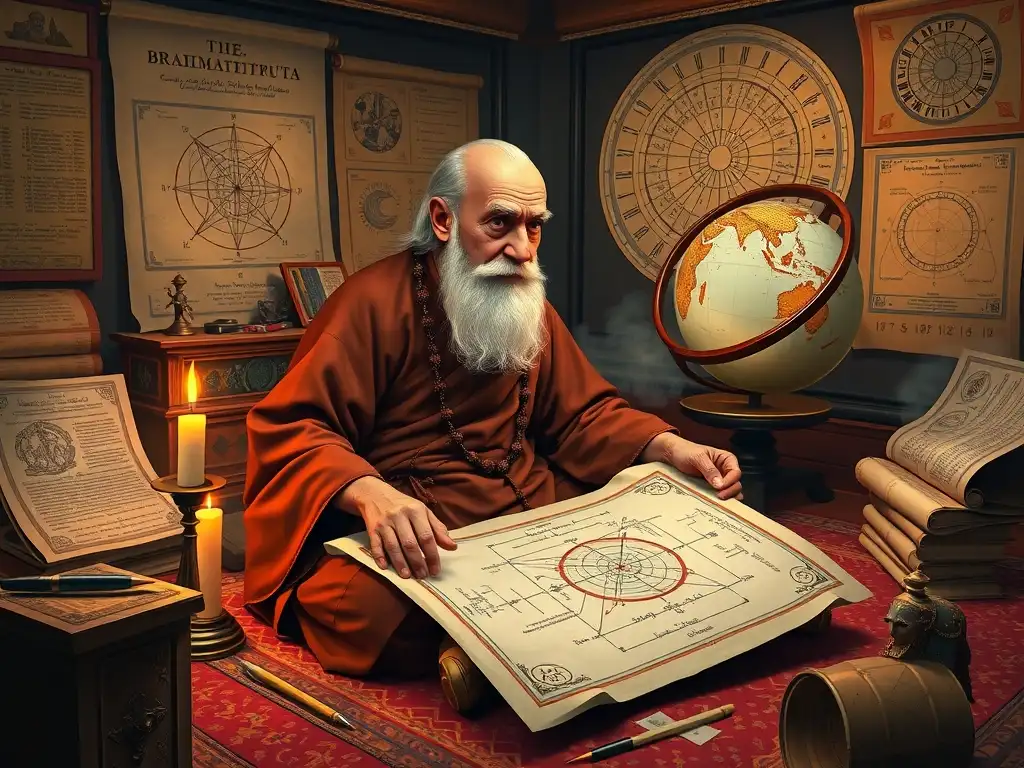
Brahmagupta, the eminent Indian mathematician from the 7th century, made significant contributions to the field of geometry, which have had a lasting impact on mathematical thought. His most notable work, the Brahmasphutasiddhanta, elaborates on various geometric principles that were foundational for future mathematicians.
One of Brahmagupta's key contributions was the formulation of rules for the calculation of areas and the properties of geometric shapes. He provided methods for determining the area of cyclic quadrilaterals, which are quadrilaterals whose vertices lie on a single circle. This was a groundbreaking advancement, as it laid the groundwork for future explorations in both geometry and trigonometry. Brahmagupta's formula for the area \( A \) of a cyclic quadrilateral with sides \( a, b, c, d \) is given by:
\[
A = \sqrt{(s-a)(s-b)(s-c)(s-d)}
\]
where \( s \) is the semi-perimeter calculated as \( s = \frac{a+b+c+d}{2} \).
In addition to his work on quadrilaterals, Brahmagupta also explored properties of circles and triangles. His insights into the relationships between angles and sides in these shapes were influential in the development of trigonometric principles in subsequent centuries. Overall, Brahmagupta's geometric contributions were not only innovative for their time but also established a rich foundation for later mathematical developments.
Innovations in Geometric Principles
Brahmagupta's innovative approaches to geometry included the introduction of algebraic methods to solve geometric problems. He was among the first to apply arithmetic operations to geometric calculations, making complex geometric problems more manageable. His work emphasized the relationship between algebra and geometry, which was a significant paradigm shift in mathematical thought.
One of the most remarkable aspects of Brahmagupta's innovations was his ability to express geometric problems in algebraic terms. For instance, he formulated the concept of the "diagonal of a rectangle" and derived formulas that related algebraic expressions to geometric constructs. This approach not only simplified calculations but also opened up new avenues for exploration in both fields.
Brahmagupta also outlined the criteria for the existence of solutions to certain geometric problems, paving the way for future mathematicians to delve deeper into both theoretical and practical applications of geometry. His geometric principles were not merely theoretical; they found applications in astronomy, architecture, and various fields, demonstrating their relevance and utility in ancient Indian society.
Methods of Solving Quadratic Equations
Brahmagupta is perhaps best known for his methods of solving quadratic equations, which were revolutionary in the context of ancient mathematics. In his seminal work, he outlined a systematic approach to solving equations of the form \( ax^2 + bx + c = 0 \).
He presented an algorithmic method for finding the roots of quadratic equations, which was a significant advancement over previous methods. Brahmagupta's procedure involved:
-
Reducing the equation to a simpler form by eliminating common factors.
-
Applying a specific formula for finding the roots, which can be summarized as:
\[
x = \frac{-b \pm \sqrt{b^2 - 4ac}}{2a}
\]
This formula is strikingly similar to the modern quadratic formula, showcasing Brahmagupta's exceptional foresight and mathematical ingenuity. His methods not only addressed the need for concrete solutions but also fostered a deeper understanding of the relationships between coefficients and roots, which would influence future mathematicians.
Brahmagupta also recognized the importance of negative solutions, a concept that was not widely accepted in his time. He explicitly stated rules for dealing with negative numbers, which was a significant step forward in the evolution of algebra. His contributions laid the groundwork for subsequent developments in algebra and number theory, marking him as a pioneer in the field.
Comparison with Other Ancient Mathematicians
Brahmagupta vs. Aryabhata: A Comparative Analysis
When comparing Brahmagupta to his contemporaries, particularly Aryabhata, it becomes evident that both mathematicians made distinct yet complementary contributions to mathematics. Aryabhata, who lived in the 5th century, is celebrated for his work in astronomy and mathematics, particularly his approximation of π and the introduction of the concept of zero as a placeholder.
While Aryabhata's work focused heavily on astronomical calculations and theories, Brahmagupta’s contributions were more algebraic and geometric in nature. For example, Aryabhata developed algorithms for calculating the positions of celestial bodies, while Brahmagupta emphasized solving equations and geometric problems.
Both mathematicians utilized the decimal system, but Brahmagupta's writings provided more explicit rules for arithmetic operations, particularly with negative numbers and zero, which were not thoroughly addressed by Aryabhata. This difference highlights how Brahmagupta expanded the mathematical landscape by integrating algebraic methods into the existing framework laid by Aryabhata.
The Distinct Approaches of Brahmagupta and Bhaskara
Brahmagupta's methodologies can also be contrasted with those of Bhaskara II, who lived in the 12th century. Bhaskara, known for his extensive work in mathematics and astronomy, built upon Brahmagupta's foundations but introduced more sophisticated techniques and concepts.
One notable distinction is in their approach to quadratic equations. While Brahmagupta formulated straightforward methods for solving these equations, Bhaskara refined these techniques, incorporating concepts of calculus and more advanced algebra. Bhaskara's work, particularly in his book Lilavati, showcased a more systematic approach to problem-solving and presented a wider array of examples, making his work more accessible to students.
Additionally, Bhaskara's treatment of negative numbers and zero was more nuanced, reflecting the evolution of mathematical thought from Brahmagupta's time. This progression illustrates how Brahmagupta's initial contributions served as a stepping stone for later mathematicians, who expanded upon his ideas and explored new dimensions of mathematical theory and practice.
While Brahmagupta laid the groundwork for algebra and geometry, his successors, like Bhaskara, took these ideas further, demonstrating the dynamic evolution of mathematics in ancient India.
The Relevance of Brahmagupta's Mathematical Concepts Today
Brahmagupta's contributions to mathematics are not merely relics of the past; they remain remarkably relevant in contemporary mathematics and various practical applications. His pioneering work in arithmetic and algebra laid foundational principles that continue to influence mathematical thought. Notably, Brahmagupta introduced the concept of zero as a number and detailed its operations, which is essential not only in pure mathematics but also in computing, engineering, and scientific research today. His rules for dealing with positive and negative numbers, particularly in his seminal text, "Brahmasphutasiddhanta," provide the groundwork for modern algebra.
Moreover, Brahmagupta's formulas for calculating the area of cyclic quadrilaterals and his work on indeterminate equations have inspired modern mathematicians to explore similar equations and geometric principles. His innovations have significantly shaped mathematical discourse, illustrating the continuity of knowledge from ancient times to the present.
Modern Applications of Brahmagupta's Theorems
Brahmagupta's theorems find applications across various fields today. For instance, his formula for the area of cyclic quadrilaterals can be seen in architecture and engineering, where understanding geometric properties is crucial for design and construction.
In computational mathematics, his methodologies for solving quadratic equations are utilized in algorithms that underlie computer programming and software development. Additionally, his work on the rules of signs when performing arithmetic operations with positive and negative numbers is foundational for modern computer science, particularly in programming languages where such operations are prevalent.
Furthermore, the principles derived from Brahmagupta's insights into indeterminate equations are relevant in cryptography and information security, where complex mathematical problems are solved to ensure data integrity and confidentiality. The adaptability and applicability of his theorems attest to their enduring relevance in a rapidly evolving mathematical landscape.
Influence on Contemporary Mathematics Education
The influence of Brahmagupta on contemporary mathematics education cannot be overstated. His systematic approach to teaching arithmetic and algebra has shaped curricula in schools and universities, particularly in regions influenced by Indian mathematics. Educators often refer to his methods when introducing concepts such as zero and negative numbers, as they provide a historical context that enriches the learning experience.
Brahmagupta’s emphasis on problem-solving and practical applications encourages students to engage with mathematics in a meaningful way. His work promotes critical thinking and analytical skills, essential in today's educational frameworks. By incorporating his theorems into mathematics education, instructors can highlight the importance of historical contributions to the field, fostering a greater appreciation for the evolution of mathematical thought.
Conclusion: The Enduring Legacy of Brahmagupta
Brahmagupta's legacy extends beyond his lifetime, influencing generations of mathematicians and scholars. His work laid crucial foundations that have allowed mathematics to flourish in various domains.
Summary of Key Contributions to Mathematics
Brahmagupta is celebrated for several key contributions, including:
- The Concept of Zero: He was one of the first to treat zero as a number, establishing rules for its use in arithmetic.
- Quadratic Equations: His methods for solving quadratic equations were groundbreaking and remain integral to algebra.
- Cyclic Quadrilaterals: He formulated a method for calculating the area of cyclic quadrilaterals, which is still taught today.
- Indeterminate Equations: Brahmagupta's work on these equations laid groundwork for future explorations in number theory.
Together, these contributions demonstrate his profound impact on mathematics, shaping it into the discipline we recognize today.
The Importance of Preserving Ancient Mathematical Knowledge
Preserving ancient mathematical knowledge, such as that of Brahmagupta, is vital for several reasons. First, it allows us to appreciate the historical development of mathematical concepts and the cultural contexts in which they emerged. Understanding these roots enriches our appreciation of modern mathematics and its applications.
Additionally, this preservation fosters interdisciplinary studies, linking mathematics with history, philosophy, and cultural studies. By studying Brahmagupta's work, contemporary mathematicians can draw inspiration from ancient methodologies and approach current mathematical problems with a fresh perspective. It reinforces the idea that mathematics is a cumulative discipline, constantly evolving while honoring its rich heritage. The legacy of Brahmagupta serves as a reminder of the interconnectedness of knowledge across time and cultures, emphasizing the need to value and preserve these ancient insights.
- Introduction to Brahmagupta's Contributions to Mathematics
- Brahmagupta's Key Contributions to Mathematics
- The Influence of Brahmagupta's Work on Future Mathematics
- Notable Texts by Brahmagupta
- Brahmagupta's Contributions to Geometry
- Comparison with Other Ancient Mathematicians
- The Relevance of Brahmagupta's Mathematical Concepts Today
- Conclusion: The Enduring Legacy of Brahmagupta
Frequently Asked Questions
What are Brahmagupta's main contributions to mathematics?
Brahmagupta is known for his pioneering work in algebra and the formulation of rules for calculating with zero. His book, "Brahmasphutasiddhanta," laid foundational concepts in mathematics.
How did Brahmagupta influence later mathematicians?
His innovative methods and theorems, particularly on quadratic equations and arithmetic, significantly influenced Islamic mathematicians and later European scholars, promoting a cross-cultural exchange of knowledge.
What is the significance of Brahmagupta's work on zero?
Brahmagupta's work on zero was revolutionary, as he defined it as a number and established rules for its use in calculations, providing a basis for modern mathematics.
Did Brahmagupta contribute to astronomy as well?
Yes, Brahmagupta made notable contributions to astronomy, including methods for calculating planetary positions and eclipses, illustrating the interconnection between mathematics and astronomy in ancient India.
How is Brahmagupta remembered today?
Brahmagupta is celebrated as a mathematical genius, and his contributions are acknowledged as critical in the development of modern mathematics, earning him a prominent place in the history of science.
Final Reflection: Embracing Brahmagupta's Timeless Legacy
In an era where mathematics continues to shape our understanding of the universe, Brahmagupta's contributions to mathematics remain profoundly relevant. His pioneering work in algebra and number theory not only laid the groundwork for future mathematicians but also provided tools that are essential in today's technological advancements. The brilliance of his insights serves as a reminder that the quest for knowledge transcends time and culture, illuminating the path for generations to come.
The influence of Brahmagupta's work is palpable in our modern cultural and social landscape, where mathematical literacy is more crucial than ever. His innovative approaches to solving quadratic equations and understanding zero have permeated various fields, from computer science to economics. As we navigate an increasingly complex world, we can draw inspiration from his legacy to foster a deeper appreciation for mathematics in our daily lives. Mathematics is the language with which God has written the universe.
– Galileo Galilei. This quote encapsulates the essence of Brahmagupta's contributions, reminding us that mathematics is not merely a subject but a universal language that connects us all.
As we reflect on Brahmagupta's remarkable achievements, I invite you to consider how his legacy can inspire your own journey in mathematics and beyond. Take a moment to explore the mathematical concepts that resonate with you, and think about how you can apply them in your life. Whether it's through problem-solving, critical thinking, or creative exploration, let Brahmagupta's genius motivate you to embrace the beauty of mathematics and its power to transform our understanding of the world.
Unleash the Mathematician Within You!
Thank you for diving into the fascinating world of Brahmagupta and his groundbreaking contributions to mathematics! We hope you've gained valuable insights into how his legacy can inspire your own intellectual journey. Now, it’s time to take that inspiration and put it into action.
- Explore Brahmagupta’s Works: Dive deeper into his texts to uncover the principles that can enhance your problem-solving skills. Consider taking online courses or reading literature related to his discoveries.
- Join a Math Community: Connect with others who share your passion for mathematics! Look for local study groups or online forums where you can exchange ideas and tackle challenges together.
- Try Solving Historical Problems: Challenge yourself by recreating some of the mathematical problems Brahmagupta addressed. Share your solutions on social media or in relevant online communities to spark discussion!
What mathematical concept from Brahmagupta's work inspired you the most, and how do you plan to incorporate it into your learning journey?