
The Relationship Between Ancient Indian Mathematics and Other Global Numerical Systems


Welcome to Ancient India History, where we embark on a fascinating journey through the rich tapestry of ancient Indian civilizations. From the remarkable innovations of the Indus Valley to the profound achievements of the Gupta Empire, we delve into the cultural and intellectual contributions that have shaped our world. In this exploration, we invite you to uncover the intriguing relationship between ancient Indian mathematics and other global numerical systems.
What secrets do these ancient calculations hold, and how have they influenced modern mathematical thought? Join us as we unravel the mysteries and marvels of a time that laid the foundation for mathematical progress across the globe.

Introduction to Ancient Indian Mathematics Contributions
Ancient Indian mathematics is a profound and intricate tapestry that weaves together the intellectual heritage of one of the world's earliest civilizations. From the sophisticated calculations of the Indus Valley Civilization to the innovative concepts developed during the Gupta Empire, the contributions of ancient Indian mathematicians have left an indelible mark on the global mathematical landscape.
This article delves into the intricate relationship between ancient Indian mathematics and other global numerical systems, highlighting the key contributions that have shaped mathematical thought across cultures and epochs. By examining the foundational principles and significant figures within this domain, we can appreciate how ancient Indian mathematics not only enriched its own civilization but also influenced mathematical practices worldwide.
Overview of Ancient Indian Mathematics
Ancient Indian mathematics is characterized by its unique approaches to arithmetic, geometry, and algebra, which were documented in various texts, including the Sulbasutras, Aryabhatiya, and Brahmasphutasiddhanta. These works laid the groundwork for mathematical practices that were innovative for their time, including:
- Decimal system: The introduction of a base-10 system, which revolutionized numerical representation.
- Zero: The conceptualization of zero as a number, which is fundamental to modern arithmetic.
- Algebraic methods: Early formulations of algebraic principles that predate similar developments in other cultures.
These contributions not only facilitated advanced calculations but also served as a bridge to later developments in mathematics across various cultures.
Significance of Contributions to Global Numerical Systems
The significance of ancient Indian mathematics extends far beyond its geographical confines. The innovative concepts developed by Indian mathematicians were instrumental in shaping mathematical practices around the globe. Key contributions include:
- Transmission of knowledge: Ancient Indian texts were translated into Arabic and later European languages, spreading mathematical concepts throughout the Islamic Golden Age and into the Renaissance.
- Influence on numeral systems: The numeral system developed in India became the foundation for the Hindu-Arabic numeral system, which is the basis for modern mathematics today.
- Mathematical techniques: Techniques such as sine functions and trigonometric tables were first developed in Indian texts, influencing later European mathematicians.
Historical Context of Ancient Indian Mathematics
To fully appreciate the contributions of ancient Indian mathematics, it is essential to understand the historical context in which these developments occurred.
Origins of Numerical Systems in Ancient India
The origins of numerical systems in ancient India can be traced back to the Indus Valley Civilization around 2500 BCE. Archaeological findings suggest that this civilization employed a form of counting and measurement, evidenced by:
- Weights and measures: Standardized weights found at archaeological sites indicate a sophisticated understanding of measurement.
- Seal inscriptions: Indus seals featuring symbols suggest an early form of numerical representation.
As Indian society evolved, so did its mathematical concepts, leading to the development of more advanced numerical systems.
Key Mathematicians and Their Contributions
Several mathematicians stand out for their groundbreaking contributions to ancient Indian mathematics. Notable figures include:
- Aryabhata (476-550 CE): Known for his work on the place value system and the calculation of the value of pi (π).
- Brahmagupta (598-668 CE): Authored the Brahmasphutasiddhanta, which included rules for solving quadratic equations and concepts of negative numbers.
- Bhaskara II (1114-1185 CE): His work, Lilavati, not only addressed practical problems in arithmetic but also explored advanced topics such as calculus.
These mathematicians laid the groundwork for future generations and significantly influenced mathematical thought across cultures.
Historical Timeline of Mathematical Developments
The evolution of ancient Indian mathematics can be encapsulated in a historical timeline that highlights key milestones and texts:
| Period | Key Developments |
|---|---|
| Indus Valley (2500-1900 BCE) | Early numerical systems and weights. |
| 5th Century CE | Aryabhata's introduction of the place value system. |
| 7th Century CE | Brahmagupta's rules for arithmetic and algebra. |
| 12th Century CE | Bhaskara II's contributions to calculus and astronomy. |
This timeline illustrates the progression of mathematical thought in ancient India and its eventual impact on global mathematical systems.
Comparative Analysis of Ancient Indian Mathematics and Other Numerical Systems
The study of ancient Indian mathematics reveals a rich tapestry of numerical systems that not only contributed significantly to the field but also interacted with various global mathematical traditions. This comparative analysis highlights the unique characteristics and contributions of ancient Indian mathematics in relation to other influential numerical systems, such as those developed in Babylon, Greece, and China. By examining these relationships, we gain insights into the shared knowledge and cultural exchanges that shaped mathematical thought across civilizations.
Ancient Indian Numerical Systems vs. Babylonian Mathematics
The ancient Indian numerical systems and Babylonian mathematics exhibit both similarities and distinct differences. The Babylonians used a base-60 (sexagesimal) system that allowed for sophisticated calculations, particularly in astronomy. In contrast, ancient Indian mathematics primarily utilized a base-10 (decimal) system, which is more intuitive for everyday counting and calculations.
One notable similarity lies in the use of positional notation. While the Babylonians employed a form of positional value, their lack of a zero concept limited their efficiency. Indian mathematicians, however, developed a fully functional positional numeral system that incorporated zero as a placeholder, enhancing the clarity and functionality of their calculations. This innovation in the representation of numbers marked a significant advancement over Babylonian methods, leading to greater ease in performing arithmetic operations.
Contributions of Ancient Indian Mathematics Compared to Greek Mathematics
When comparing ancient Indian mathematics to Greek mathematics, several key differences and contributions emerge. The Greeks, represented by mathematicians such as Euclid and Archimedes, focused extensively on geometry and formal proofs. Their work laid the foundation for modern mathematical rigor and deductive reasoning.
Ancient Indian mathematicians, on the other hand, excelled in arithmetic and algebra. The work of scholars like Aryabhata and Brahmagupta included not only geometric insights but also significant advances in number theory and practical mathematics. For instance, Brahmagupta's rules for solving quadratic equations and his concepts of negative numbers were groundbreaking and predated similar developments in Europe by centuries.
While both traditions contributed to the mathematical canon, ancient Indian mathematics placed greater emphasis on computational techniques and applications, which were pivotal for trade, astronomy, and daily life in ancient India.
Similarities and Differences with Chinese Numerical Systems
Ancient Indian mathematics and Chinese numerical systems share some similarities, particularly in their use of a positional system and the development of counting tools. The Chinese utilized a rod numeral system that allowed for efficient calculations, somewhat akin to the Indian method of using place value.
However, there are notable differences in approach and focus. Chinese mathematics, as seen in texts like the "Nine Chapters on the Mathematical Art," emphasized practical applications, such as land measurement and taxation, whereas Indian mathematics often ventured into more abstract realms, including algebra and the theoretical underpinnings of mathematics.
Moreover, while both cultures recognized the significance of zero, the Indian conceptualization of zero as a number with its own value was more revolutionary, paving the way for advancements in calculus and analysis in later centuries.
Key Contributions of Ancient Indian Mathematics
The contributions of ancient Indian mathematics are numerous and profound, influencing not only the subcontinent but also the global mathematical landscape. Key developments include the establishment of the decimal system, the conceptualization of zero, and significant advances in algebra and geometry.
The Development of the Decimal System
The decimal system, which is the foundation of modern mathematics, can be traced back to ancient India. This place-value system allows for efficient representation and manipulation of numbers, making calculations more straightforward. The use of ten digits, along with a system of place values, enabled more complex arithmetic operations and laid the groundwork for future mathematical advancements.
The influence of the Indian decimal system spread beyond the subcontinent, significantly impacting Islamic mathematics and eventually reaching Europe through translations and adaptations, solidifying its role in the development of global mathematics.
The Concept of Zero and Its Impact
The concept of zero is one of the most significant contributions of ancient Indian mathematics. Indian mathematicians like Brahmagupta formalized the use of zero, defining it as a number rather than merely a placeholder. This revolutionary idea not only facilitated the development of arithmetic and algebra but also transformed mathematical notation and calculations.
The introduction of zero allowed for more sophisticated mathematical operations, including the development of calculus in later periods. Its impact is felt across various fields, from science to engineering, and remains a cornerstone of mathematics today.
Advances in Algebra and Geometry
Ancient Indian mathematics saw remarkable advances in both algebra and geometry. Mathematicians like Aryabhata and Brahmagupta made significant strides in solving equations and understanding geometrical concepts. Aryabhata's work included methods for calculating the area of a triangle and the volume of a sphere, while Brahmagupta's rules for arithmetic operations with negative numbers laid the groundwork for future developments in algebra.
The blend of practical applications and theoretical exploration in these fields helped to create a comprehensive mathematical system that addressed real-world problems while also pushing the boundaries of mathematical thought.
Influence of Ancient Indian Mathematics on Global Numerical Systems
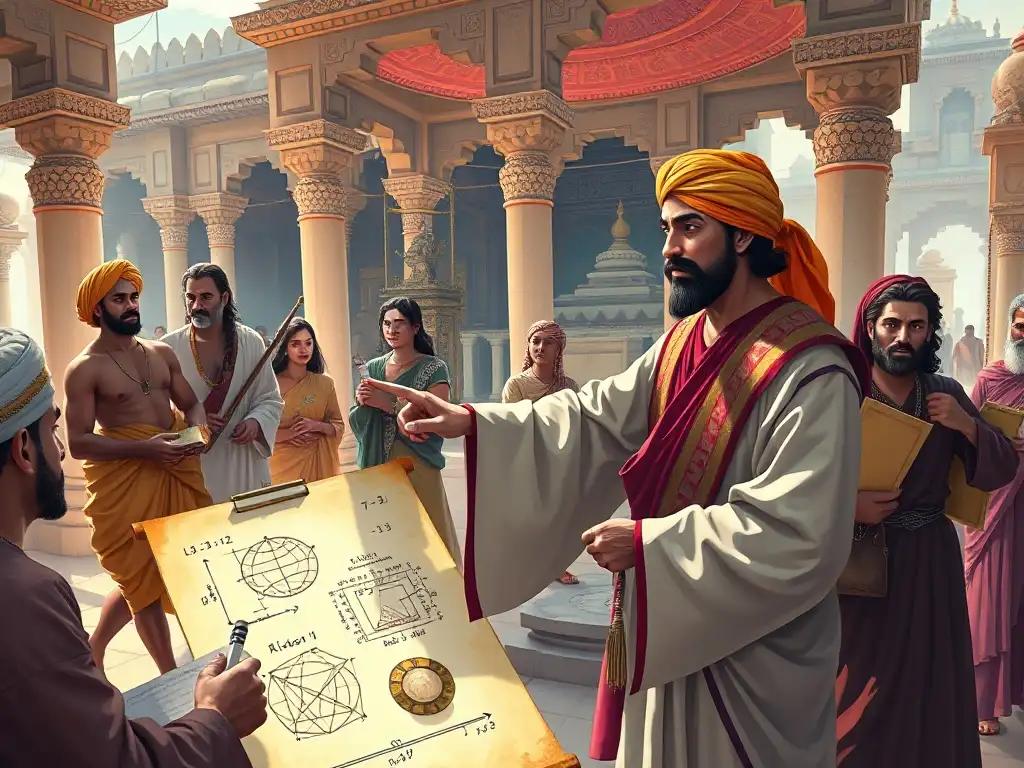
Ancient Indian mathematics has played a crucial role in shaping global numerical systems. One of the most significant contributions was the development of the decimal system and the concept of zero, which revolutionized mathematical calculations and record-keeping. This system's efficiency allowed for more complex calculations and laid the groundwork for advancements in various fields, including astronomy, commerce, and engineering. As Indian mathematicians like Aryabhata and Brahmagupta made strides in arithmetic and algebra, their work transcended geographical boundaries, influencing other cultures and civilizations.
The Spread of Indian Numerical Concepts to the Islamic World
The transmission of Indian mathematical concepts to the Islamic world primarily occurred through trade routes and scholarly exchanges. By the 7th century, Arab traders and scholars had begun to encounter Indian mathematics, particularly the numeral system that included the use of zero. The translation of key texts, such as Aryabhata's Aryabhatiya and Brahmagupta's Brahmasphutasiddhanta, into Arabic facilitated the assimilation of these ideas. This exchange not only enriched Islamic mathematics but also led to the establishment of a more sophisticated mathematical framework that would later influence European scholars during the Renaissance.
Impact on European Mathematics during the Renaissance
During the Renaissance, the reintroduction of Indian mathematical concepts into Europe marked a significant turning point in the history of mathematics. The adoption of the Hindu-Arabic numeral system simplified calculations compared to the Roman numeral system. Figures such as Fibonacci, who encountered Indian numerical ideas through Arabic texts, played a pivotal role in popularizing these concepts in Europe. This integration fostered advancements in mathematical theory and practice, enabling European mathematicians to engage in more complex computations, ultimately leading to the development of calculus and other modern mathematical disciplines.
Legacy in Modern Mathematical Practices
The legacy of ancient Indian mathematics is evident in contemporary mathematical practices. The decimal system, which originated in India, remains the foundation of modern arithmetic. Concepts such as place value and the use of zero continue to be integral to mathematics education worldwide. Furthermore, the influence of ancient Indian mathematicians is seen in various fields, including computer science, where algorithms and programming languages often draw upon fundamental mathematical principles rooted in these early contributions. The recognition of these historical influences fosters a deeper understanding of the interconnectedness of global mathematical traditions.
Challenges in Understanding the Relationship
Despite the significant contributions of ancient Indian mathematics to global numerical systems, several challenges hinder a comprehensive understanding of this relationship.
Cultural and Linguistic Barriers
Cultural and linguistic barriers have historically obstructed the appreciation and interpretation of ancient Indian mathematical texts. Many original manuscripts are written in Sanskrit, a language that poses challenges for modern scholars who may not be fluent in it. Furthermore, the cultural context in which these texts were produced often relies on specific philosophical and mathematical frameworks, making it difficult for contemporary readers to grasp their full significance. This gap has led to a limited understanding of how these concepts were originally applied and perceived.
Lack of Documentation and Preservation Issues
The preservation and documentation of ancient texts pose another significant challenge. Many mathematical manuscripts from ancient India have been lost, damaged, or remain unstudied due to a lack of resources or scholarly attention. This scarcity of primary sources limits researchers' ability to trace the evolution of mathematical ideas and their transmission to other cultures accurately. Additionally, the reliance on secondary sources for interpretation can lead to discrepancies and gaps in understanding.
Misinterpretations of Ancient Texts
Misinterpretations of ancient texts can further complicate the understanding of the relationship between ancient Indian mathematics and other global numerical systems. Scholars may project modern mathematical concepts onto ancient texts, leading to anachronistic interpretations that do not reflect the original ideas. Moreover, differing interpretations of key terms and concepts can result in divergent scholarly opinions, making it challenging to establish a unified narrative of the influence of ancient Indian mathematics on global systems. Addressing these misinterpretations requires careful analysis and a nuanced understanding of the historical context in which these texts were produced.
Conclusion: The Enduring Influence of Ancient Indian Mathematics
The legacy of ancient Indian mathematics is not merely a chapter in history; it is a foundational pillar that continues to influence modern mathematical thought and practice worldwide. From the development of the numeral system we use today to intricate concepts in algebra and geometry, the contributions from ancient Indian scholars have left an indelible mark on the evolution of mathematics. The integration of their discoveries into various global contexts underscores the universal nature of mathematical principles, transcending geographical and cultural boundaries.
As we analyze the relationships between ancient Indian mathematics and other global numerical systems, it is evident that these contributions facilitated the exchange of ideas that enriched mathematical understanding across civilizations. This interplay not only advanced mathematical techniques but also fostered a collaborative spirit among scholars throughout history. The impact of such relationships exemplifies how knowledge is often shared and transformed, leading to advancements that shape our understanding of the world.
Summary of Key Contributions
Ancient Indian mathematicians made several key contributions that have become foundational to modern mathematics. Notable achievements include:
- The Development of the Decimal System: The introduction of a base-10 positional numeral system, including the concept of zero as a number, revolutionized mathematical computation.
- Algebraic Innovations: Works such as Brahmagupta's "Brahmasphutasiddhanta" laid the groundwork for algebra, detailing rules for operations involving negative numbers and quadratic equations.
- Trigonometry: The ancient Indians developed sine and cosine functions, which influenced both mathematics and astronomy, allowing for more precise calculations in various fields.
- Geometry: Contributions to geometric principles, including the use of the Pythagorean theorem in practical applications, exemplify the advanced understanding of spatial relationships.
These contributions are not only significant in historical context but also serve as a testament to the advanced mathematical thinking present in ancient Indian civilizations.
The Importance of Ancient Indian Mathematics in Today's World
The influence of ancient Indian mathematics extends into various domains of contemporary society. In fields such as computer science, engineering, and economics, the principles established by ancient mathematicians are foundational. The decimal system, for instance, is ingrained in every aspect of modern computing and digital technology.
Moreover, the emphasis on logical reasoning and problem-solving techniques from ancient texts continues to be relevant in educational curricula worldwide. By studying ancient Indian mathematics, scholars and students alike can appreciate the depth of mathematical knowledge that has shaped our current understanding and practices. This historical perspective fosters a greater appreciation for the interconnectedness of global mathematical traditions and the importance of preserving and promoting this knowledge for future generations.
References and Further Reading
Suggested Literature on Ancient Indian Mathematics
- "A History of Indian Mathematics" by C. Kumaravel
- This book provides an extensive overview of the development of mathematical concepts and practices in ancient India, with a focus on key figures and their contributions.
- "The Mathematics of India" by S. R. S. Rao
- This work delves into the different mathematical systems used in ancient India, exploring their applications and influences on other cultures.
- "The Legacy of Ancient Indian Mathematics" by A. Chatterjee
- An insightful analysis of how ancient Indian mathematical practices have impacted modern mathematics and science.
Online Resources for Exploring Numerical Systems
- The Indian Mathematical Society: Offers a variety of resources and publications focusing on the history and contributions of Indian mathematics.
- The Digital Library of India: Hosts a collection of ancient texts and manuscripts related to Indian mathematics, available for public access.
- The MacTutor History of Mathematics Archive: Features biographical entries and historical accounts of prominent Indian mathematicians and their work in the context of global mathematics.
These resources serve as valuable tools for anyone interested in deepening their understanding of ancient Indian mathematics and its lasting impact on the world.
- Introduction to Ancient Indian Mathematics Contributions
- Historical Context of Ancient Indian Mathematics
- Comparative Analysis of Ancient Indian Mathematics and Other Numerical Systems
- Key Contributions of Ancient Indian Mathematics
- Influence of Ancient Indian Mathematics on Global Numerical Systems
- Challenges in Understanding the Relationship
- Conclusion: The Enduring Influence of Ancient Indian Mathematics
- References and Further Reading
- What are the main contributions of ancient Indian mathematics?
- How did ancient Indian mathematics influence other cultures?
- What role did Brahmagupta play in ancient Indian mathematics?
- How does the Indus Valley Civilization contribute to the understanding of early mathematics?
- What is the significance of the Gupta Empire in the development of mathematics?
Frequently Asked Questions
What are the main contributions of ancient Indian mathematics?
Ancient Indian mathematics significantly contributed to numeral systems, zero, and the concept of negative numbers. These innovations laid the foundation for modern mathematics.
How did ancient Indian mathematics influence other cultures?
Ancient Indian mathematics had a profound impact on Arab and European mathematical systems, particularly through the transmission of the decimal system and trigonometric concepts.
What role did Brahmagupta play in ancient Indian mathematics?
Brahmagupta was a pivotal figure who formulated rules for arithmetic operations and introduced methods for solving quadratic equations in his seminal work, Brahmasphutasiddhanta.
How does the Indus Valley Civilization contribute to the understanding of early mathematics?
The Indus Valley Civilization showcased early signs of mathematical understanding through measuring systems and grid layouts, indicating a sophisticated grasp of geometry.
What is the significance of the Gupta Empire in the development of mathematics?
During the Gupta Empire, there was a remarkable advancement in mathematics, particularly in calculus, algebra, and the systematic use of zero, which greatly influenced subsequent mathematical thought.
Final Reflection: The Enduring Legacy of Ancient Indian Mathematics
The contributions of ancient Indian mathematics are not just historical footnotes; they are foundational pillars that have shaped modern numerical systems across the globe. Today, as we navigate an increasingly interconnected world, the insights and innovations from ancient Indian mathematicians resonate with contemporary challenges, reminding us of the timeless nature of knowledge and its ability to transcend borders. The brilliance of their work continues to inspire mathematicians, scientists, and thinkers, proving that the quest for understanding is a universal endeavor.
The influence of ancient Indian mathematics extends far beyond its time, weaving itself into the fabric of various cultures and societies. From the introduction of the decimal system to the concept of zero, these contributions have fundamentally altered how we perceive and manipulate numbers. As we reflect on this rich legacy, we can appreciate how it has paved the way for advancements in technology, science, and education. Mathematics is the language in which God has written the universe.
– Galileo Galilei. This quote encapsulates the profound impact that mathematical discoveries have had on our understanding of the world, a sentiment that echoes the significance of ancient Indian contributions.
As we look to the future, let us embrace the lessons from ancient Indian mathematics and recognize the importance of preserving and sharing knowledge across cultures. I invite you to reflect on how these historical insights can inform your own journey, whether in education, innovation, or personal growth. By acknowledging the interconnectedness of our mathematical heritage, we can foster a deeper appreciation for the diversity of thought and creativity that continues to shape our world today. Together, let us celebrate and build upon the remarkable contributions of ancient Indian mathematics, ensuring that their legacy endures for generations to come.
Thank you for diving deep into the fascinating world of ancient Indian mathematics and its connections to global numerical systems. We hope you found insights that inspire you to further explore this remarkable history. Now, let’s take the next steps together!
- Dive deeper: Read more about specific mathematicians from ancient India and their significant contributions to mathematics worldwide. Consider visiting academic resources or reading books to enhance your understanding.
- Share the knowledge: Inform your friends or share on social media about these incredible connections to raise awareness and appreciation for ancient Indian achievements in mathematics.
- Join the conversation: Participate in the comments below or on our forums to share your thoughts and questions regarding ancient mathematics and its enduring legacy.
What aspect of ancient Indian mathematics intrigues you the most, and how do you believe it has influenced modern numerical systems?