
The Relevance of Ancient Indian Logic in Contemporary Philosophy


Welcome to Ancient India History, where we embark on an enthralling journey through the rich tapestry of ancient Indian civilizations. From the remarkable innovations of the Indus Valley to the philosophical depths of the Gupta Empire, our exploration unveils the profound contributions that continue to influence our world today.
In our featured article, we delve into the intriguing relevance of ancient Indian logic in contemporary philosophy, a topic that promises to challenge your perceptions and inspire deeper contemplation. Join us as we uncover the wisdom of the past and its echoes in the present—your adventure into the depths of ancient thought begins here!
- Introduction to Ancient Indian Logic Relevance
- Historical Context of Ancient Indian Logic
- Core Principles of Ancient Indian Logic
- Comparison of Ancient Indian Logic with Contemporary Philosophical Thought
- Applications of Ancient Indian Logic in Contemporary Issues
- Critique and Challenges of Ancient Indian Logic
- Conclusion: The Enduring Relevance of Ancient Indian Logic
- Frequently Asked Questions
- Final Reflection: The Enduring Relevance of Ancient Indian Logic
- Unlock the Wisdom of Ancient Logic Today!
Introduction to Ancient Indian Logic Relevance
The exploration of ancient Indian logic is a fascinating journey that unveils the profound contributions of Indian philosophers to the realm of logic and reasoning. From the early days of the Indus Valley civilization to the philosophical inquiries during the Gupta Empire, ancient Indian thought has laid the groundwork for various schools of philosophy, notably Nyaya and Vaisheshika.
This article delves into the relevance of ancient Indian logic in contemporary philosophy, highlighting how these ancient systems of thought continue to influence modern philosophical discourse. By examining the intricacies of ancient Indian logic, we can better understand its enduring impact on knowledge, reasoning, and the very nature of truth.
Overview of Ancient Indian Philosophy
Ancient Indian philosophy is characterized by a rich tapestry of ideas and schools that emerged over millennia. Central to this philosophical tradition are texts known as the Darshanas, which encompass six orthodox schools of thought: Nyaya, Vaisheshika, Sankhya, Yoga, Mimamsa, and Vedanta. Each of these schools offers unique insights into metaphysics, epistemology, and ethics.
- Nyaya: This school emphasizes logic and epistemology, providing systematic frameworks for reasoning and debate.
- Vaisheshika: It focuses on the nature of reality and categorization of substances, contributing to the understanding of existence.
- Sankhya: Often considered the oldest philosophical system, it outlines dualism between consciousness and matter.
The interactions among these schools fostered a vibrant intellectual environment, where logic was not only a tool for debate but also a foundational element in the pursuit of knowledge. They collectively contributed to a holistic understanding of human experience, addressing questions of existence, reality, and the means to acquire knowledge.
Significance of Logic in Ancient Indian Thought
The significance of logic in ancient Indian thought cannot be overstated. Logic was regarded as an essential tool for discerning truth and understanding the universe. The Nyaya school, in particular, developed rigorous methods of logical analysis, including:
- Pramanas (Means of Knowledge): Nyaya identified four primary means of acquiring knowledge: perception, inference, comparison, and testimony. Each method was meticulously examined to ensure reliability and validity.
- Fallacies and Valid Argumentation: The Nyaya philosophers cataloged various logical fallacies, emphasizing the importance of sound reasoning in philosophical discourse. This meticulous approach to argumentation laid the groundwork for critical thinking.
The contributions of ancient Indian logic extend beyond academic philosophy and have influenced fields such as mathematics, science, and linguistics. For instance, the logical principles articulated by ancient Indian thinkers have resonated in contemporary discussions on epistemology and the philosophy of language.
The relevance of ancient Indian logic is profound and multifaceted, providing a rich source of wisdom that continues to inform and inspire modern philosophical thought. Understanding this ancient tradition allows us to appreciate the depth and complexity of human reasoning throughout history.
Historical Context of Ancient Indian Logic

Development of Logical Systems in Ancient India
Ancient Indian logic is characterized by its systematic approach to reasoning and debate, which emerged around the 6th century BCE. This period saw the rise of various philosophical schools that laid the foundations for logical inquiry, particularly the Nyaya and Vaisheshika schools. The development of logical systems in ancient India was not merely an academic exercise but deeply intertwined with metaphysical and epistemological inquiries.
The Nyaya school, founded by the sage Gautama, emphasized the importance of valid reasoning (pramāṇa) and established a framework for logical discourse. It introduced concepts such as inference (anumāna) and analogy (upamāna) as essential tools for obtaining knowledge. The Nyaya Sutras, composed around the 2nd century BCE, served as a systematic treatise on logic, detailing the rules of reasoning and argumentation.
In parallel, the Vaisheshika school, attributed to Kanada, developed a distinct approach focusing on the nature of reality and the classification of substances. This school introduced an atomic theory, positing that all matter is composed of indivisible particles (anu). The logical implications of this view necessitated a rigorous framework for understanding causality and the relationships between different entities.
The intermingling of these schools fostered a rich environment for logical thought, leading to advancements in critical thinking, categorization, and the methodology of philosophical inquiry. The culmination of these efforts can be seen in the later works of philosophers such as Adi Shankaracharya and Kumarila Bhatta, who integrated logical reasoning with other philosophical doctrines.
Key Philosophical Schools Contributing to Logic
The evolution of ancient Indian logic cannot be fully appreciated without recognizing the key philosophical schools that contributed to its rich tapestry. Each school offered unique perspectives and methodologies that shaped the discourse on logic and reasoning.
Nyaya: The Logic of Justice
Nyaya philosophy, often referred to as the "Logic of Justice," emerged as a foundational school in ancient Indian thought. Its primary focus was on the nature of knowledge and the principles of valid reasoning. The Nyaya Sutras, composed by Gautama, outline the epistemological categories and provide a detailed analysis of the means of obtaining knowledge:
- Pramāṇa (Means of Knowledge): Nyaya identifies four valid sources of knowledge:
- Pratyaksha (Perception): Direct sensory experience.
- Anumāna (Inference): Logical deduction based on premises.
- Upamāna (Analogy): Knowledge derived from comparisons.
- Shabda (Testimony): Knowledge gained from authoritative sources.
Nyaya philosophers emphasized the importance of logical consistency and the role of debate in refining arguments. They developed rules for argumentation, including the significance of counterarguments (purvapaksha) and the need for clarity in definitions (siddhanta).
Vaisheshika: Atomism and Its Logical Framework
The Vaisheshika school, founded by Kanada, introduced a distinctive framework of logic centered around the concept of atomism. Its central tenets include:
- Categories of Existence: Vaisheshika classified reality into substances, qualities, actions, universals, and inherence. This classification served as a basis for logical analysis.
- Causality: The school explored the notion of causation, arguing that all effects arise from specific causes. This necessitated a logical structure to establish relationships between entities.
Vaisheshika philosophers employed logical reasoning to dissect the nature of reality, emphasizing that understanding the atomic structure of matter is essential for grasping broader metaphysical concepts. The systematic approach to categorization and analysis in Vaisheshika laid the groundwork for future philosophical inquiries.
Sankhya: The Dualistic Approach to Logic
Sankhya, another significant philosophical school, introduced a dualistic approach that distinguished between the material (Prakriti) and the spiritual (Purusha) realms. This dualism prompted a unique exploration of logic, particularly in the context of knowledge and liberation.
- Epistemological Framework: Sankhya philosophers recognized that knowledge arises from the interaction between Purusha and Prakriti. They proposed various means of knowledge, paralleling Nyaya's pramāṇa, but with a distinct focus on the nature of consciousness.
- Logical Implications: The dualistic model raised questions about the validity of knowledge derived from sensory experiences versus that of pure consciousness. This led to intense debates regarding the reliability of perception and inference.
The Sankhya school's contributions to logic are notable for their emphasis on the relationship between knowledge, reality, and liberation, offering a nuanced perspective that enriched the overall discourse on ancient Indian logic.
The relevance of ancient Indian logic in contemporary philosophy can be traced back to these foundational schools, each contributing unique insights into the nature of reasoning, knowledge, and existence. Their systematic approaches to logic and debate continue to influence modern philosophical thought, underscoring the enduring legacy of ancient Indian intellectual traditions.
Core Principles of Ancient Indian Logic

Ancient Indian logic, particularly within the frameworks of the Nyaya and Vaisheshika schools, is founded on several core principles that continue to hold relevance in contemporary philosophical discourse. These principles not only provide a comprehensive system for understanding knowledge and reality but also offer valuable insights into epistemology and the philosophy of language.
Central to ancient Indian logic is the concept of Pramanas, which refers to the valid means of knowledge. The ancient philosophers distinguished between different sources of knowledge, each with its own methodology and implications. This systematic approach to understanding knowledge is critical in evaluating claims and arguments, making it a vital component of both ancient and modern philosophical discussions.
The Concept of Pramanas (Sources of Knowledge)
In ancient Indian philosophy, Pramanas are classified into several categories, each representing a different means through which knowledge can be acquired. The primary types include:
- Pratyaksha (Perception):
- This is the direct experience or observation of an object. It forms the foundational basis of knowledge, as it is considered the most immediate and reliable source.
- Anumana (Inference):
- Anumana refers to knowledge gained through reasoning or inference. This method allows individuals to draw conclusions based on observations and premises, which can be applied in various contexts, including scientific inquiry and everyday reasoning.
- Upamana (Comparison or Analogy):
- This form of knowledge arises from analogical reasoning, where one draws conclusions based on similarities between known and unknown entities. It plays an essential role in language acquisition and understanding abstract concepts.
- Shabda (Verbal Testimony):
- This source pertains to knowledge derived from authoritative statements or scriptures. In the context of ancient Indian philosophy, the Vedas and other sacred texts are considered primary sources of knowledge through Shabda.
These Pramanas establish a framework for evaluating the validity of knowledge claims, which remains pertinent in contemporary philosophical discussions regarding epistemology and the nature of truth.
Types of Inference in Ancient Indian Logic
Inference, as articulated in ancient Indian logic, is a crucial tool for deriving knowledge that is not immediately observable. It encompasses various techniques for reasoning, two of which are particularly noteworthy: Anumana and Upamana.
Anumana: Inference and Its Implications
Anumana is a method of reasoning that allows for conclusions to be drawn from premises based on observed correlations. This form of inference is structured around a syllogistic framework, often represented in a three-part format:
- Major Premise: States a general rule or principle.
- Minor Premise: Applies the general rule to a specific case.
- Conclusion: Derives a specific conclusion based on the premises.
For example:
- Premise 1: All humans are mortal. (General Rule)
- Premise 2: Socrates is a human. (Specific Case)
- Conclusion: Therefore, Socrates is mortal.
This method highlights the logical relationships between concepts and supports the understanding of causality and necessity in arguments. The implications of Anumana extend beyond philosophy, influencing fields such as mathematics, science, and even artificial intelligence, where deductive reasoning plays a pivotal role.
Upamana: Comparison and Analogy
Upamana is the process of acquiring knowledge through analogy and comparison. This method allows individuals to infer properties or characteristics of one object based on its similarity to another, known object. Upamana can be particularly useful in the following contexts:
- Language Learning: Understanding new words or concepts by relating them to familiar ones.
- Abstract Thinking: Grasping complex ideas by drawing parallels with simpler, well-understood concepts.
An example of Upamana can be illustrated as follows:
- Known Object: A cow is a four-legged animal that produces milk.
- Unknown Object: A goat is also a four-legged animal.
- Inference: One may conclude that a goat may also produce milk, drawing on the analogy with cows.
This comparative reasoning reinforces the importance of context and shared characteristics in knowledge acquisition, showcasing how ancient Indian logic provides a robust methodology for understanding both the known and the unknown.
The exploration of these concepts highlights the relevance of ancient Indian logic in contemporary philosophical discussions, offering valuable frameworks for understanding knowledge, inference, and reasoning in our modern contexts.
The Role of Debate and Dialectics in Ancient Indian Philosophy
Debate and dialectics were central to the development of philosophical thought in ancient India, serving as vital tools for the exploration and articulation of ideas. These practices not only facilitated the exchange of differing viewpoints but also encouraged a rigorous examination of concepts, leading to a deeper understanding of reality and knowledge.
In the ancient Indian context, debates (known as "vada" or "jalpa") were conducted in a structured manner, often involving scholars from various philosophical schools. This process was not merely about winning an argument; rather, it aimed to uncover truth through logical reasoning and critical thinking. The ancient texts, particularly within the Nyaya school, emphasize the importance of debate as a means to refine one's arguments and to eliminate fallacies. The dialectical method, characterized by a back-and-forth exchange of ideas, allowed philosophers to challenge assumptions and clarify definitions, which was crucial for establishing a shared framework for discussion.
Moreover, the dialectical approach fostered an environment where philosophical inquiry could thrive. Schools such as Nyaya and Vaisheshika engaged in systematic debates that not only addressed metaphysical questions but also practical concerns related to ethics, epistemology, and the nature of existence. The rigorous methodologies developed in these debates contributed to a rich tapestry of philosophical thought, influencing later intellectual traditions both within and outside India.
Impact on Contemporary Thought
The influence of ancient Indian dialectics can still be felt in contemporary philosophical discourse. Modern philosophical debates often echo the structured approaches of ancient Indian logic, where the emphasis is placed on clarity, precision, and logical coherence. The relevance of these ancient practices is evident in various fields, including formal logic, cognitive science, and even artificial intelligence, where the principles of reasoning and argumentation are foundational.
Furthermore, the recognition of the value of pluralism in philosophical inquiry can be traced back to these ancient practices. The willingness to engage with differing viewpoints and the pursuit of a shared understanding remain paramount in contemporary discussions. This aspect of ancient Indian philosophy aligns with current movements that advocate for inclusivity and diversity in thought, underpinning the idea that truth can be multifaceted and complex.
The role of debate and dialectics in ancient Indian philosophy not only shaped the intellectual landscape of the time but also continues to resonate in contemporary philosophical thought. The structured methodologies and commitment to logical rigor established by ancient philosophers provide a foundation for ongoing inquiry and dialogue in the quest for knowledge and understanding.
Comparison of Ancient Indian Logic with Contemporary Philosophical Thought

The exploration of ancient Indian logic reveals a sophisticated system of thought that not only stands on its own but also provides valuable insights when compared with contemporary philosophical frameworks. This section delves into the similarities, distinct features, and ongoing relevance of ancient Indian logic in modern philosophical discourse.
Similarities with Western Logical Systems
Ancient Indian logic shares several foundational principles with Western logical systems, particularly in the realm of formal reasoning. Both traditions emphasize clarity in argumentation and the importance of establishing valid premises. Some notable similarities include:
- Deductive Reasoning: Both ancient Indian logicians, particularly the Nyaya school, and Western philosophers utilize deductive reasoning as a means to derive conclusions from established premises. For example, the Nyaya sutras articulate rules of inference that align closely with syllogistic reasoning found in Aristotelian logic.
- Categorization of Knowledge: Just as Western philosophy categorizes knowledge into distinct areas, ancient Indian logic similarly classifies knowledge into various types, such as perception (pratyaksha), inference (anumana), and testimony (sabda). This categorization aids in understanding the nature and limits of human knowledge.
- Focus on Validity: Both traditions prioritize the validity of arguments. In ancient Indian logic, the concept of "prama" (valid cognition) is central, paralleling the Western focus on soundness and validity in arguments. This common ground facilitates fruitful exchanges between the two philosophical traditions.
Distinct Features of Ancient Indian Logic
While there are similarities, ancient Indian logic possesses unique characteristics that set it apart from contemporary philosophical thought:
- Pramanas (Means of Knowledge): Ancient Indian logic delineates six pramanas: perception (pratyaksha), inference (anumana), comparison (upamana), verbal testimony (sabda), non-cognition (abhava), and postulation (arthapatti). This comprehensive framework provides a more nuanced understanding of knowledge acquisition than is commonly found in Western systems.
- Emphasis on Debate and Dialectics: The ancient Indian tradition placed significant importance on debate (vada) as a means of intellectual engagement. This dialectical approach encourages rigorous examination of opposing views, fostering a collaborative pursuit of truth that contrasts with the more adversarial nature often seen in Western philosophical discourse.
- Interconnectedness of Logic and Ethics: Ancient Indian logic is not merely an abstract tool for reasoning; it is deeply intertwined with ethical considerations. The Nyaya school, for instance, posits that valid reasoning must also lead to right action, highlighting a holistic view of knowledge that integrates logic with moral philosophy.
Relevance of Ancient Indian Logic in Modern Philosophy
The relevance of ancient Indian logic in contemporary philosophy cannot be overstated. Its principles resonate with modern discussions in various fields, including epistemology, ethics, and even artificial intelligence. Key areas of relevance include:
- Epistemological Contributions: Ancient Indian logic's detailed analysis of the means of knowledge offers valuable insights for contemporary epistemology. The nuanced understanding of perception and inference can enrich current debates about the nature of knowledge and belief.
- Ethical Frameworks: The integration of logic and ethics in ancient Indian thought prompts modern philosophers to reconsider the relationship between rationality and morality. This perspective encourages the exploration of how logical reasoning can inform ethical decision-making in today's complex world.
- Influence on Cognitive Science: The analytical rigor of ancient Indian logic has implications for the development of artificial intelligence and cognitive science. Its structured approach to reasoning aligns with contemporary efforts to model human thought processes in computational systems.
The study of ancient Indian logic not only enhances our understanding of historical philosophical traditions but also offers significant contributions to contemporary thought. By examining its similarities with Western systems, acknowledging its distinct features, and recognizing its relevance today, we can appreciate the rich legacy of ancient Indian logic and its enduring impact on philosophical discourse.
Applications of Ancient Indian Logic in Contemporary Issues

The study of ancient Indian logic, particularly through schools such as Nyaya and Vaisheshika, provides valuable insights applicable to contemporary philosophical discussions. These logical frameworks not only enhance our understanding of reasoning but also offer practical applications in various fields, including ethics and science.
Ethical Decision-Making and Logic
Ancient Indian logic significantly contributes to ethical decision-making by offering structured methodologies for evaluating moral dilemmas. The Nyaya school emphasizes the importance of pramanas (means of knowledge) in discerning right from wrong.
- Key Concepts in Ethical Logic:
- Pramanas: These are the valid sources of knowledge that guide ethical reasoning.
- Pratyaksha (perception)
- Anumana (inference)
- Upamana (comparison)
- Shabda (verbal testimony)
- Pramanas: These are the valid sources of knowledge that guide ethical reasoning.
The application of these concepts allows individuals to navigate complex moral landscapes with clarity. For instance, when faced with ethical dilemmas in business or healthcare, practitioners can utilize logical frameworks to weigh potential outcomes against ethical principles.
In ethical contexts, ancient Indian logic serves as a compass, guiding decision-makers through the murky waters of moral uncertainty.
Furthermore, the Nyaya approach promotes a form of dialectical reasoning, where dialogue and debate are encouraged to arrive at ethical conclusions. This method is particularly relevant today, as societies grapple with contentious issues such as climate change, social justice, and technological ethics. By fostering open discussions based on logical analysis, stakeholders can better understand differing perspectives and make informed decisions.
Logical Reasoning in Modern Scientific Discourse
The principles of ancient Indian logic are also reflected in modern scientific reasoning. The Nyaya and Vaisheshika schools laid foundational ideas about inference and classification that resonate with contemporary scientific methodologies.
- Influence on Scientific Method:
- Inductive Reasoning: The Nyaya school’s emphasis on inference parallels the inductive approach used in scientific research.
- Categorization: The Vaisheshika system of classifying substances and their properties influences modern taxonomy and classification systems in biology.
The systematic approach to reasoning found in ancient Indian logic encourages a rigorous examination of evidence, hypothesis testing, and the formulation of theories. For example, the Nyaya framework can help scientists articulate the logical underpinnings of their research, enhancing transparency and reproducibility in scientific discourse.
In addition, the philosophical inquiries of ancient Indian thinkers regarding the nature of reality and causation remain relevant. The dialogues surrounding anupramanavada (the theory of dependence) can inform current debates in fields such as quantum physics, where the nature of observation and reality is still a topic of much discussion.
As we explore the relevance of ancient Indian logic in contemporary philosophy, it becomes evident that these age-old principles provide a robust foundation for addressing modern challenges, fostering a dialogue that bridges the past with the present.
Critique and Challenges of Ancient Indian Logic
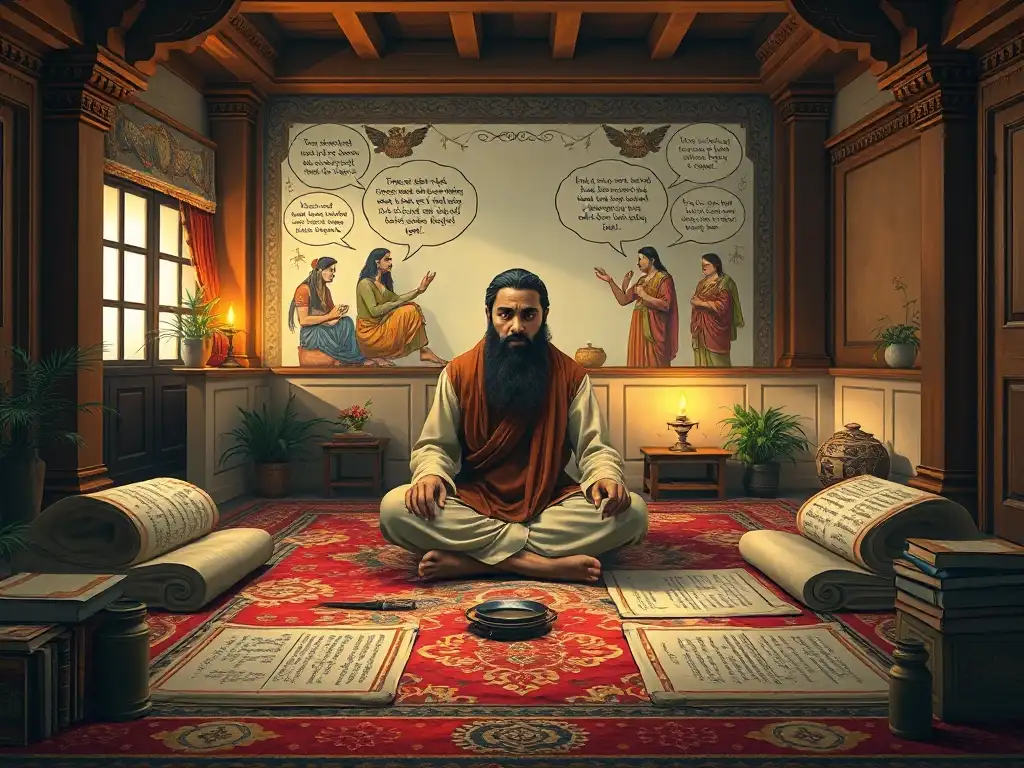
While ancient Indian logic has significantly contributed to philosophical discourse, it is not without its critiques and challenges. Scholars often encounter various obstacles when interpreting and applying ancient Indian logical frameworks, particularly in the context of contemporary philosophy. These critiques can arise from misinterpretations of ancient texts, a lack of contextual understanding, and the differing epistemological foundations that ancient Indian logic operates upon compared to Western philosophical traditions.
Misinterpretations of Ancient Texts
One of the primary challenges in understanding ancient Indian logic is the frequent misinterpretation of foundational texts. Texts such as the Nyaya Sutras and the Vaisheshika Sutras are often viewed through the lens of modern philosophical paradigms, leading to distorted understandings. Here are some key points regarding this issue:
- Language and Terminology: The Sanskrit language, rich in nuances, can lead to varied interpretations of key terms. For instance, the term "pramana" (means of knowledge) has diverse meanings that can be misconstrued when translated into contemporary languages.
- Philosophical Context: Ancient texts must be understood within their historical and cultural contexts. The philosophical debates of the time, such as those surrounding epistemology and metaphysics, are often overlooked, resulting in anachronistic readings.
- Selective Emphasis: Scholars may selectively emphasize specific arguments while neglecting others, creating a skewed representation of the logical systems. This selective reading can lead to a misunderstanding of the holistic nature of ancient Indian logic.
The Need for Contextual Understanding
To fully grasp the relevance of ancient Indian logic in contemporary philosophy, it is essential to adopt a contextual approach to its study. Here are some aspects that highlight the importance of this understanding:
- Interdisciplinary Connections: Ancient Indian logic intersects with various disciplines, including linguistics, ethics, and epistemology. A contextual understanding allows for a more comprehensive analysis of how these fields influence and inform each other.
- Cultural Perspectives: Recognizing the cultural backdrop of ancient Indian thought can enhance our understanding of its logical processes. For instance, the interplay between logic and spirituality in texts like the Yoga Sutras exemplifies how philosophical inquiry was deeply rooted in cultural practices.
- Application to Modern Issues: Ancient Indian logic offers valuable insights into contemporary philosophical problems, such as debates on perception and inference. Understanding its context can illuminate how these ancient frameworks can be applied to modern discussions about knowledge and belief systems.
Addressing the critiques and challenges associated with ancient Indian logic requires careful consideration of textual interpretations and a commitment to contextual understanding. By doing so, scholars and philosophers can better appreciate the significance and relevance of ancient Indian logic in today's philosophical landscape.
Conclusion: The Enduring Relevance of Ancient Indian Logic

Summary of Key Points
Ancient Indian logic, particularly as developed within the Nyaya and Vaisheshika schools, presents a nuanced framework for understanding epistemology, reasoning, and argumentation that remains relevant today. Key points include:
- Foundational Concepts: The principles of inference (anumana) and perception (pratyaksha), which form the bedrock of ancient Indian logic, continue to inform modern philosophical discourse. Their emphasis on systematic reasoning is mirrored in contemporary epistemological studies.
- Methodological Rigor: The structured approach of Nyaya scholars to logical reasoning and debate showcases a commitment to clarity and precision. This methodological rigor is echoed in modern logical analysis, emphasizing the importance of sound arguments.
- Comparative Philosophy: The cross-pollination of ideas between ancient Indian logic and Western philosophical traditions illustrates its global relevance. Engaging with these texts can enhance the understanding of logic and philosophy across cultures.
- Practical Applications: The practical implications of ancient Indian logic can be seen in fields such as artificial intelligence and cognitive science, where understanding human reasoning processes is crucial.
Future Directions for Research in Ancient Indian Logic
The study of ancient Indian logic is ripe for further exploration, particularly in several promising areas:
- Interdisciplinary Approaches: Collaborating with cognitive science and artificial intelligence researchers can yield insights into the applicability of ancient logical frameworks in modern technology. This could lead to advancements in machine reasoning and decision-making algorithms.
- Comparative Analyses: A deeper examination of the parallels and divergences between ancient Indian logic and other philosophical traditions, particularly Western logic, can enrich philosophical discourse. This includes investigating how these systems approach concepts such as validity, soundness, and truth.
- Textual Studies: Continued work on unearthing and translating ancient texts can shed light on lesser-known logical theories and arguments. Scholars can focus on texts from the Nyaya and Vaisheshika traditions that have not yet been fully analyzed or compared to contemporary logic.
- Practical Applications in Education: Exploring how ancient Indian logic can inform modern pedagogical practices in teaching critical thinking and reasoning skills is another area worth investigating. Integrating these teachings into curricula could foster a more holistic approach to education.
- Cultural Studies: Investigating how ancient Indian logic has influenced cultural practices and societal structures in Indian history can provide insights into its enduring relevance. This includes examining how logical reasoning has shaped legal systems, governance, and ethical frameworks throughout Indian civilization.
By pursuing these directions, researchers can ensure that the relevance of ancient Indian logic continues to be recognized and utilized in contemporary philosophical discussions.
Frequently Asked Questions
What is ancient Indian logic?
Ancient Indian logic refers to the systematic study and analysis of reasoning that emerged in ancient India, particularly through texts like the Nyaya Sutras and Buddhist logic. It emphasizes the importance of valid inference and argumentation.
How does ancient Indian logic differ from Western logic?
Ancient Indian logic incorporates a holistic approach that includes epistemology and metaphysics, differing from the more formalized structures found in Western logic. It also emphasizes the role of perception and testimony in the reasoning process.
What are the key contributions of ancient Indian logic to contemporary philosophy?
The key contributions include insights on validity, fallacies, and debate techniques, which continue to influence contemporary philosophical discourse. Scholars today explore its relevance in understanding complex arguments and critical thinking.
Why is the relevance of ancient Indian logic important today?
The relevance lies in its ability to provide alternative perspectives on reasoning and argumentation, enriching the global philosophical landscape. It encourages a deeper understanding of cultural diversity in logical traditions.
How can one study ancient Indian logic?
Studying ancient Indian logic can be pursued through academic courses, translations of primary texts, and engaging with scholarly discussions in both historical and contemporary contexts. Resources like journals and conferences on philosophy are also valuable.
Final Reflection: The Enduring Relevance of Ancient Indian Logic
The exploration of ancient Indian logic reveals its profound relevance in contemporary philosophy, demonstrating that the insights of the past continue to shape our understanding of reason and argumentation today. As we navigate an increasingly complex world, the principles established by ancient Indian philosophers provide a framework for critical thinking and ethical reasoning that is more essential than ever. The wisdom embedded in these ancient texts challenges us to reconsider our approaches to knowledge and truth in a time when misinformation is rampant.
The influence of ancient Indian logic extends beyond academic discourse; it permeates our cultural and social landscapes, inviting us to engage in deeper dialogues about the nature of reality and perception. The teachings of figures like Nyaya and Buddhist logicians have fostered a rich tradition of debate and inquiry that resonates with modern philosophical movements. As the philosopher B.K. Matilal once said, Indian logic is not merely a historical curiosity; it is a living tradition that offers valuable insights into the nature of reasoning.
This ongoing dialogue between ancient wisdom and contemporary thought encourages us to appreciate the depth of our intellectual heritage.
As we reflect on the lessons of ancient Indian logic, let us embrace the challenge to apply these timeless principles in our daily lives. Consider how you can cultivate a more nuanced understanding of arguments and engage in constructive discourse with others. In doing so, you not only honor the legacy of these ancient thinkers but also contribute to a more thoughtful and reasoned society. The relevance of ancient Indian logic is not confined to the past; it is a call to action for all of us to think critically and engage meaningfully with the world around us.
Unlock the Wisdom of Ancient Logic Today!
Thank you for diving into the fascinating world of ancient Indian logic with us! You've gained insights into how these timeless philosophies continue to resonate in contemporary thought. Now, it’s time to take your exploration further and see how you can implement these principles in your life and learning.
Here are some meaningful steps you can take right now:
- Embrace the principles of ancient logic by incorporating a daily practice of reflective thinking. Dedicate 5-10 minutes each day to contemplate a specific philosophical question or personal dilemma you encounter.
- Engage with our community! Share your reflections and insights on this article in the comments below or join our forums to discuss how ancient logic can influence modern discourse.
- Explore additional resources. Check out our recommended readings section to discover books and articles that delve deeper into these concepts. You might even uncover a perspective that surprises you!
What aspect of ancient Indian logic do you find most relevant in today’s fast-paced world? Your insights could ignite a rich discussion!