
The Interplay of Philosophy and Science in Ancient Indian Texts


Welcome to Ancient India History, where we embark on an enlightening journey through the rich tapestry of India's past. Here, the intricate relationship between ancient Indian philosophy and science unfolds, revealing how these two realms influenced each other and shaped the foundations of knowledge. In our featured article, The Interplay of Philosophy and Science in Ancient Indian Texts, we invite you to delve into the profound insights of ancient thinkers and discover how their ideas continue to resonate in today’s world.
Prepare to ignite your curiosity and explore the remarkable contributions of civilizations that laid the groundwork for modern thought. Your adventure through the ages begins now!

Introduction to Ancient Indian Philosophy and Science
The rich tapestry of ancient Indian civilization is woven with threads of profound philosophical inquiry and groundbreaking scientific contributions. Ancient Indian philosophy and science are not mere academic subjects; they reflect the intricate relationship between thought and empirical observation that defined the intellectual landscape of the time.
From the meticulous observations of celestial bodies to the metaphysical inquiries into the nature of existence, ancient Indian texts reveal a dynamic interplay between philosophy and science, shaping various fields such as mathematics, astronomy, medicine, and ethics. This article delves into how these two domains influenced each other, fostering a unique intellectual tradition that has left an indelible mark on human thought.
Overview of Ancient Indian Civilization
Ancient India, a cradle of civilization, witnessed the rise of numerous cultures and kingdoms, each contributing to a rich heritage of knowledge and wisdom. Key civilizations, such as the Indus Valley Civilization (circa 3300–1300 BCE) and the later Vedic period, laid the groundwork for philosophical and scientific exploration. The sacred texts, including the Vedas, Upanishads, and the epics like the Mahabharata and Ramayana, encapsulated a wealth of knowledge that transcended mere religious teachings, embedding profound philosophical concepts and scientific insights.
- Key Periods:
- Indus Valley Civilization: Early urban centers with advanced drainage and measurement systems.
- Vedic Period: Birthplace of major philosophical schools and scientific thought.
- Classical Period: Flourishing of philosophies such as Advaita Vedanta and the Buddhist and Jain traditions.
The Significance of Philosophy in Ancient India
Philosophy in ancient India was not confined to speculation; it was deeply intertwined with the everyday lives of individuals and communities. Philosophers sought to understand the fundamental questions of existence, ethics, and human purpose. The schools of thought such as Nyaya, Vaisheshika, Sankhya, and Yoga provided frameworks for logical reasoning, metaphysical understanding, and ethical practices.
- Influential Philosophers:
- Adi Shankaracharya: Promoted Advaita Vedanta, emphasizing non-duality.
- Buddha: Introduced principles of mindfulness and ethical living.
- Jain Tirthankaras: Advocated for non-violence and truth.
The philosophical inquiries laid the groundwork for scientific methodologies and ethical considerations that permeated various aspects of ancient Indian life.
The Role of Science in Ancient Indian Society
Science in ancient India flourished alongside philosophy, driven by a quest for knowledge and improvement of living conditions. Scholars such as Aryabhata and Brahmagupta made significant advancements in mathematics and astronomy, while the texts on Ayurveda exemplified the scientific approach to health and medicine.
- Fields of Scientific Inquiry:
- Mathematics: Development of the numeral system, including zero.
- Astronomy: Accurate calculations of planetary motion and eclipses.
- Medicine: Holistic medical systems emphasizing balance and health.
This interplay of philosophy and science not only advanced knowledge but also fostered a culture of inquiry and reflection that characterized ancient Indian society.
Key Concepts in Ancient Indian Philosophy
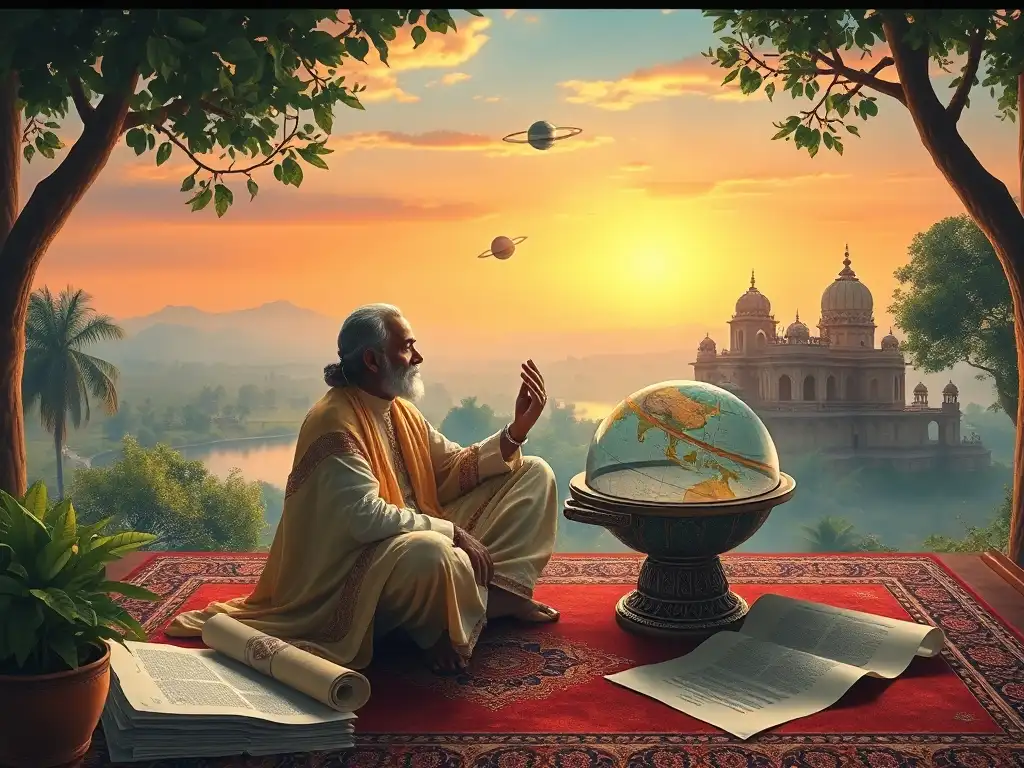
Understanding the key concepts within ancient Indian philosophy unveils the depth of thought that influenced scientific advancements.
The Nature of Reality in Indian Philosophy
Indian philosophy posits various interpretations of reality, from the empirical observations of the material world to the metaphysical discussions on the nature of consciousness. The concepts of Brahman and Atman reflect a dual understanding of the universe, where the ultimate reality is both transcendent and immanent.
The Concept of Dharma and its Scientific Implications
Dharma, often translated as "righteousness" or "duty," plays a crucial role in defining ethical behavior and societal structure. Its implications extend to scientific practices, where adherence to dharma fosters a sense of responsibility in the pursuit of knowledge and its applications.
The Philosophical Foundations of Knowledge (Jnana)
The pursuit of knowledge, or Jnana, is central to Indian philosophy. It encompasses not only the acquisition of information but also the understanding of deeper truths about existence and the universe. This philosophical foundation laid the groundwork for scientific exploration, emphasizing the importance of inquiry, observation, and critical thinking.
Through this exploration, we can appreciate the profound interconnectedness between ancient Indian philosophy and science, revealing a heritage that continues to inspire contemporary thought and inquiry.
Important Texts Reflecting the Interplay of Philosophy and Science
Ancient Indian texts serve as a bridge between philosophical thought and scientific inquiry, showcasing how these domains influenced each other throughout history. Key texts such as the Vedas, Upanishads, and Arthashastra illustrate the profound connection between spiritual understanding and empirical observation. These works not only address metaphysical questions but also delve into practical applications, embodying a holistic worldview that integrates ethics, governance, and natural phenomena. By examining these texts, we gain insight into how ancient Indian scholars approached the quest for knowledge, incorporating both philosophical reasoning and scientific methods.
The Vedas: Knowledge and Rituals
The Vedas, composed between 1500 and 500 BCE, are among the oldest sacred texts of ancient India and are foundational to Hindu philosophy and practices. They encompass a vast body of knowledge, including hymns, rituals, and philosophical teachings. The Rigveda, for instance, is filled with hymns that reflect an understanding of natural phenomena, while the Yajurveda provides detailed instructions for rituals that emphasize the significance of precise actions and their outcomes.
The Vedas also introduce concepts such as sacrifice (Yajna) and cosmology, revealing a scientific approach to understanding the universe. The ritualistic elements often exhibit systematic observation of astronomical cycles, which were crucial for agricultural planning and societal organization. This intertwining of knowledge and ritual illustrates how ancient Indian philosophy viewed science not merely as empirical study but as a means to connect with the divine.
The Upanishads: Philosophical Inquiry and Scientific Thought
Emerging as a continuation of Vedic thought around 800 to 200 BCE, the Upanishads mark a transformative phase in ancient Indian philosophy. They shift the focus from rituals to deep philosophical inquiry, exploring the nature of reality, consciousness, and the self. Concepts such as Brahman (the ultimate reality) and Atman (the individual soul) are central themes, inviting profound contemplations about existence.
In addition to metaphysical discussions, the Upanishads also reflect scientific reasoning. They engage in dialogues about the nature of perception, knowledge, and experience, laying the groundwork for epistemology. The Chandogya Upanishad, for instance, discusses the process of understanding through observation and experience, akin to empirical methods in modern science. This synthesis of philosophical and scientific thought highlights an early recognition of the importance of inquiry, observation, and introspection.
The Arthashastra: Political Science and Philosophy
Composed by Kautilya (Chanakya) in the 4th century BCE, the Arthashastra is a seminal text on statecraft, economics, and military strategy. While primarily a treatise on governance, it is steeped in philosophical reasoning that underscores the interplay between power, ethics, and human behavior. Kautilya's pragmatic approach reflects a keen understanding of human nature and societal dynamics, integrating philosophical principles with empirical observations about political and social structures.
The Arthashastra also emphasizes the importance of strategic thinking and rational decision-making in governance. By analyzing historical precedents and human motivations, Kautilya presents a systematic methodology for leadership that resonates with scientific principles. The text serves as an early example of applying philosophical concepts to real-world challenges, illustrating how ancient Indian thought harmonized ethics and practical science.
Influential Philosophical Schools in Ancient India
Ancient India was home to diverse philosophical schools that contributed significantly to the discourse on existence, knowledge, and ethics. These schools often engaged in debates over fundamental concepts, providing a rich tapestry of thought that intertwined philosophy and science. Notable schools such as Samkhya, Yoga, and Nyaya exemplify this dynamic interplay, each offering unique insights into the nature of reality and human experience.
Samkhya: Dualism and the Nature of Existence
The Samkhya school, attributed to sage Kapila, is one of the earliest philosophical systems in ancient India, dating back to the 6th century BCE. It presents a dualistic framework that distinguishes between Purusha (consciousness) and Prakriti (matter). This dualism reflects a profound understanding of existence, highlighting the interplay between the observer and the observed.
Samkhya's analytical approach resonates with scientific reasoning, as it categorizes and explains the elements of reality through a systematic enumeration of the tattvas (principles). By classifying phenomena and exploring their interrelations, Samkhya lays the groundwork for later developments in epistemology and metaphysics. Its emphasis on discernment and knowledge acquisition echoes the scientific method, encouraging individuals to seek truth through observation and experience.
Yoga: The Philosophical and Scientific Approach to Mind and Body
The Yoga school, closely associated with Patanjali's Yoga Sutras, emerged as a practical philosophy that emphasizes the integration of mind and body through disciplined practices. Yoga posits that self-realization and inner peace can be achieved through meditation, ethical living, and physical postures, forming a holistic approach to well-being.
This school reflects a scientific methodology through its structured practices and emphasis on mental discipline. The techniques outlined in the Yoga Sutras, such as meditation and breath control, are akin to empirical experiments that yield insights into consciousness and the nature of thought. By fostering self-awareness and inner clarity, Yoga demonstrates how philosophical inquiry can lead to transformative experiences, bridging the gap between theory and practice.
Nyaya: Logic and Epistemology in Ancient Indian Thought
The Nyaya school, founded by Gautama in the 2nd century BCE, is renowned for its rigorous approach to logic and epistemology. Nyaya philosophers sought to establish valid means of knowledge (pramanas) and to analyze the processes of perception, inference, and testimony. This emphasis on logical reasoning laid the groundwork for epistemological discussions that would influence both philosophy and science.
Nyaya's systematic methods reflect a scientific spirit, as its practitioners engaged in critical analysis of arguments and established criteria for truth. The school's focus on the nature of knowledge and the validity of inference resonates with the scientific method, which prioritizes observation and rational deduction. By fostering a culture of logical inquiry, Nyaya contributed significantly to the development of philosophical and scientific thought in ancient India.
Contributions of Ancient Indian Scientists and Thinkers

Ancient India was a cradle of intellectual achievement, where philosophy and science were not seen as separate entities but rather as complementary aspects of understanding the universe. The contributions of ancient Indian scientists and thinkers laid the groundwork for various disciplines, including mathematics, astronomy, medicine, and more. These thinkers perceived knowledge as a holistic pursuit, integrating empirical observations with philosophical inquiry. This interplay is evident in the works of prominent figures such as Aryabhata, Charaka, and Brahmagupta, whose legacies continue to influence modern thought.
Aryabhata: Astronomy and Mathematical Philosophy
Aryabhata, one of the most renowned mathematicians and astronomers of ancient India, made monumental contributions that blended mathematical techniques with astronomical observations. His seminal work, the Aryabhatiya, written in 499 CE, outlined various mathematical concepts, including the place value system, zero, and methods for solving quadratic equations. Aryabhata's astronomical insights included the calculation of the Earth's circumference and the periods of planetary revolutions, demonstrating his understanding of celestial mechanics.
What sets Aryabhata apart is not merely his scientific rigor but also his philosophical approach to knowledge. He viewed mathematics as a philosophical inquiry into the nature of reality, where numbers and shapes were seen as representations of deeper truths. His assertion that the Earth rotates on its axis showcased a revolutionary perspective that would later influence global astronomy.
Charaka: The Intersection of Medicine and Philosophy
Charaka, another giant in ancient Indian scholarship, is best known for his contributions to Ayurveda, the traditional system of medicine. His text, the Charaka Samhita, is a comprehensive compilation of medical knowledge, emphasizing the importance of examining the body, mind, and spirit as interconnected elements of health. Charaka's approach to medicine was deeply philosophical; he believed that physical ailments were often rooted in psychological and spiritual imbalances.
The Charaka Samhita not only provides insights into ancient medical practices but also reflects a holistic understanding of human existence. Charaka's emphasis on the ethical responsibilities of physicians resonates with contemporary discussions on medical ethics, illustrating the enduring relevance of his philosophical insights. His work highlights the idea that health cannot be separated from one’s mental and spiritual well-being, a principle that is gaining traction in modern holistic health practices.
Brahmagupta: Innovations in Mathematics and its Philosophical Context
Brahmagupta, a mathematician and astronomer from the 7th century CE, made significant advancements in mathematics that were interwoven with philosophical concepts. His work, the Brahmasphutasiddhanta, is notable for its systematic treatment of mathematics, including rules for arithmetic and the introduction of negative numbers. Brahmagupta's innovations provided a more comprehensive understanding of operations involving zero and negative quantities, which were revolutionary for his time.
Philosophically, Brahmagupta viewed mathematics as a means to understand and describe the universe. He believed in the practical applications of mathematics to solve real-world problems, bridging the gap between abstract thought and tangible outcomes. His contributions laid the groundwork for subsequent developments in algebra and arithmetic, influencing not only Indian scholars but also later mathematicians in the Islamic Golden Age and beyond.
The Legacy of Ancient Indian Philosophy and Science
The interplay of philosophy and science in ancient Indian texts has left an indelible mark on both Indian and global intellectual traditions. This legacy is evident in various fields and continues to inspire contemporary thinkers and scientists.
Influence on Modern Scientific Thought
Ancient Indian philosophy and science have significantly shaped modern scientific thought, particularly in areas such as mathematics and astronomy. Concepts introduced by thinkers like Aryabhata and Brahmagupta have found their way into contemporary mathematical frameworks. The understanding of zero as a numeral, for instance, has been fundamental to the development of calculus and computer science.
Moreover, the philosophical framework that emphasized empirical observation and rational inquiry has been integral to the scientific method. The holistic approaches found in works like the Charaka Samhita are increasingly recognized for their relevance in modern interdisciplinary studies, merging science with ethical considerations.
The Relevance of Ancient Indian Philosophy in Contemporary Science
In recent years, ancient Indian philosophy has gained renewed interest in contemporary scientific discussions. The principles of interconnectedness and holistic understanding promoted by figures like Charaka and Aryabhata resonate with current scientific paradigms in ecology, psychology, and health sciences. The acknowledgment that human well-being is tied to environmental and social contexts reflects the ancient Indian perspective that health encompasses more than just the physical body.
Additionally, the philosophical inquiries into the nature of consciousness and reality posed by ancient Indian thinkers are paralleled in modern fields such as quantum physics and cognitive science. This suggests that the ancient texts still hold valuable insights for addressing contemporary challenges.
Preservation of Knowledge through Textual Traditions
The preservation of ancient Indian philosophy and science through texts has been crucial for maintaining this rich intellectual heritage. Manuscripts, commentaries, and oral traditions have played a vital role in transmitting knowledge across generations. Institutions like the Nalanda University and the extensive libraries of ancient India acted as hubs for scholarly exchange, ensuring that these ideas were not lost to time.
Today, efforts to digitize and translate ancient texts are helping to democratize access to this knowledge, allowing a broader audience to engage with ancient Indian philosophy and science. As scholars continue to explore these texts, the intricate dance between philosophical thought and scientific inquiry remains a source of inspiration for future innovations.
Conclusion
The interplay of philosophy and science in ancient Indian texts showcases a profound understanding of the universe and human existence that transcends time. Ancient Indian philosophers and scientists approached knowledge with a holistic perspective, integrating metaphysical principles with empirical observations. This synthesis not only enriched the intellectual landscape of their time but also laid the groundwork for future explorations in various fields, including mathematics, astronomy, medicine, and ethics.
By examining texts like the Vedas, Upanishads, and works of scholars such as Aryabhata and Charaka, we can see how ancient Indian philosophy and science were deeply intertwined. This relationship fostered a culture of inquiry and innovation, encouraging individuals to seek knowledge that was both practical and transcendent.
The Lasting Impact of Ancient Indian Philosophy and Science

The impact of ancient Indian philosophy and science continues to resonate in contemporary thought and practice. Concepts such as zero in mathematics, the heliocentric theory in astronomy, and holistic approaches in medicine reflect the innovative spirit of ancient Indian scholars. Furthermore, the philosophical inquiries surrounding the nature of reality, consciousness, and ethics have inspired modern philosophical discourse and scientific exploration.
In the realm of spirituality, the ideas presented in ancient texts have influenced various global spiritual traditions, contributing to dialogues on mindfulness, meditation, and the nature of existence. The emphasis on empirical observation, rational thought, and ethical living remains relevant as society grapples with complex challenges in science, technology, and morality today.
Future Directions for Research and Exploration in Ancient Indian Texts
The rich corpus of ancient Indian texts presents numerous opportunities for further research and exploration. Scholars are encouraged to delve deeper into lesser-known manuscripts and philosophies, as well as investigate the cross-cultural exchanges that influenced ancient Indian thought. Areas such as the relationship between ancient Indian science and other civilizations, the role of women in philosophical discourse, and the evolution of scientific ideas in the context of cultural traditions are ripe for exploration.
Additionally, interdisciplinary studies that combine philosophy, science, and cultural studies can yield fresh insights into the complexities of ancient Indian thought. As new technologies and methodologies emerge, researchers can utilize digital humanities tools to analyze texts and artifacts, making ancient wisdom more accessible and relevant.
References
Key Sources and Further Reading on Ancient Indian Philosophy and Science
- The Vedas - A foundational set of texts that encompass hymns, rituals, and philosophical discourses.
- Upanishads - Philosophical treatises that explore the nature of reality and consciousness.
- Aryabhata's Aryabhatiya - A seminal work in mathematics and astronomy that introduced concepts such as the value of zero and the approximation of π.
- Charaka Samhita - An ancient text on medicine that combines empirical observation with philosophical insights on health and wellness.
- Brahmasphutasiddhanta by Brahmagupta - A significant contribution to mathematics that discusses arithmetic and algebra.
- The Yoga Sutras of Patanjali - Texts that bridge philosophy and practice, emphasizing the importance of mental discipline and ethical living.
These sources offer a window into the intricate relationship between ancient Indian philosophy and science, providing a solid foundation for anyone interested in exploring this fascinating intersection further.
- Introduction to Ancient Indian Philosophy and Science
- Overview of Ancient Indian Civilization
- The Significance of Philosophy in Ancient India
- The Role of Science in Ancient Indian Society
- Key Concepts in Ancient Indian Philosophy
- Important Texts Reflecting the Interplay of Philosophy and Science
- Influential Philosophical Schools in Ancient India
- Contributions of Ancient Indian Scientists and Thinkers
- The Legacy of Ancient Indian Philosophy and Science
- Conclusion
- The Lasting Impact of Ancient Indian Philosophy and Science
- Future Directions for Research and Exploration in Ancient Indian Texts
- References
- What is the significance of ancient Indian philosophy and science?
- How did ancient Indian texts contribute to the development of science?
- What role did philosophy play in ancient Indian scientific practices?
- Can you name some key figures in ancient Indian philosophy and science?
- How does the exploration of ancient Indian civilizations enhance our understanding of modern science?
Frequently Asked Questions
What is the significance of ancient Indian philosophy and science?
Ancient Indian philosophy and science are significant for their holistic approach to understanding the universe, emphasizing the interconnectedness of knowledge, ethics, and spirituality.
How did ancient Indian texts contribute to the development of science?
Ancient Indian texts, such as the Vedas and Upanishads, laid the groundwork for various fields including mathematics, astronomy, and medicine, showcasing a deep understanding of natural phenomena.
What role did philosophy play in ancient Indian scientific practices?
Philosophy in ancient India provided a framework for inquiry, encouraging critical thinking and exploration of metaphysical questions that influenced scientific methods and ethical considerations.
Can you name some key figures in ancient Indian philosophy and science?
Notable figures include Aryabhata, who made significant contributions to astronomy and mathematics, and Charaka, a pioneer in Ayurvedic medicine.
How does the exploration of ancient Indian civilizations enhance our understanding of modern science?
Studying ancient Indian civilizations reveals how early thinkers approached scientific inquiry, promoting an appreciation for diverse methodologies and the evolution of modern scientific thought.
Final Reflection: The Enduring Legacy of Ancient Indian Philosophy and Science
The intricate relationship between philosophy and science in ancient Indian texts remains profoundly relevant today. As we navigate an increasingly complex world, the wisdom embedded in these ancient teachings offers a unique lens through which we can understand the interplay of thought and empirical inquiry. The insights derived from ancient Indian philosophy and science not only enrich our intellectual pursuits but also challenge us to rethink the foundations of knowledge itself.
The influence of ancient Indian philosophy and science continues to resonate in contemporary discourse, shaping our understanding of ethics, metaphysics, and the natural world. The holistic approach found in texts like the Vedas and Upanishads encourages a synthesis of knowledge that transcends disciplinary boundaries. As the philosopher J. Krishnamurti once said, The ability to observe without evaluating is the highest form of intelligence.
This perspective invites us to embrace curiosity and open-mindedness, fostering a culture where philosophical inquiry and scientific exploration coexist harmoniously.
As you reflect on the teachings of ancient Indian philosophy and science, consider how these principles can be woven into your daily life. Challenge yourself to explore the interconnectedness of your thoughts and actions, and seek wisdom in the world around you. By integrating these ancient insights into your modern existence, you can cultivate a deeper understanding of yourself and the universe, ultimately contributing to a more thoughtful and compassionate society.
Unveil the Wisdom of Ancient India Today!
Thank you for exploring the captivating relationship between philosophy and science in ancient Indian texts! Your curiosity opens the door to a vast wealth of knowledge that has influenced thought throughout the ages. Now, it’s time to advance further on this enlightening journey.
- Discover more ancient texts: Visit your local library or browse online resources to uncover additional works that beautifully intertwine philosophy and science.
- Engage in discussions: Share your insights and reflections on social media or in community forums. Connect with others who are equally passionate about ancient wisdom!
- Form a study group: Invite friends or colleagues to join you in discussing these intriguing texts, fostering diverse perspectives and deeper understanding.
Which ancient Indian concept resonates with you the most, and how do you envision applying it to contemporary challenges?