
The Concept of Time in Hindu Philosophy: Cyclical vs. Linear Perspectives

Welcome to Ancient India History, where we embark on an enlightening journey through the rich tapestry of ancient Indian civilizations. Here, we delve into the profound depths of culture, philosophy, and heritage that have shaped the subcontinent. In our featured article, we explore the intriguing concepts of time in Hindu philosophy, juxtaposing the cyclical and linear perspectives that have influenced spiritual thought for centuries.
What does it mean to perceive time differently? Join us as we unravel these captivating ideas and discover how they reflect the very essence of existence in ancient Indian thought. Prepare to be inspired and informed as you dive deeper into our exploration of Ancient Indian Religions!

Introduction to Hindu Philosophy of Time Concepts
The Hindu philosophy of time concepts presents a fascinating exploration into how ancient Indian thought perceives the nature of time. Unlike the linear progression of time commonly recognized in many Western philosophies, Hinduism introduces a more intricate and cyclical understanding. This perspective echoes through the various texts, practices, and cultural traditions of India, shaping the worldview of millions.
By examining the cyclical and linear aspects of time within Hindu philosophy, we can delve deeper into the fundamental beliefs that have influenced not only spirituality but also the social and cultural fabric of ancient Indian civilizations. This article aims to illuminate these pivotal concepts, emphasizing their significance in understanding Hindu philosophy as a whole.
Overview of Time in Hindu Thought
In Hindu thought, time is not merely a series of events or a metric to measure life; it is a profound and multifaceted concept. The ancient scriptures describe time in various forms, often oscillating between the cyclical and the linear. The cyclical concept suggests that time is eternal, characterized by an infinite loop of creation, preservation, and destruction. In contrast, the linear concept posits that time has a definitive beginning and end, moving towards a specific goal or culmination. This duality provides a rich tapestry of philosophical inquiry, reflecting the complexities inherent in human existence and the universe.
Importance of Understanding Time in Hindu Philosophy
Understanding the Hindu philosophy of time concepts is crucial for several reasons:
- Cultural Significance: The perception of time influences rituals, festivals, and daily practices within Hindu culture, dictating how communities celebrate and commemorate events.
- Spiritual Insights: Recognizing the cyclical nature of time can lead to a deeper appreciation of concepts such as karma and rebirth, fostering a greater understanding of life’s purpose and spiritual progression.
- Philosophical Inquiry: Engaging with these concepts encourages philosophical discussions that transcend cultural boundaries, offering insights into the nature of existence and the universe.
Cyclical Concept of Time in Hinduism
Definition of Cyclical Time in Hindu Philosophy
The cyclical concept of time in Hinduism is rooted in the belief that the universe operates in vast cycles known as Yugas. Each cycle encompasses four distinct ages: Satya Yuga, Treta Yuga, Dvapara Yuga, and Kali Yuga. This framework presents a repeated pattern of creation, flourishing, decline, and renewal, suggesting that existence is an ongoing process rather than a linear journey.
Key Texts and Scriptures Supporting Cyclical Time
Several key texts underpin the cyclical notion of time in Hindu philosophy, including:
- The Puranas: These ancient texts elaborate on the concept of Yugas and the cosmic cycles, detailing the divine events associated with each age.
- The Mahabharata: This epic illustrates the cyclical nature of life and the moral dilemmas faced by its characters, emphasizing the transient nature of worldly existence.
- The Bhagavad Gita: Within this scripture, the cyclical nature of life and death is discussed, portraying the eternal soul's journey through various incarnations.
The Role of Karma and Rebirth in Cyclical Time
Central to the cyclical concept of time is the idea of karma and rebirth. In Hindu philosophy, actions in this life directly influence future lives, creating a cycle of cause and effect that is both moral and spiritual. This belief system fosters a sense of responsibility, encouraging individuals to act righteously, as every action reverberates through time, affecting not only the present but also future incarnations.
Festivals and Cycles: Cultural Reflections of Cyclical Time
Hindu festivals epitomize the cyclical concept of time, celebrating the rhythms of nature and life. Major festivals, such as Diwali and Holi, are reflections of the changing seasons, agricultural cycles, and mythological events that signify renewal and the triumph of good over evil. These celebrations reinforce the belief in cyclical time, as they commemorate the return of cosmic events, allowing individuals to connect with the divine and their cultural heritage.
Through this exploration of the cyclical concept of time in Hindu philosophy, we can appreciate how these ideas shape not only the spiritual landscape but also the everyday lives of individuals within ancient Indian civilizations.
Linear Concept of Time in Hinduism
Definition of Linear Time in Hindu Philosophy
The linear concept of time in Hindu philosophy is characterized by a progressive, unidirectional flow from a defined beginning to an ultimate end. Unlike cyclical views that emphasize repetition and regeneration, the linear perspective suggests that time is a finite entity with a clear trajectory. This viewpoint often aligns with historical events, personal experiences, and the progression of the universe towards a final state or culmination. The linear understanding of time is further rooted in the belief that human actions (karma) have consequences that extend beyond immediate effects, influencing future outcomes and the spiritual journey of the soul.
Historical Development of Linear Perspectives
The historical development of linear perspectives in Hindu philosophy can be traced back to various philosophical schools and religious practices. Early texts, such as the Vedas and Upanishads, primarily presented cyclical views of time; however, over time, certain interpretations began to emphasize linearity. The emergence of the Bhakti movement, with its focus on personal devotion and a progressive relationship with the divine, contributed significantly to this shift. Additionally, the influence of Western philosophical thought during colonial times introduced concepts of linearity that resonated with existing Hindu ideas about time and destiny.
Key Texts and Scriptures Supporting Linear Time
Several key texts and scriptures support the linear concept of time within Hindu philosophy. One prominent source is the Mahabharata, particularly the Bhagavad Gita, which discusses the nature of duty and the importance of action in a temporal framework. The Puranas, which recount the history of the universe, also reflect a linear progression of time from creation to dissolution, emphasizing a sequential narrative of cosmic events. Moreover, modern interpretations by philosophers such as Aurobindo Ghose have further articulated the idea of a linear evolution of consciousness, positioning human development as a journey towards higher spiritual realization.
Comparison of Cyclical and Linear Time in Hindu Philosophy
Fundamental Differences between Cyclical and Linear Perspectives
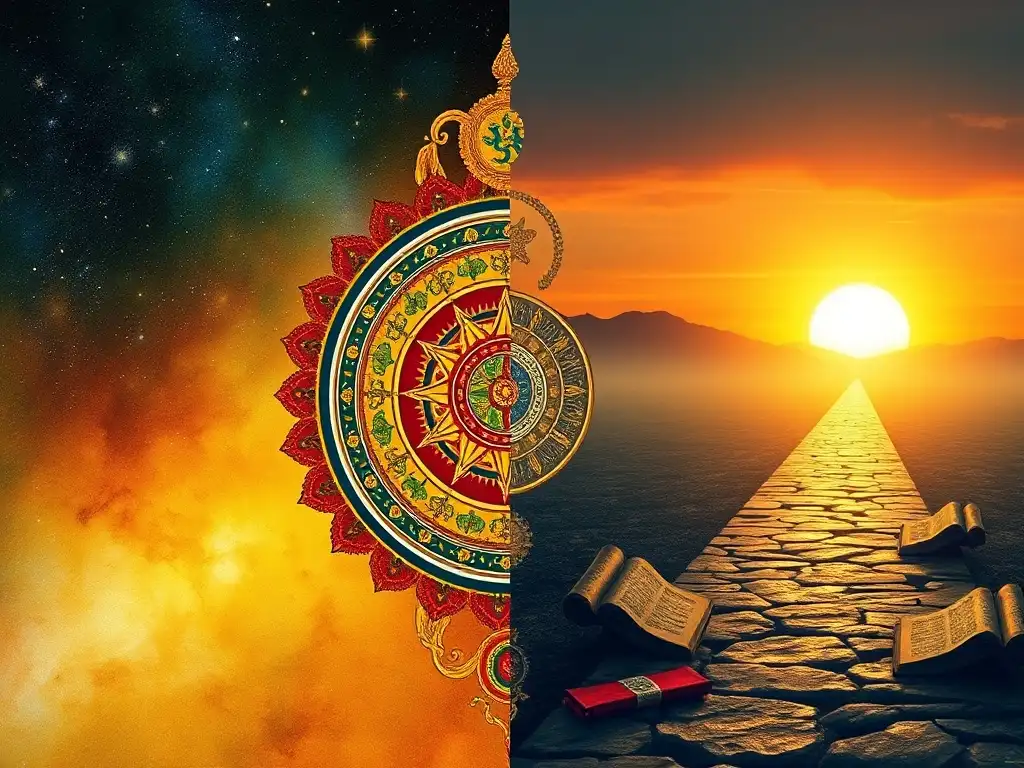
The fundamental differences between cyclical and linear perspectives in Hindu philosophy revolve around their views on existence and continuity. In cyclical time, existence is seen as a series of repeating cycles (Yugas), where creation, preservation, and destruction recur endlessly. Conversely, linear time posits that existence moves through a sequence of distinct stages leading to an ultimate conclusion. This divergence influences how adherents perceive life’s purpose: cyclical time emphasizes repetition and renewal, while linear time underscores progression and the significance of individual actions.
Implications of Each Perspective on Life and Existence
The implications of these perspectives significantly shape Hindu philosophy and practice. The cyclical view offers a sense of comfort and continuity, suggesting that life and death are part of a larger, eternal process, thus encouraging acceptance of life’s transitory nature. In contrast, the linear perspective instills a sense of urgency and responsibility, prompting individuals to engage meaningfully with their actions, as every moment contributes to their spiritual evolution. This can lead to differing approaches to ethics, morality, and spirituality, with cyclical adherents often focusing on rituals and traditions, while linear thinkers may prioritize personal growth and transformation.
How Cyclical and Linear Time Concepts Influence Hindu Practices
Cyclical and linear concepts of time influence various Hindu practices and rituals. In cyclical time, festivals such as Diwali and Holi celebrate the renewal of life and the triumph of good over evil, reinforcing the idea of perpetual return. Rituals often align with agricultural cycles, symbolizing rebirth.
On the other hand, the linear perspective influences practices like sadhana (spiritual discipline) and goal-oriented worship, which focus on individual progress and the attainment of moksha (liberation). This divergence also manifests in philosophical discussions, shaping how followers engage with texts, teachings, and community life, as they navigate the intricate relationship between time, existence, and spirituality in their everyday lives.
Conclusion: The Duality of Time in Hindu Philosophy
The concept of time in Hindu philosophy presents a fascinating duality, juxtaposing cyclical and linear perceptions. This duality reflects the complexity of existence as seen through the lens of various Hindu texts and traditions. Cyclical time, as depicted in the notions of kalachakra (the wheel of time) and yugas (ages), emphasizes the repetitive nature of life, where creation, preservation, and destruction are part of an eternal cycle. In contrast, the linear perspective, often associated with the journey of the soul through samsara (the cycle of rebirth), suggests a progression toward ultimate liberation (moksha).
This interplay between cyclical and linear time influences various aspects of Hindu culture, from rituals and festivals to philosophical discourses. Understanding this duality provides deeper insights into the spiritual practices and worldviews prevalent in ancient Indian civilizations. Ultimately, the Hindu philosophy of time encourages individuals to recognize the transient nature of the material world while embracing the eternal truths that guide spiritual evolution.
Reflection on the Significance of Time Concepts in Hindu Thought
The significance of time concepts in Hindu thought cannot be overstated. Time serves as a foundational framework within which existential questions are explored, shaping not only cosmological views but also ethical considerations and social practices. The cyclical notion of time encourages acceptance of life’s impermanent nature, fostering a sense of resilience and adaptability among individuals. This perspective is particularly evident in the way festivals are celebrated, marking the cycles of nature and the seasons, allowing communities to reflect on the past while looking forward to the future.
Conversely, the linear perspective provides a sense of purpose and direction, guiding adherents toward spiritual goals. The understanding that life is a journey towards moksha instills a sense of urgency in ethical living and spiritual practice. Thus, the intertwining of these two perceptions of time enriches Hindu philosophy, creating a comprehensive framework that accommodates both the transient and the eternal.
Future Perspectives on the Understanding of Time in Hinduism
As contemporary society grapples with rapid changes and technological advancements, the understanding of time in Hinduism may evolve yet again. Increasing interest in mindfulness, meditation, and holistic living suggests a revival of cyclical time concepts, encouraging individuals to reconnect with rhythms of nature and the universe. This shift may inspire a re-examination of ancient texts, leading to fresh interpretations that resonate with modern sensibilities.
Moreover, interdisciplinary dialogues involving philosophy, science, and spirituality could enhance our understanding of time in Hinduism. The integration of quantum physics and theories of relativity with ancient philosophical insights might pave the way for a more nuanced comprehension of time, bridging the gap between the cyclical and linear perspectives. Such explorations could contribute to a richer dialogue on existence and consciousness, allowing the teachings of Hindu philosophy to remain relevant in an ever-changing world.
References and Further Reading on Hindu Philosophy of Time Concepts
For those interested in delving deeper into the Hindu philosophy of time concepts, a variety of texts and resources can provide valuable insights. These works encompass a range of perspectives, from ancient scriptures to contemporary analyses, enriching the understanding of time in Hindu thought.
Suggested Texts and Resources for Deepening Understanding
- Bhagavad Gita: A philosophical dialogue that discusses the nature of duty, the self, and the universe, offering insights into both cyclical and linear time.
- Upanishads: Ancient texts that explore metaphysical concepts, including the nature of time, existence, and consciousness.
- Puranas: Mythological texts that elaborate on cosmic cycles and the yugas, highlighting the cyclical aspect of time.
- "The Concept of Time in Hinduism" by K. S. Shukla: A modern analysis that examines traditional views of time within the context of contemporary philosophy.
- "Hindu Philosophy: A Reader" by Christopher Key Chapple: This anthology offers a selection of key texts, including discussions on time and its implications in Hindu thought.
By engaging with these resources, readers can gain a more profound understanding of the intricate and multifaceted nature of time in Hindu philosophy.
- Introduction to Hindu Philosophy of Time Concepts
- Cyclical Concept of Time in Hinduism
- Linear Concept of Time in Hinduism
- Comparison of Cyclical and Linear Time in Hindu Philosophy
- Conclusion: The Duality of Time in Hindu Philosophy
- References and Further Reading on Hindu Philosophy of Time Concepts
- What are the main perspectives on time in Hindu philosophy?
- How does the cyclical view of time manifest in ancient Indian culture?
- What role does the concept of karma play in Hindu time philosophy?
- How is the linear perspective of time understood in Hindu philosophy?
- Can you explain the significance of the Gupta Empire in relation to Hindu philosophy?
Frequently Asked Questions
What are the main perspectives on time in Hindu philosophy?
Hindu philosophy presents two primary perspectives on time: the cyclical view, which sees time as a repeating cycle of creation and destruction, and the linear view, which perceives time as a progressive journey towards a final goal.
How does the cyclical view of time manifest in ancient Indian culture?
The cyclical view is reflected in the concept of Yugas, which are vast epochs in Hindu cosmology. This perspective emphasizes rebirth and the eternal nature of the universe, portraying life as a continuous cycle of creation, preservation, and dissolution.
What role does the concept of karma play in Hindu time philosophy?
In Hindu thought, karma is intricately tied to the concept of time, suggesting that actions in one life affect future incarnations. This reinforces the cyclical view of existence, as the consequences of actions can extend across multiple lifetimes.
How is the linear perspective of time understood in Hindu philosophy?
The linear perspective suggests that time moves towards a purpose, ultimately leading to moksha (liberation). In this view, individual lives contribute to a larger cosmic narrative, culminating in spiritual evolution.
Can you explain the significance of the Gupta Empire in relation to Hindu philosophy?
The Gupta Empire is often considered a golden age for Hindu philosophy and culture, where ideas about time, ethics, and spirituality flourished. It marked a period of significant advancements in philosophy, arts, and sciences, influencing the development of Hindu thought.
Final Reflection: Embracing the Duality of Time in Hindu Philosophy
The exploration of time in Hindu philosophy reveals profound insights that resonate with our contemporary lives. As we navigate a world increasingly defined by linear progress and deadlines, the cyclical nature of time emphasized in Hindu thought invites us to reconsider our relationship with the past, present, and future. This duality not only enriches our understanding of existence but also challenges the rigid frameworks that often govern our daily lives.
Hindu philosophy of time concepts has significantly shaped cultural and social narratives, influencing everything from art to spirituality. The cyclical view of time encourages us to see life as a series of interconnected experiences rather than a linear trajectory. This perspective fosters a sense of continuity and belonging, reminding us that every ending is merely a new beginning. As Mahatma Gandhi once said, “The future depends on what you do today,” highlighting the importance of our present actions in shaping the cycles of our lives.
As you reflect on the lessons from Hindu philosophy, consider how you can integrate these concepts into your daily life. Embrace the cyclical nature of your experiences, allowing yourself to learn from the past while remaining open to the possibilities of the future. Take a moment to pause, breathe, and appreciate the present, recognizing that each moment is a valuable part of a larger journey. By doing so, you not only honor the wisdom of Hindu philosophy but also cultivate a deeper connection with yourself and the world around you.
Embrace the Journey of Time: Act Now!
Thank you for diving deep into the fascinating concept of time in Hindu philosophy! You've gained valuable insights into the cyclical and linear perspectives that shape our understanding of existence. Now, let's take your exploration further with actionable steps that can enhance your journey.
- Reflect on your own perceptions of time: Take a moment to journal about how you view time in your life. Is it cyclical, like the seasons, or does it feel more linear, like a straight path? Writing it down can help you gain clarity and promote mindfulness.
- Connect with a community: Join discussion groups or local clubs interested in philosophy to delve deeper into these concepts. Engaging with others can enrich your understanding and offer new perspectives.
- Share your insights: Inspire others by sharing this article on social media or with friends who might connect with these ideas. Your unique viewpoint could spark meaningful conversations!
Which perspective on time resonates most with your life experiences, and in what ways do you think it influences your daily choices?