
The Symbolism of Zero: Exploring Its Meaning in Ancient Indian Culture


Welcome to Ancient India History, where we delve into the captivating tapestry of India’s rich and diverse past. Today, we invite you to explore the symbolism of zero in India—a concept that not only revolutionized mathematics but also carried profound philosophical significance in ancient Indian culture. What does this simple yet profound numeral reveal about the minds of our ancestors? Join us on this enlightening journey as we uncover the layers of meaning behind one of history’s most groundbreaking contributions to mathematics. Your adventure into the depths of ancient wisdom begins here!

Introduction to the Symbolism of Zero in India
The concept of zero is often heralded as one of the most groundbreaking contributions of ancient Indian civilization to the world of mathematics. The symbolism of zero in India transcends mere numerical value; it embodies profound philosophical and cultural implications that have shaped mathematical thought and scientific inquiry across centuries.
This article delves into the rich tapestry of zero's symbolic meaning, tracing its historical significance and exploring how it reflects the intellectual advancements of ancient Indian societies. As we embark on this exploration, we will uncover the intricate layers of meaning that zero held for mathematicians, philosophers, and the broader culture of ancient India.
Overview of Zero's Historical Significance in Mathematics
Zero's introduction into the numeral system marked a pivotal moment in the history of mathematics. Before its conceptualization, mathematicians faced limitations in representing large numbers and performing calculations. Ancient Indian scholars pioneered the formalization of zero, not only as a placeholder but also as a standalone entity. This innovation allowed for the development of the decimal system and advanced arithmetic operations, paving the way for future mathematical advancements.
- Key Milestones:
- The earliest recorded use of zero can be traced back to the 5th century CE in the work of Indian mathematician Aryabhata.
- By the 7th century, the mathematician Brahmagupta provided rules for arithmetic involving zero in his seminal text "Brahmasphutasiddhanta."
The implications of zero's introduction were profound, influencing not only mathematics but also areas such as astronomy and engineering, thus establishing a foundation for subsequent civilizations.
Importance of Zero in Ancient Indian Civilization
In ancient Indian culture, zero was not just a mathematical innovation; it was imbued with philosophical significance. The concept of 'shunya' (emptiness) in Indian philosophy parallels the mathematical zero, suggesting a deeper understanding of the void and the infinite.
- Cultural Reflections:
- The duality of existence and emptiness is a recurring theme in various Indian philosophical texts, highlighting the importance of balance.
- Zero served as a bridge between the tangible and the metaphysical, influencing art, literature, and spiritual practices.
Understanding the importance of zero in ancient Indian civilization reveals how mathematical concepts were intertwined with broader cultural and philosophical ideas, making it a linchpin in the intellectual heritage of India.
The Origins of Zero in Ancient Indian Culture
Historical Context of Mathematics in Ancient India
To truly appreciate the symbolism of zero, one must first consider the historical context in which it arose. Ancient India was a hub of intellectual activity, where scholars engaged in extensive studies of mathematics, astronomy, and philosophy. The mathematical systems developed during this period were sophisticated, characterized by an understanding of geometry, algebra, and arithmetic long before similar concepts emerged in other cultures.
- Notable Contributions:
- The Sulbasutras, dating back to around 800 BCE, showcase advanced geometrical techniques and indicate an early understanding of numerical concepts.
- The mathematical treatises produced during this period laid the groundwork for the later formalization of zero.
The rich mathematical tradition of ancient India set the stage for the emergence of zero, as scholars sought efficient ways to express and calculate large quantities.
The Emergence of Zero as a Concept
The emergence of zero as a concept can be traced through various ancient texts and inscriptions. Initially, zero was represented as a dot or a small circle, symbolizing the absence of quantity. Over time, the understanding of zero evolved, leading to its acceptance as a number in its own right.
- Development Timeline:
- The first explicit mention of zero as a numerical value is found in the Bakhshali Manuscript, dating to around the 3rd or 4th century CE.
- By the 9th century, scholars like al-Khwarizmi and al-Kindi would later spread the concept of zero to the Islamic world, further solidifying its significance in global mathematics.
The journey of zero from an abstract concept to an integral part of the numeral system reflects the innovative spirit of ancient Indian scholars and their profound understanding of mathematical principles.
The Philosophical Meaning of Zero in Indian Thought
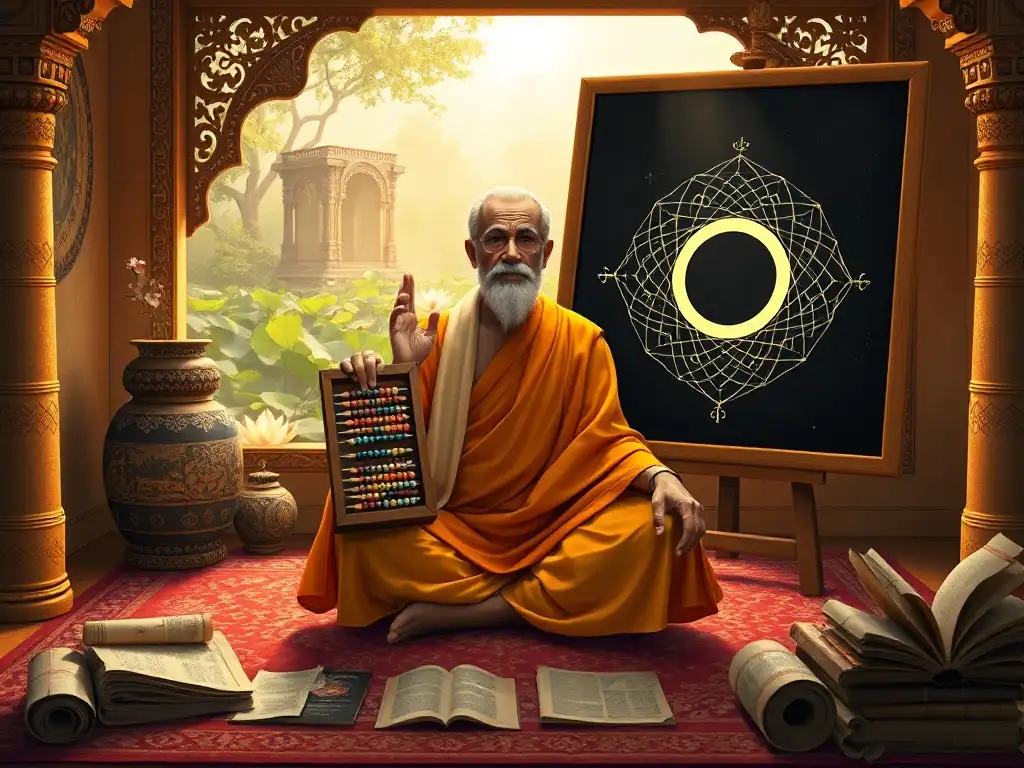
In ancient Indian philosophy, zero holds profound significance that transcends mere numerical representation. It is considered a symbol of nothingness, yet it embodies the concept of potentiality—an idea that aligns closely with various philosophical doctrines of the time. The duality of zero as both absence and presence reflects the complexities of existence, emphasizing the notion that from nothing can come everything.
Indian thinkers, particularly within the realms of Buddhism and Jainism, explored the implications of emptiness and void, viewing zero not just as a mathematical concept but as a philosophical inquiry into the nature of reality. This exploration posits that understanding zero is key to grasping the universe's cyclical nature, where creation and dissolution are two sides of the same coin. Thus, zero becomes a central theme in debates about existence, non-existence, and the interconnectedness of all things.
Zero as a Representation of Nothingness
The concept of nothingness in Indian thought is deeply rooted in texts such as the Upanishads, which delve into the essence of being and non-being. In these philosophical discourses, zero symbolizes the void or Shunya, which suggests that true enlightenment comes from transcending material existence and embracing the void. This idea is not merely nihilistic but rather serves as a gateway to understanding the fullness of life.
In mathematics, zero serves as a critical bridge between the finite and the infinite. It represents a state of balance where opposing forces converge, illustrating how nothingness can lead to a deeper understanding of existence. This duality is echoed in various aspects of Indian culture, including art, literature, and spirituality, where the interplay of form and emptiness creates a rich tapestry of meaning.
The Connection Between Zero and Spirituality in Ancient Texts
The spiritual implications of zero are deeply woven into ancient Indian texts, where it often represents the ultimate reality or Brahman. In Hindu philosophy, zero is seen as a manifestation of the divine, encapsulating the essence of creation and destruction. This idea is further explored in Buddhist philosophy, where the concept of Shunyata, or emptiness, plays a central role in understanding the nature of suffering and enlightenment.
Contemporary interpretations of these ancient texts highlight how the symbolism of zero can influence modern spiritual practices. For instance, meditation techniques that focus on emptiness allow practitioners to experience a sense of liberation and unity with the universe. This connection underscores the timeless relevance of zero in both historical and contemporary contexts, revealing its profound impact on spiritual thought in India.
The Role of Zero in Ancient Indian Mathematics
The invention of zero marked a revolutionary advancement in mathematics, significantly influencing calculations and number systems. Ancient Indian mathematicians recognized zero's potential to simplify complex arithmetic operations, laying the groundwork for future mathematical innovations.
Zero's introduction into the decimal place value system allowed for more efficient computations, transforming how numbers were represented and manipulated. This pivotal development facilitated advanced mathematical concepts that would later influence cultures worldwide, showcasing the ingenuity of ancient Indian scholars.
Zero in the Place Value System
The integration of zero into the place value system revolutionized mathematics by enabling the representation of large numbers and precise calculations. In this system, each digit's position holds significance, and zero serves as a placeholder, indicating the absence of a value in a particular position.
For example, the number 205 illustrates how zero distinguishes between two hundred and two thousand. This innovation not only streamlined arithmetic but also paved the way for algebra and calculus. The clarity and efficiency provided by the place value system, enhanced by the presence of zero, became a cornerstone of mathematical practices in ancient India and beyond.
Contributions of Indian Mathematicians to the Concept of Zero
Prominent mathematicians such as Aryabhata and Brahmagupta made significant contributions to the understanding of zero, expanding its application within mathematical frameworks. Aryabhata, in his seminal work, "Aryabhatiya," discussed the use of zero in calculations and its role in astronomical observations. His treatise laid the foundation for future mathematicians to build upon.
Brahmagupta further explored the properties of zero, defining its operations and addressing its implications in equations. His work, "Brahmasphutasiddhanta," is noteworthy for discussing the arithmetic of zero and negative numbers, emphasizing its importance as a value in calculations.
These contributions underscore the pivotal role of ancient Indian mathematicians in developing the concept of zero, which ultimately transformed mathematics and shaped the mathematical landscape across cultures. The symbolism of zero in India, therefore, intertwines not only with philosophical and spiritual meanings but also with groundbreaking advancements in mathematical thought.
Symbolism of Zero in Indian Art and Literature
The symbolism of zero in ancient Indian culture extends beyond mathematics and into the realms of art and literature. It represents not only a numerical concept but also a philosophical and spiritual idea. In Indian art, zero often signifies the void or the idea of emptiness, which can be seen as a crucial aspect of creation and existence. This duality reflects the belief that from nothingness comes creation, a theme prevalent in various Indian philosophical texts.
Depictions of Zero in Ancient Indian Art
In ancient Indian art, particularly in sculptures and temple designs, the concept of zero is subtly represented through motifs that embody the idea of infinity and the cyclical nature of life. For instance, the circular patterns found in mandalas symbolize the universe and the endless cycle of birth and rebirth. These patterns often incorporate the concept of zero as a point of origin or a central focus from which all creation emerges.
Moreover, some inscriptions and carvings in temples highlight the numerical system that includes zero, showcasing its importance in the mathematical advancements of the time. The use of geometric shapes and the representation of the cosmos reflect the philosophical significance of zero, emphasizing balance, harmony, and the integration of the finite with the infinite.
References to Zero in Classical Indian Literature
Classical Indian literature also provides insights into the symbolism of zero. Texts such as the Brahmasphutasiddhanta by Brahmagupta discuss zero not merely as a number but as a concept tied to the idea of nothingness and the void. In these writings, zero is associated with the philosophical notion of shunya, or emptiness, which plays a critical role in understanding the nature of existence.
Additionally, various poetic works and philosophical treatises explore the implications of zero, intertwining it with metaphysical concepts. The symbolism of zero in literature serves as a metaphor for the infinite potential that arises from absence, highlighting the depth of thought that ancient Indian scholars applied to this seemingly simple concept.
Comparisons with Other Cultures’ Interpretations of Zero
While the symbolism of zero is richly developed in Indian culture, other civilizations also approached the concept with differing interpretations. Understanding these variations can provide a broader context for the significance of zero globally.
The Symbolism of Zero in Ancient Mesopotamia
In Ancient Mesopotamia, the concept of zero was less defined compared to its Indian counterpart. The Mesopotamians had a positional numeral system but did not have a symbol for zero as an independent number. Instead, they used a placeholder in their cuneiform writing, which indicated the absence of a value. This absence was not viewed philosophically; rather, it served a practical purpose in calculations.
The lack of a distinct representation of zero in Mesopotamian culture limited its symbolic depth. While they recognized the need for a concept akin to zero, it did not evolve into a philosophical or metaphysical idea as it did in India, where zero was embraced as a vital element of cosmic and existential understanding.
Contrasting Views: Western Perspectives on Zero
Western perspectives on zero have historically been skeptical and conflicted. In ancient Greece, philosophers like Aristotle viewed the concept of nothingness as problematic, leading to a dismissal of zero as a legitimate number. It was only through the transmission of knowledge from the Islamic world, which had adopted and expanded upon Indian concepts of zero, that Western civilizations began to recognize its importance.
By the Renaissance, zero started to gain acceptance in Europe, evolving into a symbol of both absence and potential. This contrasts sharply with the Indian understanding of zero as a fundamental part of existence and creation. The philosophical implications of zero in the West often reflected a binary view of existence, contrasting with the more holistic interpretation seen in Indian culture.
The journey of zero from ancient India to the Western world illustrates the diverse meanings attributed to this concept, showcasing how cultural contexts shape the understanding of fundamental ideas in mathematics and philosophy.
The Legacy of Zero in Modern Mathematics

The concept of zero, originating from ancient India, has had a profound impact on modern mathematics. Its introduction revolutionized numerical systems, allowing for the development of algebra, calculus, and advanced computational methods. Before the adoption of zero, mathematical operations were cumbersome, often reliant on cumbersome counting systems without a numeral for ‘nothing.’
In the contemporary mathematical landscape, zero serves as a foundational element. It is crucial in defining the value of positional systems, enabling the representation of large numbers and the execution of complex calculations. For example, in the decimal system, the presence of zero allows us to distinguish between numbers like 10, 100, and 1000. Moreover, zero plays a vital role in calculus, particularly in defining limits and derivatives, thereby laying the groundwork for modern physics and engineering.
How Ancient Indian Concepts Influenced Global Mathematics
The journey of zero from ancient India to the rest of the world exemplifies a fascinating cultural exchange in mathematics. The earliest recorded use of zero can be traced back to the 5th century CE in Indian texts such as the Bakhshali Manuscript and the works of mathematicians like Aryabhata and Brahmagupta. These scholars not only introduced the symbol for zero but also explored its mathematical properties, including its role in arithmetic and algebra.
As Indian traders and scholars interacted with other cultures, the concept of zero began to spread. By the 7th century, the numeral system including zero reached the Islamic world through translations of Indian texts. Subsequently, Islamic mathematicians further developed this concept, which eventually made its way to Europe by the 10th century, fundamentally altering the course of Western mathematics.
The Continuing Importance of Zero in Contemporary Mathematical Thought
In modern mathematics, zero is more than just a placeholder; it embodies critical concepts that shape our understanding of the universe. One significant aspect is its role in the concept of nullity, where zero signifies the absence of quantity, leading to breakthroughs in various fields such as physics and computer science.
Additionally, zero is essential in the field of complex numbers, where it is used to define the imaginary unit. The inclusion of zero in equations facilitates the exploration of mathematical phenomena, such as singularities in physics and the behavior of functions in complex analysis. Its influence also extends into algorithms and data structures in computer science, where zero-based indexing is a fundamental concept.
Conclusion
Recap of the Symbolism of Zero in Ancient Indian Culture
The symbolism of zero in ancient Indian culture transcended mere numerical representation; it encapsulated philosophical and spiritual themes. In many Indian philosophies, zero represented the void, the infinite, and the concept of non-being. This deep connection between mathematics and philosophy illustrates how ancient Indian scholars viewed zero not just as a number, but as a profound concept that encompassed the nature of existence.
Final Thoughts on Zero’s Impact on Mathematics and Philosophy
The legacy of zero, rooted in ancient Indian thought, has left an indelible mark on both mathematics and philosophy. Its journey from the Indian subcontinent to global acceptance underscores the importance of cultural exchange in the evolution of ideas. Today, zero remains a critical component in mathematical theory and application, symbolizing not only nothingness but also the potential for infinite possibilities. As we continue to explore and expand upon these concepts, the influence of zero will undoubtedly persist as a foundational pillar in the ongoing development of mathematics and beyond.
- Introduction to the Symbolism of Zero in India
- Overview of Zero's Historical Significance in Mathematics
- Importance of Zero in Ancient Indian Civilization
- The Origins of Zero in Ancient Indian Culture
- The Philosophical Meaning of Zero in Indian Thought
- The Role of Zero in Ancient Indian Mathematics
- Symbolism of Zero in Indian Art and Literature
- Comparisons with Other Cultures’ Interpretations of Zero
- The Legacy of Zero in Modern Mathematics
- How Ancient Indian Concepts Influenced Global Mathematics
- The Continuing Importance of Zero in Contemporary Mathematical Thought
- Conclusion
- What is the significance of zero in ancient Indian culture?
- How did ancient Indians contribute to the concept of zero?
- In what mathematical texts is the symbolism of zero mentioned?
- How did the symbolism of zero influence other cultures?
- Why is the symbolism of zero considered a turning point in mathematics?
Frequently Asked Questions
What is the significance of zero in ancient Indian culture?
The zero symbolizes nothingness and the concept of the void, reflecting deep philosophical ideas in ancient Indian thought and mathematics.
How did ancient Indians contribute to the concept of zero?
Ancient Indians were instrumental in developing the concept of zero, using it as a placeholder and a number, which was revolutionary for mathematics.
In what mathematical texts is the symbolism of zero mentioned?
The symbolism of zero is prominently featured in ancient texts like the Bakhshali Manuscript and the works of mathematicians such as Brahmagupta.
How did the symbolism of zero influence other cultures?
The symbolism of zero traveled from India to the Arab world and subsequently to Europe, significantly impacting the development of modern mathematics.
Why is the symbolism of zero considered a turning point in mathematics?
The symbolism of zero allowed for the development of algebra and calculus, making complex calculations simpler and paving the way for advanced mathematical theories.
Final Reflection: The Enduring Legacy of Zero's Symbolism in India
The exploration of the symbolism of zero in India reveals its profound relevance in today's world, as it transcends mere mathematics to embody concepts of potentiality and infinity. In a time when we are constantly grappling with the complexities of existence and the vastness of knowledge, the ancient Indian understanding of zero invites us to reconsider our perceptions of emptiness and fullness. It challenges us to embrace the idea that from nothingness can emerge boundless possibilities, a notion that resonates deeply in our modern quest for meaning and innovation.
The symbolism of zero has not only shaped mathematical thought but has also woven itself into the cultural and philosophical fabric of society. Its influence can be seen in how we approach challenges and opportunities, reminding us that every ending can lead to a new beginning. As the mathematician and philosopher Alfred North Whitehead once said, The greatest invention of the nineteenth century was the invention of the method of invention.
This perspective echoes the Indian ethos surrounding zero, where the absence of value is not a void but a space for creativity and growth, encouraging us to think beyond conventional boundaries.
As we reflect on the lessons embedded in the symbolism of zero, let us challenge ourselves to embrace the potential that lies within our own lives. Consider how you can transform perceived limitations into opportunities for growth and exploration. The journey of understanding zero is not just an academic pursuit; it is an invitation to cultivate a mindset that values the unseen and the unquantifiable. By doing so, we honor the rich legacy of ancient Indian culture and empower ourselves to navigate the complexities of the present and future with a renewed sense of purpose and possibility.
Unveil the Depths of Zero: Take Action Today!
Thank you for delving into the fascinating world of zero and its profound significance in ancient Indian culture. By exploring its symbolism, you've taken a step toward understanding one of the most critical concepts in mathematics and philosophy. Now, it’s time to deepen that knowledge further and engage with this legacy.
Here are a few actionable steps to consider:
- Dive Deeper: Explore ancient Indian mathematical texts to discover how the concept of zero has shaped modern mathematics.
- Share the Knowledge: Engage in discussions about this intriguing topic with friends or in online communities to promote awareness of the cultural significance of zero.
- Join a Community: Get involved in social media groups or local events that focus on ancient Indian achievements and their influence on the world.
What impact do you think the concept of zero has had on our current understanding of mathematics and culture? **We invite you to share your thoughts with us! **