
How Ancient Indian Mathematics Influenced Global Trade Routes


Welcome to Ancient India History, where we embark on a journey through the rich tapestry of time, exploring the remarkable contributions of ancient Indian civilizations. Delve into the fascinating world of ancient Indian mathematics and uncover how it shaped global trade routes, influencing commerce and culture far beyond its borders. As we unravel the intricacies of this invaluable legacy, you'll discover the profound impact that these mathematical innovations had on societies around the world. Are you ready to explore the secrets of the past that still resonate today? Let’s dive deeper into this captivating tale!
- Introduction to Ancient Indian Mathematics and Its Impact on Global Trade Routes
- Key Features of Ancient Indian Mathematics
- The Role of Ancient Indian Mathematics in Trade Routes
- The Spread of Ancient Indian Mathematical Concepts
- The Lasting Impact of Ancient Indian Mathematics on Global Trade
- Conclusion: The Enduring Influence of Ancient Indian Mathematics on Global Trade Routes
-
Frequently Asked Questions
- What were the key contributions of ancient Indian mathematics?
- How did ancient Indian mathematics impact global trade?
- What role did the Gupta Empire play in the development of mathematics?
- How did ancient Indian mathematicians influence other cultures?
- Are there any notable ancient Indian mathematicians?
- Final Reflection: The Enduring Impact of Ancient Indian Mathematics
- Unveil the Mathematical Legacy of Ancient India!
Introduction to Ancient Indian Mathematics and Its Impact on Global Trade Routes

Ancient Indian mathematics stands as a remarkable pillar of intellectual achievement that has profoundly shaped not only the subcontinent but also the broader tapestry of global knowledge and trade. From the sophisticated calculations of the Indus Valley civilization to the advanced concepts developed during the Gupta Empire, the contributions of ancient Indian mathematicians have laid the groundwork for various mathematical principles that are still in use today.
The influence of these mathematical advancements extends beyond academia, significantly impacting global trade routes by facilitating more precise navigation, accounting, and commerce. This article delves into the intricacies of ancient Indian mathematics, exploring its historical context, key figures, and the vital role it played in enhancing trade across continents.
Overview of Ancient Indian Mathematics
Ancient Indian mathematics is characterized by its unique approaches and innovations, which emerged as early as 3000 BCE with the Indus Valley civilization. The mathematicians of this era laid the foundation for various mathematical concepts, including:
- Decimal System: The introduction of the base-10 numeral system, which simplified calculations and record-keeping.
- Zero Concept: The revolutionary idea of zero as both a placeholder and a number, radically transforming arithmetic and algebra.
- Geometry and Trigonometry: Development of geometric principles used in architecture and astronomy, exemplified in texts like the Sulbasutras.
Notable mathematicians such as Aryabhata, Brahmagupta, and Bhaskara II made significant contributions that resonate through history. Their works not only advanced mathematical theory but also provided practical tools that enhanced various aspects of life, including trade.
Importance of Mathematics in Trade
The role of mathematics in trade during ancient times cannot be overstated. As commerce expanded along burgeoning trade routes, the need for accurate measurements and calculations became paramount. Ancient Indian mathematics provided the tools necessary for:
- Navigation: Mathematical principles guided traders in navigating vast distances across land and sea, ensuring safer and more efficient journeys.
- Currency and Accounting: The development of systematic methods for accounting and currency exchange enabled traders to keep accurate records and manage finances effectively.
- Trade Agreements: Mathematical calculations were essential in formulating trade agreements, allowing for fair exchanges and negotiations between diverse cultures.
By integrating ancient Indian mathematical concepts into their trading practices, merchants were able to optimize their operations and broaden their commercial networks, thus influencing trade routes that connected different civilizations across Asia and beyond. This impact underscores the enduring legacy of ancient Indian mathematics in shaping not only local economies but also global commerce.
Key Features of Ancient Indian Mathematics

Ancient Indian mathematics is characterized by a rich tapestry of concepts, techniques, and innovations that have profoundly impacted not only the subcontinent but also the global mathematical landscape. This heritage is marked by notable advancements in arithmetic, geometry, and algebra, which were instrumental in facilitating trade and commerce.
Concepts and Innovations in Ancient Indian Mathematics
Ancient Indian mathematicians introduced several groundbreaking concepts that laid the foundation for modern mathematics. Here are some key innovations:
- Decimal System: The most significant contribution from ancient Indian mathematics is the place-value decimal system, which includes the concept of zero as a number. This system revolutionized numerical representation and calculations, allowing for more complex arithmetic.
- Algebraic Techniques: Ancient texts such as the Bakhshali Manuscript and Aryabhatiya by Aryabhata demonstrate advanced algebraic methods. Techniques for solving equations, including linear and quadratic equations, were systematically developed.
- Geometric Principles: Indian mathematicians excelled in geometry, particularly in calculating areas and volumes. The Sulba Sutras, ancient texts on geometry, provided rules for constructing altars and fire pits, showcasing practical applications of geometric principles.
- Trigonometry: The study of sine and cosine functions began in ancient India, with mathematicians like Aryabhata and Brahmagupta contributing to the understanding of these trigonometric ratios, which were essential for astronomical calculations.
- Astronomical Calculations: Mathematical techniques were intricately tied to astronomy in ancient India. The precise calculations of celestial phenomena, such as eclipses and planetary movements, relied heavily on advanced mathematical principles.
These innovations not only advanced mathematics but also significantly influenced trade by enabling more accurate calculations for commerce, navigation, and timekeeping.
Significant Mathematicians of Ancient India
Several mathematicians from ancient India played pivotal roles in shaping the mathematical landscape. Here are some of the most prominent figures:
- Aryabhata (476–550 CE):
- Known for his works in arithmetic, algebra, and astronomy, Aryabhata's Aryabhatiya introduced innovative methods for solving mathematical problems and calculations of pi (π).
- His contributions laid the groundwork for future mathematicians and were vital for trade navigation.
- Brahmagupta (598–668 CE):
- Brahmagupta's seminal work, Brahmasphutasiddhanta, outlined rules for arithmetic operations, including the treatment of zero and negative numbers.
- His work was significant for commerce as it provided merchants with a systematic approach to calculate profits and losses.
- Bhaskara I (c. 600–680 CE):
- A prominent mathematician and astronomer, Bhaskara I is known for his adaptations of Aryabhata's work and for introducing sine functions to a wider audience.
- His contributions to mathematical astronomy facilitated more accurate calculations for trade routes and timings.
- Bhaskara II (1114–1185 CE):
- Also known as Bhaskara the Great, he authored the Lilavati and Bijaganita, which covered a wide range of mathematical topics, including arithmetic, geometry, and algebra.
- His works were not only theoretical but also highly practical, often focusing on real-world applications such as trade and commerce.
These mathematicians exemplify the profound influence of ancient Indian mathematics on global trade routes, as their innovative ideas and methods enabled more effective calculation and navigation, fostering connections between civilizations. The impact of ancient Indian mathematics is evident in the way it shaped trade practices and facilitated the exchange of goods and ideas across cultures.
The Role of Ancient Indian Mathematics in Trade Routes
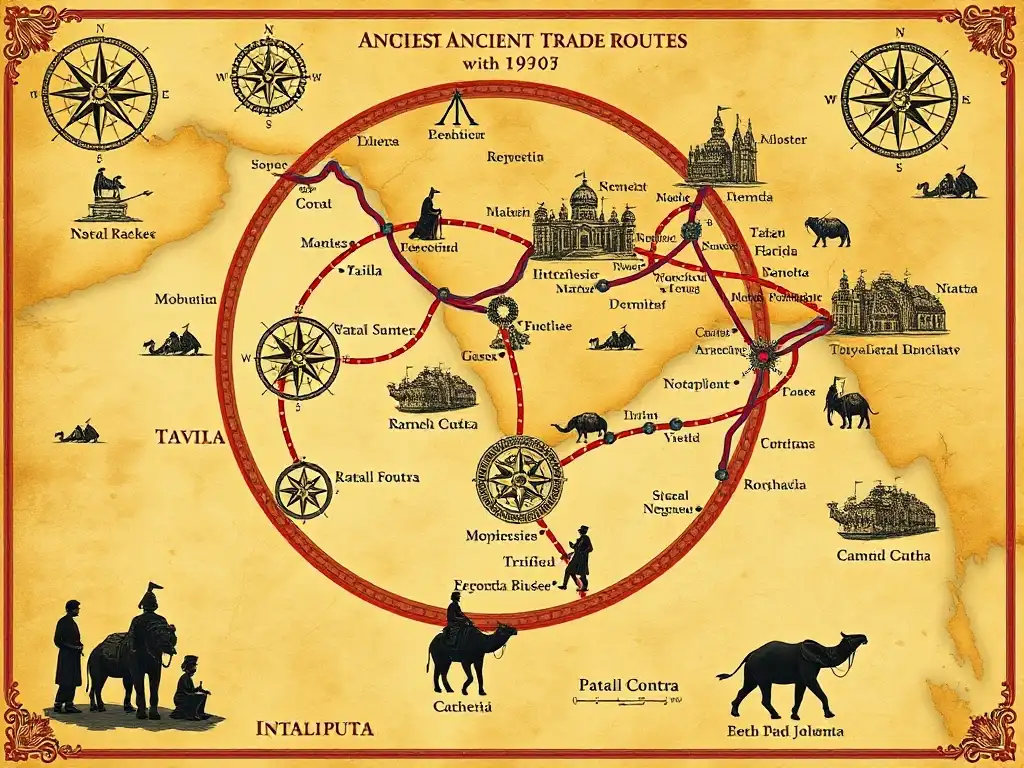
Ancient Indian mathematics played a pivotal role in shaping trade routes, not only within the subcontinent but also extending its influence across Asia and beyond. The mathematical principles developed by ancient Indian scholars facilitated navigation, commerce, and the movement of goods, thereby enhancing trade efficiency. The precision in calculations and the systematic approach to problem-solving contributed significantly to the establishment of trade networks that connected various civilizations.
The impact of ancient Indian mathematics on trade routes can be understood through various techniques and systems. This groundwork laid by mathematicians such as Aryabhata, Brahmagupta, and Bhaskara II was instrumental in advancing the understanding of numbers, geometry, and algebra, which in turn, were applied in practical trade scenarios.
Mathematical Techniques Used in Trade
- Decimal System and Place Value:
- The development of the decimal system allowed for easier computation and record-keeping. The place value system enabled merchants to perform complex calculations quickly, which was essential for trade transactions involving large sums.
- This system was later adopted globally, revolutionizing mathematics and commerce.
- Geometry in Land Measurement:
- Ancient Indian mathematicians used geometric principles to measure land accurately. This was crucial for establishing trade routes and determining the value of land for agricultural production.
- Techniques such as the use of squares and triangles helped in surveying land, which was essential for trade expansions.
- Algebra for Profit Calculations:
- Algebraic methods were employed to calculate profits, losses, and interest rates associated with trade. The ability to solve equations allowed merchants to optimize their trading strategies.
- Brahmagupta’s rules for profit calculation provided foundational knowledge that traders built upon.
- Navigation Techniques:
- Ancient Indian mathematicians contributed to the field of astronomy, which was directly linked to navigation. The knowledge of celestial bodies allowed traders to navigate accurately across vast oceans and deserts.
- The use of trigonometry in determining distances and angles significantly improved the safety and efficiency of trade voyages.
Case Studies of Trade Routes Influenced by Ancient Indian Mathematics
- The Silk Road:
- Ancient Indian mathematics facilitated interactions along the Silk Road, a significant trade route connecting India with Central Asia and beyond. The use of mathematical techniques in calculating distances and trade tariffs allowed for smoother transactions.
- Indian merchants, equipped with these mathematical tools, became key players in the exchange of silk, spices, and precious stones.
- The Maritime Trade Network:
- The Indian Ocean trade network was profoundly influenced by mathematical advancements. Navigation based on celestial observations, aided by the use of mathematical calculations, allowed traders to sail across the Indian Ocean with confidence.
- This network not only connected India with other regions but also promoted cultural exchanges, further enriching the legacy of ancient Indian mathematics.
- The Spice Trade:
- The spice trade, particularly with regions like Southeast Asia, saw the application of ancient Indian mathematical techniques in determining the value of spices and calculating shipping costs.
- Merchants utilized algebraic methods to gauge profitability, ensuring that trade remained lucrative and efficient.
- The Gupta Empire Trade Routes:
- During the Gupta Empire, ancient Indian mathematics thrived, and its application in trade was evident. The empire established extensive trade routes that connected various regions, facilitated by mathematical innovations.
- The prosperity of this period can be attributed, in part, to the effective use of mathematics in trade, establishing a thriving economy that influenced global trade practices.
The impact of ancient Indian mathematics on global trade routes cannot be overstated. The techniques developed by ancient scholars not only aided in the practical aspects of trade but also laid the groundwork for future mathematical advancements that would benefit civilizations worldwide.
The Spread of Ancient Indian Mathematical Concepts

The influence of ancient Indian mathematics extends far beyond its geographic borders, significantly impacting global trade routes. The mathematical concepts developed in ancient India, particularly during the Vedic and post-Vedic periods, played a crucial role in facilitating commerce and communication across regions.
Cultural Exchange Along Trade Routes
Ancient trade routes, such as the Silk Road and maritime paths connecting India to Southeast Asia, were not just conduits for goods; they were vibrant avenues for cultural exchange, including mathematics. Merchants and traders carried not only commodities but also ideas, knowledge, and innovations.
- Mathematical Innovations:
- Indian mathematicians developed advanced concepts such as the decimal system, zero, and the concept of infinity. These innovations allowed for more sophisticated calculations in trade, including pricing, weight measurement, and currency exchange.
- The introduction of the numeral system, known today as Hindu-Arabic numerals, streamlined calculations and record-keeping, enabling more efficient trade practices.
- Transmission of Knowledge:
- As traders traveled along these routes, they interacted with various cultures, leading to a blend of mathematical knowledge. For example, Indian mathematical texts, such as the Aryabhatiya by Aryabhata, were translated and disseminated across regions, influencing scholars in the Middle East and beyond.
- The interaction between Indian and Arab mathematicians in particular facilitated the spread of Indian numerical systems, which were later adopted in Europe.
The ancient Indian mathematicians not only shaped their own civilization but also laid the groundwork for future advancements in mathematics across the globe.
- Cultural Exchanges:
- The exchanges were often reciprocal; as Indian mathematicians adopted concepts from Greek and Persian scholars, these interactions enriched the mathematical landscape, fostering an environment of collaboration and shared knowledge.
- Festivals, fairs, and markets served as melting pots for ideas, where mathematical concepts became integral to trade negotiations and contracts.
Influence on Neighboring Civilizations
The impact of ancient Indian mathematics was profound, influencing neighboring civilizations in various ways:
- Southeast Asia:
- Countries such as Indonesia, Malaysia, and Thailand integrated Indian mathematical concepts into their trading practices. This integration was evident in their architectural designs, which often displayed sophisticated mathematical principles.
- The spread of Indian traders and Buddhist monks helped disseminate mathematical knowledge, including the use of zero and advanced arithmetic, which enhanced local trade efficiency.
- China:
- Chinese scholars encountered Indian mathematical texts through trade, leading to the adoption of the decimal system. This system significantly improved Chinese calculations in commerce, astronomy, and engineering.
- The translation of Indian mathematical works into Chinese during the Tang Dynasty marked a pivotal moment in the cross-cultural exchange of mathematical knowledge.
- Middle East:
- The mathematical contributions from ancient India were instrumental in the development of Islamic mathematics during the Golden Age. Scholars such as Al-Khwarizmi, who is often referred to as the "father of algebra," drew heavily from Indian mathematical principles.
- The concepts of algorithms and the systematic approach to calculations can be traced back to Indian influences, which were further developed and expanded upon by Middle Eastern scholars.
| Civilization | Key Influence | Impact on Trade |
|---|---|---|
| Southeast Asia | Adoption of zero and advanced arithmetic | Improved trade calculations and contracts |
| China | Integration of the decimal system | Enhanced accuracy in commerce and astronomy |
| Middle East | Development of algebra and algorithms | Revolutionized mathematical practices in trade |
The diverse interactions along trade routes not only fostered the spread of ancient Indian mathematics but also contributed to a rich tapestry of shared knowledge that shaped the mathematical landscape of various civilizations. This legacy continues to resonate in modern mathematics and trade practices worldwide.
The impact of ancient Indian mathematics on global trade routes was multifaceted, facilitating cultural exchange and laying the groundwork for advancements across neighboring civilizations. The innovations that emerged from this period not only transformed local economies but also influenced the course of mathematical thought throughout history.
The Lasting Impact of Ancient Indian Mathematics on Global Trade

Ancient Indian mathematics, with its profound insights and innovative techniques, played a pivotal role in shaping global trade routes. The mathematical advancements made by ancient Indian scholars were not only instrumental in local commerce but also significantly influenced trade practices across continents. This comprehensive impact can be observed in various areas, particularly in navigation and commerce.
The mathematical principles developed in ancient India contributed immensely to navigation—essential for maritime trade routes. The use of trigonometry and geometry allowed sailors to chart their courses with remarkable precision. Ancient Indian mathematicians, such as Aryabhata, formulated methods to calculate distances and angles, which were crucial for determining a ship's position at sea.
- Aryabhata's Sine Table: Aryabhata’s work included an early version of the sine function, enabling navigators to calculate angles effectively. This was particularly beneficial for sailors navigating the Indian Ocean and beyond.
- Astronomical Calculations: The advanced astronomical calculations made by Indian mathematicians facilitated better understanding of celestial movements. This knowledge was vital for creating accurate calendars, which in turn impacted trade cycles and market activities.
Moreover, the decimal system, which was a significant contribution of ancient Indian mathematics, was adopted by traders and merchants globally. This system simplified calculations, making it easier to conduct transactions across vast distances.
Legacy of Ancient Indian Mathematics in Modern Trade Practices
The influence of ancient Indian mathematics is still evident in contemporary trade practices. The methodologies developed centuries ago laid the groundwork for several modern mathematical concepts utilized in economic analysis and logistics.
- Standardization of Measurements:
- Ancient Indian mathematicians emphasized the importance of standardized units of measurement, which is crucial for trade agreements. This practice is echoed in today's global trade standards, where consistent measurements are vital for ensuring fairness and accuracy in transactions.
- Mathematical Models in Economics:
- The principles of mathematics established by ancient scholars are foundational to the development of modern economic models. These models rely on statistical analysis and algorithms, which trace their roots back to the mathematical concepts introduced in ancient India.
- Globalization of Trade:
- As trade routes expanded, the mathematical knowledge from ancient India spread across Asia and into the Middle East and Europe. This dissemination helped unify trade practices and contributed to the emergence of a global trading system.
The impact of ancient Indian mathematics on global trade routes is profound and multifaceted. From navigation techniques that guided explorers to the foundational principles that underpin modern economic practices, the legacy of these early mathematicians continues to resonate in today's interconnected world. The contributions of ancient Indian mathematics are not merely historical but remain relevant in shaping contemporary commerce and trade dynamics.
Conclusion: The Enduring Influence of Ancient Indian Mathematics on Global Trade Routes

Summary of Ancient Indian Mathematics' Impact
Ancient Indian mathematics has left an indelible mark on various domains, particularly in trade and commerce. The sophisticated numeral system developed, including the concept of zero, facilitated complex calculations, transforming trade practices. This numeral system enabled merchants to conduct transactions more efficiently and accurately, aiding in the expansion of trade routes across Asia and beyond.
The Siddhanta texts, particularly the Aryabhatiya by Aryabhata and the Bakhshali Manuscript, are prime examples of how mathematical concepts were documented and shared. These texts introduced advanced arithmetic and algebraic techniques that were crucial for trade calculations. For instance, merchants utilized these methods to determine profit margins, manage inventory, and calculate taxes, thus enhancing their economic activities.
The influence of ancient Indian mathematics extended beyond borders. The introduction of the decimal system and positional notation significantly impacted the mathematical practices in the Arab world, which later permeated into Europe. This cross-cultural exchange was critical for the development of global trade networks, as it allowed for standardized measurements and calculations across different civilizations.
Reflection on the Importance of Historical Contributions to Mathematics and Trade
Understanding the historical contributions of ancient Indian mathematics is essential for appreciating the evolution of mathematical thought and its practical applications in trade. The mathematical principles established in ancient India not only provided a foundation for future mathematical discoveries but also played a pivotal role in shaping economic practices.
The integration of mathematical innovations into trade practices illustrates the interconnectedness of mathematics and commerce. It reveals how societies utilized mathematical knowledge to address real-world problems, facilitating trade and cultural exchange. Thus, the study of ancient Indian mathematics is not merely an academic pursuit; it is a vital part of understanding how human civilization has advanced through the application of mathematical ideas.
As we reflect on these contributions, it becomes evident that the legacy of ancient Indian mathematics continues to influence modern mathematical practices and global trade dynamics. The impact of these early mathematicians is a reminder of the importance of preserving and studying historical knowledge, as it enriches our understanding of contemporary society and commerce.
Frequently Asked Questions
What were the key contributions of ancient Indian mathematics?
Ancient Indian mathematics made significant contributions such as the concept of zero, the decimal system, and advanced algorithms that influenced many fields, including astronomy and geometry.
How did ancient Indian mathematics impact global trade?
The mathematical advancements from ancient India played a crucial role in calculating trade routes, improving navigation, and facilitating international commerce, making trade more efficient and accurate.
What role did the Gupta Empire play in the development of mathematics?
The Gupta Empire is often regarded as the golden age of mathematics in India, where scholars made groundbreaking discoveries and formalized concepts that laid the groundwork for future mathematical theories.
How did ancient Indian mathematicians influence other cultures?
Ancient Indian mathematicians shared their knowledge through trade and scholarship, which significantly influenced various cultures, notably the Islamic Golden Age, where their works were translated and further developed.
Are there any notable ancient Indian mathematicians?
Yes, notable mathematicians such as Aryabhata, who introduced the concept of place value, and Brahmagupta, who made strides in algebra and geometry, were pivotal in shaping the course of mathematics in both India and the world.
Final Reflection: The Enduring Impact of Ancient Indian Mathematics
The legacy of ancient Indian mathematics is not merely a historical footnote; it is a powerful testament to how mathematical innovations shaped global trade routes and fostered interconnectedness across cultures. Today, as we navigate an increasingly globalized world, the principles and concepts developed by ancient Indian mathematicians continue to resonate, reminding us of the profound influence that knowledge can have on commerce and collaboration.
The impact of ancient Indian mathematics extends far beyond the confines of academia; it has woven itself into the very fabric of our cultural and social landscapes. The intricate calculations and trade practices established centuries ago laid the groundwork for modern economic systems, demonstrating that mathematics is not just a tool for numbers, but a bridge that connects diverse peoples and ideas. Mathematics knows no races or geographic boundaries; for mathematics, the cultural world is one country.
– David Hilbert. This quote encapsulates the universal nature of mathematical thought, emphasizing how ancient Indian contributions have transcended time and geography to influence global trade dynamics.
As we reflect on the lessons of ancient Indian mathematics, let us embrace the call to recognize and celebrate the interconnectedness of our world. Consider how you can apply the principles of collaboration, innovation, and cultural appreciation in your own life. Whether through fostering partnerships in your community or seeking to understand the diverse perspectives that shape our global economy, remember that the legacy of ancient Indian mathematics is not just a story of the past; it is an invitation to engage with the world around us in meaningful and transformative ways.
Unveil the Mathematical Legacy of Ancient India!
Thank you for exploring the fascinating influence of Ancient Indian mathematics on global trade routes with us! You've uncovered how this rich history has shaped commerce worldwide. Now, it’s time to take that inspiration and turn it into action!
- Dive deeper: Explore additional articles and resources that highlight the contributions of ancient cultures to the field of mathematics.
- Share your insights: Connect with friends and fellow history enthusiasts by sharing this article on social media or starting a discussion group.
- Engage with the community: Participate in forums or online communities dedicated to studying ancient civilizations and their impacts on contemporary society.
What aspect of Ancient Indian mathematics fascinates you the most, and how do you believe it can further transform today’s global trade landscape?