
How Nyaya Thinkers Addressed the Nature of Reality

Welcome to Ancient India History, where we embark on a fascinating journey through the rich tapestry of ancient Indian civilizations. In this exploration, we delve into the profound realms of thought and philosophy that have shaped our understanding of existence. Our featured article, "How Nyaya Thinkers Addressed the Nature of Reality," invites you to uncover the intricate nuances of Nyaya philosophy and its compelling discussions on reality.
Prepare to be captivated as we unravel the contributions of these ancient thinkers and their impact on modern philosophical discourse. Join us as we ignite your curiosity and inspire you to delve deeper into the wonders of India's past!
- Introduction to Nyaya Philosophy and Reality
- Historical Context of Nyaya Philosophy
- Understanding the Concept of Reality in Nyaya Philosophy
- Epistemology in Nyaya Philosophy
- Arguments for Reality: Nyaya Dialectics
- Comparison with Other Philosophical Schools
- Nyaya Philosophy's Legacy on Modern Thought
- Conclusion: The Impact of Nyaya Thinkers on the Nature of Reality
- Frequently Asked Questions
- Final Reflection: Exploring the Depths of Reality through Nyaya Philosophy
- Unveil the Depths of Reality with Nyaya Philosophy!
Introduction to Nyaya Philosophy and Reality
The Nyaya philosophy, one of the six orthodox schools of Indian philosophy, offers profound insights into the nature of reality, knowledge, and perception. Rooted in the ancient texts known as the Nyaya Sutras, this school of thought emphasizes logic and critical analysis as essential tools for understanding the world.
By exploring the intricate relationship between reality and perception, Nyaya thinkers have significantly contributed to the philosophical discourse in ancient India, shaping not only their own traditions but also influencing other schools of thought. In this article, we will delve into how Nyaya philosophers addressed the nature of reality, examining their methodologies, key concepts, and the implications of their ideas in the broader context of Indian philosophy.
Overview of Nyaya Philosophy
The Nyaya school, founded by the sage Gautama, revolves around the concept of "Nyaya," which translates to "logic" or "rules." Central to Nyaya philosophy is the analysis of valid means of knowledge (pramana), which includes perception, inference, comparison, and verbal testimony.
-
Key Concepts in Nyaya:
- Pramana (means of knowledge): The process through which knowledge is acquired.
- Pratyaksha (perception): Direct sensory experience.
- Anumana (inference): Logical deduction based on premises and conclusions.
- Upamana (comparison): Knowledge derived through analogy.
-
Methodology:
Nyaya thinkers employed rigorous logical reasoning to dissect arguments and clarify misconceptions about reality. This methodological approach allowed for a systematic examination of philosophical inquiries.
-
Influence on Other Philosophical Schools:
The analytical techniques and concepts formulated by Nyaya philosophers have had a lasting impact on other Indian philosophical traditions, including Buddhism and Vedanta, fostering a rich dialogue around metaphysics and epistemology.
Importance of Reality in Nyaya Thought
Reality holds a central position in Nyaya philosophy, where it is viewed through the lens of both epistemology and metaphysics.
-
Nature of Reality:
Nyaya philosophers assert that reality is objective and can be comprehended through logical analysis and empirical observation. They distinguish between different levels of reality, including the eternal (e.g., the soul) and the transient (e.g., material objects), emphasizing that understanding these distinctions is crucial for a complete grasp of existence.
-
Realism vs. Idealism:
Unlike some philosophical traditions that lean towards idealism, Nyaya maintains a realist perspective. This approach insists that external reality exists independently of our perception, and thus, knowledge must be grounded in an objective reality.
-
Practical Implications:
The exploration of reality in Nyaya thought not only contributes to philosophical discussions but also has practical implications in ethics and daily life. By understanding the nature of reality, individuals can cultivate a more informed and rational approach to their experiences and interactions.
The Nyaya school's rigorous examination of reality through logical frameworks has laid the groundwork for enduring philosophical inquiries, making it a cornerstone of ancient Indian thought. By appreciating the nuances of Nyaya philosophy, we can gain deeper insights into the complexities of reality and our engagement with it.
Historical Context of Nyaya Philosophy
Origins of Nyaya School of Thought
Nyaya philosophy, rooted in the ancient Indian tradition, is one of the six orthodox schools (darshanas) of Hindu philosophy. Its origins can be traced back to the Nyaya Sutras, composed by the sage Gautama (also known as Akshapada) around the 2nd century BCE. The Nyaya Sutras systematically outline the principles of logic and epistemology, emphasizing the importance of reasoning and critical analysis in understanding the nature of reality.
The Nyaya School emerged during a time of significant intellectual activity in ancient India, characterized by debates among various philosophical systems. This era saw the formulation of doctrines that questioned the nature of knowledge, perception, and the existence of an external reality. Nyaya thinkers sought to establish a framework that could resolve metaphysical inquiries through logical reasoning, thus paving the way for future philosophical discourse.
Key Figures in Nyaya Philosophy
Several notable philosophers have contributed to the development of Nyaya philosophy, each enhancing its framework and expanding its reach.
- Gautama (Akshapada): The founder of the Nyaya School, Gautama is renowned for his analytical approach to philosophy. His Nyaya Sutras laid the groundwork for the systematic study of logic and epistemology.
- Udyotakara: An influential commentator on the Nyaya Sutras, Udyotakara's works, such as the Nyaya Varttika, provided crucial interpretations of Gautama's texts. He emphasized the role of inference (anumana) as a means of acquiring knowledge about reality.
- Vatsyayana: Known for his comprehensive commentary on the Nyaya Sutras, the Nyaya Bhashya, Vatsyayana further refined the principles of Nyaya philosophy. His synthesis of Nyaya with other philosophical schools contributed to a more holistic understanding of reality.
- Raghunatha Siromani: A later Nyaya philosopher, he is celebrated for his work in the 16th century, which integrated Nyaya with the emerging ideas of the Vedanta school, highlighting the dynamic interplay between different philosophical systems in ancient India.
Influence of Nyaya on Ancient Indian Thought
The influence of Nyaya philosophy on ancient Indian thought is profound and multifaceted. Its rigorous approach to logic and epistemology significantly impacted various aspects of Indian culture, including:
- Philosophical Discourse: Nyaya's emphasis on logical reasoning laid the foundation for critical discussions in other philosophical schools, such as Vaisesika, Samkhya, and Vedanta. The principles of Nyaya served as a common ground for debates and dialogues among these systems.
- Legal and Ethical Frameworks: The logical methodologies developed by Nyaya thinkers influenced the formulation of legal theories and ethical considerations in ancient Indian society. Their principles of reasoning were applied to jurisprudence, enhancing the understanding of justice and morality.
- Scientific Inquiry: The emphasis on inference and empirical observation in Nyaya philosophy contributed to the early development of scientific thinking in India. The ideas put forth by Nyaya philosophers encouraged a systematic investigation of the natural world, promoting a culture of inquiry.
- Integration with Other Traditions: Nyaya's engagement with Buddhist, Jain, and other philosophical systems facilitated a rich intertextual dialogue, enabling the cross-pollination of ideas and the development of a more comprehensive understanding of reality.
The Nyaya philosophy and reality are deeply interwoven, with the school's logical methodologies providing essential insights into the nature of existence and the processes of knowledge acquisition. The contributions of key figures and the school's influence on various domains underscore its significance in the broader landscape of ancient Indian thought.
Understanding the Concept of Reality in Nyaya Philosophy
Definition of Reality in Nyaya Terms
In Nyaya philosophy, reality is intricately linked to knowledge and logic. The term "reality" (or "tatva") is understood as that which exists independently of our perceptions and beliefs. According to Nyaya thinkers, reality is not merely subjective but is rooted in objective existence. They emphasize that knowledge must be based on valid sources (pramanas), and these sources help in discerning true reality from illusion.
Nyaya philosophers assert that reality can be grasped through rigorous logical analysis. They categorize reality into what is "real" (astitva) and what is "unreal" (nasitva). The former is associated with entities that can be perceived or inferred, while the latter refers to non-existent entities. This distinction is crucial as it lays the groundwork for further exploration of reality and knowledge in the Nyaya system.
Categories of Reality: Padarthas
Nyaya philosophy classifies reality into five primary categories, known as padarthas. Understanding these categories is essential for grasping how Nyaya thinkers conceptualize reality:
- Dravya (Substance):
- Refers to tangible entities such as earth, water, fire, air, and ether.
- Each substance has inherent properties and can exist independently.
- Guna (Quality):
- Attributes or characteristics that can be associated with substances.
- For example, color, taste, and texture.
- Karma (Action):
- Denotes the actions or processes that substances can undergo.
- Actions are influenced by the qualities of substances.
- Samanya (Universal):
- The commonality or generality that allows for categorization.
- For instance, the universal quality of "redness" that can be found in multiple red objects.
- Vishesha (Particularity):
- The uniqueness of an entity that distinguishes it from others.
- It is what makes an individual substance distinct within its category.
These categories are not merely theoretical; they provide a framework for understanding the nature of objects and their interrelations. By analyzing these padarthas, Nyaya thinkers argue that we can arrive at a clearer, more systematic understanding of reality.
The Role of Perception in Understanding Reality
Perception (pratyaksha) plays a pivotal role in Nyaya philosophy, serving as one of the primary means of acquiring knowledge. Nyaya philosophers argue that through direct experience, individuals can access the nature of reality. They classify perception into three types:
- External Perception:
- Involves sensory experiences derived from external stimuli (sight, sound, touch, taste, smell).
- This form of perception is considered reliable for understanding external realities.
- Internal Perception:
- Concerns self-awareness and introspection, allowing individuals to experience their thoughts and feelings.
- This type of perception is crucial for understanding one's own mental states.
- Inference (Anumana):
- While not strictly perception, inference is closely related, as it allows individuals to arrive at conclusions about realities based on observed evidence.
- For example, seeing smoke may lead one to infer the presence of fire.
Nyaya philosophers stress that valid perception is essential for the acquisition of knowledge about reality. They argue that errors in perception can lead to misconceptions about the nature of existence. Thus, the rigorous analysis of perception and its types is fundamental to the Nyaya approach to understanding reality, reinforcing the idea that reality can be apprehended through logical reasoning and empirical evidence.
Epistemology in Nyaya Philosophy

Epistemology, the study of knowledge and justified belief, holds a significant place in Nyaya philosophy. The Nyaya school, one of the six orthodox systems of Indian philosophy, emphasizes a systematic approach to understanding the nature of knowledge. Its epistemological framework is not merely a theoretical discourse but serves as a practical guide to discerning truth and reality.
Nyaya thinkers posited that knowledge is essential for liberation (moksha) and that understanding the nature of reality requires a thorough investigation of knowledge itself. They distinguished between different types of knowledge and elaborated on how individuals can attain valid knowledge, which is crucial for navigating the complexities of existence.
Sources of Knowledge in Nyaya
In Nyaya philosophy, knowledge is derived from specific sources known as pramanas. These are the means through which one can obtain valid knowledge regarding the world. The Nyaya school recognizes four primary sources:
- Pratyaksha (Perception):
- This is the direct knowledge obtained through the senses. It is considered the most reliable source of knowledge, as it provides immediate evidence of reality. For example, seeing a tree provides direct knowledge of its existence.
- Anumana (Inference):
- Inference involves drawing conclusions based on observations. Nyaya philosophers argue that valid inferences must follow a logical structure. For instance, if one sees smoke, they can infer that fire is present, provided that there is a consistent relationship between smoke and fire.
- Upamana (Comparison):
- This source involves knowledge gained through analogy or comparison. For example, learning about a new animal by comparing it to a known one allows a person to form an understanding of its characteristics.
- Shabda (Testimony):
- Testimony refers to knowledge obtained from reliable sources, such as scriptures or credible individuals. This source is particularly important in the context of spiritual and philosophical teachings, where direct perception or inference may not suffice.
These sources collectively provide a comprehensive framework for Nyaya thinkers to explore and articulate their understanding of reality.
Pramanas: Means of Valid Knowledge
The concept of pramanas is central to Nyaya epistemology, as it delineates the criteria for what constitutes valid knowledge. Each pramana must fulfill specific criteria to be considered valid:
- Clarity and Distinctness: Knowledge obtained must be clear and distinct, allowing for accurate comprehension of the object of knowledge.
- Consistency: There should be no contradictions within the knowledge gained. For example, if perception and inference lead to conflicting conclusions, further investigation is necessary.
- Pragmatic Utility: Knowledge must have practical implications and should aid in navigating everyday life and spiritual pursuits.
The Nyaya school advocates for a systematic evaluation of knowledge claims through these criteria, ensuring that any acquired knowledge is robust and reliable.
The Relationship Between Knowledge and Reality
Nyaya philosophy posits a profound relationship between knowledge and reality. According to Nyaya thinkers, knowledge acts as a means to access and understand the underlying nature of reality. They assert that:
- Reality Exists Independently: Nyaya philosophers maintain that reality exists independently of our perceptions and knowledge. This objective stance emphasizes that knowledge should strive to reflect this reality accurately.
- Knowledge as a Tool: Knowledge serves as a tool to engage with and comprehend reality. The more valid knowledge one acquires through the pramanas, the closer they come to understanding the true nature of reality.
- Reality's Complexity: The nature of reality is viewed as complex and multifaceted. Nyaya thinkers acknowledge that different perspectives can yield diverse interpretations of reality, thus reinforcing the importance of a rigorous epistemological framework.
Nyaya philosophy intricately weaves together the concepts of knowledge and reality, asserting that valid knowledge is essential for grasping the complexities of existence. Through its systematic approach to epistemology, Nyaya thinkers provide valuable insights into the nature of reality, establishing a foundation for further philosophical inquiry.
Arguments for Reality: Nyaya Dialectics
The Nyaya school of thought, one of the six orthodox schools of Indian philosophy, emphasizes the importance of logical reasoning in understanding the nature of reality. Central to Nyaya philosophy is the belief that reality can be comprehended through a systematic analysis of arguments, which are essential for discerning truth from falsehood. This section explores the distinctive features of Nyaya dialectics, focusing on their approach to logical argumentation, the key arguments supporting the nature of reality, and the counterarguments along with their rebuttals.
The Nyaya Approach to Logical Argumentation
Nyaya thinkers employed a structured method of logical reasoning known as anumana (inference) to explore the nature of reality. This method is grounded in a four-step process often referred to as the pramana (means of knowledge). The steps include:
- Pratyaksha (perception): Direct observation as the primary source of knowledge.
- Anumana (inference): Drawing conclusions based on observations.
- Upamana (comparison): Gaining knowledge through analogy or comparison.
- Shabda (verbal testimony): Understanding derived from authoritative sources or scriptures.
Through these pramanas, Nyaya philosophers argue that reality can be apprehended and articulated logically. They assert that the pursuit of knowledge is not merely an intellectual exercise but a necessity for achieving liberation (moksha). The Nyaya method stands out for its rigorous analysis of propositions, where each argument is meticulously crafted and examined for validity.
Key Arguments Supporting the Nature of Reality
Nyaya thinkers present several compelling arguments to support their understanding of reality. Some of the most prominent include:
- The Argument from Change: Nyaya philosophers argue that the observable changes in the world imply an underlying reality that is causing these changes. For example, the transformation of clay into a pot suggests the existence of both clay and the pot as separate entities. The reality of the pot does not negate the reality of clay; rather, it demonstrates the interplay of substance and form.
- The Argument from Perception: This argument posits that our sensory experiences provide a reliable foundation for understanding reality. Nyaya thinkers maintain that perceptions can be validated through logical analysis. If multiple observers can perceive the same object consistently, it strengthens the claim of its reality.
- The Argument from Inference: This highlights the Nyaya belief that logical inference leads to knowledge of reality. For instance, the presence of smoke (an observed phenomenon) suggests the existence of fire (the inferred reality). Thus, inference serves as a bridge to grasping unseen realities based on visible evidence.
These arguments collectively assert that reality is not merely subjective but can be objectively understood through careful reasoning.
Counterarguments and Rebuttals in Nyaya Thought
While the Nyaya school presents robust arguments for the nature of reality, it also encounters several counterarguments, primarily from rival philosophical schools such as Buddhism and Advaita Vedanta. Key counterarguments include:
- The Illusory Nature of Perception: Critics argue that our senses can deceive us, leading to the conclusion that reality is subjective. For instance, a mirage appears real but does not exist in actuality.
- Skepticism about Inference: Some philosophers question the reliability of inference, arguing that it relies on assumptions that cannot be verified. This skepticism raises doubts about the certainty of the conclusions drawn.
In response to these counterarguments, Nyaya thinkers provide several rebuttals:
- Defense of Perception: They argue that while perception may sometimes be misleading, the consistency of perceptual experiences across different observers lends credibility to the existence of an objective reality. They maintain that rigorous examination and corroboration can help identify reliable perceptions.
- Refinement of Inference: Nyaya philosophers counter that inference is not merely based on assumptions; it is a logical process informed by established principles (like the law of non-contradiction). Inferences are not arbitrary; they follow a systematic methodology that strengthens their validity.
Nyaya philosophy engages deeply with the nature of reality through logical arguments and dialectics. By addressing both supportive arguments and counterarguments, Nyaya thinkers demonstrate a commitment to a rational exploration of existence, reinforcing the significance of logical inquiry in understanding the complexities of reality.
Comparison with Other Philosophical Schools
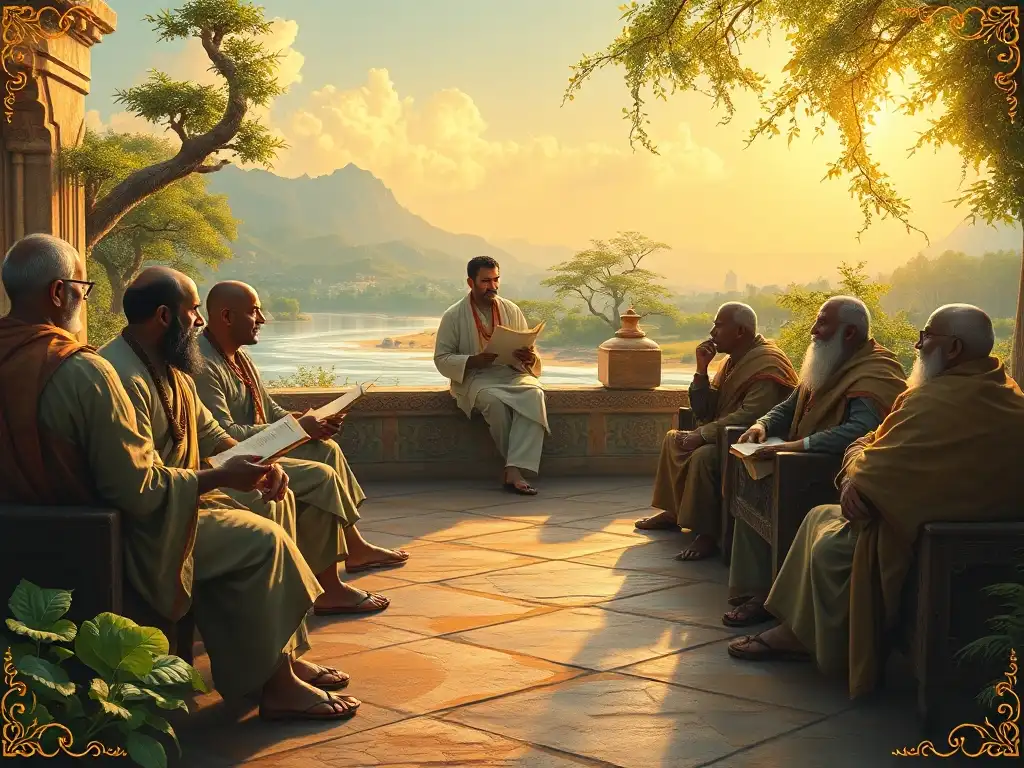
The Nyaya philosophy, primarily concerned with logic and epistemology, offers a unique perspective on the nature of reality. By comparing Nyaya with other philosophical schools, we can better understand its distinctive features and contributions to Indian thought.
Nyaya vs. Advaita Vedanta: Perspectives on Reality
Advaita Vedanta, founded by Adi Shankaracharya, posits a non-dualistic view of reality, where the ultimate truth is Brahman, and the material world is an illusion (Maya). In contrast, Nyaya philosophers maintain a dualistic approach, emphasizing the distinction between the observer (Atman) and the observed (external reality).
- Nature of Reality:
- Advaita Vedanta: Reality is ultimately unified; individual distinctions are illusory.
- Nyaya: Reality is composed of both the material and the spiritual, where both can be known and understood through proper reasoning.
- Epistemology:
- Advaita: Knowledge of Brahman is attainable through direct experience (jnana) and intuition.
- Nyaya: Knowledge is derived from pramana (means of knowledge), such as perception, inference, comparison, and testimony, focusing on logical reasoning.
- Goals of Philosophy:
- Advaita: Liberation (moksha) is achieved through the realization of oneness with Brahman.
- Nyaya: Liberation is attained by overcoming ignorance through accurate knowledge, leading to a clear understanding of reality.
Nyaya vs. Buddhism: Divergent Views on Existence
Buddhism, particularly in its early forms, challenges the notion of a permanent self or unchanging reality. Nyaya, however, asserts the existence of a stable reality that can be comprehensively analyzed and understood.
- Self and Existence:
- Buddhism: The concept of Anatta (non-self) suggests that what we perceive as self is merely a collection of changing aggregates (skandhas).
- Nyaya: The self (Atman) is considered a distinct, permanent entity capable of knowledge and experience.
- Nature of Reality:
- Buddhism: Reality is characterized by impermanence (anicca) and suffering (dukkha), leading to the conclusion that attachment to existence is the root of suffering.
- Nyaya: Reality is stable and can be known through rigorous analysis and logical reasoning, thus rejecting the notion of inherent suffering tied to existence.
- Knowledge Acquisition:
- Buddhism: Emphasizes meditation and mindfulness as pathways to understanding the nature of reality.
- Nyaya: Prioritizes logical discourse and rational inquiry as essential tools for discerning truth and understanding reality.
Synergies Between Nyaya and Other Indian Philosophies
Despite its distinct characteristics, Nyaya shares common ground with various Indian philosophical traditions, creating a rich intertextual dialogue.
- Integration with Samkhya: Both Nyaya and Samkhya emphasize the importance of epistemology in understanding reality. While Samkhya outlines a dualistic framework between Purusha (consciousness) and Prakriti (matter), Nyaya contributes logical methods to analyze their interactions.
- Influence on Jainism: Jain philosophy aligns with Nyaya’s emphasis on perception and inference as means of knowledge. The Jain concept of multiple viewpoints (anekantavada) complements Nyaya's thorough examination of reality through logical discourse.
- Interplay with Mimamsa: Nyaya's focus on logical reasoning is echoed in the Mimamsa school, which emphasizes the significance of texts and rituals. Both schools prioritize a systematic approach to understanding truth, albeit through different lenses.
Nyaya philosophy offers a robust framework for exploring the nature of reality, standing in contrast and dialogue with other philosophical traditions within the rich tapestry of Indian thought. Its emphasis on logic and epistemology not only enhances our understanding of reality but also invites deeper inquiry into the nature of existence itself.
Nyaya Philosophy's Legacy on Modern Thought
Nyaya philosophy, one of the six orthodox schools of Indian philosophy, has left an indelible mark on various domains of modern thought. This legacy is particularly evident in its rigorous approach to logic, epistemology, and metaphysics, which continues to influence contemporary philosophical discourse. The Nyaya thinkers emphasized the importance of reasoning and evidence, ultimately shaping how we understand knowledge and reality today.
The core tenets of Nyaya philosophy revolve around the concept of pramāṇa (means of knowledge), which delineates the methods through which one can gain valid knowledge. This foundational aspect of Nyaya has inspired modern philosophers to reconsider the sources and validation of knowledge. The systematic analysis of arguments and the emphasis on critical thinking have found their way into various fields, including science, ethics, and political theory.
Influence of Nyaya Philosophy on Contemporary Philosophy
Nyaya philosophy has significantly influenced contemporary philosophical thought in several key areas:
- Logic and Argumentation:
- Formal Logic: The Nyaya school’s systematic approach to logic has parallels in Western formal logic, particularly in the development of syllogistic reasoning. The rigorous categorization of fallacies and valid arguments in Nyaya has enriched modern logical frameworks.
- Debate Techniques: The Nyaya tradition's methodology for debate and discussion has informed modern discourse strategies, emphasizing clarity, coherence, and rationality.
- Epistemology:
- Theory of Knowledge: Nyaya philosophers categorized different types of knowledge (e.g., perception, inference, and testimony), which has influenced modern epistemologists in their quest to understand the nature and limits of human knowledge.
- Critical Examination: The Nyaya emphasis on critical examination of beliefs and assumptions resonates with contemporary views on skepticism and the pursuit of justified true belief.
- Metaphysics:
- Nature of Reality: The Nyaya exploration of the nature of reality, particularly the distinction between the external world and subjective experience, has parallels in contemporary metaphysical discussions about realism and idealism.
- Causation: The Nyaya analysis of causation, including the concepts of parāmarśa (direct perception) and samavāya (inherence), has influenced modern philosophical inquiries into the nature of causality and its implications for scientific understanding.
Relevance of Nyaya Concepts in Modern Discussions of Reality
The relevance of Nyaya concepts in modern discussions of reality can be seen in several contemporary debates and philosophical inquiries:
- Philosophy of Science: Nyaya's rigorous methodologies for validating knowledge align with the scientific method, emphasizing the importance of empirical evidence and logical reasoning in understanding the natural world.
- Artificial Intelligence and Epistemology: As discussions around consciousness and reality emerge in the context of artificial intelligence, Nyaya’s insights into perception and inference provide valuable frameworks for evaluating machine cognition and the nature of awareness.
- Ethics and Moral Philosophy: The Nyaya focus on the consequences of actions and the pursuit of truth influences modern ethical theories, particularly in discussions around utilitarianism and deontology. The emphasis on rational discourse in ethical decision-making echoes the Nyaya tradition.
- Interdisciplinary Applications: Nyaya concepts have been applied in diverse fields, such as cognitive science, psychology, and even legal theory, where the principles of logical reasoning and evidence-based decision-making are paramount.
The enduring legacy of Nyaya philosophy has significantly shaped modern philosophical thought, providing essential frameworks for understanding knowledge, reality, and ethical discourse. Its rigorous approach continues to challenge and inspire contemporary discussions, emphasizing the relevance of ancient Indian thought in the modern world.
Conclusion: The Impact of Nyaya Thinkers on the Nature of Reality
The Nyaya school of thought has made significant contributions to our understanding of the nature of reality, influencing various fields such as epistemology, logic, and metaphysics. By rigorously analyzing the processes of perception, inference, and testimony, Nyaya thinkers have established a systematic approach to distinguish between valid knowledge and mere belief. This analytical framework not only strengthens philosophical discourse within India but also resonates with contemporary debates in the philosophy of science and logic.
The Nyaya philosophy emphasizes the importance of pramanas (means of knowledge), which include perception (pratyaksha), inference (anumana), comparison (upamana), and testimony (shabda). Each of these pramanas plays a crucial role in how knowledge is acquired and verified, thereby shaping a nuanced perspective on reality. Furthermore, the Nyaya school's focus on logical reasoning has provided tools that remain relevant in modern analytical philosophy.
Summary of Nyaya Contributions to Philosophy
Nyaya thinkers, particularly figures like Gautama (Aksapada) and Vatsyayana, have laid foundational principles that continue to influence philosophical thought. Some key contributions include:
- Epistemology: Nyaya philosophy offers a detailed examination of how knowledge is attained, categorizing it into several types and discussing their reliability. This categorization allows for a better understanding of the limits and capabilities of human cognition.
- Logic and Argumentation: The Nyaya school is renowned for its systematic approach to logic, introducing formal methods of reasoning that are comparable to Western logical traditions. Their analysis of fallacies and valid argument forms has created a robust framework for philosophical debate.
- Metaphysics: Nyaya philosophers have engaged deeply with questions of existence and reality. Their discussions around the nature of substances, qualities, and actions provide insights into the composition of reality itself, including the interplay between the material and the abstract.
- Ethics and Morality: Nyaya thinkers also delve into topics of ethics, exploring the implications of knowledge and reality on moral conduct. Their insights prompt a reflection on how understanding reality informs ethical decision-making.
Future Directions for Research on Nyaya Philosophy and Reality
The study of Nyaya philosophy and reality remains a vibrant field, with numerous avenues for future research. Scholars can explore:
- Comparative Philosophy: Investigating parallels and contrasts between Nyaya philosophy and other philosophical traditions, such as Western empiricism or existentialism, can yield rich insights into universal themes of reality and knowledge.
- Interdisciplinary Approaches: Engaging with disciplines such as cognitive science, psychology, and artificial intelligence to assess how Nyaya concepts of knowledge and perception can inform contemporary understanding of consciousness.
- Revival of Ancient Texts: Further analysis of lesser-studied texts within the Nyaya tradition could uncover new interpretations and applications of its principles, particularly in the context of modern philosophical debates.
- Practical Applications: Examining how the principles of Nyaya philosophy can be applied to contemporary issues in ethics, law, and political philosophy, thereby demonstrating the enduring relevance of these ancient ideas in today's world.
Nyaya thinkers have profoundly shaped the discourse on the nature of reality, providing a robust framework for understanding knowledge and existence. The continued exploration of Nyaya philosophy promises to deepen our comprehension of these essential philosophical questions, bridging ancient wisdom with modern inquiry.
Frequently Asked Questions
What is Nyaya philosophy?
Nyaya philosophy is an ancient Indian school of thought that focuses on logic, epistemology, and metaphysics. It seeks to understand how knowledge is acquired and the nature of reality.
How did Nyaya thinkers define reality?
Nyaya thinkers proposed that reality consists of both perceptible and imperceptible entities. They emphasized the importance of pramanas (means of knowledge) to ascertain the nature of existence.
What are the main contributions of Nyaya philosophy?
Nyaya philosophy contributed to logical reasoning, debate, and the study of epistemology. It provided tools to discern truth and validate knowledge claims, influencing later philosophical traditions in India.
How does Nyaya philosophy relate to other Indian philosophies?
Nyaya philosophy often interacts with other schools like Vedanta and Buddhism, particularly in discussions about knowledge and reality. Its logical methods have been essential in shaping Indian philosophical discourse.
Why is Nyaya philosophy important in the study of ancient Indian history?
Nyaya philosophy is crucial for understanding the intellectual landscape of ancient India. It highlights the diverse thought processes and cultural advancements that contributed to the rich history of Indian civilization.
Final Reflection: Exploring the Depths of Reality through Nyaya Philosophy
In an age where the nature of reality is often questioned and debated, the insights of Nyaya philosophy remain profoundly relevant. The rigorous analytical approach of Nyaya thinkers not only challenges our understanding of perception and inference but also invites us to reconsider the foundations of our beliefs. As we navigate a world filled with information overload and conflicting narratives, the principles laid out by these ancient philosophers serve as a guiding light, reminding us that the pursuit of truth is both a personal and collective endeavor.
The influence of Nyaya philosophy extends far beyond its historical context; it continues to shape contemporary discussions around epistemology and metaphysics. By engaging with these ideas, we can cultivate a deeper awareness of our cognitive processes and the nature of our experiences. As philosopher Gangesha Upadhyaya once articulated, The path to knowledge is paved with careful reasoning and critical inquiry.
This sentiment resonates today as we grapple with the complexities of reality in a rapidly changing world, underscoring the importance of a thoughtful and analytical mindset.
As you reflect on the teachings of Nyaya thinkers, I encourage you to embrace the spirit of inquiry in your own life. Consider how the principles of logic and reasoning can enhance your understanding of reality and inform your decisions. Let the wisdom of Nyaya philosophy inspire you to question, analyze, and seek the truth in all aspects of your existence. By doing so, you not only honor the legacy of these great thinkers but also empower yourself to navigate the intricacies of life with clarity and purpose.
Unveil the Depths of Reality with Nyaya Philosophy!
Thank you for diving into the fascinating exploration of how Nyaya thinkers approached the nature of reality. You’ve unlocked insights that not only expand your understanding but also challenge your perception of existence itself. Now, let's take that knowledge further!
Here are a few ways you can deepen your journey into Nyaya philosophy and engage with like-minded individuals:
- Join an online discussion group centered on Eastern philosophies to share your thoughts and questions about the Nyaya perspective.
- Read a classic Nyaya text this week. Reflect on its teachings to truly appreciate its impact on our understanding of reality.
- Share your insights from this article on social media or with friends. Discuss what resonated with you the most and how these ideas could influence modern life.
What new perspectives on reality have you uncovered from the teachings of Nyaya philosophy that you would like to explore further?