
The Role of Sankhya in Shaping Ancient Indian Science and Mathematics


Welcome to Ancient India History, where we embark on a journey through the fascinating tapestry of ancient Indian civilizations. Here, we delve into the profound contributions that have shaped science, philosophy, and culture, illuminating the brilliance of the past. In our featured article, "The Role of Sankhya in Shaping Ancient Indian Science and Mathematics," we uncover the intricate connections between Sankhya philosophy and its pivotal influence on the development of mathematical thought. Prepare to explore the depths of wisdom that have guided scholars and thinkers for centuries—your adventure into the heart of ancient Indian thought begins now!

The Sankhya school of thought stands as one of the most influential philosophical systems in ancient India, playing a pivotal role in the development of science and mathematics. Rooted in a rich tapestry of metaphysical inquiry, Sankhya provides a unique framework for understanding the dualities of existence, the nature of the self, and the interaction between the material and spiritual realms.
This article delves into the intricate relationship between Sankhya philosophy and its contributions to ancient Indian science and mathematics, highlighting how its principles shaped intellectual traditions and influenced key scientific advancements. As we explore this fascinating intersection, we aim to unravel the significance of Sankhya in ancient Indian science, shedding light on its enduring legacy and relevance.
Introduction to Sankhya Philosophy
Overview of Sankhya in Ancient Indian Philosophy
Sankhya, derived from the Sanskrit word for "number," represents a systematic approach to understanding the universe through categorization and analysis. This philosophical framework, attributed to the sage Kapila, posits that all phenomena can be understood through a dualistic lens of Purusha (consciousness) and Prakriti (matter). By distinguishing these two fundamental realities, Sankhya provides insights into the nature of existence and the processes that govern it. The enumeration of principles, or tattvas, is central to this philosophy, as it seeks to explain the evolution of the universe through a mathematical and logical lens.
Importance of Sankhya in Intellectual Traditions
Sankhya's influence extends beyond philosophy into the realms of science and mathematics, serving as a foundational pillar for subsequent schools of thought. Its analytical approach laid the groundwork for rigorous methodologies in various disciplines, including astronomy, medicine, and logic. By promoting a systematic understanding of the cosmos, Sankhya encouraged scholars to adopt empirical methods and mathematical modeling, which became crucial in the advancement of ancient Indian sciences. The philosophical inquiries of Sankhya resonate with modern scientific principles, making it a critical study for anyone interested in the evolution of intellectual traditions.
Historical Context of Sankhya
Development of Sankhya Thought in Ancient India
The emergence of Sankhya thought can be traced back to the early Vedic period, where it developed as a response to the metaphysical questions of existence. Over centuries, Sankhya evolved through various interpretations and commentaries, notably during the Gupta Empire (approximately 320 to 550 CE), a period often regarded as the golden age of Indian science and culture.
Scholars such as Vishnu Sharma and Ishvara Krishna contributed significantly to the refinement of Sankhya doctrines, integrating it with other philosophical systems like Yoga and Nyaya. This period witnessed a flourishing of scientific inquiry, with mathematics and astronomy deeply intertwined with Sankhya principles.
Key Figures in the Sankhya School of Thought
Several prominent figures emerged within the Sankhya tradition, each contributing to its development and dissemination. Kapila, the founder of the Sankhya school, is credited with formulating its foundational texts, establishing a basis for philosophical discourse. Other notable scholars include Ishvara Krishna, who authored the "Sankhya Karika," a seminal work that elaborates on the core concepts of Sankhya philosophy.
Additionally, Vishnu Sharma is recognized for integrating Sankhya with practical applications in fields like mathematics and astronomy, further solidifying its relevance in ancient Indian intellectual history. Their collective contributions underscore the profound impact of Sankhya on the evolution of scientific thought in ancient India.
Principles of Sankhya
The principles of Sankhya form a foundational aspect of ancient Indian philosophy, particularly in its approach to understanding the universe and existence. Sankhya, which translates to "number" or "enumeration," posits that the universe is composed of two primary entities: Purusha (consciousness) and Prakriti (matter). This dualistic framework serves as a lens through which various phenomena can be analyzed and understood.
Sankhya emphasizes a systematic classification of reality, categorizing aspects of existence into 25 fundamental elements. These elements include the five great elements (Mahabhuta), the five senses (Indriyas), the five organs of action, the mind (Manas), the intellect (Buddhi), and the ego (Ahamkara). This enumeration is not merely academic; it forms the basis for understanding the interactions between consciousness and the material world, ultimately leading to liberation (Moksha).
Moreover, the Sankhya philosophy is underpinned by its epistemology, which identifies three valid means of knowledge: perception (Pratyaksha), inference (Anumana), and testimony (Sabda). These methods guide the inquiry into both the material and metaphysical realms, allowing for a rigorous examination of reality that promotes a deeper understanding of existence.
Fundamental Concepts of Sankhya
At the core of Sankhya philosophy are several fundamental concepts that provide insight into the nature of existence. One of the most significant is the distinction between Purusha and Prakriti. Purusha represents the eternal, unchanging essence of consciousness, while Prakriti refers to the dynamic, ever-changing material world. This interplay is crucial in understanding how consciousness interacts with matter and leads to the manifestation of the universe.
Another key concept is the idea of evolution (Parinama). According to Sankhya, the evolution of the cosmos occurs through a process of differentiation from the undifferentiated Prakriti. This process results in the emergence of various forms of matter and consciousness, ultimately leading to the complex tapestry of life and experience observed in the world.
Additionally, Sankhya introduces the notion of the three Gunas (qualities) - Sattva (purity, harmony), Rajas (activity, passion), and Tamas (inertia, darkness). These Gunas influence the behavior of individuals and the nature of material phenomena, shaping the world and human experience.
The Dualism of Purusha and Prakriti
The dualism of Purusha and Prakriti is central to Sankhya philosophy and serves as a framework for understanding the relationship between consciousness and the material universe. Purusha is perceived as the passive observer, the eternal witness that exists beyond time and space, while Prakriti is the active principle that gives rise to the physical world and all its dynamics.
This dualism has profound implications for ancient Indian science and philosophy. It encourages a view of reality that acknowledges both the material and the spiritual, highlighting the importance of understanding both realms to achieve a holistic comprehension of existence. In practical terms, this dualism influences various fields, from medicine to mathematics, where the interactions of consciousness and matter are explored to derive knowledge and solutions.
The Sankhya framework allows for a systematic approach to inquiry and understanding, promoting a balance between spiritual contemplation and empirical observation. This balance is critical in the development of scientific methodologies in ancient India, as it encourages scholars to seek knowledge through both introspection and external investigation.
Sankhya's Influence on Ancient Indian Science

Sankhya's influence on ancient Indian science is substantial, as it provides a philosophical foundation that shaped various scientific disciplines, including astronomy, medicine, and mathematics. The analytical nature of Sankhya philosophy encourages a systematic approach to scientific inquiry, emphasizing the importance of categorization and classification.
Through its principles, Sankhya laid the groundwork for the development of methodologies that prioritize empirical observation and logical reasoning. These methodologies became essential in the advancement of various scientific fields, leading to significant contributions in understanding the natural world and human existence.
Contributions of Sankhya to Scientific Methodologies
Sankhya philosophy significantly contributed to the development of scientific methodologies in ancient India by promoting a rational and systematic approach to inquiry. Its emphasis on enumeration and categorization encouraged scholars to observe, classify, and analyze natural phenomena, leading to a more profound understanding of the universe.
The principles of Sankhya fostered a culture of inquiry that valued empirical evidence and logical reasoning. This approach is evident in the works of ancient Indian scientists and philosophers, who employed the Sankhya framework to explore diverse subjects, from astronomy to medicine. For instance, the meticulous observations of celestial bodies were guided by the dualistic understanding of Purusha and Prakriti, allowing astronomers to develop accurate models of the cosmos.
Moreover, the epistemological foundations of Sankhya, which highlight perception, inference, and testimony as valid means of knowledge, encouraged scholars to adopt a critical stance towards knowledge acquisition. This critical approach led to the establishment of rigorous methods in scientific research, ensuring that conclusions were grounded in observable reality and logical coherence.
Application of Sankhya in Early Indian Mathematics
Sankhya's influence extended into the realm of mathematics, where its principles of enumeration and classification played a crucial role. The concept of counting and categorizing numbers can be traced back to the Sankhya philosophy, which emphasizes the importance of quantification in understanding reality.
Early Indian mathematicians, inspired by Sankhya, developed sophisticated systems of numeration and arithmetic. The use of zero as a placeholder and the decimal system, pivotal advancements in mathematics, were influenced by the analytical nature of Sankhya. These innovations allowed for more complex calculations and a deeper understanding of mathematical principles.
Furthermore, the philosophical underpinnings of Sankhya encouraged mathematicians to explore the relationships between numbers and the natural world. This exploration led to significant contributions in geometry and algebra, as mathematicians sought to understand the mathematical structures underlying physical phenomena. The integration of Sankhya philosophy with mathematical inquiry exemplifies the holistic approach of ancient Indian scholars, wherein philosophy and science were interwoven to foster a comprehensive understanding of existence.
Sankhya and Mathematical Concepts
The Sankhya school of thought, one of the six orthodox schools of Indian philosophy, has significantly influenced various fields, especially mathematics and science. The term "Sankhya" itself translates to "number," illustrating its intrinsic connection to numerical concepts. This philosophical system emphasizes the importance of enumeration and categorization, laying the groundwork for advanced mathematical theories. Central to Sankhya is the idea that understanding the universe requires a systematic approach to knowledge, which inherently includes mathematical reasoning.
Sankhya philosophy posits that reality is composed of two fundamental principles: Purusha (consciousness) and Prakriti (matter). This dualism extends to the mathematical realm, where numerical values can be seen as representations of both physical and metaphysical entities. The exploration of quantities, their relationships, and the categorization of phenomena mirror the philosophical inquiries inherent in Sankhya thought. Thus, the framework of Sankhya has been pivotal in shaping mathematical concepts that are foundational to ancient Indian science.
The Role of Sankhya in Number Theory
Sankhya's influence on number theory is profound, especially in the realm of arithmetic and combinatorial mathematics. Ancient Indian mathematicians, guided by Sankhya principles, developed sophisticated methods for dealing with numbers, including the concept of zero, which revolutionized mathematical calculations. The integration of the idea of enumeration into the philosophical discourse encouraged mathematicians to explore relationships between numbers in a systematic manner.
Notably, texts such as the Brahmasphutasiddhanta by Brahmagupta showcase how Sankhya principles underpinned the understanding of integers, fractions, and the rules governing arithmetic operations. The development of algorithms for arithmetic calculations, rooted in Sankhya thought, facilitated advancements in commerce and astronomy, showcasing a practical application of abstract mathematical ideas.
Geometric Principles Derived from Sankhya Philosophy
Geometric principles in ancient Indian mathematics owe much to the conceptual framework provided by the Sankhya school. The Sankhya philosophy promotes the classification and systematic arrangement of shapes and forms, which is crucial for the development of geometry. Concepts such as points, lines, and planes were explored through a Sankhya lens, leading to a better understanding of spatial relationships.
The Surya Siddhanta, an ancient Indian astronomical text, illustrates how geometric principles were applied to calculate celestial movements. The text employs geometric shapes to depict cosmic phenomena, embodying the Sankhya approach of categorization and systematic analysis. This geometric exploration not only enhanced mathematical understanding but also served practical purposes in navigation and architecture, showcasing the seamless integration of Sankhya philosophy into the realm of geometry.
Case Studies: Sankhya in Practice
The practical applications of Sankhya in ancient Indian science underscore its relevance and utility. Through various case studies, we can observe how the philosophical principles of Sankhya were transformed into actionable methodologies that drove scientific advancements.
Real-Life Applications of Sankhya in Ancient Indian Science
One of the most notable applications of Sankhya in ancient Indian science can be seen in the field of astronomy. Astronomers such as Aryabhata utilized the Sankhya framework to develop calculations for planetary movements and eclipses. The systematic counting and categorization of celestial bodies were crucial for accurate predictions, reflecting the application of Sankhya principles in observational science.
Another significant area is in the realm of medicine, particularly Ayurveda. Practitioners employed Sankhya-based classifications to categorize diseases, treatments, and medicinal plants. This systematic approach not only enhanced the efficacy of medical treatments but also contributed to the establishment of a comprehensive medical system that emphasized balance and harmony, core principles in both Sankhya and health sciences.
Examples of Mathematical Achievements Influenced by Sankhya
Several mathematical achievements in ancient India can be traced back to the influence of Sankhya philosophy. One exemplary case is the development of the decimal system, which included the innovative use of place value. This concept, deeply rooted in the Sankhya tradition of enumeration, allowed for complex calculations and laid the foundation for modern mathematics.
Additionally, the concept of algebra in ancient Indian mathematics was significantly influenced by Sankhya ideas. The techniques developed to solve quadratic equations and the formulation of rules for operations on numbers reflect a systematic approach that resonates with Sankhya principles of logic and classification. These achievements not only highlight the mathematical prowess of ancient Indian scholars but also emphasize the lasting impact of Sankhya in shaping the mathematical landscape.
The Sankhya school of thought has played a critical role in the evolution of ancient Indian science and mathematics, influencing key concepts in number theory, geometry, and practical applications across various disciplines. Its legacy continues to inspire scholars and researchers today, emphasizing the importance of systematic thinking and classification in the pursuit of knowledge.
Comparison: Sankhya vs. Other Philosophical Schools
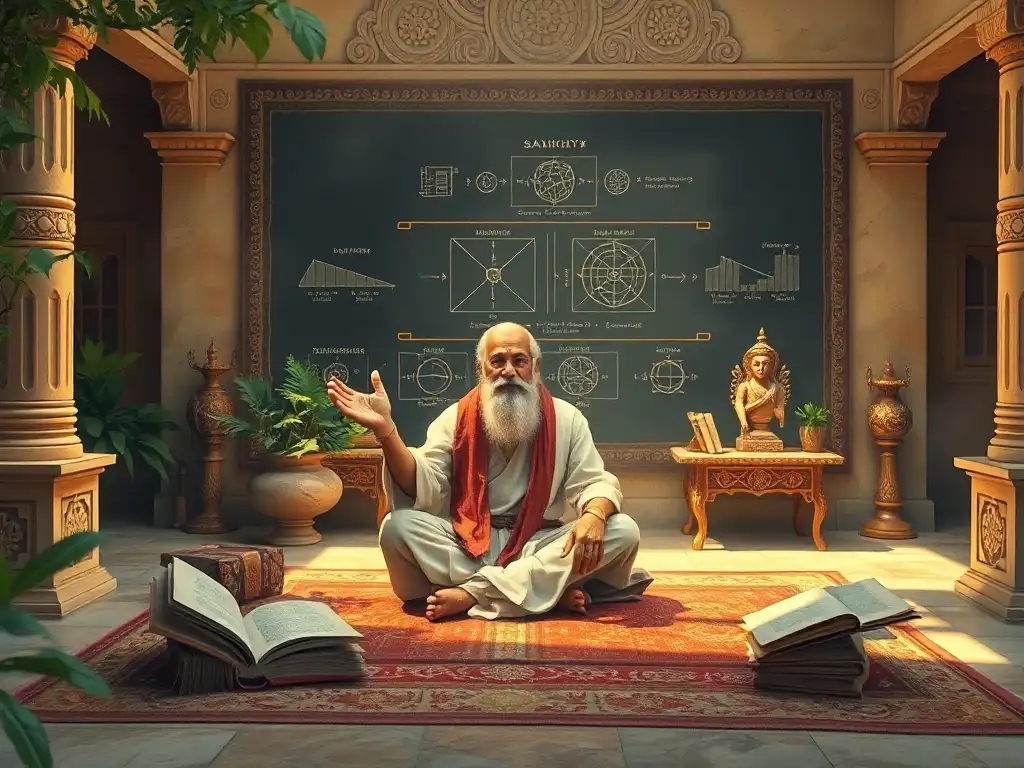
Sankhya, one of the six orthodox schools of Indian philosophy, presents a unique approach to understanding the universe and the nature of reality. Its systematic enumeration of principles, particularly the distinction between purusha (consciousness) and prakriti (matter), sets it apart from other philosophical schools. This section explores how Sankhya contrasts with major Indian philosophies, particularly Nyaya and others, highlighting its distinct contributions to ancient Indian science and mathematics.
Distinctions Between Sankhya and Nyaya
Sankhya and Nyaya, while both integral to ancient Indian philosophy, differ significantly in their methodologies and epistemological frameworks.
- Metaphysical Foundations:
- Sankhya posits a dualistic framework, emphasizing the separation of consciousness (purusha) and the material world (prakriti), which is foundational to its understanding of existence.
- Nyaya, on the other hand, is primarily concerned with logic and epistemology, seeking to establish the means of acquiring valid knowledge (pramana) through inference, perception, and testimony.
- Approach to Knowledge:
- Sankhya emphasizes a direct, introspective understanding of consciousness and the material world, leading to self-realization and liberation (moksha).
- Nyaya focuses on rigorous logical analysis and debate, providing tools for discerning truth through a systematic approach.
- Focus on Liberation:
- In Sankhya, liberation is achieved through the discernment of the eternal self from the transient material world, emphasizing a philosophical path.
- Nyaya’s emphasis is more on epistemological clarity, contributing to the fields of logic and argumentation rather than direct spiritual liberation.
These distinctions illustrate how Sankhya provides a foundational framework that not only informs philosophical discourse but also underpins its contributions to science and mathematics.
How Sankhya Differs from Other Indian Philosophies
Sankhya's unique position among Indian philosophies is characterized by several key differences:
- Numerical Framework:
- Unlike other schools, Sankhya uses a precise enumeration of elements (tattvas) that constitute reality, totaling 25 in its classical formulation. This systematic categorization aids in understanding complex phenomena, making it particularly relevant to scientific inquiry.
- Empirical Basis:
- Sankhya integrates empirical observation with philosophical reasoning, which allows it to address natural phenomena and human experience in a structured manner. This empirical aspect aligns with scientific methodology, distinguishing it from more speculative philosophies like Advaita Vedanta, which focuses on non-duality and metaphysical abstraction.
- Role of Evolution:
- The Sankhya perspective on evolution (sankhya) as a process of unfolding from the unmanifest to the manifest (prakriti to purusha) is critical for understanding development in both natural sciences and mathematics. This contrasts with Jainism's emphasis on karma and the eternal nature of souls, or Buddhism's focus on impermanence and the middle way.
Through these distinctions, Sankhya emerges not only as a philosophical discipline but also as a precursor to scientific thought in ancient India.
Conclusion
The philosophical insights of Sankhya have left an indelible mark on the landscape of ancient Indian science and mathematics. By systematically categorizing reality and offering a dualistic framework, Sankhya has influenced various disciplines, including metaphysics, epistemology, and scientific inquiry.
Summary of Sankhya's Contributions to Science and Mathematics
Sankhya's contributions to science and mathematics can be summarized as follows:
- Systematic Classification: Sankhya's enumeration of the principles of existence has provided a foundational structure for various scientific explorations.
- Integration of Disciplines: Its philosophy seamlessly integrates metaphysical concepts with practical applications in mathematics and natural sciences, fostering a holistic understanding of the universe.
- Influence on Other Schools: Sankhya has influenced subsequent philosophical schools, including Yoga and Vedanta, which have adopted its principles to expand their own frameworks.
These contributions highlight how Sankhya serves as a bridge between philosophical thought and scientific practice in ancient India.
The Legacy of Sankhya in Modern Scientific Thought
The legacy of Sankhya in modern scientific thought is notable for several reasons:
- Philosophical Underpinnings: Modern epistemology and scientific inquiry echo Sankhya's emphasis on categorization and systematic analysis, demonstrating its relevance in contemporary contexts.
- Interdisciplinary Approach: Sankhya's integration of various fields mirrors today's interdisciplinary approaches in science, where philosophy, biology, and mathematics often converge.
- Influence on Contemporary Philosophy: The dualistic nature of Sankhya continues to inform debates in metaphysics and consciousness studies, resonating with modern discussions on the mind-body problem.
The philosophical framework established by Sankhya has not only shaped ancient Indian science and mathematics but also continues to influence modern scientific thought, reaffirming its enduring significance in the exploration of knowledge and reality.
References
The study of Sankhya and its impact on ancient Indian science and mathematics is supported by a variety of key texts and scholarly research. Here, we will delve into notable texts that provide essential insights into the philosophical underpinnings of Sankhya and its mathematical applications.
Key Texts and Manuscripts on Sankhya
- Sankhya Karika: Written by Ishvara Krishna in the 4th century CE, this foundational text elaborates on the principles of the Sankhya school, detailing the dualistic nature of reality and the classification of the elements of existence. It serves as a crucial reference for understanding the metaphysical framework that influenced scientific thought in ancient India.
- Yoga Sutras of Patanjali: Although primarily focused on the practice of yoga, Patanjali’s Yoga Sutras incorporate Sankhya philosophy, particularly in its understanding of the mind and consciousness. The text elucidates the interplay between the material and the spiritual, providing insights into the scientific methods of introspection and observation.
- Bhagavad Gita: This ancient scripture, while primarily a spiritual text, incorporates Sankhya concepts, particularly in its exploration of duty (dharma) and the nature of the self (atman). The Gita's discussions about knowledge and action have implications for the development of scientific reasoning in ancient India.
- Samkhya Sutra: This text is attributed to the sage Kapila and is considered among the earliest works that outline the principles of Sankhya philosophy. It provides a systematic approach to understanding the nature of reality, which has influenced ancient Indian scientific methodologies.
- Commentaries by Later Philosophers: Various scholars, including Gaudapada and Vyasa, have written extensive commentaries on the original texts of Sankhya philosophy. Their interpretations have helped in the preservation and dissemination of Sankhya ideas, fostering further advancements in scientific thought.
Further Reading on Ancient Indian Science and Mathematics
- "A History of Ancient Indian Mathematics" by C. V. Kumar: This book provides an in-depth analysis of the evolution of mathematical concepts in ancient India, highlighting the influence of philosophical schools like Sankhya in shaping mathematical practices.
- "The History of Indian Philosophy" by Sukumar Dutta: This comprehensive work explores various philosophical schools, including Sankhya, and their contributions to science and mathematics, providing a contextual backdrop to their development.
- "Mathematics in India" by Kim Plofker: This book offers a detailed examination of the mathematical innovations that emerged in ancient India, discussing the role that various philosophical traditions, including Sankhya, played in fostering these advancements.
- "Sankhya: A Dualist Philosophy from Ancient India" by J. L. Shaw: This text focuses specifically on the Sankhya school, explaining its principles and how they were applied in the context of science and mathematics.
- "Ancient Indian Science: A Historical Overview" by R. P. Shukla: This article presents a broad overview of the scientific achievements of ancient India, emphasizing the philosophical frameworks that underpinned these developments, including the contributions of Sankhya.
These texts and resources provide a rich foundation for understanding the profound influence of Sankhya on ancient Indian science and mathematics, illustrating how philosophical inquiry can shape scientific thought and inquiry.
- Introduction to Sankhya Philosophy
- Historical Context of Sankhya
- Principles of Sankhya
- Sankhya's Influence on Ancient Indian Science
- Sankhya and Mathematical Concepts
- Case Studies: Sankhya in Practice
- Comparison: Sankhya vs. Other Philosophical Schools
- Conclusion
- References
Frequently Asked Questions
What is Sankhya in the context of ancient Indian science?
Sankhya is a philosophical system that emphasizes the importance of knowledge and the enumeration of elements in understanding the universe. It plays a crucial role in the development of ancient Indian mathematics and science.
How did Sankhya influence ancient Indian mathematics?
The principles of Sankhya contributed to the formulation of mathematical concepts such as numbers and calculations. Its systematic approach provided a foundational framework for later mathematical advancements in ancient India.
What are the main contributions of Sankhya to science?
Sankhya contributed to the classification of knowledge and the understanding of various natural phenomena. It laid the groundwork for scientific inquiry and the development of other disciplines such as astronomy and medicine.
Which ancient Indian civilizations were influenced by Sankhya?
Civilizations like the Indus Valley and the Gupta Empire were significantly influenced by Sankhya. These cultures integrated Sankhya's principles into their scientific and philosophical traditions.
Is Sankhya still relevant in contemporary discussions of science?
Yes, Sankhya continues to be relevant as it provides insights into the philosophical foundations of science and encourages a holistic view of knowledge. Its principles can still be applied in modern scientific discourse and methodologies.
Final Reflection: The Enduring Legacy of Sankhya in Ancient Indian Science
The exploration of Sankhya's profound influence on ancient Indian science and mathematics reveals a rich tapestry of knowledge that continues to resonate in today's intellectual pursuits. As we delve into the principles of Sankhya, we uncover not only a philosophical framework but also a systematic approach that laid the groundwork for various scientific disciplines. This ancient wisdom reminds us that the quest for knowledge is timeless, and the insights gained from Sankhya are as relevant now as they were centuries ago.
The impact of Sankhya extends beyond its historical context, shaping the cultural and social landscape of modern India and beyond. By understanding the duality of existence and the importance of analytical reasoning, we can appreciate how these concepts have permeated various fields, from mathematics to psychology. As we reflect on this legacy, we are reminded of the words of Albert Einstein: The most beautiful experience we can have is the mysterious. It is the fundamental emotion which stands at the cradle of true art and true science.
This quote encapsulates the essence of Sankhya, urging us to embrace the mysteries of existence while employing rigorous analysis in our quest for understanding.
As we conclude our journey through the role of Sankhya in ancient Indian science, I invite you to reflect on how these ancient teachings can inspire your own pursuit of knowledge. Consider how the principles of Sankhya can be applied in your life, whether in scientific inquiry, personal growth, or philosophical exploration. Let the wisdom of the past guide you as you navigate the complexities of the present and future, fostering a deeper connection with the world around you. Embrace the legacy of Sankhya, and allow it to illuminate your path toward discovery and understanding.
Unveil the Wisdom of Sankhya and Transform Your Understanding!
Thank you for diving deep into the fascinating role of Sankhya in ancient Indian science and mathematics! This rich tradition not only laid the groundwork for countless discoveries but also invites us to explore the vast knowledge it offers. Now, it’s time to take what you’ve learned and put it into action!
- Delve deeper: Explore classic texts on Sankhya philosophy to enhance your understanding and uncover the connections between ancient concepts and contemporary science.
- Share your insights: Discuss your favorite principles of Sankhya with friends or engage in online communities—let’s spread the wisdom together!
- Join the conversation: Participate in local or virtual workshops focused on ancient Indian mathematics—who knows what new perspectives you’ll gain?
What aspects of Sankhya sparked your curiosity, and how will you integrate its principles into your daily life?