
Vaisheshika and the Nature of the Universe: An Ancient Perspective


Welcome to Ancient India History, where we embark on a fascinating journey through the rich tapestry of India's past. In this exploration, we delve into the profound realms of philosophy, shedding light on the Vaisheshika philosophy of ancient India. What insights did this ancient school of thought offer about the nature of the universe?
Join us as we unravel the complexities of existence and the unique contributions of Indian thinkers that continue to resonate today. Prepare to be captivated by the wisdom of ages past and discover how these philosophies shape our understanding of reality. Dive in to explore more!
- Introduction to Vaisheshika Philosophy in Ancient India
- Historical Context of Vaisheshika Philosophy
- Core Principles of Vaisheshika Philosophy
- Vaisheshika and the Nature of the Universe
- The Influence of Vaisheshika on Ancient Indian Science
- The Legacy of Vaisheshika Philosophy
- Conclusion: The Enduring Nature of Vaisheshika Philosophy in Ancient India
- Frequently Asked Questions
- Final Reflection: Embracing the Wisdom of Vaisheshika Philosophy
- Unveil the Secrets of Ancient Wisdom!
Introduction to Vaisheshika Philosophy in Ancient India
Vaisheshika philosophy represents one of the foundational schools of thought in ancient Indian philosophy, offering profound insights into the nature of the universe and our understanding of reality. Developed around the 6th century BCE by the sage Kanada, Vaisheshika is deeply intertwined with the broader context of Indian metaphysics and epistemology. It proposes a unique perspective on the universe, emphasizing the categorization and analysis of all substances and phenomena. The term "Vaisheshika" itself translates to "that which is special" or "particular," reflecting its focus on the individual qualities that define the material world.
This philosophy is not just an abstract theoretical framework, but a significant intellectual tradition that has influenced various aspects of Indian culture, science, and spirituality. By delving into the principles of Vaisheshika, we can uncover how ancient Indian thinkers approached the questions of existence, causality, and the nature of reality itself. The exploration of this philosophy provides a window into the rich tapestry of ancient Indian thought, highlighting its relevance and contributions to both historical and contemporary discussions surrounding the universe and human understanding.
Overview of Vaisheshika Philosophy
At the core of Vaisheshika philosophy lies a systematic classification of the material world, which is divided into several categories known as "padarthas." These categories include:
- Dravya (Substance): The fundamental entities that exist in the universe, such as earth, water, fire, air, and space.
- Guna (Quality): The attributes or characteristics that substances possess, like color, taste, smell, and texture.
- Karma (Action): The potential for motion or action inherent in substances.
- Samanya (Universality): The common properties shared by different substances.
- Vishesha (Particularity): The unique qualities that differentiate one substance from another.
- Abhava (Non-existence): The concept of absence or non-existence, which is also considered a category.
The philosophy posits that by understanding these categories, one can gain insights into the nature of reality and the interconnections between various elements of existence. Vaisheshika also engages with the concept of anu (atom), proposing that all physical substances are composed of indivisible particles, laying the groundwork for atomic theory in ancient India.
Significance of Vaisheshika in Ancient Indian Thought
Vaisheshika holds a place of great importance in the philosophical landscape of ancient India, particularly in its interactions with other schools of thought, such as Nyaya, which focuses on logic and epistemology. The synthesis of these schools has enriched Indian philosophy, providing a comprehensive framework for understanding reality.
- Influence on Science: The analytical approach of Vaisheshika has been instrumental in the development of early scientific thought in India. Its emphasis on observation, classification, and logical reasoning resonates with modern scientific methodologies.
- Cultural Impact: Beyond philosophy and science, Vaisheshika has permeated literature, art, and spirituality, influencing various aspects of cultural life in ancient and medieval India.
- Historical Context: The teachings of Vaisheshika were not developed in isolation; they emerged in a vibrant intellectual milieu where dialogues with other philosophical traditions flourished. This cross-pollination of ideas has left a lasting legacy that is still relevant today.
Vaisheshika philosophy offers a rich and intricate view of the universe that invites ongoing exploration and appreciation, making it a crucial element of ancient Indian thought and a treasure trove for contemporary scholars and enthusiasts alike.
Historical Context of Vaisheshika Philosophy

The Origins of Vaisheshika in Ancient India
Vaisheshika philosophy, one of the six orthodox schools of Indian philosophy, developed in ancient India around the 2nd century BCE. It emerged alongside the other philosophical traditions, particularly the Nyaya school, which focuses on logic and epistemology. The term "Vaisheshika" derives from the Sanskrit word "viśeṣa," meaning "particular" or "specific." This highlights the school's emphasis on the detailed analysis of substances and their properties.
The origins of Vaisheshika can be traced back to the Kanada Sutras, attributed to the sage Kanada, who is often credited as the founder of this school. The philosophy itself was influenced by various cultural and intellectual currents prevalent during that time, including the Vedic traditions and the developing ideas of metaphysics and natural philosophy. The foundational texts of Vaisheshika include the Vaisheshika Sutras, which systematically categorize the material world and its constituents.
At its core, Vaisheshika philosophy seeks to understand the universe through a framework that categorizes all existing entities into specific categories, such as substances, qualities, actions, and universals. This analytical approach laid the groundwork for subsequent philosophical inquiries in ancient India, particularly concerning metaphysics and the nature of reality.
Key Figures in Vaisheshika Philosophy
Kanada: The Founder of Vaisheshika
Kanada, often referred to as Kanada Maharshi, is the pivotal figure in the establishment of Vaisheshika philosophy. He is believed to have lived around the 6th century BCE, though precise dates remain a topic of scholarly debate. Kanada's contributions to philosophy are monumental, particularly through his systematic exposition of the physical world and its elements.
In his seminal work, the Vaisheshika Sutras, Kanada outlines a comprehensive framework for understanding reality. He categorizes substances into various classes, such as:
- Dravya (Substance): Includes earth, water, fire, air, and ether.
- Guna (Quality): Attributes of substances like color, taste, and smell.
- Karma (Action): Movements or activities performed by substances.
- Samanya (Universality): Common characteristics shared by multiple entities.
- Vishesha (Particularity): Specific attributes that distinguish one entity from another.
Kanada's emphasis on observation and logical reasoning marks a significant departure from earlier philosophical traditions that relied heavily on metaphysical speculation. His work laid the foundation for a systematic study of the natural world, influencing later philosophical discourse in India and beyond.
Contributions of Other Philosophers
While Kanada is the foremost figure in Vaisheshika philosophy, several other philosophers have significantly contributed to its development and refinement. Among these is Gautama, the founder of the Nyaya school, whose emphasis on logic and epistemology complemented the ontological inquiries of Vaisheshika.
Another notable figure is Udayana, a medieval philosopher who integrated Vaisheshika thought with elements of logic, furthering the dialogue between the two schools. His work, particularly in the Kiranavali, showcases how Vaisheshika philosophy evolved over time, incorporating new insights and addressing critiques from other schools.
Additionally, Prashastapada, an important commentator on the Vaisheshika Sutras, helped clarify and expand upon Kanada's ideas. His writings provided deeper insights into the nature of substances and their interactions, which enriched the philosophical landscape of ancient India.
While Kanada remains the central figure in Vaisheshika philosophy, the contributions of other philosophers helped shape its development, leading to a rich and nuanced tradition that continues to influence philosophical thought today.
Core Principles of Vaisheshika Philosophy

The Vaisheshika philosophy, one of the six orthodox schools of Indian philosophy, offers a unique understanding of the nature of the universe. Founded by the sage Kanada in the 2nd century BCE, this school emphasizes a materialistic view of reality, focusing on the classification of the physical world and its fundamental components. At its core, Vaisheshika philosophy seeks to analyze the essence of existence through a systematic approach, categorizing substances, qualities, and actions.
The philosophy is grounded in the belief that the universe is made up of eternal, indivisible atoms (anu) that combine to form larger entities. Vaisheshika posits that understanding these components is essential for comprehending the nature of the cosmos and the processes that govern it. The intricacies of this philosophy reveal a profound connection between metaphysics and empirical observation, laying the groundwork for future philosophical inquiries in India.
The Concept of Dravya (Substance)
In Vaisheshika philosophy, Dravya refers to substance, which is a fundamental building block of reality. Dravya is understood as the entity that possesses qualities and can undergo changes. The Vaisheshika system classifies Dravya into different categories, providing a framework for understanding the material world. This classification is essential, as it differentiates between various types of substances and their characteristics.
Dravya is considered to be eternal and indivisible at its most fundamental level, but it can manifest in various forms through the combination and interaction of its intrinsic qualities. The concept of Dravya highlights the importance of substance in the formation of the universe and the relationships between different entities.
Types of Dravya in Vaisheshika Philosophy
Vaisheshika philosophy identifies nine types of Dravya, each representing different categories of substances. These include:
- Prithvi (Earth): The solid substance, characterized by qualities such as smell, taste, color, and texture.
- Apāna (Water): The liquid substance, which possesses qualities of fluidity and taste.
- Tejas (Fire): The hot and luminous substance, associated with qualities like heat and light.
- Vāyu (Air): The gaseous substance, characterized by motion and the absence of shape.
- Ākāśa (Ether): The space or void that allows for the existence and movement of other substances.
- Kala (Time): An intangible substance that governs the sequence of events.
- Dharma (Space): Refers to the capacity of objects to occupy space.
- Atma (Soul): The conscious substance that embodies individuality.
- Manas (Mind): The mental substance that enables perception and cognition.
This classification allows for a comprehensive understanding of the physical world and its components, illustrating how they interact and influence one another.
The Role of Gunas (Qualities) and Karma (Action)
In the Vaisheshika framework, Gunas or qualities play a crucial role in defining the characteristics of Dravya. Each substance is characterized by specific Gunas that determine its attributes and behaviors. The Gunas include:
- Rupa (Form): Determines the physical appearance.
- Rasa (Taste): Defines the flavor of the substance.
- Gandha (Smell): Relates to the odor of the substance.
- Sparsha (Touch): Concerns the tactile qualities.
- Parimana (Magnitude): Refers to the size or extent of the substance.
These qualities are essential for understanding how substances interact, change, and influence the world around them.
In addition to Gunas, the concept of Karma plays an integral role in Vaisheshika philosophy. Karma refers to action and the principle of cause and effect. It is believed that every action produces a corresponding reaction in the universe, shaping the destinies of individuals and entities alike. The interplay between Karma and the intrinsic qualities of substances provides a framework for understanding the dynamic processes of the universe.
The Vaisheshika philosophy of ancient India offers a detailed exploration of the nature of reality through its core principles of Dravya, Gunas, and Karma. This philosophical inquiry into the workings of the universe has laid the groundwork for further developments in Indian metaphysics and continues to influence contemporary thought.
The Theory of Padarthas (Categories of Existence)
The Vaisheshika philosophy, founded by the sage Kanada in ancient India, introduces a systematic framework for understanding the nature of reality through its concept of Padarthas, or categories of existence. This framework is pivotal for grasping how the Vaisheshika school perceives the universe and its components. The term "Padartha" can be translated to mean "that which exists" or "object of experience," and it is essential for categorizing all that constitutes reality.
The Nine Categories of Padarthas
The Vaisheshika school identifies nine distinct Padarthas, which serve as the fundamental categories of existence. These categories are crucial for analyzing and categorizing all entities in the universe. They are:
- Dravya (Substance): This category includes all forms of matter, encompassing both tangible and intangible substances. Dravya is further divided into:
- Panchabhuta: The five great elements (earth, water, fire, air, and space).
- Sukshma Dravya: Subtle substances, which include atoms and molecules.
- Guna (Quality): Guna refers to the attributes or qualities of substances. These include characteristics such as color, taste, smell, and touch.
- Karma (Action): This category represents the actions or movements of substances. It is through karma that substances interact and change.
- Samanya (Generality): Samanya pertains to the universal characteristics that multiple entities share. For instance, the common quality of being 'solid' in all solid substances.
- Vishesha (Particularity): Vishesha indicates the unique qualities that differentiate one object from another. For example, a specific red apple is unique due to its distinct color and shape.
- Samavaya (Inherence): This category describes the intrinsic relation between substances and their qualities. For example, the color red cannot exist independently of a surface that exhibits it.
- Abhava (Non-existence): Abhava encompasses the concept of absence or non-being. It is a crucial aspect of understanding the nature of reality since it distinguishes between existence and non-existence.
- Pramana (Means of Knowledge): Pramana refers to the valid means through which knowledge is acquired. This includes perception, inference, and testimony, which are essential for understanding reality.
- Upadhi (Conditioning Factor): Upadhi denotes the limiting conditions that affect the nature and characteristics of a substance. It plays a role in how substances manifest in the material world.
Significance of Padarthas in Understanding Reality
The categorization of Padarthas is not merely an academic endeavor; it serves as a comprehensive philosophical tool for examining the universe's complexities. By dissecting existence into these categories, the Vaisheshika philosophy provides a coherent understanding of how various entities interact and coexist within the cosmos.
This systematic approach also facilitates discussions around metaphysical questions, such as the nature of existence, the relationship between the material and the immaterial, and the principles of causation. Moreover, the emphasis on categories like Guna and Vishesha underscores the importance of both general and specific properties in defining reality.
The Theory of Padarthas is a cornerstone of Vaisheshika philosophy, offering insights into the fundamental structure of existence while emphasizing the interconnectedness of all entities within the universe. Understanding these categories enables a deeper exploration of the philosophical inquiries that have shaped ancient Indian thought and continue to influence contemporary discussions on metaphysics.
Vaisheshika and the Nature of the Universe
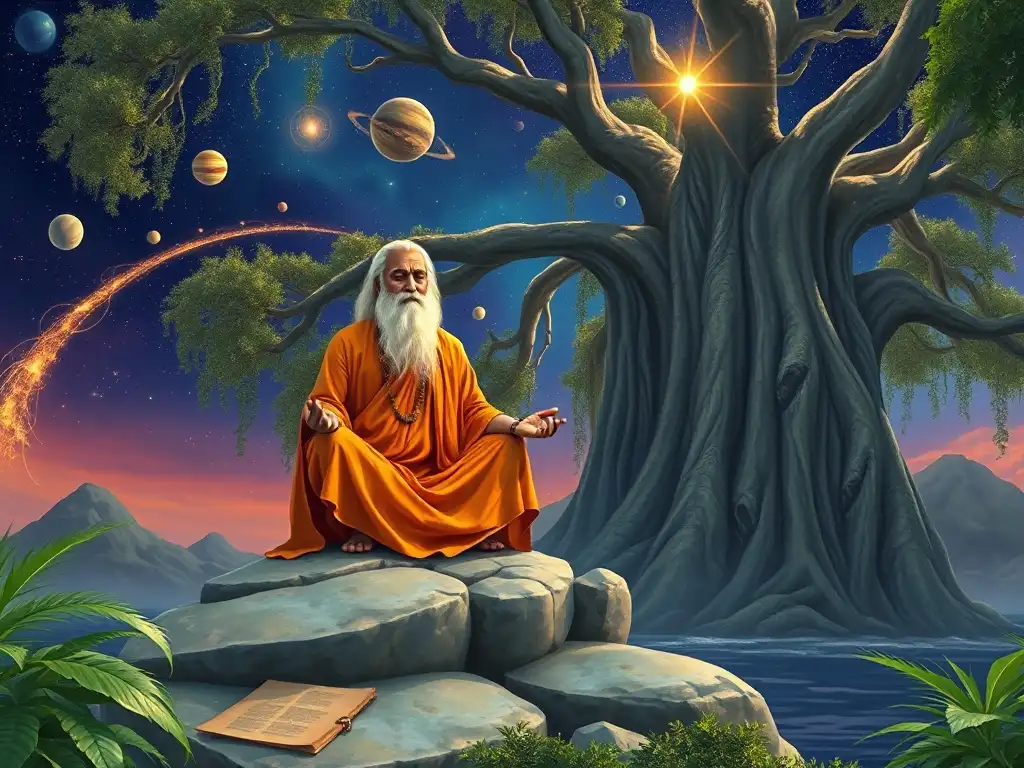
Understanding the Universe through Vaisheshika Lens
Vaisheshika philosophy, one of the six orthodox schools of Indian philosophy, offers a unique perspective on the nature of the universe. Founded by the sage Kanada in the 2nd century BCE, it primarily focuses on categorizing and analyzing the elements of the physical world. The core premise of Vaisheshika is that the universe is composed of indivisible particles called anu (atoms) that combine to form larger entities. This atomic theory of matter predates similar theories in the Western world by centuries.
The universe, according to Vaisheshika, is characterized by a diversity of substances, which are systematically categorized into nine categories known as padārthas. These categories include:
- Dravya (substance)
- Guna (quality)
- Karma (action)
- Samanya (universality)
- Vishesha (particularity)
- Samavaya (inherence)
- Abhava (absence)
- Pramana (proof)
- Aparā (non-activity)
By understanding these categories, one can gain insight into the structure and functioning of the universe. Vaisheshika also emphasizes the role of perception and inference in acquiring knowledge, suggesting that the material world can be understood through careful observation and logical reasoning.
The Interconnection of Dravya and Guna
In Vaisheshika philosophy, dravya (substance) and guna (quality) play a crucial role in understanding the nature of existence. Dravya is the foundation, representing the physical entities in the universe, while guna refers to the characteristics or properties these substances possess.
Classification of Dravyas
Dravyas are categorized into five primary elements known as the pañchamahābhūta, which include:
- Prithvi (earth)
- Apā (water)
- Tejas (fire)
- Vāyu (air)
- Ākāśa (ether)
These five elements manifest in various forms, combining to create the diverse world we experience.
Characteristics of Gunas
Gunas can be further divided into two main categories:
- Sattva (purity, harmony)
- Rajas (activity, passion)
- Tamas (inertia, darkness)
Each substance possesses a combination of these qualities, which determine its behavior and interactions with other substances. The interplay between dravya and guna is fundamental to the Vaisheshika understanding of reality, suggesting that to comprehend the universe, one must explore both the substances and their qualities.
The Concept of Space and Time in Vaisheshika
Vaisheshika also presents distinctive views on the concepts of space ( ākāśa) and time ( kāla). Space is considered an infinite, unchanging entity that accommodates the existence of all substances. It acts as the stage on which the interactions and transformations of dravyas occur.
Space ( Ākāśa)
- Infinite and Boundless: Space is not defined by physical dimensions but is seen as an omnipresent medium.
- Container of Objects: All substances exist within this space, which allows for their movement and interaction.
Time ( Kāla)
Time in Vaisheshika philosophy is regarded as a continuous and eternal flow, essential for understanding change and motion in the universe. Key aspects include:
- Cyclical Nature: Time is perceived as cyclical, with periods of creation and destruction.
- Measurement: Vaisheshika introduces the concept of measuring time through units that align with cosmic rhythms, influencing the behavior of matter.
Both space and time are integral to the Vaisheshika framework, providing a comprehensive understanding of how the universe operates. Through the exploration of these concepts, one can appreciate the depth of ancient Indian thought regarding existence and the cosmos.
By delving into the nuances of Vaisheshika philosophy, we gain a richer understanding of not only ancient Indian thought but also the foundational ideas that influenced subsequent philosophical developments in the region.
The Influence of Vaisheshika on Ancient Indian Science

The Vaisheshika philosophy, founded by the sage Kanada in ancient India, significantly influenced the landscape of science and metaphysics. This school of thought is primarily concerned with the nature of reality and the categorization of the universe's substances. The philosophical inquiries of Vaisheshika laid the groundwork for various scientific principles that resonate even in modern scientific discourse.
Contributions to Physics and Metaphysics
Vaisheshika philosophy is notable for its detailed classification of substances and its exploration of the physical universe. Kanada postulated that all matter consists of small, indivisible particles called anu (atoms). This concept aligns with the contemporary understanding of atomic theory, highlighting the advanced nature of ancient Indian scientific thought.
- Categories of Substances: The Vaisheshika system identifies nine categories (padarthas) that include:
- Dravya (substance)
- Guna (quality)
- Karma (action)
- Samanya (genus)
- Vishesha (particularity)
- Abhava (non-existence)
- Samavaya (inherence)
- Paratva (superior)
- Aparatva (inferior)
These categories serve as foundational elements for understanding the physical world and its interactions. The rigorous classification system allowed for a systematic analysis of nature, which can be seen as an early form of scientific methodology.
- Atomic Theory: The notion of anu reflects an understanding of the universe's composition at a microscopic level. Kanada theorized that these atoms combine in various ways to form the diverse substances observed in the world. This atomic perspective not only predated similar Western theories but also paved the way for later scientific advancements in fields such as chemistry and physics.
- Causation and Change: Vaisheshika also delves into the principles of causation, positing that every effect has a cause, a fundamental concept in both philosophy and science. The examination of how substances interact, change, and evolve contributes significantly to metaphysical discussions about the nature of existence and reality.
The Relationship Between Vaisheshika and Other Indian Philosophical Schools
The Vaisheshika school maintained a complex relationship with other philosophical traditions in ancient India, particularly with Nyaya and Samkhya.
- Vaisheshika and Nyaya: The Nyaya school, known for its epistemological inquiries, often collaborated with Vaisheshika to enhance philosophical understanding. While Vaisheshika focused on categorizing substances, Nyaya emphasized the means of obtaining knowledge about those substances. This synergy allowed for a comprehensive exploration of reality, combining metaphysics with logic.
- Influence on Samkhya: The philosophical discourse between Vaisheshika and Samkhya is equally significant. Samkhya's dualistic framework, which separates the material world (Prakriti) from consciousness (Purusha), complements Vaisheshika's materialistic focus. Together, these schools illustrate the rich tapestry of thought in ancient Indian philosophy, where discussions about the nature of reality were deeply interconnected.
- Integration with Advaita Vedanta: Although differing in fundamental beliefs, Vaisheshika's exploration of the material world also contributed to the development of later philosophical systems like Advaita Vedanta. The discussions surrounding the nature of reality and existence influenced the metaphysical debates that characterized the evolution of Indian philosophy.
The Vaisheshika philosophy not only provided detailed insights into the nature of substances and their interactions but also engaged in a dynamic relationship with other philosophical schools, enriching the intellectual landscape of ancient India. Its contributions to both physics and metaphysics remain a testament to the profound understanding of the universe that ancient Indian thinkers possessed.
The Legacy of Vaisheshika Philosophy
The Vaisheshika philosophy, founded by the sage Kanada in ancient India, represents a significant contribution to the realm of metaphysics and epistemology. This school of thought is notable for its detailed analysis of the nature of reality, distinguishing between various substances, qualities, and actions. Its legacy has not only influenced Indian philosophical discourse but has also left an indelible mark on the development of scientific thought.
Continuing Relevance of Vaisheshika in Modern Thought
The principles of Vaisheshika philosophy have found resonance in contemporary discussions surrounding the nature of matter and the universe. Its categorization of substances into dravya (substances), guna (qualities), karma (actions), samanya (universality), vishesha (particularity), and abhaava (non-existence) continues to provide a foundational framework for understanding complex scientific concepts.
Key Concepts and Their Modern Parallels
- Substances and Elements: Vaisheshika identifies nine fundamental substances, paralleling modern scientific classifications of matter. For instance, the concept of dravya can be likened to the atomic theory, where all matter is composed of atoms.
- Qualitative Analysis: The examination of qualities ( guna) in Vaisheshika can be seen reflected in contemporary fields such as chemistry and physics, where understanding the properties of elements is crucial for advancements in technology.
- Causation and Change: The exploration of karma, or action, in the Vaisheshika system aligns with modern discussions on causality in physics. This can be observed in theories regarding the laws of motion and energy transfer.
The enduring nature of these concepts illustrates the profound insights that ancient philosophers had regarding the universe, many of which remain relevant in today's scientific discourse.
Vaisheshika Philosophy in Contemporary Discussions
In recent years, the resurgence of interest in ancient philosophies has paved the way for the integration of Vaisheshika thought within modern philosophical debates. Scholars and thinkers are increasingly recognizing the value of ancient Indian perspectives in addressing contemporary issues in metaphysics, ethics, and epistemology.
Interdisciplinary Dialogues
- Philosophy and Science: The dialogue between Vaisheshika philosophy and modern scientific theories fosters a deeper understanding of the universe. The mechanistic views of nature prevalent in Western philosophy can be contrasted with the nuanced understanding of substance and quality in Vaisheshika.
- Ethics and Environmentalism: The Vaisheshika emphasis on the interconnectedness of all substances resonates with modern environmental ethics, advocating for a holistic approach to nature. This perspective encourages a respectful and sustainable interaction with the environment, drawing from ancient wisdom to inform contemporary practices.
- Cultural Relevance: The Vaisheshika school is increasingly being discussed in the context of cultural identity and heritage. As globalization spreads, the importance of indigenous philosophies like Vaisheshika becomes crucial in grounding modern societies in their historical and cultural narratives.
The Vaisheshika philosophy, with its intricate understanding of the nature of reality, continues to inspire and inform modern thought, demonstrating that the wisdom of ancient India is not just a relic of the past but a living tradition that can enrich contemporary discussions across various fields.
Conclusion: The Enduring Nature of Vaisheshika Philosophy in Ancient India

Recap of the Key Ideas
The Vaisheshika philosophy, rooted deeply in ancient India, offers a distinctive perspective on the nature of reality and existence. Developed by the sage Kanada around the 2nd century BCE, this school of thought emphasizes the categorization of reality into six fundamental substances: earth, water, fire, air, space, and time. These elements were not viewed in isolation; rather, they were interconnected and contributed to a comprehensive understanding of the universe.
One of the core tenets of Vaisheshika is the idea of anu (atoms). Kanada proposed that everything in the universe is composed of indivisible particles that combine to form larger entities. This atomic theory laid the groundwork for later developments in both Indian and Western philosophy, highlighting the unity of material substances in an ever-changing cosmos.
Additionally, the Vaisheshika school introduced a systematic methodology for understanding the world through perception (pratyaksha), inference (anumana), and testimony (shabda). This tripartite approach not only influenced philosophical discourse in ancient India but also contributed significantly to the evolution of scientific thought.
The Impact of Vaisheshika on the Understanding of the Universe
The influence of Vaisheshika philosophy on ancient Indian thought is profound, particularly in its approach to understanding the universe. By introducing a systematic framework and emphasizing empirical observation, this philosophy encouraged a rational inquiry into the natural world.
- Metaphysical Foundations:
- The classification of substances into categories such as dravya (substance), guna (quality), and karma (action) provided a structured lens through which to examine existence. This classification not only enriched philosophical discourse but also informed various fields such as natural sciences and medicine.
- Influence on Other Philosophical Schools:
- The ideas presented by Vaisheshika were integral to the development of other philosophies, particularly Nyaya (the school of logic) and Samkhya (the enumeration school). This cross-pollination of ideas facilitated a richer understanding of metaphysics and epistemology in ancient India.
- Legacy in Scientific Thought:
- The atomic theory articulated by Kanada anticipated modern scientific principles, suggesting that matter is composed of discrete units. This notion resonates with contemporary physics, reinforcing the idea that ancient Indian thinkers had a sophisticated understanding of the universe.
- Interdisciplinary Connections:
- Vaisheshika's emphasis on observation and classification has had lasting implications beyond philosophy, impacting various disciplines such as astronomy, biology, and ethics. The integration of philosophical inquiry with empirical investigation set a precedent for future intellectual endeavors.
The Vaisheshika philosophy not only shaped the ancient Indian worldview but also left an enduring legacy that continues to influence contemporary thought. Its systematic approach to understanding the universe exemplifies the rich intellectual tradition of ancient India, highlighting the importance of philosophy in the quest for knowledge.
Frequently Asked Questions
What is Vaisheshika philosophy in ancient India?
Vaisheshika philosophy is an ancient Indian school of thought that focuses on the nature of the universe and its components. It emphasizes the study of substances and their qualities, aiming to understand the material world.
How did Vaisheshika contribute to Indian philosophy?
Vaisheshika significantly contributed by introducing concepts such as atomism and the classification of elements. This philosophical approach laid the groundwork for later developments in both science and metaphysics.
Who was the founder of Vaisheshika philosophy?
The founder of Vaisheshika philosophy is Kanada, an ancient philosopher who proposed that the universe is made up of indivisible particles called anu or atoms. His teachings became foundational for this school of thought.
What are the main tenets of Vaisheshika philosophy?
The main tenets include the belief in permanence of atoms, the classification of substances into categories like earth, water, fire, air, and ether, and the role of qualitative properties in understanding the universe.
How does Vaisheshika relate to other Indian philosophies?
Vaisheshika is often studied alongside Nyaya philosophy, as both schools explore the nature of reality and knowledge. Together, they provide a comprehensive view of Indian metaphysics and influence various other philosophical traditions.
Final Reflection: Embracing the Wisdom of Vaisheshika Philosophy
The insights of Vaisheshika philosophy, rooted in ancient India, resonate profoundly in today's quest for understanding the universe. As we navigate an increasingly complex world, the principles of this ancient school of thought remind us that the pursuit of knowledge is not merely an academic endeavor but a fundamental aspect of our existence. The exploration of the nature of reality, as articulated by the Vaisheshika thinkers, invites us to question and appreciate the intricate tapestry of the universe around us.
Cultural and social landscapes are continually shaped by the philosophies we embrace. The teachings of Vaisheshika, with their emphasis on categorization and the nature of substances, have influenced not only philosophical discourse but also scientific inquiry throughout history. This ancient perspective encourages us to approach modern challenges with a sense of curiosity and respect for the natural world. As the philosopher Kanada once stated, The universe is a manifestation of the infinite, and understanding it requires both intellect and intuition.
This timeless wisdom serves as a reminder of our interconnectedness with the cosmos.
As we reflect on the lessons of Vaisheshika philosophy, let us commit to integrating its principles into our daily lives. Take a moment to ponder the nature of your own existence and the universe that envelops you. How can the insights from this ancient tradition inspire you to seek deeper understanding and connection in your life? By embracing the wisdom of the past, we can cultivate a more profound awareness of our place in the universe and contribute to a more harmonious future.
Unveil the Secrets of Ancient Wisdom!
Thank you for diving into the captivating world of Vaisheshika and its insights into the nature of the universe! You've gained valuable perspectives that can influence your understanding of existence. Now, let's take those insights and transform them into meaningful actions.
- Explore further by reading classic texts related to Vaisheshika philosophy and its implications for modern science.
- Discuss your thoughts with friends or join an online forum dedicated to ancient philosophies—share what you've learned!
- Consider enrolling in a course that delves deeper into Indian philosophy and its relevance in today's world.
What new perspectives on the universe do you think Vaisheshika can bring to your life?