
Ancient Indian Mathematicians Who Predicted the Value of Pi

Welcome to Ancient India History, where we embark on an exhilarating journey through time to uncover the remarkable contributions of ancient Indian civilizations. From the sophisticated urban planning of the Indus Valley to the intellectual brilliance of the Gupta Empire, the tapestry of India's past is woven with extraordinary stories.
In our featured article, we delve into the fascinating world of ancient Indian mathematicians and Pi—discover how these brilliant minds not only grasped the concept of Pi but also laid the groundwork for mathematical principles that continue to influence modern science today. Join us as we explore the legacy that has shaped our understanding of mathematics, and prepare to be amazed by the insights that await you!
- Introduction to Ancient Indian Mathematicians and Pi
- Historical Context of Mathematics in Ancient India
- Prominent Ancient Indian Mathematicians Who Predicted Pi
- Techniques and Methods Used by Ancient Indian Mathematicians
- Comparison of Ancient Indian Approximations of Pi with Other Civilizations
- Legacy of Ancient Indian Mathematicians in Modern Mathematics
- Conclusion: The Enduring Impact of Ancient Indian Mathematicians on Pi
-
Frequently Asked Questions
- What contributions did ancient Indian mathematicians make to the concept of Pi?
- How accurate were the calculations of Pi by ancient Indian scholars?
- Did ancient Indian texts discuss the value of Pi?
- How did the understanding of Pi influence later mathematical developments in India?
- Are there modern implications of ancient Indian calculations of Pi?
- Final Reflection: The Timeless Legacy of Ancient Indian Mathematicians and Pi
- Unveil the Secrets of Ancient Wisdom!
Introduction to Ancient Indian Mathematicians and Pi
The exploration of ancient Indian mathematicians reveals a remarkable legacy of intellectual achievement, particularly in the realm of mathematics. Among their most notable contributions is the early understanding and calculation of the mathematical constant Pi (π). Ancient Indian scholars not only engaged with this irrational number but also established methodologies for its approximation that were far ahead of their time.
This article delves into the fascinating history of ancient Indian mathematicians who played a pivotal role in predicting the value of Pi, highlighting their innovative techniques and the broader implications of their work. By examining these contributions, we can appreciate how these early thinkers laid the groundwork for modern mathematics and enriched the global understanding of mathematical concepts.
Overview of Pi in Mathematics
Pi (π) is a mathematical constant that represents the ratio of a circle's circumference to its diameter, approximately equal to 3.14159. This ratio is fundamental in various fields of mathematics, science, and engineering. Its significance extends beyond simple geometric calculations, influencing areas such as:
- Trigonometry: Where it is essential in defining sine, cosine, and tangent functions.
- Calculus: As it appears in integral and differential equations, often in relation to circular functions.
- Physics: Particularly in formulas involving waves, oscillations, and circular motion.
Historically, the quest to calculate Pi accurately has captivated mathematicians across cultures and epochs. Ancient civilizations, including those in India, made significant strides in approximating this constant, employing innovative methods that showcased their advanced understanding of mathematics.
Significance of Ancient Indian Contributions to Mathematics
The contributions of ancient Indian mathematicians to the understanding of Pi are profound and multifaceted. Notable figures such as Aryabhata and Brahmagupta made groundbreaking advancements that not only influenced subsequent generations but also set a precedent for mathematical thought worldwide. Here are several key points highlighting their contributions:
- Aryabhata (476–550 CE): One of the earliest mathematicians to provide an accurate approximation of Pi as 3.1416, Aryabhata's work laid the foundation for later studies. His treatise, the Aryabhatiya, introduced methods for calculating areas and volumes, showcasing his deep understanding of geometry.
- Brahmagupta (598–668 CE): In his seminal work, Brahmasphutasiddhanta, he refined the value of Pi further and discussed its applications in various formulas related to geometry. Brahmagupta's insights into mathematical operations set a standard for future scholars.
- Influence on Global Mathematics: The methods and approximations derived from ancient Indian works on Pi influenced not only Indian mathematicians but also Islamic scholars and, eventually, European mathematicians during the Renaissance.
The pioneering efforts of ancient Indian mathematicians in relation to Pi underscore a rich tradition of mathematical inquiry and exploration that continues to resonate in contemporary mathematics. Their work serves as a testament to the intellectual heritage of ancient India, showcasing how early insights into complex mathematical concepts can shape our understanding of the world.
Historical Context of Mathematics in Ancient India
Mathematics in ancient India has a rich and intricate history that dates back thousands of years. The mathematical developments during this period were not merely academic; they were deeply intertwined with various aspects of daily life, including trade, astronomy, and architecture. Ancient Indian mathematicians laid the groundwork for significant mathematical concepts that continue to influence modern mathematics.
The Role of Mathematics in Ancient Indian Society
Mathematics played a crucial role in various facets of ancient Indian society. It was essential for:
- Trade and Commerce: Merchants utilized arithmetic for calculating prices, measuring weights, and managing accounts. The emergence of a decimal system facilitated trade across vast distances.
- Agriculture: Farmers relied on mathematical principles for land measurement, crop rotation, and seasonal planning. Techniques for irrigation and crop management were often based on mathematical calculations.
- Astronomy: Ancient Indian astronomers were adept in mathematics, employing it to predict celestial events, which influenced religious practices and agricultural cycles. Notable works, such as the Surya Siddhanta, illustrate the integration of mathematics and astronomy.
- Architecture and Engineering: Mathematics was crucial in the construction of temples, fortresses, and public works. The precise geometric designs reflect advanced mathematical understanding.
The use of mathematics extended beyond practical applications; it also played a significant role in the philosophical and religious thought of the time. Concepts such as infinity and zero, which are foundational to modern mathematics, were explored in depth by ancient Indian thinkers.
Key Civilizations Contributing to Mathematical Knowledge
Several ancient Indian civilizations significantly contributed to the development of mathematics, each adding layers of complexity and innovation to mathematical knowledge.
- Indus Valley Civilization (c. 2600–1900 BCE):
- The earliest evidence of mathematical thinking can be traced back to the Indus Valley Civilization. Archaeological findings suggest that the people had a sophisticated understanding of measurement, as shown by standardized weights and measures used in trade.
- Vedic Period (c. 1500–500 BCE):
- The Vedic texts, particularly the Sulba Sutras, contain early mathematical concepts, including geometry related to altar construction and rituals. The Sulba Sutras introduced methods for constructing right angles and calculating areas, showcasing an advanced understanding of geometric principles.
- Classical Period (c. 200 BCE–1200 CE):
- This era saw the emergence of prominent mathematicians such as Aryabhata, Brahmagupta, and Bhaskara. Aryabhata introduced the concept of zero and the place value system, while Brahmagupta developed rules for arithmetic operations involving zero. Bhaskara's work further expanded on these concepts, including advancements in algebra and trigonometry.
- Gupta Empire (c. 320–550 CE):
- Often regarded as the golden age of mathematics in India, the Gupta Empire fostered significant mathematical progress. The mathematicians of this period made groundbreaking contributions to the understanding of Pi, with approximations that were remarkably precise for their time.
These civilizations collectively laid the foundations for a mathematical tradition in ancient India that would influence not only the region but also the development of mathematics globally. The insights and discoveries of ancient Indian mathematicians regarding Pi and other mathematical concepts remain a testament to their ingenuity and enduring legacy.
Prominent Ancient Indian Mathematicians Who Predicted Pi
Aryabhata: The Pioneer of Indian Mathematics
Aryabhata, born in 476 CE, is often regarded as one of the most influential mathematicians and astronomers in ancient India. He introduced numerous mathematical concepts and methods that laid the groundwork for future advancements in the field. His work not only encompassed mathematics but also astronomy, as he aimed to provide a systematic understanding of the cosmos. Aryabhata's most notable contribution is his approximation of the value of Pi, which reflects a deep understanding of geometry and its applications.
Aryabhata's Approximation of Pi
In his seminal work, the Aryabhatiya, Aryabhata approximated Pi (π) as 3.1416, a value remarkably close to the actual value of π (approximately 3.14159). He derived this approximation through geometric principles, specifically by calculating the circumference of a circle in relation to its diameter. Aryabhata stated that:
The circumference of a circle is equal to eight times the length of its radius.
This statement implies the value of π can be approximated as 3.14 when considering a circle's diameter in relation to its circumference. Aryabhata’s method of calculating the area of a circle, using the formula \( A = \pi r^2 \), further showcases his mathematical prowess.
Influences on Later Mathematicians
Aryabhata's work had a profound impact on subsequent mathematicians, both in India and beyond. His approximation of π was referenced and refined by later scholars such as Brahmagupta and Bhaskara. The clarity and precision of Aryabhata's calculations influenced not only Indian mathematics but also Islamic mathematicians during the medieval period. His legacy continues to be celebrated, as his ideas were foundational in the development of mathematics across cultures.
Brahmagupta: The Mathematician and Astronomer
Brahmagupta, who lived in the 7th century CE, is another prominent figure in the realm of ancient Indian mathematics. His work, particularly the Brahmasphutasiddhanta, serves as a critical text that combines both astronomical and mathematical theories. Brahmagupta's contributions to the understanding of Pi were significant, as he elaborated on the concepts introduced by Aryabhata and provided a more refined understanding of circular geometry.
Brahmagupta's Work on Circle Geometry
In his writings, Brahmagupta approached circles with a focus on both theoretical and practical applications. He stated that:
The area of a circle is the same as the area of a square whose side is equal to the circle's diameter.
This assertion indicates Brahmagupta's keen insight into geometry and his ability to manipulate mathematical relationships. He also calculated Pi as 3.2 for practical purposes, showing an understanding that approximations could vary based on application.
His Contributions to the Understanding of Pi
Brahmagupta's exploration of Pi extended beyond its numerical value; he also discussed its implications in various mathematical contexts. He introduced rules for calculating areas and volumes, which involved the use of Pi. His work bridged the gap between theoretical mathematics and its practical application in astronomy, land surveying, and architecture.
Through his rigorous methods and innovative formulations, Brahmagupta played a crucial role in advancing the understanding of Pi in ancient Indian mathematics. His contributions not only enriched the field but also laid the groundwork for future scholars who would continue to explore the intricacies of Pi and its applications.
Bhaskara I: The Early Commentator
Bhaskara I, an influential mathematician and astronomer from the 7th century CE, is renowned for his pioneering work in Indian mathematics and his contributions to the understanding of mathematical concepts, including the value of Pi. He is best known for his commentary on the Aryabhatiya of Aryabhata, where he provided insights and methods that would shape mathematical discourse in India. His approach to mathematics was deeply rooted in the practical applications of astronomy, where precise calculations were crucial.
Bhaskara I's innovative use of the decimal system and his introduction of sine functions laid the groundwork for future developments in trigonometry. Moreover, his approximation of Pi as being equal to 3.1416 is notable, reflecting his understanding of the circumference-to-diameter ratio in circles. This approximation was advanced for his time and demonstrated a level of mathematical sophistication that would influence subsequent generations of mathematicians.
Bhaskara I's Approximations and Techniques
In his writings, Bhaskara I provided several approximations for the value of Pi, showcasing different methodologies to achieve greater accuracy. He derived the value by using geometric principles, particularly focusing on the properties of circles. His calculation methods involved:
- Geometric constructions: Bhaskara I employed geometric techniques to illustrate the relationship between a circle's circumference and diameter, providing a visual understanding of Pi.
- Numerical approximations: He presented the value of Pi as being 3.1416, a remarkable approximation that closely aligns with the modern value of Pi (approximately 3.14159).
- Rational approximations: Bhaskara I also explored rational approximations, such as using fractions to represent Pi, which facilitated calculations in various mathematical contexts.
These techniques not only enhanced the accuracy of mathematical calculations in his era but also served as a foundation for later mathematicians who would build upon his work.
Impact on Further Mathematical Developments
The contributions of Bhaskara I had a significant impact on the trajectory of mathematics in India and beyond. His commentaries and techniques influenced several key areas:
- Mathematical notation and methods: Bhaskara I's work helped standardize mathematical notation, particularly in trigonometry, which is essential for calculations involving Pi.
- Educational frameworks: His teachings became integral to the curriculum of later mathematicians and astronomers, promoting a culture of mathematical inquiry and innovation.
- Cultural exchanges: As his works were disseminated, they influenced mathematical thought in other regions, contributing to a broader understanding of mathematical concepts across cultures.
Overall, Bhaskara I's legacy as an early commentator and mathematician paved the way for future exploration and understanding of mathematical principles, particularly related to Pi.
Bhaskara II: The Great Mathematician
Bhaskara II, also known as Bhaskara Acharya, lived in the 12th century CE and is often hailed as one of the greatest mathematicians of ancient India. His seminal work, the Lilavati and the Bijaganita, not only covered a wide range of mathematical topics but also presented sophisticated methods for calculating Pi. His contributions significantly advanced the field of mathematics and astronomy, establishing him as a pivotal figure in ancient Indian scholarship.
Bhaskara II's exploration of mathematical concepts was marked by a blend of rigorous analysis and practical application. His work on Pi was particularly influential, providing insights that would resonate through the ages.
Contributions to Astronomy and Pi
Bhaskara II's contributions to astronomy were deeply intertwined with his mathematical explorations, particularly in the context of calculating celestial events. His work on Pi was essential for precise astronomical calculations, including:
- Lunar and solar eclipses: Bhaskara II's calculations of the positions of celestial bodies relied heavily on accurate measurements of Pi, allowing him to predict eclipses with remarkable precision.
- Planetary motions: By incorporating Pi into his calculations, he improved the understanding of planetary orbits, which was crucial for developing astronomical models.
- Timekeeping and calendars: His mathematical insights contributed to the refinement of calendars, linking astronomical phenomena with terrestrial timekeeping.
Through these contributions, Bhaskara II showcased the vital role of Pi in practical astronomy, establishing a lasting legacy in both mathematics and celestial observations.
Notable Works Relating to Pi
Bhaskara II authored several notable works that addressed the value of Pi and its applications in mathematics. His most significant texts include:
- Lilavati: This work covers a broad spectrum of mathematical topics and includes discussions on geometry and the calculation of Pi. It is presented in a poetic form, making it accessible to learners of all ages.
- Bijaganita: Focusing on algebra, this text contained methods for solving equations that often utilized the value of Pi in geometric contexts.
- Karanakutuhala: This treatise delves into mathematical astronomy, detailing methods for calculating celestial events where Pi plays a critical role in understanding circular motions and cycles.
These texts not only contributed to the mathematical heritage of India but also served as educational resources that influenced generations of mathematicians and astronomers, reinforcing the significance of Pi in both theoretical and practical applications.
Techniques and Methods Used by Ancient Indian Mathematicians

Ancient Indian mathematicians employed a variety of innovative techniques and methods to calculate the value of Pi (π), showcasing their advanced understanding of mathematics. Their approaches were not only practical but also theoretical, blending geometry with algebraic concepts. This section will explore some of the key techniques that these mathematicians utilized in their calculations.
Geometric Approaches to Calculating Pi
One of the primary methods used by ancient Indian mathematicians was geometric in nature. They often relied on the properties of circles and polygons to arrive at approximations for Pi.
- Inscribed and Circumscribed Polygons: Mathematicians like Aryabhata (476–550 CE) and later mathematicians utilized inscribed and circumscribed polygons to provide bounds for the value of Pi. By calculating the perimeters of these polygons, they could derive upper and lower estimates for Pi.
- For example, Aryabhata used a 96-sided polygon (96-gon) to estimate Pi, yielding a value of approximately 3.1416, which is remarkably close to the modern approximation of 3.14159.
- The Circle's Properties: The ancient texts often referred to the relationship between the diameter and circumference of a circle. This foundational understanding laid the groundwork for further explorations into Pi's value.
By combining these geometric insights, ancient Indian mathematicians not only approximated Pi but also established the foundational principles that would influence future mathematical developments.
Use of Series and Infinite Processes in Ancient India
Another significant approach was the use of series and infinite processes, reflecting a profound understanding of mathematical concepts. This method was particularly advanced for its time and demonstrated the intellectual depth of ancient Indian mathematicians.
- Infinite Series: Some texts, such as the Siddhanta Shiromani by Bhaskara II (1114–1185 CE), explored the concept of infinite series to calculate Pi. Bhaskara II's work included a series expansion that provided an iterative method to refine the approximation of Pi.
- His series represented Pi as a limit of a sequence, showcasing a nascent understanding of calculus concepts that would not be fully developed until centuries later in Europe.
- Continued Fractions: The use of continued fractions was another method referenced in ancient Indian mathematics. This technique allowed mathematicians to express Pi in terms of converging fractions, leading to more accurate approximations.
Through these innovative approaches, ancient Indian mathematicians demonstrated not only their ability to approximate Pi but also their contributions to the evolution of mathematical thought. Their techniques influenced later mathematicians across cultures and laid important groundwork for the global understanding of Pi.
The techniques and methods employed by ancient Indian mathematicians were multifaceted, combining geometric insights with advanced series calculations. These approaches not only highlighted their mathematical prowess but also contributed significantly to the broader field of mathematics, particularly in the realm of Pi.
Comparison of Ancient Indian Approximations of Pi with Other Civilizations
Ancient Indian Approximations vs. Greek Approximations
Ancient Indian mathematicians made significant contributions to the understanding of Pi (π) that are noteworthy when compared to their Greek counterparts. The approximations of Pi in ancient India can be traced back to texts such as the Sulbasutras, which date back to around 800 BCE to 200 BCE. The Sulbasutras provided geometric principles for constructing altars, and within their verses, mathematicians derived approximations for Pi.
- Approximation of Pi in Ancient India:
- The Sulbasutras presented Pi as approximately \(3.16\) and also suggested that \( \frac{22}{7} \) is a practical approximation, which is remarkably close to the actual value of \( \pi \approx 3.14159\).
- Other texts, such as Aryabhata's Aryabhatiya around 499 CE, gave a more refined approximation of \(3.1416\), demonstrating an impressive understanding of the value of Pi and its applications.
In contrast, Greek mathematicians, notably Archimedes, approached Pi through a geometric lens, utilizing polygons to approximate the circumference of a circle. Archimedes calculated Pi to be between \(3.1408\) and \(3.1429\) by inscribing and circumscribing polygons around a circle, showcasing a methodical and rigorous approach.
- Notable Greek Approximations:
- Archimedes used a 96-sided polygon to derive a more accurate value for Pi, which became foundational for later mathematical explorations in Europe.
- The Greeks also used the ratio \( \frac{22}{7} \) but were less focused on deriving Pi through algebraic means compared to the Indian mathematicians.
This comparison highlights how ancient Indian mathematicians utilized both geometric and algebraic methods to arrive at their approximations, showing a unique integration of practical applications and theoretical understanding.
The Influence of Indian Mathematics on Global Understanding of Pi
The contributions of ancient Indian mathematicians significantly influenced the global understanding of Pi, particularly during the Medieval period when Indian texts were translated into Arabic and later into Latin. This dissemination of knowledge helped bridge gaps between civilizations and facilitated the spread of mathematical concepts across the world.
- Key Influences:
- The translation of texts such as Aryabhata's Aryabhatiya and Brahmagupta's Brahmasphutasiddhanta introduced sophisticated methods of calculation and approximation of Pi to scholars in the Islamic Golden Age.
- Indian mathematicians were among the first to treat Pi as a constant, paving the way for future mathematicians to explore its properties and applications further.
- Impact on Islamic Mathematics:
- The works of Indian mathematicians were foundational for Islamic scholars, who expanded on these ideas and incorporated them into their own mathematical frameworks.
- The use of \( \frac{22}{7} \) as a common approximation for Pi became widespread in various calculations, impacting fields ranging from astronomy to architecture.
- Legacy and Modern Mathematics:
- The rigor in the Indian approach to mathematics, particularly in the treatment of Pi, laid a groundwork that would later influence European mathematicians during the Renaissance.
- Today, the understanding of Pi continues to evolve, but the foundational work of ancient Indian mathematicians remains a crucial chapter in the history of mathematics.
The ancient Indian approximations of Pi not only showcased an advanced understanding of mathematics but also played a pivotal role in shaping the global discourse on this fundamental constant. The blend of practical applications, theoretical exploration, and subsequent influence on later civilizations underscores the importance of ancient Indian mathematicians in the realm of mathematics.
Legacy of Ancient Indian Mathematicians in Modern Mathematics
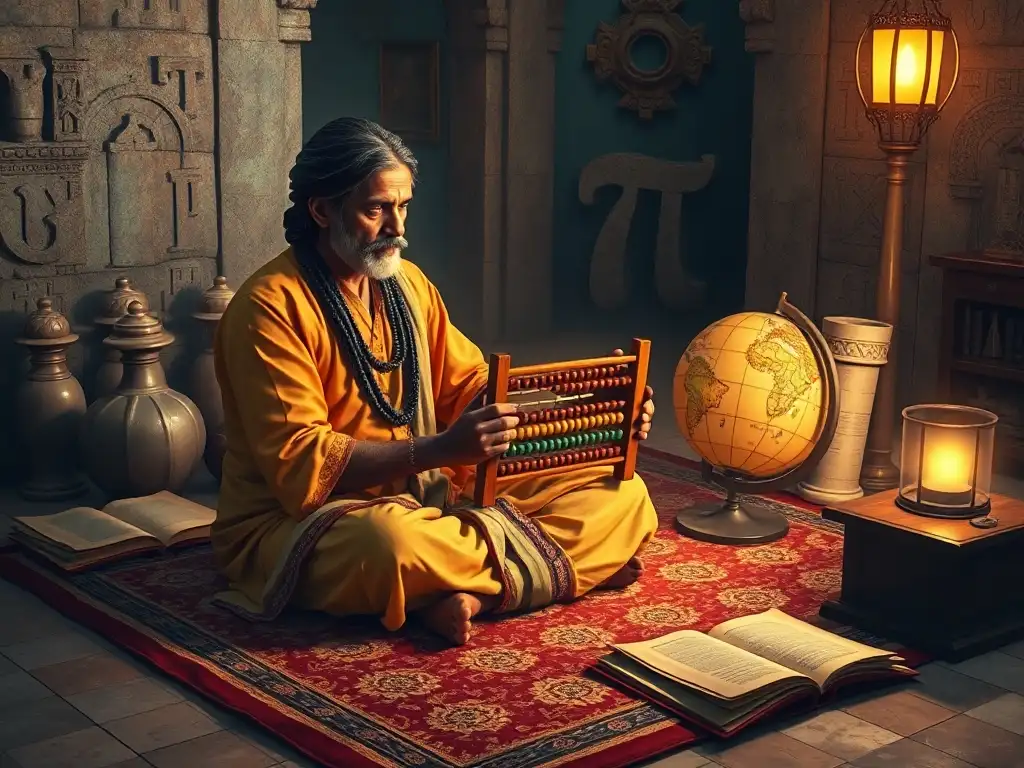
The legacy of ancient Indian mathematicians is profound, showcasing a rich tapestry of mathematical thought that has significantly influenced modern mathematics. Among their notable contributions is the early approximation of the value of Pi (π), which highlights their advanced understanding of geometry and number theory.
Mathematicians such as Aryabhata and Brahmagupta laid foundational principles that would echo through centuries, affecting not only Indian scholars but also mathematicians worldwide. Their works revealed sophisticated techniques for calculations and geometric proofs, many of which remain relevant in contemporary mathematics.
Continuing Influence of Ancient Indian Techniques
Ancient Indian mathematicians utilized innovative methods that continue to shape mathematical practices today. Their work on approximating Pi is particularly noteworthy. For instance, Aryabhata (476–550 CE) is credited with providing an approximation of Pi as 3.1416, which is remarkably close to the modern value. This demonstrates not only their calculation skills but also their understanding of circular geometry.
The Brahmasphutasiddhanta, authored by Brahmagupta in the 7th century, provided further insights into arithmetic and geometry. He introduced rules for arithmetic operations with zero and negative numbers, which are foundational in modern mathematics. The techniques for solving quadratic equations found in this work laid the groundwork for algebraic methods that are prevalent today.
Moreover, the Siddhanta Siromani by Bhaskara II in the 12th century expanded on these concepts, offering methods for calculating the area of a circle, which inherently required a precise understanding of Pi. These ancient texts not only contributed to mathematical theory but also served as practical guides for astronomical calculations, influencing later Islamic and European mathematicians.
Recognition of Ancient Contributions in Contemporary Mathematics
In contemporary mathematics, the contributions of ancient Indian mathematicians are increasingly recognized and appreciated. Scholars and mathematicians around the world have begun to delve into historical texts, uncovering the depth of knowledge possessed by these early thinkers.
A notable example of this recognition is found in academic circles, where research papers and conferences highlight the sophistication of Indian mathematical techniques. The International Congress of Mathematicians has featured discussions on ancient Indian mathematics, emphasizing its relevance to modern mathematical problems.
Additionally, educational curricula in mathematics have begun to incorporate the teachings of ancient Indian mathematicians, showcasing their methodologies and results. This integration not only honors their legacy but also inspires new generations of mathematicians to explore historical roots in their field.
The legacy of ancient Indian mathematicians extends far beyond their time. Their innovative approaches to mathematics, particularly in the context of Pi, continue to influence modern mathematical thought and practice. As we recognize their contributions, we gain a deeper appreciation for the rich history of mathematics that has shaped our understanding of the world today.
Conclusion: The Enduring Impact of Ancient Indian Mathematicians on Pi

The legacy of ancient Indian mathematicians is profound, particularly in their contributions to the understanding of Pi (π). Their work not only laid the groundwork for future mathematical exploration but also highlighted the sophisticated nature of mathematical thought in ancient India. Figures such as Aryabhata and Brahmagupta utilized innovative methods to approximate Pi, showcasing a deep understanding of geometry and numerical systems.
Their calculations, often based on empirical observations, revealed an early grasp of the relationship between a circle's diameter and its circumference, a foundational concept still relevant in modern mathematics. For instance, Aryabhata’s approximation of Pi as 3.1416 demonstrates remarkable accuracy for his time, while Brahmagupta offered a value of 3.1410, which also reflects a significant understanding of the ratio.
These mathematicians employed a combination of empirical and theoretical approaches, paving the way for future scholars around the world. Their methodologies, rooted in rigorous observation and logical reasoning, continue to be respected and studied within contemporary mathematics, influencing various fields, including astronomy and engineering.
Summary of Key Contributions and Their Significance
The contributions of ancient Indian mathematicians towards the understanding of Pi can be summarized as follows:
- Aryabhata (476–550 CE):
- Introduced the concept of using fractions for calculations.
- Provided the approximation of Pi as \( \frac{62832}{20000} \) or 3.1416, which is remarkably close to the modern value of Pi.
- Brahmagupta (598–668 CE):
- Offered a value of Pi as 3.1410, showcasing an understanding of circles.
- His work included rules for calculating the circumference and area of a circle, which were foundational for later mathematicians.
- Madhava of Sangamagrama (c. 1340–1425 CE):
- Developed the infinite series for Pi, which laid the groundwork for calculus.
- His contributions herald a significant shift in mathematical thinking, emphasizing series and convergence.
The significance of these contributions extends beyond just numerical approximations; they illustrate a sophisticated level of mathematical reasoning and a deep engagement with geometry that was advanced for their respective eras. This knowledge not only influenced contemporaneous cultures but also had lasting implications on the course of mathematical development globally.
Future Research Directions in Ancient Indian Mathematics and Pi
As interest in the history of mathematics grows, future research could explore several avenues regarding ancient Indian mathematicians and their work with Pi:
- Comparative Analysis:
- Conduct comparative studies between ancient Indian methods of calculating Pi and those from other cultures, such as the Greeks and Chinese, to highlight unique approaches and shared knowledge.
- Manuscript Studies:
- Investigate ancient manuscripts and texts that may contain additional insights into the methodologies employed by mathematicians like Aryabhata and Brahmagupta, which could further illuminate their thought processes.
- Technological Impact:
- Explore how ancient Indian mathematical concepts, especially regarding Pi, influenced technological advancements in architecture, astronomy, and engineering during and after their time.
- Educational Framework:
- Develop educational programs that integrate ancient Indian mathematics into modern curricula, emphasizing its relevance and contributions to contemporary mathematical thought.
- Interdisciplinary Research:
- Encourage interdisciplinary research that connects mathematics with history, philosophy, and culture, offering a holistic understanding of how ancient Indian mathematicians viewed and utilized Pi in various contexts.
By pursuing these research directions, scholars can continue to uncover the rich tapestry of ancient Indian mathematics and its enduring influence on the understanding of Pi and mathematical principles as a whole.
Frequently Asked Questions
What contributions did ancient Indian mathematicians make to the concept of Pi?
Ancient Indian mathematicians, notably Aryabhata, calculated the value of Pi with remarkable accuracy, laying foundational work for trigonometry and geometry.
How accurate were the calculations of Pi by ancient Indian scholars?
The calculations of Pi by ancient Indian scholars like Baudhayana were remarkably precise, estimating it as 3.1416, which is very close to the modern value of Pi.
Did ancient Indian texts discuss the value of Pi?
Yes, ancient Indian texts such as the Sulba Sutras provide detailed calculations and methods for determining the value of Pi, showcasing the sophistication of their mathematical knowledge.
How did the understanding of Pi influence later mathematical developments in India?
The work on Pi by ancient Indian mathematicians greatly influenced later scholars, leading to advancements in mathematics and establishing a strong tradition of scientific inquiry.
Are there modern implications of ancient Indian calculations of Pi?
Yes, the early calculations of Pi by Indian mathematicians contributed to the global understanding of mathematics, demonstrating the importance of cross-cultural exchanges in the development of scientific knowledge.
Final Reflection: The Timeless Legacy of Ancient Indian Mathematicians and Pi
The brilliance of ancient Indian mathematicians in predicting the value of Pi resonates profoundly in today's world, highlighting their remarkable contributions to mathematics and science. As we navigate an era increasingly defined by technology and precision, the foundational work of these scholars serves as a reminder of the enduring impact of their insights. Their calculations were not merely academic exercises; they were pioneering steps that laid the groundwork for future generations to explore the infinite complexities of mathematics.
The influence of ancient Indian mathematicians extends far beyond their time, shaping the cultural and intellectual landscape of mathematics globally. Their work inspires a sense of wonder and curiosity that transcends centuries. As we reflect on their achievements, we are reminded of the words of the great mathematician Srinivasa Ramanujan: An equation for me has no meaning unless it represents a thought of God.
This perspective invites us to appreciate mathematics not just as a tool, but as a profound expression of human creativity and understanding, bridging the gap between the ancient and the modern.
As we conclude this exploration of ancient Indian mathematicians and their remarkable predictions of Pi, I encourage you to reflect on the significance of their legacy in your own life. Consider how the pursuit of knowledge and understanding can inspire you to think critically and creatively. Let their stories motivate you to delve deeper into the realms of mathematics, science, and beyond, fostering a spirit of inquiry that honors their contributions while paving the way for future discoveries. Embrace the challenge of learning and let the wisdom of the past guide your journey into the future.
Unveil the Secrets of Ancient Wisdom!
Thank you for diving into the fascinating world of Ancient Indian mathematicians and their incredible predictions about the value of Pi! You've discovered how these brilliant minds paved the way for modern mathematics. Now, it's your turn to take action and further your exploration of this rich heritage.
Here’s how you can continue your journey:
- Unlock more knowledge: Research and read about other significant contributions from Ancient Indian scholars—there’s a wealth of information waiting for you!
- Engage with the community: Share your newfound insights on social media or discussion forums to inspire others. Don't hesitate to spark a conversation about how these ancient theories continue to influence contemporary mathematics!
- Explore interactive resources: Look for online courses or documentaries that delve deeper into ancient mathematics—learning can be an exciting adventure!
What aspect of Ancient Indian mathematics intrigues you the most, and how can you share that curiosity with others?