
The Contributions of Southern Indian Scholars to Mathematics and Astronomy

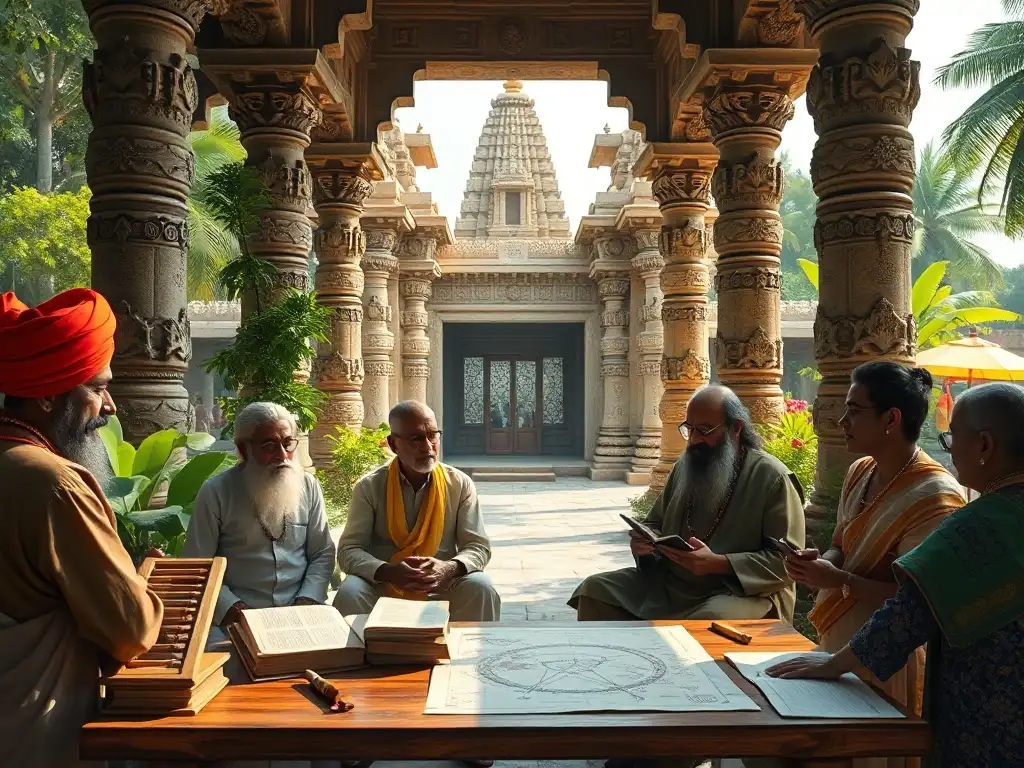
Welcome to Ancient India History, where we embark on a journey through time to uncover the remarkable tapestry of India’s rich heritage. Today, we delve into the fascinating Southern Indian contributions to mathematics, highlighting the brilliant scholars who shaped the field and laid the groundwork for future innovations. Have you ever wondered how ancient thinkers from this vibrant region influenced modern mathematics and astronomy? Join us as we explore the profound impact of these intellectual giants and their enduring legacy. Your adventure into the depths of history awaits!

The contributions of Southern Indian scholars to mathematics and astronomy represent a significant chapter in the annals of ancient Indian civilization. These scholars not only advanced mathematical theories and astronomical models but also laid the groundwork for future generations of thinkers and scientists. The rich cultural tapestry of Southern India, with its unique historical context, played a crucial role in nurturing these intellectual achievements.
This article explores the pivotal figures and their groundbreaking work in mathematics and astronomy, emphasizing how their insights continue to influence modern science and mathematics. By delving into the lives and contributions of these scholars, we aim to shed light on the profound impact of Southern Indian contributions to mathematics and the broader scientific community.
Introduction to Southern Indian Scholars
Overview of Southern India’s Historical Context
Southern India has a rich and diverse history that spans several millennia. The region was home to various dynasties, including the Cholas, Pandyas, and Cheras, which fostered a vibrant cultural and intellectual environment. The flourishing trade routes and interactions with other cultures facilitated the exchange of ideas and knowledge. Notably, the ancient city of Kanchipuram became a hub for learning, where scholars from various disciplines, including mathematics and astronomy, convened to share their insights. The patronage of kings and wealthy merchants further encouraged the pursuit of knowledge, leading to remarkable advancements during this period.
Importance of Mathematics and Astronomy in Ancient Southern India
Mathematics and astronomy were integral to the daily lives of people in ancient Southern India. Mathematics served practical purposes, such as land measurement, trade calculations, and architecture, while astronomy played a vital role in agricultural planning and navigation. The scholars of this era developed sophisticated techniques in arithmetic, algebra, and geometry, which were crucial for both academic pursuits and everyday applications. Furthermore, the astronomical observations made by these scholars laid the foundation for calendars and timekeeping systems that were widely used across the region.
Key Southern Indian Mathematicians and Astronomers
Aryabhata: The Pioneer of Indian Mathematics
Aryabhata, born in the 5th century CE, is often regarded as the pioneer of Indian mathematics. His seminal work, the Aryabhatiya, outlines various mathematical concepts, including the place-value system and the concept of zero. Aryabhata's contributions to astronomy are equally significant; he proposed that the Earth rotates on its axis and provided methods for calculating the positions of celestial bodies. His innovative approach not only influenced subsequent Indian scholars but also garnered recognition in the broader scientific community.
Brahmagupta: The Mathematician of the Gupta Period
Brahmagupta, a contemporary of Aryabhata, made remarkable strides in mathematics during the Gupta period. His work, Brahmasphutasiddhanta, addresses important topics such as quadratic equations, arithmetic operations, and rules for calculating with negative numbers. Brahmagupta's contributions were groundbreaking; he formulated the rules for arithmetic operations involving zero and negative numbers, which revolutionized mathematical thought in India and beyond.
Bhaskara I and Bhaskara II: The Dual Legacy
The legacy of Bhaskara I and Bhaskara II further highlights the advancements made by Southern Indian scholars. Bhaskara I, who lived in the 7th century, is celebrated for his translations and commentaries on Aryabhata's work, as well as his contributions to trigonometry. His work laid the groundwork for future scholars. Bhaskara II, also known as Bhaskara the Great, emerged in the 12th century with his monumental text, the Siddhanta Shiromani. This comprehensive work includes sections on mathematics and astronomy, detailing methods for solving complex equations and astronomical calculations. Bhaskara II's influence extended beyond India, inspiring mathematicians and astronomers worldwide.
Through the exploration of these key figures, we can appreciate the depth and breadth of Southern Indian contributions to mathematics and astronomy, showcasing the region's vital role in the history of science.
Southern Indian Contributions to Mathematics
Southern India has played an instrumental role in the development of mathematics, contributing significantly to various mathematical concepts and systems that have influenced not just the Indian subcontinent but the world. Scholars from this region have made remarkable advancements, particularly during the classical period, which laid the groundwork for modern mathematics. Their contributions encompass a wide range of areas, including number systems, trigonometry, algebra, and geometry, which continue to be relevant today.
Development of Number Systems in Southern India
The development of number systems in Southern India is notable for its early adoption and refinement of the decimal system. Renowned mathematicians such as Aryabhata and Brahmagupta, although not exclusively from Southern India, were influenced by the foundational work of scholars from this region. The use of place value and the concept of zero emerged prominently in Southern Indian mathematics, facilitating calculations and record-keeping.
Southern Indian contributions also include the introduction of unique numerical notations, which were used in various texts, such as the Surya Siddhanta and the works of the Tamil mathematician Bhaskara I. These innovations provided a more efficient means of computation, allowing for complex mathematical operations to be performed with greater ease.
Innovations in Trigonometry
Southern Indian scholars made groundbreaking contributions to trigonometry, particularly in the formulation of sine and cosine functions. The mathematician Varahamihira, who lived during the 6th century CE, is often credited with the development of trigonometric tables that were significantly more accurate than those available in other parts of the world at the time.
Moreover, the Kerala School of Astronomy and Mathematics, which flourished between the 14th and 16th centuries, further advanced trigonometric methods. Scholars like Madhava and his disciple Parameshvara developed infinite series for trigonometric functions and made significant strides in approximating sine and cosine values, influencing later European mathematicians such as Newton and Leibniz.
The Concept of Zero and Its Origins
The concept of zero is one of the most profound contributions of Southern Indian scholars to mathematics. Although the idea of zero existed in various forms across different cultures, it was in Southern India that it was fully developed and integrated into the number system. The earliest recorded mention of zero as a numeral can be traced back to the work of Brahmagupta in the 7th century CE, where he defined it and provided rules for its use in arithmetic operations.
This revolutionary concept paved the way for more advanced mathematical operations and allowed for the representation of large numbers and complex calculations. The significance of zero transcended mathematical boundaries, influencing philosophy, science, and economics throughout the ages.
Contributions to Algebra and Geometry
Southern Indian scholars made significant strides in both algebra and geometry, establishing foundational principles that would shape future mathematical thought. The work of Brahmagupta in algebraic equations, particularly in solving quadratic equations, is a testament to the sophistication of Southern Indian mathematics. His Brahmasphutasiddhanta addresses various algebraic problems and provides methods for solving them, making it one of the earliest texts on algebra.
In geometry, mathematicians from Southern India explored various aspects, including the calculation of areas and volumes. The Kerala School, in particular, developed innovative techniques in geometry that were instrumental in understanding the properties of shapes and figures. Their work laid the groundwork for later developments in both Indian and global mathematical traditions.
Southern Indian Contributions to Astronomy
The contributions of Southern Indian scholars to astronomy are equally impressive, reflecting a deep understanding of celestial phenomena and their mathematical underpinnings. These scholars were not only astronomers but also mathematicians who employed rigorous methods to observe and interpret the movements of celestial bodies.
The Role of Southern Indian Scholars in Astronomy
Southern Indian scholars played a crucial role in advancing astronomical knowledge through their meticulous observations and calculations. Prominent figures such as Aryabhata and later astronomers from the Kerala School established techniques for astronomical predictions. They developed detailed models of planetary motion and made significant contributions to the understanding of eclipses, planetary conjunctions, and other celestial events.
These scholars also authored influential texts that served as important references for both Indian and Arab astronomers. Their work laid the foundation for future developments in astronomy, influencing not only their contemporaries but also subsequent generations of scholars worldwide.
Celestial Mechanics and Calendrical Calculations
Southern Indian astronomers excelled in celestial mechanics, creating accurate models to explain the movements of planets and stars. They developed sophisticated calendrical calculations, which were essential for religious and agricultural purposes. The use of precise astronomical calculations allowed them to create calendars that were not only accurate but also aligned with seasonal changes, which was vital for agrarian societies.
The Kerala School's advancements in this field included the formulation of various astronomical algorithms, enabling them to predict eclipses and planetary movements with remarkable precision. This knowledge was crucial for the agricultural practices of the time and facilitated trade and cultural exchanges throughout the region.
Influence on Global Astronomy: Southern Indian Contributions
The influence of Southern Indian contributions to astronomy reached far beyond its borders. The mathematical techniques and astronomical models developed by Southern Indian scholars were transmitted to the Islamic world and eventually to Europe, significantly shaping the course of global astronomy.
The works of Madhava and his contemporaries were translated and studied by Arab scholars, who integrated these ideas into their own astronomical practices. Subsequent European astronomers, such as Copernicus and Kepler, built upon these foundations, highlighting the profound impact of Southern Indian astronomy on the development of modern science.
The legacy of Southern Indian scholars in mathematics and astronomy is a testament to their intellectual prowess and cultural significance. Their contributions continue to resonate and inspire, underscoring the rich heritage of ancient Indian civilizations.
The Legacy of Southern Indian Scholars

Southern Indian scholars, particularly during the medieval period, played a pivotal role in the development of mathematics and astronomy. The scholarly pursuits in this region were characterized by an integration of indigenous knowledge and influences from other cultures, particularly the Greeks and Persians. Notable figures such as Brahmagupta, Bhaskara I, and Bhaskara II (also known as Bhaskara the Great) emerged from this region, contributing significantly to both fields.
The contributions of these scholars revolved around the formulation of key mathematical concepts such as zero, the decimal system, and advanced techniques in algebra. Their astronomical treatises not only addressed planetary motion and eclipses but also provided methods for calculating the positions of celestial bodies. This period saw the emergence of sophisticated astronomical instruments and observatories, which facilitated practical observations and theoretical advancements. The legacy of these scholars has influenced generations, establishing a strong foundation for subsequent developments in mathematics and astronomy.
Impact on Later Indian Mathematics and Astronomy
The works of Southern Indian scholars laid the groundwork for later advancements in Indian mathematics and astronomy. Their innovative approaches to solving mathematical problems and understanding celestial phenomena directly influenced subsequent scholars such as Madhava of Sangamagrama, who is often regarded as the founder of the Kerala School of Astronomy and Mathematics. Madhava and his contemporaries built upon the methods established by earlier scholars, introducing concepts such as infinite series and calculus, which were revolutionary for their time.
Moreover, the rigorous methodologies and analytical techniques developed by Southern Indian mathematicians became integral to the broader Indian mathematical tradition. The systematic use of algorithms for calculations and the focus on practical applications in trade and navigation further emphasized the relevance of these contributions, ensuring their preservation and evolution through subsequent generations.
Influence on Islamic and Western Scholars
The mathematical and astronomical knowledge produced by Southern Indian scholars significantly impacted both Islamic and Western intellectual traditions. During the medieval period, as Islamic scholars translated and expanded upon Indian texts, they incorporated Southern Indian mathematical concepts into their own works. For instance, the introduction of the numeral system, including the concept of zero, was a crucial element that enriched Islamic mathematics.
This cross-cultural exchange facilitated the transfer of knowledge to Europe during the Renaissance. Western scholars, encountering the translations of Arabic texts, recognized the profound contributions of Southern Indian mathematics. Figures like Fibonacci, who encountered these mathematical concepts through Arabic sources, were instrumental in bringing Indian mathematical ideas into the European context. The ripple effect of Southern Indian contributions can be seen in the evolution of mathematics and astronomy across continents.
Preservation of Knowledge through Manuscripts and Texts
The preservation of knowledge by Southern Indian scholars was crucial for the transmission of their mathematical and astronomical insights. Manuscripts produced during this period, such as the "Lilavati" and "Bijaganita" by Bhaskara II, encapsulated complex mathematical theories and practical applications. These texts were meticulously copied and disseminated across various regions, ensuring that the knowledge was not lost to time.
In addition to mathematical treatises, astronomical texts like "Siddhanta Shiromani" compiled significant observations and methodologies that influenced future scholars. The careful preservation of these manuscripts in temple libraries and monasteries allowed for the continuity of knowledge, which was essential for the study of mathematics and astronomy in subsequent generations.
Conclusion
Summary of Southern Indian Contributions to Mathematics and Astronomy
Southern Indian scholars made remarkable contributions to mathematics and astronomy that have shaped not only Indian intellectual traditions but also global knowledge. Their pioneering work in the development of numerical systems, algebraic techniques, and astronomical observations laid a foundation for future advancements. The influence of figures such as Bhaskara II and Madhava highlights the innovative spirit of this region, which fostered an environment of scholarly inquiry and practical application.
The Lasting Influence on Modern Scientific Thought
The lasting influence of Southern Indian contributions to mathematics and astronomy is evident in modern scientific thought. Concepts that originated from this era continue to underpin contemporary mathematics and astronomical studies. The acknowledgment of zero as a number, the use of advanced algorithms, and the methods for celestial calculations are all rooted in the legacy of Southern Indian scholars. Their work not only enriched their own culture but also provided a crucial link in the development of mathematics and astronomy worldwide, signaling the importance of cross-cultural exchanges in the evolution of scientific knowledge.
Further Reading and Resources
To delve deeper into the significant contributions of Southern Indian scholars to mathematics and astronomy, a variety of resources are available. These resources include books, articles, and online platforms that provide comprehensive insights into the achievements and methodologies of these ancient civilizations. Below are some recommended books and online resources that can enhance your understanding of this fascinating topic.
Recommended Books on Southern Indian Mathematics
-
"Indian Mathematics: A Historical Perspective" by Kim Plofker
This book offers an extensive overview of the development of mathematics in India, with a specific focus on Southern Indian contributions. The author explores various mathematical concepts and their historical significance, making it an essential read for anyone interested in the subject.
-
"Mathematics in India" by Kim Plofker
In this critical work, Plofker discusses the evolution of mathematical ideas in India, highlighting the unique contributions from Southern scholars. The book provides a detailed examination of texts and figures that have shaped Indian mathematics.
-
"The History of Mathematics: A Brief Course" by Roger L. Cooke
Although broader in scope, this book includes sections dedicated to Indian mathematics, with insights into the specific contributions from Southern India. It is an excellent resource for understanding the global context of these developments.
-
"Ancient Indian Mathematics" by S. G. Dani
This book delves into specific mathematical techniques and texts from ancient India, including those from Southern scholars. Dani's exploration of mathematical astronomy and computations is particularly noteworthy.
-
"A History of Indian Astronomy" by C. V. V. Sarma
This work focuses on the astronomical achievements of ancient Indian scholars, with substantial attention given to the contributions from the Southern regions. It provides an in-depth analysis of astronomical texts and their implications.
Online Resources for Exploring Ancient Indian Astronomy
-
Digital Library of India
A vast repository of ancient texts, manuscripts, and scholarly articles related to Indian mathematics and astronomy. Users can access various resources that shed light on the contributions of Southern Indian scholars.
-
The Indian Academy of Sciences
This platform provides access to research papers and articles focused on the history of Indian mathematics and astronomy. It often features works that discuss the achievements of Southern Indian scholars in these fields.
-
Archive.org
A treasure trove of digitized historical documents, Archive.org houses a variety of texts related to ancient Indian astronomy and mathematics. It includes translations and commentaries that can enhance understanding.
-
HathiTrust Digital Library
This collaborative repository contains a vast collection of digitized texts, including many works on Indian mathematics and astronomy. It is an excellent resource for researchers and enthusiasts alike.
-
NASA's Exoplanet Exploration
While primarily focused on modern astronomy, this site discusses historical astronomical concepts and contributions from various cultures, including Southern India. It can provide context and perspective on ancient contributions to the field.
These resources serve as a foundation for further exploration into the rich mathematical and astronomical heritage of Southern India, allowing readers to appreciate the remarkable intellect and innovations of ancient scholars.
- Introduction to Southern Indian Scholars
- Key Southern Indian Mathematicians and Astronomers
- Southern Indian Contributions to Mathematics
- Southern Indian Contributions to Astronomy
- The Legacy of Southern Indian Scholars
- Conclusion
- Further Reading and Resources
- What were the significant mathematical contributions from Southern Indian scholars?
- Who is a prominent figure in Southern Indian mathematics?
- How did Southern Indian astronomers influence the field?
- What role did temples play in the advancement of mathematics in Southern India?
- How did the contributions of Southern Indian scholars affect later civilizations?
Frequently Asked Questions
What were the significant mathematical contributions from Southern Indian scholars?
Southern Indian scholars made notable contributions such as the development of the decimal system, advancements in trigonometry, and the introduction of zero as a number.
Who is a prominent figure in Southern Indian mathematics?
One of the most celebrated figures is Brahmagupta, who provided important insights into algebra and geometry during the 7th century.
How did Southern Indian astronomers influence the field?
Southern Indian astronomers, such as Aryabhata, pioneered methods for calculating celestial movements and contributed significantly to astronomical theories.
What role did temples play in the advancement of mathematics in Southern India?
Temples served as centers of learning and were instrumental in the patronage of scholars, fostering an environment where mathematics and astronomy thrived.
How did the contributions of Southern Indian scholars affect later civilizations?
The mathematical and astronomical advancements made by Southern Indian scholars laid the groundwork for future developments in both Indian and global mathematics, influencing scholars around the world.
Final Reflection: Celebrating Southern Indian Contributions to Mathematics and Astronomy
The remarkable achievements of Southern Indian scholars in mathematics and astronomy are not just historical footnotes; they are foundational pillars that continue to shape our understanding of these fields today. As we navigate an increasingly complex world, the brilliance of mathematicians and astronomers from Southern India serves as a reminder of the rich intellectual heritage that has influenced global scientific thought. Their contributions, often overlooked, are a testament to the power of knowledge and innovation that transcends time and geography.
The legacy of these scholars is woven into the fabric of our cultural and scientific landscape, inspiring generations to pursue knowledge and exploration. Their work has laid the groundwork for modern mathematical principles and astronomical discoveries, demonstrating that the pursuit of understanding is a universal endeavor. The greatest mathematicians are not those who have solved the most problems, but those who have inspired others to think differently.
This sentiment encapsulates the enduring impact of Southern Indian scholars, whose insights continue to resonate in contemporary discussions about mathematics and science.
As we reflect on the profound contributions of Southern Indian scholars, let us embrace the invitation to explore and celebrate this rich heritage in our own lives. Consider how you can draw inspiration from their legacy to foster curiosity and innovation in your own pursuits. Whether through education, research, or simply sharing knowledge, we all have a role to play in honoring the past while shaping the future. Let us commit to recognizing and amplifying the voices of those who have paved the way for us, ensuring that their contributions are not forgotten but celebrated for generations to come.
Unveil the Legacy of Southern Indian Scholars!
Thank you for joining us on this enlightening journey through the remarkable contributions of Southern Indian scholars to mathematics and astronomy. We hope you’ve discovered the profound impact these thinkers have had on our understanding of science and the universe!
Now, let’s turn that inspiration into action. Here are a few ways you can deepen your engagement with this fascinating topic:
- Explore further: Dive into the rich history of Southern Indian mathematics by reading books or articles that highlight key figures and their groundbreaking theories.
- Share the knowledge: Discuss what you've learned with friends, or share your insights on social media to spark conversations about the significant contributions of ancient scholars.
- Join a community: Connect with fellow enthusiasts by participating in online forums or local history groups that focus on the advancements in ancient science and mathematics.
What aspect of Southern Indian scholars’ contributions resonates with you the most, and how do you think they have shaped our modern understanding of science? Let’s keep the conversation going!