
Ancient Jain Scholars: Contributions to Philosophy, Logic, and Science


Welcome to Ancient India History, where we take you on a captivating journey through the rich tapestry of ancient Indian civilizations. Today, we delve into the profound contributions of Ancient Jain scholars, who not only shaped philosophical thought but also made remarkable strides in logic and science. What secrets did these thinkers uncover that still resonate in our world today? Join us as we explore their enduring legacy and the intricate ways their ideas continue to influence modern discourse. Prepare to uncover the wisdom of the past and see how it illuminates the present!
- Introduction to Ancient Jain Scholars and Their Contributions
- Key Contributions of Ancient Jain Scholars to Philosophy
- Contributions to Logic by Ancient Jain Scholars
- Contributions to Science by Ancient Jain Scholars
- Interconnections Between Jain Philosophy, Logic, and Science
- Legacy of Ancient Jain Scholars in Modern Times
- Conclusion: The Enduring Impact of Ancient Jain Scholars
- Frequently Asked Questions
- Final Reflection: The Enduring Legacy of Ancient Jain Scholars
- Unleash the Wisdom of Ancient Jain Scholars!
Introduction to Ancient Jain Scholars and Their Contributions
The contributions of ancient Jain scholars to philosophy, logic, and science are a vital part of India's rich historical tapestry. Jainism, with its profound ethical and philosophical principles, has shaped various aspects of Indian culture and intellectual thought.
Dating back to the early centuries of the Common Era, these scholars played a crucial role in the development of logical reasoning, metaphysics, and scientific inquiry, influencing not only their own religious community but also the broader academic landscape of ancient India. This article delves into the significant contributions made by Jain scholars, highlighting their impact on philosophy and science, as well as their enduring legacy in the realm of logic and ethical discourse.
Overview of Jainism and Its Philosophical Roots
Jainism is one of the oldest religions in India, characterized by its emphasis on non-violence (ahimsa), truth (satya), and asceticism. The philosophical roots of Jainism can be traced back to its founder, Mahavira, who lived during the 6th century BCE. His teachings laid the groundwork for a complex system of thought that encompasses:
- Metaphysics: Jain philosophy presents a unique understanding of reality, positing that the universe is eternal and composed of living (jiva) and non-living (ajiva) substances. This dualistic approach allows for a comprehensive exploration of existence and the interrelation of all beings.
- Ethics: Central to Jainism is the principle of non-violence, which extends beyond mere physical harm to include verbal and mental actions. Jains believe in the sanctity of all life forms, advocating for a lifestyle that minimizes harm to other beings.
- Epistemology: Jain scholars developed a sophisticated framework for understanding knowledge, emphasizing the concept of "anekantavada" or non-absolutism. This principle asserts that truth can be perceived from multiple perspectives, allowing for a more nuanced understanding of reality.
Importance of Jain Scholars in Ancient Indian History
The contributions of ancient Jain scholars are significant for several reasons:
- Intellectual Legacy: Jain scholars like Umaswati and Siddhasena Divakara made groundbreaking contributions to philosophy and logic. They developed rigorous systems of thought that influenced not just Jainism but also other Indian philosophical traditions. Their works on logic and epistemology laid the foundations for later intellectual pursuits in India.
- Scientific Inquiry: Jain scholars were pioneers in various fields of science, including mathematics, astronomy, and biology. Their meticulous observations and analyses of natural phenomena contributed to the advancements in these disciplines during ancient times. For instance, the Jain texts often reflect a deep understanding of mathematics, particularly in their calculations and theories related to infinity.
- Cultural Influence: The philosophical and ethical teachings of Jainism have permeated various aspects of Indian culture, including art, literature, and social practices. The emphasis on compassion and non-violence has had a lasting impact on Indian society and continues to resonate in contemporary discussions on ethics and morality.
The ancient Jain scholars' contributions to philosophy, logic, and science not only enriched their own traditions but also significantly shaped the intellectual landscape of ancient India, leaving a legacy that continues to be relevant today.
Key Contributions of Ancient Jain Scholars to Philosophy
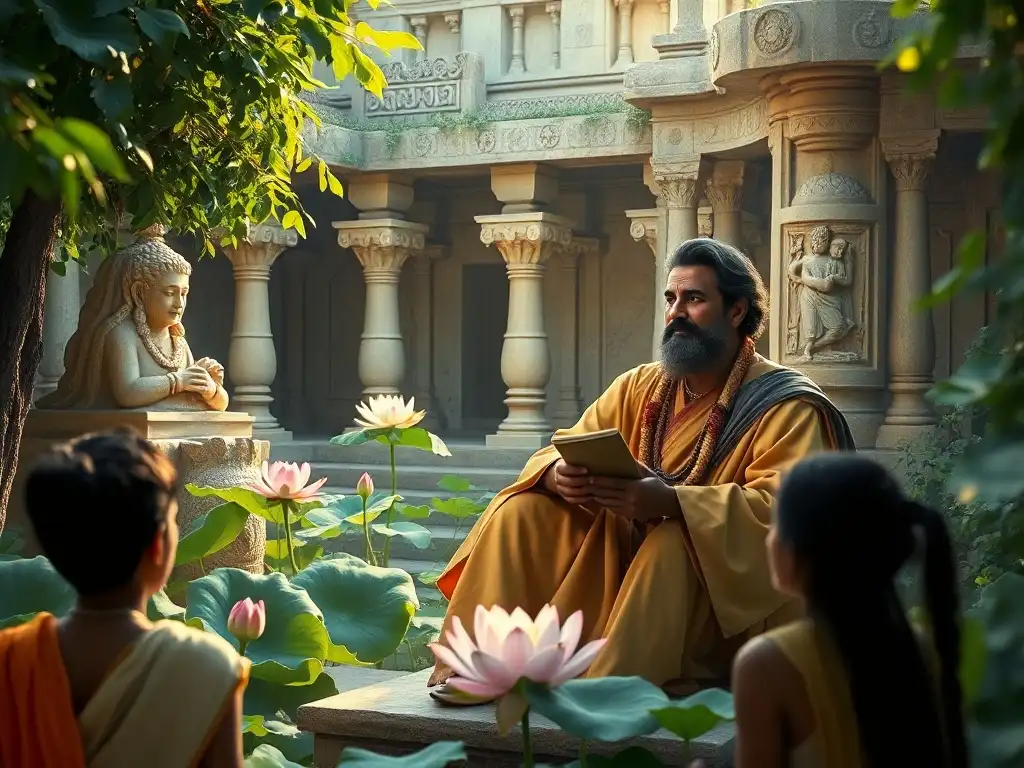
Development of Jain Ethical Philosophy
The development of Jain ethical philosophy is one of the most significant contributions of ancient Jain scholars. Central to Jain ethics is the principle of Ahimsa, or non-violence, which extends beyond mere physical harm to encompass mental and emotional dimensions as well. This comprehensive understanding of non-violence emerged from the teachings of Mahavira, the 24th Tirthankara, who emphasized compassion towards all living beings.
Jain scholars meticulously articulated ethical precepts, which include:
- Aparigraha: Non-possessiveness, advocating for minimal attachment to material possessions.
- Satya: Truthfulness, emphasizing the importance of honesty in thought, word, and deed.
- Asteya: Non-stealing, stressing respect for others' property and rights.
- Brahmacharya: Celibacy or chastity, encouraging purity of thought and action.
These ethical principles not only fostered a deeply introspective lifestyle among Jains but also influenced broader Indian philosophical discourse. The integration of these concepts into daily life provided a framework for moral conduct that resonated with various Indian communities.
Notable Jain Philosophers and Their Works
Several ancient Jain scholars made profound contributions to philosophy, logic, and science, enriching the intellectual landscape of India. Notable figures include:
- Umaswati (or Umaswami): Known for his seminal work, the Tattvartha Sutra, which synthesizes Jain beliefs and serves as an authoritative text on Jain philosophy. This text is pivotal as it lays down the fundamental principles of Jainism, including the concepts of the soul, karma, and liberation.
- Akhara Suri: A distinguished philosopher and author of Samayasara, which explores the nature of the soul and the path to liberation. His works encourage self-examination and discipline, aligning with Jain ethical standards.
- Hemachandra: A polymath known for his contributions to many fields, including grammar, philosophy, and history. His Dhvanyaloka is particularly notable for its insights into aesthetics and the nature of reality, merging Jain philosophical thought with literary theory.
- Rajendrasuri: His extensive writings on the concept of Syadvada (the doctrine of conditioned predication) further advanced Jain logics and metaphysics, emphasizing the relativity of truth.
These scholars not only preserved Jain teachings but also engaged critically with contemporary philosophical debates, shaping the intellectual heritage of ancient India.
Influence of Jain Philosophy on Other Indian Philosophical Traditions
The influence of ancient Jain scholars on other Indian philosophical traditions is profound and multifaceted. Jain philosophy, with its unique doctrines and rigorous ethical framework, left an indelible mark on various schools of thought:
- Buddhism: The parallels between Jain and Buddhist ethics, particularly in the emphasis on non-violence and compassion, suggest a shared philosophical lineage. Jain concepts of karma and rebirth also resonate within Buddhist teachings, where they are adapted to fit Buddhist metaphysical perspectives.
- Hinduism: Jain ideas have permeated Hindu philosophical texts, particularly in discussions surrounding ethics and metaphysics. The notion of Ahimsa has been integrated into Hindu practices, influencing figures like Mahatma Gandhi in the 20th century.
- Nyaya and Mimamsa: Jain contributions to logic and epistemology, especially through the works of scholars like Umaswati, informed the Nyaya school, which emphasizes logical reasoning. Jain debates on perception and inference provided critical counterarguments that enriched the discourse within these philosophical traditions.
The contributions of ancient Jain scholars extend beyond their own religious framework, influencing a wide array of philosophical discussions across ancient Indian thought. Their legacy continues to inspire contemporary ethical and philosophical inquiries.
Contributions to Logic by Ancient Jain Scholars

The contributions of ancient Jain scholars to the field of logic are profound and have significantly influenced philosophical discourse in India. Jain logic, known as "Syādvāda," emphasizes the relativity of truth and the multiplicity of viewpoints. This framework is not only a cornerstone of Jain philosophy but also serves as a critical element in the broader landscape of Indian logic.
Jain scholars developed a unique approach to logic that integrates ethical considerations with epistemological inquiries. This dual focus allowed them to explore complex concepts such as validity, proof, and argumentation while maintaining a commitment to non-violence and truth. As a result, Jain logic is marked by its distinctive methodologies and principles that differentiate it from other philosophical traditions.
Jain Logic: Concepts and Principles
Jain logic is grounded in several key concepts that reflect its philosophical underpinnings:
- Syādvāda (Conditional Proposition): This principle posits that every statement can be seen from multiple perspectives, leading to a conditional understanding of truth. For instance, the statement "An object exists" may also be qualified as "An object exists, and does not exist, and exists and does not exist" depending on the context and perspective.
- Anekāntavāda (Multiplicity of Existence): This principle asserts that reality is multifaceted and cannot be captured in a single viewpoint. It encourages the exploration of differing perspectives to arrive at a more comprehensive understanding of truth.
- Naya (Partial Standpoint): Jain scholars introduced the concept of "naya," which refers to the partial truth inherent in different assertions. By recognizing the limitations of individual statements, they advocated for a more nuanced approach to logic and discussion.
These concepts collectively challenge the absolutist tendencies found in other logical systems, promoting a more inclusive and flexible understanding of truth.
Key Figures in Jain Logic and Their Theories
Several eminent Jain scholars have made notable contributions to the field of logic, each bringing unique insights and theories:
- Umaswati (Umaswami): Often regarded as one of the foremost figures in Jain philosophy, he authored the "Tattvartha Sutra," which outlines the foundational principles of Jainism, including logic and epistemology. His work emphasizes the importance of understanding reality through multiple perspectives.
- Bhadrabahu: A prominent scholar of the 4th century CE, Bhadrabahu is known for his contributions to the logic of "syādvāda." His philosophical discourse laid the groundwork for further explorations of conditional arguments and the relativity of truth.
- Haribhadra: A significant figure in both Jain and Buddhist traditions, Haribhadra's writings delve into the intricacies of argumentation and the interplay of different logical systems. He advocated for the synthesis of Jain logic with other Indian philosophies.
These scholars not only shaped Jain logic but also engaged in dialogues with other philosophical traditions, enriching the intellectual landscape of ancient India.
Comparison of Jain Logic with Other Indian Logical Systems
When examining Jain logic in relation to other Indian logical systems, several key distinctions and similarities emerge:
- Versus Nyaya Logic: The Nyaya school emphasizes a more formalized approach to logic, focusing on syllogisms and the validity of arguments. In contrast, Jain logic prioritizes the relativity of truth and the multiplicity of perspectives, which can lead to a more dynamic discourse.
- Versus Buddhist Logic: Buddhist logic, particularly as articulated by Dignāga and Dharmakīrti, centers on the nature of perception and inference. While there are overlaps in methodologies, Jain logic's emphasis on ethical considerations and non-absolutism sets it apart.
- Common Ground: Despite these differences, Jain logic shares commonalities with other Indian systems, such as the focus on epistemological inquiries and the quest for understanding reality. This intersection creates a rich tapestry of philosophical thought that continues to inspire scholars today.
The contributions of ancient Jain scholars to the field of logic represent a significant and enduring legacy. Their innovative concepts and theories have not only enriched Jain philosophy but have also influenced broader discussions within Indian philosophy, making their work essential for understanding the complexities of logical thought in ancient India.
Contributions to Science by Ancient Jain Scholars

Ancient Jain scholars made significant contributions to various fields of science, deeply rooted in their philosophical principles and ethical teachings. Their works not only influenced the intellectual landscape of ancient India but also laid a foundation for future advancements in science and technology. This section explores their contributions in the realms of natural sciences, mathematics, astronomy, and medicine.
Jainism and the Natural Sciences
The Jain worldview emphasizes a profound respect for all living beings and the environment, which fostered a spirit of inquiry into the natural world. Jain scholars approached the study of nature through a lens of observation and empirical analysis. They engaged in various scientific disciplines, including:
- Botany: Jain texts often include detailed descriptions of plants, their medicinal properties, and ecological roles. Scholars like Hemachandra documented the characteristics of plants and their classification.
- Zoology: Jain teachings advocate for non-violence (ahimsa), leading to extensive studies on animal behavior and their habitats. Scholars meticulously described different species and their interactions within ecosystems.
- Environmental Science: The Jain emphasis on ecological balance and sustainability prompted early explorations of environmental science. Jain texts advocate for natural conservation practices and the importance of maintaining ecological harmony.
The Jain approach to natural sciences is characterized by rigorous methodology and ethical considerations, showcasing their commitment to knowledge and non-violence.
Innovations in Mathematics and Astronomy by Jain Scholars
Ancient Jain scholars were pioneers in mathematics and astronomy, contributing to concepts that were ahead of their time. Their works included:
- Mathematical Concepts: Jains developed significant mathematical ideas, including the concept of infinity and the use of decimal systems. The Jain mathematician Bhadrabahu formulated principles of combinatorial mathematics and contributed to integer and fraction theories.
- Astronomy: Jain astronomers made notable strides in understanding celestial bodies. Aryabhata, although not a Jain, was influenced by Jain texts, which provided foundational astronomical knowledge. Jain scholars meticulously calculated planetary positions and movements, using observational techniques that foreshadowed modern astronomy.
- Calendrical Systems: Jain scholars developed sophisticated calendrical systems that integrated astronomy with religious observances. Their calendars were based on lunar cycles and included detailed calculations of time and seasonal changes.
The innovations made by Jain scholars in mathematics and astronomy demonstrate their advanced understanding of numerical systems and their application to the natural world.
The Role of Jain Scholars in Advancing Medical Knowledge
Jain scholars were instrumental in the development of medicinal practices and healthcare systems in ancient India. Their contributions included:
- Ayurveda: Jain texts contributed to the principles of Ayurveda, emphasizing holistic health and the importance of diet, herbs, and natural remedies. Scholars like Vāgbhaṭa, influenced by Jain teachings, detailed medicinal plants and their uses.
- Surgery and Healing: Jain physicians practiced advanced surgical techniques and were known for their expertise in treating ailments. They documented various surgical procedures and medicinal treatments in texts such as the Sushruta Samhita, which, while primarily attributed to Sushruta, was influenced by broader Jain medical knowledge.
- Ethics in Medicine: The principle of ahimsa guided Jain scholars in their medical practices, promoting non-violence and ethical considerations in treatment methods. This approach not only shaped their medical practices but also influenced the ethical standards of healthcare in ancient India.
The contributions of Jain scholars to medicine underscore their commitment to health, ethics, and the well-being of both individuals and communities. Their legacy continues to resonate in modern medical practices, emphasizing the importance of ethical considerations in healthcare.
Interconnections Between Jain Philosophy, Logic, and Science

How Jain Philosophical Ideas Influence Scientific Thought
Jain philosophy, with its emphasis on non-violence (Ahimsa), multiplicity of viewpoints (Anekantavada), and the importance of knowledge (Jñāna), has significantly influenced scientific thought in various ways. One of the core principles of Jainism is the belief in the interconnectedness of all living beings and the universe. This understanding encourages a holistic view of scientific inquiry, fostering an appreciation for the complexities of natural phenomena.
-
Ahimsa and Environmental Science
The principle of Ahimsa promotes respect for all life forms and has inspired ecological studies that emphasize sustainable practices and biodiversity conservation. Scholars like Vardhamana Mahavira have advocated for a lifestyle that minimizes harm to the environment, leading to early discussions on ecological balance that resonate with modern environmental science.
-
Anekantavada and Scientific Methodology
Anekantavada posits that truth is multifaceted and can be perceived from various perspectives. This philosophical stance encourages critical thinking and the examination of multiple hypotheses in scientific research. By recognizing the limitations of any single viewpoint, Jain scholars have contributed to the development of methodologies that prioritize objectivity and rigorous analysis in scientific pursuits.
-
Karma and Causality
Jainism’s concept of karma, which explains the causal relationships between actions and their consequences, parallels scientific principles of causality. This philosophical framework has inspired scholars to explore the underlying mechanisms of natural laws, contributing to advancements in fields such as physics and biology.
The Synergy Between Logic and Scientific Inquiry in Jainism
Jain scholars have made notable contributions to logic and reasoning, which have been instrumental in shaping scientific inquiry. The integration of logical frameworks into the understanding of scientific principles has allowed for a more structured approach to knowledge acquisition.
-
Jain Logic (Syādvāda)
The doctrine of Syādvāda, which emphasizes conditional statements and the relativity of truth, serves as a precursor to modern logical theories. Jain thinkers like Umaswati and Dharmakirti developed intricate logical systems that dissected arguments and assertions. Their work laid the groundwork for analytical reasoning, which is essential in scientific methodologies today.
-
Epistemology and the Nature of Knowledge
Jain epistemology categorizes knowledge into various forms, such as direct perception, inference, and testimony. This classification has influenced the way scientific knowledge is constructed and validated. By understanding different modalities of knowledge, researchers are better equipped to evaluate evidence and formulate theories.
-
Practical Applications in Mathematics and Astronomy
Jain scholars excelled in mathematics and astronomy, often employing logical reasoning to solve complex problems. Contributions such as the development of decimal systems and accurate astronomical calculations reflect the synergy of logic and scientific inquiry. The mathematical precision demonstrated by Jain scholars highlights their understanding of logical principles, which are foundational to scientific exploration.
The interconnections between Jain philosophy, logic, and science reveal a rich tapestry of intellectual contributions that resonate with contemporary scientific thought. The emphasis on ethical considerations, multifaceted perspectives, and rigorous logical analysis underscores the profound impact of ancient Jain scholars on the evolution of philosophy and science.
Legacy of Ancient Jain Scholars in Modern Times

The legacy of ancient Jain scholars is profound, interweaving their contributions into the fabric of modern thought, philosophy, and scientific inquiry. Their teachings continue to resonate, demonstrating the timeless nature of their insights and the relevance of Jain principles in contemporary society.
Continuing Influence of Jain Contributions on Contemporary Philosophy
The philosophical contributions of ancient Jain scholars have significantly shaped various schools of thought, especially in the realms of ethics and metaphysics. Notably, concepts such as Anekantavada (the doctrine of non-absolutism) encourage a pluralistic viewpoint, fostering tolerance and open-mindedness in philosophical discussions.
- Anekantavada promotes the understanding that truth and reality are perceived differently from various perspectives. This principle is increasingly relevant in today’s multicultural societies, where diverse beliefs coexist.
- Syādvāda, another key philosophical doctrine, emphasizes conditional predication, allowing for a nuanced approach to truth claims. This has been influential in debates about relativism and is echoed in various modern philosophical discourses.
In contemporary philosophy, thinkers such as Mahatma Gandhi drew inspiration from Jain ethics, particularly the principle of Ahimsa (non-violence). Gandhi's application of non-violence during India's struggle for independence exemplifies the practical implications of Jain philosophical teachings, highlighting their enduring influence on social and political thought.
Revitalization of Jain Scientific Principles in the Modern Era
The scientific contributions of ancient Jain scholars, particularly in fields such as mathematics, astronomy, and biology, are experiencing a renaissance in modern academia. Scholars are increasingly recognizing the advanced methodologies and insights that Jain thinkers provided centuries ago.
- Mathematical Advancements:
- Jain mathematicians, like Bhadrabahu and Aaryabhatta, were pioneers in the development of concepts such as zero and the decimal system. Their work laid the groundwork for future mathematical exploration, influencing not just Indian mathematics but also global developments.
- Astronomy and Cosmology:
- Ancient Jain scholars made significant strides in understanding celestial bodies, with texts like the Surya Siddhanta providing early calculations of planetary motion. Contemporary astronomers are revisiting these ancient texts, finding parallels with modern astronomical principles.
- Biology and Environmental Science:
- The Jain emphasis on ecological balance and the interconnectedness of life forms is gaining traction in today's environmental sciences. The concept of Ahimsa extends beyond human interactions, advocating for the protection of all living beings, which is increasingly relevant in discussions about biodiversity and conservation.
The contributions of ancient Jain scholars are not merely relics of the past; they are vibrant threads woven into the tapestry of modern thought. Their philosophies and scientific insights continue to inspire and inform contemporary discourse, reaffirming the significance of ancient Jain scholars' contributions in our present-day world.
Conclusion: The Enduring Impact of Ancient Jain Scholars

Summary of Their Philosophical, Logical, and Scientific Contributions
Ancient Jain scholars made substantial contributions across various fields, including philosophy, logic, and science, significantly shaping the intellectual landscape of ancient India. Their works not only influenced Jain thought but also had a lasting impact on broader Indian philosophy and science.
Philosophical Contributions:
- Anekantavada (Multiplicity of Views): Central to Jain philosophy, this doctrine posits that truth is multifaceted and can be understood from different perspectives. Scholars like Umaswati articulated this concept, emphasizing that no single viewpoint can encapsulate the entirety of reality.
- Syādvāda (Conditional Assertion): This approach, closely related to Anekantavada, teaches that assertions about reality should account for various conditions. It was elaborated by scholars such as Bhadrabahu, who argued for the relativity of knowledge and the importance of context in understanding truth.
Logical Contributions:
- Pramana (Means of Knowledge): Jain logicians contributed significantly to the theory of knowledge. They identified various pramanas including perception, inference, and testimony, which laid the groundwork for later philosophical discourses.
- Debate Techniques: Ancient Jain scholars developed sophisticated methods for formal debate and logical reasoning. The works of Kumarila Bhatta and others reflect Jain contributions to logic, emphasizing dialectics that are still relevant in contemporary discussions.
Scientific Contributions:
- Mathematics and Astronomy: Jain scholars like Bhaskara I and Aryabhata advanced mathematical concepts, including algorithms for computation and astronomical calculations. Their meticulous records and methods contributed to the accuracy of celestial predictions.
- Biology and Botany: The Jains' emphasis on ahimsa (non-violence) led to significant research in biology and botany. Scholars meticulously documented various plant species and their uses, promoting an understanding of ecological balance and sustainable practices.
Final Thoughts on the Importance of Jain Scholarship in Ancient Indian History
The contributions of ancient Jain scholars are vital not only in the context of Jainism but also for the broader historical and cultural narrative of ancient India. By promoting ideals of non-violence, truth, and intellectual inquiry, they fostered an environment that valued diverse perspectives and rigorous debate.
The philosophical frameworks established by these scholars continue to resonate in modern philosophical discussions, emphasizing the importance of understanding multiple viewpoints. Similarly, their advancements in logic and science laid the groundwork for future generations of thinkers and scientists, influencing various fields from mathematics to environmental science.
The ancient Jain scholars' contributions are crucial for appreciating the intricate tapestry of ancient Indian thought. Their legacy endures, serving as a reminder of the rich intellectual heritage that emerged from ancient Indian civilizations, particularly in the realms of philosophy, logic, and science. As we explore this history, we gain valuable insights into the principles that shaped not only Jainism but also the larger discourse of Indian culture and philosophy.
Frequently Asked Questions
What were the main contributions of Ancient Jain scholars to philosophy?
Ancient Jain scholars significantly impacted philosophy by developing concepts such as non-violence (Ahimsa) and truthfulness (Satya), which are foundational to both Jainism and broader Indian philosophical thought.
How did Jain scholars influence the field of logic?
Jain scholars pioneered logical reasoning by introducing rigorous methods for argumentation and dialectics, which influenced later Indian logic and shaped philosophical discussions across various schools of thought.
What advancements did Jain scholars make in science?
Jain scholars contributed to science, particularly in areas such as mathematics and astronomy, by developing theories on celestial phenomena and making significant strides in numerical systems and calculations.
How did Jain philosophy address the concept of truth?
Jain philosophy emphasizes the multiplicity of viewpoints (Anekantavada), suggesting that truth is complex and can be perceived differently based on perspective, thereby enriching philosophical discourse.
Why is the study of Ancient Jain scholars important today?
Studying Ancient Jain scholars provides insights into the cultural and intellectual heritage of India, highlighting their contributions to ethics, logic, and science, which remain relevant in contemporary discussions on these topics.
Final Reflection: The Enduring Legacy of Ancient Jain Scholars
The contributions of ancient Jain scholars to philosophy, logic, and science remain profoundly relevant today, as we navigate an increasingly complex world. Their insights not only shaped the intellectual landscape of their time but also provide timeless wisdom that can guide contemporary thought and ethical considerations. In an era where divisive ideologies often overshadow reasoned discourse, the teachings of these scholars remind us of the importance of critical thinking and compassion in our pursuit of knowledge.
The influence of ancient Jain scholars extends far beyond their historical context, continuing to resonate in modern philosophical and scientific discussions. Their emphasis on non-violence, truth, and the interconnectedness of all life challenges us to reconsider our values and actions in an age marked by rapid technological advancement and environmental crises. As Mahatma Gandhi once said, “The greatness of a nation and its moral progress can be judged by the way its animals are treated.” This sentiment echoes the Jain principle of ahimsa (non-violence), urging us to reflect on our responsibilities toward all living beings.
As we contemplate the lessons imparted by ancient Jain scholars, let us take a moment to integrate their principles into our daily lives. Consider how you can embody the values of compassion, critical inquiry, and ethical responsibility in your interactions with others and the world around you. By doing so, we not only honor the legacy of these remarkable thinkers but also contribute to a more harmonious and enlightened society. Embrace the wisdom of the past as a guiding light for the future, and let it inspire you to make a meaningful impact in your own life and community.
Unleash the Wisdom of Ancient Jain Scholars!
Thank you for taking the time to explore the remarkable contributions of ancient Jain scholars in philosophy, logic, and science. Their insights not only shaped the intellectual landscape of their era but continue to inspire us today. Now, it’s your turn to engage with this rich legacy!
Here are some actionable steps you can take:
- Explore a Jain text or philosophy book: Start your journey by reading a key work such as the **Tattvartha Sutra**, and discover how these ancient teachings remain relevant in contemporary society.
- Join or participate in a local discussion group: Connect with others who share an interest in Jain philosophy, fostering meaningful conversations and gaining deeper insights.
- Share your learning experiences: Whether on social media or with friends, spread the word about the extraordinary knowledge of Jain scholars; you never know who might be inspired by your insights!
As you reflect on these contributions, consider this: How can the principles of Jain philosophy influence modern thought and decision-making in our lives today?