
Decoding Ancient Indian Mathematical Texts: A Journey into Numerical Mastery

Welcome to Ancient India History, where we embark on a fascinating journey through the rich tapestry of ancient Indian civilizations. Here, we delve deep into their profound cultural contributions, highlighting the remarkable mathematical advancements that emerged from the land of the Indus Valley to the flourishing Gupta Empire.
In our featured article, "Decoding Ancient Indian Mathematical Texts: A Journey into Numerical Mastery," we invite you to uncover the secrets of ancient Indian mathematical contributions that have shaped the world of numbers as we know it today. Prepare to be inspired and intrigued as you explore the legacy of intellect and innovation that continues to resonate through the ages!
The history of mathematics in ancient India is a captivating narrative that showcases the remarkable contributions made by Indian scholars in the realm of numbers and calculations. From the sophisticated numerical systems of the Indus Valley Civilization to the profound mathematical treatises of the Gupta Empire, the journey of ancient Indian mathematics is a testament to human ingenuity and intellectual pursuit. This article delves into the rich tapestry of ancient Indian mathematical contributions, exploring their foundational concepts, innovative techniques, and the profound impact they had on the global mathematical landscape.
The mathematical texts and treatises from ancient India not only reflect the advanced understanding of mathematics at the time but also provide insights into the cultural and philosophical thought processes that governed these civilizations. With a focus on key texts such as the Sulbasutras, Aryabhatiya, and Brahmasphutasiddhanta, we will uncover how ancient Indian mathematicians approached problems of geometry, algebra, and arithmetic.
Through this exploration, readers will gain a deeper appreciation of the numerical mastery exhibited by ancient Indian scholars and the lasting legacy of their contributions, which continue to influence modern mathematics. Join us as we embark on this enlightening journey into the world of ancient Indian mathematics, where numbers were not just symbols, but gateways to understanding the universe.
- Introduction to Ancient Indian Mathematical Contributions
- Historical Context of Ancient Indian Mathematics
- Key Ancient Indian Mathematical Texts
- Major Themes in Ancient Indian Mathematical Contributions
- Techniques and Methods in Ancient Indian Mathematics
- The Influence of Ancient Indian Mathematics on Global Knowledge
- Conclusion: Legacy of Ancient Indian Mathematical Contributions
- References for Further Study on Ancient Indian Mathematics
-
Frequently Asked Questions
- What are some significant mathematical contributions from ancient India?
- How did ancient Indian mathematicians influence global mathematics?
- What role did the Indus Valley Civilization play in mathematics?
- How did the Gupta Empire contribute to the field of mathematics?
- What are some ancient texts that document Indian mathematical knowledge?
- Final Reflection: Embracing the Legacy of Ancient Indian Mathematical Contributions
- Unlock the Secrets of Ancient Wisdom!
Introduction to Ancient Indian Mathematical Contributions
Ancient Indian mathematical contributions form a cornerstone of the broader history of mathematics, showcasing the ingenuity and sophistication of early Indian scholars. These contributions span various domains, including arithmetic, algebra, geometry, and astronomy, with a legacy that has influenced mathematical thought worldwide. This section delves into the essence of ancient Indian mathematics, its historical context, and its lasting significance.
Overview of Ancient Indian Mathematics
Ancient Indian mathematics is characterized by its systematic approach to numbers and operations. Key texts, such as the Sulba Sutras, the Aryabhatiya, and the Bakhshali Manuscript, provide insight into the mathematical practices of the time. The mathematical concepts developed during this period include:
- Decimal System: The introduction of a positional decimal system, including the concept of zero, revolutionized numerical representation and computation.
- Arithmetic Operations: Ancient mathematicians excelled in basic arithmetic operations, such as addition, subtraction, multiplication, and division, often using innovative techniques that laid the groundwork for modern methods.
- Geometric Principles: The Sulba Sutras provide geometric constructions for altars, illustrating the practical application of mathematics in religious rituals.
- Algebra: The work of mathematicians like Brahmagupta and Bhaskara II in the 7th and 12th centuries respectively, highlighted algebraic structures and solutions to equations, showcasing early forms of algebraic thinking.
These contributions not only reflect advanced mathematical concepts but also demonstrate an intricate understanding of various practical applications, from astronomy to architecture, solidifying the role of mathematics in ancient Indian culture.
Importance of Ancient Texts in Understanding Numerical Systems
Ancient texts are invaluable for understanding the evolution of numerical systems in India. These texts not only document mathematical principles but also provide context for their application in daily life and religious practices. Here are several ways these texts enhance our understanding:
- Cultural Context: The mathematical concepts found in ancient texts are often intertwined with cultural practices, such as rituals and astronomy. For example, the Aryabhatiya emphasizes the connection between mathematics and the timing of celestial events, underscoring the significance of numbers in ancient Indian society.
- Transmissions of Knowledge: Ancient texts served as a means of transmitting mathematical knowledge across generations. They illustrate how ideas were preserved, adapted, and expanded upon, contributing to a rich intellectual tradition. The Bakhshali Manuscript, for instance, reveals early methods of solving linear equations and highlights the continuity of mathematical thought.
- Innovative Techniques: The methods documented in these texts, such as the use of algorithms and geometric constructions, showcase the innovative spirit of ancient Indian mathematicians. Understanding these techniques provides insight into their problem-solving approaches and their influence on subsequent mathematical developments.
- Global Influence: Ancient Indian texts had a significant impact on the development of mathematics in other cultures. The spread of Indian numerals and concepts via trade routes to the Arab world and eventually to Europe illustrates the global importance of these contributions.
The exploration of ancient Indian mathematical contributions through historical texts reveals a profound understanding of numerical systems that has shaped mathematical thought throughout history. The legacy of these contributions continues to be relevant, serving as a foundation for modern mathematics and inspiring future generations of mathematicians.
Historical Context of Ancient Indian Mathematics
The historical backdrop of ancient Indian mathematics is rich and multifaceted, reflecting the interplay between culture, philosophy, and scientific inquiry. Mathematics in ancient India developed through different eras, each contributing unique insights and methods that have profoundly influenced mathematical thought globally. The roots of these contributions can be traced back to the early numerical systems of the Indus Valley Civilization, evolving through the Vedic period and culminating in significant advancements during the Gupta Empire.
The Indus Valley Civilization: Early Numerical Systems
The Indus Valley Civilization (circa 3300–1300 BCE) stands as one of the earliest cradles of human civilization, showcasing remarkable urban planning and social organization. Among its many achievements, this civilization exhibited a sophisticated understanding of numerical systems.
- Seals and Inscriptions: Archaeological findings, including seals and inscriptions, indicate that the Indus people utilized a form of writing that likely included numerical symbols. For instance, the famous "unicorn seal" displays a series of symbols that may represent quantities, suggesting the presence of a numerical system.
- Weights and Measures: The Indus Valley Civilization also demonstrated advanced measurement techniques. Standardized weights made of stone have been discovered, indicating a system of trade that required precise calculations. These weights reveal a decimal system, which is foundational for modern mathematics.
- Urban Planning and Geometry: The grid-like layout of major cities such as Mohenjo-Daro and Harappa indicates an understanding of geometry and spatial organization. The meticulous planning of these cities suggests that the Indus people had practical applications for mathematical concepts, particularly in construction and engineering.
Contributions During the Vedic Period
The Vedic period (circa 1500–500 BCE) marks a transformative era for ancient Indian mathematics, characterized by the development of new mathematical concepts intertwined with Vedic philosophy and rituals.
- Sanskrit Texts and Numerology: The Vedas, ancient sacred texts of India, laid the groundwork for mathematical thought. They introduced concepts of numerology and calculations related to rituals. The mathematical aspects can be seen in the "Shulba Sutras," which discuss geometric principles necessary for constructing altars.
- Decimal System and Place Value: The Vedic mathematicians made significant strides in the decimal system, which is crucial for efficient calculations. The place-value system, which allows for the representation of large numbers, emerged during this period, paving the way for more complex mathematical operations.
- Astronomical Calculations: The Vedic texts also contain astronomical calculations, where mathematics played a vital role in determining the timing of rituals. This necessitated the development of trigonometric concepts, showcasing the interplay between mathematics and astronomy.
Mathematical Advancements in the Gupta Empire
The Gupta Empire (circa 320–550 CE) is often referred to as the "Golden Age" of Indian mathematics, reflecting a period of unprecedented growth and innovation.
- Aryabhata's Contributions: Aryabhata, one of the most renowned mathematicians of this era, made remarkable contributions such as the introduction of zero as a numeral and the establishment of a place-value system. His work "Aryabhatiya" addresses various mathematical topics, including arithmetic, algebra, and trigonometry.
- The Concept of Zero: The introduction of zero as both a placeholder and a number revolutionized mathematics. This concept, alongside the decimal system, laid the foundation for modern numerical systems.
- Advances in Algebra and Trigonometry: Gupta mathematicians expanded on earlier works, developing algebraic methods and trigonometric functions. For example, they worked on sine tables and explored the properties of triangles, which had significant implications for future mathematical studies.
The historical context of ancient Indian mathematics is a testament to the intellectual achievements of its civilizations. From the early numerical systems of the Indus Valley through the profound contributions of the Vedic period to the advancements seen during the Gupta Empire, ancient Indian mathematical contributions have played a pivotal role in shaping the trajectory of mathematics as we know it today.
Key Ancient Indian Mathematical Texts
Ancient India is home to a wealth of mathematical knowledge encapsulated in various texts that have significantly influenced mathematical thought and practice across the globe. This section explores three pivotal works that showcase the brilliance of ancient Indian mathematicians and their contributions to numerical systems.
Aryabhata's "Aryabhatiya": A Mathematical Milestone
Aryabhata, one of the foremost mathematicians and astronomers of ancient India, authored the "Aryabhatiya" around 499 CE. This seminal work is divided into four sections: Gitikapada, Ganitapada, Kalakriya, and Golapada, each addressing different aspects of mathematics and astronomy.
- Key Contributions:
- Place Value System: Aryabhata is credited with introducing the place value system, which is fundamental to modern mathematics. His notation allowed for the representation of large numbers and complex calculations.
- Zero Concept: He also conceptualized zero as a number, which was revolutionary and laid the groundwork for future mathematical developments.
- Trigonometric Functions: Aryabhata utilized sine and cosine functions, providing tables that facilitated astronomical calculations.
In Aryabhata's work, we see the early seeds of algebra, geometry, and arithmetic that would blossom in later centuries.
Brahmagupta's "Brahmasphutasiddhanta": Innovations in Algebra
Written in 628 CE, Brahmagupta's "Brahmasphutasiddhanta" is a profound treatise that expanded upon Aryabhata's work and introduced several groundbreaking concepts in algebra and number theory.
- Key Contributions:
- Rules for Operations with Zero: Brahmagupta was one of the first to formulate rules for arithmetic operations involving zero, such as division by zero, which was a significant theoretical advancement.
- Quadratic Equations: He developed methods for solving quadratic equations, providing algorithms that are still relevant today.
- Negative Numbers: Brahmagupta recognized the importance of negative numbers and established rules for their manipulation, marking a pivotal shift in mathematical thought.
| Concept | Description |
|---|---|
| Operations with Zero | Introduced rules for addition, subtraction, and multiplication with zero. |
| Quadratic Solutions | Outlined procedures for solving equations, including practical examples. |
| Negative Numbers | Acknowledged and provided rules for arithmetic with negative values. |
Bhaskara II's "Lilavati": Practical Applications of Mathematics
Bhaskara II, a prominent mathematician of the 12th century, authored "Lilavati," a text that blends mathematics with poetry to make the subject engaging and accessible. This work serves not only as a mathematical manual but also as a practical guide for everyday life.
- Key Contributions:
- Arithmetic and Geometry: "Lilavati" covers various topics such as arithmetic operations, fractions, and geometric principles, making it a comprehensive reference for practical mathematics.
- Real-World Problems: The text includes numerous problems related to commerce, agriculture, and astronomy, thereby demonstrating the applicability of mathematics in daily life.
- Visual Learning: Bhaskara II employed vivid illustrations and poetic verses, making complex concepts easier to understand and remember.
Notable Problem Types in "Lilavati":
- Work and Time Problems: Techniques for calculating work done by multiple agents.
- Age Problems: Mathematical puzzles involving the ages of individuals at different times.
- Geometry: Applications in calculating areas and volumes of various shapes.
Bhaskara II's 'Lilavati' is more than a mathematical text; it is a bridge connecting theoretical concepts to practical application.
Through these texts, ancient Indian mathematicians laid the foundation for numerous mathematical principles still in use today, showcasing their remarkable contributions to the field of mathematics.
Major Themes in Ancient Indian Mathematical Contributions
The Concept of Zero and Its Historical Significance
The concept of zero is one of the most groundbreaking contributions of ancient Indian mathematics. The earliest recorded use of zero can be traced back to the 5th century CE in the work of mathematician Aryabhata. He used a symbol for zero that indicated the absence of a quantity, which was revolutionary at the time. This was not just a placeholder but a number in its own right, enabling complex calculations and the representation of large numbers.
Mathematical Implications of Zero
- Place Value System: The introduction of zero allowed for the development of the place value system, where the value of a digit is determined by its position. For example, in the number 205, the "0" indicates that there are no tens, significantly simplifying arithmetic operations.
- Calculative Efficiency: Zero facilitated easier calculations, particularly in subtraction and addition, where it acted as a neutral element. For instance, \( a + 0 = a \) and \( a - 0 = a \) became commonplace.
- Infinity and Limits: The concept of zero also paved the way for advanced mathematical theories, including limits and calculus. Ancient texts hinted at ideas that resemble the modern understanding of infinity.
The significance of zero transcends mathematics and influenced various fields, including astronomy and philosophy, marking a profound shift in the way numbers were perceived.
Advances in Arithmetic and Algebra
Ancient Indian mathematicians made significant strides in arithmetic and algebra, establishing foundational principles that would influence future generations. Texts such as the Bakhshali Manuscript and Lilavati showcase these advancements.
Key Contributions
- Algorithms: The ancient Indians developed several algorithms for arithmetic operations. For example, the "rule of false" was a method for solving quadratic equations. This systematic approach to problem-solving laid the groundwork for algebra as we know it today.
- Negative Numbers: The recognition and use of negative numbers were significant in ancient Indian mathematics. They were often represented in practical problems involving debts or losses, allowing for a more comprehensive mathematical framework.
- Fractions and Decimals: Ancient texts also explored the concept of fractions, with meticulous methods for addition, subtraction, multiplication, and division of fractions. The decimal system used in ancient India was vital for calculations, and it made its way to the Islamic world and then to Europe.
- Mathematical Riddles: Many ancient texts included riddles and puzzles, demonstrating the application of arithmetic and algebra in everyday life. This approach not only made learning engaging but also encouraged logical thinking.
Geometry and Trigonometry in Ancient Texts
The study of geometry and trigonometry in ancient India is illustrated through various texts, such as the Surya Siddhanta and works by mathematicians like Brahmagupta and Bhaskara.
Geometric Contributions
- Area and Volume Calculations: Ancient Indians formulated formulas to calculate the area of various shapes, including circles, triangles, and polygons. They also delved into three-dimensional geometry, determining volumes of solids like spheres and cylinders.
- Construction Techniques: Texts reveal sophisticated techniques for constructing geometric shapes and understanding properties such as congruence and similarity. This knowledge was essential not only for mathematics but also for architecture and astronomy.
Trigonometric Innovations
- Sine and Cosine Functions: The Surya Siddhanta introduced sine and cosine functions, which were crucial for astronomical calculations. The sine table created during this period is among the earliest of its kind.
- Right-Angled Triangles: The Pythagorean theorem, although attributed to the Greeks, had early references in Indian texts, indicating that Indian mathematicians were aware of the relationship between the sides of right-angled triangles long before it was formally documented in the West.
The advances in geometry and trigonometry highlight the sophistication and depth of ancient Indian mathematical contributions. These themes not only reflect the intellectual prowess of the civilization but also demonstrate their lasting impact on mathematics and science globally.
Techniques and Methods in Ancient Indian Mathematics
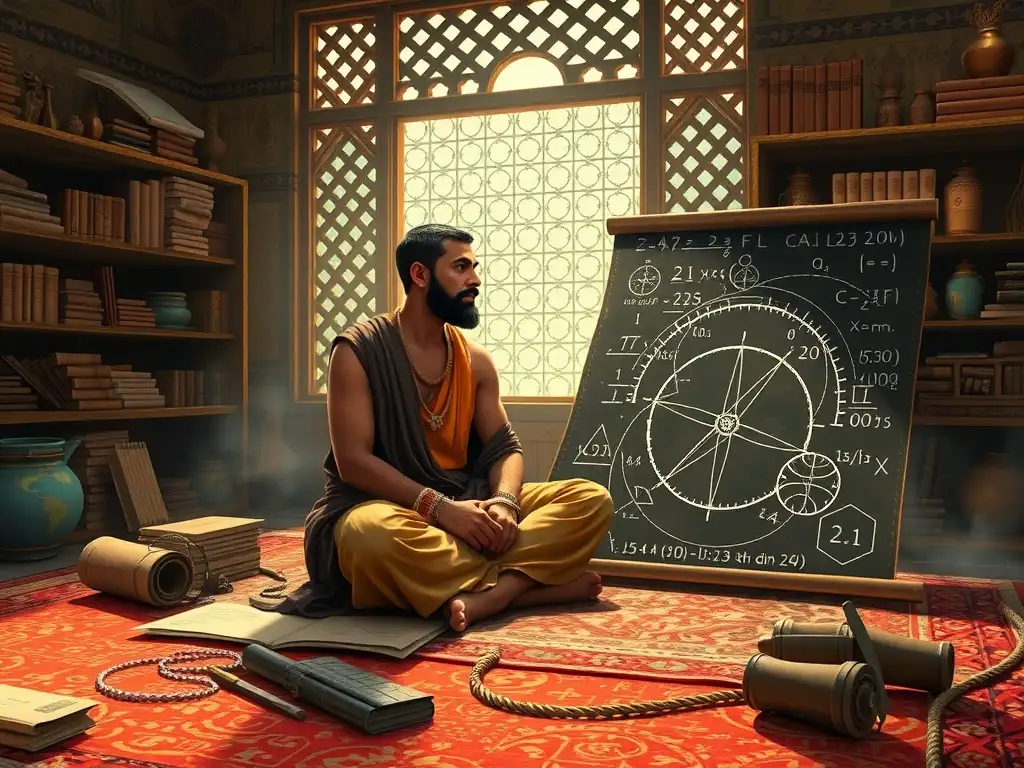
Numerical Techniques: Place Value and Decimal System
Ancient Indian mathematics introduced revolutionary concepts that significantly shaped the development of numerical systems worldwide. One of the most profound contributions is the place value system, which allows numbers to be expressed with clarity and precision. This system assigns a value to a digit based on its position in a number. For instance, in the number 203, the 2 represents two hundreds, the 0 signifies zero tens, and the 3 denotes three units. This innovative approach simplifies calculations and enhances computational efficiency.
The decimal system, which uses ten symbols (0-9), emerged prominently in ancient India, particularly during the Gupta period (around 4th to 6th centuries CE). This system was not only practical but also laid the groundwork for future mathematical advancements. The use of zero as a placeholder and a number in its own right was a groundbreaking idea that provided a way to represent the absence of value. This concept eventually spread to the Arab world and then to Europe, marking a pivotal moment in the history of mathematics.
Ancient Algorithms: Calculation Methods and Their Applications
Ancient Indian mathematicians devised various algorithms that facilitated complex calculations, making mathematics more accessible. One notable method is the sutra, a mnemonic device or formula that enables the solving of equations efficiently. The famous Aryabhata, in his seminal work Aryabhatiya, outlined several algorithms for arithmetic operations, including multiplication, division, and extraction of square roots.
For example, Aryabhata's method for multiplication, known as the "cross-multiplication" technique, involves arranging numbers in a grid and summing the products of the diagonals. This method not only streamlines calculations but also reflects the sophistication of mathematical thought in ancient India.
Moreover, the Bakhshali manuscript, an ancient text discovered in the 19th century, contains detailed algorithms for solving linear and quadratic equations. This manuscript illustrates the practical applications of these mathematical techniques in commerce, astronomy, and architecture, highlighting the integral role of mathematics in ancient Indian society.
The Use of Poetry in Mathematical Texts
In ancient India, mathematics was often intertwined with poetry, offering a unique approach to disseminating mathematical knowledge. Poetic verses served as mnemonic devices, making it easier for students to memorize complex algorithms and concepts. This method not only enhanced retention but also added an artistic dimension to mathematical education.
The famous mathematician Brahmagupta employed poetic verses in his work, Brahmasphutasiddhanta, to present mathematical principles. The use of rhythm and meter in these texts transformed mathematical instructions into engaging literature, fostering a deeper appreciation for the subject.
Additionally, the "Ganitakaumudi" by Bhaskara II exemplifies this blend of poetry and mathematics. This text meticulously details the rules of arithmetic and geometry while employing poetic forms to facilitate understanding. The artistic presentation of mathematical concepts reflects the cultural significance of mathematics in ancient Indian civilization and its role as a form of intellectual and artistic expression.
The exploration of these techniques and methods reveals the depth and sophistication of ancient Indian mathematical contributions. By establishing foundational concepts such as the place value system and developing algorithms that facilitate calculations, ancient Indian mathematicians laid the groundwork for future innovations in mathematics. The integration of poetry into mathematical texts further highlights the cultural richness of this discipline, showcasing how mathematics was not just a practical tool but also a profound form of artistic expression.
The Influence of Ancient Indian Mathematics on Global Knowledge
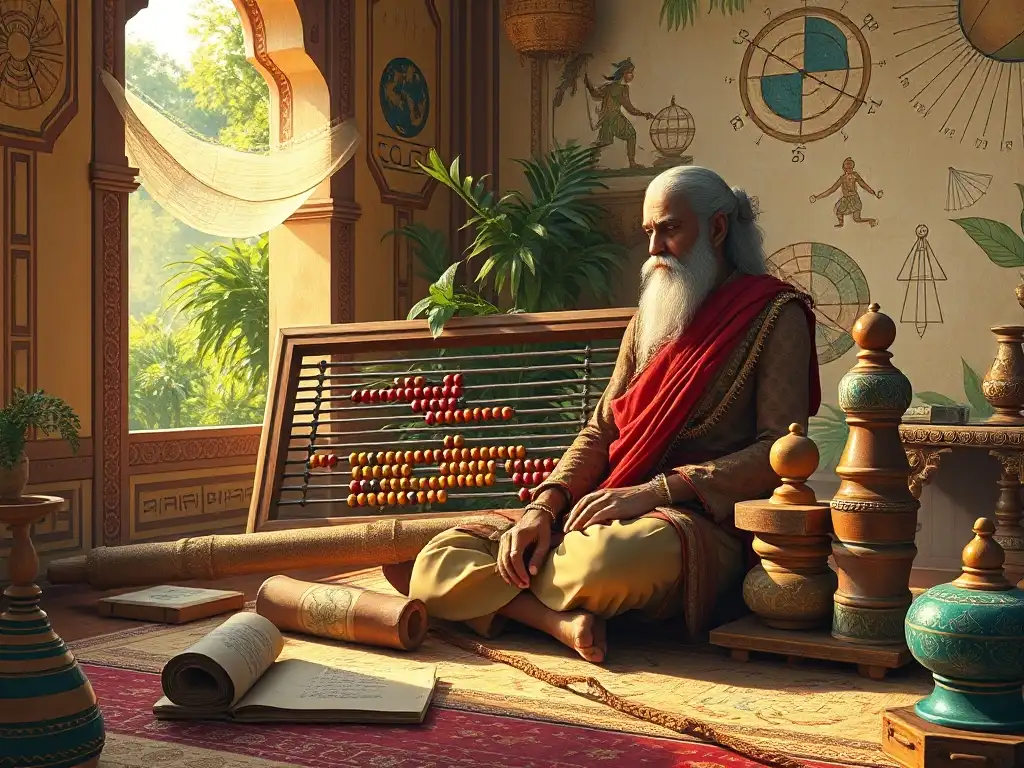
The influence of ancient Indian mathematics on global knowledge is profound and multifaceted. The numerical systems and mathematical concepts developed in ancient India laid the groundwork for many mathematical techniques and theories that are still in use today. One of the most significant contributions is the decimal place value system, which revolutionized numerical representation and arithmetic operations. This system was not only pivotal for Indian scholars but also served as a springboard for mathematical advancements across the globe.
Transmission of Mathematical Ideas to the Islamic World
The transmission of ancient Indian mathematical ideas to the Islamic world occurred primarily through trade routes and cultural exchanges during the medieval period. Notably, scholars from India, such as Brahmagupta and Aryabhata, produced texts that detailed sophisticated mathematical concepts, including algebra and trigonometry. These works were translated into Arabic, allowing Islamic mathematicians to build upon them.
Key aspects of this transmission include:
- Translation Movement: The translation of texts from Sanskrit to Arabic played a significant role in preserving and disseminating ancient Indian mathematical knowledge. Notable translations occurred in centers of learning, such as Baghdad's House of Wisdom.
- Adoption of the Numerals: The introduction of the Hindu-Arabic numeral system (0-9) from India to the Islamic world facilitated easier calculations and record-keeping. This numeral system eventually spread to Europe, transforming how mathematics was taught and understood.
- Influential Scholars: Scholars like Al-Khwarizmi, who drew heavily on Indian mathematical texts, are credited with developing algebra. His seminal work, "Al-Kitab al-Mukhtasar fi Hisab al-Jabr wal-Muqabala," was instrumental in establishing algebra as a distinct mathematical discipline.
The cross-pollination of ideas between Indian and Islamic mathematicians not only enriched Islamic scholarship but also laid the foundation for future mathematical advancements in Europe.
Impact on European Mathematics During the Renaissance
The impact of ancient Indian mathematical contributions on European mathematics during the Renaissance was significant and transformative. As Europe emerged from the Middle Ages, the reintroduction of classical knowledge coincided with the increased availability of Arabic texts, which included translations of Indian mathematical works.
Key factors influencing this impact include:
- Spread of the Hindu-Arabic Numerals: By the 15th century, the Hindu-Arabic numeral system had largely replaced Roman numerals in Europe. This shift allowed for more complex calculations, contributing to advancements in various fields, including commerce, navigation, and science.
- Mathematical Texts: The works of Indian mathematicians, particularly in areas like arithmetic and geometry, were integrated into European curricula. Texts such as "Liber Abaci" by Fibonacci, which introduced the Hindu-Arabic numeral system to the Western world, showcased the efficacy of these mathematical ideas.
- Renaissance Thinkers: Notable figures during the Renaissance, such as Johannes Kepler and Galileo Galilei, benefited from the mathematical foundations laid by their predecessors, including those from ancient India. Their work in astronomy and physics was significantly enhanced by the numerical systems and methods developed in India.
The ancient Indian mathematical contributions not only shaped the mathematical landscape of their time but also had lasting effects on global mathematics. The journey of these ideas from India to the Islamic world and ultimately to Europe highlights the interconnectedness of knowledge across cultures and epochs, paving the way for a richer understanding of mathematics today.
Conclusion: Legacy of Ancient Indian Mathematical Contributions
The legacy of ancient Indian mathematical contributions is both profound and far-reaching, significantly influencing the development of mathematics across the globe. This rich heritage is characterized by a unique blend of theoretical prowess and practical applications, showcasing the ingenuity of ancient Indian mathematicians. Notable figures such as Aryabhata, Brahmagupta, and Bhaskara made groundbreaking advancements in various mathematical fields, including arithmetic, algebra, and geometry.
The ancient Indian numeral system, particularly the concept of zero and the decimal place value system, stands out as a monumental achievement. These innovations not only simplified calculations but also laid the groundwork for future mathematical developments. The translations and adaptations of Indian mathematical texts into Arabic and later into Latin during the Middle Ages further illustrate the widespread impact of these contributions.
As we decode the intricate mathematical texts from ancient India, we uncover a treasure trove of knowledge that continues to inspire mathematicians and scholars today. The methods and concepts developed in this era remain relevant, demonstrating the timeless nature of these mathematical frameworks.
Continuing Influence on Modern Mathematics
The influence of ancient Indian mathematical contributions can be seen in several modern mathematical concepts and methods. For example, the decimal system, which originated in India, is now the standard numerical system used worldwide. This system's efficiency facilitates complex calculations, making it indispensable in various fields such as science, engineering, and finance.
Moreover, the works of mathematicians like Aryabhata, who introduced trigonometric functions and algorithms for square roots, have paved the way for advancements in calculus and trigonometry. The Aryabhata's sine table, for instance, is still referenced in modern trigonometry. Additionally, Brahmagupta's rules for solving quadratic equations and his contributions to arithmetic operations have become fundamental components of algebra taught in contemporary mathematics curricula.
The principles laid down in ancient Indian mathematical texts have also fostered a global appreciation for mathematical rigor and proof. The systematic approach to problem-solving and the emphasis on logical reasoning continue to shape mathematical education and research today, reinforcing the importance of these ancient contributions.
The Importance of Preserving and Studying Ancient Texts
Preserving and studying ancient Indian mathematical texts is crucial for understanding the evolution of mathematical thought and practices. These texts serve as essential resources that not only reveal the methodologies used by ancient mathematicians but also reflect the cultural and intellectual milieu of their time.
- Cultural Insight: The mathematical texts often intertwine with astronomical, philosophical, and religious contexts, providing a holistic view of ancient Indian society. Understanding these connections enriches our knowledge of how mathematics was perceived and utilized in everyday life.
- Historical Context: By examining the historical developments documented in these texts, researchers can trace the lineage of mathematical ideas. This historical context is essential for appreciating how ancient contributions influenced later mathematical advancements in other cultures.
- Educational Value: Incorporating the study of ancient Indian mathematics into modern curricula can inspire new generations of mathematicians. It encourages students to explore diverse mathematical traditions, fostering a more inclusive view of the discipline.
- Preservation Efforts: Institutions and scholars are increasingly recognizing the need to digitize and translate these ancient texts, ensuring their accessibility for future study. Such efforts are vital for keeping this rich mathematical heritage alive and relevant.
The exploration of ancient Indian mathematical contributions not only highlights their significance in shaping modern mathematics but also emphasizes the importance of preserving this knowledge for future generations. The journey into these historical texts reveals an intricate tapestry of numerical mastery that continues to inspire and inform contemporary mathematical thought.
References for Further Study on Ancient Indian Mathematics
Suggested Readings and Resources
To deepen your understanding of ancient Indian mathematical contributions, a variety of scholarly works and resources are available. These texts cover the historical context, mathematical concepts, and the cultural significance of mathematics in ancient India. Here are some recommended readings:
- "The History of Mathematics: A Brief Course" by Roger L. Cooke
- This comprehensive book provides an overview of the development of mathematics globally, with dedicated sections on ancient Indian contributions.
- "A History of Indian Mathematics" by C. N. Srinivasiengar
- A seminal work that traces the evolution of mathematical ideas in India, discussing texts like the Aryabhatiya and the Siddhanta Shiromani.
- "Mathematics in India" by Kim Plofker
- This book explores the mathematical achievements in India from ancient times to the modern era, highlighting key figures and their contributions.
- "The Ganita Sutras of Baudhayana"
- An ancient text that provides insights into the mathematical practices of the time, including geometry and arithmetic.
- "The Mathematics of Ancient India" by M. N. Srinivas
- A focused examination of the mathematical techniques and principles used in ancient Indian texts.
These resources will provide a solid foundation for anyone interested in the intricate world of ancient Indian mathematics.
Online Databases and Archives for Ancient Mathematical Texts
For researchers and enthusiasts looking to access primary sources and historical texts, numerous online databases and archives are available. Here are some key platforms where you can find ancient Indian mathematical manuscripts:
- Digital Library of India
- A vast repository of digitized texts, including ancient manuscripts, books, and journals related to mathematics and science.
- Internet Archive
- Offers a collection of texts pertaining to ancient and medieval Indian mathematics, including scanned versions of historical works.
- Project Gutenberg
- A library of free eBooks, which includes various mathematical texts from different cultures, including India.
- The British Library – Online Gallery
- Hosts a selection of digitized manuscripts, including mathematical works from ancient India, available for public viewing.
- Indira Gandhi National Centre for the Arts (IGNCA)
- Provides access to a wealth of resources on Indian art, culture, and literature, including mathematical texts and treatises.
Utilizing these databases will enhance your research and provide access to valuable materials that illuminate the rich tradition of ancient Indian mathematics.
Frequently Asked Questions
What are some significant mathematical contributions from ancient India?
Ancient Indian scholars made significant contributions such as the concept of zero, the decimal system, and advancements in geometry and algebra that laid the groundwork for modern mathematics.
How did ancient Indian mathematicians influence global mathematics?
The works of ancient Indian mathematicians like Aryabhata and Brahmagupta introduced fundamental concepts that were later transmitted to the Islamic world and then to Europe, greatly influencing global mathematical development.
What role did the Indus Valley Civilization play in mathematics?
The Indus Valley Civilization showcased early numerical systems through artifacts like seals and weights, indicating a sophisticated understanding of measurement and trade, which were essential for mathematical development.
How did the Gupta Empire contribute to the field of mathematics?
During the Gupta Empire, scholars made remarkable advancements in mathematics, including the development of trigonometric concepts and the formalization of algebraic rules, significantly enhancing the discipline's complexity and application.
What are some ancient texts that document Indian mathematical knowledge?
Notable texts like the Bakhshali Manuscript and Aryabhata's Aryabhatiya contain essential information on numerical techniques, calculations, and mathematical theories, showcasing the depth of ancient Indian mathematical knowledge.
Final Reflection: Embracing the Legacy of Ancient Indian Mathematical Contributions
The exploration of ancient Indian mathematical texts reveals a profound legacy that continues to shape our understanding of mathematics today. From the intricate concepts of zero to the sophisticated methods of calculation, these contributions are not merely historical footnotes; they are the foundation upon which modern mathematics stands. The brilliance of ancient Indian scholars is a testament to human ingenuity and the relentless pursuit of knowledge.
The influence of these mathematical advancements transcends time and geography, weaving itself into the very fabric of our contemporary society. As we navigate through the complexities of modern mathematics, we must recognize and honor the roots of these ideas that emerged from ancient Indian texts. Mathematics is the language in which God has written the universe.
This quote encapsulates the essence of how ancient Indian mathematicians viewed their work—not just as numbers and equations, but as a divine exploration of the universe itself.
As we reflect on the lessons from these ancient texts, let us carry forward the spirit of inquiry and innovation that characterized their creators. I invite you to delve deeper into the world of mathematics, to appreciate the rich history that informs our present, and to apply these timeless principles in your own life. Embrace the journey of learning, and let the wisdom of ancient Indian mathematical contributions inspire you to explore, discover, and innovate in your own unique way.
Unlock the Secrets of Ancient Wisdom!
Thank you for diving into the fascinating world of ancient Indian mathematics with us! You've explored rich traditions that have shaped numerical mastery. Now, it’s time to put that knowledge into action!
Here are some powerful steps you can take:
- Start a Study Group: Connect with fellow enthusiasts to delve deeper into ancient mathematical texts. Share insights and discuss interpretations to broaden your understanding.
- Explore Practical Applications: Apply ancient mathematical concepts in your daily life. Whether it's calculations for cooking or budgeting, see how these time-tested techniques can enhance your skills!
- Share Your Findings: Spread the knowledge! Post interesting facts or insights about ancient Indian mathematics on social media, or contribute a guest article to our community.
What ancient mathematical concept are you most excited to explore further? Let's ignite a dialogue!