
The Role of Mathematics in Ancient Indian Warfare and Strategy

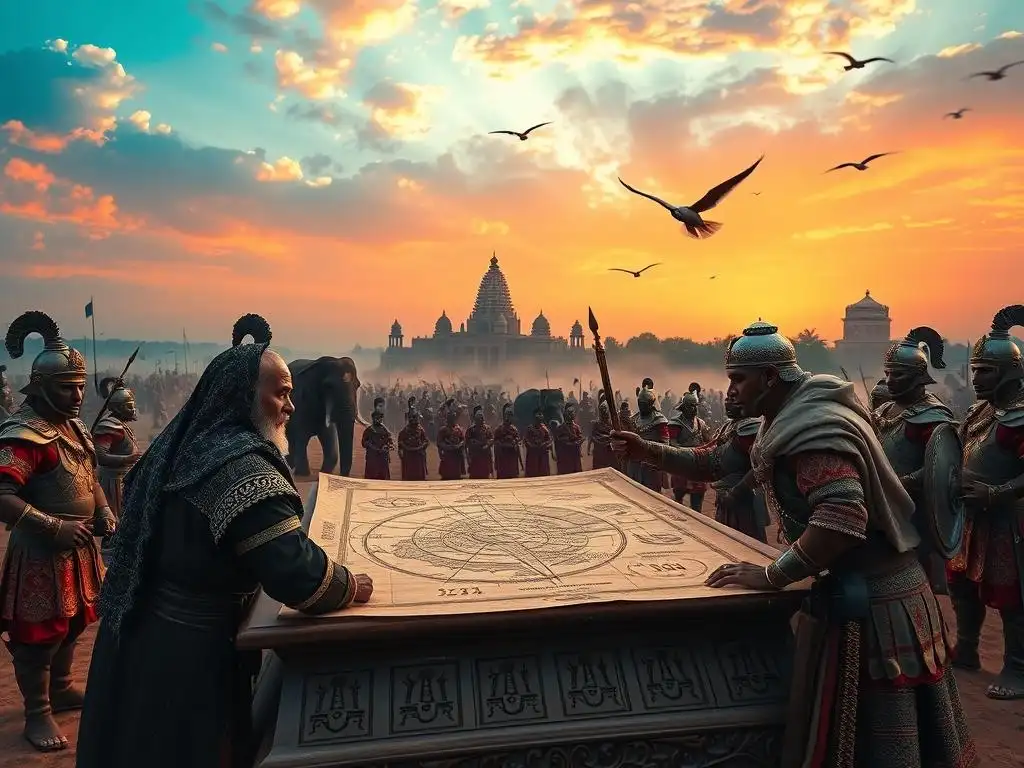
Welcome to Ancient India History, where we embark on a journey to uncover the rich and diverse tapestry of ancient Indian civilizations. Dive into the fascinating world of ancient Indian mathematics warfare, a pivotal yet often overlooked element that shaped strategies and outcomes on the battlefield. How did the ingenious minds of the past intertwine numerical prowess with military tactics?
Explore our latest article, "The Role of Mathematics in Ancient Indian Warfare and Strategy," and unlock the secrets of how math was not just a tool, but a weapon in the hands of brilliant strategists. Your adventure into the depths of history starts here— are you ready to discover the mathematical marvels that influenced empires?
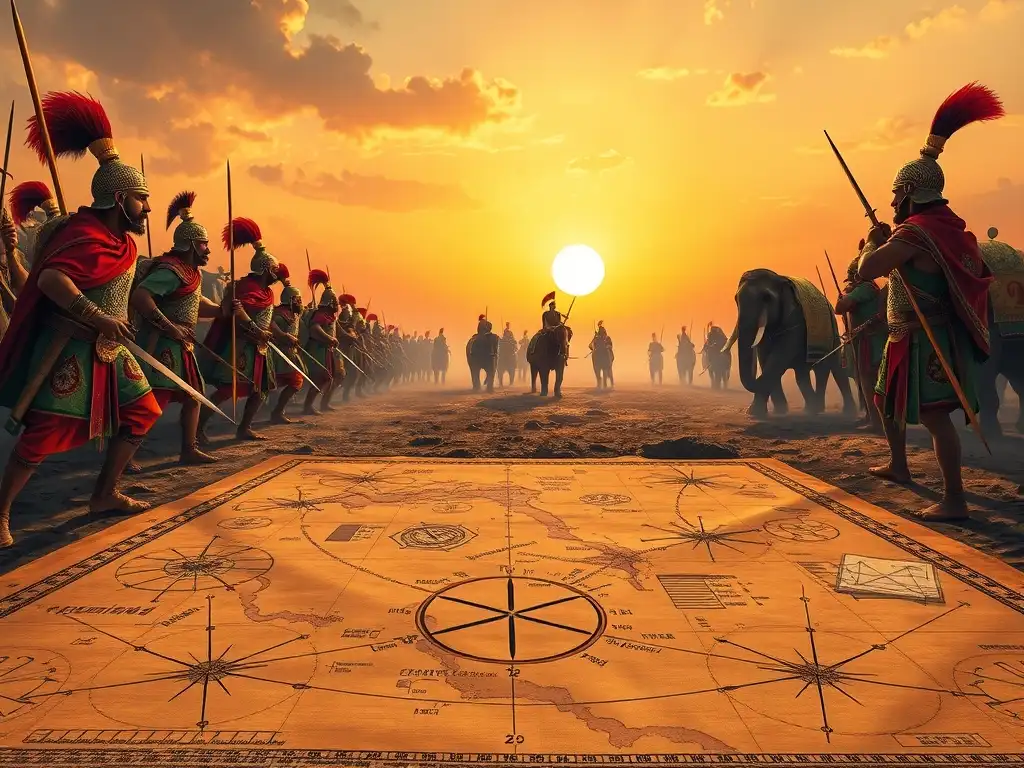
Introduction to Ancient Indian Mathematics and Warfare
Ancient Indian civilizations were not only known for their rich cultural heritage and philosophical advancements but also for their significant contributions to mathematics, which played a crucial role in warfare and military strategy. The evolution of mathematical concepts in ancient India, particularly during periods such as the Indus Valley Civilization and the Gupta Empire, provided strategic advantages in battles, logistics, and the overall planning of military campaigns.
Through the application of mathematical principles, ancient Indian strategists were able to enhance their tactical approaches, optimize resource allocation, and improve their chances of success in conflicts. In this article, we will explore the intricate relationship between ancient Indian mathematics and warfare, highlighting key concepts that shaped military strategies.
Overview of Ancient Indian Civilizations
Ancient India saw the rise and fall of several great civilizations, each contributing to the advancement of knowledge and skills, including mathematics.
- Indus Valley Civilization (c. 2500–1900 BCE): Known for its urban planning, the inhabitants demonstrated a sophisticated understanding of measurement and geometry, which laid the groundwork for future mathematical developments.
- Maurya Empire (c. 322–185 BCE): This era marked significant military expansion, where knowledge of mathematics was critical in strategizing conquests and managing vast territories.
- Gupta Empire (c. 320–550 CE): Often referred to as the Golden Age of India, this period saw remarkable advancements in mathematics, particularly with the contributions of mathematicians like Aryabhata and Brahmagupta, whose works influenced warfare tactics.
Significance of Mathematics in Military Strategy
Mathematics served as a foundational tool in the formulation of military strategies in ancient India. The ability to calculate distances, estimate troop movements, and analyze battle formations was vital for ensuring effective deployment in warfare. Key aspects include:
- Tactical Planning: Mathematical calculations aided commanders in devising battle plans that maximized their strengths while exploiting the weaknesses of their opponents.
- Resource Management: Understanding arithmetic allowed for efficient logistics, ensuring that supplies and reinforcements were properly calculated and distributed during campaigns.
- Predictive Analysis: By employing mathematical models, strategists could predict outcomes based on various scenarios, enhancing decision-making in the heat of battle.
Key Mathematical Concepts in Ancient Indian Warfare
Understanding the critical mathematical concepts that influenced ancient Indian warfare provides insight into how civilizations approached military conflicts with precision and strategy.
Geometry and Its Applications in Battle Formations
The use of geometry was paramount in designing effective battle formations. Ancient Indian military leaders utilized geometric principles to create formations that optimized visibility and defense, such as:
- Phalanx arrangements: Troops were organized in geometric patterns to maximize their effectiveness in combat.
- Fortification designs: The layout of forts often employed geometric shapes to enhance defense against invasions.
Arithmetic and Logistics in Ancient Warfare
Arithmetic was essential for managing the logistics of ancient Indian armies. Key applications included:
- Troop calculations: Estimating the number of soldiers needed for specific campaigns based on mathematical principles ensured that armies were adequately prepared for battles.
- Supply chain management: Mathematics facilitated the organization and distribution of resources, ensuring that armies were well-equipped during prolonged engagements.
The Use of Astronomy in Strategic Planning
Astronomy also played a vital role in ancient Indian warfare. The understanding of celestial bodies allowed military leaders to:
- Navigate and plan: Knowledge of the stars was used for navigation during campaigns and for timing attacks based on celestial events.
- Calendar creation: Understanding seasonal cycles aided in determining the best times for warfare, aligning military actions with favorable conditions.
Through these mathematical applications, ancient Indian civilizations demonstrated a remarkable integration of mathematics into warfare, showcasing their advanced understanding of the discipline and its practical implications in military strategy.
Notable Mathematicians and Their Contributions
Ancient Indian mathematics has been greatly influenced by several notable mathematicians whose innovative contributions laid the groundwork for many mathematical principles still relevant today. Their work not only advanced mathematical theory but also found practical applications in warfare and military strategy. Below are the key figures whose contributions significantly impacted the field of mathematics and its application in warfare.
Aryabhata: The Pioneer of Mathematical Innovations
Aryabhata, one of the earliest and most influential mathematicians of ancient India, lived in the 5th century CE. His work, particularly the Aryabhatiya, is a cornerstone in the history of mathematics. Aryabhata introduced the concept of zero as a placeholder, which revolutionized mathematical calculations.
In the context of warfare, Aryabhata's contributions extended to astronomy and trigonometry, essential for navigation and the timing of military maneuvers. His methods for calculating the positions of celestial bodies assisted in planning battles based on astrological predictions, a common practice in ancient Indian warfare.
Brahmagupta: Mathematics in Military Tactics
Brahmagupta, a 7th-century mathematician, is renowned for his seminal work, the Brahmasphutasiddhanta. This text not only addressed arithmetic and algebra but also included rules for solving quadratic equations, which could be applied in various military scenarios, such as calculating distances and resource allocations.
His work in mathematics was crucial for strategists who needed precise calculations for troop movements and the construction of fortifications. Brahmagupta's rules for the handling of negative numbers and the use of algorithms further enhanced the logistical capabilities of ancient military leaders.
Bhaskara II: Advancements in Calculative Techniques
Bhaskara II, also known as Bhaskara the Great, lived in the 12th century and is celebrated for his comprehensive treatise, the Lilavati. His contributions to mathematics included advancements in calculus and the systematic use of algorithms for computations.
In warfare, Bhaskara's mathematical techniques were applied in the design of weaponry and in strategizing troop formations. His insights into cyclic and periodic functions could be utilized to predict the outcomes of battles based on various tactical approaches, showcasing the integral role of mathematics in military strategy.
Ancient Texts on Warfare and Mathematics
The intersection of mathematics and military strategy in ancient India is well-documented in various texts that provide insights into the mathematical principles guiding warfare tactics. These texts reflect the sophisticated understanding of mathematics among ancient Indian scholars and their practical applications.
The Arthashastra: A Treatise on Strategy and Mathematics
The Arthashastra, attributed to Kautilya (Chanakya) in the 4th century BCE, is one of the most important texts on statecraft and military strategy. It emphasizes the significance of mathematics in planning and executing military operations.
Kautilya outlines various strategies for resource management, troop deployment, and fortification, often employing mathematical principles to optimize outcomes. The text illustrates how mathematical calculations were fundamental to warfare, enabling strategists to make informed decisions based on quantitative assessments.
The Mahabharata: Mathematical Insights in War Narratives
The Mahabharata, an epic narrative that includes detailed accounts of the Kurukshetra War, also contains mathematical insights embedded within its storytelling. The text features various calculations related to troop numbers, logistics, and strategies used by different factions during the war.
The strategic dilemmas faced by characters such as Arjuna and Krishna often involve mathematical reasoning, reflecting the importance of calculus and geometry in understanding battle formations and the effectiveness of different military tactics.
Other Historical Texts and Their Contributions to Warfare Mathematics
In addition to the Arthashastra and Mahabharata, several other historical texts contributed to the understanding of mathematics in warfare. Works like Siddhanta Shiromani by Bhaskara II and various treatises on geometry provided critical insights into the spatial reasoning required for battlefield tactics.
These texts collectively highlight the role of ancient Indian mathematics in formulating strategies, managing resources, and enhancing the effectiveness of military operations. They serve as a testament to the sophisticated interplay between mathematics and warfare in ancient Indian civilization.
Case Studies: Historical Battles and Mathematical Strategies
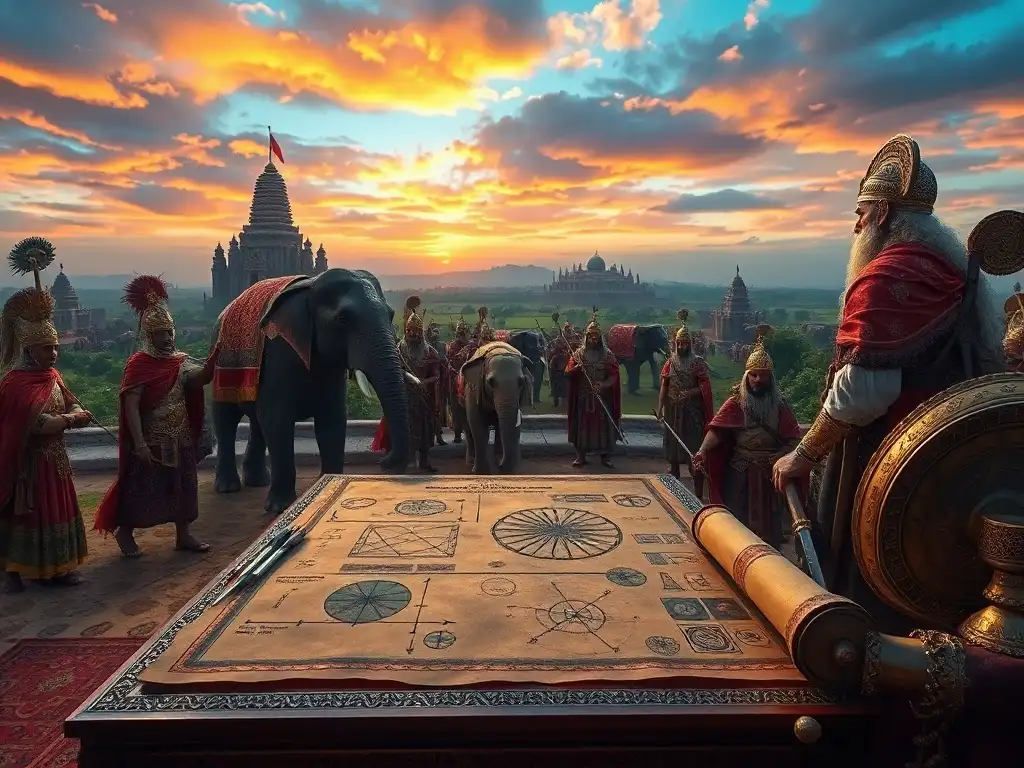
Throughout ancient Indian history, warfare was not merely a matter of brute strength; it was deeply intertwined with strategic planning and mathematical applications. This relationship is evident in various historical battles that employed mathematical principles to gain a tactical advantage. By studying these case studies, we can gain insights into how ancient Indian mathematics influenced military strategies and outcomes.
The Kalinga War: Strategic Planning and Mathematical Applications
The Kalinga War (c. 261 BCE), fought between the Mauryan emperor Ashoka and the state of Kalinga, stands out as a significant example of strategic planning enhanced by mathematical applications. Ashoka's forces were tasked with overcoming a fierce and resilient opponent. To achieve this, mathematicians and strategists likely utilized techniques such as geometry and logistics to plan troop movements and formations.
- Logistics and Supply Lines: Mathematical calculations would have been crucial in determining the optimal routes for supply lines, ensuring that troops were well-equipped and maintained during prolonged engagements.
- Terrain Analysis: Understanding the geographical landscape was vital. The use of geometry helped in mapping the terrain, allowing strategists to identify advantageous positions for ambushes and fortifications.
Ashoka's victory at Kalinga, despite heavy casualties, marked a pivotal moment that led to his conversion to Buddhism and a focus on peace. However, the mathematical strategies employed during this campaign demonstrated the importance of intellect in warfare.
The Gupta Empire: Innovations in Warfare Tactics
During the Gupta Empire (c. 240-550 CE), significant innovations in warfare tactics emerged, influenced by advances in mathematics. The Guptas are often hailed as the Golden Age of India, not only for their contributions to arts and sciences but also for their military strategies.
- Formation Techniques: The Guptas utilized complex formation techniques, such as the "Chakra Vyuha" (the circular formation), which required precise calculations for positioning and movement. This formation allowed for a flexible defense and offense during battles.
- Siege Warfare and Mathematics: The Gupta Empire saw the development of sophisticated siege techniques, which relied on mathematical principles to calculate the necessary force and angle of projectiles. The application of trigonometry in determining the trajectory of catapults and other siege engines exemplified the integration of mathematics in warfare.
The Gupta military’s effectiveness was largely due to their ability to adapt and innovate, using mathematics as a tool for enhancing their military prowess.
Analysis of Military Campaigns Utilizing Mathematical Principles
A detailed analysis of various military campaigns from ancient India reveals a consistent pattern of incorporating mathematical principles into warfare. Calculations regarding troop deployment, resource allocation, and battlefield tactics played a crucial role in determining the outcomes of these conflicts.
- Troop Deployment: Commanders often relied on mathematical ratios to determine the optimal number of troops to allocate to different fronts in a battle, ensuring a balanced approach to offense and defense.
- Resource Management: Effective resource management was essential for sustaining long campaigns. Mathematical models helped in forecasting supply needs based on troop size and duration of the campaign.
These analyses underscore the fact that ancient Indian military leaders understood the importance of mathematics not just as a theoretical discipline but as a practical tool that could lead to victory.
Conclusion: The Legacy of Ancient Indian Mathematics in Warfare
The legacy of ancient Indian mathematics in warfare extends far beyond historical battles. Its principles have influenced military thought and strategy throughout the ages, shaping how conflicts are approached even today.
Impact on Subsequent Military Strategies
The mathematical strategies developed in ancient India laid the groundwork for subsequent military doctrines. Later empires, both in India and beyond, adopted these principles, recognizing the value of strategic planning and logistical calculations in warfare. The emphasis on geometry, logistics, and resource management became foundational in military education.
- Military Treatises: Texts such as "Arthashastra," attributed to Chanakya, reflect the integration of mathematics into military theory, emphasizing the importance of strategic planning.
- Cross-Cultural Influence: As trade routes expanded and cultures interacted, the mathematical principles from ancient India found their way into the military strategies of other civilizations, influencing tactics on a broader scale.
Influence on Modern Warfare Tactics and Strategy
Modern military tactics continue to draw inspiration from ancient Indian mathematical principles. The integration of technology and mathematics in contemporary warfare echoes the historical practices established centuries ago.
- Mathematical Modeling: Today’s military operations employ advanced mathematical modeling and simulations to predict outcomes and optimize strategies, a practice that can be traced back to ancient Indian methodologies.
- Geospatial Analysis: The use of geospatial analysis in planning and executing military operations reflects the ancient understanding of terrain and resource management, showcasing the continuity of mathematical applications in warfare.
In essence, the rich legacy of ancient Indian mathematics in warfare not only contributed to the successes of historical battles but also paved the way for modern military strategies, demonstrating the timeless relevance of mathematics in the art of warfare.
References and Further Reading on Ancient Indian Mathematics in Warfare
The study of ancient Indian mathematics, particularly in the context of warfare and strategy, is a fascinating area that blends numerical prowess with tactical applications. Below are some suggested resources for those interested in delving deeper into this rich subject.
Suggested Books and Articles
-
"The History of Mathematics: A Brief Course" by Roger L. Cooke
This comprehensive guide offers insights into how ancient Indian mathematicians contributed to various fields, including military strategy. It discusses key concepts and figures, providing a broader context for the role of mathematics in warfare.
-
"Mathematics in India" by Kim Plofker
This book explores the development of mathematics in India, including its applications in warfare. Plofker's work is a must-read for understanding the cultural and historical significance of mathematics in ancient Indian society.
-
"The Mathematics of War: A History of Military Strategy" by John E. McGrath
While not exclusively focused on India, this book provides a comparative perspective on how mathematics has influenced warfare across different civilizations, including insights into ancient Indian strategies.
-
"Vedic Mathematics: A Mathematical Treasure" by Jagadguru Swami Sri Bharati Krishna Tirthaji
This text elaborates on the Vedic system of mathematics, which includes techniques that were likely applied in strategic military operations. It offers unique insights into the mathematical methodologies that shaped ancient Indian warfare.
-
"The Art of War" by Sun Tzu (translated by various authors)
Although originally a Chinese text, this foundational work on military strategy has influenced military thinkers worldwide, including in ancient India. Understanding these strategic principles can provide context for India's unique mathematical contributions.
Online Resources for Further Exploration
-
Indian Mathematical Society
A dedicated platform that offers a wealth of resources on the contributions of Indian mathematicians, including those relevant to warfare. It features articles, papers, and historical documents.
-
The Digital South Asia Library
This online resource provides access to a variety of texts related to ancient Indian history and mathematics. It includes scanned manuscripts and publications that explore the intersection of mathematics and military strategy.
-
The Project Gutenberg
A free online library that includes several historical texts on mathematics and warfare, with specific sections dedicated to Indian contributions. Search for keywords related to ancient Indian mathematics to find relevant works.
-
Online Courses on Ancient Indian Mathematics
Platforms like Coursera and edX occasionally offer courses focusing on the history of mathematics in various cultures, including India. These courses may touch upon the applications of mathematics in warfare.
-
Academic Journals and Databases
Websites like JSTOR and Google Scholar provide access to numerous articles and research papers on ancient Indian mathematics, including its role in warfare strategies. Searching for terms like “ancient Indian mathematics warfare” will yield valuable scholarly resources.
These references and resources will provide a solid foundation for anyone looking to further explore the connections between mathematics and warfare in ancient Indian history.
- Introduction to Ancient Indian Mathematics and Warfare
- Key Mathematical Concepts in Ancient Indian Warfare
- Notable Mathematicians and Their Contributions
- Ancient Texts on Warfare and Mathematics
- Case Studies: Historical Battles and Mathematical Strategies
- Conclusion: The Legacy of Ancient Indian Mathematics in Warfare
- References and Further Reading on Ancient Indian Mathematics in Warfare
- What was the significance of mathematics in ancient Indian warfare?
- How did ancient Indian mathematicians contribute to military strategy?
- Were there specific texts that focused on mathematics in warfare?
- Did ancient Indian civilizations use any tools or instruments for calculations in warfare?
- How did the Gupta Empire influence the field of mathematics in relation to warfare?
Frequently Asked Questions
What was the significance of mathematics in ancient Indian warfare?
Mathematics played a crucial role in ancient Indian warfare, aiding in strategic planning, troop movements, and calculating distances for effective attacks.
How did ancient Indian mathematicians contribute to military strategy?
Ancient Indian mathematicians developed advanced techniques in geometry and algebra, which were essential for artillery calculations and battlefield formations.
Were there specific texts that focused on mathematics in warfare?
Yes, texts like the Arthashastra by Kautilya discussed various aspects of warfare, including the application of mathematical concepts for strategic advantage.
Did ancient Indian civilizations use any tools or instruments for calculations in warfare?
Ancient Indian civilizations utilized tools like the astrolabe and geometry tools to perform calculations required for navigation and military tactics.
How did the Gupta Empire influence the field of mathematics in relation to warfare?
The Gupta Empire was a golden age for mathematics, where scholars made significant advancements that directly influenced military strategy and improved the effectiveness of warfare.
Final Reflection: The Enduring Legacy of Ancient Indian Mathematics in Warfare
The intricate relationship between mathematics and warfare in ancient India underscores a profound truth: the strategies and calculations that shaped battles were not merely tactical, but a reflection of a civilization's intellectual prowess. Today, as we navigate complex global challenges, the lessons from ancient Indian mathematics remind us that strategic thinking and analytical skills remain vital in both conflict and peace. The ability to calculate, predict, and adapt is as crucial now as it was centuries ago.
The influence of ancient Indian mathematics extends far beyond the battlefield; it has woven itself into the very fabric of our cultural and social landscapes. The principles of geometry and algebra that guided military strategies have also informed architecture, astronomy, and even modern technology. As we reflect on this legacy, we recognize that the intellectual achievements of ancient Indian mathematicians continue to inspire contemporary thinkers and strategists. Mathematics is the language with which God has written the universe.
– Galileo Galilei. This quote resonates deeply, as it highlights the universal application of mathematical principles that transcends time and discipline.
As we conclude our exploration of the role of mathematics in ancient Indian warfare, I invite you to reflect on how these timeless strategies can inform your own life. Consider the challenges you face and the calculations you must make—whether in personal decisions, professional endeavors, or community engagements. Embrace the spirit of inquiry and strategic thinking that defined ancient Indian mathematicians, and let it guide you in navigating the complexities of the modern world. By honoring this legacy, we not only celebrate our past but also empower ourselves to forge a brighter future.
Unveil the Mathematical Mastery of Ancient Warfare!
Thank you for diving into the fascinating world of mathematics in ancient Indian warfare! You’ve gained insight into how numbers shaped strategies and transformed battles. Now, let’s take the next step to explore this rich history further.
Here are some actionable suggestions for you:
- Dive deeper into specific mathematical concepts used in warfare by exploring ancient texts or documentaries that focus on Indian military strategy.
- Share this article with friends and fellow history enthusiasts to spark discussions about the brilliance of ancient tactics and mathematics.
- Join online forums or local groups dedicated to ancient Indian history to connect with other passionate learners and historians.
Which mathematical strategies from ancient times do you believe hold the most relevance in today's military tactics?