
Zero: The Key to Understanding Ancient Indian Mathematical Masterpieces


Welcome to Ancient India History, where we embark on a fascinating journey through the rich tapestry of one of the world's oldest civilizations. In our exploration, we shine a spotlight on a remarkable aspect of this heritage: ancient Indian mathematics history. Did you know that the concept of zero, a seemingly simple yet revolutionary idea, played a pivotal role in shaping mathematical thought?
Join us as we uncover the profound contributions of ancient Indian scholars, revealing how their groundbreaking discoveries continue to influence our understanding of mathematics today. Prepare to dive deeper into a world of intellectual brilliance that will leave you eagerly wanting more!
- Introduction to Ancient Indian Mathematics History
- The Concept of Zero in Ancient India
- Mathematical Masterpieces of Ancient India
- The Evolution of Zero in Mathematical Systems
- Cultural Impact of Zero in Ancient Indian Society
- Comparison of Ancient Indian Mathematics with Other Civilizations
- Conclusion: The Legacy of Zero in Ancient Indian Mathematics
- Further Reading and Resources on Ancient Indian Mathematics History
-
Frequently Asked Questions
- What is the significance of zero in ancient Indian mathematics?
- How did ancient Indian mathematicians contribute to the concept of zero?
- Why is the study of ancient Indian mathematics important today?
- What cultures were influenced by ancient Indian mathematics?
- Where can I learn more about ancient Indian mathematical achievements?
- Final Reflection: The Timeless Legacy of Zero in Ancient Indian Mathematics
- Unlock the Secrets of Ancient Indian Mathematics!
Introduction to Ancient Indian Mathematics History
Ancient Indian mathematics is a fascinating subject that encapsulates the ingenuity and intellect of civilizations that flourished millennia ago. From the sophisticated calculations of the Indus Valley Civilization to the groundbreaking contributions during the Gupta Empire, the history of mathematics in ancient India is rich and diverse.
One of the most significant milestones in this journey is the invention of zero, a concept that revolutionized mathematical thought and has had a lasting impact on mathematics as we know it today. In this article, we will explore the pivotal role that zero played in ancient Indian mathematics history, highlighting its significance in understanding the broader mathematical masterpieces that emerged from this vibrant culture.
Overview of Ancient Indian Contributions to Mathematics
Ancient India is renowned for its remarkable contributions to various fields of knowledge, particularly in mathematics. Several key advancements made during this period laid the groundwork for modern mathematical concepts:
- Numerical System:
- The development of the decimal place-value system, which facilitated complex calculations and representation of numbers.
- The introduction of symbols for numbers 1-9, along with the concept of zero, which was crucial for the functioning of this system.
- Algorithms and Techniques:
- Mathematicians like Aryabhata and Brahmagupta formulated algorithms for arithmetic operations, including addition, subtraction, multiplication, and division.
- Techniques for extracting square roots and cube roots were also developed, showcasing a deep understanding of geometry and algebra.
- Trigonometry and Astronomical Calculations:
- The concept of sine and cosine was explored, with applications in astronomy that exemplified the integration of mathematics with scientific inquiry.
- Ancient Indian texts like the "Surya Siddhanta" provided detailed methods for calculating the positions of celestial bodies.
These contributions not only advanced the field of mathematics but also influenced various cultures across the globe, paving the way for future discoveries and innovations.
Importance of Zero in Mathematical Development
The invention of zero is often regarded as one of the most significant contributions of ancient Indian mathematics. This seemingly simple digit had profound implications for mathematical development:
- Placeholder Functionality: Zero serves as a placeholder in the decimal system, allowing for the proper representation of numbers such as 10, 100, and 1000, which are essential for performing arithmetic operations.
- Conceptual Framework: The introduction of zero provided a framework for understanding the concept of nothingness, which was a philosophical breakthrough that influenced both mathematics and science.
- Facilitation of Complex Calculations: With zero, mathematicians could perform more complex calculations and develop sophisticated mathematical theories, leading to advancements in algebra and beyond.
- Global Influence: The concept of zero eventually spread beyond India, influencing mathematical practices in the Islamic world and later in Europe, shaping the course of mathematics as we know it today.
The significance of zero in ancient Indian mathematics history cannot be overstated. It was a key driver of mathematical innovation that transformed the discipline and laid the foundation for future generations of mathematicians.
The Concept of Zero in Ancient India
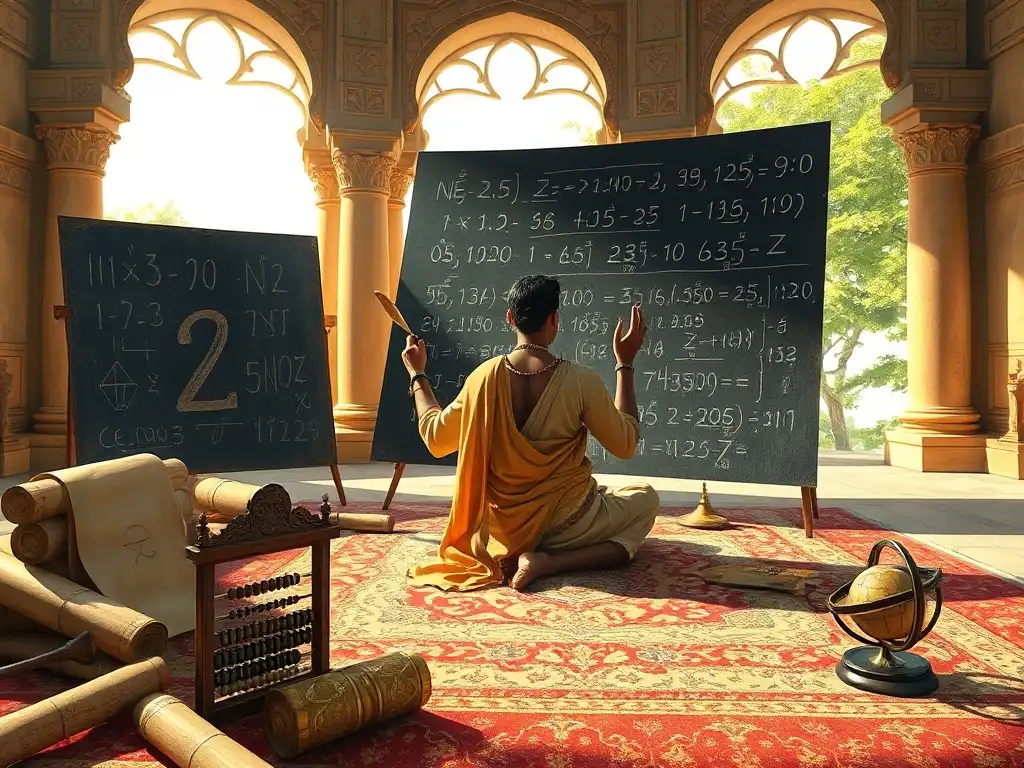
Definition and Significance of Zero in Mathematics
Zero is not merely a numeral; it represents a profound concept in the world of mathematics. In ancient Indian mathematics, zero functioned as both a placeholder and a symbol of absence. This dual role of zero is crucial for the positional number system, facilitating calculations and representing values accurately.
The significance of zero extends beyond being just a number. It is the foundation for several mathematical concepts, including:
- Place Value System: The use of zero allows for the representation of large numbers efficiently. For example, in the number 205, zero indicates that there are no tens, which clarifies its value.
- Arithmetic Operations: Zero plays a pivotal role in addition and subtraction. Adding zero to any number leaves it unchanged, while subtracting a number from itself results in zero, establishing crucial properties of identity and nullification.
- Mathematical Constructs: In advanced mathematics, zero is essential in defining limits, continuity, and functions. It is integral in calculus, where the concept of approaching zero leads to significant discoveries.
The philosophical implications of zero in ancient Indian thought also deserve attention. It represented the void or nothingness, aligning with spiritual and metaphysical beliefs prevalent in Indian philosophy. This intersection of mathematics and philosophy showcases the depth of understanding that ancient Indian scholars possessed regarding zero's role in both numerical and existential realms.
Historical Origins of Zero in Indian Culture
The origins of zero in ancient India can be traced back to early numeral systems, notably during the Indus Valley Civilization (c. 3300–1300 BCE). While direct evidence of zero usage is scarce from this period, the foundations for a positional numeral system were being established. However, it was during the Gupta period (c. 320–550 CE) that zero began to take its recognizable form.
Historical texts, especially the Bakhshali Manuscript, dating back to the 7th century, provide some of the earliest documented instances of zero as a distinct numeral. This manuscript illustrates the use of zero in calculations and reflects a sophisticated understanding of its mathematical utility.
A seminal figure in the formalization of zero is Brahmagupta, a 7th-century mathematician who made significant contributions to mathematics and astronomy. He defined zero in his seminal work, the Brahmasphutasiddhanta, where he outlined rules for arithmetic involving zero:
- Addition and Subtraction: Brahmagupta stated that a positive number minus a positive number equals zero, encapsulating the concept of nullification.
- Multiplication: He posited that zero multiplied by any number yields zero, an essential property that laid the groundwork for further mathematical exploration.
The journey of zero did not remain confined to Indian borders. Through trade and cultural exchanges, the concept of zero traveled to the Arab world and eventually to Europe, transforming mathematical practices globally. The adoption of zero revolutionized mathematics, marking a pivotal moment in the history of mathematics.
The historical journey of zero in ancient Indian culture reflects both a mathematical breakthrough and a philosophical evolution. Its implications continue to resonate in modern mathematics, underscoring its importance in the narrative of ancient Indian mathematics history.
Mathematical Masterpieces of Ancient India

Key Texts Influencing Ancient Indian Mathematics
Ancient Indian mathematics was profoundly shaped by several key texts that laid down foundational concepts and techniques. These texts not only reflect the mathematical prowess of the time but also illustrate the philosophical and practical applications of mathematics in daily life.
- Aryabhatiya: Authored by Aryabhata in 499 CE, this seminal work encompasses a wide range of topics, including arithmetic, algebra, and astronomy. Aryabhata introduced the concept of zero as a placeholder, which was revolutionary for the time. His innovative approach to mathematics is evident in the following areas:
- Place Value System: Aryabhata emphasized the positional value of numbers, which was crucial for the development of a decimal system.
- Trigonometry: He made significant advances in trigonometric functions, introducing sine and cosine, which were utilized in astronomical calculations.
- Brahmasphutasiddhanta: Written by Brahmagupta in 628 CE, this text further advanced the concepts introduced by Aryabhata. It is notable for:
- Rules for Arithmetic Operations: Brahmagupta formulated rules for addition, subtraction, multiplication, and division, including operations involving negative numbers.
- Solutions to Quadratic Equations: He provided methods for solving quadratic equations, showcasing the sophistication of algebra in ancient India.
- Siddhanta Shiromani: Composed by Bhaskara II in the 12th century, this text expanded the understanding of mathematics and astronomy. Key contributions include:
- Calculus Concepts: Bhaskara introduced early concepts of calculus, such as the idea of the derivative.
- Advanced Algebra: His work included methods for solving linear and quadratic equations, further solidifying the mathematical framework established by his predecessors.
Aryabhata’s Contributions to Mathematics
Aryabhata stands as a pivotal figure in the history of ancient Indian mathematics. His contributions span various mathematical domains, and his innovative approaches have had a lasting impact.
- Introduction of Zero: Aryabhata's work is credited with popularizing the concept of zero, which he referred to as "shunya." This revolutionary idea was crucial in creating a more efficient numerical system, allowing for the representation of large numbers and facilitating complex calculations.
- Astronomical Calculations: Aryabhata's mathematical techniques were primarily aimed at solving astronomical problems. He calculated the circumference of the Earth to be approximately 39,968 kilometers, showcasing his advanced understanding of geometry and measurement.
- Approximation of Pi: Aryabhata provided an accurate approximation of π (pi) as 3.1416, which was remarkably close to its true value. This approximation played a significant role in various mathematical applications, especially in geometry.
Brahmagupta and His Innovations
Brahmagupta's contributions to mathematics were revolutionary, particularly in his formulation of rules and methods that advanced mathematical thinking in ancient India.
- Arithmetic with Negative Numbers: One of Brahmagupta's most significant contributions was his comprehensive treatment of negative numbers. He formulated rules for arithmetic operations involving both positive and negative numbers, establishing a foundation for modern algebra.
- Geometric Principles: In his text, Brahmagupta provided methods for calculating the area of cyclic quadrilaterals and the volumes of geometric shapes, which illustrated his deep understanding of geometry.
- Quadratic Equations: Brahmagupta's work also included systematic methods for solving quadratic equations. He presented specific solutions and conditions for these equations, which were pioneering for the time.
Influence of the Gupta Empire on Mathematical Advancements
The Gupta Empire, often referred to as the "Golden Age of India," significantly contributed to the development of mathematics, fostering an environment of innovation and scholarship.
- Cultural Flourishing: The era saw a remarkable flourishing of arts and sciences, with mathematics being a key area of development. Scholars like Aryabhata and Brahmagupta thrived during this period, leading to groundbreaking discoveries.
- Educational Institutions: The establishment of universities, such as Nalanda, attracted scholars from across the region. This exchange of ideas and knowledge facilitated advancements in mathematics and other sciences.
- Integration of Mathematics with Astronomy: The Gupta scholars emphasized the application of mathematics in astronomy, leading to precise calculations of celestial movements. This integration not only advanced mathematical techniques but also established a strong link between mathematical theory and practical application.
The mathematical masterpieces of ancient India, particularly during the Gupta Empire, showcase a rich legacy of innovation and intellectual achievement. The contributions of key figures like Aryabhata and Brahmagupta, along with the influential texts of the time, played a crucial role in shaping the trajectory of mathematics as we know it today.
The Evolution of Zero in Mathematical Systems
Transition from the Concept of Nothingness to Zero
The journey of zero from a mere concept of nothingness to a foundational pillar in mathematics is a remarkable narrative in the history of ancient Indian mathematics. Initially, the idea of "nothing" was represented in various forms across cultures, but it was in ancient India that it evolved into the symbol we recognize today. This transformation can be traced back to the Indus Valley Civilization, where early forms of numerical representation began to take shape.
In ancient Indian texts, concepts akin to zero were observed in philosophical discussions. The term "shunya," which translates to "void" or "empty," encapsulated the essence of nothingness. However, it was not until the 5th century CE that zero was formally recognized as a numeral. The mathematician Brahmagupta is credited with articulating rules for arithmetic involving zero in his seminal work, Brahmasphutasiddhanta. He introduced the concept that zero could act as a placeholder and perform operations like addition and subtraction.
The shift from an abstract concept to an operational numeral allowed scholars to adopt zero in various mathematical contexts. This was a significant step, as it facilitated more complex calculations and laid the groundwork for future advancements in mathematics. The acceptance of zero in Indian mathematics profoundly influenced the development of mathematical thought globally, with its principles eventually traveling along trade routes to the Islamic world and then to Europe.
Zero’s Role in Place Value System and Calculations
The introduction of zero was pivotal in establishing the place value system, which became a cornerstone of ancient Indian mathematics history. This innovative system allowed numbers to be represented more efficiently, where the position of a digit indicates its value. For instance, in the number 205, the zero signifies that there are no tens, effectively allowing for the representation of larger numbers without the need for additional symbols.
This system revolutionized calculations, making them more straightforward. The use of zero not only simplified arithmetic operations but also enhanced the accuracy of computations. The ability to perform addition, subtraction, multiplication, and division using zero and the place value system enabled mathematicians to tackle complex problems with relative ease.
| Operation | Example | Result |
|---|---|---|
| Addition | 205 + 0 | 205 |
| Subtraction | 205 - 0 | 205 |
| Multiplication | 205 × 0 | 0 |
| Division | 205 ÷ 5 | 41 |
Moreover, the advent of zero facilitated the development of algebra and calculus in later centuries. The rules established during the time of Brahmagupta laid the groundwork for future mathematicians to explore more advanced concepts, ultimately leading to the rich tapestry of mathematical innovations that followed.
The evolution of zero from a philosophical idea to a vital mathematical tool marks a significant chapter in the history of ancient Indian mathematics. Its impact on the place value system and calculations not only transformed local mathematical practices but also had far-reaching consequences for global mathematics. The legacy of zero continues to be felt in modern mathematics, underscoring its importance in the evolution of numerical systems.
Cultural Impact of Zero in Ancient Indian Society
In ancient Indian society, the concept of zero was not merely a mathematical innovation but a profound philosophical idea that influenced various aspects of culture, science, and daily life. The introduction and acceptance of zero revolutionized mathematical thinking, enabling more complex calculations and enhancing the understanding of the universe. Its cultural impact can be traced through various domains, including astronomy, trade, and philosophy.
Zero in Astronomy and Astrological Calculations
The role of zero in astronomy and astrological calculations was crucial in ancient India. Indian astronomers utilized zero to express the concept of null values, which was essential for accurately defining celestial events and cycles.
- Astronomical Texts: Ancient texts such as the Surya Siddhanta (circa 400 CE) illustrate the application of zero in calculating planetary positions and eclipse timings. This foundational work employed a positional numeral system that included zero, allowing for more intricate computations than previously possible.
- Astrological Predictions: Astrology held significant weight in ancient Indian culture, where precise calculations determined auspicious timings for rituals and events. The use of zero facilitated complex astrological charts, enabling astrologers to make refined predictions based on planetary positions.
- Mathematical Formulations: Indian mathematicians like Aryabhata contributed immensely to the field by incorporating zero into their calculations of planetary movements. His work demonstrated that zero was not just a placeholder but an integral part of mathematical expressions, which led to a deeper understanding of time cycles and astronomical phenomena.
The impact of zero on astronomy was not limited to calculations; it also shaped philosophical discussions about the nature of infinity and the cosmos, which were fundamental to Indian metaphysics.
Influence on Trade and Commerce through Mathematical Innovations
The advent of zero significantly transformed trade and commerce in ancient India, where mathematics played a pivotal role in economic transactions and calculations.
- Accounting Systems: Traders and merchants employed zero in their accounting systems, enabling them to maintain more accurate records of profits, losses, and transactions. The introduction of zero allowed for clearer representation of debts and balances, facilitating smoother trade operations.
- Complex Calculations: With the inclusion of zero, merchants could perform complex calculations involving large numbers, which were essential for trade across vast regions. The ability to calculate interest, taxes, and prices became more efficient, thus boosting economic activity.
- Standardization of Measurements: The concept of zero contributed to the standardization of weights and measures, which was crucial for fair trade practices. This standardization fostered trust among traders and consumers, ultimately enhancing economic stability.
- Cultural Exchanges: The mathematical innovations stemming from the use of zero also played a role in cultural exchanges through trade routes, such as the Silk Road. The spread of mathematical ideas facilitated interactions among diverse cultures and civilizations, positioning ancient India as a center of mathematical knowledge.
The cultural impact of zero in ancient Indian society was profound, influencing not only mathematics but also astronomy, commerce, and philosophical thought. The legacy of this remarkable concept continues to resonate in modern mathematics and its applications.
Comparison of Ancient Indian Mathematics with Other Civilizations

Similarities and Differences in Mathematical Concepts
Ancient Indian mathematics exhibits both unique features and shared traits with the mathematical practices of other ancient civilizations.
Similarities:
- Numerical Systems: Like the Egyptians and Babylonians, ancient Indian mathematicians developed a positional numeral system. However, the Indian system uniquely incorporated the concept of zero, which was revolutionary.
- Geometric Principles: The Greeks and Indians both explored geometric concepts. For instance, while Euclid's "Elements" laid the groundwork for geometry in the West, Indian mathematicians such as Aryabhata also made significant contributions, particularly in the area of trigonometry.
Differences:
- Concept of Zero: One of the most significant differences is the adoption and use of zero as a number by ancient Indian mathematicians. This abstract concept was not present in the numerical systems of the Greeks or Romans.
- Algebraic Innovations: Indian mathematicians, particularly during the Gupta period, made progress in algebra that was not as pronounced in other civilizations. For instance, the method of solving quadratic equations was more systematic in Indian texts compared to their counterparts elsewhere.
Table of Key Comparisons
| Aspect | Ancient India | Ancient Greece | Ancient Babylon |
|---|---|---|---|
| Numerical System | Positional, includes zero | Positional, lacks zero | Base 60, lacks zero |
| Geometry | Trigonometry, area formulas | Euclidean geometry | Practical measurements |
| Algebra | Systematic quadratic solutions | Limited algebraic concepts | Basic arithmetic |
| Notation | Use of symbols | Geometric diagrams | Cuneiform tablets |
The Global Influence of Ancient Indian Mathematics
The contributions of ancient Indian mathematics have had a profound and enduring influence on mathematics globally. Key aspects of this influence include:
- Transmission of Knowledge: Ancient Indian mathematical texts, such as the "Aryabhatiya" and "Brahmasphutasiddhanta," were translated into Arabic during the medieval period. This facilitated the spread of innovative concepts, particularly the numeral system and the concept of zero, into the Islamic world and subsequently into Europe.
- Adoption in Islamic Mathematics: The Islamic Golden Age saw a significant absorption of Indian mathematical ideas. Mathematicians like Al-Khwarizmi utilized Indian methods, which laid the groundwork for algebra and arithmetic as recognized today. His works, particularly "Al-Kitab al-Mukhtasar fi Hisab al-Jabr wal-Muqabala," were pivotal in introducing Indian numerals to the West.
- Modern Mathematics: The impacts of ancient Indian mathematics are still evident today. The decimal system, which originated in India, is the foundation of modern mathematics and commerce worldwide. The concept of zero as both a placeholder and a number has transformed mathematical thinking, enabling complex calculations and advancements in science and engineering.
- Cultural Exchanges: The interactions between Indian, Greek, and later Islamic mathematicians facilitated a rich exchange of ideas, enhancing the development of mathematics as a universal language. This intercultural dialogue has shaped various mathematical disciplines, including calculus, probability, and number theory.
The unique innovations in ancient Indian mathematics, particularly the invention of zero, not only distinguished it from other civilizations but also laid the groundwork for future mathematical advancements around the globe.
Conclusion: The Legacy of Zero in Ancient Indian Mathematics
The invention of zero represents one of the most significant milestones in the history of mathematics, particularly within the context of ancient Indian mathematics. This revolutionary concept not only transformed mathematical calculations but also laid the groundwork for advanced mathematical theories and practices that followed. The number zero, symbolizing the absence of quantity, provided a crucial framework for the conceptualization of numbers and operations in a way that was previously unimaginable.
Zero facilitated the development of the decimal system, which is now the foundation of modern arithmetic. By allowing mathematicians to represent large numbers efficiently and perform complex calculations, the introduction of zero enabled significant advancements in various fields, including astronomy, commerce, and engineering. The legacy of zero is not just an artifact of history; it continues to influence mathematical thought and practices across the globe today.
Lasting Impact on Modern Mathematics and Science
The impact of zero transcends its initial creation in ancient India, reaching into the very fabric of modern mathematics and science. Here are some key areas where the influence of zero is particularly evident:
- Arithmetic and Algebra: The inclusion of zero in the number system has simplified arithmetic operations. For example, operations like addition and multiplication have been streamlined, allowing for more efficient calculations. Algebra is also heavily dependent on the concept of zero, especially in solving equations.
- Place Value System: The place value system, which is fundamental in representing numbers, relies on zero as a placeholder. This system drastically reduces the complexity involved in mathematical computations, making it easier to understand and use large numbers.
- Calculus and Advanced Mathematics: The concept of limits in calculus often involves approaching zero, leading to foundational principles in mathematical analysis. Moreover, zero plays a critical role in various mathematical theories, such as set theory and topology.
- Scientific Notation: Zero is essential in scientific notation, which is widely used in scientific disciplines to express very large or very small numbers. This notation simplifies calculations and clarifies the presentation of data.
The ramifications of zero extend beyond mathematics into fields such as physics, computer science, and economics, showcasing its versatility and importance across disciplines.
Reflection on the Importance of Studying Ancient Indian Mathematics History
Studying ancient Indian mathematics history, particularly the invention of zero, offers profound insights into the intellectual achievements of ancient civilizations and their contributions to the world. Here are several reasons why this study is essential:
- Cultural Heritage: Understanding the history of mathematics in ancient India allows us to appreciate the rich cultural heritage of the region. It highlights the innovations and thought processes that emerged from Indian scholars, showcasing their role in the global narrative of mathematical development.
- Inspiration for Future Generations: The remarkable achievements of ancient Indian mathematicians can serve as a source of inspiration for contemporary mathematicians and scientists. Their work exemplifies creativity, perseverance, and intellectual curiosity, essential traits for future innovations.
- Interdisciplinary Connections: The study of ancient Indian mathematics intertwines with history, philosophy, and cultural studies, illustrating how mathematics is not merely a technical discipline but also a reflection of societal values and intellectual pursuits.
- Global Mathematical Discourse: Recognizing the contributions of ancient India to mathematics enriches the global discourse on mathematical history. It encourages a more inclusive and comprehensive understanding of the evolution of mathematical concepts across different cultures.
The legacy of zero in ancient Indian mathematics is a testament to the ingenuity of early mathematicians and their lasting impact on the modern world. By exploring this rich history, we not only honor their contributions but also pave the way for future advancements in mathematics and related fields.
Further Reading and Resources on Ancient Indian Mathematics History
Recommended Books and Articles
To delve deeper into the fascinating world of ancient Indian mathematics history, several books and articles stand out as essential readings:
- "The History of Mathematics: A Brief Course" by Roger L. Cooke
- This book provides an overview of mathematical developments throughout history, with significant sections dedicated to ancient Indian contributions, including the invention of zero.
- "Mathematics in India" by Kim Plofker
- Plofker's work is a comprehensive exploration of the mathematical advancements made in India, highlighting key figures and their contributions, particularly during the classical period.
- "The Indian Mathematician Bhaskara II" by Ranjan Roy
- This article focuses on Bhaskara II's work and his impact on mathematics, illustrating the depth of knowledge present in ancient India.
- "A History of Indian Mathematics" by C. Kumaravel
- This detailed examination covers the evolution of mathematical concepts in India, including significant milestones such as the introduction of zero.
- "Zero: The Biography of a Dangerous Idea" by Charles Seife
- Although not exclusively about Indian mathematics, this book discusses the philosophical implications and historical significance of the concept of zero, tracing its roots back to ancient Indian scholars.
Online Resources and Educational Materials
The digital age has made a wealth of information accessible for those interested in exploring ancient Indian mathematics history. Here are some valuable online resources and educational materials:
- The MacTutor History of Mathematics Archive
- This online resource offers detailed biographies of mathematicians and historical context for various mathematical concepts, including those from ancient India.
- Khan Academy: Ancient Indian Mathematics
- An educational platform that provides free courses and lectures on various mathematical topics, including lessons on the history and significance of zero.
- The Digital Library of India
- A vast repository of digitized texts that includes works on ancient mathematics, providing primary sources and scholarly research available for free.
- Coursera: Mathematics for Computer Science
- While not solely focused on ancient Indian mathematics, this course includes modules that discuss the foundations of mathematics, including the role of zero in modern computation.
- YouTube Channels: Numberphile and 3Blue1Brown
- These channels offer engaging videos that explain mathematical concepts, including historical insights into the development of zero and its implications in mathematics.
By exploring these recommended books and online resources, readers can gain a deeper understanding of the rich history and contributions of ancient Indian mathematics, particularly the pivotal role that zero played in shaping mathematical thought.
Frequently Asked Questions
What is the significance of zero in ancient Indian mathematics?
Zero is a crucial concept in ancient Indian mathematics that allowed for the development of place value and calculations, fundamentally changing mathematical practices.
How did ancient Indian mathematicians contribute to the concept of zero?
Ancient Indian mathematicians, such as Brahmagupta and Aryabhata, pioneered the use of zero as a numerical digit, which was a revolutionary step in the evolution of mathematics.
Why is the study of ancient Indian mathematics important today?
Studying ancient Indian mathematics is essential because it highlights innovations that laid the groundwork for modern mathematics, influencing various fields.
What cultures were influenced by ancient Indian mathematics?
Ancient Indian mathematics had a significant impact on other cultures, especially during the Silk Road trade, where it influenced Islamic mathematics and later European mathematics.
Where can I learn more about ancient Indian mathematical achievements?
To explore more about ancient Indian mathematics, resources like historical texts, academic journals, and dedicated websites on ancient Indian history can provide in-depth information and context.
Final Reflection: The Timeless Legacy of Zero in Ancient Indian Mathematics
The exploration of zero as a concept in ancient Indian mathematics is not just a historical inquiry; it is a profound reminder of how innovative thinking can reshape our understanding of the world. Today, as we navigate an increasingly complex digital landscape, the principles derived from ancient Indian mathematical masterpieces continue to hold immense relevance, illustrating the power of abstraction and the importance of foundational concepts in mathematics.
The influence of ancient Indian mathematics, particularly the introduction of zero, resonates deeply within our contemporary culture and education systems. This foundational concept has not only transformed mathematical practices but has also inspired countless innovations across various fields, from computer science to engineering. As the mathematician Carl Friedrich Gauss once said, "> Mathematics is the queen of the sciences and number theory is its crown jewel." This underscores the enduring significance of concepts like zero, which serve as the bedrock for advanced mathematical theories and applications.
As we reflect on the lessons from ancient Indian mathematics, let us embrace the spirit of curiosity and innovation that these scholars exemplified. Consider how you can apply the principles of zero—representing both absence and potential—to your own life. Whether in problem-solving, creativity, or personal growth, remember that sometimes, it is the voids that lead to the most profound discoveries. Engage with the legacy of these mathematical pioneers and allow their insights to inspire your journey toward understanding and innovation.
Unlock the Secrets of Ancient Indian Mathematics!
Thank you for diving into the fascinating world of ancient Indian mathematics through this article! We hope you gained valuable insights into how the concept of zero transformed mathematical thought. Now it’s time to take that knowledge further and explore the depths of these intellectual masterpieces.
Here are a few actions you can take right now to deepen your understanding and appreciation:
- Delve deeper into the history of zero by accessing more resources on the contributions of ancient Indian mathematicians through reputable websites and academic journals.
- Start a conversation with friends or online communities by sharing this article and discussing how the concept of zero shapes modern mathematics.
- Challenge yourself to learn a new mathematical concept or technique from ancient Indian texts; you might discover some surprising methods!
How do you think the introduction of zero influenced cultures around the world? Share your thoughts below!