
The Legacy of Mathematics in Ancient Indian Literature and Poetry

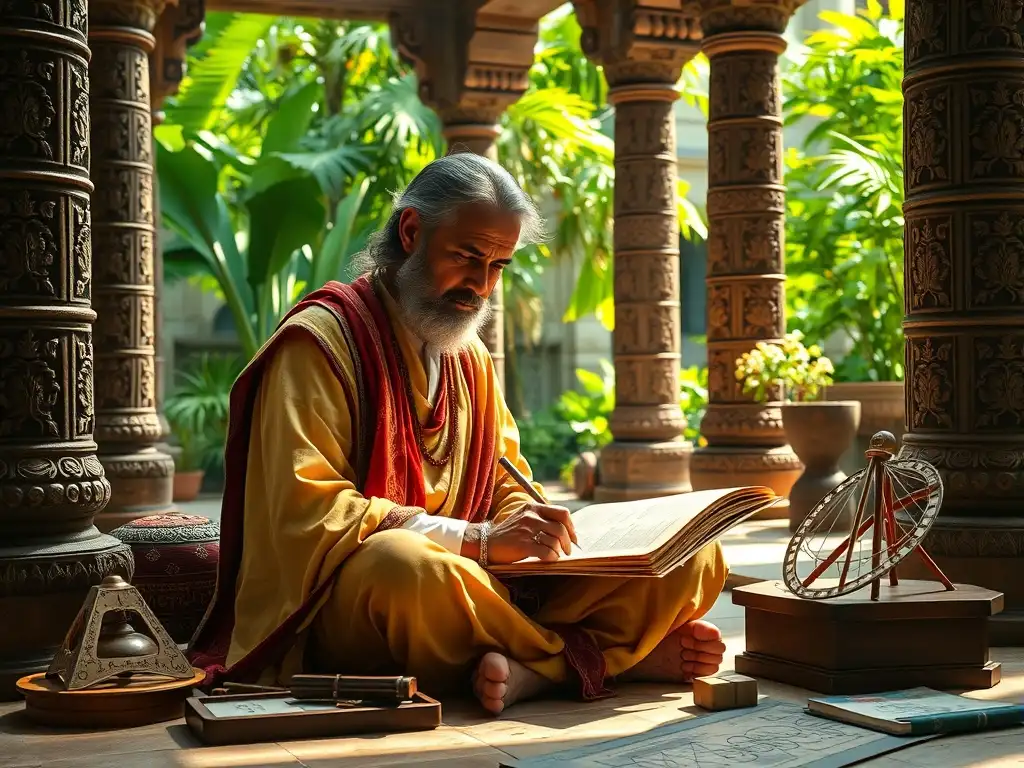
Welcome to Ancient India History, where we embark on a fascinating journey through the vibrant tapestry of ancient Indian civilizations. Here, we delve into the remarkable contributions of ancient Indian mathematics, a legacy that has shaped not only the subcontinent but also the world. In our featured article, "The Legacy of Mathematics in Ancient Indian Literature and Poetry," we explore the intricate ways in which mathematical concepts were woven into the cultural fabric of the time.
Prepare to uncover the secrets of how these intellectual advancements influenced poetry, literature, and beyond, sparking curiosity and inspiring further exploration into the profound impact of ancient Indian thinkers. Join us as we unravel this captivating story!
Exploring the intersection of mathematics and literature in ancient India reveals a profound legacy that continues to influence contemporary thought. Ancient Indian mathematics contributions are not only reflected in numerical systems but are also intricately woven into the fabric of literary and poetic works.
This article delves into how mathematical concepts have been expressed through various literary forms, showcasing the ingenuity of ancient scholars and poets. Through this exploration, we aim to highlight the significance of mathematics in ancient Indian culture, emphasizing its role in shaping not just numerical systems but also the broader spectrum of intellectual and artistic endeavors.
Introduction to Ancient Indian Mathematics Contributions
Overview of Mathematics in Ancient India
Ancient India boasts a rich tradition of mathematics, with contributions that date back thousands of years. The civilization made significant advancements in various mathematical fields, including arithmetic, geometry, and algebra. Notable texts, such as the Sulbasutras, laid the groundwork for geometrical principles used in altar construction, while the Aryabhatiya by Aryabhata introduced concepts like zero and place value. These contributions not only advanced mathematical knowledge but also played a vital role in practical applications, from architecture to astronomy.
Importance of Literature and Poetry in Mathematical Context
Literature and poetry in ancient India served as important vessels for the transmission of mathematical knowledge. Poets and scholars often employed mathematical concepts to convey deeper philosophical meanings, illustrating the harmony between numeric precision and artistic expression. This fusion of mathematics and literature enriched both fields, allowing for a more holistic understanding of the world. Through verses that encapsulated mathematical principles, ancient Indian poets inspired generations to appreciate the beauty of numbers and their relationship to life and nature.
Historical Context of Mathematics in Ancient Indian Literature
Development of Numerical Systems in Ancient India
The development of numerical systems in ancient India is a remarkable story of innovation. The decimal system, which is now universally adopted, originated in this region. The introduction of symbols for numbers and the concept of zero transformed mathematical calculations and paved the way for future advancements. This numerical system was not merely a mathematical tool; it was also reflected in literary texts, where poets often incorporated numerical symbolism to convey complex ideas and emotions.
Influence of Ancient Indian Mathematics on Literature
The influence of ancient Indian mathematics on literature is evident in several works where mathematical themes are interwoven with poetic expressions. For instance, the Ganita Sutras, which discuss mathematical operations, are often complemented by poetic verses that enhance their understanding and appeal. Furthermore, ancient texts reveal how poets used mathematical metaphors to explore philosophical and spiritual concepts, making mathematics an integral part of the literary landscape. This interplay between mathematics and poetry not only enriched the literary tradition but also showcased the intellectual prowess of ancient Indian civilization.
Notable Works of Poetry Reflecting Mathematical Concepts
Ancient Indian literature is rich with poetic expressions that reflect the sophisticated understanding of mathematics among its scholars and poets. Several notable works intertwine mathematical concepts with poetic imagery, showcasing the profound connections between these two disciplines. These literary pieces not only highlight the mathematical knowledge of the time but also illustrate how these concepts were woven into the cultural fabric of ancient Indian society.
"Jayadeva’s Gitagovinda" and Its Mathematical Symbolism
Jayadeva's Gitagovinda, a 12th-century poem, is renowned for its lyrical beauty and spiritual depth. However, it also contains rich mathematical symbolism that enhances its thematic elements. The poem uses the concept of time in a cyclical manner, reflecting the mathematical idea of infinity. Jayadeva employs rhythmic patterns and meter that echo mathematical precision, creating a harmonious balance between form and content.
The verses often utilize the concept of ratios, particularly in the depiction of love and separation, symbolizing the harmony found in mathematical relationships. This blending of mathematics with poetic expression serves as a testament to the advanced understanding of concepts like symmetry and proportion that existed in ancient Indian thought.
"Brahmagupta's Brahmasphutasiddhanta" in Poetic Form
Brahmagupta’s Brahmasphutasiddhanta, written in the 7th century, is one of the earliest texts that systematically dealt with mathematics. While it is primarily a mathematical treatise, Brahmagupta conveys his ideas in a poetic format, making complex concepts accessible. The work covers arithmetic, geometry, and algebra, and its verses encapsulate rules and principles that govern these fields.
In his poetry, Brahmagupta introduces algebraic operations through metaphors and analogies, allowing readers to grasp the essence of mathematical reasoning. For instance, he poetically describes the zero and its significance, illustrating its revolutionary role in mathematics. This poetic approach not only highlights the mathematical contributions of the era but also emphasizes the aesthetic qualities of mathematical thought.
Mathematical Imagery in Kalidasa’s Works
Kalidasa, one of the most celebrated poets of ancient India, often infused his works with mathematical imagery and concepts. In plays such as Shakuntala and poetic compositions like Meghaduta, Kalidasa employs geometry to describe natural phenomena and human emotions. His vivid descriptions of landscapes often utilize geometric shapes and spatial relationships that reflect a deep understanding of mathematical principles.
For example, in Meghaduta, the cloud is portrayed as a messenger, and its journey across various terrains involves mathematical concepts of distance and direction. Kalidasa's use of imagery highlights how mathematics can serve as a metaphor for life's journeys, emphasizing the interconnectedness of human experience and the natural world.
Key Themes in Ancient Indian Poetry and Mathematics
The intertwining of mathematics and poetry in ancient India reveals several key themes that reflect the cultural and intellectual climate of the time. These themes demonstrate how mathematical ideas were not only practical tools but also sources of inspiration for artistic expression.
Geometry and Spatial Representation in Poetry
Geometry plays a significant role in ancient Indian poetry, where spatial representation is often used to convey emotions and concepts. Poets utilized geometrical shapes to symbolize relationships and experiences, creating a vivid mental imagery for readers. The use of geometric metaphors allowed poets to express complex ideas about love, nature, and existence in a manner that resonates with both the mathematical and artistic senses.
For instance, the circularity of love may be represented through the imagery of a circle, emphasizing continuity and eternity. Similarly, the use of angles and lines in descriptions can reflect the complexities of relationships and emotional landscapes.
Arithmetic and Numerical Patterns in Verses
Ancient Indian poetry frequently employs arithmetic and numerical patterns, which serve as structural elements within verses. Poets often use numerical symmetry and repetition to create rhythm and musicality in their works. The arrangement of syllables can reflect mathematical sequences, enhancing the auditory experience of the poem.
For example, the meter in Sanskrit poetry often follows specific numerical patterns, such as the Anushtubh meter, which consists of 32 syllables arranged in a particular order. This mathematical structuring not only adds to the aesthetic quality of the poetry but also showcases the poets' deep appreciation for numerical balance.
Algebraic Concepts Expressed through Metaphor
Algebraic concepts are subtly embedded within ancient Indian poetry, often expressed through metaphorical language. Poets adeptly used algebraic ideas to articulate complex human emotions and philosophical thoughts. For instance, the notion of variables can be represented through characters and their changing relationships, reflecting the dynamic nature of love and life.
Additionally, metaphors related to equations and solutions can symbolize the search for harmony and balance in personal and societal contexts. This metaphorical expression of algebra highlights the intellectual sophistication of ancient Indian poets, revealing how they navigated both mathematical and emotional landscapes in their works.
Contribution of Ancient Indian Mathematicians to Literature

The contributions of ancient Indian mathematicians extend beyond mere calculations and numerical systems; they also significantly influenced literature and poetry. These scholars integrated mathematical concepts into their literary works, which not only showcased their mathematical prowess but also enriched the cultural fabric of ancient India. Through poetry, they communicated complex mathematical ideas in an accessible and engaging manner, ensuring that their knowledge was preserved and transmitted across generations. This literary approach played a crucial role in embedding mathematics within the broader narrative of Indian culture, making it an integral part of educational and philosophical discussions.
Aryabhata and His Poetic Contributions to Mathematics
Aryabhata, one of the most renowned mathematicians and astronomers of ancient India, made significant contributions to mathematics that were encapsulated in his poetic works. His seminal text, the Aryabhatiya, is a blend of mathematics and poetry, presenting mathematical concepts through verses that are both rhythmic and memorable. Aryabhata introduced concepts such as zero, place value, and algorithms for arithmetic operations, all elegantly expressed in a poetic format.
The use of poetry allowed Aryabhata's ideas to reach a wider audience, making complex mathematical principles more relatable. For instance, he employed mnemonic devices within his verses, making it easier for students and scholars to remember intricate calculations. This fusion of mathematics and literature not only established a model for future mathematicians but also highlighted the aesthetic qualities of numerical expressions, thus enriching the intellectual tradition of ancient India.
Bhaskara II: Blending Poetry with Mathematical Concepts
Following in the footsteps of Aryabhata, Bhaskara II, also known as Bhaskara the Younger, further exemplified the integration of mathematics and poetry in his works. His masterpiece, the Lilavati, is particularly notable for its poetic form, which provides a comprehensive exploration of arithmetic, geometry, and algebra. The text is not merely a mathematical treatise; it is also a love story that intertwines personal themes with mathematical problems, making the study of mathematics more engaging.
In Lilavati, Bhaskara II uses poetry to present problems and their solutions in a narrative style, often incorporating stories and parables that illustrate mathematical concepts. This method not only made mathematics more appealing but also ensured that the knowledge was preserved in a format that could be orally transmitted. His works have had a lasting impact, demonstrating how literature can serve as a vehicle for mathematical knowledge, and inspiring generations of mathematicians and poets alike.
Legacy of Ancient Indian Mathematics in Cultural Narratives
The legacy of ancient Indian mathematics is deeply woven into the cultural narratives of the region, with literature and poetry playing a pivotal role in its preservation and promotion. The poetic expressions of mathematical concepts not only served educational purposes but also contributed to the cultural identity of ancient India. As these works were transmitted through generations, they shaped the understanding of mathematics as an integral part of Indian heritage.
Preservation of Mathematical Knowledge through Poetry
Poetry served as an effective means of preserving mathematical knowledge in ancient India. The rhythmic and mnemonic nature of poetic forms facilitated the memorization and oral transmission of complex mathematical ideas. As scholars composed mathematical texts in verse, they ensured that their discoveries were not lost to time. This preservation was particularly crucial in a largely oral culture, where written texts were scarce, and knowledge was passed through spoken word.
Many ancient texts, including those by Aryabhata and Bhaskara II, were designed to be recited and performed, further embedding mathematical knowledge within the cultural practices of the time. This approach allowed for the continued relevance of mathematical concepts, as they were integrated into religious and philosophical discussions, thus enriching the overall intellectual landscape of ancient India.
The Role of Oral Tradition in Maintaining Mathematical Heritage
Oral tradition played a critical role in maintaining the mathematical heritage of ancient India. In a society where literacy was limited, the oral transmission of knowledge ensured that mathematical concepts were accessible to a broader audience. Scholars, poets, and teachers would recite mathematical verses, often accompanied by discussions and practical applications, fostering a communal learning environment.
Through oral tradition, ideas were not only preserved but also adapted and enriched over time. This dynamic exchange allowed for the evolution of mathematical thought, as new interpretations and applications emerged through storytelling and poetic expression. The oral tradition thus became a vital link in the chain of knowledge, ensuring that the contributions of ancient Indian mathematicians remained alive and influential long after their original compositions were created.
Conclusion: The Lasting Impact of Ancient Indian Mathematics Contributions
The contributions of ancient Indian mathematics have left an indelible mark on the world, influencing not only the development of mathematical concepts but also shaping the literary landscape of the time. Through texts such as the Aryabhatiya by Aryabhata and Brahmasphutasiddhanta by Brahmagupta, ancient Indian mathematicians articulated complex ideas in a manner that intertwined mathematical principles with poetic elegance. The legacy of these contributions can be seen in various fields, including astronomy, geometry, and even philosophy, demonstrating how mathematics was intricately linked to other aspects of culture and knowledge in ancient India.
The impact of ancient Indian mathematics extends beyond its historical context; it serves as a foundation for contemporary mathematical thought. The decimal system, the concept of zero, and various numerical algorithms introduced by these mathematicians have become essential components of modern mathematics. The fusion of mathematics and poetry not only enhanced the beauty of mathematical expression but also made complex ideas more accessible to a broader audience. As such, the legacy of ancient Indian mathematics is a testament to the innovative spirit and intellectual prowess of its scholars.
Summary of Key Contributions and Their Significance
Ancient Indian mathematics is characterized by several key contributions that have profoundly influenced both mathematics and literature. Among the most notable are:
- The Concept of Zero: The introduction of zero as a number and its integration into the decimal system revolutionized numerical representation and calculation methods.
- Decimal System: The positional decimal system developed in ancient India provided a framework for arithmetic that is still in use today.
- Algebraic Innovations: Works like Brahmagupta's Brahmasphutasiddhanta introduced rules for solving quadratic equations and outlined methods for calculating the area of various geometrical shapes.
- Trigonometry: Aryabhata's contributions to trigonometric functions laid the groundwork for future developments in astronomy and mathematics.
These contributions were not merely theoretical; they found expression in various forms of literature, such as poetry and prose, that celebrated mathematical thought. The integration of mathematics into literature served to enhance its aesthetic appeal while also preserving complex ideas for future generations. This duality of purpose highlights the significance of ancient Indian mathematics as both a scientific discipline and a cultural artifact.
Future Perspectives on Ancient Indian Mathematics and Literature
The future of ancient Indian mathematics and its literary representations holds promising avenues for exploration. As contemporary scholars and mathematicians delve deeper into the works of ancient Indian mathematicians, there is a growing recognition of the need to preserve and analyze these texts. The digitization of manuscripts and collaborative research efforts can facilitate a broader understanding of their contributions and their relevance to modern mathematics.
Moreover, interdisciplinary studies that bridge mathematics, literature, and cultural history can uncover new insights into the ways in which numerical systems influenced artistic expressions in ancient India. Educational initiatives aimed at integrating ancient Indian mathematical concepts into modern curricula can foster a renewed appreciation for these contributions among students and enthusiasts alike.
The legacy of ancient Indian mathematics not only enriches our understanding of mathematical history but also invites us to reflect on the interconnectedness of knowledge and culture. The ongoing exploration of these themes promises to illuminate the profound impact of ancient Indian contributions on both past and future generations.
- Introduction to Ancient Indian Mathematics Contributions
- Historical Context of Mathematics in Ancient Indian Literature
- Notable Works of Poetry Reflecting Mathematical Concepts
- Key Themes in Ancient Indian Poetry and Mathematics
- Contribution of Ancient Indian Mathematicians to Literature
- Legacy of Ancient Indian Mathematics in Cultural Narratives
- Conclusion: The Lasting Impact of Ancient Indian Mathematics Contributions
- What are the main contributions of ancient Indian mathematics?
- How did ancient Indian literature influence mathematical concepts?
- What role did astronomy play in ancient Indian mathematics?
- Who were the notable mathematicians in ancient India?
- How does ancient Indian mathematics compare to other civilizations?
Frequently Asked Questions
What are the main contributions of ancient Indian mathematics?
Ancient Indian mathematics contributed significantly to number systems, geometry, and algebra. Innovations like the concept of zero and the decimal system have had a lasting impact on mathematics worldwide.
How did ancient Indian literature influence mathematical concepts?
Ancient Indian literature, particularly texts like the Aryabhatiya and Brahmagupta's works, embedded mathematical principles in poetry and prose, making them more accessible and memorable for learners.
What role did astronomy play in ancient Indian mathematics?
Astronomy was crucial in ancient India, as it required advanced calculations for celestial observations. This led to the development of trigonometry and calendrical mathematics, enhancing both fields significantly.
Who were the notable mathematicians in ancient India?
Prominent figures include Aryabhata, known for his work on the place value system, and Brahmagupta, who made significant strides in algebra and geometry. Their contributions laid the groundwork for future mathematicians.
How does ancient Indian mathematics compare to other civilizations?
Ancient Indian mathematics is unique in its emphasis on theoretical foundations and practical applications, often outperforming contemporaneous civilizations in areas like calculus and trigonometry. Their holistic approach influenced many later developments in the field.
Final Reflection: The Enduring Legacy of Ancient Indian Mathematics
The contributions of ancient Indian mathematics are not merely historical footnotes; they are foundational pillars that continue to shape our understanding of the world today. The intricate relationship between mathematics and literature in ancient India reveals a profound cultural appreciation for knowledge, creativity, and the pursuit of truth. As we navigate the complexities of modern life, the wisdom embedded in these ancient texts serves as a reminder of the timeless nature of intellectual exploration.
The influence of ancient Indian mathematics extends far beyond the confines of academia; it permeates our cultural and social landscapes, inspiring generations of thinkers and creators. From the poetic verses of Aryabhata to the philosophical musings of Brahmagupta, these contributions have woven a rich tapestry that celebrates the beauty of numbers and their applications in everyday life. Mathematics is the language in which God has written the universe.
– Galileo Galilei. This quote encapsulates the essence of how ancient Indian mathematicians viewed their craft—not just as a discipline, but as a divine exploration of the cosmos.
As we reflect on the lessons from ancient Indian mathematics, let us embrace the spirit of inquiry and creativity that these scholars exemplified. I invite you to explore the intersections of mathematics and art in your own life, recognizing that each equation, each poem, and each moment of inspiration is a step toward a deeper understanding of the universe. In doing so, we honor the legacy of those who came before us and pave the way for future generations to continue this beautiful journey of discovery.
Unveil the Power of Ancient Indian Mathematics Today!
Thank you for taking the time to explore the fascinating intersection of mathematics and literature in ancient Indian history. We hope you’ve gained valuable insights into how these elements shaped culture and knowledge in remarkable ways. Now, it’s time to take action and deepen your understanding even further!
- Dive deeper: Explore the works of ancient Indian poets and mathematicians to discover how they seamlessly blended mathematical concepts with artistic expression.
- Share your findings: Connect with friends and fellow enthusiasts to discuss the profound impact of these contributions on contemporary education.
- Engage with the community: Join online forums or local groups dedicated to ancient history, allowing you to exchange ideas and insights about this rich heritage.
How can the mathematical wisdom found in ancient poetry inspire your own thinking or creativity today?