
The Fascinating World of Ancient Indian Astronomy and Its Mythological Roots

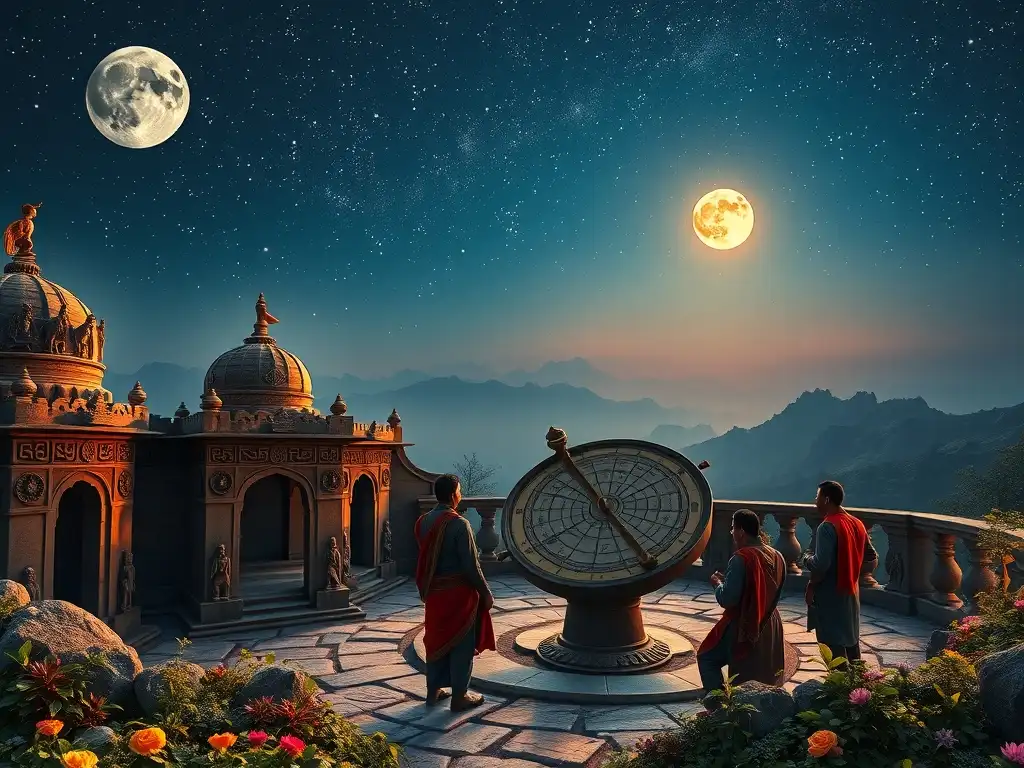
Welcome to Ancient India History, where we embark on an exhilarating journey through the rich tapestry of ancient Indian civilizations. Discover the fascinating world of ancient Indian astronomy and its mythological roots, a topic that intertwines the brilliance of scientific thought with the enchanting narratives of mythology. As we delve deeper into this captivating subject, you'll uncover how the celestial wonders not only shaped the cosmos but also influenced the cultural and spiritual landscapes of ancient India. Are you ready to explore the stars through the eyes of an ancient civilization? Let’s begin this enlightening adventure!
Introduction to Ancient Indian Astronomy and Mythology
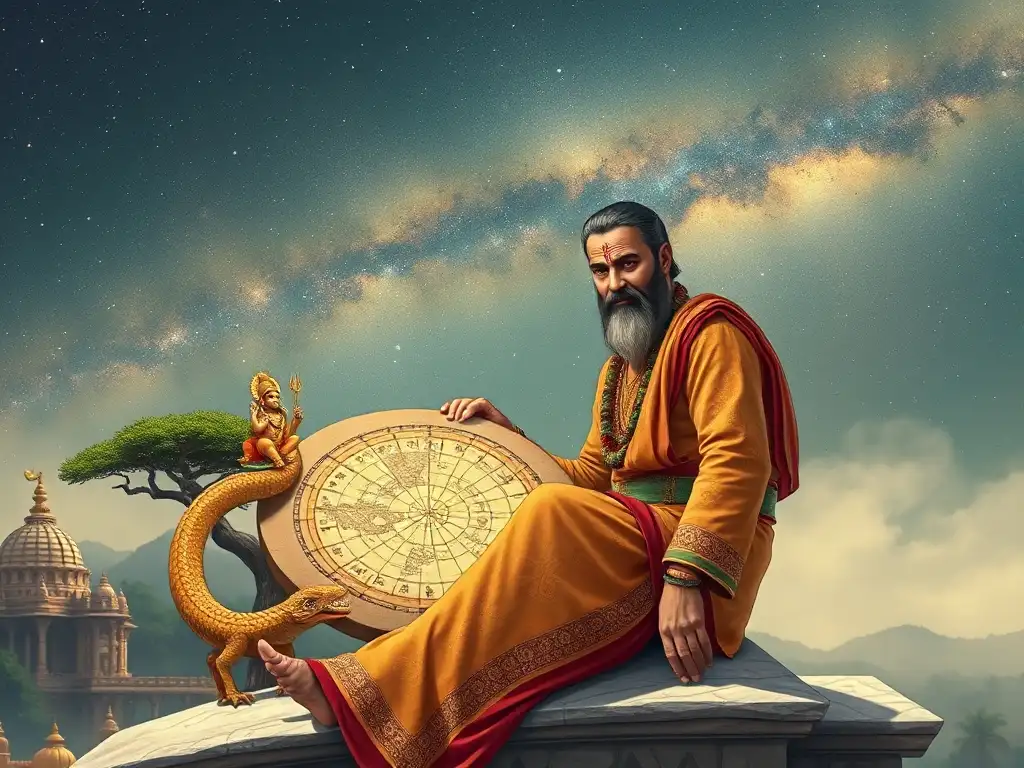
Ancient Indian astronomy is a captivating field that intertwines scientific inquiry with profound mythological narratives. From the meticulous observations of celestial bodies to the intricate mathematical calculations that have influenced modern astronomy, ancient Indian civilizations made remarkable contributions to our understanding of the universe.
The rich tapestry of ancient Indian astronomy mythology not only reflects the scientific achievements of the time but also illustrates how these early astronomers viewed their place in the cosmos through a mythological lens. This article will explore the intricate relationship between astronomy and mythology in ancient India, highlighting key practices, historical contexts, and foundational texts that shaped this fascinating discipline.
Overview of Ancient Indian Astronomical Practices
Ancient Indian astronomers demonstrated a sophisticated understanding of celestial phenomena. Their practices included:
- Observational Astronomy: Early astronomers utilized their keen observations to track the movements of planets and stars, leading to the development of calendars and agricultural schedules.
- Mathematical Innovations: The use of advanced mathematical concepts such as trigonometry and calculus allowed astronomers to predict celestial events with remarkable accuracy.
- Astrological Connections: Astronomy was deeply intertwined with astrology, where celestial alignments were believed to influence human affairs and natural phenomena.
The integration of these practices laid the groundwork for further advancements in both astronomy and mathematics in ancient India.
Importance of Mythology in Ancient Indian Astronomy
Mythology played a crucial role in shaping ancient Indian astronomical thought. The stories and deities associated with celestial bodies provided a framework through which early astronomers could interpret their observations. Key aspects include:
- Personification of Celestial Bodies: Planets and constellations were often personified as gods and goddesses, each representing various aspects of life and nature.
- Cultural Narratives: Mythological tales often explained astronomical phenomena, such as eclipses, through narratives that connected the cosmos with human experience.
- Religious Practices: Many astronomical events were linked to religious rituals, emphasizing the significance of celestial movements in the cultural and spiritual lives of ancient Indians.
Understanding these mythological underpinnings is essential to grasp the full scope of ancient Indian astronomy.
Historical Context of Ancient Indian Astronomy
The historical context of ancient Indian astronomy is marked by significant developments and contributions that have resonated throughout history.
The Development of Astronomy in Ancient India
The evolution of astronomy in ancient India can be traced through several key phases:
- Indus Valley Civilization (c. 3300–1300 BCE): Early evidence of astronomical practices, such as the alignment of city layouts with celestial events, suggests a foundational understanding of astronomy.
- Vedic Period (c. 1500–500 BCE): The Vedas contain references to celestial phenomena and astrological practices, marking a period of rich astronomical thought.
- Classical Period (c. 400 BCE–1200 CE): Scholars like Aryabhata and Brahmagupta made groundbreaking contributions, paving the way for modern astronomical concepts.
This historical progression reveals a continuous quest for knowledge that transcended generations.
Key Historical Texts and Manuscripts on Astronomy
Several pivotal texts and manuscripts have preserved ancient Indian astronomical knowledge:
- Aryabhatiya: Written by Aryabhata in the 5th century CE, this text outlines a range of astronomical calculations and introduces the concept of zero.
- Brahmasphutasiddhanta: Authored by Brahmagupta in the 7th century CE, this work discusses planetary motions, eclipses, and the calculation of areas and volumes.
- Surya Siddhanta: A comprehensive treatise on astronomy, this text provides detailed descriptions of celestial calculations and has influenced subsequent astronomical thought in India and beyond.
These texts reflect the depth and sophistication of ancient Indian astronomy, showcasing a legacy that continues to inspire scholars and enthusiasts today.
Major Contributions of Ancient Indian Astronomers
Ancient Indian astronomers played a pivotal role in the development of astronomical knowledge, significantly influencing both Indian and global science. Their work encompassed various fields such as mathematics, cosmology, and astrology, blending empirical observation with philosophical inquiry. The contributions of key figures like Aryabhata, Brahmagupta, and Varahamihira mark a rich legacy of innovation that laid the groundwork for future scientific exploration.
- Aryabhata (476–550 CE) is known for his seminal work, the Aryabhatiya, which introduced concepts such as the approximation of pi and the calculation of the circumference of the earth.
- Brahmagupta (598–668 CE) made important advancements in algebra and astronomy, particularly regarding the calculation of eclipses and the formulation of rules for zero.
- Varahamihira (505–587 CE) contributed to both astronomy and astrology through his encyclopedic texts, which synthesized earlier knowledge and introduced new concepts.
These scholars not only compiled and expanded existing knowledge but also inspired generations of scientists across cultures, showcasing the importance of ancient Indian astronomy in the broader context of world history.
Aryabhata and His Influence on Astronomy
Aryabhata, often referred to as the father of Indian mathematics and astronomy, made groundbreaking contributions that revolutionized the understanding of celestial phenomena. His most famous work, the Aryabhatiya, was divided into four sections covering arithmetic, algebra, geometry, and astronomy.
One of Aryabhata's most significant achievements was his description of the heliocentric nature of planetary motion, where he proposed that the earth rotates on its axis. He accurately calculated the length of the solar year as approximately 365.358 days and provided methods for predicting eclipses, which showcased his understanding of celestial mechanics.
His influence extended beyond India; the mathematical concepts he introduced, including the place value system and the use of zero, later spread to other cultures, laying the foundation for modern mathematics and astronomy.
Brahmagupta's Mathematical Innovations
Brahmagupta was a pioneering mathematician and astronomer whose works furthered the understanding of calculations related to astronomical phenomena. His influential text, the Brahmasphutasiddhanta, provided rules for arithmetic operations and introduced the concept of zero as a number, which was revolutionary for its time.
In his writings, Brahmagupta discussed methods for calculating the positions of planets and determining the times of eclipses with remarkable accuracy. He established rules for solving quadratic equations and laid down the groundwork for positive and negative numbers, significantly influencing mathematical thought in India and beyond.
Brahmagupta's contributions were instrumental in integrating mathematics with astronomy, enabling future scholars to develop more complex astronomical calculations and predictions.
Varahamihira's Contributions to Astrology and Astronomy
Varahamihira was a prominent astronomer and astrologer whose comprehensive works bridged the gap between astronomy and astrology in ancient India. His most notable texts, including the Brihat Samhita, encompassed a wide range of topics, from astrology to meteorology, and even included elements of architecture and gemology.
In astronomy, Varahamihira's observations on planetary movements and eclipses were groundbreaking. He compiled data from earlier astronomers, refining it with his own observations. His work emphasized the importance of empirical evidence in astronomical calculations, which was a significant advancement at the time.
Moreover, his astrological insights, particularly those related to horoscopes and planetary positions, influenced both scientific and cultural practices in ancient India, demonstrating the intertwined nature of astronomy and astrology in Indian society.
Mythological Influences on Ancient Indian Astronomy
The interplay between mythology and astronomy in ancient India is profound, as celestial bodies and astronomical events were often personified and explained through mythological narratives. This unique fusion provided a cultural context for understanding the cosmos, influencing both scientific inquiry and spiritual beliefs.
Deities Associated with Astronomy in Indian Mythology
In Hindu mythology, various deities are directly linked to celestial phenomena, reflecting the importance of astronomy in religious practices. For instance:
- Chandra (the Moon) is often depicted as a deity riding a chariot across the night sky, symbolizing the lunar cycles and their impact on timekeeping in ancient India.
- Surya (the Sun) is worshipped as a vital source of life and energy, with rituals often timed to solar events such as solstices and equinoxes.
- Shani (Saturn) and other planets are personified as deities that influenced human destiny, emphasizing the belief that celestial movements directly affected terrestrial events.
These deities not only served as focal points for worship but also reinforced the understanding of astronomical cycles and their significance in daily life.
Cosmic Concepts in Hindu Mythology and Their Astronomical Significance
Hindu mythology presents a rich tapestry of cosmic concepts that resonate with astronomical principles. For example, the notion of Kalachakra (the Wheel of Time) symbolizes the cyclic nature of time and the universe, reflecting astronomical cycles such as the rotation of planets and the passage of seasons.
Moreover, the Myth of the Churning of the Ocean (Samudra Manthan) is often interpreted as an allegory for cosmic creation and the alignment of celestial bodies. This mythological narrative parallels astronomical events like eclipses and the movements of planets, illustrating how ancient Indians sought to explain the mysteries of the universe through myth.
These cosmic concepts not only enriched religious and philosophical discourse but also served as frameworks for understanding celestial phenomena.
The Role of Epics (Mahabharata and Ramayana) in Astronomical Narratives
The epics of ancient India, particularly the Mahabharata and the Ramayana, are replete with astronomical references that highlight the significance of celestial events in cultural narratives. For instance, the Mahabharata contains detailed descriptions of planetary alignments and their implications for the characters and events within the story.
The Ramayana also includes astronomical references, such as the timing of Rama's return to Ayodhya being aligned with specific planetary positions, showcasing how celestial mechanics were intertwined with storytelling and moral lessons.
These narratives not only enriched the cultural fabric of ancient India but also served as a means to record and transmit astronomical knowledge through generations, emphasizing the importance of celestial observations in shaping historical and mythological contexts.
Astronomical Techniques and Instruments in Ancient India
Ancient Indian astronomy was marked by a sophisticated understanding of celestial phenomena and the development of various techniques and instruments to observe and measure them. Scholars in ancient India utilized a blend of observational precision and mathematical calculations to create a comprehensive framework for understanding the cosmos. Notably, they created tools that were not only functional but also imbued with cultural significance and mythological connections.
Among the key instruments were the sundials, which harnessed the sun's position to tell time, and water clocks (or clepsydras), which measured time through the regulated flow of water. These devices were often used in temples and public spaces, reflecting the society's integration of science with daily life and spirituality. Observatories, known as Jantar Mantar, served as monumental sites where astronomers could study celestial bodies systematically.
Use of Sundials and Water Clocks
Sundials were one of the earliest timekeeping devices employed in ancient India. They functioned by casting a shadow on a calibrated surface, allowing for the measurement of time based on the sun's position in the sky. These devices were not only practical but also served as symbols of the sun's divine nature in Hindu mythology.
Water clocks, on the other hand, provided a more consistent measurement of time, particularly useful during cloudy days when sundials were ineffective. By regulating the flow of water from one vessel to another, these clocks enabled astronomers to keep track of time with great accuracy. Ancient texts, such as the Aryabhatiya by Aryabhata, demonstrate the advanced understanding of timekeeping methods during this period.
The Role of Observatories in Ancient India
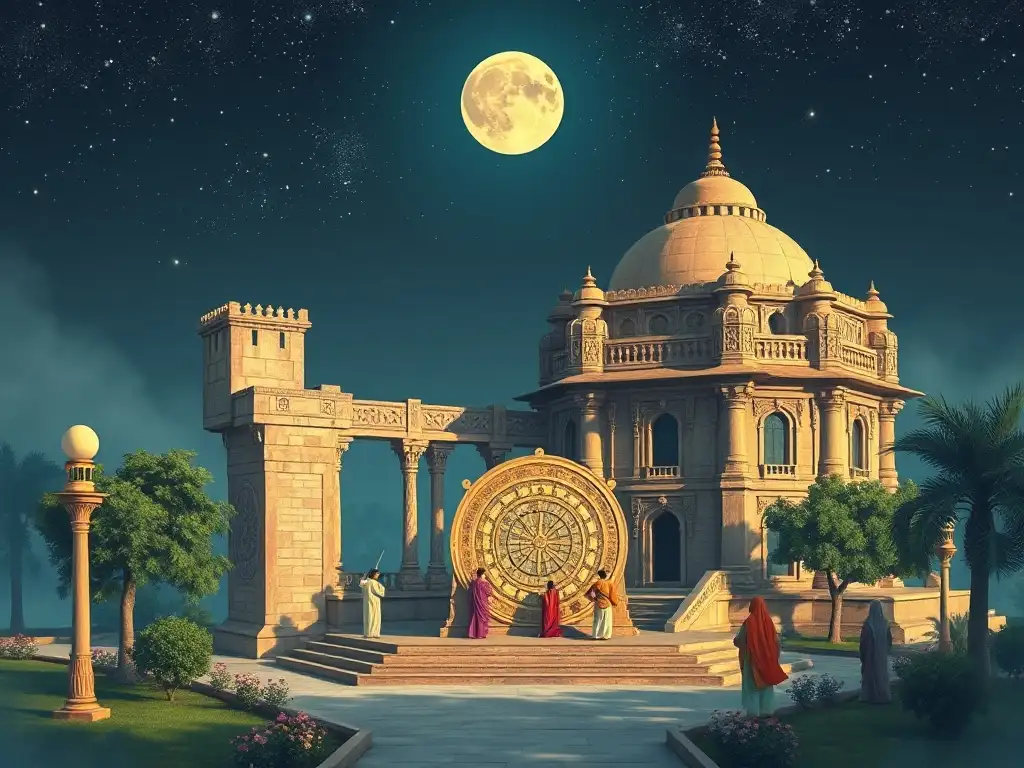
The concept of observatories in ancient India was revolutionary, with structures like the Jantar Mantar built in cities such as Jaipur and Delhi. These massive instruments were designed to measure time, predict eclipses, and track celestial bodies. The Jantar Mantar in Jaipur, for instance, contains a Samrat Yantra (the giant sundial) that can measure time to an accuracy of two seconds.
These observatories were not merely functional; they were also deeply rooted in the cultural and mythological narratives of the time. They served as centers for astronomical research, where scholars and astronomers could gather to exchange knowledge, conduct observations, and develop theories about the universe. The significance of these sites extended beyond science, often intertwining with religious practices and philosophical inquiries into the nature of existence.
Techniques for Calculating Time and Celestial Events
Ancient Indian astronomers employed various mathematical techniques to calculate time and predict celestial events. They utilized a base-60 system for timekeeping, which allowed for detailed calculations of hours and minutes. Their astronomical texts, such as the Surya Siddhanta, provided methodologies for determining the positions of celestial bodies, eclipses, and planetary movements.
The use of sine and cosine functions in trigonometry was also prevalent, facilitating the accurate computation of angles and distances in astronomical observations. Furthermore, the integration of mythology into these calculations gave rise to calendars that were not only scientifically accurate but also aligned with cultural and religious festivals, reinforcing the connection between astronomy and mythology in ancient Indian society.
Case Studies of Mythological Events in Astronomy
The intertwining of mythology and astronomy in ancient India is evident in the stories and legends that explain celestial phenomena. These narratives provided a cultural context for astronomical observations, enriching the understanding of the cosmos among ancient Indians.
The Story of Chandra (Moon) and His Influence on Calendrical Systems
Chandra, the moon god, holds a significant place in Hindu mythology and has profoundly influenced the development of calendrical systems in ancient India. His waxing and waning phases were interpreted as symbols of fertility and renewal, leading to the establishment of lunar calendars that governed agricultural practices and religious observances.
The lunar calendar, based on Chandra's cycles, allowed for the organization of festivals, rituals, and agricultural activities. This connection between the moon and timekeeping illustrates how mythology shaped practical applications in daily life, with Chandra embodying the rhythms of nature and the cycles of time.
The Cosmic Dance of Shiva and Its Astronomical Implications
The cosmic dance of Shiva, known as Nataraja, symbolizes the rhythm of the universe and its cyclical nature. This dance represents the creation, preservation, and destruction of the cosmos, mirroring the movements of celestial bodies. The depiction of Shiva in this dynamic pose serves as a metaphor for the interplay between cosmic forces and earthly phenomena.
Astronomers in ancient India recognized the significance of celestial movements in relation to mythological stories, using them as a framework to explain astronomical events. The understanding of these cosmic rhythms informed agricultural cycles, religious festivals, and seasonal changes, demonstrating a profound integration of astronomy and mythology that enriched the cultural tapestry of ancient Indian civilization.
The Legacy of Ancient Indian Astronomy and Mythology
The legacy of ancient Indian astronomy is deeply intertwined with its rich mythology, creating a unique tapestry that reflects both scientific inquiry and cultural beliefs. Ancient Indian astronomers, such as Aryabhata and Varahamihira, made significant contributions to the understanding of celestial bodies, mathematical calculations, and the movement of planets. Their works were often framed within a mythological context, with celestial phenomena being interpreted as manifestations of divine actions or cosmic events.
For instance, the cycles of the moon and sun were often associated with various deities, and the movements of stars were seen as a reflection of the cosmic order maintained by these divine beings. This intermingling of astronomy and mythology not only enriched the narratives surrounding the stars and planets but also provided a framework for understanding the universe that was accessible to the general populace. The ancient texts, such as the "Surya Siddhanta," serve as a testament to the sophisticated astronomical knowledge of the time, which was often communicated through allegorical tales and mythic figures.
Influence on Later Civilizations and Cultures
The astronomical knowledge and mythological concepts developed in ancient India significantly influenced later civilizations and cultures, particularly in regions like the Middle East and Southeast Asia. The translation of key texts, such as Aryabhata’s "Aryabhatiya," into Arabic during the Islamic Golden Age played a crucial role in the transmission of Indian astronomical knowledge to the Western world. This cross-cultural exchange led to advancements in navigation, timekeeping, and calendar systems, which incorporated both mathematical precision and mythological elements.
Moreover, the impact of ancient Indian astronomy extended to Southeast Asia, where Hindu and Buddhist cosmologies influenced local beliefs and practices. Temples were often oriented according to celestial events, and the alignment of structures reflected astronomical knowledge intertwined with mythological significance. For example, the temples of Angkor in Cambodia showcase how Indian astronomical principles were adopted and adapted within local contexts, blending scientific understanding with mythological narratives.
Relevance of Ancient Indian Astronomy in Modern Science
Ancient Indian astronomy holds considerable relevance in modern scientific discourse, particularly in the fields of mathematics and physics. The sophisticated mathematical techniques developed by ancient Indian astronomers laid the groundwork for many contemporary concepts. The decimal system, the notion of zero, and advanced trigonometric functions all trace their origins back to the works of Indian mathematicians.
Furthermore, modern astrophysics continues to explore phenomena that were first documented in ancient texts, such as eclipses and planetary movements. The methodologies employed by ancient astronomers, involving meticulous observations and calculations, resonate with the scientific approach used today. As researchers delve into the historical context of these scientific advancements, they uncover a wealth of knowledge that not only enhances our understanding of ancient civilizations but also sheds light on the foundational principles of modern science.
Conclusion: The Intertwining of Astronomy and Mythology in Ancient India
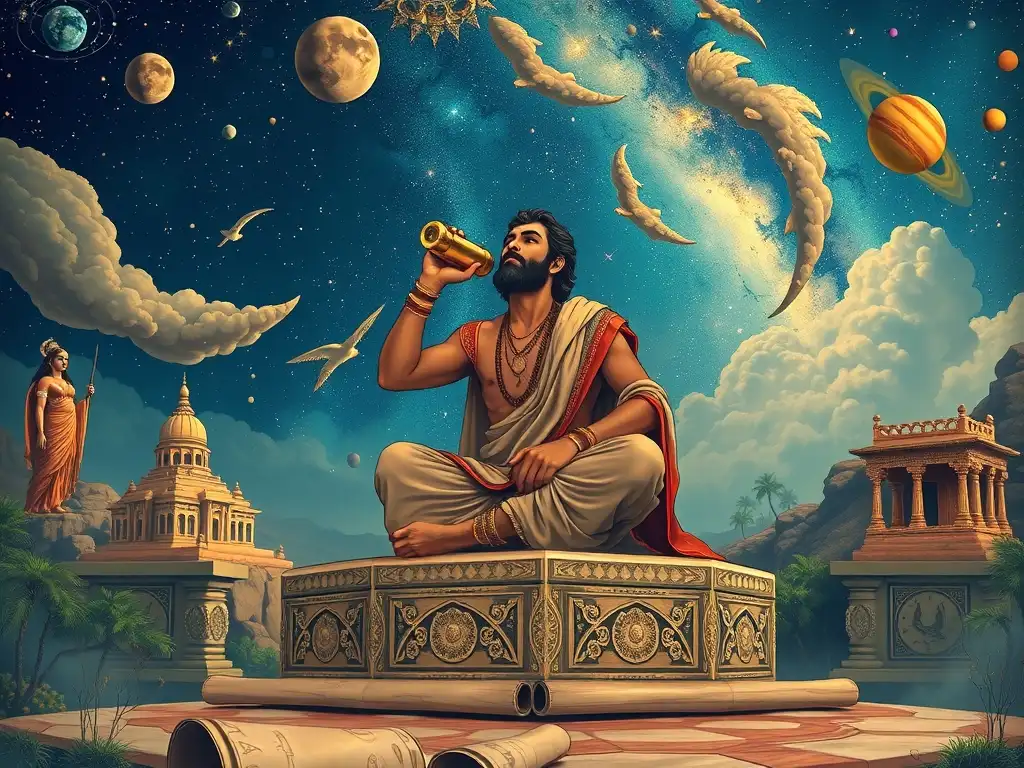
The intertwining of astronomy and mythology in ancient India presents a fascinating narrative that highlights the profound relationship between scientific inquiry and cultural expression. This relationship was not merely about understanding celestial phenomena; it was also about embedding these understandings within a larger cosmological framework that included gods, myths, and cultural practices.
As we explore this intricate tapestry, it becomes clear that ancient Indian astronomy was not just a scientific endeavor but a means of connecting the cosmos with human experience, belief systems, and societal values. This holistic understanding continues to inspire contemporary thought, bridging the gap between ancient wisdom and modern scientific exploration.
Summary of Key Points on Ancient Indian Astronomy Mythology
- Interconnection with Mythology: Ancient Indian astronomy was deeply influenced by mythology, with celestial phenomena often attributed to divine actions.
- Contributions of Scholars: Thinkers like Aryabhata and Varahamihira played pivotal roles in advancing astronomical knowledge, embedding it within cultural narratives.
- Cross-Cultural Influence: The astronomical knowledge from ancient India significantly impacted later civilizations, notably through translations and adaptations in the Islamic world and Southeast Asia.
- Mathematical Foundations: Many modern mathematical concepts, such as the decimal system and trigonometry, have their roots in ancient Indian astronomical practices.
The Lasting Impact of Mythological Roots on Scientific Thought
The mythological roots of ancient Indian astronomy have left a lasting impact on scientific thought by fostering a holistic approach to understanding the universe. This perspective acknowledges the significance of cultural narratives and beliefs in shaping scientific inquiry. By recognizing the role of mythology in the development of astronomical concepts, modern scientists can appreciate the diverse ways in which human beings have sought to comprehend the cosmos.
Furthermore, the integration of mythology with scientific exploration encourages a more interdisciplinary approach to knowledge. It allows for the appreciation of the cultural dimensions of science, reminding us that the pursuit of knowledge is not solely a rational endeavor but also a deeply human one, influenced by stories, beliefs, and the quest for meaning in the vastness of the universe.
References
The study of ancient Indian astronomy is enriched by a vast array of texts, manuscripts, and scholarly interpretations. Key references include ancient scriptures such as the Vedanga Jyotisha, which highlights the astronomical knowledge embedded in Vedic texts, and the Surya Siddhanta, a seminal work that outlines various astronomical calculations and their applications. Additionally, the Aryabhatiya by Aryabhata stands as a cornerstone in the history of Indian mathematics and astronomy, showcasing the sophistication of ancient Indian thought.
Modern scholarly works also play a crucial role in understanding the intersection of astronomy and mythology. Notable contemporary scholars have published extensive research that delves into the mythological narratives surrounding celestial bodies, which add depth to the scientific understanding of astronomy in ancient India.
Suggested Reading on Ancient Indian Astronomy and Mythology
-
"Astronomy in Ancient India" by J. C. Bhattacharya
This book provides a comprehensive overview of the astronomical practices and beliefs in ancient India, detailing how they influenced various aspects of Indian life and culture.
-
"The Astronomical Tradition in India: A Historical Perspective" by M. S. Rojas
Rojas explores the historical development of astronomy in India, focusing on the mythological narratives that shaped scientific thought.
-
"Cosmic Order and Myth in Ancient India" by N. S. Rajaram
This work delves into the relationship between myth and astronomy, illustrating how ancient Indian myths reflect astronomical phenomena and contribute to the understanding of the cosmos.
-
"Indian Astronomy: A Historical Perspective" by R. C. Gupta
Gupta examines the evolution of astronomical knowledge in India, with particular emphasis on the mythological contexts that provided a framework for scientific inquiry.
-
"The Role of Mythology in Indian Astronomy" by A. K. Sharma
This book investigates the influence of mythological stories on the development of astronomical concepts, showcasing how these narratives served as educational tools in ancient India.
Notable Scholars and Works in the Field
-
Aryabhata (476–550 CE)
Renowned for his work Aryabhatiya, Aryabhata laid the foundation for mathematical astronomy in India. His contributions include the introduction of the concept of zero and the calculation of the circumference of the Earth.
-
Brahmagupta (598–668 CE)
In his seminal text Brahmasphutasiddhanta, Brahmagupta presented significant advancements in arithmetic and algebra, while also discussing topics related to eclipses and planetary motions.
-
Varahamihira (505–587 CE)
A prominent astronomer and astrologer, Varahamihira authored the Brihat Samhita, which not only discussed astronomical phenomena but also integrated mythological elements, demonstrating the cultural relevance of celestial events.
-
Bhaskara I (c. 600–680 CE)
Bhaskara I’s works included commentaries on Aryabhata’s theories and provided further insights into the calculations of planetary positions, emphasizing the integration of mythology in astronomical observations.
-
Bhaskara II (1114–1185 CE)
Known as Bhaskara the Great, his influential work Siddhanta Shiromani encompassed both mathematics and astronomy, reflecting a deep understanding of celestial mechanics intertwined with mythological aspects.
These scholars and their works illustrate the profound relationship between ancient Indian astronomy and mythology, highlighting how cultural narratives shaped scientific inquiry and understanding in ancient Indian civilization.
- Introduction to Ancient Indian Astronomy and Mythology
- Historical Context of Ancient Indian Astronomy
- Major Contributions of Ancient Indian Astronomers
- Mythological Influences on Ancient Indian Astronomy
- Astronomical Techniques and Instruments in Ancient India
- Use of Sundials and Water Clocks
- The Role of Observatories in Ancient India
- Techniques for Calculating Time and Celestial Events
- Case Studies of Mythological Events in Astronomy
- The Legacy of Ancient Indian Astronomy and Mythology
- Influence on Later Civilizations and Cultures
- Relevance of Ancient Indian Astronomy in Modern Science
- Conclusion: The Intertwining of Astronomy and Mythology in Ancient India
- Summary of Key Points on Ancient Indian Astronomy Mythology
- The Lasting Impact of Mythological Roots on Scientific Thought
- References
- Suggested Reading on Ancient Indian Astronomy and Mythology
- Notable Scholars and Works in the Field
Frequently Asked Questions
What is ancient Indian astronomy mythology?
Ancient Indian astronomy mythology refers to the mythological stories and concepts that influenced the development of astronomy in ancient India, intertwining spiritual beliefs with scientific observations.
How did mythology influence ancient Indian astronomy?
Mythology provided a cultural context for astronomical observations, often linking celestial bodies to deities and mythical narratives, thus shaping the interpretation of astronomical phenomena.
What are some key texts on ancient Indian astronomy?
Key texts include the Surya Siddhanta and the Aryabhatiya, which contain mathematical calculations and astronomical principles rooted in both science and mythology.
Who were the prominent figures in ancient Indian astronomy?
Prominent figures include Aryabhata, who introduced the concept of the earth's rotation, and Varahamihira, known for his contributions to astronomy and astrology within a mythological framework.
How does ancient Indian astronomy compare to other ancient civilizations?
Ancient Indian astronomy was unique in its integration of mythology, providing a rich narrative that complemented its scientific achievements, distinguishing it from the more empirical approaches of other civilizations.
Final Reflection: The Timeless Connection Between Ancient Indian Astronomy and Mythology
The intricate tapestry of ancient Indian astronomy and its mythological roots remains profoundly relevant today, as we continue to seek meaning in the cosmos. The celestial observations and interpretations crafted by ancient scholars not only laid the groundwork for modern astronomy but also enriched our cultural narratives. This duality of science and mythology invites us to explore how our ancestors viewed the universe, reminding us that the stars have always been a source of wonder and inspiration.
The influence of ancient Indian astronomy on contemporary culture is undeniable, as it shapes our understanding of time, space, and the rhythms of nature. The stories woven into the fabric of the cosmos serve as a bridge connecting generations, fostering a sense of identity and belonging. As Carl Sagan once said, “We are made of star-stuff,” highlighting the intrinsic relationship between humanity and the universe. This connection encourages us to reflect on our place within the grand scheme of existence and the narratives that guide us.
As we look to the future, I invite you to embrace the lessons embedded in the myths and astronomical insights of ancient India. Consider how these timeless stories can inspire your own journey through life. Reflect on the ways in which the cosmos influences your daily experiences and aspirations. Let the wisdom of the past guide you as you navigate the complexities of the present, reminding you that we are all part of a larger narrative that transcends time and space.
Unveil the Celestial Secrets of Ancient India!
Thank you for taking the time to explore the spectacular cosmos of ancient Indian astronomy and its rich mythological connections. By diving into this intriguing world, you’ve uncovered the deep wisdom and innovation that shaped our understanding of the stars. Now, let’s turn that knowledge into action and further immerse ourselves in this celestial journey!
- Join our community: Share your thoughts on ancient astronomy with fellow enthusiasts on our forum at ancientindiahistory.com.
- Explore further: Check out our collection of ancient texts and resources to deepen your understanding of how mythology and astronomy intertwine.
- Share the knowledge: Inspire friends by sharing this article through your social media channels—let’s spread fascination about our heritage!
What aspect of ancient Indian astronomy resonates with you the most, and how can it inspire your view of the cosmos today?