
How Ancient Indian Texts Explain the Motion of Celestial Bodies


Welcome to Ancient India History, where we embark on a fascinating journey through the rich tapestry of India's past. Here, we delve into the profound insights of ancient Indian texts on celestial motion, exploring how these time-honored writings have shaped our understanding of the cosmos. Have you ever wondered how ancient civilizations perceived the stars and planets?
Join us as we uncover the scientific brilliance of the Indus Valley to the Gupta Empire, revealing the astonishing ways in which these early thinkers contributed to the field of astronomy. Your adventure into the depths of ancient wisdom awaits—dare to continue exploring!
- Introduction to Ancient Indian Texts and Celestial Motion
- Historical Context of Celestial Motion in Ancient India
- Key Ancient Indian Texts Explaining Celestial Motion
- Concepts of Celestial Motion in Ancient Indian Astronomy
- Methodologies Used in Ancient Indian Astronomy
- Influence of Ancient Indian Texts on Later Astronomy
- Conclusion: The Legacy of Ancient Indian Texts on Celestial Motion
- Further Reading on Ancient Indian Astronomy and Celestial Motion
- Frequently Asked Questions
- Final Reflection: The Timeless Wisdom of Ancient Indian Texts on Celestial Motion
- Unveil the Mysteries of Celestial Motion!
Introduction to Ancient Indian Texts and Celestial Motion
Ancient Indian texts represent a remarkable repository of knowledge that spans various domains, including astronomy, mathematics, and philosophy. These texts not only reflect the intellectual pursuits of ancient Indian civilizations but also offer profound insights into their understanding of the natural world. Among the myriad topics explored, the motion of celestial bodies stands out as a significant area of inquiry. Scholars and astronomers of ancient India meticulously observed and documented the movements of planets, stars, and other celestial phenomena, formulating theories that contributed immensely to the field of astronomy.
This article delves into how ancient Indian texts explain celestial motion, highlighting their significance in the broader context of scientific thought and discovery. By examining these texts, we can uncover the principles and methodologies that governed ancient Indian astronomy, revealing a sophisticated understanding of the cosmos that echoes through time.
Overview of Ancient Indian Texts
The wealth of ancient Indian texts encompasses a variety of genres, including religious scriptures, philosophical treatises, and scientific manuscripts. Some of the most notable texts related to astronomy include:
- Surya Siddhanta: A foundational text that provides comprehensive calculations regarding celestial phenomena, including the positions of celestial bodies and eclipses.
- Aryabhatiya: Written by the renowned mathematician and astronomer Aryabhata, this text introduces concepts such as the rotation of the Earth and the calculation of time based on celestial movements.
- Brahmasphutasiddhanta: Authored by Brahmagupta, this work is pivotal in understanding the mathematical aspects of astronomy, including rules for calculating planetary positions.
These texts not only embody the scientific knowledge of their time but also reflect the philosophical underpinnings that influenced ancient Indian thought. The integration of mathematics and astronomy in these works illustrates a holistic approach to understanding the universe.
Importance of Celestial Motion in Ancient Indian Astronomy
The study of celestial motion held immense significance in ancient Indian astronomy for several reasons:
- Calendrical Systems: Accurate observations of celestial bodies were essential for developing calendars, which were crucial for agricultural practices, religious rituals, and daily life.
- Navigation: Understanding the motion of stars and planets enabled ancient Indians to navigate vast distances, particularly during trade expeditions and pilgrimages.
- Philosophical Inquiry: Celestial motion was not only a scientific concern but also a philosophical one. The movement of celestial bodies was often linked to cosmic principles and the nature of existence itself.
- Cultural Significance: Celestial events, such as eclipses and planetary conjunctions, were imbued with cultural and religious meanings, influencing art, literature, and mythology.
The meticulous study of celestial motion in ancient India was intertwined with various aspects of life, reflecting a profound understanding that resonated through the ages. The insights gleaned from these ancient texts continue to inspire modern astronomical inquiries and enrich our appreciation of the cosmos.
Historical Context of Celestial Motion in Ancient India

The exploration of celestial motion in ancient India is deeply intertwined with the civilization's rich heritage of astronomy and mathematics. The observation of celestial bodies—such as the sun, moon, planets, and stars—was not merely a scientific endeavor but also held profound cultural and religious significance. Ancient Indian astronomers sought to understand the cosmos in a way that integrated spiritual beliefs with empirical observation, leading to a unique interpretation of celestial phenomena.
The Role of Astronomy in Ancient Indian Civilization
Astronomy in ancient India was not just an academic pursuit; it was an essential aspect of daily life and religious observance.
- Calendrical Systems: The Indian calendar was based on lunar cycles, with months corresponding to phases of the moon. This necessitated precise calculations to determine auspicious dates for festivals and rituals.
- Agricultural Practices: Celestial observations helped farmers determine the best times for sowing and harvesting, linking astronomy directly to sustenance.
- Astrology: The study of celestial motion was closely associated with astrology. Ancient texts like the "Brahmanas" and later "Jyotisha" texts governed astrological practices, significantly influencing social and political decisions.
- Cultural Significance: Celestial bodies were often personified within the Hindu pantheon, where deities were associated with various celestial phenomena, further embedding astronomy into religious practice.
The confluence of these elements showcases how deeply integrated celestial observations were in the fabric of ancient Indian society, setting the stage for a sophisticated understanding of celestial mechanics.
Key Ancient Indian Texts on Celestial Motion
Ancient Indian texts provide a wealth of knowledge regarding celestial motion, with notable contributions from various scholars. Here are some key texts that exemplify this knowledge:
- Surya Siddhanta:
- Composed around the 4th to 5th century CE, this seminal work outlines the mathematical principles of astronomy.
- It includes extensive discussions on the calculation of the positions of celestial bodies, eclipses, and the length of the year.
- The text employs mathematical formulas that are remarkably advanced, indicating a deep understanding of spherical geometry.
- Aryabhatiya:
- Written by Aryabhata in the 5th century CE, this text is one of the earliest to present a systematic approach to astronomy and mathematics.
- Aryabhata introduced the concept of the earth's rotation on its axis, explaining celestial motion in a way that predated similar discoveries in the West.
- He also laid down the principles for calculating the circumference of the earth and the distance to the moon.
- Brahmasphutasiddhanta:
- Authored by Brahmagupta in the 7th century CE, this work is notable for its comprehensive treatment of arithmetic and algebra alongside celestial mechanics.
- It addresses planetary motions and provides rules for predicting eclipses, showcasing a blend of mathematical prowess and astronomical observation.
- Khanda Khadyaka:
- Written by Bhaskara I in the 7th century CE, this text focuses on astronomical calculations and includes methods for predicting planetary positions.
- It highlights the significance of observational data, emphasizing the need for empirical evidence in celestial studies.
These texts collectively demonstrate the advanced understanding of celestial motion in ancient India, contributing significantly to the global body of astronomical knowledge. They reveal a civilization that not only observed the heavens but also sought to mathematically articulate its workings, laying the groundwork for future astronomical discoveries.
Key Ancient Indian Texts Explaining Celestial Motion
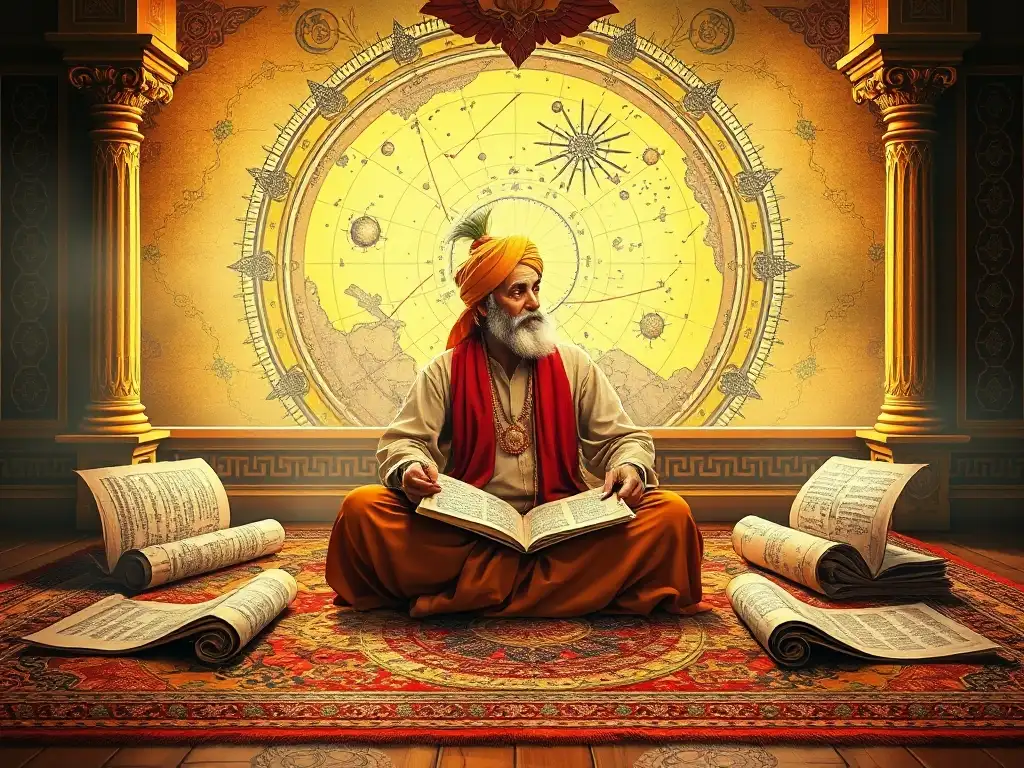
The Surya Siddhanta: Principles of Celestial Motion
The Surya Siddhanta is one of the most important ancient Indian texts that provide detailed insights into celestial motion. Dating back to the 4th to 5th centuries CE, this astronomical treatise is attributed to an anonymous author and is a cornerstone of Indian astronomy. The text presents a comprehensive explanation of various celestial phenomena, including the movements of the sun, moon, planets, and stars.
Key Features:
- Mathematical Foundations: The Surya Siddhanta employs sophisticated mathematics to describe celestial motions. It uses trigonometry and provides formulas for calculating the positions of celestial bodies.
- Solar and Lunar Cycles: The text elaborates on the solar and lunar cycles, detailing the lengths of days, months, and years. It emphasizes the importance of understanding these cycles for agricultural and religious practices.
- Earth's Rotation and Revolution: It posits that the Earth rotates on its axis and revolves around the sun, which was a groundbreaking concept for its time. The text describes the daily motion of celestial bodies as a result of this rotation.
Aryabhata's Contributions to Celestial Motion
Aryabhata, a prominent mathematician and astronomer of the 5th century CE, made significant contributions to the understanding of celestial motion through his seminal work, the Aryabhatiya. This text is foundational in the fields of mathematics and astronomy, providing insights that are still relevant today.
Key Contributions:
- Heliocentric Model: Aryabhata proposed a heliocentric model where the Earth rotates on its axis, leading to the apparent motion of celestial bodies. This was a revolutionary idea that challenged prevailing geocentric views.
- Sine Functions: He introduced the concept of sine functions, which allowed for precise calculations of angles and distances in celestial navigation and astronomy.
- Accurate Time Calculation: Aryabhata developed methods to calculate time based on the positions of celestial bodies, which included the calculation of solar eclipses and the lengths of seasons. His work laid the groundwork for future advancements in astronomy.
Brahmagupta's Theories on Celestial Bodies
Brahmagupta, who lived in the 7th century CE, expanded upon Aryabhata's theories in his work, the Brahmasphutasiddhanta. This text is renowned for its contributions to both mathematics and astronomy, particularly regarding celestial motion.
Key Theories:
- Lunar and Solar Eclipses: Brahmagupta provided detailed explanations of lunar and solar eclipses, describing their causes and calculations for predicting their occurrences. He introduced rules for determining the timing of eclipses based on the relative positions of the Earth, moon, and sun.
- Gravitational Influence: He was one of the first to suggest that celestial bodies exert gravitational influence on one another, an idea that resonates with modern understanding of gravity.
- Calendar Systems: Brahmagupta's work also included the creation of calendar systems based on celestial events, which were vital for agricultural societies and religious observances.
These texts reflect the advanced understanding of celestial motion in ancient India and demonstrate the significant contributions of Indian astronomers to the field. Through their detailed observations and innovative theories, they laid the groundwork for future explorations in astronomy and mathematics.
Concepts of Celestial Motion in Ancient Indian Astronomy

Ancient Indian astronomy is a profound field that reveals the intricate understanding of celestial motion by scholars of the time. This knowledge is encapsulated in various ancient Indian texts, which serve not only as records of astronomical observations but also as philosophical treatises that illustrate the connection between the cosmos and human existence. Through meticulous observations and calculations, ancient Indian astronomers developed models to explain the movements of celestial bodies, contributing significantly to the field of astronomy.
Geocentric vs. Heliocentric Models in Ancient Indian Texts
The debate between geocentric and heliocentric models of the universe has been a significant aspect of astronomical discourse throughout history. Ancient Indian texts primarily endorsed the geocentric model, where the Earth was considered the center of the universe.
- Geocentric Model:
- Texts such as the Aryabhatiya by Aryabhata describe the Earth as a stationary body with celestial bodies revolving around it. Aryabhata proposed that the apparent motion of the stars and planets was due to the rotation of the Earth on its axis.
- The Siddhanta Shiromani by Bhaskara II further illustrates the geocentric perspective, emphasizing that the sun, moon, and planets move in circular orbits around the Earth.
- Heliocentric Model:
- Although ancient Indian texts predominantly presented a geocentric view, some scholars, particularly in later periods, hinted at a heliocentric understanding. For instance, the Brahmasphutasiddhanta by Brahmagupta discussed planetary motions in a way that could be interpreted as acknowledging the sun's central position in the solar system.
The contrasting views highlight the evolution of thought regarding celestial motion in ancient Indian astronomy.
Understanding the Movement of Planets and Stars
Ancient Indian astronomers meticulously tracked the movements of planets and stars, providing a wealth of information on celestial mechanics. Their observations led to the formulation of various concepts:
- Planetary Motion:
- The motion of planets was classified into two categories:direct motion (the apparent forward motion of planets) and retrograde motion (the perceived backward motion). Texts like the Surya Siddhanta provided formulas to calculate the positions of planets based on their periods and the time elapsed.
- Zodiacal Constellations:
- The twelve zodiac signs played a crucial role in understanding celestial motion. Each zodiac sign was associated with specific planetary movements, enabling astronomers to predict eclipses and other astronomical events.
- Sidereal and Synodic Periods:
- Ancient Indian texts distinguished between the sidereal period (the time taken for a planet to return to the same position relative to the stars) and the synodic period (the time taken for a planet to return to the same position relative to the Earth and the Sun). This distinction was vital for accurate astronomical calculations.
The detailed study of celestial bodies illustrates the sophisticated understanding of motion that ancient Indian astronomers possessed.
The Role of Eclipses in Ancient Indian Astronomy
Eclipses held significant importance in ancient Indian astronomy, both as celestial events and as markers for timekeeping. The ancient texts provided extensive explanations for these phenomena:
- Types of Eclipses:
- Ancient texts classified eclipses into two types:solar eclipses and lunar eclipses. The Aryabhatiya details the mechanisms behind these occurrences, attributing solar eclipses to the moon obstructing the sunlight and lunar eclipses to the Earth's shadow falling on the moon.
- Predictive Techniques:
- Astronomers developed predictive techniques to forecast eclipses. The Surya Siddhanta includes algorithms and cycles to predict the timing and nature of future eclipses, showcasing the analytical prowess of ancient Indian scholars.
- Cultural Significance:
- Eclipses were not only astronomical events but also held cultural and religious significance. They were often viewed as omens and were meticulously observed to ensure favorable outcomes in agricultural and social activities.
Understanding the role of eclipses deepens the appreciation of the ancient Indian approach to celestial phenomena, emphasizing both the scientific and cultural dimensions of their astronomical knowledge.
The exploration of celestial motion in ancient Indian texts reveals a rich tapestry of scientific inquiry and cultural significance, underscoring the contributions of ancient Indian scholars to the field of astronomy.
Methodologies Used in Ancient Indian Astronomy
In ancient India, astronomy was deeply intertwined with religious practices and agricultural cycles. The methodologies used by astronomers of the time were meticulous and reflected a sophisticated understanding of celestial phenomena. The ancient Indian texts detail various approaches and frameworks that scholars employed to observe and calculate the motion of celestial bodies.
Astronomical Calculations in Ancient Indian Texts
Ancient Indian texts, such as the Aryabhatiya by Aryabhata, the Surya Siddhanta, and the Brahmasphutasiddhanta by Brahmagupta, contain extensive methods for calculating celestial motions. These texts utilized a combination of empirical observations and mathematical calculations.
- Mathematical Foundations:
- The ancient Indian mathematicians developed a variety of numerical systems, including the use of zero and place value notation, which were crucial for astronomical calculations.
- Techniques such as sine and cosine were employed to compute angles and distances between celestial bodies.
- Key Formulas:
- The texts provided specific formulas for determining the positions of planets, eclipses, and other celestial events. For example, Aryabhata described the calculation of the circumference of the Earth, leading to significant advancements in understanding planetary motion.
- Observational Data:
- Astronomers meticulously recorded observations of planetary positions and movements over time, which were then compiled into tables. These tables served as vital references for future calculations and predictions.
- Cyclical Nature of Celestial Events:
- Ancient Indian astronomers recognized the cyclic nature of celestial phenomena, leading to the development of calendars that aligned with astronomical events. The intercalation of months and the regulation of lunar and solar calendars were also addressed in these texts.
Instruments and Techniques for Observing Celestial Bodies
The advancement of astronomy in ancient India was also supported by the development of various instruments and observational techniques.
- Instruments:
- Gnomons: Simple devices used to cast shadows, helping determine the time of day and seasons based on the position of the sun.
- Quadrants and Astrolabes: These instruments allowed astronomers to measure the angles of celestial bodies above the horizon, aiding in calculating their positions accurately.
- Techniques:
- Ecliptic and Equatorial Systems: Ancient Indian astronomers utilized these systems to map the sky and track the motion of celestial bodies across different latitudes.
- Celestial Observatories: Significant structures like Jantar Mantar, built in the 18th century, were inspired by earlier methods and allowed for precise astronomical observations.
- Empirical Observation:
- Observers often relied on naked-eye observations, recording the positions of stars, planets, and other celestial phenomena. This empirical approach laid the groundwork for the theoretical frameworks found in ancient texts.
- Integration with Cosmology:
- The study of celestial motion was closely linked to cosmological beliefs in ancient India. Celestial events were often interpreted as manifestations of divine will, influencing not only scientific inquiry but also cultural and religious practices.
Through these methodologies and techniques, ancient Indian astronomers made remarkable contributions to the field of astronomy, significantly influencing subsequent developments in both India and the broader world. Their work on celestial motion remains a testament to the intellectual achievements of ancient Indian civilization.
Influence of Ancient Indian Texts on Later Astronomy

Transmission of Knowledge to Other Cultures
Ancient Indian texts played a pivotal role in the transmission of astronomical knowledge across cultures. Key works such as the Surya Siddhanta and Aryabhata's Aryabhatiya formulated mathematical techniques and astronomical concepts that became foundational in later astronomical studies, not only in India but also beyond its borders.
Key Contributions:
- Surya Siddhanta: This text, dating back to the 4th or 5th century CE, presented calculations regarding the length of the solar year and detailed methods for predicting eclipses. Its influence can be seen in various cultures that adopted and adapted its principles.
- Aryabhatiya: Written by Aryabhata in the 5th century CE, this work introduced concepts such as the rotation of the Earth on its axis and the use of decimal notation, which enhanced the precision of astronomical calculations.
These texts were translated into Arabic during the 8th to 10th centuries, facilitating the dissemination of Indian astronomical knowledge to the Islamic world. Scholars in regions such as Persia and the Middle East not only translated these texts but also expanded upon them, leading to a rich exchange of ideas.
Impact on Islamic and Western Astronomy
The impact of ancient Indian texts on Islamic and Western astronomy is profound, marking significant advancements in the understanding of celestial motion.
Islamic Astronomy:
- Al-Battani and Al-Khwarizmi were among the scholars who integrated Indian astronomical knowledge into Islamic studies. Their works often referenced the Surya Siddhanta, and they utilized its methods to refine astronomical tables, particularly in the calculation of planetary positions.
- The Zij al-Sindhind, a set of astronomical tables compiled from Indian texts, became fundamental in the practice of astronomy throughout the Islamic Golden Age.
Western Astronomy:
- The transmission of knowledge continued into the Western world during the Renaissance. Texts such as Copernicus’ De revolutionibus orbium coelestium reflect the influence of earlier astronomical models, which can be traced back to Indian sources.
- The introduction of new mathematical techniques derived from Indian texts, including the sine function, revolutionized the way Western astronomers approached celestial calculations.
Summary Table of Influences:
| Culture | Key Texts | Contributions |
|---|---|---|
| Ancient India | Surya Siddhanta, Aryabhatiya | Foundations of trigonometry, eclipse predictions |
| Islamic | Zij al-Sindhind | Refinement of astronomical tables, planetary motion |
| Western | Copernicus’ works | Adoption of Indian mathematical methods, heliocentric model |
The legacy of ancient Indian texts in celestial motion continues to be recognized today, as they laid the groundwork for future astronomical advancements across various cultures. Their influence underscores the interconnectedness of scientific knowledge throughout history.
Conclusion: The Legacy of Ancient Indian Texts on Celestial Motion
Summary of Key Contributions to Astronomy
Ancient Indian texts have made significant contributions to the understanding of celestial motion, merging mathematics, philosophy, and astronomy. One of the most influential works is the Surya Siddhanta, a 5th-century text that outlines the movement of celestial bodies with remarkable precision. It introduced concepts such as:
- The calculation of the Earth's circumference: Ancient Indian scholars estimated the Earth's circumference to be approximately 39,968 kilometers, a figure that closely aligns with modern measurements.
- The calculation of time: The text describes a system of timekeeping that includes the concept of the day divided into hours, minutes, and seconds, showcasing an advanced understanding of temporal measurement.
Furthermore, the Aryabhatiya by Aryabhata, penned in the 5th century, offered insights into:
- The rotation of the Earth: Aryabhata proposed that the Earth rotates on its axis, explaining the apparent motion of stars and planets.
- Accurate predictions of eclipses: His calculations provided methods to predict solar and lunar eclipses, which were crucial for both astronomical observations and religious practices.
The Brahmasphutasiddhanta by Brahmagupta also contributed significantly by formalizing the rules for arithmetic operations and introducing the concept of zero, facilitating more complex calculations in astronomy.
Lasting Importance of Ancient Indian Astronomy in Modern Context
The insights from ancient Indian texts on celestial motion continue to resonate in modern astronomy and mathematics. Scholars today recognize that many of the principles established by ancient Indian astronomers laid foundational concepts that would influence later developments in both Eastern and Western scientific traditions.
In a contemporary context, the methodologies and observational techniques described in these texts are being revisited as researchers explore:
- Astrophysics: The equations derived from ancient texts provide a historical basis for understanding gravitational forces and planetary motion.
- Cultural astronomy: The significance of celestial bodies in ancient Indian culture highlights the interconnection between astronomy and social practices, offering insights into how celestial observations influenced calendars, agriculture, and ritualistic events.
Moreover, the revival of interest in ancient Indian scientific contributions encourages a multidisciplinary approach, merging history, philosophy, and science. By studying these texts, modern scholars can gain a deeper appreciation for the sophistication of ancient civilizations and their enduring legacy in the realm of celestial motion.
The examination of ancient Indian texts on celestial motion not only enriches our understanding of the past but also inspires future inquiries into the cosmos, reaffirming the profound impact of these early astronomers on the science of today.
Further Reading on Ancient Indian Astronomy and Celestial Motion
Recommended Texts and Resources for Deeper Understanding
To gain a comprehensive understanding of how ancient Indian texts explain celestial motion, several key resources can be explored. These texts not only provide insights into astronomical concepts but also reflect the cultural and scientific advancements made by ancient Indian civilizations. Here are some recommended texts and resources:
- Aryabhatiya by Aryabhata
- This seminal work, composed in the 5th century CE, discusses a variety of topics including arithmetic, algebra, and astronomy. Aryabhata's innovative approach to calculating the positions of celestial bodies, such as planets and stars, has been influential in the field of astronomy.
- Surya Siddhanta
- An ancient Indian astronomical text that details the movements of celestial bodies. It is a vital resource for understanding ancient Indian calculations of time, eclipses, and planetary positions. The text also includes mathematical formulas that were advanced for its time.
- Brahmasphutasiddhanta by Brahmagupta
- Written in 628 CE, this text covers various mathematical and astronomical concepts. Brahmagupta's work is notable for its systematic treatment of arithmetic operations and its commentary on the motion of celestial bodies, providing a bridge between mathematics and astronomy.
- Ganita Sara Sangraha by Bhaskara I
- This text offers insight into the mixing of mathematics and astronomy, emphasizing practical applications such as calculating eclipses and determining the positions of planets. Bhaskara I's contributions are crucial for understanding the mathematical underpinnings of ancient Indian astronomy.
- The History of Indian Astronomy
- A comprehensive overview of the evolution of astronomical thought in India, this resource sheds light on the influences and developments in the field over the centuries. It provides context for the ancient texts and their relevance to celestial motion.
To further explore the rich contributions of ancient Indian scholars in the fields of science and mathematics, here are some related articles that delve into specific topics:
-
The Role of Mathematics in Ancient Indian Astronomy
This article examines how mathematical principles were applied in astronomical calculations, emphasizing their significance in understanding celestial phenomena.
-
The Influence of Indian Astronomy on the World
A discussion on how ancient Indian astronomical knowledge spread beyond its borders, influencing other cultures and scientific thought in different parts of the world.
-
Mathematical Innovations of Ancient Indian Scholars
An exploration of groundbreaking mathematical concepts developed in ancient India, highlighting figures like Aryabhata and Brahmagupta and their lasting impact on mathematics and astronomy.
-
Eclipses and Their Significance in Ancient Indian Culture
This article investigates the importance of eclipses in ancient Indian texts and culture, and how they were perceived by scholars and the general public.
-
Celestial Navigation and Ancient Indian Seafaring
A look into how ancient Indian navigators used celestial bodies for navigation, showcasing the practical applications of astronomy in maritime activities.
By engaging with these texts and articles, readers can deepen their understanding of ancient Indian texts on celestial motion and appreciate the remarkable advancements made by scholars in this field.
Frequently Asked Questions
What are ancient Indian texts that discuss celestial motion?
Ancient Indian texts like the Surya Siddhanta and Aryabhata's Aryabhatiya provide detailed mathematical and astronomical insights into the motion of celestial bodies.
How did ancient Indian scholars contribute to astronomy?
Ancient Indian scholars made significant contributions by developing accurate models for planetary motion and using trigonometry to predict celestial events, showcasing their advanced understanding of astronomy.
What is the significance of the Surya Siddhanta?
The Surya Siddhanta is a foundational text in Indian astronomy that outlines solar movements, eclipses, and planetary positions, influencing both ancient and modern astronomical practices.
How did the Gupta Empire impact the study of celestial motion?
The Gupta Empire was a golden age for science, where scholars like Aryabhata advanced the study of celestial motion, integrating philosophy and mathematics with astronomical observations.
Are there modern implications of ancient Indian astronomical texts?
Yes, modern astronomers still refer to ancient Indian texts for their historical significance and the mathematical techniques they developed, which can provide insights into contemporary astronomical challenges.
Final Reflection: The Timeless Wisdom of Ancient Indian Texts on Celestial Motion
The exploration of ancient Indian texts reveals a profound understanding of celestial motion that remains remarkably relevant today. As we navigate an era dominated by technological advancements and scientific discoveries, the insights from these ancient scriptures remind us of humanity's enduring quest to comprehend the universe. The intricate observations and theories presented in these texts not only laid the foundation for astronomical studies but also challenge us to appreciate the depth of knowledge that existed long before modern science.
The influence of these ancient teachings continues to resonate in our cultural and scientific landscapes. They serve as a bridge connecting past wisdom with contemporary inquiry, inspiring both scholars and enthusiasts alike. As we delve into the celestial mechanics described in texts like the Surya Siddhanta, we uncover a rich tapestry of thought that encourages us to look beyond the surface of our current understanding. The universe is not only more strange than we imagine; it is stranger than we can imagine.
This quote encapsulates the essence of our exploration, urging us to remain open to the mysteries that lie ahead.
As you reflect on the lessons from ancient Indian texts regarding celestial motion, consider how this knowledge can inspire your own journey of discovery. Embrace the curiosity that these ancient scholars embodied, and allow it to guide you in your quest for understanding the cosmos. Whether through further study, personal exploration, or simply contemplating the night sky, let the wisdom of the past illuminate your path forward, reminding you that the pursuit of knowledge is a timeless endeavor that transcends generations.
Unveil the Mysteries of Celestial Motion!
Thank you for taking the time to explore how ancient Indian texts illuminate our understanding of celestial bodies. You've uncovered remarkable insights that not only connect us to history but also enrich our appreciation of the universe.
Now, let's turn this knowledge into action! Here are some engaging steps you can take:
- Dive deeper: Choose an ancient Indian text we discussed and spend time reading it thoroughly—discover additional layers of wisdom about celestial motion.
- Share your insights: Discuss what you've learned with friends or on social media—let's spark a conversation about ancient knowledge and its relevance today!
- Join a community: Find online forums or local groups focused on ancient sciences where you can exchange ideas, questions, and discoveries with like-minded enthusiasts.
As you step forward into this fascinating exploration, consider this: How do you think ancient knowledge can shape our future understanding of science?