
Vedic Literature and Its Contribution to Indian Mathematics and Astronomy


Welcome to Ancient India History, where we embark on a captivating journey through the rich tapestry of ancient Indian civilization. Get ready to uncover the profound influence of Vedic literature in Indian mathematics, a cornerstone of knowledge that has shaped not just mathematical concepts but also the very foundations of astronomy.
As you delve deeper into our featured article, "Vedic Literature and Its Contribution to Indian Mathematics and Astronomy," prepare to ignite your curiosity about how ancient texts continue to resonate in today's world. Join us as we explore the intricate connections between spirituality and science in one of the most fascinating eras of human history!
- Introduction to Vedic Literature and Its Impact on Indian Mathematics and Astronomy
- Historical Context of Vedic Literature
- Vedic Mathematics: Concepts and Theories
- Vedic Astronomy: Insights and Innovations
- Influence of Vedic Literature on Subsequent Indian Scholars
- Comparisons: Vedic Literature and Other Ancient Civilizations
- Conclusion: The Lasting Legacy of Vedic Literature in Indian Mathematics and Astronomy
- References for Further Reading on Vedic Literature in Indian Mathematics and Astronomy
- Frequently Asked Questions
- Final Reflection: The Enduring Legacy of Vedic Literature in Indian Mathematics
- Explore the Mathematical Wonders of Vedic Literature!
Introduction to Vedic Literature and Its Impact on Indian Mathematics and Astronomy
Vedic literature, a cornerstone of ancient Indian civilization, encompasses a vast body of texts that not only reflect the spiritual and philosophical pursuits of the time but also contribute significantly to the realms of mathematics and astronomy. Originating from the Vedas, which are among the oldest scriptures in the world, this literary corpus provides invaluable insights into the scientific thinking and methodologies that flourished in ancient India.
As we delve into the intricate relationship between Vedic literature and its influence on Indian mathematics, we will uncover how these ancient texts laid the groundwork for advanced mathematical concepts and astronomical knowledge that have shaped the intellectual landscape of India.
Definition of Vedic Literature
Vedic literature refers to the collection of sacred texts that form the foundation of Hindu philosophy and spirituality. Composed in early Sanskrit, the Vedas consist of four primary texts: the Rigveda, Samaveda, Yajurveda, and Atharvaveda. Each of these texts serves distinct purposes, encompassing hymns, rituals, and philosophical discourses.
- Rigveda: Contains hymns dedicated to various deities and natural forces.
- Samaveda: Focuses on melodies and chants used in rituals.
- Yajurveda: Comprises prose mantras and instructions for rituals.
- Atharvaveda: Includes spells, incantations, and practical knowledge.
Beyond their religious significance, Vedic texts also delve into various fields of knowledge, including mathematics and astronomy, revealing the sophistication of ancient Indian thought.
Overview of Indian Mathematics and Astronomy
The mathematical and astronomical traditions in ancient India are characterized by their complexity and innovation. From the early contributions of the Indus Valley civilization to the later developments during the Gupta Empire, Indian scholars made significant strides in various mathematical concepts, such as:
- Arithmetic: Development of numeral systems, including the concept of zero.
- Geometry: Advanced techniques in measuring land and constructing architectural marvels.
- Astronomy: Calculation of planetary positions, eclipses, and celestial phenomena.
Ancient Indian mathematicians and astronomers, including figures like Aryabhata and Brahmagupta, explored these concepts, many of which were influenced by the philosophical underpinnings of Vedic literature.
Importance of Vedic Texts in Ancient Indian Sciences
The Vedic texts laid the groundwork for the development of mathematical and astronomical sciences in ancient India. Their emphasis on precise measurements and rituals necessitated accurate calculations, leading to advancements in these fields.
- Numerical Systems: The Vedas introduced a decimal system, which became fundamental in mathematical calculations.
- Astronomical Observations: Rituals described in the Vedic texts often required astronomical knowledge, prompting scholars to develop sophisticated methods for tracking celestial bodies.
Moreover, the philosophical insights found within the Upanishads, which are part of the Vedic literature, fostered a scientific mindset that encouraged inquiry and exploration. As a result, Vedic literature not only enriched spiritual life but also catalyzed advancements in mathematics and astronomy that have had a lasting impact on subsequent generations.
Historical Context of Vedic Literature

The Vedic literature represents one of the most significant contributions to the cultural and intellectual heritage of ancient India. Emerging around 1500 BCE, these texts laid the groundwork for various fields, including philosophy, spirituality, mathematics, and astronomy. The Vedas, which are the oldest scriptures in Hinduism, encapsulate a collection of hymns, rituals, and philosophical discourses, reflecting the societal norms and intellectual pursuits of the time.
During the period of the Vedic civilization, which spanned several centuries, the society was predominantly agrarian, with a strong emphasis on rituals and sacrifices. The oral tradition played a crucial role in the preservation and transmission of Vedic texts, ensuring that knowledge was passed down through generations. The synthesis of ideas found in Vedic literature eventually influenced various aspects of Indian culture, including mathematics and astronomy, making it a cornerstone of ancient Indian scholarship.
Origins and Timeline of Vedic Texts
The Vedic texts are traditionally divided into four main collections: the Rigveda, Yajurveda, Samaveda, and Atharvaveda. Each Veda consists of four parts: Samhitas (hymns), Brahmanas (rituals), Aranyakas (theological discussions), and Upanishads (philosophical speculations). The timeline of these texts can be broadly categorized into three phases:
- Composition (circa 1500 - 500 BCE):
- The Rigveda, the oldest of the Vedas, is believed to have been composed first, followed by the other Vedas.
- This period marks the transition from oral tradition to written texts.
- Redaction (circa 500 - 200 BCE):
- The texts underwent various modifications and expansions during this time, reflecting the evolving socio-religious landscape.
- Commentaries and additional texts began to emerge, enriching the existing corpus.
- Transmission (circa 200 BCE - 500 CE):
- Vedic literature began to be systematically compiled and preserved.
- The influence of Vedic thought began to permeate other fields, including mathematics and astronomy.
Key Vedic Texts Influencing Mathematics and Astronomy
The Vedic texts not only served religious purposes but also contained mathematical and astronomical concepts that were revolutionary for their time. Below are the details of each Veda and its contributions to these fields:
Rigveda
The Rigveda, comprising 1,028 hymns, is primarily a collection of praises and invocations directed toward deities. Notably, it contains references to numerical concepts and measurements, which laid early foundations for mathematical thought. Key aspects include:
- Numerical Patterns: The hymns often utilize numerical expressions, reflecting an early understanding of counting and arithmetic.
- Cosmological References: The Rigveda discusses celestial phenomena, suggesting an awareness of the cosmos and cycles of time.
Yajurveda
The Yajurveda focuses on rituals and sacrifices, providing instructions on the performance of these rites. It significantly influenced mathematics through:
- Geometric Ritual Constructs: The Yajurveda includes detailed descriptions of the geometric shapes used in sacrificial altars, which necessitated an understanding of geometry and spatial arrangements.
- Time Measurement: This Veda emphasizes the importance of precise timing for rituals, leading to the development of calendars and astronomical calculations.
Samaveda
The Samaveda is primarily a liturgical text, consisting of melodies and chants for rituals. Its contributions to mathematics and astronomy are subtle yet significant:
- Musical Patterns and Ratios: The rhythmic patterns and musical notations in the Samaveda reflect an early understanding of ratios and proportions, which are fundamental in mathematics.
- Astronomical Alignments: The chants are often aligned with celestial events, indicating an observational approach to astronomy.
Atharvaveda
The Atharvaveda is considered the most diverse of the Vedas, encompassing hymns, spells, and incantations. Its contributions to mathematics and astronomy include:
- Practical Applications: It contains verses related to measurement, suggesting the application of mathematical concepts in daily life and agriculture.
- Astrological References: The text includes astrological elements, reflecting an early understanding of the influence of celestial bodies on human affairs.
Vedic literature plays a pivotal role in the development of mathematics and astronomy in ancient India. The intricate connections between these texts and the fields of study reveal a sophisticated understanding of numerical and astronomical concepts, laying the groundwork for future advancements in Indian mathematics.
Vedic Mathematics: Concepts and Theories

Vedic mathematics is a system of mathematics that originated from ancient Indian scriptures known as the Vedas, specifically composed around 1500 BCE to 500 BCE. This mathematical framework is characterized by its unique techniques and principles, which allow for rapid calculations and problem-solving. Rooted in the philosophical underpinnings of Vedic literature, this approach emphasizes mental calculations and the use of sutras (aphorisms) to simplify complex mathematical operations.
The key concept of Vedic mathematics is that it is not merely a collection of formulas but a holistic system that fosters an understanding of mathematical relationships and patterns. The sutras serve as guidelines that enable practitioners to explore mathematics creatively and intuitively. This has profound implications not only for pure mathematics but also for practical applications in fields such as astronomy, architecture, and commerce in ancient India.
Fundamental Principles of Vedic Mathematics
The foundation of Vedic mathematics lies in a set of 16 primary sutras and 13 sub-sutras, which cover a wide range of mathematical topics. These principles are designed to facilitate quick and efficient problem-solving. Some of the fundamental sutras include:
- Ekadhikena Purvena: This sutra translates to "By one more than the previous one" and is used for squaring numbers.
- Nikhilam Navatashcaramam Dashatah: Meaning "All from 9 and the last from 10," this principle simplifies subtraction and complements.
- Urdhva-Tiryagbhyam: This translates to "Vertically and Crosswise," which provides methods for multiplication of large numbers.
These sutras not only provide techniques but also encourage flexibility in thinking about numbers and their relationships.
Key Contributions of Vedic Literature to Mathematical Concepts
Vedic literature has made significant contributions to various mathematical concepts that are foundational to modern mathematics. The influence of this ancient wisdom can be observed in several key areas:
Number Systems in Vedic Texts
The Vedic texts introduce sophisticated number systems, including decimal and binary systems. The use of place value and the concept of zero are significant contributions that stem from this literature. For instance, the Brahmasphutasiddhanta, a treatise by the mathematician Brahmagupta, illustrates the use of zero in calculations, paving the way for more advanced mathematical thought.
- Decimal System: The Vedic literature emphasizes the importance of a positional decimal system, which allows for the representation of large numbers efficiently.
- Fractions: The texts also explore the concept of fractions, which were integral to trade and commerce in ancient India.
Algebraic Techniques and Their Origins
Vedic mathematics encompasses a variety of algebraic techniques that are detailed in ancient texts. These methods include:
- Linear Equations: Solutions to linear equations can be derived through the application of Vedic sutras.
- Quadratic Equations: The handling of quadratic equations is simplified by methods that can be traced back to Vedic literature, showcasing an early understanding of algebra.
The algebraic techniques in Vedic literature emphasize problem-solving through intuitive methods, which were practical for mathematicians and astronomers of the time.
Geometrical Knowledge from Vedic Literature
Geometrical concepts are well-documented in Vedic literature, particularly in the context of architecture and astronomy. The ancient texts provide insights into:
- Geometry of Shapes: Sutras related to the calculations of areas and volumes of various geometric shapes, such as circles and squares, are found in Vedic texts.
- Astronomical Measurements: Vedic scholars developed methods for calculating distances and angles, crucial for astronomical observations.
This geometrical knowledge not only reflects the advanced mathematical understanding of ancient Indian civilizations but also their application in practical fields such as farming, construction, and navigation.
Conclusion
The Vedic literature in Indian mathematics has laid the groundwork for various mathematical concepts and techniques that continue to influence modern mathematics. The unique approach of Vedic mathematics, with its emphasis on sutras and intuitive problem-solving, showcases the rich mathematical heritage of ancient India and its lasting impact on the development of the discipline.
Vedic Astronomy: Insights and Innovations
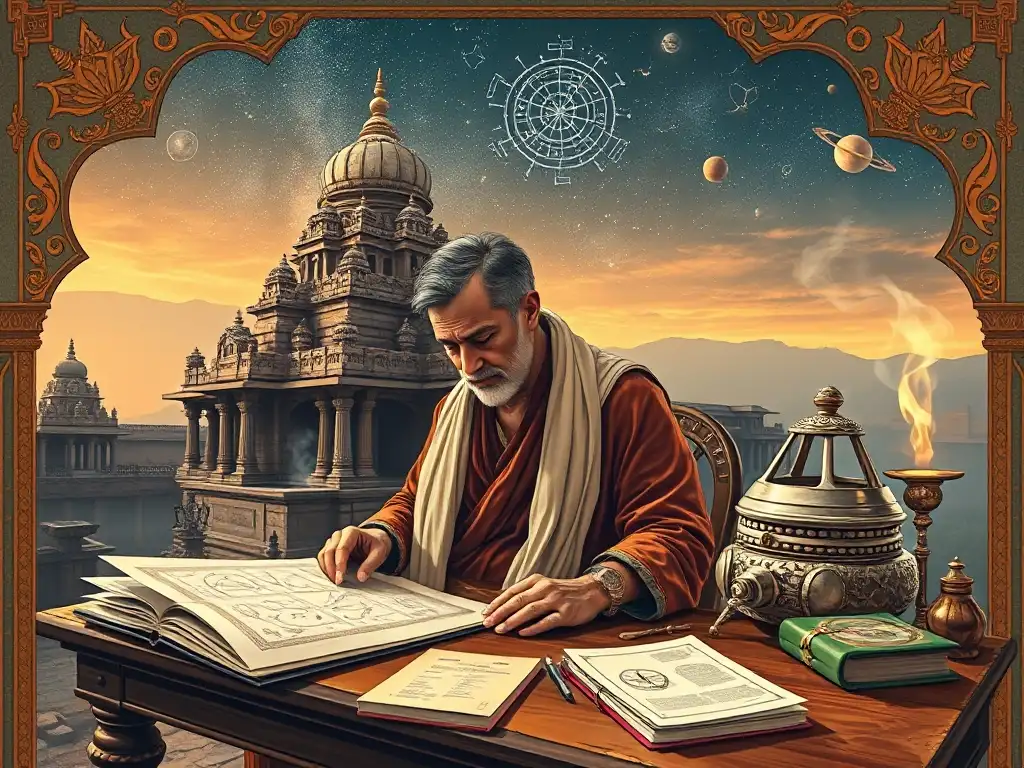
Vedic astronomy, an integral aspect of Vedic literature, represents a sophisticated understanding of celestial phenomena that significantly influenced ancient Indian mathematics and science. The Vedas, particularly the Yajurveda and Atharvaveda, contain hymns and verses that allude to astronomical concepts, reflecting a deep engagement with the cosmos. This integration of astronomy within Vedic texts not only facilitated ritualistic practices but also contributed to advancements in mathematical calculations.
Vedic Perspectives on Astronomy
The Vedic texts exhibit a profound appreciation for the cosmos, viewing astronomical phenomena as manifestations of divine order. The concept of Rta, or cosmic order, is central to Vedic thought, suggesting that the movements of celestial bodies follow a predetermined path that is both harmonious and cyclical. The Siddhantic literature, which developed later, built on these ideas, providing a framework for understanding celestial mechanics.
Vedic scholars were particularly interested in the cycles of the moon and sun, which were crucial for agricultural practices and ritual timings. The Jyotisha, or Vedic astrology, emerged as a field of study that intertwined astronomy with religious and philosophical beliefs, showcasing the Vedic perspective that the cosmos is inherently linked to human destiny.
Astronomical Calculations in Vedic Literature
The Vedic literature is replete with references to various mathematical concepts that underpin astronomical calculations. This includes the use of geometric principles and arithmetic operations to predict celestial events. Key elements include:
- Mathematical Ratios: The Vedic texts employed ratios to describe the relationships between cycles of various celestial phenomena.
- Trigonometric Concepts: Early forms of trigonometry can be traced back to the astronomical calculations in Vedic literature, particularly in determining the angles of celestial bodies.
These mathematical foundations laid the groundwork for subsequent developments in Indian mathematics, influencing scholars in the fields of astronomy and mathematics alike.
Calendar Systems and Timekeeping
One of the significant contributions of Vedic literature to mathematics is the development of calendar systems. The Vedic texts reference various lunar and solar calendars, which were essential for agricultural planning and religious observances. Key aspects include:
- Lunar Months: The observation of lunar phases led to the division of the year into 12 lunar months, which were aligned with specific agricultural cycles.
- Solar Year: The Vedic scholars recognized the importance of the solar year, establishing a 365-day calendar that accounted for the seasonal changes.
The alignment of these calendars with celestial events exemplifies the intricate relationship between astronomy and practical life in ancient India.
Celestial Bodies and Their Movements
The Vedic understanding of celestial bodies was not merely observational; it involved complex calculations regarding their movements. The texts illustrate knowledge about:
- Planetary Positions: The Vedic literature details the positions of planets such as Mars, Venus, and Jupiter, highlighting their significance in rituals and astrology.
- Eclipses: The Vedic scholars had a remarkable grasp of eclipses and their cycles, which were crucial for timing rituals and festivals.
This knowledge was instrumental in shaping the astronomical practices of later Indian scholars, who expanded upon the foundations laid by Vedic literature, ultimately leading to the development of sophisticated astronomical theories.
The contributions of Vedic literature to Indian mathematics and astronomy are profound, reflecting a rich tapestry of knowledge that intertwines cosmology with practical applications, ultimately influencing not only ancient Indian civilization but also laying groundwork for future scientific advancements.
Influence of Vedic Literature on Subsequent Indian Scholars

The influence of Vedic literature on Indian mathematics and astronomy is profound and far-reaching. The Vedas, particularly the Rigveda and the Yajurveda, laid the foundational principles that later scholars would build upon. The Vedic texts not only provided religious and philosophical insights but also contained mathematical concepts and astronomical knowledge that were crucial for the development of these fields in ancient India.
Contributions of Ancient Indian Mathematicians and Astronomers
Ancient Indian mathematicians and astronomers drew heavily from Vedic literature, integrating its concepts into their works. The methodologies and theories found within the Vedas were instrumental in shaping their approaches to mathematics and astronomy. Below are some notable contributors who exemplified this connection.
Aryabhata's Works and Vedic Influences
Aryabhata, one of the most renowned mathematicians and astronomers of ancient India, was significantly influenced by Vedic literature. His seminal work, the Aryabhatiya, completed in 499 CE, reflects Vedic concepts in its mathematical formulations.
- Mathematical Innovations: Aryabhata introduced the concept of zero as a placeholder and developed methods for solving quadratic equations. His calculations for the value of pi (π) and the approximation of sine functions are noteworthy, echoing principles found in Vedic texts.
- Astronomical Insights: In his astronomical observations, Aryabhata emphasized the importance of the Earth’s rotation—a concept that has roots in the cosmological views presented in the Vedas. He posited that the apparent motion of celestial bodies was due to the Earth spinning on its axis.
Brahmagupta's Contributions
Following Aryabhata, Brahmagupta, who lived in the 7th century CE, further advanced the mathematical knowledge of the time. His work, Brahmasphutasiddhanta, showcases the impact of Vedic literature on his ideas and formulations.
- Rules for Arithmetic: Brahmagupta refined the rules for arithmetic operations, including rules for dealing with zero and negative numbers. His methods for calculating areas and volumes can be traced back to Vedic mathematical concepts.
- Astronomical Calculations: He made significant contributions to astronomy, including methods for predicting eclipses and understanding planetary motions. His emphasis on observational techniques in astronomy reflects the systematic approach found in Vedic texts.
Bhaskara's Innovations
Bhaskara II, also known as Bhaskara the Great, lived in the 12th century CE and is celebrated for his work Siddhanta Shiromani. His innovations further illustrate the long-standing influence of Vedic literature in mathematics and astronomy.
- Advanced Mathematical Concepts: Bhaskara introduced concepts such as the “Bhaskara's lemma” and made advancements in calculus long before it was formally recognized in the West. His methods for solving polynomial equations were influenced by earlier Vedic mathematical principles.
- Astronomical Treatises: His astronomical treatises provided methods for calculating the positions of celestial bodies and predicting eclipses, reflecting a deep understanding of the cosmos that can be traced back to Vedic cosmology.
The contributions of Aryabhata, Brahmagupta, and Bhaskara highlight how Vedic literature in Indian mathematics served as a cornerstone for the development of sophisticated mathematical and astronomical concepts, shaping the trajectory of these fields in ancient India and beyond.
Comparisons: Vedic Literature and Other Ancient Civilizations

In examining the contributions of Vedic literature to Indian mathematics and astronomy, it is essential to place it in the context of other ancient civilizations. This comparison reveals both shared characteristics and unique elements that distinguish Vedic contributions from those of contemporaneous cultures.
Similarities with Greek Mathematics and Astronomy
Vedic literature shares some intriguing similarities with the mathematical and astronomical advancements of ancient Greece. Both civilizations sought to understand the universe through systematic observation and calculations, leading to significant developments in their respective fields.
- Systematic Approaches:
- Both the Vedic texts and Greek philosophers employed systematic approaches to mathematics. The Sulbasutras, for instance, outlined geometric principles for constructing altars, akin to the geometrics studied by Euclid in his elements.
- The Greeks focused on deductive reasoning, while Vedic scholars utilized inductive reasoning, drawing general principles from specific examples, which is evident in their astronomical calculations.
- Numerical Systems:
- The Vedic texts made use of an early form of decimal system, similar to the Greek use of numerals. The Brahmi numerals found in later texts suggest an early understanding of place value, paralleling the advancements made by the Greeks.
- Astronomical Calculations:
- Both cultures developed complex astronomical models. The Aryabhata, a Vedic mathematician, calculated the solar year with remarkable accuracy, similar to calculations made by Greek astronomers like Hipparchus and Ptolemy. Both civilizations recognized the cyclic nature of celestial bodies, leading to the creation of calendars.
- Cosmology:
- The philosophical underpinnings of mathematics and astronomy in both cultures reflect a deep-seated desire to comprehend the cosmos. Vedic literature often interlinks mathematics with metaphysical concepts, much like the Greeks did, particularly in the works of Plato and Aristotle, where mathematical ratios were believed to govern the universe.
Unique Aspects of Vedic Contributions
While there are noteworthy similarities, Vedic literature also presents unique contributions that set it apart from the mathematical and astronomical traditions of other ancient civilizations.
- Integration of Mathematics with Rituals:
- Vedic mathematics was deeply intertwined with religious rituals. The Sulbasutras served not only as mathematical texts but also as manuals for the construction of altars required for Vedic sacrifices, showcasing a unique blend of spirituality and mathematics that is less pronounced in Greek traditions.
- Innovative Concepts:
- The concept of zero as a placeholder emerged from Vedic thought, leading to revolutionary developments in mathematics. This idea, while later formalized in Indian texts, was pivotal for mathematical computations, distinguishing Indian mathematics from Greek approaches that lacked a concept of zero.
- Astronomical Texts:
- Vedic literature includes detailed astronomical texts like the Surya Siddhanta, which not only describes celestial movements but also includes methodologies for calculating eclipses and planetary positions, showcasing a practical application of astronomical knowledge that was unique to Indian scholars.
- Cyclic Time:
- The Vedic view of time as cyclical, represented through concepts like Yugas, contrasts with the linear perceptions prevalent in Greek thought. This perspective influenced mathematics and astronomy, as calculations often accounted for vast cycles of time rather than fixed points.
While Vedic literature shares certain mathematical and astronomical characteristics with ancient Greek civilization, its unique integration of spirituality, the introduction of zero, and distinctive views on time and cosmology highlight its unparalleled contributions to Indian mathematics and astronomy.
Conclusion: The Lasting Legacy of Vedic Literature in Indian Mathematics and Astronomy

Summary of Key Contributions
Vedic literature has played a pivotal role in shaping the foundations of Indian mathematics and astronomy, influencing both ancient and modern practices. The Siddhantas and Shastras, texts derived from the Vedic tradition, introduced various mathematical concepts such as arithmetic, geometry, and algebra. Notable contributions include:
- The Concept of Zero: The Vedic texts hinted at the idea of zero, which was crucial for the development of arithmetic and calculus.
- Place Value System: This system, first codified in the Vedic texts, laid the groundwork for the numerical system we use today.
- Trigonometric Functions: The Vedic mathematicians explored sine and cosine functions, which are essential for astronomical calculations.
- Mathematical Astronomy: Texts like the Surya Siddhanta detail methods for calculating eclipses, planetary motions, and the timing of religious rituals based on celestial observations.
These contributions illustrate the profound impact of Vedic literature on the evolution of mathematical thought and astronomical practices in ancient India, forming the basis for further advancements in these fields.
Reflection on the Importance of Vedic Knowledge Today
The relevance of Vedic knowledge extends far beyond its historical context. In contemporary society, the principles established in Vedic literature continue to resonate in various fields:
- Education: The emphasis on logical reasoning and problem-solving in Vedic mathematics serves as a foundation for modern educational practices.
- Cultural Heritage: Understanding Vedic literature fosters a deeper appreciation for India's rich historical tapestry, connecting modern Indians to their ancestral wisdom.
- Interdisciplinary Studies: The integration of mathematics, astronomy, and spirituality seen in Vedic texts encourages interdisciplinary research, bridging gaps between science and the humanities.
In an era where data and technology dominate, revisiting Vedic principles may provide innovative insights that align with contemporary challenges. Thus, the study of Vedic literature in Indian mathematics is not merely an academic pursuit; it is a vital link to our past that informs our present and shapes our future.
References for Further Reading on Vedic Literature in Indian Mathematics and Astronomy
Recommended Books and Articles
To deepen your understanding of Vedic literature in Indian mathematics, a selection of essential books and articles is invaluable. Here are some noteworthy recommendations:
- "The Vedas: A Historical and Philosophical Perspective" by Dr. R. C. Sharma
- This comprehensive work delves into the philosophical underpinnings of the Vedas, exploring their impact on various fields, including mathematics and astronomy.
- "Mathematical Thought in India" by Kim Plofker
- Plofker's book provides an extensive analysis of the development of mathematical ideas in ancient India, with specific references to the Vedic texts.
- "Indian Astronomy: An Introduction" by S. R. Sarma
- This book outlines the contributions of ancient Indian astronomers, emphasizing the role of Vedic literature in shaping astronomical concepts and practices.
- "The History of Mathematics in India" by C. N. Srinivasacharya
- A detailed account that traces the evolution of mathematical thought in India, including significant insights drawn from Vedic texts.
- "Vedic Mathematics: Sixteen Simple Sutras" by Bharati Krishna Tirthaji
- This work presents ancient techniques of calculation derived from Vedic literature, showcasing the innovative methods of mathematical problem-solving.
Academic Journals and Research Papers
For those interested in a more scholarly approach, the following academic journals and research papers provide rigorous studies on the influence of Vedic literature in Indian mathematics and astronomy:
- Journal of Indian Philosophy
- This journal frequently publishes articles that examine the philosophical aspects of Vedic texts, including their applications in mathematical concepts.
- Indian Journal of History of Science
- Articles in this journal often explore the historical progression of scientific thought in India, highlighting the contributions of Vedic literature to mathematics and astronomy.
- Research Paper: "The Contribution of Vedic Texts to Mathematical Concepts"
- This research paper provides a detailed examination of how Vedic literature laid the groundwork for later mathematical advancements in India, with specific examples and analyses.
- Research Paper: "Astronomy in the Vedic Period"
- An insightful study that discusses the astronomical knowledge contained within Vedic texts, illustrating how these early writings influenced later astronomical practices.
- "Vedic Mathematics: A Historical Perspective" by R. K. Gupta
- This paper traces the historical development of mathematical techniques from the Vedic period to later mathematical schools in India.
By engaging with these resources, scholars and enthusiasts can gain a deeper appreciation for the rich legacy of Vedic literature in shaping Indian mathematics and astronomy.
Frequently Asked Questions
What is Vedic literature?
Vedic literature consists of ancient texts composed in Sanskrit, primarily sacred hymns and philosophical writings that form the foundation of Hindu culture and spirituality.
How does Vedic literature relate to mathematics?
Vedic literature contains early mathematical concepts and techniques, including arithmetic, geometry, and astronomy, which were crucial for various practical applications in ancient India.
What are some contributions of Vedic literature to Indian mathematics?
Vedic literature introduced significant mathematical principles such as binary numbers and the decimal system, which greatly influenced later mathematical developments in India and beyond.
How did Vedic literature impact astronomy?
The astronomical texts within Vedic literature provided insights into celestial calculations and the construction of calendars, laying the groundwork for further advancements in Indian astronomy.
Why is Vedic literature important in the study of Indian history?
Vedic literature is essential for understanding the intellectual traditions of ancient India, showcasing how mathematics and astronomy evolved and contributed to the rich tapestry of Indian civilization.
Final Reflection: The Enduring Legacy of Vedic Literature in Indian Mathematics
Vedic literature has profoundly shaped the foundations of Indian mathematics and astronomy, making its relevance in today's world undeniable. As we explore the intricate connections between ancient texts and modern scientific thought, it becomes clear that the wisdom encapsulated in these scriptures continues to inspire contemporary scholars and enthusiasts alike. The mathematical concepts and astronomical insights derived from Vedic literature not only highlight the intellectual prowess of ancient India but also serve as a testament to the timeless nature of knowledge.
The influence of Vedic literature on the cultural and social landscape of India is both profound and ongoing. The principles laid out in these texts have transcended generations, fostering a rich tradition of inquiry and exploration. As we engage with this heritage, we can appreciate how it has shaped not only mathematical thought but also the broader understanding of the universe. Mathematics is the language in which God has written the universe.
– Galileo Galilei. This quote resonates deeply with the essence of Vedic literature, which seeks to decode the mysteries of existence through the lens of mathematics and astronomy.
As we conclude this exploration, I invite you to reflect on the lessons embedded within Vedic literature and consider how they can be applied in your own life. Embrace the spirit of inquiry and the pursuit of knowledge that these ancient texts embody. Whether through studying mathematics, exploring the cosmos, or simply seeking a deeper understanding of the world around you, let the wisdom of Vedic literature guide your journey. Together, we can honor this legacy and ensure that the contributions of our ancestors continue to illuminate the path for future generations.
Explore the Mathematical Wonders of Vedic Literature!
Thank you for diving into the fascinating world of Vedic literature and its remarkable influence on Indian mathematics and astronomy! Your interest helps to keep this rich heritage alive, and we hope you feel inspired to explore further.
To deepen your understanding and celebrate this incredible contribution, consider taking the following actions:
- Dive deeper into a specific Vedic text: Explore the Sulbasutras and its intricate mathematical concepts.
- Share your findings: Discuss your discoveries with friends or share them on social media to inspire others!
- Join a community: Engage with online forums or local study groups dedicated to ancient Indian mathematics and astronomy.
Which aspect of Vedic mathematics has amazed you the most, and how do you believe it can influence contemporary mathematical education?