
The Legacy of Nagarjuna: How His Philosophy Shaped Buddhist Thought

Welcome to Ancient India History, where we embark on a fascinating journey through the rich tapestry of India's past. In this exploration, we delve into the profound influence of Nagarjuna on Buddhism, a pivotal figure whose philosophical insights have shaped Buddhist thought for centuries. As we uncover the layers of his legacy, we invite you to discover how his ideas not only transformed religious practices but also resonated through the ages, influencing countless lives.
Are you ready to unlock the secrets of this remarkable philosopher? Join us as we dive deeper into the legacy of Nagarjuna and his enduring impact on ancient Indian religions.
Introduction to Nagarjuna's Influence on Buddhism
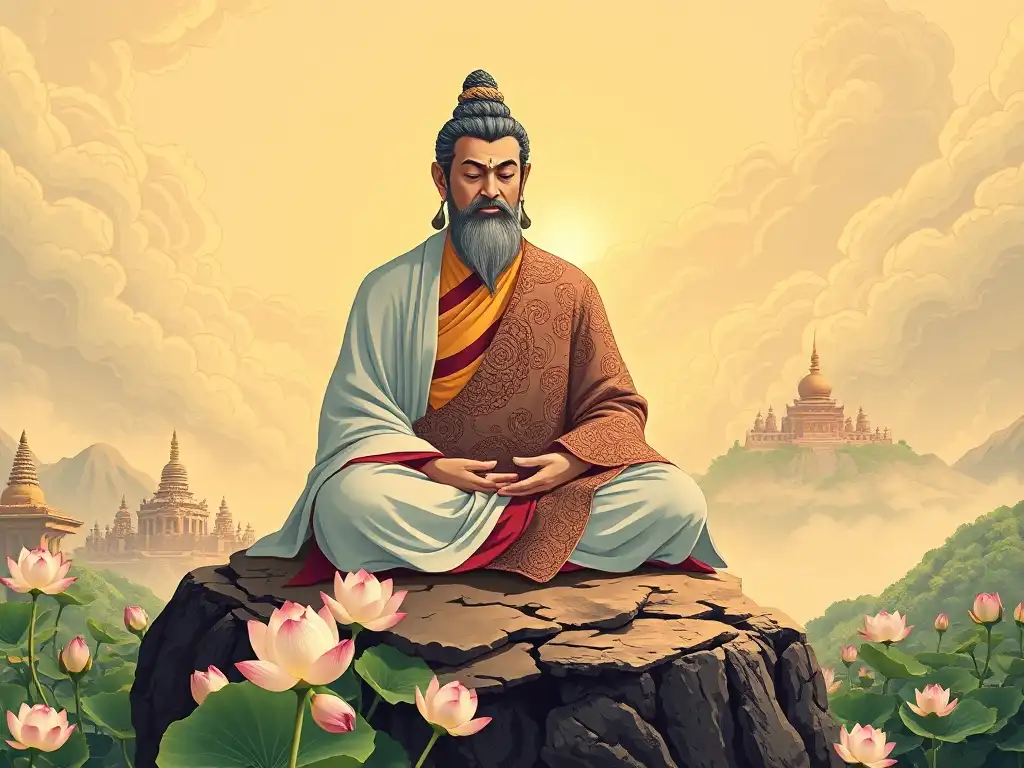
Nagarjuna, a pivotal figure in the development of Mahayana Buddhism, has left an indelible mark on Buddhist thought through his profound philosophical contributions. Often referred to as the "second Buddha," Nagarjuna's teachings have not only influenced the trajectory of Buddhist philosophy but have also permeated various aspects of spiritual and intellectual discourse within ancient Indian traditions.
His works, notably the Mūlamadhyamakakārikā (Fundamental Verses on the Middle Way), delve into the nature of reality, emptiness, and the interdependent origination of phenomena. This article aims to explore Nagarjuna's influence on Buddhism, examining his life, core concepts, and the methodologies he employed to articulate his philosophy.
Overview of Nagarjuna's Life and Background
Nagarjuna is believed to have lived in the 2nd to 3rd century CE, although precise dates remain uncertain. Born in South India, he is said to have been a follower of the Buddhist teachings from an early age, deeply influenced by the philosophical currents of his time. As he matured, he became a prominent scholar and monk, establishing monasteries and teaching across India. His philosophical inquiries were often a response to the prevailing views of his contemporaries, including both Buddhist and non-Buddhist schools of thought.
Nagarjuna's legacy is marked by his ability to synthesize and challenge existing doctrines, positioning himself as a central figure in the Madhyamaka school of thought. His works, characterized by a unique blend of rigorous analysis and poetic insight, continue to resonate with scholars and practitioners alike, underscoring the significance of his contributions to Buddhist philosophy.
Significance of Nagarjuna in Buddhist Philosophy
Nagarjuna's significance in Buddhist philosophy cannot be overstated. His interpretation of the concept of śūnyatā (emptiness) serves as a foundational element of Mahayana Buddhism. By arguing that all phenomena are empty of inherent existence, Nagarjuna opened up new avenues for understanding the nature of reality and the self. This perspective not only challenged the traditional views of permanence and essence but also emphasized the importance of dependent origination, illustrating how all things arise in relation to one another.
Furthermore, Nagarjuna's influence extends beyond the confines of Buddhism; his ideas have impacted various philosophical traditions, including those in the West. His dialectical method and critical approach to metaphysical assertions have inspired countless philosophers and thinkers, making him a crucial figure in the broader context of philosophical inquiry.
Understanding Nagarjuna's Philosophy
Core Concepts of Nagarjuna's Thought
Nagarjuna's philosophical framework is built upon several core concepts that collectively reshape the understanding of Buddhist teachings:
- Emptiness (śūnyatā): This concept posits that no object possesses an intrinsic, independent existence. Everything is contingent upon other factors, leading to the assertion that ultimate reality is devoid of inherent nature.
- Dependent Origination (pratītyasamutpāda): Nagarjuna elaborated on this fundamental Buddhist principle, emphasizing that all phenomena arise in dependence on causes and conditions. This interdependent nature of existence reflects the dynamic and relational quality of reality.
- Two Truths Doctrine: He introduced the distinction between conventional truth and ultimate truth, arguing that while phenomena may appear to have intrinsic existence at the conventional level, they are ultimately empty of such essence.
Nagarjuna's Methodology: Dialectical Reasoning
Nagarjuna's methodology is characterized by his use of dialectical reasoning, a technique that involves critical analysis and debate to reveal contradictions within established views. By employing this approach, he effectively dismantled rigid philosophical positions and encouraged a more nuanced understanding of the complexities of existence.
His dialectical method often involves:
- Contradiction and Negation: Nagarjuna would present opposing views and demonstrate their inconsistencies, leading to a deeper insight into the nature of reality.
- Use of Paradox: By embracing paradoxical statements, Nagarjuna highlighted the limitations of language and conceptual thinking, guiding practitioners towards direct experience of reality rather than mere intellectual understanding.
Through this innovative approach, Nagarjuna not only clarified key tenets of Buddhist philosophy but also fostered a spirit of inquiry that continues to influence Buddhist thought today.
Nagarjuna's Influence on Buddhist Schools
Nagarjuna, a prominent philosopher of the 2nd century CE, significantly impacted the development of various Buddhist schools, particularly through his advocacy for the concept of emptiness (śūnyatā). His philosophical insights laid the groundwork for Mahayana Buddhism, which emerged as a major branch of Buddhism, emphasizing the role of the bodhisattva and the pursuit of enlightenment for all sentient beings. Nagarjuna's dialectical method challenged existing interpretations of Buddhist teachings, fostering a nuanced understanding of reality that moved away from rigid dogmas.
Nagarjuna's influence is also evident in the way different Buddhist schools interpret and incorporate his teachings. While Mahayana Buddhism embraced his ideas, other schools, particularly Theravada Buddhism, had a more cautious approach. This dynamic interaction illustrates how Nagarjuna's philosophy has shaped and continues to shape the diverse landscape of Buddhist thought, encouraging ongoing dialogue and reinterpretation across various traditions.
Mahayana Buddhism and Nagarjuna's Impact
Mahayana Buddhism regards Nagarjuna as one of its principal thinkers, whose ideas of emptiness and interdependent origination have become foundational. His seminal work, the "Mulamadhyamakakarika" (Fundamental Verses on the Middle Way), articulates the concept that all phenomena are empty of inherent existence, which implies that reality is contingent upon various causes and conditions. This perspective allows for a more compassionate view of existence, reinforcing the Mahayana ideal of the bodhisattva, who seeks enlightenment not just for themselves but for all beings.
Nagarjuna’s philosophical approach also led to the formation of the Madhyamaka school, which emphasizes the middle path between existence and non-existence. The Madhyamaka framework encouraged Mahayana practitioners to transcend dualistic thinking, fostering a more profound understanding of Buddhist teachings. His influence can be traced throughout Mahayana texts, where his concepts have been utilized to elaborate on the nature of reality, the path to enlightenment, and the compassionate actions of a bodhisattva.
Theravada Buddhism's Response to Nagarjuna
Theravada Buddhism, while respecting Nagarjuna's contributions, has traditionally approached his ideas with caution. The Theravada school emphasizes the historical teachings of the Buddha and tends to adhere closely to the Pali Canon. While Nagarjuna's interpretations of emptiness and interdependence are acknowledged, they are often viewed through a different lens, focusing more on the individual path to enlightenment than the collective aspiration central to Mahayana thought.
In Theravada discourse, Nagarjuna’s ideas are sometimes seen as too abstract or philosophical, leading to a reluctance to fully integrate his teachings into their practice. Instead, Theravada practitioners emphasize the Four Noble Truths and the Eightfold Path as the primary means of achieving enlightenment. Nevertheless, Nagarjuna's influence has sparked discussions within Theravada circles, prompting scholars and practitioners to reassess the implications of his philosophy in relation to their own understanding of Buddhist teachings.
Key Texts by Nagarjuna
Nagarjuna's philosophical contributions are encapsulated in several key texts that have greatly influenced Buddhist thought. Foremost among these is the "Mulamadhyamakakarika," which serves as a foundational text for the Madhyamaka school of philosophy. Additionally, Nagarjuna authored various other works that address different aspects of Buddhist philosophy, ethics, and metaphysics, each contributing uniquely to the discourse and development of Buddhist thought.
Overview of "Mulamadhyamakakarika" and Its Importance
The "Mulamadhyamakakarika," often referred to as the "Fundamental Verses on the Middle Way," is considered Nagarjuna's most significant work. Comprising 447 verses, this text presents a systematic examination of various philosophical concepts, employing a dialectical method that critiques and deconstructs various views on existence and reality.
The paramount theme of the text is the concept of emptiness, which Nagarjuna articulates as the lack of inherent existence in all phenomena. By challenging the notions of intrinsic nature, Nagarjuna encourages readers to perceive the interconnectedness of all things, fostering a deeper understanding of the impermanent and contingent nature of reality. This text not only influenced Mahayana philosophy but has also been pivotal in shaping Buddhist logic, ethics, and metaphysics across various traditions.
Other Influential Works and Their Contributions
In addition to the "Mulamadhyamakakarika," Nagarjuna authored several other influential texts that further explore his philosophical ideas. Among these are:
- "Vigrahavyavartani" (The Refutation of Objections): In this work, Nagarjuna addresses common philosophical objections to his views on emptiness, reinforcing the importance of logical reasoning in Buddhist discourse.
- "Seventy Verses on Emptiness" (Sūnyatāsaptati): This text elaborates on the implications of emptiness in various contexts, providing insights into the nature of reality and the path to enlightenment.
- "Ratnavali" (Precious Garland): A work that combines philosophical discourse with practical ethical teachings, emphasizing the significance of virtue and compassion in the pursuit of enlightenment.
These texts collectively contribute to the richness of Nagarjuna's philosophical legacy, demonstrating his profound influence on the evolution of Buddhist thought and practice throughout history.
The Legacy of Nagarjuna in Modern Buddhism
Nagarjuna, a pivotal figure in Buddhist philosophy, is renowned for his profound contributions to the development of Mahayana Buddhism. His works, particularly the "Mūlamadhyamakakārikā" (Fundamental Verses on the Middle Way), have laid the groundwork for various interpretations and schools of thought within Buddhism. Nagarjuna’s central tenet of śūnyatā (emptiness) has had a lasting impact, promoting a view of reality that transcends dualistic thinking. In modern Buddhism, his legacy is evident in the emphasis on non-attachment and the interdependent nature of all phenomena, which continues to inspire practitioners around the globe.
Nagarjuna's influence is not confined to historical context; contemporary Buddhist teachers often draw on his teachings to address modern dilemmas. His insights into the nature of suffering and the path to enlightenment resonate deeply in today's fast-paced world, where mindfulness and compassion are increasingly relevant. The philosophical rigor of Nagarjuna encourages practitioners to engage with their beliefs critically, fostering a more profound understanding of the Dharma.
How Nagarjuna's Ideas Resonate Today
Nagarjuna's philosophy, particularly his concept of emptiness, offers a framework for understanding the nature of existence that remains pertinent in modern discussions about reality and perception. By teaching that all phenomena are empty of inherent existence, he invites us to reconsider our attachments and the solidity of our identities. This idea resonates strongly in contemporary mindfulness practices, where the emphasis is on observing thoughts and feelings without clinging to them.
Furthermore, Nagarjuna's dialectical method encourages an open-minded approach to philosophical inquiry, promoting dialogue between differing viewpoints. This is increasingly important in a world characterized by polarization and conflict. His teachings encourage individuals to recognize the validity of multiple perspectives, fostering a more compassionate understanding among diverse communities.
The Global Influence of Nagarjuna's Philosophy
The teachings of Nagarjuna have transcended cultural boundaries, influencing not only various Buddhist traditions but also intersecting with modern philosophical thought worldwide. His ideas have found resonance in Western philosophy, particularly in discussions around existentialism and postmodernism. Scholars and philosophers often reference his work when exploring themes of reality, perception, and the nature of truth.
In countries like Tibet, China, and Japan, Nagarjuna's influence has directly shaped the development of Buddhist schools such as Madhyamaka, Chan, and Zen. Each tradition interprets his teachings through its cultural lens, yet the core principles of interdependence and emptiness remain central. This cross-cultural dialogue underscores the universal relevance of Nagarjuna's ideas, making them a vital component of global philosophical discourse.
Conclusion: Nagarjuna's Enduring Impact on Buddhism
Nagarjuna's contributions to Buddhist thought are both profound and lasting, creating a philosophical framework that continues to inspire and challenge practitioners and scholars alike. His exploration of emptiness not only reshaped the landscape of Buddhism but also provided a lens through which to view the complexities of existence.
Summary of Nagarjuna's Influence on Buddhist Thought
Nagarjuna's influence on Buddhism is marked by his innovative interpretations of core Buddhist concepts. His teachings on emptiness and dependent origination have become foundational for many Mahayana schools. Moreover, his dialectical approach encourages a critical examination of beliefs, fostering a deeper engagement with the Dharma. This enduring legacy is reflected in the practices and philosophies of contemporary Buddhism, illustrating the timeless relevance of his insights.
Final Thoughts on the Relevance of Nagarjuna Today
As we navigate the complexities of the modern world, Nagarjuna's philosophy offers valuable guidance. His teachings encourage us to embrace uncertainty, cultivate compassion, and remain open to diverse perspectives. In a time when many seek clarity and understanding, Nagarjuna's insights into emptiness and interdependence provide a profound framework for personal and collective growth. By continuing to explore and apply his teachings, we honor his legacy and contribute to the ongoing evolution of Buddhist thought.
- Introduction to Nagarjuna's Influence on Buddhism
- Understanding Nagarjuna's Philosophy
- Nagarjuna's Influence on Buddhist Schools
- Key Texts by Nagarjuna
- The Legacy of Nagarjuna in Modern Buddhism
- Conclusion: Nagarjuna's Enduring Impact on Buddhism
Frequently Asked Questions
What is Nagarjuna's significance in Buddhism?
Nagarjuna is a pivotal figure in Buddhism known for developing Madhyamaka philosophy, which emphasizes the concept of emptiness. His teachings profoundly influenced Buddhist thought and practice.
How did Nagarjuna contribute to Buddhist philosophy?
Nagarjuna's philosophical innovations introduced critical ideas that challenged existing notions of reality and existence, leading to a deeper understanding of the Middle Way in Buddhism.
What are the main concepts introduced by Nagarjuna?
Key concepts introduced by Nagarjuna include sunyata (emptiness), the two truths doctrine, and the idea of dependent origination, which together form the foundation of Madhyamaka philosophy.
How has Nagarjuna's work influenced later Buddhist thinkers?
Nagarjuna's ideas laid the groundwork for later Buddhist philosophers, influencing schools such as Tibetan Buddhism and Zen, which continue to explore themes of emptiness and interconnectedness.
Where can I learn more about Nagarjuna's writings?
To delve deeper into Nagarjuna's philosophy, explore his texts like the Mulamadhyamakakarika (Fundamental Verses on the Middle Way) and various commentaries that discuss his impact on Buddhist thought.
Final Reflection: The Enduring Influence of Nagarjuna on Buddhism
Nagarjuna's philosophy remains profoundly relevant today, as it challenges us to reconsider the nature of reality and the path to enlightenment. In a world increasingly defined by dualities and rigid categorizations, Nagarjuna's teachings encourage us to embrace the complexity of existence and the interdependence of all things. His insights into emptiness and the Middle Way not only shaped Buddhist thought but also resonate with contemporary philosophical discussions, reminding us that the journey toward understanding is often non-linear and multifaceted.
The legacy of Nagarjuna continues to influence not just scholars and practitioners of Buddhism, but also the broader cultural and social landscape. His ideas have permeated various disciplines, from philosophy to psychology, encouraging a more nuanced approach to life’s challenges. As we navigate the complexities of modern existence, we can draw inspiration from Nagarjuna's emphasis on compassion and wisdom. The ultimate truth is beyond words, but it is through our actions that we can express it.
This notion invites us to reflect on how we can embody these principles in our daily lives, fostering a more harmonious and interconnected world.
As we conclude our exploration of Nagarjuna's influence on Buddhism, I invite you to reflect on how his teachings can inform your own life. Consider the ways in which you can apply the principles of emptiness and interdependence in your interactions and decisions. Let Nagarjuna's legacy inspire you to seek deeper understanding and compassion in your journey, reminding you that the path to enlightenment is not just a personal endeavor but a collective one that shapes the world around us.
Unveil the Wisdom of Nagarjuna: Take Action Today!
Thank you for diving into the profound legacy of Nagarjuna and exploring how his philosophy has shaped Buddhist thought. Your interest in this intricate topic opens the door to new perspectives and deeper understanding. Now, let’s transform that knowledge into action!
- Immerse Yourself: Spend 15 minutes today reading one of Nagarjuna's key texts and reflect on how it can apply to your life.
- Join the Conversation: Share your insights and interpretations in our community forum. Connect with others who are passionate about Buddhist philosophy!
- Explore Further: Follow our website for upcoming articles that delve deeper into other influential thinkers and philosophies throughout ancient Indian history.
Which aspect of Nagarjuna's philosophy resonates with you the most, and how do you plan to incorporate it into your daily routine?