
The Genius of Aryabhata: Revolutionizing Mathematics in Ancient India


Welcome to Ancient India History, where we embark on an enlightening journey through the fascinating tapestry of ancient Indian civilizations. Dive deep into the remarkable contributions that have shaped our understanding of the world, starting with the extraordinary mathematical innovations of Aryabhata. This brilliant mind not only revolutionized mathematical thought in ancient India but also laid the groundwork for future advancements. Are you ready to uncover the genius of Aryabhata and discover how his insights continue to influence mathematics today? Let’s explore!
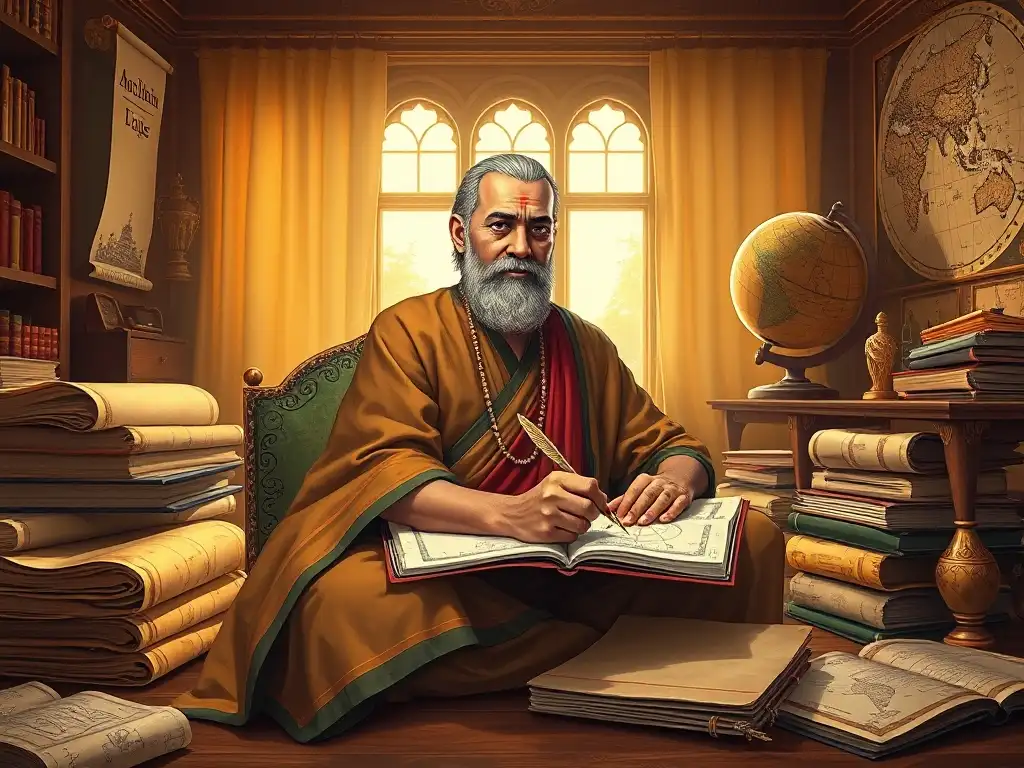
Introduction to Aryabhata
Aryabhata, an illustrious figure in the realm of mathematics and astronomy, emerged as a beacon of knowledge during a time when the Indian subcontinent was rich with intellectual pursuits. Born in 476 CE in the city of Kusumapura (modern-day Patna), Aryabhata's work laid the foundation for numerous mathematical concepts that would influence scholars for centuries.
His magnum opus, the Aryabhatiya, encapsulates not only his mathematical discoveries but also reflects the cultural and scientific advancements of ancient India. As we delve into the contributions of Aryabhata to mathematics, we uncover a legacy that not only revolutionized mathematical thought in India but also resonated across civilizations, making Aryabhata a pivotal figure in the global history of science.
Overview of Aryabhata's Life and Era
Aryabhata lived during the Gupta Empire, a period often heralded as the Golden Age of India, where arts, science, and philosophy flourished. This era provided the fertile ground for intellectual endeavors, allowing Aryabhata to thrive as a mathematician and astronomer. His early education and influences are believed to have stemmed from the renowned Nalanda University, a cradle of learning known for its rigorous scholarship.
His life was characterized by a relentless pursuit of knowledge, where he sought to address the mathematical challenges of his time. Aryabhata's contributions are not merely historical footnotes; they reflect a profound understanding of mathematics and its applications, setting the stage for future scholars.
Importance of Aryabhata in Ancient Indian Mathematics
Aryabhata's significance in ancient Indian mathematics cannot be overstated. He is often regarded as the first major mathematician and astronomer of the classical era. His work introduced a systematic approach to mathematics, moving beyond mere arithmetic calculations to the realms of abstraction and theory. He effectively bridged the gap between practical mathematics used in daily life and the theoretical frameworks that underpin advanced mathematical concepts.
Moreover, Aryabhata's influence extended beyond India, impacting scholars in the Islamic world and Europe, where his works were translated and studied. His emphasis on a decimal place-value system and the introduction of zero were revolutionary steps that paved the way for the modern numerical system we utilize today.
Aryabhata's Contributions to Mathematics
Aryabhata's contributions to mathematics are vast and varied, encapsulating key concepts that have stood the test of time. His work in the Aryabhatiya encompasses arithmetic, algebra, and geometry, showcasing his profound understanding and innovative spirit. Below, we explore some of the key aspects of Aryabhata's mathematical contributions.
Key Mathematical Concepts Introduced by Aryabhata
Aryabhata is credited with several pioneering concepts that would shape the future of mathematics:
- Place Value System: Aryabhata was one of the first to adopt a decimal place-value system, which allowed for more efficient calculations.
- The Concept of Zero: Though used in various forms earlier, Aryabhata formalized the concept of zero, which has become a fundamental element in mathematics.
- Approximation of π (Pi): He approximated π to four decimal places (3.1416), demonstrating an understanding of circles that was far ahead of his time.
These concepts not only enhanced mathematical calculations but also influenced subsequent mathematicians and scholars across various cultures.
Aryabhata's Innovations in Arithmetic
Aryabhata's innovative approach to arithmetic is evident in his methods for performing calculations. He introduced techniques for:
- Multiplication and Division: Aryabhata developed systematic procedures for multiplication and division, including rules for simplification.
- Square and Cube Roots: He provided methods for extracting square and cube roots, which laid the groundwork for further exploration in algebra and geometry.
These innovations simplified complex calculations and made arithmetic more accessible, aiding in the progression of mathematical study in ancient India.
Advancements in Algebra by Aryabhata
In the realm of algebra, Aryabhata's contributions are equally significant. He formulated rules for solving linear equations and introduced algorithms for computing unknowns. His work in algebra included:
- Algebraic Identities: Aryabhata identified and utilized various algebraic identities that are foundational to modern algebra.
- Use of Letters: He employed letters to denote unknown quantities, a practice that is a precursor to modern algebraic notation.
Through these advancements, Aryabhata not only enriched the field of mathematics but also established a methodology that would be adopted by future mathematicians, ensuring his influence persisted through the ages.
Aryabhata's Work on Astronomy and Its Mathematical Implications
Aryabhata, one of the most renowned mathematicians and astronomers of ancient India, made significant contributions that intertwined the fields of mathematics and astronomy. His seminal work, the Aryabhatiya, written in 499 CE, not only provided insights into astronomical phenomena but also laid the groundwork for mathematical principles that would be utilized for centuries. Aryabhata approached astronomy with a unique perspective, emphasizing the importance of mathematical precision in understanding celestial movements.
In his calculations, Aryabhata introduced concepts that were groundbreaking for his time, such as the approximation of π (pi) as 3.1416. This level of accuracy was crucial for calculating the circumferences of celestial bodies and understanding their movements. Furthermore, his work on time measurement and the division of the day into 24 hours reflected an advanced comprehension of timekeeping that was essential for astronomical observations.
The Relationship Between Mathematics and Astronomy in Aryabhata's Work

The relationship between mathematics and astronomy in Aryabhata's work is marked by a profound integration of numerical analysis and celestial mechanics. Aryabhata viewed the universe through a mathematical lens, which allowed him to formulate theories that explained the apparent motion of stars and planets. He utilized arithmetic and algebraic techniques to derive formulas for calculating eclipses and planetary positions, demonstrating a sophisticated understanding of both disciplines.
For instance, Aryabhata's method of using sine tables was revolutionary, as it provided a systematic way to calculate the angles and distances between celestial bodies. His recognition of the Earth’s rotation as the cause of the apparent movement of stars underscored his innovative approach. This relationship not only advanced the field of astronomy in India but also set a precedent for future scholars who would rely on mathematical frameworks to explore cosmic phenomena.
Aryabhata's Methods for Calculating Planetary Positions
Aryabhata developed a series of mathematical procedures for accurately calculating the positions of planets, which were essential for creating astronomical models. His methods involved the use of sine functions and geometric principles, allowing him to predict planetary movements with remarkable accuracy. He introduced a systematic approach to trigonometry, which included the calculation of sine values and their application to celestial navigation.
One of Aryabhata's notable contributions was the formulation of a model for planetary motion that accounted for both the elliptical orbits of planets and their periodicity. He provided algorithms for determining the longitudes and latitudes of celestial bodies, which were crucial for astrological predictions and calendar making. His meticulous calculations laid the groundwork for later advancements in both Indian and Islamic astronomy.
The Impact of Aryabhata's Contributions on Future Generations
Aryabhata's contributions significantly impacted not only his contemporaries but also future generations of mathematicians and astronomers. His pioneering work inspired further research and exploration in both fields, leading to advancements that would shape the future of mathematics in India and beyond. The methodologies he established became foundational for subsequent scholars, who built upon his theories to refine and expand the understanding of astronomy and mathematics.
Influence on Later Mathematicians in Ancient India
The influence of Aryabhata's work on later mathematicians in ancient India is evident in the writings of figures such as Brahmagupta and Bhaskara. These scholars adopted and adapted Aryabhata's mathematical techniques, particularly in the areas of arithmetic, algebra, and astronomy. Brahmagupta, for instance, expanded on Aryabhata's concepts of zero and negative numbers, contributing to a more comprehensive understanding of mathematical principles.
Moreover, Aryabhata's emphasis on systematic calculation and rigorous proofs set a standard for mathematical practice in India. His legacy continued through the Brahmasphutasiddhanta of Brahmagupta and the Lilavati of Bhaskara II, which reflected Aryabhata's influence on the evolution of mathematics in the subcontinent.
Aryabhata's Legacy in Global Mathematics
Aryabhata's legacy extends beyond the borders of India, influencing the global mathematical community. His methods and insights were transmitted to the Islamic world, where scholars translated his works and incorporated his mathematical techniques into their own research. The introduction of concepts such as sine and trigonometric functions from Aryabhata's work played a vital role in the development of mathematics during the Islamic Golden Age.
As European mathematicians later encountered these translations, Aryabhata's contributions began to permeate Western mathematics as well. His pioneering work laid the groundwork for future advancements in calculus and astronomy, making him a key figure in the history of mathematics that transcends cultural and geographical boundaries. Today, Aryabhata is celebrated not only as a mathematician but also as a pivotal contributor to the collective knowledge of the human understanding of the universe.
Comparison of Aryabhata's Contributions with Other Ancient Mathematicians

Aryabhata's contributions to mathematics stand out not only for their originality but also for their profound influence on subsequent scholars. When comparing his work with that of other ancient mathematicians, such as Brahmagupta, and considering the broader mathematical traditions in Greece and China, several similarities and differences emerge. Aryabhata's approach to mathematical concepts, particularly in the fields of arithmetic, algebra, and astronomical calculations, showcases both unique methodologies and shared themes with his contemporaries and predecessors.
Similarities and Differences with Brahmagupta
Brahmagupta, another eminent mathematician from ancient India, made significant strides in algebra and number theory. Both Aryabhata and Brahmagupta contributed to the understanding of zero and its operations, but their approaches differed. Aryabhata, in his seminal work "Aryabhatiya," emphasized an abstract and theoretical framework, focusing on the principles of mathematics as a discipline. In contrast, Brahmagupta's "Brahmasphutasiddhanta" provided practical applications, offering solutions to real-world problems, including rules for handling debts and partnerships.
While both mathematicians were innovative in their own rights, Aryabhata is credited with introducing the concept of place value and the use of trigonometric functions, which were not as emphasized in Brahmagupta’s work. Additionally, Aryabhata's method of calculating the area of a triangle and the volume of a sphere showcased a geometric approach that was distinct from Brahmagupta's algebraic focus. This divergence highlights the evolution of mathematical thought in ancient India, with Aryabhata laying the groundwork for future developments.
Contrasts with Other Cultures: Greek and Chinese Mathematicians
When contrasting Aryabhata's contributions with those of Greek and Chinese mathematicians, notable differences in methodology and focus become apparent. Greek mathematicians, such as Euclid and Archimedes, emphasized geometric proofs and theorems. In contrast, Aryabhata's work was more algebraic and computational, indicating a shift toward practical applications of mathematics. For instance, while Euclid’s "Elements" laid down the foundations of geometry, Aryabhata's emphasis on the decimal system and arithmetic operations demonstrated a more advanced numerical understanding.
Chinese mathematicians, such as Liu Hui and Sun Zi, also made significant advancements in mathematics, particularly in arithmetic and geometry. However, Aryabhata’s introduction of sine and cosine functions was a groundbreaking development that was not mirrored in Chinese mathematical texts until much later. Furthermore, Aryabhata's approach to astronomical calculations, including the approximation of π (pi) and the use of fractions, showcased a level of sophistication that set his work apart from his contemporaries in both Greece and China.
Conclusion: The Lasting Legacy of Aryabhata in Mathematics
Aryabhata’s impact on mathematics is profound and enduring, influencing not only his contemporaries but also future generations of mathematicians across the world. His innovative concepts and methods have laid the groundwork for many mathematical principles still in use today.
Summary of Aryabhata's Major Contributions
Aryabhata's major contributions include the introduction of the concept of zero, advancements in the decimal system, the calculation of square roots, and the establishment of sine and cosine in trigonometry. His work on the approximation of π as 3.1416 and his methods for solving quadratic equations also highlight his mathematical genius. Moreover, Aryabhata's astronomical observations and calculations, particularly regarding the Earth's rotation and the moon's motion, reflect a comprehensive understanding of both mathematics and science.
The Significance of Aryabhata in the Context of Ancient Indian Civilization
In the broader context of ancient Indian civilization, Aryabhata's contributions represent a pivotal moment in the evolution of mathematics and astronomy. His work not only signifies a high level of intellectual achievement but also illustrates the cultural and scholarly advancements of the time. Aryabhata’s legacy transcends geographical boundaries, as his ideas were absorbed into the mathematical traditions of other cultures, influencing scholars in the Islamic world and later European mathematicians. His emphasis on logical reasoning and systematic problem-solving continues to inspire modern mathematics, ensuring that his genius remains relevant in contemporary times.
Further Reading on Aryabhata and Ancient Indian Mathematics
To gain a deeper understanding of Aryabhata's contributions to mathematics and the broader context of ancient Indian mathematics, it is essential to explore various resources that delve into his life, works, and the intellectual environment of his time. Below are recommendations for books, articles, and online resources that provide valuable insights into Aryabhata's genius and the mathematical advancements in ancient India.
Recommended Books and Articles on Aryabhata's Contributions
-
"Aryabhata: The Man Who Knew Infinity" by A. S. M. S. A. Shastri
This biography not only sheds light on Aryabhata's life but also explores his major works, including the Aryabhatiya. It provides a comprehensive view of his mathematical theories and their impact on subsequent generations.
-
"The Mathematics of India" by G. N. Tiwari
This book covers various Indian mathematicians, emphasizing the foundational principles laid by Aryabhata. It includes discussions on the significance of his innovations in arithmetic, algebra, and astronomy.
-
"Aryabhata’s Place in the History of Mathematics" by K. R. Rao
An insightful article that places Aryabhata within the historical context of mathematics, examining his contributions in detail and their influence on both Indian and global mathematical traditions.
-
"The Aryabhatiya of Aryabhata" (translated and annotated by C. T. Rajagopal)
This is a translated version of Aryabhata's seminal work, providing modern readers with access to his original text along with annotations that clarify complex concepts and their relevance today.
-
"Mathematical Thought from Ancient to Modern Times" by Morris Kline
Although not exclusively focused on Aryabhata, this work provides a broader historical perspective on mathematics, including significant contributions from Indian mathematicians, with Aryabhata as a pivotal figure.
Online Resources for Exploring Ancient Indian Mathematics
- The Indian Mathematical Society: This organization offers a wealth of resources, including articles, journals, and conference papers focused on the history of mathematics in India, featuring topics on Aryabhata and his methodologies.
- The MacTutor History of Mathematics Archive: A comprehensive online database that includes a dedicated section on Aryabhata, discussing his life, works, and the mathematical concepts he introduced.
- World Digital Library: This online resource features historical documents and manuscripts, including translations and interpretations of Aryabhata's works, allowing users to explore his contributions in-depth.
- YouTube Lectures and Documentaries: Various educational channels provide visual explanations of Aryabhata's theories and their mathematical significance. These resources often include discussions from mathematicians and historians specializing in ancient Indian mathematics.
- Online Courses and MOOCs: Platforms like Coursera and edX occasionally offer courses that include modules on ancient Indian mathematics, providing insights into Aryabhata’s contributions within a wider mathematical framework.
By engaging with these recommended readings and online resources, enthusiasts and scholars can develop a robust understanding of Aryabhata's profound influence on mathematics and the legacy of ancient Indian scholars in this field.
- Introduction to Aryabhata
- Aryabhata's Contributions to Mathematics
- Aryabhata's Work on Astronomy and Its Mathematical Implications
- The Relationship Between Mathematics and Astronomy in Aryabhata's Work
- Aryabhata's Methods for Calculating Planetary Positions
- The Impact of Aryabhata's Contributions on Future Generations
- Comparison of Aryabhata's Contributions with Other Ancient Mathematicians
- Conclusion: The Lasting Legacy of Aryabhata in Mathematics
- Further Reading on Aryabhata and Ancient Indian Mathematics
Frequently Asked Questions
What were Aryabhata's major contributions to mathematics?
Aryabhata made significant contributions such as the introduction of the concept of zero, the calculation of pi, and the formulation of methods for solving quadratic equations.
How did Aryabhata influence later mathematicians?
His work laid the foundation for future mathematicians in India and beyond, influencing scholars like Brahmagupta and Bhaskara in their mathematical explorations.
What is Aryabhata's most famous work?
His most famous work, the Aryabhatiya, is a comprehensive treatise that covers arithmetic, algebra, and astronomy, showcasing his innovative approaches.
How did Aryabhata's work spread to other cultures?
Aryabhata's texts were translated into Arabic and later into Latin, which helped disseminate his ideas across Middle Eastern and European cultures during the medieval period.
What was Aryabhata's approach to astronomy?
Aryabhata proposed that the Earth rotates on its axis and accurately calculated the length of the solar year, marking a significant advancement in the understanding of astronomy in ancient times.
Final Reflection: The Enduring Legacy of Aryabhata's Mathematical Genius
The contributions of Aryabhata to mathematics are not just relics of ancient history; they are foundational pillars that continue to shape our understanding of the world today. In an era where technology and mathematics intertwine more than ever, the brilliance of Aryabhata serves as a reminder of the profound impact that one individual's intellect can have on the trajectory of human knowledge. His pioneering work in areas such as the place value system and the concept of zero resonates in every calculation we perform today, underscoring the timeless relevance of his discoveries.
Culture and society have been significantly influenced by Aryabhata's innovations, which laid the groundwork for future mathematicians and scientists across the globe. His insights not only advanced mathematics but also inspired generations to pursue knowledge and inquiry. As we reflect on his contributions, we are reminded of the words of the mathematician Carl Friedrich Gauss: Mathematics is the queen of the sciences and number theory is its crown jewel.
Aryabhata's work exemplifies this sentiment, showcasing how mathematical exploration can illuminate the path for countless disciplines.
As we move forward, let us embrace the spirit of inquiry and innovation that Aryabhata embodied. I invite you to reflect on how you can apply his lessons of curiosity and perseverance in your own life. Whether it’s through pursuing mathematics, supporting scientific endeavors, or simply fostering a mindset of exploration, each of us has the potential to contribute to the ongoing legacy of knowledge. Let Aryabhata's genius inspire you to push boundaries and seek out the extraordinary in the ordinary, for the world is still ripe with discoveries waiting to be made.
Unleash Your Inner Mathematician!
Thank you for diving into the remarkable legacy of Aryabhata and his revolutionary contributions to mathematics! Your journey through ancient Indian brilliance has opened the door to understanding the profound impact mathematicians have on our world today. Now, it’s time to take this knowledge further and engage with the wonders that mathematics offers.
Here’s how you can connect and explore the topic even deeper:
- Immerse Yourself: Challenge yourself with a mathematical puzzle inspired by Aryabhata's concepts. Try solving problems that utilize the principles of astronomy and algebra he formulated.
- Share the Wisdom: Spread the knowledge! Discuss Aryabhata's influence on mathematics with friends or on social media. Engage others in learning about this incredible figure.
- Join a Community: Explore local or online communities dedicated to mathematics. Share your insights and learn from others who are equally passionate about the subject.
What aspect of Aryabhata's work do you find most inspiring, and how do you plan to incorporate it into your life?