
The Legacy of Brahmagupta: Pioneering Work in Algebra and Numerals


Welcome to Ancient India History, where we embark on a captivating journey through the rich tapestry of ancient Indian civilizations. Today, we delve into the remarkable contributions of Brahmagupta—a luminary whose pioneering work in algebra not only shaped mathematics but also laid the groundwork for future scholars. What secrets did this brilliant mind uncover, and how did his discoveries influence the world?
Prepare to be intrigued as we explore the legacy of Brahmagupta and his transformative impact on the realm of numbers. Join us in unraveling the mysteries of ancient mathematics and discover the profound connections that echo through time.

Introduction to Brahmagupta's Contributions to Algebra
Brahmagupta, an eminent mathematician and astronomer of ancient India, made groundbreaking contributions to the field of algebra that continue to influence modern mathematics. Active during the 7th century CE, Brahmagupta's work emerged during a period when mathematical thought was blossoming in India. His treatises not only provided foundational principles of algebra but also introduced concepts related to numbers, equations, and the use of zero, thereby shaping the course of mathematical history. This article explores Brahmagupta's significant contributions to algebra, examining how his innovations laid the groundwork for future mathematicians and enriched the numerical systems of ancient India.
Overview of Brahmagupta's Life and Era
Brahmagupta was born in the region of present-day Rajasthan, India, around 598 CE. He was the son of a mathematician and grew up in an environment steeped in mathematical inquiry. His most notable work, the Brahmasphutasiddhanta, written in 628 CE, is a comprehensive text that encompasses both mathematical and astronomical concepts.
This era in India was marked by a thriving intellectual culture, where scholars engaged in deep explorations of various fields, including mathematics, astronomy, and philosophy. Brahmagupta's contributions can be viewed as a culmination of this rich tradition, as he synthesized knowledge from earlier works and provided new insights that transformed mathematical thought.
Significance of Brahmagupta in Ancient Indian Mathematics
Brahmagupta's significance in the realm of ancient Indian mathematics cannot be overstated. He is often credited with formalizing the rules of arithmetic and algebra, particularly regarding operations with negative numbers and zero. His assertion that zero is a number and can be used in calculations was revolutionary and paved the way for its eventual acceptance in mathematics globally.
Furthermore, he was one of the first to address the solution of quadratic equations, providing systematic methods for solving them. Brahmagupta's work is not only a testament to his genius but also reflects the advanced nature of mathematical understanding in ancient India, making him a pivotal figure in the history of mathematics.
Key Contributions of Brahmagupta to Algebra
Brahmagupta's contributions to algebra are manifold, ranging from foundational principles to innovative concepts that were ahead of his time. His writings serve as a critical link between ancient and modern mathematics, illustrating the evolution of algebraic thought over centuries.
The First Comprehensive Algebraic Text
The Brahmasphutasiddhanta is recognized as one of the first comprehensive texts on algebra. In it, Brahmagupta elaborates on various operations involving numbers, including addition, subtraction, multiplication, and division. He introduced clear definitions and rules for handling both positive and negative numbers, which was revolutionary for his time. This text provided methods for solving linear and quadratic equations and laid the groundwork for future algebraic studies. Brahmagupta's systematic approach to these topics ensured that his work was accessible and applicable, influencing generations of mathematicians.
Innovations in Algebraic Concepts
Brahmagupta's innovations extended beyond mere calculations; he introduced fundamental concepts that redefined algebra. Notably, he formulated rules for the manipulation of zero, emphasizing how it can interact with other numbers in calculations. He also explored the properties of numbers, including the treatment of fractions and the concept of the "rule of signs" for determining the signs of products and quotients.
His methods for solving quadratic equations were particularly advanced, as he provided solutions to equations of the form \( ax^2 + bx + c = 0 \) and even discussed cases with no real solutions. The clarity and depth of his work mark a significant milestone in the history of algebra, showcasing his role as a pioneer in the development of mathematical thought.
Brahmagupta's Numerical System
Brahmagupta, a prominent mathematician and astronomer from ancient India, made significant strides in the development of numerical systems, particularly through his seminal work, Brahmasphutasiddhanta, written in 628 CE. His numerical system was revolutionary, introducing concepts that formed the foundation of algebra as we know it today.
One of his key contributions was the establishment of zero as a number, not merely a placeholder. This concept was critical in simplifying calculations and facilitating the development of advanced arithmetic operations. Brahmagupta's system allowed for the representation of numbers in a positional format, which greatly enhanced the efficiency of mathematical operations.
Development of Indian Numerals
The numerical system established by Brahmagupta laid the groundwork for what would later evolve into the modern decimal system. His work included rules for arithmetic operations—addition, subtraction, multiplication, and division—along with methods for solving linear and quadratic equations. Notably, Brahmagupta presented a systematic approach to calculating the area of geometric shapes, using numerical coefficients that illustrated the practical applications of his theories in real-world contexts.
Additionally, his treatise included guidelines for handling negative numbers, which was uncommon in mathematical literature at the time. Brahmagupta’s insights into the use of negative numbers expanded the possibilities of problem-solving and algebraic manipulation, marking a significant advancement in the numerical landscape of ancient India.
Impact of Brahmagupta's Numerical Innovations
Brahmagupta's innovations in numerical systems had far-reaching implications. By establishing a clear understanding of operations involving zero and negative numbers, he set a precedent for future mathematicians. His systematic approach not only facilitated calculations but also improved the accuracy of astronomical predictions, which were crucial for navigation and calendar calculations in ancient India.
Moreover, the clarity of his numerical system influenced the way mathematics was taught and practiced in ancient Indian society. As his works circulated, they provided a framework for scholars to build upon, leading to further developments in mathematics and astronomy. His methodologies were adopted and adapted by subsequent generations, enhancing the overall mathematical literacy of the civilization.
The Impact of Brahmagupta's Work on Future Generations
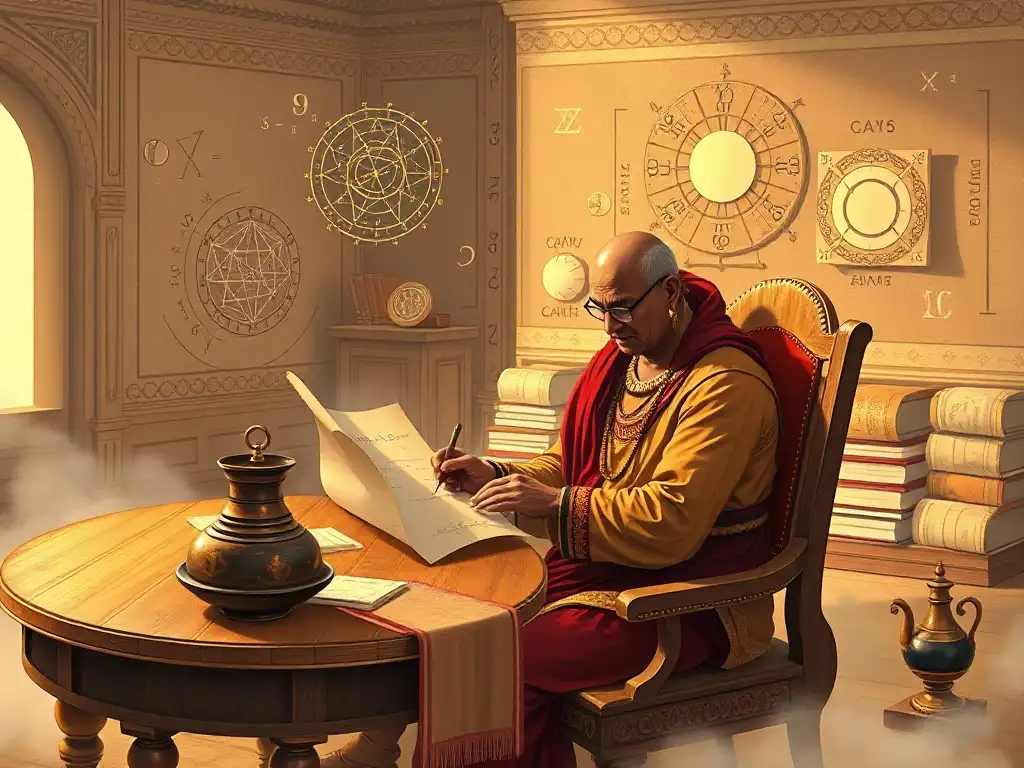
Brahmagupta's contributions to algebra and numerical systems did not remain confined to ancient India; they reverberated through time and geography, influencing various cultures and mathematical traditions.
Influence on Islamic Mathematics
The translations of Brahmagupta's works into Arabic played a crucial role in the development of Islamic mathematics. Scholars such as Al-Khwarizmi, who is often referred to as the "father of algebra," drew heavily from Brahmagupta's principles. The algebraic methods and numerical innovations outlined in Brahmasphutasiddhanta were integrated into the broader mathematical discourse of the Islamic Golden Age, leading to significant advancements in both pure and applied mathematics.
The adoption of Brahmagupta's concepts by Islamic mathematicians facilitated the spread of these ideas to Europe, particularly during the Middle Ages, when the Latin translations of Arabic texts emerged. This cross-cultural exchange laid the groundwork for the Renaissance and the eventual establishment of modern mathematics.
Lasting Legacy in Modern Mathematics
The legacy of Brahmagupta is evident in contemporary mathematics, particularly in the use of the decimal system and the conceptualization of zero. His work on algebra set the stage for future mathematicians to explore complex equations and develop advanced mathematical theories.
Even today, educational systems around the world recognize the importance of zero and negative numbers—concepts that Brahmagupta articulated centuries ago. His influence can be seen in various fields, including computer science, engineering, and economics, where numerical systems play a critical role.
Brahmagupta's contributions to algebra and numerical systems represent a pivotal moment in the history of mathematics, showcasing the profound impact that ancient Indian scholars had on the development of mathematical thought globally.
Conclusion: The Enduring Legacy of Brahmagupta
Brahmagupta's contributions to algebra and numerals are not merely historical footnotes; they represent a significant leap in the development of mathematical thought. His innovative work laid the groundwork for future mathematicians in India and beyond, influencing various fields such as astronomy, commerce, and geometry. By introducing systematic approaches to solving quadratic equations and defining rules for arithmetic operations involving zero and negative numbers, Brahmagupta provided invaluable tools that transformed mathematical practices.
Moreover, the principles and methods he articulated in his seminal text, Brahmasphutasiddhanta, continue to resonate in modern mathematics, highlighting the universal relevance of his ideas. His legacy is not only evident in the advancements of mathematics but also in the broader cultural appreciation for the logical and abstract thinking that it nurtures.
Summary of Brahmagupta's Contributions to Algebra and Numerals
Brahmagupta's work is characterized by several pivotal contributions:
- Rules for Arithmetic Operations: He established clear rules for the operations of addition, subtraction, multiplication, and division, particularly focusing on the treatment of zero and negative numbers.
- Quadratic Equations: Brahmagupta made significant strides in solving quadratic equations, providing methods that were algorithmic in nature and accessible.
- Numerical Notation: His advocacy for the place-value system and the use of zero in calculations marked a turning point in mathematical notation, allowing for greater computational efficiency.
- Practical Applications: He emphasized the application of mathematics to real-world problems, particularly in fields such as astronomy and land measurement, thereby demonstrating the practical utility of algebra.
These contributions collectively cemented his place as a pioneering figure in mathematics, with effects felt long after his time.
Reflection on the Importance of Preserving Ancient Mathematical Knowledge
Preserving ancient mathematical knowledge is crucial for several reasons:
- Cultural Heritage: Ancient mathematics reflects the intellectual achievements of civilizations. Understanding these contributions helps preserve the cultural identity and historical context of mathematical development.
- Educational Value: The methods and concepts developed by mathematicians like Brahmagupta serve as foundational knowledge for students and scholars. They provide insights into problem-solving techniques and the evolution of mathematical thought.
- Innovation Inspiration: Ancient mathematical principles often contain timeless wisdom that can inspire modern innovations. By studying historical contributions, contemporary mathematicians and scientists can draw upon a rich reservoir of ideas.
- Interdisciplinary Connections: The study of ancient mathematics fosters connections between various fields, including history, philosophy, and science. It illuminates how mathematical ideas intersect with broader human endeavors.
Brahmagupta's pioneering work in algebra and numerals not only shaped the mathematical landscape of his time but also continues to inspire and inform current mathematical practices. Preserving this knowledge is essential for honoring our intellectual heritage and fostering future advancements in mathematics and related disciplines.
- Introduction to Brahmagupta's Contributions to Algebra
- Key Contributions of Brahmagupta to Algebra
- Brahmagupta's Numerical System
- The Impact of Brahmagupta's Work on Future Generations
- Conclusion: The Enduring Legacy of Brahmagupta
Frequently Asked Questions
What are Brahmagupta's main contributions to algebra?
Brahmagupta is known for his foundational work in algebra, particularly his rules for solving quadratic equations. He also introduced concepts such as zero as a number and the use of negative numbers.
How did Brahmagupta influence later mathematicians?
His innovative algebraic methods and writings laid the groundwork for later mathematicians in both India and the Islamic world, significantly impacting the development of mathematics.
What is the significance of Brahmagupta's book "Brahmasphutasiddhanta"?
"Brahmasphutasiddhanta" is a key text that outlines Brahmagupta's theories on mathematics and astronomy. It includes his rules for arithmetic operations and contributions to algebra.
In what ways did Brahmagupta address the concept of zero?
Brahmagupta was one of the first to formalize the concept of zero in arithmetic, defining it as a number that represents nothing and laying the foundation for its use in calculations.
How did Brahmagupta's work influence the Gupta Empire?
Brahmagupta's mathematical advancements played a crucial role in the intellectual flourishing of the Gupta Empire, contributing to its reputation as a center for science and learning in ancient India.
Final Reflection: Embracing Brahmagupta's Legacy in Modern Mathematics
Brahmagupta's contributions to algebra are not merely historical footnotes; they are foundational pillars that continue to shape our understanding of mathematics today. As we navigate an increasingly complex world, the principles established by Brahmagupta remind us of the timeless nature of mathematical inquiry and its profound impact on various fields, from science to technology. His work serves as a testament to the enduring power of knowledge and innovation, urging us to appreciate the roots of our current mathematical practices.
Cultural and social landscapes have been significantly influenced by Brahmagupta's groundbreaking ideas. His introduction of zero and rules for solving quadratic equations not only revolutionized mathematics in his time but also laid the groundwork for future generations. As we reflect on his legacy, we recognize that his contributions transcended geographical boundaries and cultural divides, fostering a global dialogue in mathematics. Mathematics knows no races or geographic boundaries; for mathematics, the cultural world is one country.
This quote encapsulates the universal nature of Brahmagupta's work, emphasizing how his insights continue to resonate across diverse cultures and societies.
As we look to the future, let us take a moment to reflect on how we can embody Brahmagupta's spirit of curiosity and innovation in our own lives. Consider how you can apply the lessons from his contributions to algebra in your daily pursuits, whether in academic endeavors, professional challenges, or personal growth. Embrace the idea that every problem has a solution waiting to be discovered, and let Brahmagupta's legacy inspire you to explore, question, and innovate in your own journey through mathematics and beyond.
Unveil the Legacy of Brahmagupta and Ignite Your Journey in Mathematics!
Thank you for diving into the fascinating world of Brahmagupta's contributions to algebra and numerals! Your interest not only enriches your knowledge but also helps keep the spirit of ancient innovation alive. Now, it’s time to take that inspiration and transform it into action.
Here are some engaging ways you can explore and honor Brahmagupta's legacy:
- Delve Deep: Research and explore more about Brahmagupta's works. Consider reading his original texts and various interpretations to appreciate his profound insights into mathematics.
- Share & Discuss: Engage in conversations with friends or participate in online communities about how Brahmagupta’s principles can be applied in modern mathematics. Share your insights on social media to inspire others!
- Explore Further: Challenge yourself with problems inspired by ancient Indian mathematics. Tackle algebraic equations that reflect the historical context of Brahmagupta’s era.
What aspect of Brahmagupta's work inspires you the most, and how do you think it shapes our understanding of mathematics today?