
The Philosophical Debates in the Upanishads: Key Thinkers and Ideas

Welcome to Ancient India History, where we embark on a journey through the tapestry of time, exploring the rich and diverse history, culture, and contributions of ancient Indian civilizations. Today, we delve into the Philosophy of Upanishads thinkers, uncovering the profound debates that shaped the spiritual and intellectual landscape of India. What insights did these early philosophers offer, and how do their ideas resonate in our world today? Join us as we unravel the mysteries of the Upanishads and the remarkable thinkers behind them, igniting your curiosity and inspiring a deeper understanding of ancient Indian religions.
Introduction to the Philosophy of Upanishads Thinkers
The Upanishads, often regarded as the culmination of Vedic thought, represent a profound philosophical tradition that explores the nature of reality, the self (Atman), and the ultimate principle of the universe (Brahman). Emerging around 800 to 400 BCE, these texts mark a pivotal transition from ritualistic practices to introspective philosophy, inviting thinkers to engage in deep contemplation about existence and consciousness. The philosophy of Upanishads thinkers not only laid the groundwork for subsequent Hindu philosophical schools but also influenced broader discussions in Indian thought, ethics, and spirituality.
Within the Upanishadic discourse, we encounter key figures who sought to unravel the mysteries of life through dialogues and debates. Their insights and arguments provide a rich tapestry of ideas that continue to resonate. These thinkers, such as Yajnavalkya and Shankara, delve into themes of metaphysics, epistemology, and morality, shaping the intellectual landscape of ancient India. As we explore the various facets of Upanishadic philosophy, we will uncover the significance of these thinkers and the enduring relevance of their ideas in contemporary discussions.
Overview of the Upanishads in Ancient Indian Philosophy
The Upanishads, comprising over 200 texts, are part of the larger corpus known as the Vedas, which are foundational to Hindu philosophy and spirituality. They serve as philosophical commentaries on the earlier Vedic texts, focusing on meditative practices and the pursuit of knowledge. The core teachings of the Upanishads revolve around the relationship between Atman and Brahman—the individual soul and the universal consciousness. This interconnectedness signifies a fundamental realization that transcends dualistic thinking.
Key themes found throughout the Upanishads include:
- Self-Realization: The quest for understanding one's true nature and the realization that Atman is Brahman.
- Meditation and Knowledge: Emphasis on the importance of meditation (dhyana) as a means to attain higher knowledge (jnana).
- Cosmology and Creation: Various theories explaining the creation of the universe and the role of divine principles.
The philosophical debates within the Upanishads often take the form of dialogues, where different viewpoints are expressed, challenged, and refined. This dialectical approach not only enriches the understanding of ancient Indian philosophy but also encourages a spirit of inquiry and critical thinking.
Importance of the Upanishads in Hindu Thought
The Upanishads hold a central place in Hindu thought, influencing not just philosophy but also spirituality, ethics, and the development of various schools of thought. Their teachings have been foundational for later philosophical systems, such as Advaita Vedanta, which stems from the non-dualistic interpretations of the Upanishads.
The importance of the Upanishads can be summarized through several key points:
- Philosophical Foundation: They provide a robust framework for understanding the nature of reality and consciousness, establishing concepts that have persisted throughout Indian philosophy.
- Spiritual Guidance: The Upanishads offer profound insights into the nature of the self and the universe, guiding practitioners in their spiritual journeys through meditation and reflection.
- Cultural Influence: As a cornerstone of Hindu philosophy, the Upanishads have shaped cultural practices, rituals, and ethical teachings across centuries, reinforcing their relevance in both historical and contemporary contexts.
The Philosophy of Upanishads thinkers encapsulates a rich intellectual tradition that invites ongoing exploration and dialogue. Their contributions not only define ancient Indian philosophy but also continue to inspire seekers and scholars around the world today.
- Introduction to the Philosophy of Upanishads Thinkers
- Overview of the Upanishads in Ancient Indian Philosophy
- Importance of the Upanishads in Hindu Thought
Key Thinkers in Upanishadic Philosophy
Sage Yajnavalkya stands as one of the most distinguished thinkers in the realm of Upanishadic philosophy. His contributions primarily revolve around the concept of Brahman, the ultimate reality that underpins the universe. In the Brihadaranyaka Upanishad, Yajnavalkya engages in profound dialogues that explore the nature of existence and the self.
He famously asserts that “Brahman is the source of all that exists”, indicating a non-dualistic view where individual souls ( atman) and Brahman are fundamentally one. This assertion underlines a critical shift in thinking from ritualistic practices to metaphysical inquiry, emphasizing knowledge ( jnana) as the path to liberation ( moksha).
Yajnavalkya's debates with other scholars, especially in the context of defining the nature of the self, illuminate his philosophical approach:
- The nature of atman: Yajnavalkya argues that the self is eternal and unchanging, contrasting transient physical forms.
- The relationship between atman and Brahman: He posits that understanding the true nature of atman leads to the realization of Brahman, thus advocating for a direct experiential knowledge over mere ritual performance.
Through his teachings, Yajnavalkya not only shaped the philosophical landscape of the Upanishads but also laid the groundwork for future discussions on metaphysics in Indian philosophy.
Gaudapada and the Advaita Vedanta Philosophy
Gaudapada, a pivotal figure in the evolution of Upanishadic thought, is renowned for his seminal work, the Mandukya Karika. His philosophy is characterized by Advaita Vedanta, which emphasizes non-dualism and the idea that reality is fundamentally unified. Gaudapada’s interpretation of the Mandukya Upanishad provides a comprehensive exploration of consciousness and existence.
Key tenets of Gaudapada's philosophy include:
- The nature of reality: He posits that the phenomenal world ( vyavahara) is an illusion ( maya) and that the ultimate reality is the non-dual Brahman.
- The concept of Ajativada: This doctrine suggests that there is no creation or destruction in reality; all phenomena are mere manifestations of the one true essence.
- Dream and waking states: Gaudapada draws parallels between the dream state and waking life, illustrating that both are equally illusory in relation to the absolute truth.
His influence extends beyond the Upanishads, as he laid the philosophical groundwork that later thinkers, such as Shankara, would build upon. Gaudapada's work instigated a deeper exploration of Brahman and the self, fostering a rich tradition of inquiry that continues to resonate in contemporary discussions of Indian philosophy.
Shankara's Influence on Upanishadic Interpretations
Adi Shankaracharya (Shankara) is a monumental figure in the interpretation and propagation of Upanishadic philosophy, particularly Advaita Vedanta. Living in the 8th century CE, Shankara revitalized the study of the Upanishads and established a systematic approach to understanding their metaphysical teachings.
His contributions can be summarized as follows:
- Commentaries on the Upanishads: Shankara authored extensive commentaries on major Upanishadic texts, elucidating their philosophical nuances. His interpretations emphasized the non-dual nature of reality and the intimacy between atman and Brahman.
- Establishment of Monastic Orders: By founding monastic institutions, Shankara ensured the preservation and dissemination of Upanishadic teachings, enabling a structured approach to philosophical study and spiritual practice.
- Dialectical Method: Shankara employed a dialectical approach in his teachings, often engaging in debates with proponents of dualistic philosophies. His ability to refute opposing views effectively showcased the robustness of his interpretation of the Upanishads.
- Advaita as a Path to Liberation: Shankara articulated that realization of the non-dual Brahman leads to liberation from the cycle of birth and death (samsara). His teachings emphasized the importance of self-inquiry and discernment in achieving this realization.
Shankara's profound impact on the philosophy of Upanishads is evident in his rigorous interpretations, which continue to influence contemporary understanding of Indian philosophy and spirituality. His work not only shaped the discourse on Brahman but also established a lasting legacy that redefined the relationship between philosophy and spiritual practice in Hinduism.
Other Notable Philosophers and Their Contributions
In addition to the prominent thinkers like Yajnavalkya and Naciketas, several other philosophers made significant contributions to the philosophy of the Upanishads. These figures played vital roles in shaping the discourse and expanding the understanding of metaphysical concepts, ethics, and the nature of reality.
1. Gautama (Akṣapāda)
Gautama, also known as Akṣapāda, is renowned for his analytical approach to philosophy. He is credited with the foundational work in the Nyaya school, which emphasizes logic and epistemology. While not directly associated with the Upanishads, his contributions are critical in interpreting and understanding the philosophical implications of the texts.
- Key Contributions:
- Developed a systematic approach to logic, focusing on the means of acquiring valid knowledge (pramana).
- His work laid the groundwork for later philosophical debates within the Upanishadic tradition.
2. Bhartrhari
Bhartrhari, another influential thinker, is often associated with the philosophy of language and the nature of reality. His works reflect a deep engagement with the themes found in the Upanishads, particularly the relationship between language, meaning, and ultimate reality.
- Key Contributions:
- Introduced the concept of Shabda (sound or word) as a vehicle for conveying knowledge and truth.
- Explored the idea of Brahman as the ultimate reality, linking linguistic expression with metaphysical principles.
3. Patanjali
Patanjali, the sage credited with compiling the Yoga Sutras, also drew upon the philosophical ideas presented in the Upanishads. His contributions to the understanding of meditation and self-realization are closely tied to Upanishadic thought.
- Key Contributions:
- Emphasized the importance of meditation (dhyana) as a means to attain self-knowledge and union with Brahman.
- His synthesis of yoga philosophy with Upanishadic teachings has influenced many spiritual traditions in India.
4. Shankara (Adi Shankaracharya)
Shankara, a later philosopher in the 8th century CE, is one of the most significant figures in Indian philosophy. His interpretations of the Upanishads helped establish the doctrine of Advaita Vedanta, a non-dualistic philosophy that emphasizes the oneness of the individual soul (Atman) and the ultimate reality (Brahman).
- Key Contributions:
- Developed the concept of Maya (illusion), explaining the nature of reality and perception.
- His commentaries on the Upanishads clarified complex philosophical ideas, making them accessible to a broader audience.
5. Ramanuja
Ramanuja, who lived in the 11th century CE, offered a different perspective on Upanishadic philosophy through his advocacy for Vishishtadvaita (qualified non-dualism). He emphasized a personal relationship with the divine, which contrasted with Shankara's more abstract interpretations.
- Key Contributions:
- Argued for the importance of devotion (bhakti) as a means to connect with Brahman.
- His interpretations of the Upanishads helped pave the way for later devotional movements in Hinduism.
These notable philosophers, through their diverse perspectives and interpretations, significantly enriched the philosophical landscape of the Upanishads. Their contributions continue to influence contemporary thought and practice within the realms of spirituality and philosophy in India and beyond.
Core Ideas and Themes in Upanishadic Philosophy
The Upanishads, as the culmination of Vedic thought, delve into profound philosophical inquiries that shaped ancient Indian civilization. Central to their teachings are concepts that explore the nature of existence, the self, and the universe. This section highlights the core ideas and themes that define Upanishadic philosophy, emphasizing the contributions of key thinkers and their enduring relevance.
The Nature of Reality: Brahman and Atman
In the Upanishadic worldview, the concepts of Brahman and Atman are foundational. Brahman represents the ultimate, unchanging reality that underlies the cosmos, while Atman refers to the individual self or soul. The relationship between these two concepts is pivotal in understanding Upanishadic philosophy:
- Brahman: Described as infinite, eternal, and beyond human comprehension, Brahman is the source of all existence. It transcends physical forms and dualities, embodying unity in diversity. The Chandogya Upanishad articulates this by stating, “In the beginning, there was the One without a second.” This assertion emphasizes the non-dualistic nature of reality.
- Atman: Atman is seen as the essence of individual beings. The Upanishads propose that realizing the identity of Atman with Brahman leads to liberation (moksha). The famous phrase "Tat Tvam Asi" (That Thou Art) from the Chandogya Upanishad encapsulates this key teaching, indicating that the individual soul is fundamentally the same as the universal spirit.
The synthesis of Brahman and Atman illustrates the Upanishadic view that the ultimate goal of human life is to recognize this fundamental unity and transcend the illusion of separateness.
The Concept of Maya and Illusion in Upanishadic Thought
The concept of Maya plays a crucial role in Upanishadic philosophy. Maya refers to the illusion that obscures the true nature of reality, leading individuals to perceive the world as separate and diverse rather than as an expression of the singular Brahman.
- Illusory Nature of the World: The Upanishads assert that the material world is transient and deceptive. As articulated in the Mandukya Upanishad, the experiences of waking, dreaming, and deep sleep are all states of consciousness that do not reflect ultimate reality. They are likened to dreams, reinforcing the idea that what we perceive is not the absolute truth.
- Overcoming Maya: The philosophical path involves overcoming Maya through knowledge (jnana) and meditation (dhyana). The Upanishads encourage seekers to engage in self-inquiry and contemplation to pierce through the veil of illusion. The realization of the non-duality of Brahman and Atman serves as a guide to navigate this complex landscape.
Understanding Maya is essential to grasping the Upanishadic perspective on existence, encouraging individuals to seek deeper truths beyond sensory perceptions.
Karma and Rebirth: Philosophical Implications
The principles of Karma and rebirth are intricately woven into the fabric of Upanishadic philosophy, providing a framework for understanding moral responsibility and the cycle of life and death.
- Karma: The notion of Karma implies that every action has consequences, influencing the individual's future experiences. The Upanishads emphasize that one's thoughts, words, and deeds shape their destiny. This is articulated in the Bhagavad Gita, which, while not an Upanishad, draws heavily on Upanishadic ideas, stating, “One is bound by one’s actions” (Karma).
- Rebirth: The cycle of birth, death, and rebirth (samsara) is viewed as a result of accumulated Karma. The Upanishads teach that liberation (moksha) from this cycle is achieved through self-realization and understanding the true nature of Atman and Brahman. The Katha Upanishad speaks of the soul's journey beyond physical existence, emphasizing that true knowledge leads to liberation from the cycle of rebirth.
The interplay between Karma and rebirth highlights the ethical dimensions of Upanishadic thought, urging individuals to live a life of righteousness and seek spiritual knowledge as a means to transcend the limitations of earthly existence.
This comprehensive exploration of the core ideas and themes in Upanishadic philosophy not only underscores the profound insights of ancient Indian thinkers but also illustrates the timeless relevance of their teachings in contemporary spiritual discourse. The Philosophy of Upanishads thinkers continues to inspire seekers on their quest for truth and self-discovery.
The Path to Liberation: Moksha in Upanishadic Philosophy
In the Upanishads, the concept of Moksha is central to the philosophical discourse, representing the ultimate goal of human existence. Moksha is defined as liberation from the cycle of birth, death, and rebirth (samsara), allowing the individual soul (Atman) to unite with the universal consciousness (Brahman). This union signifies a release from the limitations of the physical world and the realization of one's true nature.
The Upanishadic thinkers propose various paths to achieve Moksha, reflecting a rich diversity of thought. One prominent approach is through knowledge (jnana), emphasizing the importance of understanding the self and the nature of reality. For instance, the famous phrase "Tat Tvam Asi" (That Thou Art) from the Chandogya Upanishad encapsulates this idea, suggesting that the individual soul is not separate from the divine essence. This path encourages deep meditation and introspection to uncover the inherent unity between Atman and Brahman.
Another significant method discussed in the Upanishads is devotion (bhakti). Though more prominently featured in later texts, the roots of bhakti can be traced back to the Upanishadic ideas where devotion to the supreme reality is seen as a means of transcending worldly attachments. Through sincere devotion and surrender, individuals can cultivate a direct relationship with the divine, facilitating their journey towards liberation.
Additionally, the Upanishads also recognize the role of self-discipline (tapas) and ethical living (dharma) as essential components of the spiritual path. By practicing restraint and adhering to moral principles, seekers can purify their minds and hearts, aligning themselves with the higher truths of existence. The Mandukya Upanishad, for example, emphasizes the significance of meditation and contemplation as tools for realizing the ultimate truth.
The concept of Moksha in Upanishadic philosophy embodies a transformative journey toward self-realization and liberation. Through a combination of knowledge, devotion, and ethical conduct, individuals are guided toward the profound understanding that they are intrinsically connected to the universe, thus enabling them to transcend the limitations of worldly existence. The philosophical debates surrounding Moksha remain crucial for understanding the spiritual landscape of ancient Indian thought and continue to influence contemporary discussions on spirituality and liberation.
Philosophical Debates within the Upanishads
The Upanishads, often referred to as the culmination of Vedic thought, represent a profound shift in the philosophical landscape of ancient India. These texts delve into the nature of reality, the self, and the ultimate purpose of human existence. The philosophical debates within the Upanishads are characterized by dialogues that explore metaphysical concepts, ethical dilemmas, and the quest for knowledge. Key thinkers emerge within these texts, each contributing unique perspectives that have influenced Indian philosophy for centuries.
One of the most famous dialogues in the Upanishads occurs between the sage Yajnavalkya and his wife Maitreyi in the Brihadaranyaka Upanishad. This exchange highlights the philosophical depth and intellectual rigor present in ancient Indian thought.
- Context of the Dialogue: The conversation begins when Yajnavalkya prepares to renounce worldly life in pursuit of spiritual wisdom. He offers Maitreyi wealth, but she questions the value of material possessions in the quest for immortality.
- Key Ideas Explored:
- Atman and Brahman: Maitreyi's inquiry about the nature of the self leads to the assertion that the ultimate reality (Brahman) and the individual self (Atman) are one and the same. This principle of non-dualism is a cornerstone of Upanishadic philosophy.
- Knowledge vs. Wealth: Their dialogue emphasizes that true knowledge transcends material wealth, asserting that understanding the self is far more valuable than any physical possession.
This interaction is pivotal as it lays the groundwork for subsequent discussions on the nature of existence, knowledge, and the relationship between the individual and the cosmos.
The Discourse on Knowledge and Ignorance
The Upanishads also engage in profound discussions about the distinctions between knowledge (vidya) and ignorance (avidya). This discourse is critical for understanding the path to liberation (moksha).
- Definitions:
- Vidya: Represents knowledge that leads to liberation, encompassing self-awareness and understanding of the ultimate truth.
- Avidya: Refers to ignorance, the misconception of reality that binds individuals to the cycle of birth and rebirth (samsara).
- Philosophical Implications:
- The texts argue that ignorance stems from a lack of understanding of the self and the nature of reality. The recognition of the Atman as the true essence of being is necessary to overcome ignorance.
- This duality between knowledge and ignorance manifests in various philosophical schools, ultimately influencing the development of concepts such as moksha and the importance of self-realization.
Through these discussions, the Upanishads provide a framework for understanding the human condition and the pursuit of spiritual enlightenment.
Conflicts Between Dualism and Non-Dualism
The philosophical debates in the Upanishads are not without their conflicts, particularly regarding the concepts of dualism and non-dualism. These opposing viewpoints reflect the diverse intellectual landscape of ancient Indian philosophy.
- Dualism (Dvaita):
- Proponents of dualism, such as the philosopher Madhva, argue that the individual soul (Atman) and the supreme being (Brahman) are distinct entities. This perspective emphasizes the importance of devotion (bhakti) to a personal god.
- Non-Dualism (Advaita):
- In contrast, thinkers like Adi Shankaracharya advocate for non-dualism, positing that the Atman and Brahman are ultimately one. This view promotes the idea that the perceived duality of existence is an illusion (maya).
- Philosophical Tensions:
- The ongoing debate between these two perspectives has led to various interpretations of the Upanishadic texts and has significantly influenced later philosophical developments in Hinduism.
- The synthesis of these ideas has resulted in a rich tapestry of thought, where both dualistic and non-dualistic elements coexist, providing a comprehensive understanding of the divine and the self.
These conflicts highlight the dynamic nature of Upanishadic philosophy, illustrating how varying interpretations continue to shape the discourse on spirituality and existence in modern times.
The Influence of Upanishadic Philosophy on Later Indian Thought
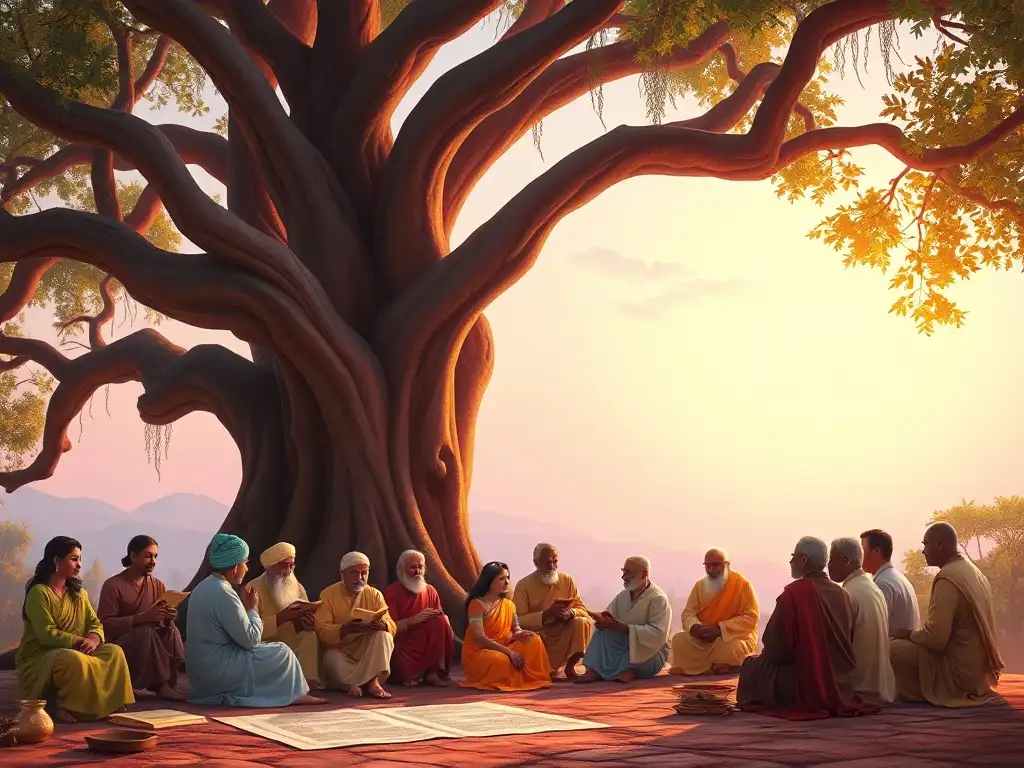
The Upanishads, a collection of ancient texts central to Hindu philosophy, have significantly shaped the course of Indian thought and spirituality. Their exploration of metaphysical concepts, the nature of reality, and the self has not only influenced Hinduism but has also permeated the ideologies of other Indian philosophical traditions. The ideas presented in the Upanishads laid the groundwork for various schools of thought that emerged in India, showcasing their enduring impact throughout history.
Connection to Buddhism and Jainism
The philosophical debates found in the Upanishads had a profound effect on the development of Buddhism and Jainism, two major religious traditions that emerged in India around the same time. Both these religions share several core ideas with Upanishadic philosophy, particularly regarding the nature of the self (Atman) and the ultimate reality (Brahman).
- Concept of Anatta: In Buddhism, the notion of non-self (Anatta) contrasts with the Upanishadic view of a permanent, unchanging self. However, this concept arose partly as a reaction to Upanishadic teachings, highlighting the philosophical dialogue between these traditions.
- Karma and Rebirth: Jainism, like the Upanishads, emphasizes the significance of karma and the cycle of birth and rebirth (samsara). Yet, Jain thinkers expanded upon these ideas, introducing a more rigorous ethical framework that influenced later interpretations of karma across various Indian philosophies.
- Meditative Practices: Both Buddhism and Jainism adopted practices of meditation and self-discipline from Upanishadic texts, which highlight the importance of introspection in attaining spiritual knowledge and liberation.
The interconnections between these philosophies reveal a rich tapestry of thought, where the Upanishads provided foundational concepts that were either adopted or adapted by later thinkers in Buddhism and Jainism.
Impact on Medieval Indian Philosophers
During the medieval period, the influence of Upanishadic philosophy is evident in the works of several prominent Indian philosophers. Their ideas continued to resonate, leading to new interpretations and expansions of Upanishadic thought.
- Advaita Vedanta: Philosophers like Adi Shankaracharya (8th century CE) were pivotal in developing Advaita Vedanta, a non-dualistic interpretation of the Upanishads. Shankaracharya emphasized the unity of Atman and Brahman, arguing that individual souls are fundamentally one with the ultimate reality. His commentaries on the Upanishads revitalized their teachings and established a philosophical framework that became foundational in Hindu thought.
- Vishishtadvaita Vedanta: Similarly, Ramanuja (11th century CE) offered a qualified non-dual perspective where the individual soul retains its identity while being part of the divine. His interpretation drew from Upanishadic themes, underscoring the personal relationship between the soul and God.
- Bhakti Movement: The Bhakti movement, which flourished in medieval India, also reflects Upanishadic influences. Devotional poets like Kabir and Mirabai integrated Upanishadic ideas of the divine into their writings, emphasizing personal experience and devotion over ritualistic practices, thereby democratizing spirituality.
This period marked a flourishing of philosophical engagement with Upanishadic ideas, leading to diverse interpretations that enriched Indian intellectual traditions.
The Legacy of Upanishadic Philosophy in Modern Thought
In the modern era, the philosophical inquiries of the Upanishads continue to resonate across various fields, including philosophy, psychology, and spirituality. Their impact is evident in the following ways:
- Global Philosophical Discourse: The Upanishads have drawn interest from Western philosophers and thinkers, such as Arthur Schopenhauer and Carl Jung, who recognized their profound insights into the nature of self and consciousness. This cross-cultural dialogue has led to a broader appreciation of Indian philosophy in global contexts.
- Psychological Insights: Contemporary psychology often aligns with Upanishadic views on self-awareness and consciousness. The emphasis on introspection and self-realization in the Upanishads parallels modern psychological practices that advocate for mindfulness and personal growth.
- Spiritual Movements: Modern spiritual movements, including those led by figures like Swami Vivekananda and Maharishi Mahesh Yogi, have popularized Upanishadic teachings worldwide. Their interpretations have contributed to the global interest in Eastern philosophies and practices, fostering a blend of ancient wisdom with contemporary spirituality.
The philosophy of Upanishads thinkers has left an indelible mark on various domains of thought, demonstrating the timeless relevance of their teachings and the continuous evolution of ideas stemming from these ancient texts.
Conclusion: The Enduring Relevance of Upanishadic Philosophy
The Upanishads serve as a cornerstone of Indian philosophical thought, offering profound insights into the nature of existence, consciousness, and the ultimate reality, Brahman. Their teachings transcend time and geographical boundaries, influencing not only Indian philosophy but also engaging with global philosophical traditions. The rich tapestry of discussions found within these texts highlights the dialogues between various thinkers, each contributing to a deeper understanding of the self and the cosmos.
Reflection on the Contributions of Upanishads to Global Philosophy
The philosophical inquiries posed in the Upanishads reflect a quest for knowledge that resonates with many global philosophical movements. Key concepts such as Atman (the individual self) and Brahman (the ultimate reality) have drawn parallels with Western philosophical explorations of the self, particularly in the works of thinkers like Descartes and Kant.
- Influence on Western Thought: The idea of a universal consciousness can be seen in the works of philosophers such as Hegel and Schopenhauer, who were influenced by Eastern thought. For instance, Schopenhauer emphasized the notion of the will, reminiscent of the Upanishadic idea of an underlying unity in existence.
- Spiritual and Ethical Frameworks: The Upanishadic teachings on ethics, meditation, and self-realization have permeated various spiritual practices around the world, contributing to the foundations of mindfulness and holistic approaches to well-being.
- Interfaith Dialogues: The universal themes found in the Upanishads foster interfaith dialogues, encouraging a synthesis of ideas across religious paradigms. These texts invite contemplative exchanges that enrich philosophical discourse globally.
The Significance of Upanishadic Thinkers in Contemporary Discourse
The thinkers of the Upanishads, such as Yajnavalkya, Gargi, and Svetaketu, have left an indelible mark on contemporary philosophical discussions.
- Yajnavalkya's Dialogues: As one of the prominent figures, Yajnavalkya's dialogues illustrate the importance of questioning and intellectual rigor. His exchanges with Gargi and others emphasize the value of critical inquiry, a principle that remains vital in modern philosophy and science.
- Gargi's Contributions: Gargi's bold challenges to male philosophers mark her as a pioneering figure in feminist thought. Her questions about the nature of reality and the self echo in current discussions regarding gender and philosophical authority.
- Relevance in Modern Contexts: The Upanishadic emphasis on self-exploration and the interconnectedness of all beings resonates with contemporary movements focusing on holistic understanding, environmental ethics, and the pursuit of inner peace.
The philosophy of Upanishads thinkers continues to inspire and challenge contemporary philosophical debates, bridging ancient wisdom with modern inquiries. Their contributions are not only instrumental in understanding the essence of human existence but also in fostering a global dialogue that respects diverse philosophical traditions while seeking common ground. The enduring relevance of Upanishadic philosophy underscores its role as a timeless guide for seekers of truth and wisdom across cultures.
Further Reading on Upanishadic Philosophy and Thinkers
Recommended Texts and Commentaries
To delve deeper into the Philosophy of Upanishads thinkers, a variety of texts and commentaries are available that provide insight into the profound philosophical debates and concepts articulated in these ancient scriptures. Below are some recommended readings:
- The Upanishads (Translated by Eknath Easwaran)
- This translation is accessible yet retains the depth of the original texts. Easwaran provides insightful commentary that helps readers navigate the complex philosophical ideas.
- Upanishads: An Introduction (By R. C. Prasad)
- This book serves as a great introductory text that outlines key themes and thinkers in Upanishadic philosophy, making it suitable for both beginners and those seeking a refresher.
- The Principal Upanishads (Translated by S. Radhakrishnan)
- A classic translation accompanied by extensive commentary, Radhakrishnan's work is essential for anyone wishing to understand the historical and philosophical context of the Upanishads.
- The Essence of the Upanishads: A Key to Indian Philosophy (By Eknath Easwaran)
- This work distills the core teachings of the Upanishads into a digestible format, emphasizing the relevance of these ancient ideas to modern life.
- A History of Indian Philosophy (By Surendranath Dasgupta)
- This comprehensive multi-volume work covers the evolution of Indian philosophical thought, including detailed discussions on Upanishadic thinkers and their contributions.
Online Resources for Deeper Understanding of Upanishads
In addition to traditional texts, various online resources can enhance your understanding of the Philosophy of Upanishads thinkers. Here are some valuable platforms and materials:
-
Stanford Encyclopedia of Philosophy
This resource offers scholarly articles on key concepts and thinkers from the Upanishads. It provides an academic perspective on their philosophical implications.
-
Internet Archive
A treasure trove of historical texts, the Internet Archive has digitized versions of many commentaries and translations of the Upanishads, allowing for free access to classical works.
-
Coursera and edX
These platforms occasionally offer courses related to Indian philosophy, including the Upanishads. Look for courses by reputable universities that cover Hindu philosophy or religious studies.
-
YouTube Lectures
Many scholars and practitioners share their insights on the Upanishads through lecture series. Channels that focus on Indian philosophy often feature discussions on prominent thinkers and their ideas.
-
Podcasts
Several podcasts delve into the philosophy of Hinduism, including episodes specifically dedicated to the Upanishads. These can provide a more conversational and engaging exploration of the topics.
By exploring these texts and online resources, readers can gain a deeper appreciation of the rich philosophical tradition embedded within the Upanishads and the influential thinkers who shaped its discourse.
Frequently Asked Questions
What are the Upanishads?
The Upanishads are a collection of ancient Indian texts that form the philosophical basis of Hinduism, exploring concepts like Brahman (ultimate reality) and Atman (soul).
Who were the key thinkers associated with the Upanishads?
Key thinkers include Yajnavalkya, Uddalaka Aruni, and Shankara, who contributed significantly to the philosophical debates surrounding the nature of reality and existence.
What philosophical ideas are presented in the Upanishads?
The Upanishads delve into metaphysical concepts, ethics, and the relationship between the individual self (Atman) and the universal spirit (Brahman), emphasizing self-realization.
How do the Upanishads influence modern philosophy?
The philosophy of the Upanishads has profoundly influenced modern thinkers and spiritual movements, encouraging exploration of consciousness and the nature of existence.
What is the significance of philosophical debates in the Upanishads?
These debates highlight the diverse perspectives on fundamental questions of life, fostering a rich tradition of intellectual inquiry that continues to resonate in contemporary thought.
Final Reflection: Embracing the Wisdom of Upanishadic Thinkers
The philosophical debates in the Upanishads resonate profoundly with our contemporary quest for meaning and understanding. In a world increasingly characterized by rapid change and uncertainty, the timeless inquiries posed by thinkers such as Yajnavalkya and Shankara challenge us to reflect on the nature of reality, the self, and our interconnectedness with the universe. Their insights remind us that philosophy is not merely an academic pursuit but a vital tool for navigating the complexities of existence.
Cultural and social landscapes are continually shaped by the profound ideas originating from the Upanishads. The teachings of these ancient sages have transcended time, influencing not only Indian philosophy but also the broader global discourse on spirituality and ethics. As we grapple with questions of identity, consciousness, and the essence of life, we find ourselves echoing the sentiments of these thinkers. The ultimate aim of the Upanishads is to realize the oneness of the individual soul with the universal spirit.
This realization is not just a philosophical concept; it is a transformative experience that has the power to reshape our lives and communities.
As you reflect on the rich tapestry of ideas presented in the Upanishads, I invite you to engage with these teachings actively. Consider how the philosophies of these thinkers can inform your own life and choices. What insights can you draw from their debates to enhance your understanding of yourself and your place in the world? Embrace the opportunity to explore these profound questions, allowing the wisdom of the Upanishads to guide you on your journey toward self-discovery and enlightenment.
Unlock the Wisdom of the Upanishads Today!
Thank you for diving into the rich philosophical landscape of the Upanishads with us! We hope you found inspiration in the thoughts of key thinkers and the profound ideas discussed. Now, let's take this knowledge a step further and integrate these insights into your life.
Here are some practical ways to connect with the wisdom of the Upanishads:
- Engage in Daily Reflection: Set aside time each day to ponder a specific verse or idea from the Upanishads. Allow these teachings to shape your perspective and guide your actions.
- Join a Discussion Group: Seek out local or online communities that share your interest in ancient philosophies. Exchange ideas and enhance your understanding through diverse perspectives.
- Create a Personal Journal: Document your thoughts and interpretations of the texts you read. This unique journey can deepen your comprehension and provide valuable insights.
Which insights from the Upanishads will you explore further on your personal journey? We invite you to share your thoughts below!