
The Role of the Four Great Disciples of the Buddha


Welcome to Ancient India History, where we embark on a captivating journey through the rich tapestry of ancient Indian civilizations. Today, we delve into the profound impact of Buddha's Four Great Disciples, whose teachings and actions shaped the very foundation of Buddhism and its spread across the subcontinent. These remarkable figures not only exemplified the essence of enlightenment but also played pivotal roles in disseminating the wisdom of the Buddha.
As you explore this article, prepare to uncover the intricate connections between their lives and the broader landscape of ancient Indian religions. Join us in unraveling the legacy of these disciples, and discover how their contributions continue to resonate in spiritual practices today!

Introduction to Buddha's Four Great Disciples
In the rich tapestry of ancient Indian history and the development of Buddhism, the Buddha's Four Great Disciples stand out as pivotal figures who played a crucial role in the dissemination of his teachings. These disciples— Sariputta, Moggallana, Ananda, and Mahakasyapa—were not only close companions of Siddhartha Gautama, the Buddha, but also instrumental in shaping early Buddhist thought and practice. Their contributions extend beyond mere following; they were vital in interpreting, teaching, and preserving the Buddha's messages, thus ensuring the survival and growth of Buddhism throughout the ages.
The significance of these disciples is reflected in their unique qualities and the specific roles they fulfilled within the early Buddhist community. Their diverse backgrounds and strengths complemented the teachings of the Buddha, allowing them to connect with various audiences, from lay practitioners to ascetics. Understanding their lives and contributions provides a deeper insight into the early Buddhist movement and the foundational principles that continue to guide millions today.
Significance of the Disciples in Buddhism
The Four Great Disciples of the Buddha each possessed distinctive attributes that contributed significantly to the spread and establishment of Buddhism.
- Sariputta:
- Known for his wisdom and analytical mind, Sariputta was often regarded as the Buddha's chief disciple.
- His ability to understand and articulate complex teachings made him a critical figure in the development of Buddhist doctrine.
- He is credited with many significant discourses that laid the groundwork for later philosophical developments in Buddhism.
- Moggallana:
- Moggallana was celebrated for his supernatural abilities and deep meditative insights.
- His prowess in spiritual practices helped to attract many followers, showcasing the transformative power of meditation.
- He played a key role in countering challenges from rival philosophical schools, reinforcing the credibility of the Buddha's teachings.
- Ananda:
- Serving as the Buddha's personal attendant for many years, Ananda was instrumental in preserving the teachings through oral tradition.
- His remarkable memory allowed him to recall the Buddha’s discourses accurately, which later became foundational texts in the Buddhist canon.
- Ananda’s compassionate nature and dedication to service exemplified the core principles of Buddhism.
- Mahakasyapa:
- Known for his ascetic practices, Mahakasyapa represented the monastic ideal within Buddhism.
- He played a crucial role in the First Buddhist Council, where key teachings were compiled and standardized.
- His emphasis on direct experience and insight paved the way for the development of Zen Buddhism.
The combined efforts of these four disciples were vital in establishing a cohesive community of monks and lay followers, which facilitated the spread of Buddhist teachings across ancient India and beyond. Their legacy continues to inspire practitioners, making them integral figures not only in Buddhism but also in the broader context of ancient Indian history.
- What are the names of Buddha's Four Great Disciples?
- How did the Four Great Disciples contribute to Buddhism?
- What is the significance of Ananda among Buddha's disciples?
- How did Sariputta and Moggallana influence Buddhist philosophy?
- What lessons can modern practitioners learn from the Four Great Disciples?
Overview of Each Great Disciple
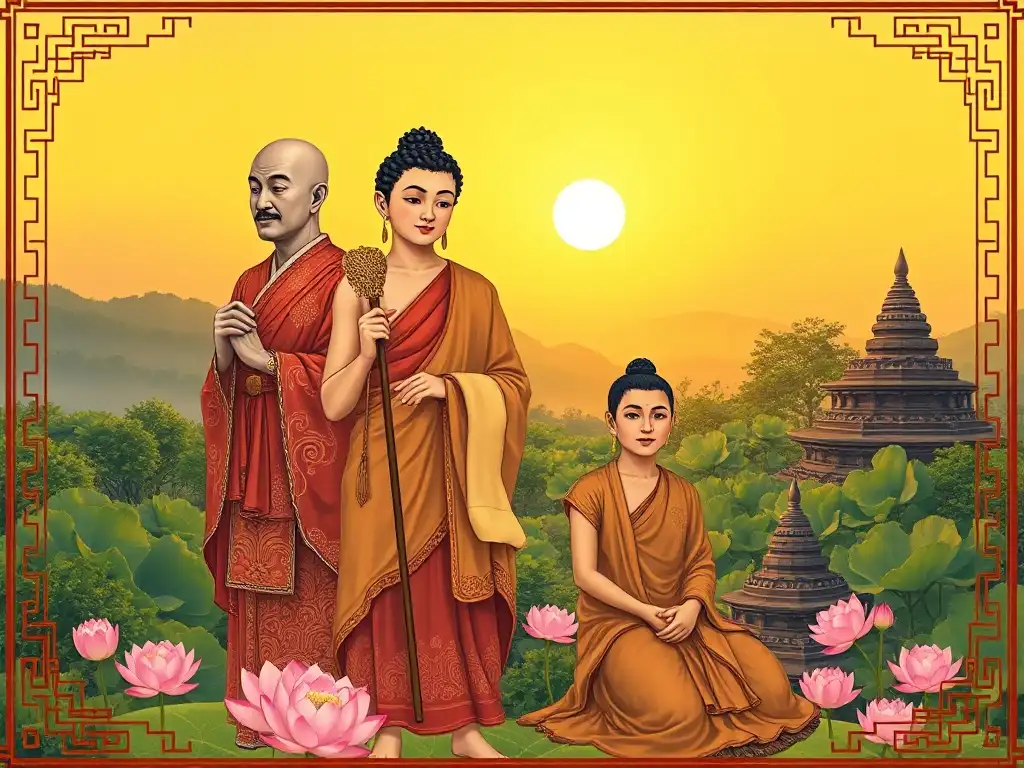
The teachings of the Buddha were profoundly shaped and disseminated by his four great disciples, each of whom played a significant role in the early development of Buddhism. This section delves into the contributions and unique characteristics of each disciple, highlighting their impact on the Buddhist community and teachings.
1. Sariputta: The Chief Disciple
Sariputta is often regarded as the foremost disciple of the Buddha, renowned for his wisdom and understanding of the Dharma. As the chief disciple, he played a pivotal role in guiding the Sangha and disseminating the teachings of Buddhism.
Contributions to Buddhist Teachings
Sariputta's contributions to Buddhist teachings are monumental. He was known for his ability to articulate the Buddha's messages in a clear and accessible manner. His profound understanding of the Four Noble Truths and the Noble Eightfold Path made him an exemplary figure for followers. Notably, he was instrumental in developing the concept of dependent origination, which explains the interconnectedness of all phenomena.
- Key Teachings:
- Emphasized the importance of mindfulness and meditation.
- Helped in formulating the Abhidhamma, a critical part of Buddhist philosophy that explores the nature of reality.
His teachings often focused on practical applications of the Dharma, allowing followers to grasp complex concepts easily.
Role in the Early Sangha
As the chief disciple, Sariputta played a crucial role in establishing the early Sangha. He was responsible for educating new monks, ensuring they understood the core tenets of Buddhism. His leadership qualities were evident in his ability to maintain harmony within the community.
- Key Responsibilities:
- Mentored countless disciples, guiding them in their spiritual journeys.
- Acted as a mediator during disputes, fostering a sense of unity and purpose within the Sangha.
Sariputta's influence extended beyond his lifetime, as his teachings continued to inspire future generations of Buddhists.
2. Moggallana: The Master of Psychic Powers
Moggallana, another of the Buddha's great disciples, was celebrated for his exceptional psychic abilities and deep understanding of the supernatural aspects of existence. His unique talents set him apart as a vital figure in the early Buddhist community.
Unique Abilities and Their Impact
Moggallana possessed various psychic powers, including the ability to read minds and perform miraculous feats. These abilities not only showcased the potential of meditation and spiritual practice but also helped to attract followers to the Buddha's teachings.
- Notable Powers:
- Divine Eye: The ability to see beyond the physical world and perceive the past and future.
- Teleportation: Moggallana could travel instantaneously, demonstrating the advanced states of meditation he achieved.
Moggallana’s powers reinforced the credibility of the Buddhist teachings, as many were drawn to the promise of attaining such abilities through diligent practice and adherence to the Dharma.
Moggallana’s Influence on Buddhist Practices
Moggallana's psychic abilities had a profound influence on Buddhist practices, particularly regarding the importance of meditation. His experiences demonstrated the possibilities that lay within the meditative path, inspiring practitioners to delve deeper into their spiritual journeys.
- Impact on Practices:
- Encouraged the development of meditation techniques aimed at achieving higher states of consciousness.
- Fostered an interest in the study of Abhidhamma, as practitioners sought to understand the nature of reality and the mind.
Moggallana's legacy as the master of psychic powers highlights the multifaceted nature of Buddhist practice, blending philosophical inquiry with experiential knowledge.
3. Ananda: The Guardian of the Buddha's Teachings
Ananda, one of the most revered disciples of the Buddha, played a pivotal role in the establishment and preservation of Buddhism. As the Buddha’s cousin and personal attendant for many years, Ananda was intimately acquainted with the Buddha's teachings and life. His dedication and memory were instrumental in ensuring that the core principles of Buddhism were accurately recorded and transmitted to future generations.
Ananda's Role in Preserving Teachings
Ananda's unique position as the Buddha's attendant allowed him to witness countless teachings and discourses firsthand. His remarkable memory became a key asset in preserving the Buddha's teachings, particularly in the years following the Buddha's death. Ananda is credited with recalling and reciting many of the discourses (suttas) during the early gatherings of the Buddhist community. This ability to accurately recall the Buddha's words ensured that his teachings were not lost to time and could be shared with a wider audience.
Moreover, Ananda's commitment to the Buddha's teachings extended beyond mere memorization. He actively engaged with various communities, sharing the lessons he learned and encouraging others to adopt the path of enlightenment. His role as a teacher and a guide helped solidify the foundational beliefs of Buddhism among early followers.
Importance in the First Buddhist Council
Ananda's significance was further highlighted during the First Buddhist Council, which took place shortly after the Buddha's passing in 483 BCE. This council was convened to compile the teachings of the Buddha and to establish a unified doctrine for the burgeoning Buddhist community. Ananda's presence was crucial, as he was able to recite many of the Buddha's discourses with accuracy and detail.
At this council, Ananda's contributions were not limited to recitation; he also advocated for the inclusion of teachings that addressed the lay community, recognizing the importance of making Buddhist principles accessible to all. His efforts helped shape the early structure of Buddhist teachings, ensuring that they were comprehensive and reflective of the Buddha's intentions. Ananda's role in the First Buddhist Council cemented his status as a guardian of the Buddha's teachings, fostering the continuity of Buddhism through subsequent generations.
4. Mahakasyapa: The Leader of the Monastic Community
Mahakasyapa, another of the Buddha's foremost disciples, is celebrated for his leadership within the monastic community. Known for his ascetic practices and profound understanding of the Dharma, Mahakasyapa played a significant role in shaping early Buddhism and establishing its monastic traditions.
Contributions to Monastic Discipline
Mahakasyapa's contributions to the development of monastic discipline are noteworthy. He is often credited with emphasizing the importance of strict adherence to the Vinaya, the monastic code of conduct. His leadership style was marked by an emphasis on discipline, which helped to maintain the integrity and unity of the monastic community.
As a proponent of asceticism, Mahakasyapa set an example for other monks by practicing simplicity and self-restraint. His lifestyle encouraged many to adopt similar practices, thus reinforcing the values of moderation and mindfulness in daily life. This focus on discipline and ethical conduct became a cornerstone of Buddhist monastic life, influencing generations of monks who followed his example.
Role in the Transmission of Teachings
Mahakasyapa also played a pivotal role in the transmission of the Buddha's teachings. After the Buddha's death, he took on the responsibility of preserving and disseminating the Dharma, ensuring that the core teachings would endure. His leadership during the First Buddhist Council was crucial, as he guided the assembly in the compilation of the Buddha's teachings and the establishment of the monastic community's rules.
In addition to his administrative contributions, Mahakasyapa is often associated with the Zen tradition of Buddhism, which emphasizes direct experience and meditation. His approach to teaching encouraged practitioners to seek enlightenment through personal insight rather than solely through doctrinal study. This emphasis on experiential learning has had a lasting impact on Buddhist practice, making Mahakasyapa a key figure in the evolution of Buddhist thought and practice.
The Impact of Buddha's Four Great Disciples on Buddhism

Buddha's Four Great Disciples—Sariputta, Mahamoggallana, Ananda, and Upali—played a pivotal role in shaping the early Buddhist community and spreading its teachings. Their unique contributions were instrumental in not only preserving the core tenets of Buddhism but also expanding its reach across ancient India. This section delves into the significant impact these disciples had on the development and proliferation of Buddhism.
Development of Early Buddhist Communities
The establishment of early Buddhist communities can be traced back to the foundational work of Buddha's Four Great Disciples. Each disciple brought distinct qualities and capabilities, contributing to the growth of Buddhism in various ways:
- Sariputta:
- Known for his exceptional wisdom and understanding, Sariputta became the chief disciple and was often regarded as the Buddha's closest companion.
- He played a crucial role in teaching the Four Noble Truths and the Eightfold Path, ensuring that these principles were clearly articulated to followers.
- His ability to explain complex concepts in simple terms helped demystify Buddhism for new adherents.
- Mahamoggallana:
- Recognized for his mastery of psychic powers, Mahamoggallana was instrumental in attracting followers through his demonstrations of supernatural abilities.
- He often traveled to different regions, sharing the Buddha's teachings and drawing people into the fold of the monastic community.
- His role in protecting the early Buddhist community against threats and adversities further solidified the faith's stability.
- Ananda:
- As the Buddha's personal attendant, Ananda had unparalleled access to the Buddha’s teachings and was crucial in their preservation.
- He played a key role in the First Buddhist Council, where he helped compile the Pali Canon, ensuring that the Buddha’s words were accurately recorded for future generations.
- His compassionate nature and ability to connect with laypeople made him an effective communicator of Buddhist values.
- Upali:
- Originally a barber, Upali was a lay disciple who later became a prominent monk known for his understanding of monastic discipline.
- He was responsible for clarifying the Vinaya Pitaka, the regulatory framework for the Buddhist monastic community, which ensured a harmonious and disciplined environment for practitioners.
- His background as a layperson allowed him to bridge the gap between the monks and the general populace, fostering inclusivity within the Buddhist community.
Together, these disciples laid the groundwork for a robust monastic tradition and established the core teachings of Buddhism that would guide future generations.
Spread of Buddhism in Ancient India
The efforts of Buddha's Four Great Disciples significantly contributed to the spread of Buddhism across ancient India. Their influence can be observed through various channels:
- Missionary Activities:
- The disciples took on the role of missionaries, traveling far and wide to disseminate the Buddha's teachings. This proactive approach enabled Buddhism to reach diverse audiences, including those in remote villages.
- Formation of Monastic Orders:
- By establishing monastic orders, the disciples created structured communities where individuals could practice and learn about Buddhism. This organization not only facilitated education but also provided a support system for practitioners.
- Engagement with Local Cultures:
- The disciples adapted the teachings of the Buddha to align with local customs and beliefs, making Buddhism more accessible to different populations. This cultural integration played a vital role in its acceptance.
- Royal Patronage:
- The disciples' teachings and charisma attracted the attention of various kings and rulers, leading to royal patronage. Notable figures, such as Emperor Ashoka, later became staunch supporters of Buddhism, further aiding its expansion.
The result of these efforts was a thriving network of Buddhist communities that spanned across regions, leading to the establishment of significant sites such as Sarnath and Bodh Gaya. These locations became pilgrimage centers, fostering a lasting legacy that influenced not only the religious landscape of ancient India but also the wider world.
The impact of Buddha's Four Great Disciples on the development and spread of Buddhism in ancient India is profound. Their unique contributions ensured that the teachings of the Buddha were preserved, practiced, and propagated, laying the foundation for one of the world's major religions.
The Legacy of the Four Great Disciples

Influence on Later Buddhist Traditions
The four great disciples of the Buddha—Sariputta, Maudgalyayana, Ananda, and Kasyapa—played a pivotal role in shaping the early Buddhist community and its teachings. Their contributions not only established foundational doctrines but also influenced the development of various Buddhist traditions across Asia.
- Sariputta (Sāriputta): Known for his profound wisdom, Sariputta's teachings emphasized the importance of understanding the Four Noble Truths and the Eightfold Path. His analytical approach to Buddhist philosophy laid the groundwork for later scholars, especially in the Theravada tradition. Sariputta's interpretations can be seen echoed in texts such as the Abhidhamma, which elaborates on the nature of mind and matter.
- Maudgalyayana (Moggallāna): Renowned for his supernatural abilities, Maudgalyayana's focus on meditation and psychic powers influenced the Vajrayana tradition. His emphasis on the Meditative Absorption (Dhyana) practices is reflected in the Mahayana sutras, where advanced meditative states are often discussed as pathways to enlightenment.
- Ananda: As the Buddha's personal attendant, Ananda's role was crucial in preserving the Buddha's teachings. His remarkable memory allowed for the compilation of the Pali Canon, which became the scriptural basis for Theravada Buddhism. Ananda's advocacy for the inclusion of women in the monastic community led to the establishment of the Bhikkhuni Sangha, promoting gender inclusivity in Buddhist practice.
- Kasyapa: Known for his ascetic practices and leadership, Kasyapa's influence extended to the spread of Buddhism in ancient India and beyond. His teachings on communal living and ethical conduct became integral to various sects, particularly in the Mahayana tradition where community and lay participation are emphasized.
The legacy of these disciples can be traced through the evolution of Buddhist thought, where their interpretations and practices continue to resonate in contemporary Buddhist communities. The emphasis on meditation, ethical conduct, and community structure seen in modern Buddhism can be directly linked to the foundational work of the Buddha's four great disciples.
Recognition in Buddhist Literature and Art
The contributions of the four great disciples have been immortalized in various Buddhist texts and artistic representations throughout centuries. Their portrayal serves not only as a means of honoring their legacy but also as a source of inspiration for practitioners.
Literary Recognition
- Sutras and Commentaries: Major Buddhist texts, such as the Digha Nikaya and Samyutta Nikaya, frequently reference the dialogues and teachings of these disciples. Their roles during pivotal moments in the Buddha's life are documented, providing insight into their character and contributions to the spread of Buddhism.
- Buddhist Commentaries: Works like Visuddhimagga (Path of Purification) by Buddhaghosa highlight Sariputta's wisdom and Ananda's role in preserving teachings. These texts serve as critical resources for understanding the evolution of Buddhist doctrine and practice.
Artistic Representations
- Sculptures and Statues: The four great disciples are often depicted in ancient sculptures and carvings found in stupas and monasteries. For instance, the famous Sanchi Stupa features reliefs that illustrate key events involving these disciples, celebrating their dedication and key moments in the Buddhist narrative.
- Painting and Iconography: In traditional Buddhist art, Ananda is frequently depicted accompanying the Buddha, symbolizing his role as the custodian of teachings. Meanwhile, Maudgalyayana's miraculous feats are illustrated in murals, emphasizing his supernatural powers and meditative prowess.
The recognition of the four great disciples in literature and art not only reflects their significance but also continues to inspire generations of practitioners, scholars, and artists. Their portrayal serves as a reminder of the enduring impact of their teachings and practices on the rich tapestry of Buddhist history and culture.
Conclusion: The Enduring Influence of Buddha's Four Great Disciples

The legacy of Buddha's Four Great Disciples—Sariputta, Moggallana, Ananda, and Mahakasyapa—continues to shape the landscape of Buddhism today. Their contributions not only facilitated the spread of the Buddha's teachings but also laid the groundwork for the monastic and lay communities that followed. Each disciple played a unique role, embodying the principles of diligence, wisdom, and compassion that are central to Buddhist practice.
Reflection on Their Role in Advancing Buddhism
The impact of Buddha's Four Great Disciples can be observed through various dimensions of the early Buddhist community:
- Sariputta: Renowned for his wisdom, Sariputta was instrumental in doctrinal development and clarification. His ability to articulate complex ideas in accessible terms made him a pivotal figure in teaching and disseminating the Buddha's teachings. His analytical skills helped establish the framework for many Buddhist doctrines, influencing generations of monks and lay followers.
- Moggallana: As the foremost disciple in supernatural abilities, Moggallana's experiences and teachings on meditation and concentration provided crucial insights into the spiritual practices of early Buddhism. His emphasis on the importance of mental training and the cultivation of insight has had a lasting influence on various meditation traditions within Buddhism.
- Ananda: Often referred to as the "keeper of the Buddha's words," Ananda's role in preserving and reciting the Buddha's teachings at the First Buddhist Council was vital. His dedication to memorizing the discourses ensured that the teachings were transmitted accurately, allowing them to be recorded and shared with future generations. Ananda's compassionate approach and deep understanding of the lay community's needs helped bridge the gap between monastic and lay practices.
- Mahakasyapa: Recognized for his ascetic practices and leadership, Mahakasyapa played a crucial role in establishing the monastic order. His adherence to the Vinaya (monastic code) and promotion of a disciplined lifestyle set a standard for monastic communities. His leadership during the early councils helped unify the Sangha and ensured the continuity of the Buddha's teachings.
The combined efforts of these four disciples not only ensured the survival of the Buddha's teachings but also facilitated their adaptation and growth in diverse cultural contexts. Their lives exemplified the principles of compassion, wisdom, and community—the core tenets of Buddhism that resonate to this day.
The enduring influence of Buddha's Four Great Disciples continues to inspire practitioners and scholars alike, encouraging a deeper exploration of their teachings and the foundational aspects of Buddhism. As we reflect on their roles, we recognize that their contributions transcend time, inviting all to engage with the timeless wisdom of the Buddha's path.
Frequently Asked Questions
What are the names of Buddha's Four Great Disciples?
The Four Great Disciples of the Buddha include Sariputta, Moggallana, Ananda, and Kasyapa. Each played a significant role in spreading Buddha's teachings.
How did the Four Great Disciples contribute to Buddhism?
The disciples helped establish the Sangha, the Buddhist community, and were instrumental in interpreting and sharing Buddha's teachings throughout ancient India.
What is the significance of Ananda among Buddha's disciples?
Ananda is known for his exceptional memory and was responsible for reciting many of Buddha’s teachings after his passing, ensuring the preservation of the Dharma.
How did Sariputta and Moggallana influence Buddhist philosophy?
Sariputta was known for his wisdom and logical reasoning, while Moggallana was famed for his supernatural abilities. Together, they helped to develop core philosophical concepts in Buddhism.
What lessons can modern practitioners learn from the Four Great Disciples?
The disciples exemplify qualities such as dedication, wisdom, and compassion, which are essential for modern practitioners seeking to embody the principles of Buddhism in everyday life.
Final Reflection: Embracing the Wisdom of Buddha's Four Great Disciples
The teachings and legacies of Buddha's Four Great Disciples remain profoundly relevant in today's fast-paced world. As we navigate the complexities of modern life, the virtues exemplified by these disciples—faith, compassion, wisdom, and dedication—serve as guiding principles that can help us cultivate a more meaningful existence. Their stories remind us that the path to enlightenment is not just a personal journey but a collective endeavor that requires us to uplift one another.
The influence of these disciples extends far beyond their historical context; they continue to shape our cultural and social landscapes. Their teachings inspire countless individuals to seek inner peace and understanding in an increasingly chaotic world. As we reflect on their contributions, we can find solace in the words of the Buddha himself: Just as a candle cannot burn without fire, men cannot live without a spiritual life.
This quote encapsulates the essence of their teachings, urging us to nurture our spiritual selves in order to foster harmony in our communities.
As you ponder the lessons of Buddha's Four Great Disciples, I invite you to take a moment to reflect on how their virtues can be integrated into your own life. Consider how you can embody their teachings of compassion and wisdom in your daily interactions. By embracing these principles, you not only honor their legacy but also contribute to a more compassionate and understanding world. Let their stories inspire you to embark on your own journey of growth and enlightenment, as we all strive to become better versions of ourselves.
Unlock the Wisdom of the Buddha's Disciples!
Thank you for joining us on this enlightening journey through the teachings and legacies of the Four Great Disciples of the Buddha. By exploring their profound insights, you've taken the first step toward deepening your understanding of Buddhist philosophy and its relevance in today's world.
Now, it's time to put this knowledge into action! Here are a few ways you can further connect with the teachings of these remarkable figures:
- Reflect and Write: Take a moment to journal your thoughts about how the teachings of one of the disciples resonate with your life. Consider what lessons you can implement today.
- Join a Community: Seek out local Buddhist groups or online forums to discuss the insights of these disciples. Engaging with others can enhance your understanding and provide mutual support.
- Share Your Insights: Write a summary of what you learned and share it on social media. Tag friends who might find it inspiring, as sparking conversations about these teachings can create meaningful connections!
How can you incorporate the wisdom of the Buddha's disciples into your daily life to foster a greater sense of peace and understanding?