
Vaisheshika's Atomism: A Tale of Scientific Inquiry in Ancient Times


Welcome to Ancient India History, where we embark on a journey through time to unravel the rich tapestry of India’s past. Here, we delve into the remarkable cultural contributions of ancient civilizations, from the Indus Valley to the majestic Gupta Empire. Our featured article, “Vaisheshika's Atomism: A Tale of Scientific Inquiry in Ancient Times,” invites you to explore the fascinating concept of Ancient Indian atomic theory, a testament to the profound intellect and curiosity that characterized this era.
Prepare to be captivated as we uncover the philosophical and scientific marvels that shaped a civilization, and discover how these ideas resonate even today. Dive in and let the exploration begin!
The exploration of ancient Indian philosophy reveals a profound engagement with the nature of reality, particularly through the lens of atomism as articulated by the Vaisheshika school. This school of thought, founded by the sage Kanada in the 6th century BCE, presents an intricate understanding of the material world that predates many modern scientific theories. Rooted in a framework that combines metaphysics with a systematic approach to categorizing substances, the Vaisheshika philosophy offers insights into early scientific inquiry and lays the groundwork for the later developments of atomic theory.
By examining the principles of Vaisheshika's atomism, we uncover not only the intellectual advancements of ancient India but also their contributions to the broader landscape of scientific thought. The emphasis on observation, classification, and the nature of existence highlights the innovative spirit of ancient Indian scholars who sought to explain the universe through logical reasoning and empirical evidence. This article delves into the core tenets of the Vaisheshika philosophy, its historical context, and its lasting influence on both Indian and global scientific traditions.
The Foundations of Vaisheshika Philosophy
Vaisheshika philosophy is characterized by its unique perspective on reality, proposing that all matter is composed of indivisible particles known as "paramanu" (atoms). According to Kanada, these atoms combine to form the various substances we observe in the world. The Vaisheshika system classifies reality into different categories, including:
- Dravya (Substance): The fundamental building blocks of the universe.
- Guna (Quality): Attributes that describe substances.
- Karma (Action): The motion or activities of substances.
- Sambhava (Inherent capability): Potentialities of substances to manifest various states.
- Utpatti (Causation): The process of creation and transformation.
This categorization illustrates a sophisticated understanding of the natural world, allowing for a systematic inquiry into the relationships between different entities.
Historical Context and Influences
The development of Vaisheshika's atomic theory must be understood within the broader intellectual landscape of ancient India. During the period of its inception, other philosophical schools, such as Nyaya, were also flourishing, fostering a rich dialogue about epistemology, metaphysics, and ethics. The interplay between these schools contributed to the evolution of scientific thought, as scholars engaged in debates and refined their ideas through rigorous logical analysis.
Moreover, the historical context of the time—marked by advances in mathematics, astronomy, and medicine—provided fertile ground for the emergence of atomic theory. Vaisheshika's contributions can be viewed as an integral part of a larger tradition of inquiry that sought to unravel the mysteries of existence and the cosmos.
The Lasting Impact of Vaisheshika Atomism
The legacy of Vaisheshika atomism extends beyond its immediate philosophical contributions. Its principles influenced various fields, including:
- Science: The emphasis on observation and categorization laid the groundwork for empirical methodologies.
- Philosophy: Vaisheshika's ideas on causation and the nature of substances invigorated discussions in metaphysics.
- Culture: The integration of scientific inquiry with spiritual and ethical considerations reflected the holistic worldview of ancient Indian society.
As we explore the nuances of Vaisheshika's atomic theory, we recognize its significance not only within the scope of ancient Indian philosophy but also in the global narrative of scientific thought. The principles formulated by Kanada continue to resonate today, reminding us of the rich intellectual heritage that shapes our understanding of the universe.
- The Foundations of Vaisheshika Philosophy
- Historical Context and Influences
- The Lasting Impact of Vaisheshika Atomism
Introduction to Ancient Indian Atomic Theory

The concept of atomism in ancient India is deeply rooted in the philosophical schools that emerged during the Vedic period and continued to evolve through various epochs. The Vaisheshika school, founded by the sage Kanada, played a pivotal role in the development of atomic theory, intertwining philosophical inquiry with early scientific thought.
This approach not only sought to explain the nature of matter but also aimed to explore the underlying principles governing the universe. The ancient Indian atomic theory provides a comprehensive framework that, while differing from modern scientific paradigms, reflects a remarkable depth of understanding regarding the material world.
Overview of Atomic Concepts in Ancient India
Ancient Indian philosophers proposed that all matter is composed of indivisible units known as "anu," or atoms. This atomic concept is a significant departure from the prevailing beliefs of the time, which often viewed matter as continuous. The core ideas surrounding atomic theory in ancient India can be summarized as follows:
- Indivisible Particles: The Vaisheshika philosophy posits that atoms are the smallest constituents of matter, which cannot be further divided. This concept is akin to the modern notion of elementary particles in physics.
- Combination of Atoms: According to Vaisheshika, these atoms combine in various ways to form larger substances, similar to how chemical compounds are formed in modern chemistry. The properties of these compounds are determined by the nature and arrangement of the constituent atoms.
- Qualitative Aspects: The ancient Indian atomic theory also emphasizes the qualitative aspects of atoms, suggesting that different types of atoms possess distinct properties. For instance, the characteristics of earth, water, fire, and air can be attributed to the specific combinations and interactions of their respective atoms.
- Interrelation with Other Elements: The Vaisheshika system describes how these atoms interact with "dharma" (properties) and "guna" (qualities), leading to the manifestation of the physical world. This holistic view anticipates some modern theories that consider the relational dynamics between particles.
The exploration of these concepts indicates a sophisticated understanding of matter that predates many Western theories by centuries, showcasing the intellectual richness of ancient Indian philosophy.
Importance of Vaisheshika Philosophy in Scientific Thought
The Vaisheshika philosophy holds a significant place in the history of scientific thought for several reasons:
- Foundational Framework: Vaisheshika served as a foundational framework for later philosophical and scientific inquiries in India, influencing other schools of thought, such as Nyaya, which focused on logic and epistemology. This interconnection fostered a comprehensive approach to understanding reality that spanned various disciplines.
- Empirical Observation: One of the hallmarks of the Vaisheshika school was its emphasis on empirical observation and rational analysis. Philosophers like Kanada advocated for a systematic study of nature, which resonates with the scientific method employed today. They believed that knowledge should be derived from experience and observation, setting a precedent for future scientific endeavors.
- Integration of Philosophy and Science: The integration of philosophical inquiry with scientific exploration in Vaisheshika highlights the importance of a multidisciplinary approach to knowledge. This philosophy did not merely seek to categorize matter but aimed to understand the principles governing the universe, encouraging a dialogue between metaphysics and the physical sciences.
- Influence on Later Thinkers: The atomic theory proposed by the Vaisheshika school influenced numerous scholars and thinkers in subsequent centuries, both within India and beyond. The ideas surrounding the nature of matter laid the groundwork for further developments in chemistry and physics, particularly in the context of Indian scientific traditions.
The Vaisheshika philosophy's contributions to ancient Indian atomic theory exemplify a remarkable blend of philosophical thought and scientific inquiry. Its legacy continues to inspire contemporary discussions on the nature of reality and the underlying principles of existence, marking a significant chapter in the history of human thought.
Historical Context of Vaisheshika Philosophy

The Vaisheshika philosophy, one of the six orthodox schools of Indian philosophy, emerged during a period marked by profound intellectual inquiry and cultural evolution in ancient India. This school is primarily concerned with the nature of reality and the classification of objects in the universe, laying the groundwork for what would later be recognized as atomic theory.
Emergence of Philosophical Schools in Ancient India
During the early centuries BCE, India witnessed the emergence of various philosophical schools, each seeking to explain the nature of existence, knowledge, and the cosmos. This era was characterized by a rich tapestry of thoughts, where questions about the material world and the self were intensely debated. Among these schools, the Nyaya and Vaisheshika philosophies were pivotal in shaping the discourse around logic and metaphysics.
- Cultural Milieu: The backdrop of the time included significant political, social, and religious transformations, such as the rise of Buddhism and Jainism, which challenged the orthodox views of the Vedic tradition. The Vaisheshika school sought to synthesize these challenges, offering a systematic approach to understanding the material world.
- Influence of the Upanishads: The philosophical inquiries of the Vaisheshika were deeply influenced by the Upanishads, which emphasized the exploration of being and consciousness. This influence is evident in the Vaisheshika's focus on categorizing the fundamental elements of existence.
- Integration with Nyaya: The close relationship between Nyaya and Vaisheshika can also be seen as a response to the philosophical needs of the time. While Nyaya focused on epistemology and logic, Vaisheshika provided a metaphysical framework that complemented these discussions, particularly in terms of physical reality.
Key Figures in Vaisheshika: Kanada and His Contributions
At the heart of Vaisheshika philosophy is Kanada, its founder, who lived around the 2nd century BCE. His contributions were instrumental in establishing the foundational principles of atomic theory in ancient Indian thought.
- Philosophical Texts: Kanada is best known for his work, the Vaisheshika Sutra, a comprehensive text that outlines the principles of his philosophy. This text systematically categorizes the elements of reality into seven categories: substance, quality, action, generality, particularity, relation, and inherence.
- Atomic Theory: Kanada's revolutionary idea was the concept of "anu" (atom), which posits that all physical objects are composed of indivisible particles. This idea predates modern atomic theory and highlights a remarkable understanding of matter. In his view, atoms are eternal, imperceptible, and combine to form all substances in the universe.
- Causation and Change: Alongside his atomic theory, Kanada explored the concept of causation, asserting that the interaction of atoms leads to the formation and dissolution of material objects. This exploration reflects a profound understanding of change and permanence in nature.
- Influence on Subsequent Thought: Kanada's ideas not only laid the groundwork for later developments in Indian philosophy but also influenced various scientific discourses. His emphasis on empirical observation and logical reasoning paved the way for future scholars to explore the material world in a systematic manner.
The Vaisheshika philosophy, through the lens of Kanada's contributions, provides a compelling narrative of ancient Indian atomic theory. It reflects a rich intellectual tradition that continues to inspire philosophical inquiry and scientific exploration even today.
Fundamental Principles of Vaisheshika Atomism
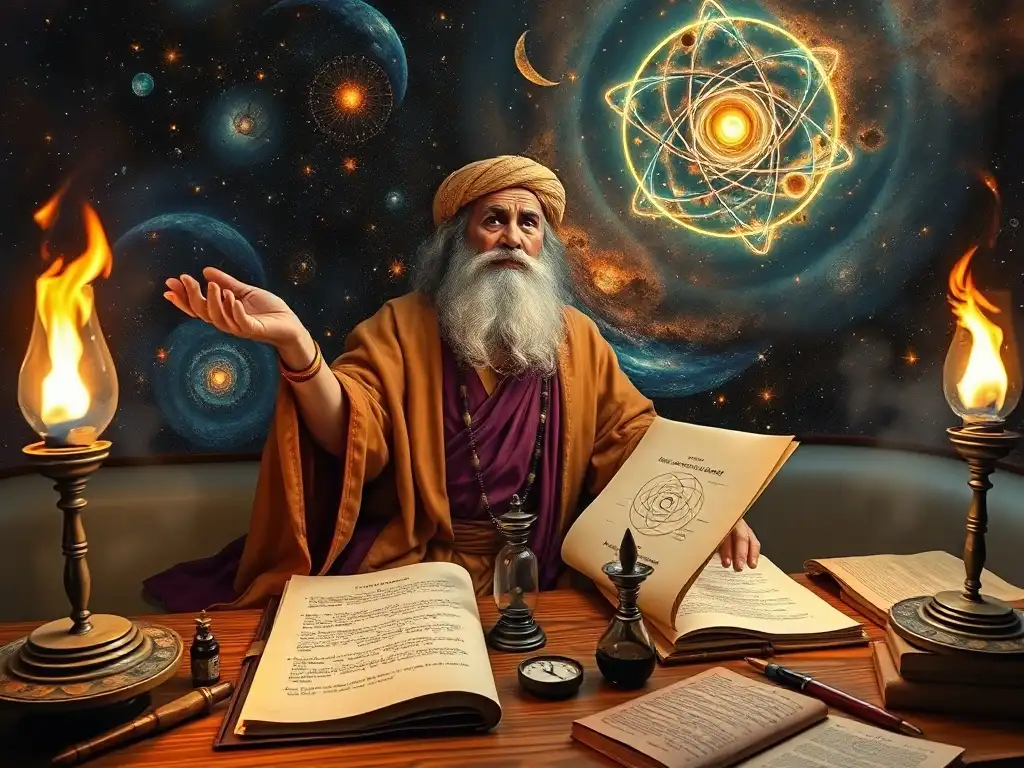
Vaisheshika, one of the six orthodox schools of Indian philosophy, offers a unique perspective on the nature of reality through its atomic theory. This philosophical framework posits that everything in the universe is composed of indivisible particles known as "anu," or atoms. The Vaisheshika system, developed by sage Kanada, emphasizes a systematic approach to understanding the composition of the material world, melding metaphysics with early scientific inquiry.
At its core, Vaisheshika atomism provides a foundation for understanding the physical and metaphysical aspects of existence. By focusing on the nature and interactions of these atoms, the philosophy seeks to explain not only the structure of matter but also the underlying principles that govern the universe.
Definition of Anu (Atom) and Its Properties
In Vaisheshika philosophy, the term "anu" refers specifically to the atom, which is considered the smallest, indivisible unit of matter. The concept of anu is pivotal, as it serves as the building block for all substances in the universe. Here are some key aspects of anu:
- Indivisibility: Anu is considered to be indivisible; it cannot be broken down into smaller components, making it a fundamental unit of matter.
- Atomic Composition: According to Vaisheshika, all physical objects are composed of these atoms. For instance, water is a combination of hydrogen and oxygen atoms, while various elements arise from different atomic configurations.
- Inherent Properties: Each anu possesses specific qualities that determine its interaction with other atoms. These properties may include its weight, shape, and size, which contribute to the characteristics of the larger substances formed from them.
The notion of anu not only reflects the physical aspect of matter but also carries metaphysical significance, as it embodies the essence of existence within the Vaisheshika framework.
The Role of Categories (Padarthas) in Vaisheshika Philosophy
Vaisheshika philosophy categorizes reality into distinct classes known as "padarthas," which are essential for understanding the nature of existence and the relationships between various entities. These categories serve as a framework to analyze the complexities of the universe, and they include the following:
- Substance (Dravya): Refers to the fundamental entities or materials that exist in the universe, such as earth, water, fire, air, and ether. Substances are the bearers of qualities.
- Quality (Guna): These are attributes or characteristics that substances possess. For example, color, taste, and smell are qualities that define the nature of a substance.
- Action (Karma): This category pertains to the activities or processes that substances undergo. For instance, the action of burning is associated with the quality of fire.
- Generality (Samanya): This refers to the universal characteristics shared by a group of substances. It underlines the common nature that various entities may share despite their differences.
- Particularity (Vishesh): In contrast to generality, particularity denotes the unique attributes that distinguish one substance from another. For example, while both a rose and a daisy are flowers (generality), each has its unique attributes (particularity).
- Non-existence (Abhava): This category addresses the concept of absence or the lack of a substance or quality. It is crucial for understanding the nature of reality in terms of what exists versus what does not.
The integration of these categories within the Vaisheshika framework illustrates a comprehensive approach to understanding reality. The interplay between atoms and these categories allows for a nuanced exploration of both the physical and philosophical dimensions of existence, highlighting the sophisticated nature of ancient Indian atomic theory.
Comparison of Vaisheshika Atomism with Other Philosophical Schools

Vaisheshika vs. Nyaya: Epistemology and Metaphysics
The Vaisheshika school of philosophy, founded by Kanada, posits a unique atomic theory that plays a crucial role in its metaphysical framework. In contrast, the Nyaya school, established by Gautama, focuses intensely on epistemology and logical reasoning. Understanding the distinctions between these two schools reveals their contributions to the ancient Indian atomic theory.
- Core Concepts:
- Vaisheshika:
- Emphasizes the existence of anu (atoms) as the smallest entities, which combine to form larger substances.
- Classifies reality into categories such as substance, quality, action, generality, particularity, and inherence.
- Nyaya:
- Concentrates on the means of obtaining true knowledge (pramana), which includes perception, inference, comparison, and testimony.
- Establishes a rigorous methodology for logical analysis, focusing on valid arguments and fallacies.
- Vaisheshika:
- Epistemological Differences:
- Vaisheshika accepts pratyaksha (perception) and anumana (inference) as primary sources of knowledge, emphasizing the physical aspects of atoms and their interactions.
- Nyaya extends this by incorporating a detailed analysis of the processes of cognition, arguing for a more structured approach to epistemology, including the examination of fallibility in perception.
- Metaphysical Implications:
- The Vaisheshika view on atoms leads to a materialistic interpretation of the universe, where everything is composed of indivisible particles.
- The Nyaya perspective introduces a more abstract understanding of reality, where not only physical entities but also concepts and logical constructs are considered essential to understanding existence.
Vaisheshika vs. Sankhya: Dualism and the Nature of Reality
The Sankhya school, attributed to Kapila, provides a dualistic framework that contrasts with the Vaisheshika atomism's materialism. By comparing these two philosophical traditions, we can gain insights into their differing views on the nature of reality and existence.
- Ontological Framework:
- Vaisheshika:
- Focuses on the physical world and the interactions of atoms as the basis for all phenomena.
- Asserts that reality is composed of substances (including atoms) and their attributes, leading to a fundamentally materialist ontology.
- Sankhya:
- Proposes a dualistic view of reality consisting of Purusha (consciousness) and Prakriti (matter).
- Asserts that the interplay between these two fundamental principles gives rise to the diversity of the universe.
- Vaisheshika:
- Nature of Knowledge:
- Vaisheshika advocates for a scientific inquiry into the material world, seeking to understand the properties and behaviors of atoms through observation and logical deduction.
- Sankhya emphasizes self-knowledge and introspection as pathways to understanding the true nature of reality, prioritizing metaphysical inquiry over empirical investigation.
- Philosophical Implications:
- The Vaisheshika atomism allows for a more pragmatic approach to understanding reality, where knowledge stems from the study of physical interactions.
- In contrast, Sankhya's dualism promotes a more abstract philosophical inquiry, focusing on the relationship between consciousness and matter, ultimately leading to liberation (moksha) through the realization of the distinction between Purusha and Prakriti.
The comparison between Vaisheshika atomism and other philosophical schools like Nyaya and Sankhya highlights the rich tapestry of thought in ancient Indian philosophy. Each school offers unique insights into the nature of reality, knowledge, and the universe, contributing to the broader discourse on ancient Indian atomic theory.
The Influence of Vaisheshika on Later Scientific Thought

Impact on Indian Philosophy and Science
The Vaisheshika school, founded by the sage Kanada in the 6th century BCE, introduced a systematic atomic theory that significantly influenced both Indian philosophy and science. Central to this philosophy is the belief in the existence of paramāṇus (atoms) as the fundamental building blocks of all matter. This perspective laid the groundwork for subsequent philosophical debates about the nature of reality, ontology, and metaphysics in ancient Indian thought.
- Integration with Nyaya:
- The Vaisheshika system was closely linked with the Nyaya school, which emphasized logic and epistemology. Together, they provided a comprehensive framework for understanding the universe.
- The Nyaya-Vaisheshika synthesis allowed for a more rigorous analysis of concepts such as cause and effect, further refining the atomic theory and its implications for natural phenomena.
- Influence on Later Philosophers:
- Philosophers like Dharmakirti and later Advaita Vedanta thinkers drew from Vaisheshika's atomic theory to develop their own ideas about reality and perception.
- The materialist elements of Vaisheshika also contributed to the development of Lokayata or Charvaka, which posited a more empirical approach to understanding the world, prioritizing sensory experience over metaphysical speculation.
- Scientific Inquiry:
- The meticulous classification of substances and their properties in the Vaisheshika texts foreshadowed later scientific methods. The emphasis on empirical observation and logical reasoning paved the way for future Indian scientists and scholars to engage in systematic inquiry.
Legacy of Vaisheshika Atomism in Global Context
The influence of Vaisheshika's atomic theory extends beyond the boundaries of Indian philosophy, resonating with various global philosophical and scientific traditions.
- Parallel Developments in Greek Philosophy:
- The ideas of Leucippus and Democritus, who proposed a similar atomic model in ancient Greece, reflect a remarkable parallel to Vaisheshika ideas. Both traditions sought to explain the nature of matter through indivisible particles, although their methodologies and philosophical implications diverged.
- Impact on Islamic Philosophy:
- During the Islamic Golden Age, philosophers such as Al-Farabi and Avicenna engaged with Indian philosophical texts, including those of Vaisheshika. They integrated atomic concepts into their own metaphysical frameworks, influencing the development of early modern science in the Islamic world.
- Renaissance and Beyond:
- The rediscovery of atomism during the Renaissance, particularly through the works of scientists like Galileo and Newton, can be traced back to ancient philosophies, including Vaisheshika. The resurgence of interest in materialism and the study of the physical world was undoubtedly inspired by earlier atomic theories.
- Contemporary Relevance:
- Today, atomic theory is foundational in modern physics and chemistry. The ancient Indian atomic theory’s emphasis on indivisible particles can be seen as an early precursor to contemporary models of matter, illustrating the timelessness of these philosophical inquiries.
The Vaisheshika school's atomic theory not only shaped Indian scientific thought but also left an indelible mark on global philosophical traditions. Its legacy continues to inspire inquiry into the nature of existence and the fundamental structure of the universe.
Modern Interpretations of Ancient Indian Atomic Theory

The ancient Indian atomic theory, particularly as articulated by the Vaisheshika school, continues to resonate in contemporary scientific discourse. This philosophical system, founded by sage Kanada around the 6th century BCE, proposed that all matter is composed of indivisible particles called "anu" (atoms). Modern interpretations of these ideas reveal not only their historical significance but also their relevance in today's scientific paradigms.
Relevance of Vaisheshika in Contemporary Scientific Discourse
The Vaisheshika school introduced a systematic approach to understanding the nature of matter, emphasizing the concept of atomism long before similar ideas emerged in the Western world. The key tenets of Vaisheshika, such as the classification of substances and their properties, parallel certain aspects of modern physics and chemistry.
- Philosophical Foundations: The emphasis on observation and inference in Vaisheshika resonates with the scientific method used today. Kanada's insistence on empirical validation laid the groundwork for future scientific endeavors, highlighting the importance of rigorous inquiry.
- Subatomic Particles: The recognition of atoms as the fundamental building blocks of matter aligns with contemporary understandings of chemistry. Vaisheshika's insights into the interaction of these particles foreshadowed the development of atomic theory in the 19th century.
- Influence on Modern Physics: Scholars have noted that aspects of quantum theory echo the principles found in Vaisheshika. For instance, the idea of indivisible particles is akin to the concept of quarks and leptons in particle physics, suggesting a remarkable foresight in the ancient Indian framework.
Comparative Analysis with Modern Atomic Theories
To elucidate the impact of ancient Indian atomic theory, a comparative analysis with modern atomic theories reveals both similarities and discrepancies:
| Aspect | Vaisheshika Atomic Theory | Modern Atomic Theory |
|---|---|---|
| Definition of Atom | Indivisible particle (anu) | Smallest unit of matter, can exist as stable and unstable isotopes |
| Nature of Matter | Composed of atoms and their properties | Composed of protons, neutrons, and electrons, with interactions defined by quantum mechanics |
| Classification | Elements classified into categories (e.g., earth, water) | Periodic table organizes elements based on atomic structure |
| Interaction | Atoms interact through properties like color, taste, and smell | Interactions explained through forces (electromagnetic, strong, weak) |
| Philosophical Approach | Emphasizes observation and inference | Relies on experimental data and mathematical modeling |
The ancient Indian atomic theory, particularly as encapsulated in Vaisheshika philosophy, provides a rich foundation for understanding the evolution of scientific thought. The parallels between ancient and modern theories underscore the profound nature of scientific inquiry across cultures and epochs, inviting further exploration into how these historical insights can inform contemporary research and education in the sciences. The legacy of Vaisheshika remains not only a testament to the intellectual achievements of ancient India but also a source of inspiration for ongoing scientific exploration.
Conclusion: The Enduring Legacy of Vaisheshika's Atomism
The Vaisheshika school of philosophy, founded by the sage Kanada, presents a profound exploration of atomic theory that continues to resonate in contemporary scientific discourse. This philosophical framework, emphasizing the role of indivisible particles called "anu" (atoms), not only laid the groundwork for subsequent Indian philosophical thought but also contributed significantly to the global understanding of atomism.
The legacy of Ancient Indian atomic theory is evident in its systematic classification of substances and their interactions. Vaisheshika meticulously categorized the elements and their properties, leading to a nuanced understanding of the material world. This meticulous approach mirrors modern scientific methodologies, showcasing the advanced level of inquiry that characterized ancient Indian scholarship.
Reflection on the Significance of Ancient Indian Atomic Theory
The significance of Ancient Indian atomic theory lies in its interdisciplinary nature, merging philosophy, science, and logic. The Vaisheshika system posits that all material substances are composed of atoms, which combine to form various entities, echoing the principles found in contemporary atomic theory. The implications of this idea extend beyond mere physicality; they delve into the philosophical considerations of existence, change, and the nature of reality itself.
Moreover, the Vaisheshika perspective on perception and inference as valid means of gaining knowledge resonates with modern scientific methods. By advocating for empirical observation and logical reasoning, this school of thought established a framework that encourages inquiry and skepticism—values that are at the heart of scientific exploration today.
The atomic theory proposed by Vaisheshika is also significant for its ethical considerations. The belief that all matter is interconnected fosters a sense of responsibility towards the environment and encourages a holistic view of existence. This perspective aligns with contemporary discussions on sustainability and ecological consciousness, emphasizing the relevance of ancient wisdom in addressing modern challenges.
Future Directions in Research on Vaisheshika and Indian Philosophy
Research on Vaisheshika and Indian philosophy is poised for exciting developments, particularly as scholars seek to bridge the gap between ancient insights and contemporary science. Future inquiries could focus on:
- Comparative Studies: Analyzing the parallels between Vaisheshika's atomic theory and modern physics, particularly in quantum mechanics and particle physics.
- Interdisciplinary Approaches: Collaborating with scientists, philosophers, and historians to explore how ancient theories can inform current scientific paradigms.
- Cultural Impact: Investigating how Vaisheshika's ideas influenced other philosophical schools in India and beyond, shaping the discourse on nature and existence.
- Education and Dissemination: Developing curricula that incorporate ancient Indian philosophical concepts into modern educational frameworks to foster a deeper understanding of scientific inquiry.
The exploration of Ancient Indian atomic theory through the lens of Vaisheshika offers rich opportunities for scholarship and dialogue. As we delve deeper into these ancient texts and teachings, we uncover not only the intellectual heritage of India but also a reservoir of insights that can inform our understanding of the universe today. The enduring legacy of Vaisheshika's atomism invites us to appreciate the depth of ancient wisdom in our quest for knowledge and understanding.
Frequently Asked Questions
What is Vaisheshika's Atomism?
Vaisheshika's Atomism is an ancient Indian philosophical system that explores the concept of atoms as the fundamental building blocks of matter, developed by the sage Kanada.
How did ancient Indian civilizations contribute to the atomic theory?
Ancient Indian civilizations introduced the idea of indivisible particles, or atoms, as early as the 6th century BCE, influencing later scientific thought and development in modern atomic theory.
Who was Kanada and what was his role in atomism?
Kanada was a prominent philosopher and the founder of the Vaisheshika school of thought, who articulated theories about matter, atoms, and their combinations, laying the groundwork for further scientific inquiry.
How does Vaisheshika's Atomism compare to modern atomic theory?
While Vaisheshika's Atomism posits that atoms are the smallest units of matter, modern atomic theory further explores subatomic particles and the complex interactions between them, showing an evolution of thought over centuries.
Why is the study of ancient Indian atomic theory important today?
Studying ancient Indian atomic theory is crucial as it highlights the scientific advancements of early civilizations, fostering a deeper understanding of the historical impact on contemporary science and philosophy.
Final Reflection: The Enduring Legacy of Ancient Indian Atomic Theory
In exploring Ancient Indian atomic theory, we uncover a profound narrative that transcends time, illustrating the remarkable depth of scientific inquiry in ancient civilizations. The insights of Vaisheshika philosophy not only laid the groundwork for future scientific thought but also challenge our contemporary understanding of the universe. As we navigate the complexities of modern science, it is essential to recognize that the seeds of inquiry were sown long ago, reminding us that the pursuit of knowledge is a timeless endeavor.
The influence of Vaisheshika's atomism continues to resonate in today's cultural and intellectual landscape. This ancient framework of understanding matter and its properties has shaped philosophical discourse and scientific exploration across centuries. As we reflect on this legacy, we are reminded of the words of the philosopher Bertrand Russell: Science may set limits to knowledge, but should not set limits to imagination.
This quote encapsulates the spirit of inquiry that characterized ancient Indian thinkers, urging us to embrace curiosity and creativity in our quest for understanding.
As we conclude this exploration, I invite you to reflect on the lessons of ancient wisdom and their relevance in our lives today. Consider how the principles of inquiry, observation, and critical thinking can be applied to your own experiences. Let the story of Vaisheshika inspire you to delve deeper into the mysteries of the world around you, fostering a lifelong passion for learning and discovery. Embrace the legacy of ancient Indian atomic theory, and allow it to guide you as you navigate the complexities of modern existence.
Embrace the Wisdom of Ancient Science!
Thank you for immersing yourself in the captivating world of Vaisheshika's atomism with us! You've uncovered the profound insights of an ancient scientific inquiry that continues to resonate in today's context. Now, let's harness that knowledge to inspire curiosity and exploration in our own lives.
Here’s how you can engage further with this remarkable legacy:
- Dive Deeper: Explore more about Vaisheshika philosophy—read related articles on our website to enhance your understanding of ancient science.
- Share the Knowledge: Engage in discussions with friends or online communities! Start conversations about how ancient philosophies can influence modern scientific thought.
- Reflect Creatively: Consider journaling your thoughts on how the principles of atomism can be applied to contemporary issues—what connections can you identify?
What aspect of ancient scientific inquiry fascinates you the most, and how do you envision it inspiring our future explorations?