

Ancient Indian Legal Texts (e.g., Manu Smriti)
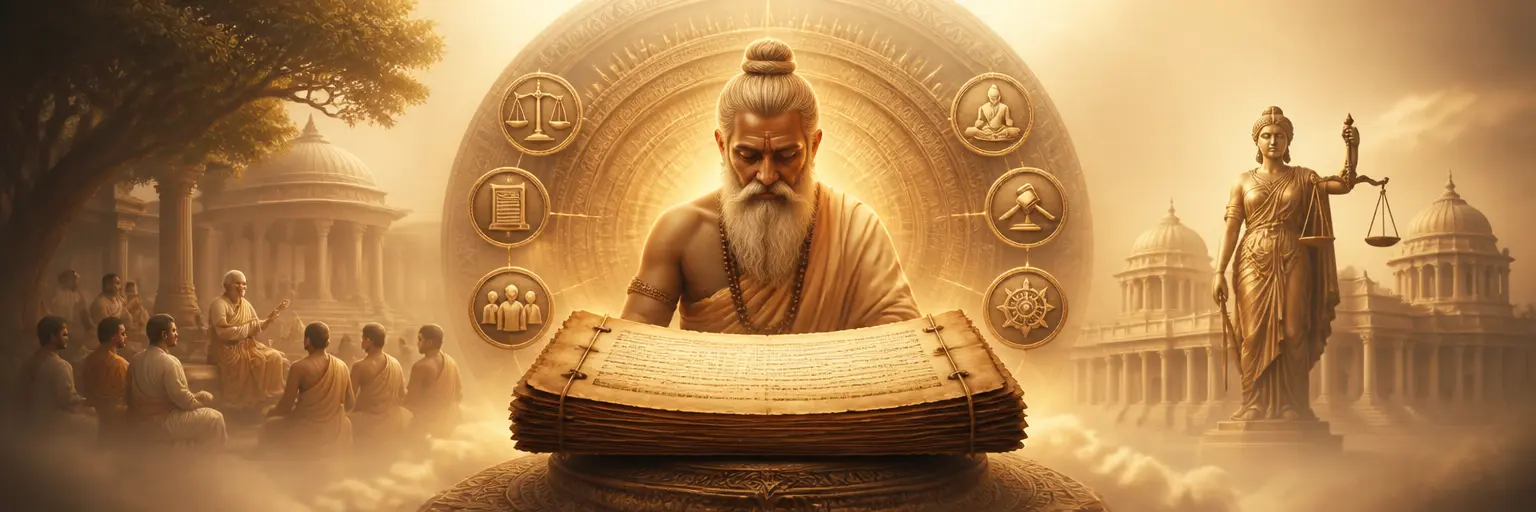

Ancient Indian Legal Texts (e.g., Manu Smriti)
38 articles in this topic
Start here
- Ancient Indian Legal Texts (e.g., Manu Smriti)The Importance of Customary Law in Ancient Indian Legal Systems
- Ancient Indian Legal Texts (e.g., Manu Smriti)The Relevance of Ancient Indian Legal Texts in Global Legal Discourse
- Ancient Indian Legal Texts (e.g., Manu Smriti)How Ancient Indian Laws Addressed Social Justice and Inequality
Read more about this topic
Explore Ancient Indian legal texts, including the influential Manu Smriti, to discover how early Indian societies approached justice, governance, social duties, property, and ethics. These historic law codes offer valuable insight into the legal systems, cultural values, and administrative traditions that shaped ancient India.
More in Ancient Indian Legal Texts (e.g., Manu Smriti)

Ancient Indian Legal Texts (e.g., Manu Smriti)
The Intersection of Religion and Law in Ancient Indian Civilizations

Ancient Indian Legal Texts (e.g., Manu Smriti)
The Concept of Justice in Ancient India: Lessons for Today
Ancient Indian Legal Texts (e.g., Manu Smriti)
The Role of Legal Scholars in Preserving Ancient Indian Law

Ancient Indian Legal Texts (e.g., Manu Smriti)
Exploring the Afterlife of Ancient Indian Legal Principles in Modern Law
Ancient Indian Legal Texts (e.g., Manu Smriti)
The Role of Ancient Indian Legal Texts in Shaping Cultural Identity

Ancient Indian Legal Texts (e.g., Manu Smriti)
The Legacy of Ancient Indian Legal Texts in Contemporary Legal Studies

Ancient Indian Legal Texts (e.g., Manu Smriti)
The Smriti Tradition: How Ancient Texts Guided Social Norms and Ethics

Ancient Indian Legal Texts (e.g., Manu Smriti)
The Connection Between Law and Philosophy in Ancient India
📜 Ancient Indian Legal Texts: Manu Smriti and Early Indian Law Codes
Explore Ancient Indian legal texts and the development of law, ethics, social duties, and governance in early South Asia. This subcategory examines influential works such as the Manu Smriti, along with broader traditions of Dharmashastra, royal edicts, customary law, judicial practice, and political thought. Readers can discover how ancient Indian communities understood justice, punishment, property, family relationships, kingship, religious duty, and social order while placing these sources within the wider history of ancient India.
⚖️ Manu Smriti and the Dharmashastra Tradition
Learn about the Manu Smriti, also known as the Laws of Manu, and its place within the wider Dharmashastra tradition. Articles in this section explain the text’s structure, themes, historical setting, Sanskrit terminology, and discussions of dharma, duty, conduct, ritual obligations, inheritance, legal procedure, and punishment.
Content also distinguishes between religious ideals, social prescriptions, and the practical administration of law. Readers can expect balanced explanations that consider authorship, dating, manuscript transmission, commentaries, and the ways later scholars have interpreted this important ancient Indian legal text.
🏛️ Kingship, Courts, and the Administration of Justice
Discover how ancient Indian legal and political literature described the role of the king, judges, officials, witnesses, and local communities in maintaining order. This section explores concepts such as royal justice, legal testimony, evidence, fines, corporal punishment, dispute resolution, and the relationship between religious authority and state power.
Readers will also encounter comparisons between normative law codes and the realities of governance in ancient kingdoms. Discussions may include the Arthashastra, court administration, taxation, espionage, public duties, and the practical responsibilities associated with ancient Indian kingship.
🪷 Dharma, Duty, and Social Organization
Ancient Indian legal texts often connected law with dharma, a broad concept encompassing duty, morality, religious order, social responsibility, and proper conduct. Explore how these works addressed individual behavior, life stages, family obligations, occupational duties, ritual practice, and relationships between different social groups.
This section presents these ideas with historical context rather than treating them as simple descriptions of everyday life. Readers can examine the difference between prescriptive texts and lived experience, including how women, merchants, farmers, rulers, religious specialists, and marginalized communities appear in ancient legal and ethical discussions.
📚 Sources, Commentaries, and Historical Context
Study the range of evidence used to understand ancient Indian law codes, including Sanskrit legal treatises, epic literature, inscriptions, Buddhist and Jain writings, archaeological evidence, and regional traditions. These sources help historians reconstruct changing ideas about justice, authority, property, social regulation, and political organization.
Articles also explain why ancient legal texts must be read critically. Texts were copied, edited, interpreted, and commented upon over long periods, while local custom and royal policy could shape legal practice. This approach helps readers understand the difference between a formal legal prescription and the diverse historical societies of ancient India.
🌏 Comparisons with Other Ancient Legal Traditions
Explore comparative perspectives on the Manu Smriti and other ancient legal traditions, including Roman law, Greek law, Mesopotamian law codes, Buddhist monastic rules, and Chinese legal thought. Comparisons focus on legal authority, punishment, family law, social hierarchy, property, kingship, and the relationship between religion and governance.
These comparisons do not assume that all legal systems developed in the same way. Instead, they highlight distinctive features of ancient Indian jurisprudence while helping readers identify broader patterns in the history of law, including the use of written norms, customary practice, judicial authority, and moral legitimacy.
🔍 Frequently Asked Questions About Ancient Indian Legal Texts
What is the Manu Smriti?
The Manu Smriti, or Laws of Manu, is a Sanskrit Dharmashastra text that discusses dharma, social duties, religious conduct, family relationships, legal procedure, punishment, inheritance, and kingship. It is one of the best-known ancient Indian legal and ethical texts, although its date, authorship, transmission, and historical influence remain subjects of scholarly debate.
Was the Manu Smriti the only law code in ancient India?
No. Ancient India had a diverse body of legal and ethical literature, including other Dharmashastra works, Dharmasutras, the Arthashastra, royal inscriptions, customary practices, Buddhist and Jain regulations, and regional traditions. The Manu Smriti was influential, but it did not represent a single uniform legal system for every ancient Indian kingdom or community.
What subjects do ancient Indian legal texts discuss?
Ancient Indian legal texts address topics such as justice, kingship, courts, evidence, contracts, property, inheritance, marriage, family duties, taxation, crime, punishment, ritual obligations, and social conduct. Many works combine legal rules with religious, moral, and political teachings, reflecting the ancient Indian concept that law and dharma were closely connected.
Did ancient Indian rulers follow the Manu Smriti exactly?
There is no evidence that every ruler or community followed the Manu Smriti in an identical way. Legal practice was shaped by royal decrees, local customs, guilds, family traditions, religious institutions, regional conditions, and other texts. The Manu Smriti is best understood as a normative source that offers an idealized model of social and legal order rather than a complete record of everyday practice.
How should modern readers interpret the Manu Smriti?
Modern readers should approach the text historically and critically. It contains valuable evidence about ancient Indian concepts of duty, authority, law, and social organization, but it also includes hierarchical and discriminatory prescriptions that should not be treated as timeless ethical standards. Studying its historical context, commentaries, limitations, and relationship to other sources provides a more accurate understanding of ancient Indian legal history.