
The Intertwined Histories of Indian and Chinese Dynasties: A Tale of Power and Exchange

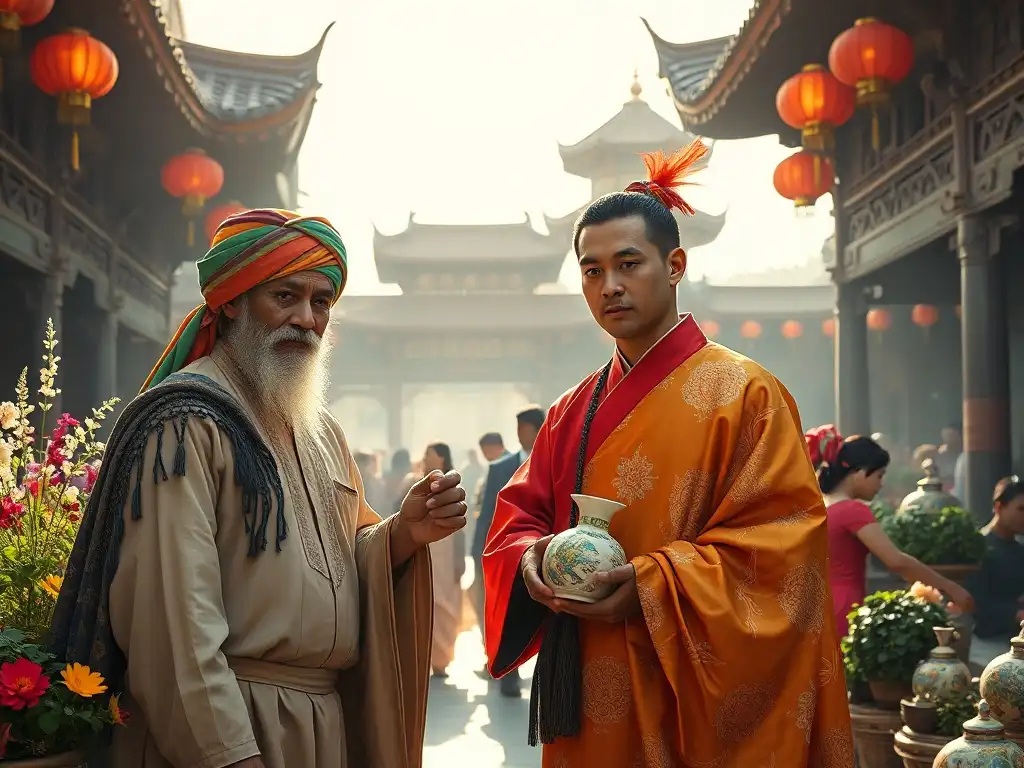
Welcome to Ancient India History, where we invite you to journey through the intricate tapestry of ancient Indian civilizations. Delve into the fascinating narrative of the Indian Chinese dynasties exchange history, a complex saga of cultural interactions and mutual influence that shaped the destinies of both nations. As you explore this compelling article, prepare to uncover the hidden connections and remarkable exchanges that defined an era of power and collaboration. Join us as we unveil the stories that have long been woven into the fabric of history, inviting you to discover the profound impact of these ancient interactions.
- Introduction to Indian Chinese Dynasties Exchange History
- Historical Context of Indian and Chinese Dynasties
- Key Periods of Exchange Between Indian and Chinese Dynasties
- Major Contributions and Influences
- Notable Figures in Indian Chinese Exchanges
- Challenges and Conflicts in Indian Chinese Relations
- Conclusion: The Legacy of Indian Chinese Dynasties Exchange History
- References and Further Reading
-
Frequently Asked Questions
- What were the main Indian dynasties involved in exchanges with China?
- How did trade influence the relationship between Indian and Chinese dynasties?
- What role did Buddhism play in the Indian-Chinese exchange?
- Were there any notable diplomatic missions between the two regions?
- What lasting impacts did the Indian-Chinese exchanges have on history?
- Final Reflection: The Enduring Legacy of Indian and Chinese Dynasties
- Uncover the Connections Between India and China!
Introduction to Indian Chinese Dynasties Exchange History
The histories of ancient India and China are not only marked by their individual achievements but also by the profound interactions and exchanges between their dynasties. From trade routes to cultural exchanges, the Indian and Chinese civilizations have influenced each other over centuries, creating a rich tapestry of shared history.
This article delves into the fascinating dynamics of the Indian Chinese dynasties exchange history, exploring how these two great civilizations have shaped one another through diplomacy, commerce, and cultural dialogues. By understanding this intertwined history, we can appreciate the complexities of their relationship and the legacies that continue to impact their modern identities.
Overview of Indian and Chinese Dynasties
The historical landscape of India and China is characterized by a series of powerful dynasties that ruled vast territories, each contributing to the growth of art, science, and philosophy.
- India's Notable Dynasties:
- Maurya Empire (322–185 BCE): Established a centralized government and promoted Buddhism beyond India.
- Gupta Empire (c. 240–550 CE): Known as the Golden Age of India, marked by significant advancements in mathematics, astronomy, and literature.
- China's Notable Dynasties:
- Han Dynasty (206 BCE–220 CE): A period of expansion and cultural flourishing, establishing the Silk Road.
- Tang Dynasty (618–907 CE): Known for its cosmopolitan culture and significant trade with neighboring regions.
Both civilizations experienced periods of prosperity and challenge, leading to interactions that fostered a unique exchange of ideas, goods, and technologies. The Silk Road stands as a testament to this exchange, facilitating trade and cultural interactions between these two ancient powers.
Importance of Studying Their Intertwined Histories
Understanding the intertwined histories of Indian and Chinese dynasties is crucial for several reasons:
- Cultural Exchange: The interaction between these civilizations led to the sharing of art, literature, and religious beliefs. For instance, the spread of Buddhism from India to China significantly influenced Chinese culture and spirituality.
- Trade Relations: The economic exchanges through trade routes helped both civilizations thrive. They traded goods such as silk, spices, and precious stones, which not only enriched their economies but also their cultural fabric.
- Diplomatic Ties: Political alliances and diplomatic missions were common, influencing policies and fostering peace between regions. Notable exchanges, such as the missions sent by Indian kings to Chinese courts, reveal the depth of their diplomatic relations.
- Technological Innovations: The flow of knowledge, including advancements in mathematics, astronomy, and medicine, played a vital role in the development of both societies.
By studying these intertwined histories, we gain insights into how ancient interactions have shaped contemporary cultures and continue to influence modern geopolitics, economics, and cultural identities. Such an exploration highlights the importance of cross-cultural dialogue in an increasingly interconnected world.
Historical Context of Indian and Chinese Dynasties
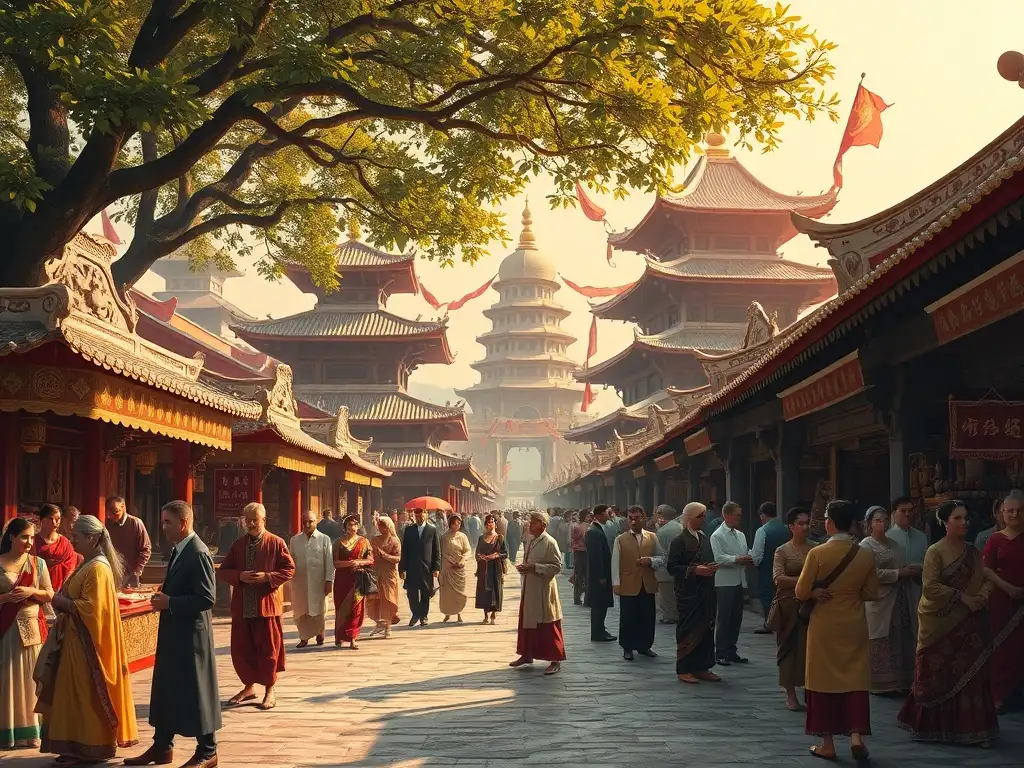
The Rise of Ancient Indian Civilizations
The ancient Indian subcontinent was home to some of the earliest and most sophisticated civilizations in history. The rise of these civilizations can be traced back to the Indus Valley, which flourished around 2500 BCE. This period laid the foundation for subsequent empires and cultural developments that influenced not only India but also its neighboring regions, including China.
The Indus Valley Civilization
The Indus Valley Civilization (IVC), also known as the Harappan Civilization, is noted for its advanced urban planning, architecture, and social organization. Notable cities such as Harappa and Mohenjo-Daro were characterized by grid layouts, advanced drainage systems, and standardized fired-brick constructions. The economy of the IVC was primarily agrarian, but it also engaged in extensive trade with distant regions, including Mesopotamia.
Key Features of the Indus Valley Civilization:
- Urban Planning: The cities were meticulously planned with streets laid out in a grid pattern.
- Trade Networks: Archaeological findings suggest the IVC traded beads, textiles, and pottery with regions as far away as Mesopotamia and possibly even China.
- Writing System: Although still undeciphered, the existence of seals with inscriptions indicates a complex administrative system.
Despite its advancements, the decline of the IVC around 1900 BCE remains a subject of debate, with theories ranging from climate change to invasion.
The Maurya and Gupta Empires
Following the decline of the IVC, the Indian subcontinent saw the emergence of powerful empires, notably the Maurya and Gupta Empires. The Maurya Empire, founded by Chandragupta Maurya in the 4th century BCE, unified much of India and is renowned for its significant contributions to governance, trade, and culture.
Maurya Empire Highlights:
- Ashoka the Great: A prominent Mauryan ruler who embraced Buddhism and promoted non-violence and welfare, leaving a legacy through his edicts.
- Trade Expansion: The Mauryan Empire established trade routes connecting India to Central Asia and beyond, facilitating cultural exchanges with neighboring civilizations.
The Gupta Empire, which followed, is often referred to as the "Golden Age" of India due to its achievements in art, science, and philosophy. The Guptas fostered an environment that encouraged intellectual pursuits and trade.
Gupta Empire Highlights:
- Cultural Flourishing: Significant advancements in mathematics (including the concept of zero), astronomy, and literature.
- Silk Road Connections: The Gupta period witnessed increased interactions with Chinese dynasties, particularly through the Silk Road, leading to a rich exchange of goods and ideas.
The Evolution of Chinese Dynasties
The history of China is marked by the rise and fall of numerous dynasties, each contributing to the rich tapestry of Chinese culture, philosophy, and governance. The evolution of these dynasties provides insight into the interactions that occurred with neighboring regions, including India.
The Xia, Shang, and Zhou Dynasties
The early Chinese dynasties, namely Xia, Shang, and Zhou, laid the groundwork for Chinese civilization. The Xia Dynasty, often considered the first, remains somewhat legendary, while the Shang Dynasty (c. 1600–1046 BCE) is known for its advancements in bronze metallurgy and writing.
Key Aspects of Early Chinese Dynasties:
- Shang Dynasty Innovations: Development of a writing system, oracle bones for divination, and significant advancements in bronze casting.
- Zhou Dynasty Philosophy: The emergence of Confucianism and Daoism, which shaped Chinese thought and governance, and laid the groundwork for later dynasties.
The Zhou Dynasty is particularly notable for its feudal system and the concept of the Mandate of Heaven, which justified the rule of the emperor.
The Qin and Han Dynasties
The Qin Dynasty (221–206 BCE) marked a significant turning point in Chinese history, known for its unification of China and the establishment of a centralized bureaucratic state. The subsequent Han Dynasty (206 BCE–220 CE) is often viewed as a golden age of Chinese civilization, with remarkable advancements in technology, culture, and trade.
Highlights of the Qin and Han Dynasties:
- Qin Dynasty Achievements: Standardization of weights, measures, and writing, as well as the construction of the Great Wall of China.
- Silk Road Development: The Han Dynasty expanded trade routes that connected China with India and the Mediterranean, facilitating cultural, technological, and commercial exchanges.
Both the Qin and Han dynasties played crucial roles in shaping the Indian-Chinese exchange history, as they established connections that would allow for the flow of goods, ideas, and cultures between these two ancient civilizations. Through trade, diplomacy, and cultural exchanges, the legacies of Indian and Chinese dynasties have been intertwined throughout history.
Key Periods of Exchange Between Indian and Chinese Dynasties
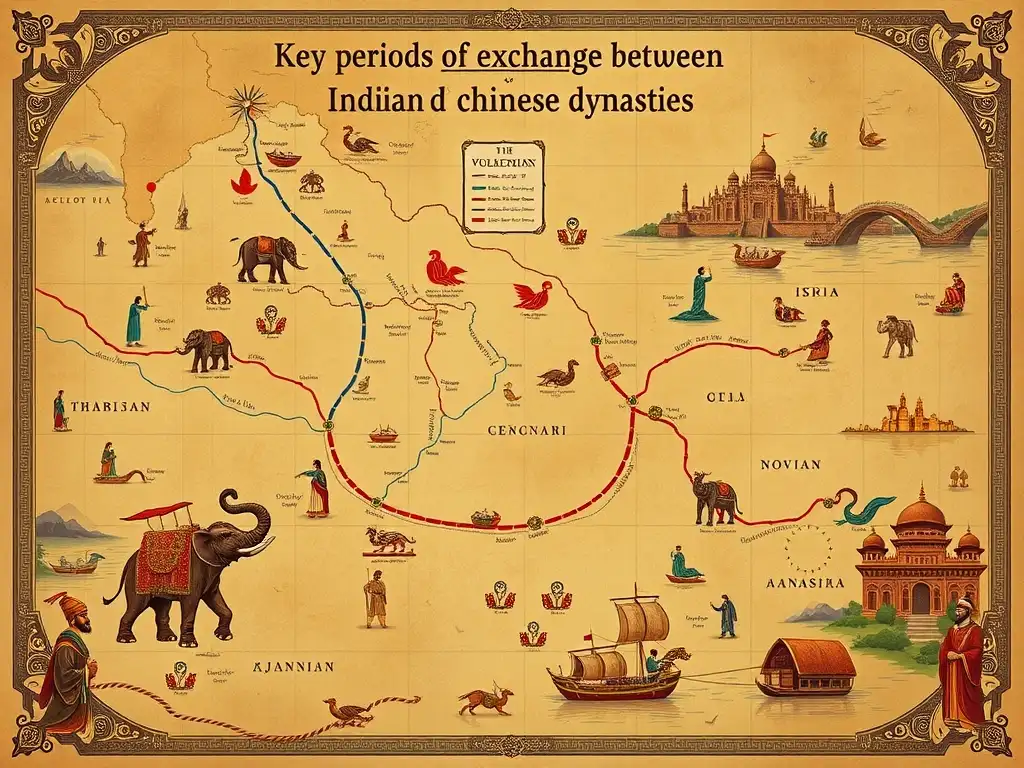
Early Interactions: Trade Routes and Cultural Flow
The exchanges between Indian and Chinese dynasties can be traced back to ancient times, primarily through established trade routes. These interactions facilitated not only economic trade but also the flow of ideas, culture, and technology between the two civilizations. The significance of these exchanges is underscored by the various routes that connected India and China, which served as conduits for both goods and cultural practices.
The Silk Road and Its Significance
The Silk Road was a network of trade routes that connected the East and West, flourishing from around the 2nd century BCE. This route was instrumental in the exchange of silk, spices, and precious stones, but its importance extended beyond mere trade.
- Cultural Exchange: The Silk Road enabled the transfer of artistic ideas, religious beliefs, and technologies, such as papermaking and metallurgy.
- Political Alliances: Diplomatic missions were common, leading to formal alliances between Indian and Chinese dynasties, fostering a sense of shared cultural heritage.
- Impact on Society: The interactions along the Silk Road contributed to the socio-economic evolution of both societies, leading to urbanization in regions along the trade routes.
Maritime Trade and Cultural Exchanges
In addition to overland routes, maritime trade played a critical role in the exchanges between Indian and Chinese civilizations. By the 1st century CE, seafaring routes began to flourish, notably through the Indian Ocean.
- Key Ports: Ports like Tianjin in China and Kolkata in India became vibrant hubs of trade and cultural exchange.
- Goods and Ideas: Spices, textiles, and ceramics were traded, alongside ideas in philosophy, science, and art, which enriched both cultures.
- Technological Innovations: The maritime exchanges led to advancements in shipbuilding and navigation techniques, enhancing maritime trade efficiency.
The Influence of Buddhism on Indian and Chinese Dynasties
Buddhism stands out as one of the most significant cultural exchanges between Indian and Chinese dynasties. Originating in India in the 5th century BCE, Buddhism spread extensively into China, profoundly influencing its philosophy and culture.
The Spread of Buddhism from India to China
The transmission of Buddhism to China occurred primarily through the Silk Road, with central figures such as Bodhidharma playing pivotal roles.
- Historical Routes: Following the collapse of the Han dynasty, monks traveled along established trade routes, bringing Buddhist texts and teachings to China.
- Cultural Integration: Buddhism was often syncretized with local Chinese beliefs, leading to unique schools of thought, such as Chan (Zen) Buddhism.
- Patronage: Chinese emperors often supported Buddhist missions, leading to the construction of temples and monasteries that served as cultural centers.
The Role of Monastic Exchanges
Monastic exchanges were fundamental to the dissemination of Buddhist teachings between India and China.
- Monastic Networks: Indian monks traveled to Chinese monasteries to teach, while Chinese monks visited Indian centers of learning to deepen their understanding of Buddhist texts.
- Translation Movements: The translation of Buddhist texts into Chinese led to a rich literary tradition, significantly impacting Chinese literature and philosophy.
- Cultural Festivals: The celebrations of Buddhist festivals brought together communities from both cultures, fostering a sense of unity and shared beliefs.
The intertwined histories of Indian and Chinese dynasties exemplify a rich tapestry of exchanges that encompass trade, cultural practices, and religious beliefs, culminating in a shared heritage that continues to resonate in modern times.
Major Contributions and Influences
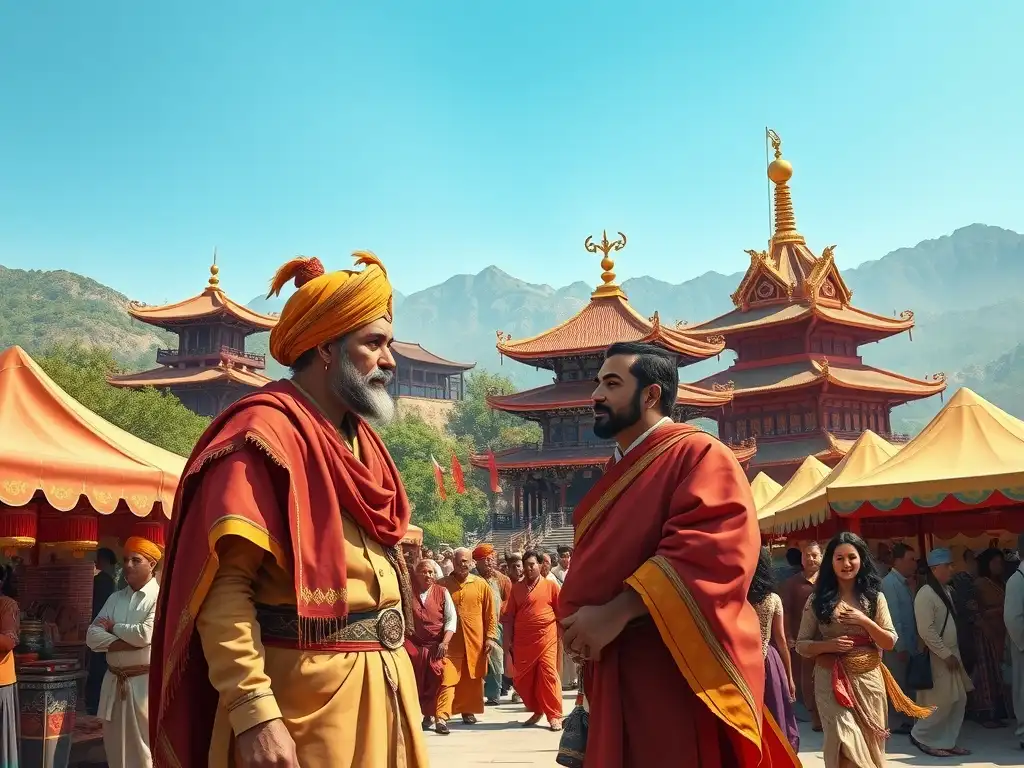
The historical relationship between Indian and Chinese dynasties is marked not only by political interactions but also by significant cultural exchanges that have shaped both civilizations profoundly. Throughout centuries, the interplay of ideas, art, literature, and scientific advancements has fostered a rich tapestry of mutual influence. This section delves into the major contributions and influences of Indian and Chinese cultures on each other, highlighting the remarkable legacy that emerged from their intertwined histories.
Indian Contributions to Chinese Culture
Indian culture has had a considerable impact on various aspects of Chinese civilization, particularly during periods of increased interaction such as the Silk Road era. The contributions can be seen across different fields, including literature, science, and mathematics.
Literature, Science, and Mathematics
The exchange of literary works and scholarly texts between India and China has played a crucial role in shaping intellectual traditions in both regions.
- Buddhism and Religious Texts: One of the most significant contributions was the introduction of Buddhism to China through Indian scholars and monks, such as Xuanzang. This led to the translation of numerous Buddhist texts, which enriched Chinese spiritual and philosophical thought. The Heart Sutra and Lotus Sutra, for example, were translated into Chinese and have had lasting impacts on Chinese Buddhism.
- Mathematics: Indian mathematicians, particularly during the Gupta Empire, developed concepts such as zero and the decimal system, which eventually found their way to China. The Chinese adopted these numerical advancements, greatly enhancing their mathematical calculations and scientific pursuits. Notably, the work of Indian mathematicians like Aryabhata and Brahmagupta influenced Chinese mathematical treatises during the Tang and Song dynasties.
- Astronomy: The exchange also extended to astronomy. Indian astronomical texts, such as the Surya Siddhanta, introduced Chinese scholars to advanced astronomical calculations. This knowledge facilitated the development of more accurate calendars and navigation techniques in China.
Through these contributions, Indian culture significantly shaped Chinese literature, science, and mathematics, fostering a legacy of intellectual exchange that continues to be recognized today.
Chinese Influences on Indian Civilization
Conversely, Chinese civilization has also left its mark on India, particularly in areas such as art, philosophy, and governance. The cross-cultural exchanges enriched Indian society in various ways.
Art, Philosophy, and Governance
The influence of Chinese culture on Indian civilization is evident in several domains:
- Artistic Styles: The introduction of Chinese artistic techniques, especially during the periods of Mongol rule in India, led to the blending of styles. Chinese motifs and techniques can be seen in several Indian artworks, particularly in the field of textiles and pottery. The use of intricate patterns and vibrant colors became more pronounced, showcasing a fusion of artistic traditions.
- Philosophy and Thought: The philosophical dialogues between Indian and Chinese thinkers, especially during the early medieval period, resulted in a unique synthesis of ideas. Concepts of harmony and balance, as seen in Chinese philosophical traditions, began to influence Indian thought. This can be observed in the writings of influential figures like Chan (Zen) Buddhism, which borrowed elements from both traditions, emphasizing meditation and personal insight.
- Governance and Administration: The bureaucratic systems of governance in ancient China, particularly during the Han dynasty, provided a model for Indian rulers. The concept of a structured administrative framework, along with emphasis on meritocracy and civil service examinations, influenced Indian governance practices, particularly during the Maurya and Gupta empires.
The interplay of Indian and Chinese influences has created a rich cultural dialogue that has significantly shaped the historical trajectories of both civilizations. Understanding these contributions helps illuminate the complex tapestry of human history and the transformative power of intercultural exchanges.
Notable Figures in Indian Chinese Exchanges
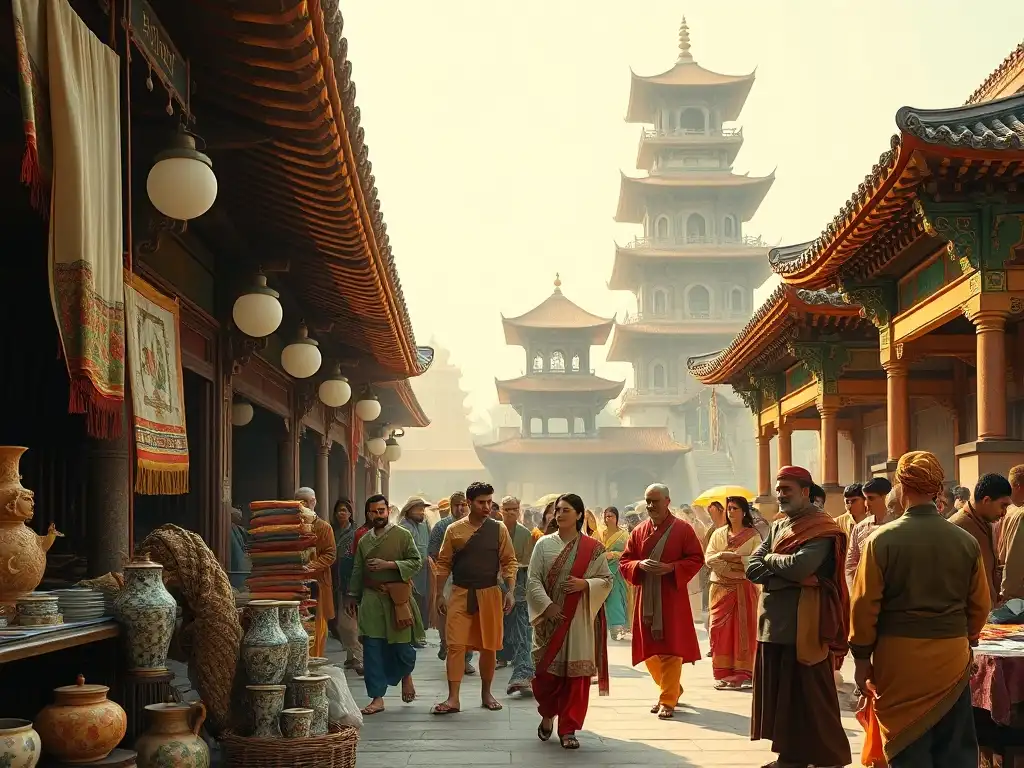
The historical exchanges between Indian and Chinese dynasties were enriched by the contributions of various notable figures, whose explorations and scholarly work laid the groundwork for cultural, religious, and intellectual exchanges. These individuals played pivotal roles in facilitating dialogue between the two great civilizations, promoting mutual understanding and collaboration.
Indian Scholars and Travelers
Indian scholars and travelers ventured into China, often embarking on arduous journeys to disseminate knowledge, particularly in the fields of Buddhism, philosophy, and science. Their accounts not only provide insights into their travels but also reflect the cultural exchanges that transpired during their time.
Fa-Hien and Xuanzang
Fa-Hien (circa 399-414 CE) was an early Indian monk whose travels to China were primarily motivated by his desire to acquire Buddhist texts. His journey, documented in his work A Record of Buddhist Countries, provides a detailed portrayal of the social and political landscapes of the regions he traversed, including India, Central Asia, and China. His observations regarding the practice of Buddhism in different cultures illustrate the adaptability and evolution of the religion.
Xuanzang (602-664 CE), another prominent figure, undertook a legendary pilgrimage to India to gather Buddhist scriptures. His journey spanned over 17 years, and he traveled through perilous terrains, including the treacherous Silk Road. Xuanzang's detailed accounts, compiled in Great Tang Records on the Western Regions, not only highlight the rich spiritual and cultural heritage of India but also emphasize the importance of Indian philosophy in shaping Chinese Buddhism. His efforts led to significant exchanges of texts and ideas, fostering a deeper understanding of Buddhism in China.
Chinese Scholars and Their Impact
Chinese scholars also played a crucial role in the exchanges between the two civilizations, often serving as conduits of knowledge and cultural practices that enriched both societies.
Zhang Qian and His Expeditions
Zhang Qian (circa 195-114 BCE), a Han dynasty envoy, is often regarded as a pioneer of the Silk Road expeditions. His journeys to Central Asia and beyond were primarily diplomatic missions aimed at forging alliances and expanding trade routes. His travels significantly impacted the Indian-Chinese exchanges, as he was one of the first to document the rich cultures he encountered, including those in India.
Zhang Qian's reports highlighted the potential for trade and cultural interaction, which led to increased exchanges of goods, ideas, and technologies between India and China. His accounts served as a foundation for future diplomatic missions and contributed to the establishment of the Silk Road as a vital link in the exchange of not just commodities, but also philosophies and religions.
Through their significant contributions, these scholars and travelers illustrate the profound interconnectedness between Indian and Chinese dynasties, marking a history rich in cultural and intellectual exchange that shaped both civilizations profoundly. The interplay of ideas, beliefs, and practices continues to resonate in contemporary discussions of cultural heritage and history.
Challenges and Conflicts in Indian Chinese Relations
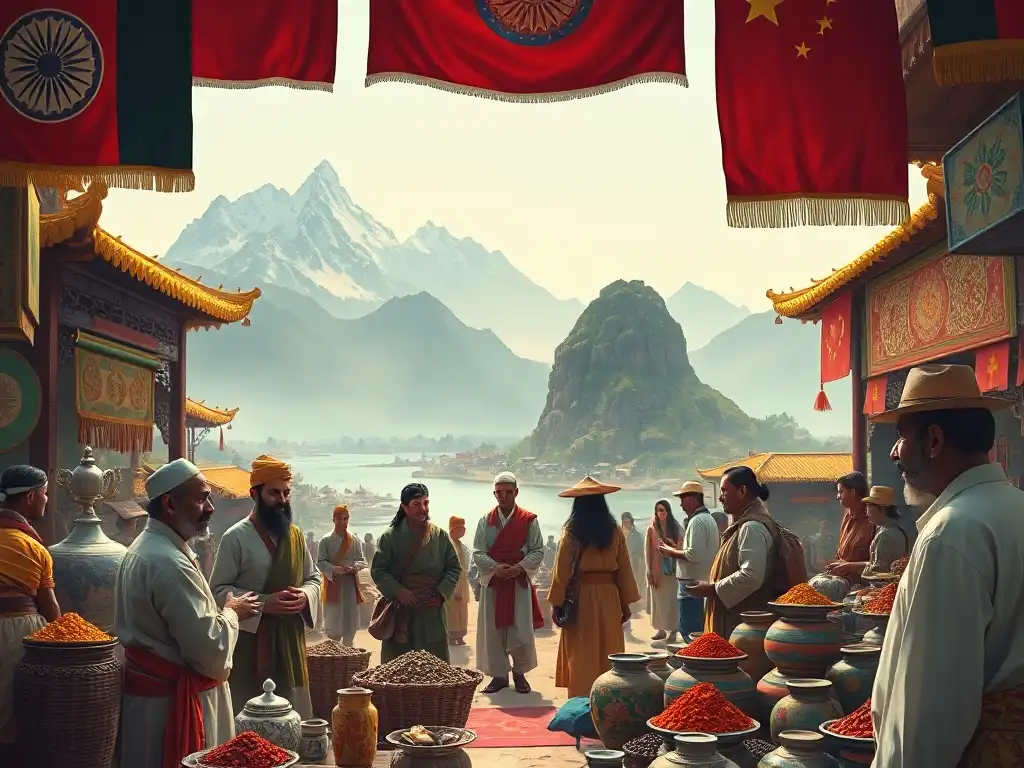
The historical relationship between Indian and Chinese dynasties has been marked by both collaboration and conflict. While trade and cultural exchanges flourished, various challenges and conflicts have also shaped the dynamics of their interactions. This section delves into the political rivalries, military conflicts, and cultural misunderstandings that have defined the intertwined histories of these two ancient civilizations.
Political Rivalries and Military Conflicts
Political rivalry between Indian and Chinese dynasties can be traced back to ancient times, often fueled by territorial ambitions and cultural dominance. Key events that exemplify these tensions include:
- The Mauryan Empire and the Han Dynasty: During the 3rd century BCE, the rise of the Mauryan Empire in India and the Han Dynasty in China led to a competitive atmosphere. Both empires sought to expand their territories and influence in Central Asia, impacting trade routes and alliances.
- The Kushan Empire and the Sui Dynasty: The Kushan Empire (1st to 3rd century CE) played a significant role in facilitating trade along the Silk Road. However, as the Sui Dynasty emerged (581-618 CE), tensions arose over control of these lucrative trade routes, leading to military skirmishes.
- The Tang Dynasty and the Gupta Empire: The Tang Dynasty (618-907 CE) and the Gupta Empire (c. 240-550 CE) experienced periods of both cooperation and conflict. The Tang's military campaigns in Central Asia often clashed with Gupta interests, leading to territorial disputes and diplomatic tensions.
The Impact of the Silk Road on Political Dynamics
The Silk Road acted as a double-edged sword in the political interactions between Indian and Chinese dynasties. While it facilitated trade and cultural exchange, it also intensified political rivalries due to its strategic importance.
- Trade as a Catalyst for Conflict: Control over the Silk Road routes often led to conflicts, as both empires sought to dominate trade and resource access. The competition for economic power frequently translated into military confrontations.
- Diplomatic Missions and Espionage: The importance of the Silk Road encouraged diplomatic missions between Indian and Chinese dynasties. However, these missions sometimes resulted in espionage, where each side sought to gather intelligence on the other's military capabilities and alliances.
- Cultural Diplomacy vs. Military Aggression: While some rulers attempted to foster goodwill through cultural exchanges, others resorted to military aggression to assert dominance. The balance between cultural diplomacy and military action significantly influenced their relations.
Cultural Misunderstandings and Resolutions
Cultural exchanges between India and China have been profound, yet they were often hindered by misunderstandings and differences in philosophies, religions, and social structures. Addressing these misunderstandings has been pivotal in resolving conflicts and fostering cooperation.
- Religious Differences: The spread of Buddhism from India to China in the 1st century CE exemplifies a significant cultural exchange. However, initial resistance to Buddhist teachings in China stemmed from Confucian and Daoist beliefs, leading to misunderstandings. Over time, syncretism emerged as a resolution, blending elements of Buddhism with Chinese philosophies.
- Language Barriers: Communication difficulties often exacerbated misunderstandings. The lack of a common language hindered diplomatic negotiations and cultural exchanges. Efforts to translate texts and educate diplomats in each other's languages have helped bridge these gaps.
- Artistic Interpretations: Artistic expressions from both cultures often misrepresented one another's beliefs and practices. For instance, Indian depictions of Chinese figures were sometimes exaggerated or stylized, leading to misconceptions. Collaborative art projects and cultural festivals have been employed as tools for reconciliation and mutual appreciation.
The resolution of these cultural misunderstandings has not only facilitated better relations but has also enriched the cultural landscapes of both civilizations, showcasing the potential for cooperation amidst challenges.
The complexities of the Indian-Chinese exchange history reflect a rich tapestry of interactions that shaped the sociopolitical landscapes of both regions. Understanding these challenges and conflicts is crucial for appreciating the depth of their historical ties.
Conclusion: The Legacy of Indian Chinese Dynasties Exchange History
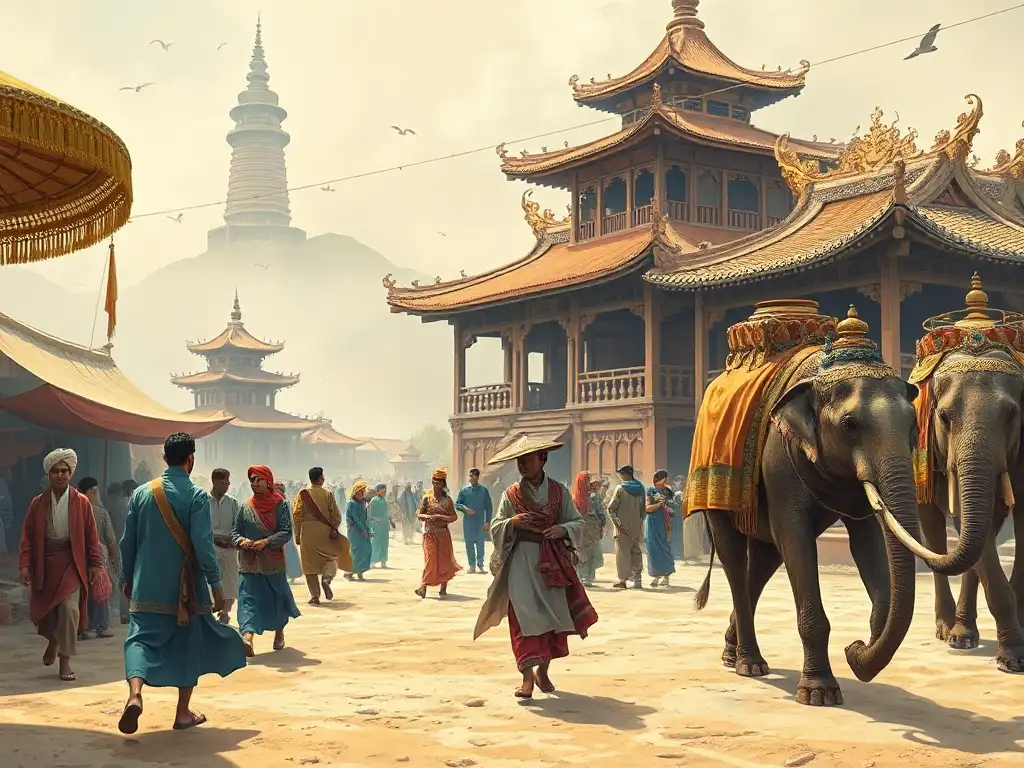
The exchange history between Indian and Chinese dynasties has left an indelible mark on both civilizations, shaping cultural, economic, and intellectual landscapes that continue to influence the modern world. Understanding this legacy is crucial for appreciating the complexity of contemporary India-China relations and their shared heritage.
Lasting Impact on Modern India and China
The historical interactions between Indian and Chinese dynasties have led to a multitude of influences that persist in the contemporary landscape of both nations.
- Cultural Exchange:
- The dissemination of Buddhism from India to China during the Han dynasty facilitated a profound spiritual and philosophical exchange. This can be observed in the presence of Buddhist art and architecture throughout China, which reflects Indian motifs and narratives.
- Indian and Chinese literature have also been deeply intertwined, with texts such as the Panchatantra influencing Chinese storytelling traditions. The adaptation of these narratives demonstrates the fluidity of cultural expression between the two nations.
- Trade Relations:
- The Silk Road, a crucial conduit for trade, allowed for the exchange of goods such as silk, spices, and precious stones. This economic interaction laid the groundwork for future bilateral trade relations, which remain significant in the global economy today.
- Modern India and China continue to engage in substantial trade, driven by historical precedents. For instance, in 2021, trade between the two nations reached $125 billion, illustrating the enduring nature of their economic ties.
- Intellectual Legacy:
- The historical exchange of knowledge in areas such as mathematics, astronomy, and medicine has left a lasting impact. Indian numerals and concepts like zero profoundly influenced Chinese mathematics, while Chinese herbal medicine and acupuncture techniques have found a place in Indian alternative health practices.
- Today, both countries engage in collaborative research and initiatives, building on their shared intellectual heritage.
Future Perspectives on Cultural Exchanges
Looking ahead, the potential for cultural exchanges between India and China remains vast.
- Digital Era Opportunities:
- The rise of digital technology offers new platforms for cultural exchange, allowing for the sharing of art, literature, and educational materials across borders. Online learning and cultural programs can facilitate deeper understanding and appreciation between the two nations.
- Social media has become a powerful tool for promoting cultural events and fostering dialogue, enabling a direct connection between the youth of both countries.
- Strengthening Partnerships:
- Initiatives such as the India-China Cultural Exchange Program can further promote mutual understanding by encouraging academia, artists, and cultural practitioners to collaborate and share their experiences.
- Joint ventures in film, literature, and art exhibitions can showcase the rich heritage of both civilizations, creating a platform for dialogue and exchange.
- Challenges and Resolutions:
- While historical exchanges have laid a strong foundation, contemporary geopolitical tensions pose challenges. Addressing misunderstandings through cultural diplomacy will be essential in fostering a peaceful coexistence and mutual respect.
- Promoting cultural awareness through education and public discourse can help mitigate biases and encourage appreciation of each other's heritage.
The intricate tapestry woven by the Indian and Chinese dynasties throughout history not only enriches our understanding of their past but also holds significant promise for future exchanges. Embracing this legacy is key to fostering a harmonious relationship that celebrates shared values and collective growth.
References and Further Reading
Suggested Books and Articles on Indian Chinese Exchanges
-
“India and China: A History of Cultural Exchanges”
This book delves into the historical interactions between India and China, exploring how cultural exchanges shaped both civilizations. It provides a comprehensive overview of the philosophical, religious, and artistic influences that flowed between these two great powers.
-
“The Silk Roads: A New History of the World” by Peter Frankopan
Frankopan's work offers a broader perspective on the interconnectedness of ancient civilizations, including the crucial exchanges between Indian and Chinese dynasties. It discusses trade routes and the movement of ideas, goods, and cultures.
-
“The Lost History of Indian and Chinese Relations” by R. C. Sharma
This article investigates the historical narratives that have often overlooked the significant exchanges between these two regions. It provides a critical analysis of archaeological findings and historical texts that illustrate their interconnected past.
-
“Cultural Exchanges along the Silk Route”
A scholarly article that highlights the specific cultural exchanges that occurred along the Silk Road, emphasizing the roles of Indian and Chinese dynasties. It discusses the impact of these exchanges on art, religion, and technology.
-
“Trade and Diplomacy in Ancient India and China”
This research paper examines the diplomatic relations and trade agreements between Indian and Chinese dynasties, shedding light on how these interactions influenced their political landscapes.
Online Resources for Further Exploration
-
The Chinese Academy of Social Sciences
This site contains numerous publications and research papers focused on Sino-Indian relations, particularly during ancient times. It offers valuable insights and current academic perspectives.
-
Digital Silk Road Project
An initiative that provides a wealth of resources related to the history of trade routes, including routes used by Indian and Chinese merchants. The site includes maps, articles, and databases.
-
The Indian Council of Historical Research
This online resource features a collection of articles and papers focusing on Indian history, with sections dedicated to the interactions with China throughout various dynasties.
-
Asia Society: India-China Relations
This platform provides articles, expert opinions, and historical analyses on the relationship between India and China, with a focus on cultural and economic exchanges.
-
The National Museum of India
The museum’s website presents online exhibits that showcase artifacts from ancient India, including those influenced by Chinese culture, illustrating the tangible aspects of their historical exchanges.
Frequently Asked Questions
What were the main Indian dynasties involved in exchanges with China?
Several Indian dynasties, including the Maurya and Gupta empires, engaged in significant trade and cultural exchanges with Chinese dynasties throughout history.
How did trade influence the relationship between Indian and Chinese dynasties?
Trade routes, such as the Silk Road, facilitated not only the exchange of goods but also cultural ideas, religions, and technologies between Indian and Chinese civilizations.
What role did Buddhism play in the Indian-Chinese exchange?
Buddhism served as a crucial vehicle for cultural exchange, with Indian monks traveling to China, spreading philosophical ideas and texts that helped shape Chinese thought.
Were there any notable diplomatic missions between the two regions?
Yes, multiple diplomatic missions occurred, such as the travels of Fa-Hien and Xuanzang, who documented their journeys and the cultural exchanges they witnessed between India and China.
What lasting impacts did the Indian-Chinese exchanges have on history?
The exchanges left a profound impact on art, science, and religion, influencing the development of both civilizations and fostering a legacy of mutual respect and cultural enrichment.
Final Reflection: The Enduring Legacy of Indian and Chinese Dynasties
The intricate tapestry of Indian and Chinese dynasties reveals a profound truth about our shared history: the power of cultural exchange and mutual influence is as relevant today as it was centuries ago. In an era marked by globalization, understanding the historical connections between these two great civilizations offers invaluable lessons on cooperation, diplomacy, and the importance of shared narratives. The legacies of these dynasties remind us that the flow of ideas, trade, and culture can transcend borders and shape societies in remarkable ways.
The historical exchanges between India and China have not only enriched their respective cultures but also laid the groundwork for contemporary interactions in a rapidly changing world. As we navigate the complexities of modern geopolitics, the stories of these dynasties serve as a reminder of the potential for collaboration and understanding. History is not a burden on the memory but an illumination of the soul.
This quote encapsulates the essence of learning from the past, urging us to recognize the value of our intertwined histories as we forge new paths forward.
As we reflect on the lessons drawn from the dynamic interplay between Indian and Chinese dynasties, I invite you to consider how these historical narratives can inspire your own journey. What can you learn from the past to foster connections in your life today? Embrace the spirit of exchange, seek understanding, and let the stories of these great civilizations guide you in building bridges across cultures. The future is shaped by our willingness to learn from one another, and every small act of connection can contribute to a more harmonious world.
Uncover the Connections Between India and China!
Thank you for diving into the fascinating world of Indian and Chinese dynasties with us! We hope you’ve gained valuable insights into their rich histories and the powerful exchanges that have shaped both civilizations. Now, it’s your turn to take action and further explore this captivating topic.
Here are a few ways you can continue your journey:
- Dive deeper: Read about specific dynasties and their impacts on trade and culture. Consider checking out our related articles on Ancient Indian history.
- Engage with the community: Share your thoughts on the connections between these two great civilizations. Join our forum and discuss with fellow history enthusiasts!
- Spread the word: Share this article with friends or on social media to spark conversations about the intertwined histories of India and China.
What aspect of this rich history intrigues you the most—trade, culture, or the power dynamics between the two civilizations? Let us know in the comments!