
The Unseen Connection: How Ancient India Influenced Greek Philosophy


Welcome to Ancient India History, where we embark on a fascinating journey through time to uncover the rich tapestry of ancient Indian civilizations. Have you ever wondered how the profound philosophies of ancient India intertwined with those of Greece, shaping thought across continents? In our featured article, "The Unseen Connection: How Ancient India Influenced Greek Philosophy," we delve into this intriguing relationship, revealing the lesser-known stories that highlight the profound impact of Indian culture on Greek intellectual traditions. Prepare to explore the depths of history and uncover the secrets of a remarkable exchange between two great civilizations—your adventure awaits!

Introduction to Ancient India and Greek Philosophy
The intricate tapestry of ancient civilizations reveals countless threads of interaction and influence, one of the most fascinating being the connection between Ancient India and Greek philosophy. This relationship, often overlooked, provides significant insights into how ideas, beliefs, and cultures can intertwine across vast distances and time periods.
From the flourishing cities of the Indus Valley to the intellectual endeavors of the Greek philosophers, both civilizations offered profound contributions that have shaped the course of human thought. Understanding this unseen connection not only enriches our knowledge of history but also highlights the remarkable ways in which ancient societies interacted and influenced one another.
Overview of Ancient Indian Civilization
Ancient India, with its roots tracing back to the Indus Valley Civilization around 2500 BCE, boasted a rich cultural and intellectual heritage. This civilization was characterized by advanced urban planning, sophisticated drainage systems, and a vibrant trade network that facilitated contact with neighboring regions. As time progressed, the emergence of major religious and philosophical schools, such as Hinduism, Buddhism, and Jainism, played a pivotal role in shaping the societal norms and values of ancient Indian life.
- Key Features of Ancient Indian Civilization:
- Religion and Philosophy: The spiritual and philosophical texts, including the Vedas, Upanishads, and Buddhist scriptures, laid the groundwork for complex metaphysical inquiries and ethical considerations.
- Art and Architecture: The period saw remarkable achievements in art, sculpture, and architecture, including the construction of stupas and temples that reflected the philosophical thoughts prevalent at the time.
- Science and Mathematics: Ancient Indian scholars made significant advances in mathematics, astronomy, and medicine, contributing to a legacy that would influence later civilizations.
The Emergence of Greek Philosophy
Simultaneously, the ancient Greek civilization witnessed the rise of philosophy as a formal discipline. Beginning in the 6th century BCE with thinkers like Thales and Pythagoras, Greek philosophy sought to understand the nature of existence, ethics, and knowledge through reason and observation.
- Notable Greek Philosophers:
- Socrates: Known for his Socratic method, which emphasized dialogue and questioning as a means of discovering truth.
- Plato: A student of Socrates, he established the Academy and wrote extensively on forms, ethics, and politics.
- Aristotle: A student of Plato, he contributed to various fields including logic, metaphysics, and ethics, laying the groundwork for future philosophical inquiry.
Historical Context of Indian-Greek Relations
The interactions between Ancient India and Greece were facilitated by a variety of factors, including trade, conquests, and the exchange of ideas. This historical context is crucial for understanding how Indian philosophies may have influenced Greek thought.
Trade Routes and Cultural Exchange
The ancient trade routes, such as the Silk Road, served as conduits for not only goods but also for the exchange of ideas and cultural practices. Indian merchants and travelers played a vital role in this exchange, bringing their philosophies and religious beliefs into contact with Greek thinkers.
- Key Trade Routes:
- The Maritime Silk Road, linking India to the Mediterranean.
- Overland routes connecting the Indus Valley with Greek territories.
Political Alliances and Interactions
The establishment of political alliances, especially following the conquests of Alexander the Great, opened channels for direct interaction between Indian and Greek scholars. This period saw an increase in the exchange of philosophical ideas, which would later resonate through the ages.
- Notable Events:
- Alexander's campaigns in India (327-325 BCE) prompted dialogues between his troops and Indian philosophers.
- The subsequent formation of the Greco-Bactrian Kingdom, where Indian and Greek cultures coexisted and thrived.
By tracing these connections, we can begin to unravel the profound influence that Ancient India had on Greek philosophy, showcasing a narrative that continues to resonate in contemporary discussions on cultural exchange and philosophical development.
Key Philosophical Concepts in Ancient India

Ancient Indian philosophy is rich with key concepts that have had a lasting impact on various fields of thought, including ethics, metaphysics, and epistemology. Central to this philosophical tradition are ideas such as dharma (duty/righteousness), karma (action and its consequences), and moksha (liberation from the cycle of birth and death). These concepts not only shaped individual lives but also influenced societal structures, emphasizing the interconnectedness of all beings and the importance of moral choices.
The philosophical inquiries in ancient India emphasized the nature of reality, the self, and the universe, leading to profound contemplations on existence. The interplay between the material and spiritual realms is a recurring theme, which can be seen in texts like the Vedas, Upanishads, and various philosophical treatises. This foundation provided fertile ground for dialogues with other cultures, notably the Greeks, as they sought to understand similar metaphysical questions.
The Foundations of Indian Philosophy
The roots of Indian philosophy can be traced back to the Vedic texts, which emerged around 1500 BCE. These texts introduced early concepts of cosmology, ethics, and metaphysics, laying the groundwork for subsequent philosophical exploration. Fundamental to this tradition is the distinction between Brahman (the ultimate reality) and Atman (the individual soul), which posits that understanding the relationship between the two is essential for spiritual enlightenment.
Over time, various philosophical schools emerged, each offering unique interpretations of these foundational ideas. The Upanishads, composed between 800 and 400 BCE, further developed these concepts, emphasizing introspection and meditative practices as pathways to knowledge and self-realization. The integration of ritual and philosophy in these texts symbolizes the comprehensive nature of Indian thought, merging practical and existential inquiries.
Major Schools of Thought: Samkhya, Yoga, and Vedanta
Among the prominent schools of Indian philosophy, Samkhya, Yoga, and Vedanta stand out for their distinctive approaches to understanding existence.
- Samkhya: This dualistic school posits two fundamental realities: Purusha (consciousness) and Prakriti (matter). Samkhya outlines a systematic framework for understanding the nature of reality, emphasizing the importance of knowledge and discernment in achieving liberation.
- Yoga: Closely linked to Samkhya, Yoga focuses on the practical aspects of attaining enlightenment through disciplined practices, including meditation, ethical living, and physical postures. The Yoga Sutras, attributed to Patanjali, codify these practices and provide insights into the mind-body connection.
- Vedanta: Emerging from the Upanishads, Vedanta interprets the unity of Brahman and Atman, claiming that realizing this identity is the essence of spiritual liberation. Different sub-schools of Vedanta offer varying perspectives on this relationship, contributing to a rich tapestry of thought.
These schools of thought not only shaped Indian philosophy but also provided a framework that would influence later philosophical discourses, including those in ancient Greece.
The Impact of Indian Philosophy on Greek Thought
The philosophical exchanges between ancient India and Greece are pivotal in understanding the evolution of thought in both cultures. Indian philosophical concepts found their way into Greek discussions, particularly during the time of Alexander the Great and his encounters with Indian thinkers. This cross-pollination of ideas fostered a unique blend of intellectual traditions.
Early Greek Philosophers and Indian Influences
Several early Greek philosophers, such as Pythagoras and Plato, exhibited an interest in Indian philosophical concepts. Pythagoras, known for his mathematical and ethical teachings, is often linked to ideas reminiscent of Indian thought, particularly in his emphasis on the immortality of the soul and the cyclical nature of existence.
Plato’s theory of forms, which suggests that non-material abstract forms represent the most accurate reality, parallels Indian notions of Brahman as the ultimate truth. Additionally, the dialogues of Socrates, emphasizing the importance of self-knowledge and ethical living, resonate with the Indian philosophical emphasis on introspection and the moral implications of one’s actions.
The Role of Alexander the Great in Cultural Exchange
The conquests of Alexander the Great in the 4th century BCE served as a significant catalyst for cultural exchange between India and Greece. His campaigns into the Indian subcontinent facilitated direct interactions between Greek and Indian philosophers, leading to a fusion of ideas.
This cultural dialogue is exemplified by the encounters between Alexander and Indian sages known as the Gymnosophists, who shared insights on ethics, ascetic practices, and the nature of reality. These exchanges not only enriched Greek philosophy but also contributed to the development of Hellenistic philosophy, as ideas from Indian thought were integrated into the broader philosophical landscape of the time.
The influence of ancient Indian philosophy on Greek thought is a testament to the interconnectedness of civilizations. The philosophical dialogues that emerged from this interaction laid the groundwork for future intellectual pursuits, illustrating the enduring legacy of these ancient traditions.
Comparative Analysis of Philosophical Ideas
The philosophical dialogue between ancient India and Greece presents a fascinating landscape where ideas converged, diverged, and influenced each other profoundly. Despite geographical and cultural distances, both civilizations grappled with fundamental questions about existence, morality, and the nature of the self. This comparative analysis reveals striking parallels and notable distinctions in their philosophical frameworks, highlighting the depth of cross-cultural engagement that shaped their intellectual heritage.
Concepts of Existence and Reality
In ancient Indian philosophy, particularly within the schools of Vedanta and Buddhism, the nature of existence is often characterized by concepts such as Brahman (the ultimate reality) and Maya (illusion). Vedanta posits that Brahman is the eternal, unchanging reality underlying the universe, while Maya creates the illusion of a diverse world. Conversely, ancient Greek philosophers, such as Heraclitus and Parmenides, explored existence through the lens of change and permanence. Heraclitus famously stated that "everything flows," emphasizing the transient nature of reality, while Parmenides argued for a singular, unchanging essence of being.
These contrasting views lead to a rich dialogue on the nature of reality, where Indian thought highlights the interplay between illusion and truth, while Greek philosophy approaches it through the lens of dialectics and metaphysics. This discourse has significant implications for understanding the philosophical traditions of both cultures, suggesting that the exploration of existence is a universal human concern.
The Nature of the Self: Atman vs. Greek Concepts of Soul

The Indian concept of Atman, which refers to the true self or soul, is a pivotal element of many philosophical traditions in India, particularly Hinduism. Atman is viewed as eternal, unchanging, and ultimately identical to Brahman, the universal spirit. In contrast, Greek philosophy presents various interpretations of the soul, notably those articulated by Plato and Aristotle. Plato viewed the soul as immortal and distinct from the body, emphasizing its role in seeking truth and knowledge. Aristotle, however, approached the soul more as the essence of a living being, intricately linked to the body and its functions.
The dialogue between Atman and Greek notions of the soul raises profound questions about identity, consciousness, and the afterlife. While both traditions acknowledge the significance of the self, Indian philosophy often emphasizes the metaphysical unity of Atman with the cosmos, whereas Greek thought tends to focus on the soul's individual journey towards knowledge and virtue.
Ethics and Morality: Dharma vs. Greek Virtue Ethics
In ancient Indian philosophy, Dharma represents a complex and multifaceted concept encompassing duty, righteousness, and moral law. It varies according to one’s role in society and the stage of life, making it deeply contextual. Conversely, Greek virtue ethics, as articulated by philosophers like Aristotle, centers on the cultivation of character and the pursuit of the Golden Mean—a balanced approach to achieving virtue.
The comparative analysis of Dharma and Greek virtue ethics reveals both shared concerns regarding moral conduct and significant differences in approach. While Dharma is often situational and prescriptive, reflecting the diverse roles individuals play within a community, Greek ethics tends to emphasize universal virtues applicable across various contexts. This divergence enriches the discourse on morality, highlighting the interplay between individual responsibility and societal obligations in both traditions.
Case Studies: Specific Greek Philosophers Influenced by Indian Thought
The intellectual exchange between ancient India and Greece is evident through specific philosophers whose works reflect the influence of Indian thought. Examining these case studies reveals the nuances of interaction and the transmission of ideas across cultures.
Pythagoras and Mathematical Mysticism
Pythagoras, the ancient Greek philosopher and mathematician, is often associated with the mystical significance of numbers and their relationship to the cosmos. His belief in the harmony of the universe resonates with Indian mathematical traditions, particularly those found in texts like the Sulbasutras, which explore the sacred geometry underlying Vedic rituals. Both traditions attribute deep philosophical meaning to numbers, suggesting a shared understanding of the universe's structure and order.
Moreover, Pythagoreanism's emphasis on the transcendental nature of numbers parallels Indian notions of mathematical abstraction and metaphysical inquiry, indicating a profound intellectual connection. The Pythagorean concept of the cosmos as an ordered system governed by numerical relationships echoes the Indian understanding of the universe as an interconnected whole, underscoring the cross-cultural exchange of ideas in mathematics and philosophy.
Plato and the Theory of Forms: Parallels in Indian Thought
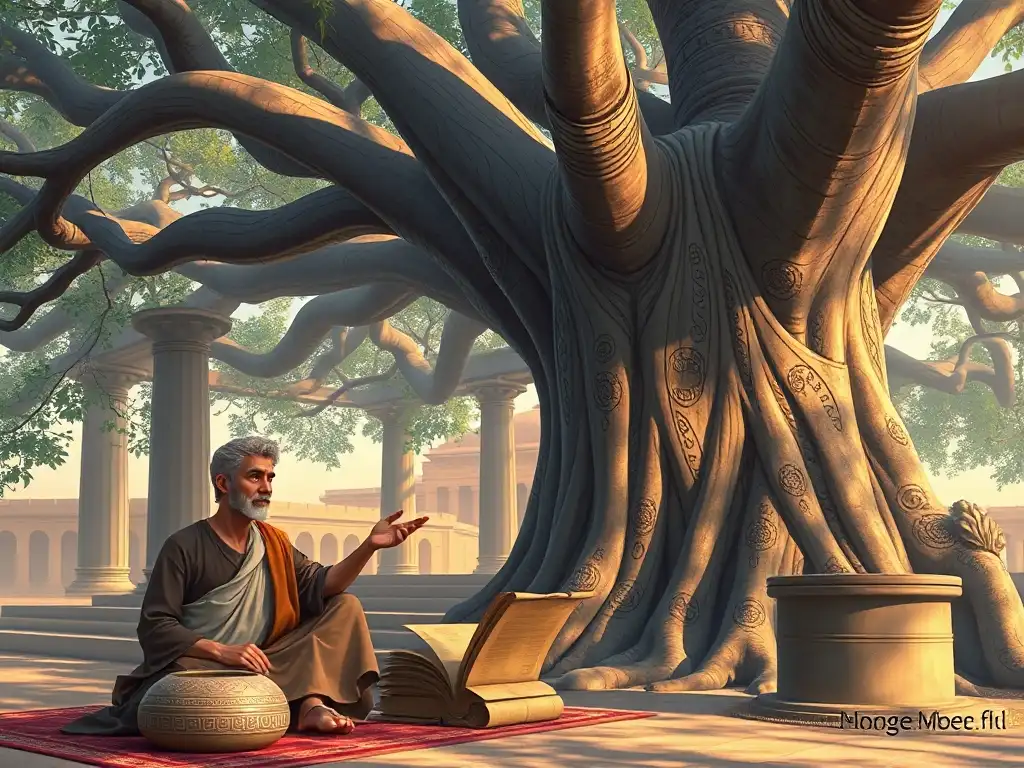
Plato's Theory of Forms, which posits that the material world is a reflection of a higher reality of perfect, abstract forms, bears intriguing similarities to Indian philosophical concepts. The notion of Maya in Indian thought suggests that the physical world is an illusion, while the ultimate reality is found in the eternal forms or ideas, akin to Plato's realm of forms.
Furthermore, the Indian philosophical tradition, particularly in the context of Advaita Vedanta, emphasizes the non-duality between the individual self and the ultimate reality, echoing Plato's idea that knowledge of the forms leads to understanding the true essence of being. Both traditions grapple with the tension between the material and the ideal, revealing a shared pursuit of deeper truths that transcend ordinary existence. This interplay illustrates how ancient Indian thought may have contributed to the development of Greek philosophical ideas, enriching the discourse on metaphysics and epistemology.
The Legacy of Indian Influence on Greek Philosophy
The interaction between ancient Indian and Greek philosophies is a fascinating subject that highlights the profound impact that Indian thought had on the development of Greek philosophy. The exchanges between these two rich traditions occurred mainly during the time of Alexander the Great, whose conquests brought him into contact with various Indian philosophies and practices. Notably, Indian concepts such as karma, dharma, and the cyclical nature of existence resonated with Greek thinkers, leading to a fusion of ideas that enriched both traditions.
One of the most significant legacies of this interaction is the introduction of Indian metaphysical ideas into Greek thought. The notion of an eternal soul ( atman) and the idea of liberation ( moksha) were particularly influential, providing a different perspective on existence and the purpose of life. These concepts challenged Greek philosophers to explore deeper existential questions, influencing notable figures such as Plato and later, the Stoics.
Furthermore, the ethical frameworks derived from Indian philosophy, particularly those emphasizing non-violence ( ahimsa) and compassion, left a lasting imprint on Greek ethical thought. This merging of ideas not only contributed to the philosophical discourse of the time but also laid the groundwork for future philosophical developments in both cultures.
Lasting Effects on Subsequent Philosophical Movements
The intermingling of Indian and Greek philosophies set the stage for numerous philosophical movements that followed. The Hellenistic period, marked by the rise of schools such as Stoicism and Epicureanism, witnessed a significant incorporation of Indian ideas. Stoicism, in particular, was influenced by the Indian concepts of self-control and detachment, which echo the teachings of the Buddha.
Additionally, the transmission of Indian philosophical texts into the later Roman Empire further ensured that these ideas continued to permeate Western thought. The emphasis on meditation and introspection found in Indian philosophy was mirrored in certain Greek practices, leading to a more holistic approach to philosophy that combined ethical living with personal well-being.
As the centuries progressed, the Renaissance saw a revived interest in classical texts, including those influenced by Indian philosophy. The dialogues between Eastern and Western thought became more pronounced, demonstrating a continuous thread of cross-cultural influence that shaped the foundations of modern philosophical inquiry.
The Transmission of Knowledge Through the Ages
The transmission of knowledge between ancient India and Greece was facilitated by various routes, including trade, conquests, and scholarly exchanges. The Silk Road played a crucial role in this process, acting as a conduit for the exchange of ideas, texts, and teachings. Indian scholars traveled to Greek territories, bringing with them rich philosophical traditions that were gradually assimilated into Greek thought.
Moreover, the translations of Indian texts into Greek during the Hellenistic period were pivotal in spreading Indian philosophical concepts. Works such as the Yoga Sutras and various texts on Buddhism were studied by Greek philosophers, who sought to understand these new ideas and integrate them into their own frameworks.
The influence did not remain stagnant; it evolved over the centuries, adapting to the cultural contexts of different eras. The rise of Neoplatonism in the third century CE, for instance, demonstrates how Indian metaphysical ideas were reinterpreted within a new philosophical system, further entrenching the legacy of Indian thought in Western philosophy.
Conclusion: The Unseen Connection in Historical Perspective
The connection between ancient India and Greek philosophy is a testament to the power of cross-cultural exchanges in shaping human thought. This interplay not only enriched the philosophical landscapes of both civilizations but also laid the groundwork for future dialogues between Eastern and Western philosophies.
Summary of Ancient India’s Influence on Greek Philosophy
The influence of ancient India on Greek philosophy is evident in various aspects, including metaphysical concepts, ethical frameworks, and methods of introspection. The rich tapestry of ideas woven from these interactions has profoundly impacted subsequent philosophical movements and continues to resonate in contemporary thought.
Importance of Understanding Cross-Cultural Exchanges
Understanding the intricacies of cross-cultural exchanges, such as the influence of ancient India on Greek philosophy, is vital for appreciating the complexity of human intellectual history. It fosters a broader perspective on how ideas evolve, adapt, and inspire through interactions across diverse cultures. This awareness not only enriches our understanding of history but also highlights the ongoing relevance of intercultural dialogue in today’s globalized world.
References and Further Reading on Ancient Indian and Greek Philosophies
Exploring the connections between ancient Indian philosophies and Greek thought requires a diverse array of resources. Below are some valuable references that provide insights into the philosophical dialogues between these two ancient civilizations.
Suggested Books and Articles
-
"The Influence of Indian Thought on the Development of Greek Philosophy" by J. N. Mohanty
This book delves into the philosophical dialogues and exchanges between Indian and Greek thinkers, highlighting key concepts and the evolution of ideas.
-
"Greek Philosophy and Indian Thought" by R. C. Gupta
This work discusses the similarities and differences between the two philosophical systems, with a focus on metaphysics, ethics, and epistemology.
-
"Comparative Philosophy: Indian and Western" by S. R. Sharma
A comprehensive examination of how Indian philosophies have interacted with Western thought, including essential comparisons with Greek philosophy.
-
"Buddhism and the Greeks: The Early Influence of Indian Philosophy on Hellenistic Thought" by Christopher I. Beckwith
This article explores the direct influences of Buddhism on Greek philosophy, emphasizing the cross-cultural exchanges during the Hellenistic period.
-
"The Philosophy of the Upanishads and Its Impact on Western Thought" by David J. Kalupahana
This text provides insights into the Upanishads and their philosophical implications, along with their resonance in Greek philosophical circles.
Online Resources for Deeper Exploration
-
Stanford Encyclopedia of Philosophy
This online resource contains extensive entries on both Indian and Greek philosophies, providing a thorough grounding in the key concepts, historical contexts, and influential figures.
-
Internet Archive
A treasure trove of texts, the Internet Archive hosts numerous works related to ancient Indian and Greek philosophy, allowing readers to access original writings and translations.
-
The Ancient History Encyclopedia
This site offers articles that explore the interactions between ancient civilizations, including the philosophical exchanges between India and Greece.
-
Academia.edu
A platform where scholars share research papers, many of which focus on the influences of Indian philosophy on Greek thought. Users can search and follow topics of interest.
-
Project Gutenberg
This digital library provides free access to a wide range of classical texts, including works by ancient philosophers. It’s an excellent resource for those looking to read original philosophical works.
These resources collectively provide a comprehensive foundation for understanding the profound and often understated connections between ancient Indian philosophies and Greek thought. They serve as a springboard for further study and exploration of this intricate web of influence.
- Introduction to Ancient India and Greek Philosophy
- Overview of Ancient Indian Civilization
- The Emergence of Greek Philosophy
- Historical Context of Indian-Greek Relations
- Key Philosophical Concepts in Ancient India
- The Impact of Indian Philosophy on Greek Thought
- Comparative Analysis of Philosophical Ideas
- Concepts of Existence and Reality
- The Nature of the Self: Atman vs. Greek Concepts of Soul
- Ethics and Morality: Dharma vs. Greek Virtue Ethics
- Case Studies: Specific Greek Philosophers Influenced by Indian Thought
- Pythagoras and Mathematical Mysticism
- Plato and the Theory of Forms: Parallels in Indian Thought
- The Legacy of Indian Influence on Greek Philosophy
- Conclusion: The Unseen Connection in Historical Perspective
- References and Further Reading on Ancient Indian and Greek Philosophies
- What is the main focus of the article "The Unseen Connection: How Ancient India Influenced Greek Philosophy"?
- How did ancient Indian philosophies impact Greek thinkers?
- What are some specific contributions of ancient Indian thought to Greek philosophy?
- Why is the connection between ancient India and Greek philosophy significant?
- How can I learn more about the influence of ancient India on Greek philosophy?
Frequently Asked Questions
What is the main focus of the article "The Unseen Connection: How Ancient India Influenced Greek Philosophy"?
The article explores the historical connections between ancient Indian thought and Greek philosophy, highlighting how these cultures influenced one another.
How did ancient Indian philosophies impact Greek thinkers?
Ancient Indian philosophies, particularly Buddhism and Hinduism, introduced concepts like metaphysics and ethics that significantly shaped Greek philosophical discussions, especially during the Hellenistic period.
What are some specific contributions of ancient Indian thought to Greek philosophy?
Key contributions include ideas of karma, dharma, and non-duality, which resonated with Greek philosophers and prompted deeper inquiries into morality and existence.
Why is the connection between ancient India and Greek philosophy significant?
This connection is significant as it showcases the cross-cultural exchanges that enriched both civilizations, demonstrating that philosophical ideas are often universal and interconnected.
How can I learn more about the influence of ancient India on Greek philosophy?
To learn more, explore resources on ancient Indian texts, Hellenistic philosophy, and the history of cross-cultural interactions in ancient times for a comprehensive understanding.
Final Reflection: The Enduring Legacy of Ancient India's Influence on Greek Philosophy
The profound connections between Ancient India and Greek philosophy remind us that the exchange of ideas transcends time and geography. In today's increasingly interconnected world, understanding these historical dialogues can illuminate our contemporary philosophical inquiries and cultural exchanges. The realization that two seemingly disparate civilizations shared intellectual pursuits underscores the universality of human thought and the quest for knowledge.
The influence of Ancient India on Greek philosophy is not merely a historical footnote; it is a testament to the rich tapestry of human understanding that continues to shape our cultural and social landscapes. This interplay of ideas has fostered a legacy that inspires modern thinkers and philosophers to explore the depths of consciousness, ethics, and existence. As the philosopher Jiddu Krishnamurti once said, The ability to observe without evaluating is the highest form of intelligence.
This notion encapsulates the essence of the dialogue between these two great traditions, urging us to seek wisdom beyond borders.
As we reflect on this remarkable connection, let us embrace the lessons of curiosity and openness that it imparts. I invite you to explore the philosophies that resonate with you, to engage in dialogues that challenge your perspectives, and to recognize the shared heritage of thought that binds us all. By doing so, we not only honor the past but also pave the way for a future enriched by diverse ideas and collaborative understanding.
Unveil the Profound Connections Today!
Thank you for diving into the fascinating world of how ancient India shaped Greek philosophy. Your engagement with this topic not only enriches your understanding but also opens doors to a wealth of knowledge that can inspire new ideas and perspectives. Now, let's take action to further explore these captivating connections!
- Explore more ancient texts that highlight the exchange of ideas, such as the Upanishads and Buddhist sutras.
- Share your insights by discussing this article with friends or on social media—help spread awareness of this incredible heritage!
- Join online forums or local book clubs focused on ancient philosophies to engage with like-minded individuals eager to learn.
What unexpected connections between ancient cultures have you discovered that changed your perspective on philosophy?