
How Ancient Indian Universities Supported the Study of Astronomy


Welcome to Ancient India History, where we embark on a fascinating journey through time to uncover the rich tapestry of ancient Indian civilizations. Delve into the remarkable contributions of scholars and the sophisticated educational systems that flourished in this vibrant era.
Our featured article, “How Ancient Indian Universities Supported the Study of Astronomy,” invites you to explore the intricate relationship between education and the stars, revealing how ancient Indian universities nurtured brilliant minds in the field of astronomy. Prepare to be intrigued and inspired as you uncover the secrets of a civilization that not only looked up at the heavens but also paved the way for future generations of thinkers and innovators.
- Introduction to Ancient Indian Astronomy Education
- The Role of Ancient Indian Universities in Astronomy
- Teaching Methods in Ancient Indian Astronomy Education
- Contributions of Ancient Indian Scholars to Astronomy
- The Impact of Ancient Indian Astronomy on Modern Science
- Challenges and Decline of Astronomy Education in Ancient India
- Conclusion
-
Frequently Asked Questions
- What role did ancient Indian universities play in astronomy education?
- How did ancient Indian astronomers contribute to the field?
- What subjects were studied alongside astronomy in ancient Indian universities?
- Were there notable figures in ancient Indian astronomy?
- How is ancient Indian astronomy education relevant today?
- Final Reflection: The Enduring Legacy of Ancient Indian Astronomy Education
- Unveil the Wonders of Ancient Indian Astronomy!
Introduction to Ancient Indian Astronomy Education
The study of astronomy in ancient India was deeply intertwined with the cultural, religious, and scientific fabric of the civilization. Ancient Indian universities, such as the renowned Nalanda and Takshashila, played a pivotal role in fostering this intellectual tradition, offering a structured environment for the exploration of astronomical concepts.
These institutions not only imparted knowledge but also encouraged critical thinking and empirical observation, which were essential for advancing the understanding of celestial phenomena. This article delves into how ancient Indian universities supported the study of astronomy, highlighting their contributions to the field and the significance of astronomy within the broader context of ancient Indian education.
Overview of Ancient Indian Universities
Ancient Indian universities were centers of learning that attracted scholars from various regions, facilitating a rich exchange of knowledge. The most notable among these institutions include:
- Nalanda University: Founded in the 5th century CE, Nalanda became a beacon of knowledge, renowned for its vast library and distinguished faculty. It offered courses in various subjects, including astronomy, mathematics, and philosophy. Students were encouraged to conduct observations and practical experiments, which contributed to the development of astronomical theories.
- Takshashila (Taxila): One of the earliest universities in the world, Takshashila was active around the 6th century BCE. It provided a diverse curriculum, including medicine, military science, and astronomy. The university attracted eminent scholars and students, fostering an environment where astronomy was studied alongside other sciences.
- Vikramshila University: Established in the 8th century CE, Vikramshila emerged as a significant center for Buddhist learning and scholarship. It had a robust astronomy curriculum, where students studied celestial movements and astrological implications, reflecting the interrelation between astronomy and spirituality in ancient India.
These universities were not merely places of rote learning; they emphasized debate, discussion, and practical application of knowledge, fostering a comprehensive understanding of astronomy and its relevance to daily life.
Importance of Astronomy in Ancient Indian Culture
Astronomy held a prominent place in ancient Indian culture, influencing various aspects of life, including religion, agriculture, and navigation. The significance of astronomy can be summarized as follows:
- Religious Practices: Celestial events often dictated religious calendars and rituals. Festivals and ceremonies were meticulously timed according to lunar and solar cycles, showcasing the integration of astronomy into spiritual life.
- Agricultural Planning: The timing of agricultural activities was closely linked to astronomical observations. Farmers relied on celestial patterns to determine the optimal times for planting and harvesting crops, ensuring food security.
- Navigation and Trade: Ancient Indian traders and travelers utilized astronomical knowledge for navigation. Techniques such as reading the positions of stars and planets were essential for long-distance voyages across seas and deserts.
- Scientific Inquiry: The pursuit of astronomy spurred advancements in mathematics and physics. Scholars developed sophisticated theories and tools, such as the astrolabe and shadow instruments, to measure celestial phenomena accurately.
The interplay between astronomy and culture in ancient India underscores the significance of these studies, not only as a scientific endeavor but also as a vital component of the societal framework. Through the lens of education, ancient Indian universities played an instrumental role in nurturing this rich tradition of astronomical inquiry.
The Role of Ancient Indian Universities in Astronomy
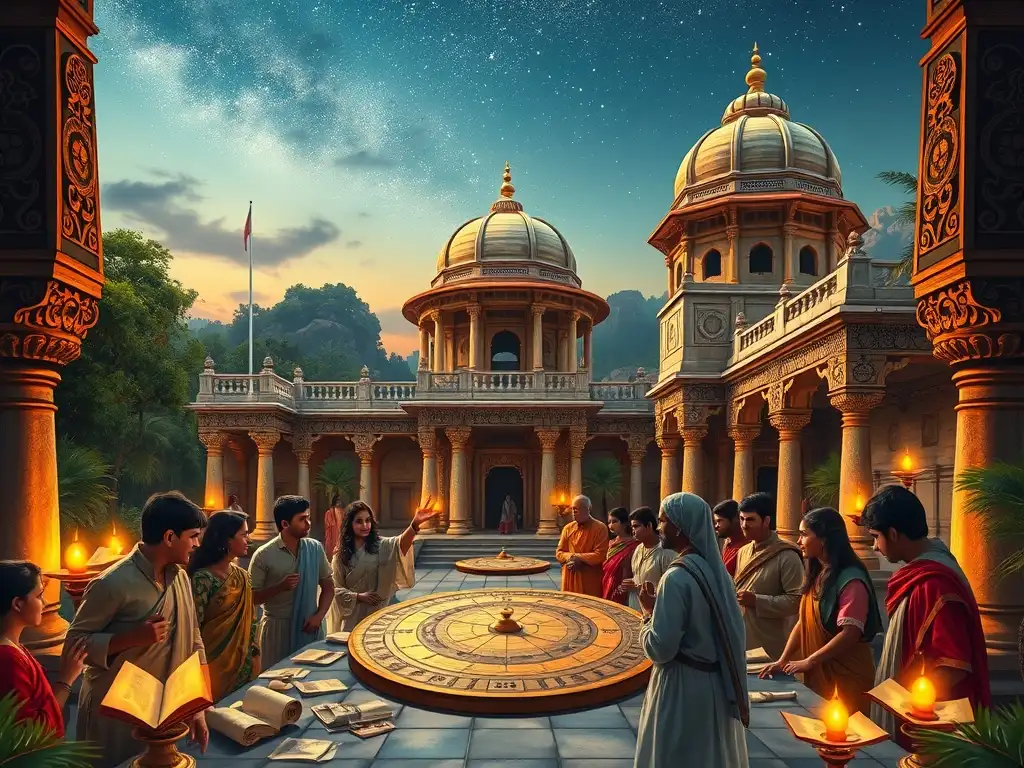
Ancient Indian universities played a pivotal role in the advancement of various disciplines, with astronomy being one of the most significant areas of study. Institutions such as Nalanda and Taxila were not merely places of learning; they were vibrant centers of intellectual exchange and innovation. These universities fostered a rich environment that encouraged the exploration of celestial phenomena, the development of astronomical instruments, and the formulation of complex theories about the universe. The contributions of these institutions to ancient Indian astronomy education are invaluable and continue to resonate in modern scientific discourse.
Nalanda University: A Hub for Astronomical Studies
Nalanda University, founded in the 5th century CE, is often recognized as one of the first residential universities in the world. It attracted scholars from various regions, facilitating a diverse exchange of ideas, particularly in astronomy.
Curriculum and Courses Offered in Astronomy
The curriculum at Nalanda was broad and comprehensive, incorporating various subjects, but astronomy held a significant place. Students were exposed to:
- Celestial Navigation: Techniques for determining one's position on Earth using celestial bodies.
- Astrology and Cosmology: Understanding the movements of stars and planets and their influence on earthly events.
- Mathematical Astronomy: Application of mathematics to predict celestial occurrences and solve astronomical problems.
Courses often included practical training, allowing students to observe celestial events and utilize instruments like the groma and astrolabe, which were essential for astronomical measurements.
Notable Astronomers Associated with Nalanda
Several distinguished astronomers were linked to Nalanda University, contributing to the development of astronomical thought in ancient India. Some of the notable figures include:
- Aryabhata: One of the first known mathematicians and astronomers, Aryabhata's work laid foundational principles for later astronomical studies.
- Varahamihira: A polymath who wrote extensively on astrology and astronomy, Varahamihira’s contributions to the Brihat Samhita include detailed observations on celestial phenomena.
These scholars not only advanced astronomical education but also enriched the cultural and scientific heritage of ancient India.
Taxila University: The Intersection of Education and Astronomy
Taxila University, established around the 6th century BCE, served as a crucial center for learning, particularly renowned for its comprehensive educational approach that included astronomy as one of its core subjects.
Contributions to Astronomical Knowledge
Taxila's contribution to astronomy was multifaceted, integrating knowledge from various cultural traditions. Key aspects include:
- Development of Theories: Scholars at Taxila synthesized ideas from Greek, Persian, and local traditions, refining astronomical theories.
- Astronomical Texts: The university produced numerous texts that documented celestial events and phenomena, significantly influencing later scholars.
The university’s curriculum emphasized practical observation, encouraging students to engage with the cosmos directly.
Influential Scholars and Their Work
Taxila was home to many influential scholars whose work shaped the field of astronomy:
- Panini: Although primarily known for his work in linguistics, Panini's analytical methods influenced the logical structuring of astronomical texts.
- Kautilya: While more famous for his political treatise, Arthashastra, Kautilya’s insights into the timing of agricultural activities based on astronomical observations demonstrate the practical applications of astronomy in ancient society.
These scholars exemplified the interconnectedness of various fields of study, emphasizing that astronomical education was not isolated but rather intertwined with other academic disciplines.
Ancient Indian universities like Nalanda and Taxila were instrumental in fostering a culture of astronomical education. Through their rigorous curricula and the work of notable scholars, these institutions laid the groundwork for future advancements in astronomy and contributed significantly to the rich tapestry of ancient Indian knowledge.
Teaching Methods in Ancient Indian Astronomy Education

Ancient Indian universities, particularly renowned institutions like Nalanda and Takshashila, played a pivotal role in shaping the educational landscape of astronomy. The methods employed for teaching astronomy were diverse and reflected a deep understanding of both theoretical and practical aspects of the subject. These methods not only fostered a robust educational framework but also contributed significantly to the advancement of astronomical knowledge.
Practical Observations and Celestial Measurements
One of the cornerstone methods of ancient Indian astronomy education was the emphasis on practical observations. Students and scholars were encouraged to engage directly with the cosmos, which involved the following components:
- Use of Instruments: Ancient Indian astronomers developed a variety of instruments like the gola (spherical model of the heavens), shanku (gnomon), and yasti (staff) for measuring celestial bodies. These tools allowed students to measure angles, observe celestial events like eclipses, and track the movement of planets.
- Field Observations: Students often spent considerable time observing celestial phenomena in open spaces, away from the obstructions of urban settings. This hands-on experience was crucial for understanding the dynamics of celestial movements and the principles of astronomy.
- Celestial Calendars: Ancient astronomers created detailed calendars based on lunar and solar cycles. By observing the moon's phases and the sun's position, students could learn how to predict astronomical events, which was vital for agricultural and religious practices.
The integration of practical observations into the curriculum allowed students to connect theoretical concepts with real-world applications, enhancing their understanding of astronomy.
Use of Texts and Manuscripts in Astronomy Education
Textual study was another fundamental aspect of ancient Indian astronomy education, where scholars utilized a rich repository of texts and manuscripts. This approach encompassed several key elements:
- Primary Texts: Important scriptures such as the Surya Siddhanta, Aryabhatiya, and Brahmasphutasiddhanta provided foundational knowledge in mathematics and astronomy. These texts served as instructional guides, outlining theories, calculations, and celestial phenomena.
- Commentaries and Treatises: Scholars often wrote extensive commentaries on primary texts, which helped elucidate complex theories and mathematical models. These commentaries, such as those by Bhaskara I and Varahamihira, were critical in making advanced astronomical concepts accessible to students.
- Oral Tradition: In addition to written texts, oral transmission played a significant role in teaching. Professors and eminent scholars would engage in discussions and debates, allowing students to critically analyze and synthesize information from various sources.
The combination of texts and oral traditions created a comprehensive learning environment that was essential for the development of ancient Indian astronomy education. Students were not only required to memorize complex theories but also to apply them practically, thus fostering a holistic approach to learning.
Through these diverse teaching methods, ancient Indian universities provided a robust foundation for astronomy education, enabling scholars to make significant contributions to the field that would resonate through the ages. The emphasis on practical observations alongside textual studies exemplifies the sophisticated educational systems in place during this remarkable period of ancient Indian history.
Contributions of Ancient Indian Scholars to Astronomy
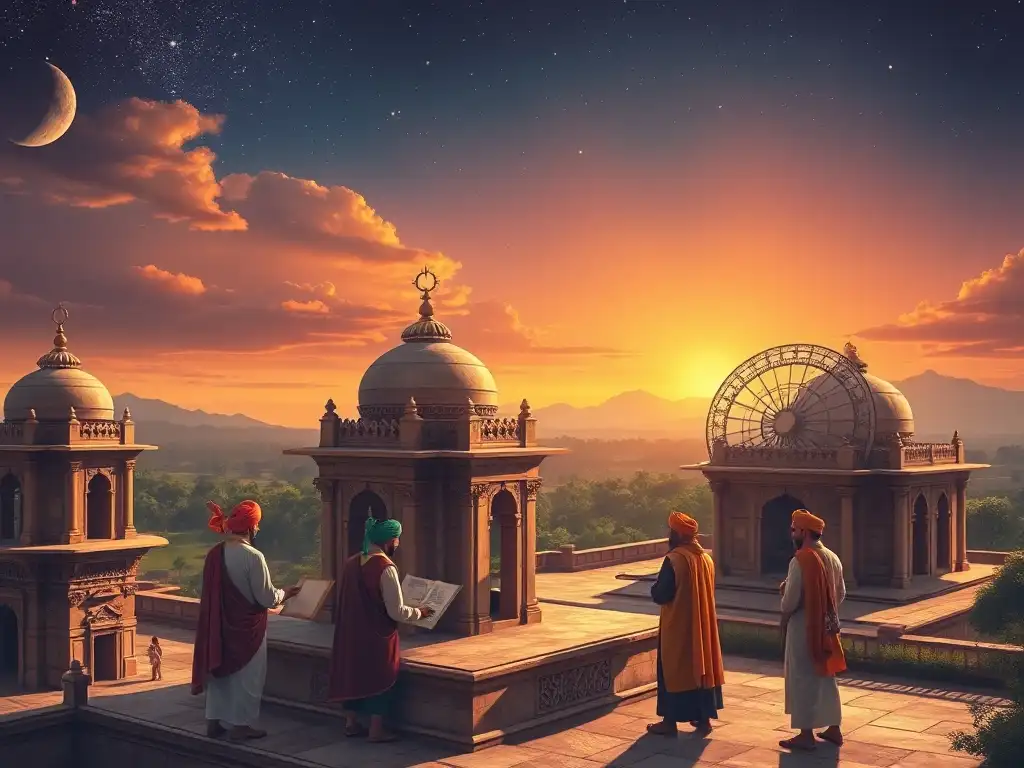
Ancient Indian scholars made remarkable contributions to the field of astronomy, laying foundational principles that would influence both Eastern and Western civilizations. The universities of ancient India, particularly centers like Nalanda and Takshashila, served as vibrant hubs for astronomical study, fostering an environment where scholars could innovate, debate, and expand the understanding of celestial phenomena. This section delves into the notable figures who shaped ancient Indian astronomy education, highlighting their groundbreaking work and theories.
Aryabhata: The Pioneer of Indian Astronomy
Aryabhata, often hailed as the father of Indian astronomy, was a mathematician and astronomer who made significant strides in the understanding of celestial movements. Born in 476 CE, his most renowned work, the Aryabhatiya, introduced several revolutionary concepts:
- Heliocentrism: Aryabhata proposed that the Earth rotates on its axis. This was a pivotal departure from the geocentric models prevalent in his time.
- Calculation of Pi: He calculated the value of π (pi) as 3.1416, which was remarkably accurate for the era.
- Astronomical Calculations: Aryabhata provided methods to calculate the positions of celestial bodies, eclipses, and the length of the solar year—approximately 365.358 days.
His work laid the groundwork for subsequent advancements in astronomy and mathematics, influencing scholars not only in India but also across the globe.
Brahmagupta and His Innovations in Astronomy
Brahmagupta, who lived in the 7th century CE, further developed Aryabhata’s ideas and introduced new concepts that would become fundamental in astronomy. His seminal text, the Brahmasphutasiddhanta, contained several key contributions:
- Rules for Eclipses: Brahmagupta provided detailed rules for predicting solar and lunar eclipses, enhancing the accuracy of astronomical forecasts.
- Zero as a Number: He was one of the first to treat zero as a number with its own properties, a concept crucial for mathematical calculations in astronomy.
- Planetary Motion: Brahmagupta described the motion of planets and introduced methods for calculating their positions, addressing issues of retrograde motion—a concept that would later be critical in astronomy.
His insights not only advanced the field of astronomy but also contributed to the development of a sophisticated mathematical framework.
Varahamihira: Bridging Astronomy and Astrology
Varahamihira, a contemporary of Brahmagupta, made significant contributions to both astronomy and astrology. His work, Brihat Samhita, is a comprehensive treatise that combines scientific knowledge with astrological principles. Key aspects of his contributions include:
- Astronomical Tables: Varahamihira compiled extensive tables that provided data on the positions of celestial bodies, which were critical for both navigation and timekeeping.
- Weather Predictions: He emphasized the connection between astronomy and meteorology, offering insights into weather patterns based on celestial observations.
- Astrological Influence: Varahamihira argued that celestial phenomena directly influence terrestrial events, thus bridging the gap between astronomy and astrology—a perspective that dominated Indian thought for centuries.
His integrative approach to astronomy and astrology highlighted the cultural significance of celestial studies in ancient India, reflecting a worldview that saw the cosmos as interconnected with human affairs.
The contributions of these ancient Indian scholars not only enriched astronomy but also laid the foundation for a systematic approach to celestial studies that would resonate through history, making India a significant player in the global narrative of astronomical education.
The Impact of Ancient Indian Astronomy on Modern Science
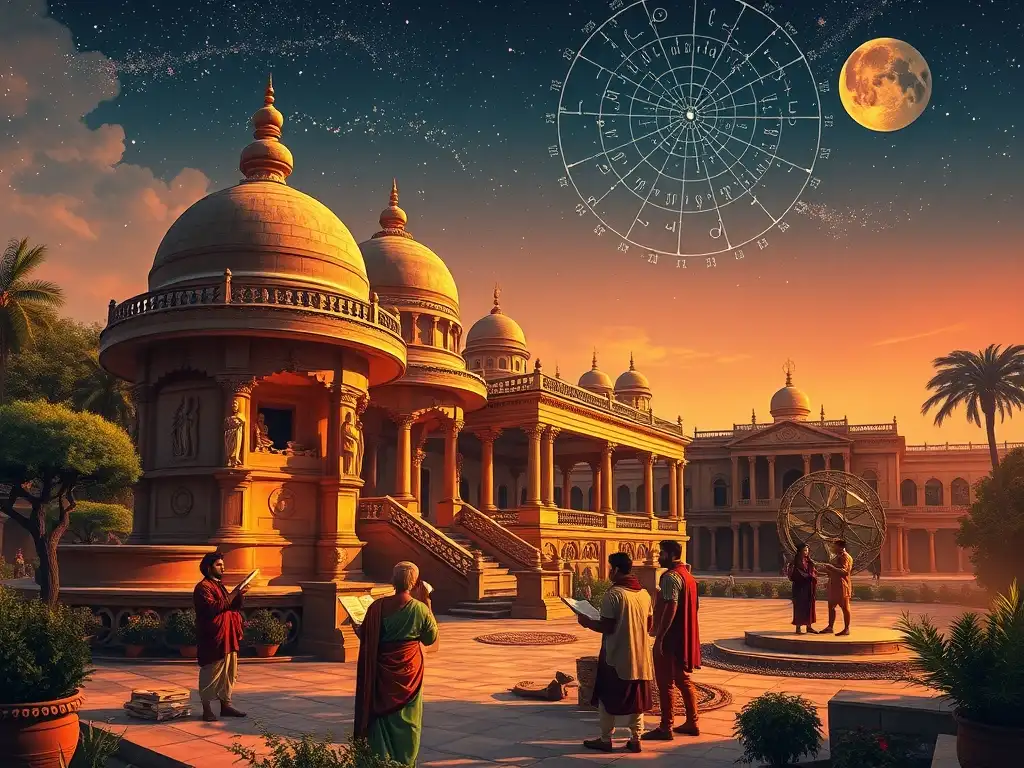
Ancient Indian astronomy has had a profound influence on the development of modern scientific thought and practices. The contributions of scholars from ancient Indian universities, such as Nalanda and Vikramshila, laid the groundwork for various astronomical concepts that resonate within contemporary science. The meticulous observations, innovative methodologies, and theoretical frameworks established by these scholars are not only remarkable in their own right, but they also serve as a bridge connecting ancient wisdom to modern scientific understanding.
Continuity of Knowledge: From Ancient to Modern Times
The continuity of astronomical knowledge from ancient India to the present day is an exemplary case of how foundational ideas can persist through time. Scholars like Aryabhata, Brahmagupta, and Bhaskara II made significant advancements in understanding celestial phenomena, timekeeping, and mathematical calculations.
-
Key Contributions of Ancient Astronomers:
- Aryabhata (476-550 CE): Introduced the concept of the Earth's rotation on its axis and formulated methods for calculating the circumference of the Earth. His work, Aryabhatiya, remains influential in both astronomy and mathematics.
- Brahmagupta (598-668 CE): Known for his work Brahmasphutasiddhanta, which included rules for calculating eclipses and planetary positions, as well as the introduction of zero as a mathematical concept.
- Bhaskara II (1114-1185 CE): Expanded on the works of his predecessors and contributed to the field of algebra and calculus, facilitating predictions of lunar and solar eclipses.
-
Preservation of Knowledge:
Ancient texts were translated and preserved over centuries, allowing for a seamless transition of knowledge across generations. Institutions like Nalanda became crucial in this process, where scholars studied, debated, and disseminated astronomical knowledge. The preservation of manuscripts in Sanskrit and their subsequent translations into Arabic and Latin helped infuse Indian astronomical theories into the global scientific community.
-
Integration into Modern Education:
The principles established by ancient Indian astronomers have been integrated into modern curricula, particularly in the fields of mathematics and physics. Concepts such as the heliocentric model and planetary motion are often traced back to the foundational work done in ancient times.
Influence on Global Astronomy Practices
Ancient Indian astronomy not only flourished within its own cultural context but also exerted a significant influence on global practices. The exchange of ideas across cultures facilitated the spread of Indian astronomical concepts to various parts of the world.
-
Cultural Exchanges:
Trade routes and scholarly exchanges between India and neighboring civilizations, such as the Middle East and Europe, facilitated the dissemination of astronomical knowledge. The translation of Indian texts into Arabic played a pivotal role in the development of Islamic astronomy, which, in turn, influenced European astronomers during the Renaissance.
-
Adoption of Techniques:
The observational techniques developed by ancient Indian astronomers were adopted and adapted by scholars in other regions. For instance, the use of zīj tables, which were based on Indian astronomical computations, allowed astronomers in the Islamic Golden Age to refine their own practices in celestial navigation and timekeeping.
-
Lasting Legacy:
The legacy of ancient Indian astronomy is evident in modern scientific practices, particularly in the fields of mathematics, navigation, and observational astronomy. The algorithms for calculating eclipses and planetary positions, developed centuries ago, are still relevant in today’s studies.
The impact of ancient Indian astronomy education extends far beyond its historical context. The principles established by scholars in ancient universities continue to resonate in modern scientific discourse, illustrating the enduring legacy of these civilizations in shaping our understanding of the cosmos.
Challenges and Decline of Astronomy Education in Ancient India
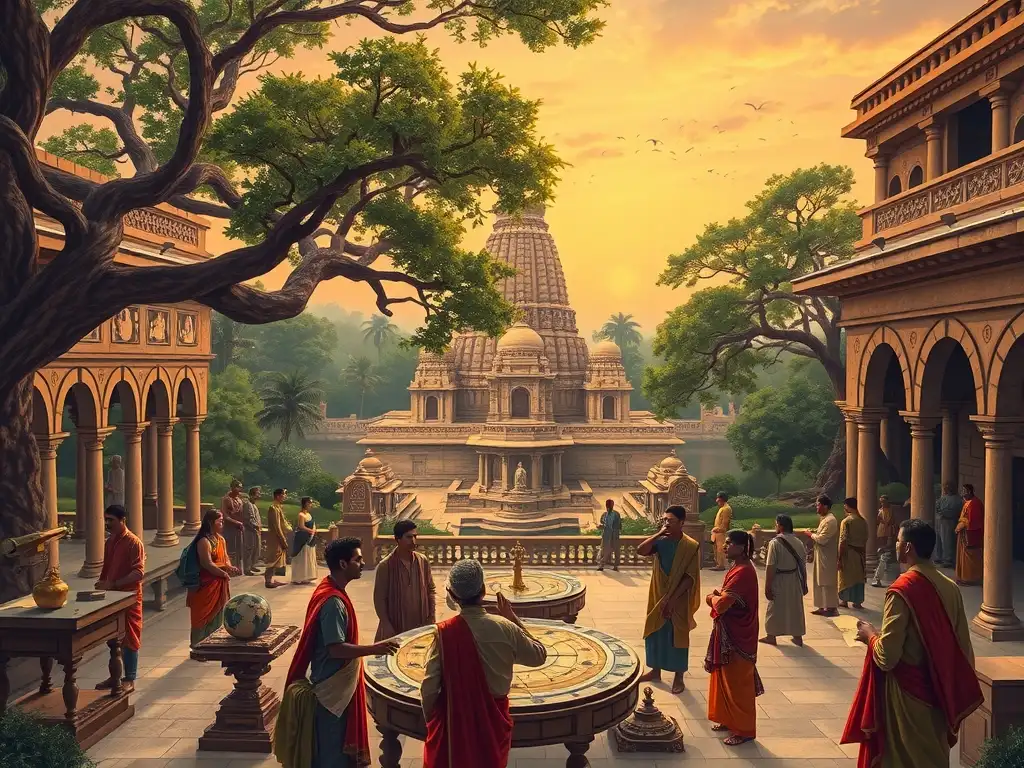
The study of astronomy in ancient India faced significant challenges that ultimately contributed to its decline. Despite the early advancements and contributions made by Indian astronomers, a combination of political, social, and intellectual factors began to erode the foundations of astronomy education in these prestigious institutions.
One of the most profound influences on the decline of astronomy education in ancient India was the changing political landscape. With the rise and fall of various dynasties, the patronage that universities like Nalanda and Takshashila received fluctuated dramatically. When key rulers shifted their focus toward more immediate political and military concerns, funding for educational institutions dwindled.
-
Declining Royal Patronage:
As the Gupta Empire weakened, subsequent rulers often prioritized military expenditures over scholarly pursuits. The once-vibrant support for astronomy was undermined, leading to a reduction in resources available for research and education.
-
Social Turmoil:
Social upheaval, including invasions and internal strife, contributed to a climate of instability that dissuaded scholars from pursuing or teaching subjects like astronomy. These tumultuous conditions often resulted in the closing of educational institutions or a drastic reduction in student enrollment.
The societal perception of astronomy also changed, as it became intertwined with religious and superstitious beliefs. The shift in focus from empirical observation to dogmatic interpretations led to a stagnation of scientific inquiry, diminishing the rigorous analytical approach that had characterized ancient Indian astronomy.
The Shift in Focus from Astronomy to Other Disciplines
As political and social factors altered the landscape of education, there was a corresponding shift in academic focus within ancient Indian universities.
-
Emergence of Other Disciplines:
The study of logic, philosophy, and religious texts began to overshadow the empirical sciences, including astronomy. Scholars moved towards disciplines that were perceived as more relevant to spiritual and societal needs, causing a gradual decline in the emphasis on astronomical studies.
-
Integration into Religious Practices:
Astronomy was increasingly viewed through a theological lens, with its principles often being used to support religious rituals and calendars rather than for scientific exploration. This integration caused the discipline to lose its independent status as a field of study, further contributing to its decline.
-
Influence of Regional Cultures:
The influence of regional cultures and traditions led to diverse educational priorities. In some cases, local customs prioritized astrology over astronomy, leading to a further relegation of scientific approaches to the study of celestial bodies.
Ultimately, the combination of political instability, shifting educational priorities, and changing societal values resulted in the decline of astronomy education in ancient Indian universities. While the foundational contributions of ancient Indian astronomy remain significant, these challenges illustrate the complex interplay of factors that can affect academic pursuits over time.
Conclusion

Summary of Ancient Indian Contributions to Astronomy Education
Ancient Indian astronomy education was characterized by its profound understanding of celestial phenomena, innovative methodologies, and a commitment to integrating astronomy with other disciplines. Universities like Nalanda and Takshashila served as pivotal centers for astronomical studies, where scholars engaged in rigorous observation and theoretical work.
Key Contributions:
-
Comprehensive Texts:
Ancient scholars authored significant texts that detailed celestial mechanics, eclipses, and planetary motion. Works such as the Surya Siddhanta not only provided mathematical models but also practical applications for agricultural and religious calendars.
-
Observational Techniques:
The use of sophisticated instruments, including the gnomon and astrolabe, showcased the advanced observational capabilities of ancient Indian astronomers. These tools facilitated precise measurements of celestial bodies, laying the groundwork for future astronomical studies.
-
Integration with Mathematics:
Ancient Indian astronomy education was deeply intertwined with mathematics, particularly in areas such as trigonometry. The contributions of mathematicians like Aryabhata and Brahmagupta were instrumental in developing mathematical concepts that enhanced astronomical calculations.
-
Cultural Significance:
Astronomy was not only a scientific pursuit but also held significant cultural and spiritual importance. Festivals and rituals were often aligned with astronomical events, demonstrating the holistic nature of ancient Indian education, where science and culture coexisted harmoniously.
The Legacy of Ancient Indian Universities in Modern Astronomy
The influence of ancient Indian universities on modern astronomy cannot be overstated. The rigorous academic frameworks and innovative approaches fostered by these institutions have left an indelible mark on contemporary astronomical studies.
Enduring Impact:
-
Curriculum Development:
Modern astronomy education continues to draw from the comprehensive curriculum established by ancient Indian scholars. The emphasis on observation, mathematical rigor, and interdisciplinary studies remains relevant in today's educational systems.
-
Global Recognition:
The contributions of ancient Indian astronomers are increasingly recognized in the global scientific community. Their pioneering work has been foundational in the development of astronomy as a discipline, influencing scholars across cultures and eras.
-
Research and Collaboration:
Today, international collaborations in astronomical research often reflect the spirit of inquiry and cooperation that characterized ancient Indian universities. Scholars continue to explore ancient texts and methodologies, bridging the gap between historical knowledge and modern science.
-
Cultural Heritage:
The legacy of ancient Indian astronomy education is celebrated in various cultural contexts, inspiring a renewed interest in the history of science. This recognition not only honors the past but also motivates current and future generations to explore the cosmos with curiosity and reverence.
The contributions of ancient Indian universities towards astronomy education have laid a strong foundation for both historical scholarship and contemporary scientific inquiry, ensuring that the rich legacy of ancient Indian astronomy continues to illuminate our understanding of the universe.
Frequently Asked Questions
What role did ancient Indian universities play in astronomy education?
Ancient Indian universities, such as Nalanda and Takshashila, were pivotal in providing a structured education in astronomy, encouraging both theoretical and practical learning.
How did ancient Indian astronomers contribute to the field?
Ancient Indian astronomers made significant contributions, including the development of astronomical texts and tools, and the formulation of precise calendar systems that are still referenced today.
What subjects were studied alongside astronomy in ancient Indian universities?
Students at ancient Indian universities explored various subjects, including mathematics, astrology, and philosophy, which were essential for a comprehensive understanding of astronomy and its applications.
Were there notable figures in ancient Indian astronomy?
Yes, figures like Aryabhata and Brahmagupta are renowned for their groundbreaking work in astronomy, including the concept of zero and methods for calculating planetary positions.
How is ancient Indian astronomy education relevant today?
The principles and practices established in ancient Indian astronomy education laid the groundwork for modern astronomical studies, demonstrating the lasting impact of these ancient civilizations on contemporary science.
Final Reflection: The Enduring Legacy of Ancient Indian Astronomy Education
The exploration of ancient Indian universities and their contributions to astronomy education remains profoundly relevant today. As we navigate an era increasingly defined by scientific advancement and technological innovation, the foundational principles established by these institutions remind us of the importance of curiosity and knowledge in shaping our understanding of the universe. The rich history of ancient Indian astronomy not only showcases the brilliance of early scholars but also serves as a beacon for contemporary education systems striving to inspire future generations.
The influence of ancient Indian astronomy education extends far beyond its historical context; it continues to resonate within our cultural and scientific landscapes. The rigorous methodologies and holistic approaches adopted by these universities laid the groundwork for a comprehensive understanding of celestial phenomena. This legacy encourages us to appreciate the interconnectedness of various fields of study. As the renowned astronomer Carl Sagan once said, Somewhere, something incredible is waiting to be known.
This sentiment captures the essence of the pursuit of knowledge that was so deeply ingrained in ancient Indian educational practices.
As we reflect on the lessons from ancient Indian universities, let us embrace the spirit of inquiry and innovation that they embodied. I invite you to consider how you can integrate this legacy into your own life, whether through the pursuit of knowledge, fostering curiosity in others, or advocating for a more inclusive and interdisciplinary approach to education. The universe is vast, and like the scholars of ancient India, we too have the potential to uncover its mysteries and inspire future generations to reach for the stars.
Unveil the Wonders of Ancient Indian Astronomy!
Thank you for diving into the fascinating world of ancient Indian universities and their role in the study of astronomy! You've gained valuable insights into how these institutions fostered knowledge and curiosity about the universe. Now, it's time to take that inspiration and turn it into action!
Here are a few steps you can take to deepen your connection with this captivating topic:
- Engage with the Past: Visit a local library or online archive to explore ancient texts and writings on Indian astronomy. You might discover inspiring ideas that shaped our understanding of the cosmos!
- Join a Community: Connect with fellow astronomy enthusiasts by joining forums or groups dedicated to the study of ancient sciences. Collaborating with others can spark new ideas and enhance your appreciation for this rich field.
- Spread the Knowledge: Share this article with your friends and encourage discussions about the rich history of astronomy in ancient India. The more we converse about it, the more we inspire others to learn!
What aspect of ancient Indian astronomy fascinates you the most, and how do you believe it can inspire modern scientific exploration?