
How Ancient Indian Universities Contributed to Mathematics and Astronomy


Welcome to Ancient India History, where we embark on a fascinating journey through the rich tapestry of ancient Indian civilizations. In this exploration, we shine a light on the pivotal role that ancient Indian universities played in shaping the realms of mathematics and astronomy. What groundbreaking discoveries emerged from these centers of learning, and how did they influence the world as we know it today? Prepare to uncover the profound contributions that not only defined an era but also laid the groundwork for future generations. Dive in and let the legacy of knowledge inspire your curiosity!
- Introduction to Ancient Indian Universities and Their Contributions
- Historical Context of Ancient Indian Universities
- Mathematics in Ancient Indian Universities
- Astronomy in Ancient Indian Universities
- The Interconnection Between Mathematics and Astronomy
- Legacy of Ancient Indian Universities in Mathematics and Astronomy
- Conclusion
-
Frequently Asked Questions
- What were the major ancient Indian universities known for mathematics and astronomy?
- How did ancient Indian universities influence modern mathematics?
- What role did astronomy play in ancient Indian education?
- Who were some key figures in mathematics and astronomy from ancient India?
- How did ancient Indian universities promote cross-cultural exchanges?
- Final Reflection: The Enduring Legacy of Ancient Indian Universities in Mathematics and Astronomy
- Unveil the Secrets of Ancient Wisdom!
Introduction to Ancient Indian Universities and Their Contributions
Ancient Indian universities were remarkable institutions that played a pivotal role in shaping the educational landscape of not only India but also the world. Among these, universities like Nalanda and Takshashila stood out as centers of learning, attracting scholars, philosophers, and students from various regions.
These institutions were not merely places for rote learning; they fostered critical thinking and innovation, particularly in the fields of mathematics and astronomy. This article delves into how ancient Indian universities contributed significantly to these disciplines, highlighting their methodologies, notable scholars, and the lasting impact of their contributions on both Indian and global knowledge systems.
Overview of Ancient Indian Universities
Ancient Indian universities emerged around the 5th century BCE, with Takshashila being one of the earliest. These universities were characterized by their diverse curricula, which included subjects such as philosophy, medicine, mathematics, astronomy, and the arts.
- Nalanda University, established in the 5th century CE, became a prominent center for higher learning.
- Taxila, or Takshashila, was known for its comprehensive approach to education and its emphasis on practical knowledge.
These institutions offered not only theoretical knowledge but also practical applications, promoting a holistic understanding of various scientific fields. Scholars from these universities made significant contributions to mathematics and astronomy, laying the groundwork for future advancements.
Importance of Mathematics and Astronomy in Ancient Indian Education
Mathematics and astronomy were integral components of the curriculum at ancient Indian universities, reflecting the civilization's deep understanding of the natural world.
- Mathematics:
- Ancient Indian scholars excelled in various mathematical concepts, including arithmetic, geometry, and algebra.
- Notable texts such as the Aryabhatiya by Aryabhata introduced concepts like zero and the decimal system, which were revolutionary for their time.
- Astronomy:
- Astronomy was closely linked with mathematics, as it was essential for calendar-making, navigation, and agricultural planning.
- Scholars like Varahamihira and Brahmagupta made significant advancements in understanding celestial phenomena, contributing to the development of astronomical theories that influenced both Indian and global perspectives.
The emphasis on these subjects not only facilitated practical applications in daily life but also encouraged philosophical inquiries about the universe, ultimately enriching the intellectual heritage of ancient India.
Historical Context of Ancient Indian Universities

The origins of ancient Indian universities trace back to a period marked by significant intellectual and cultural advancements. During the Vedic period (approximately 1500–500 BCE), education primarily occurred in informal settings, such as ashrams and gurukuls, where students learned under the guidance of a guru. However, as society evolved, the need for more structured educational institutions became apparent, leading to the establishment of formal universities around the 5th century CE.
These universities were not just centers of learning; they were vibrant communities that fostered discussions on various subjects, including mathematics and astronomy. The rise of these institutions coincided with the flourishing of trade, philosophy, and science, allowing scholars to exchange ideas and knowledge from different regions, including the influences of Greek and Persian thought.
The Rise of Educational Institutions in Ancient India
The formalization of education in ancient India can be attributed to several factors:
- Cultural and Religious Motivations: The spread of Buddhism and Jainism encouraged the establishment of monasteries that doubled as educational centers, fostering scholarly pursuits.
- Political Support: Kings and rulers recognized the importance of education and often patronized these institutions, providing resources and funding. For instance, Emperor Ashoka was known for his support of Buddhist universities.
- Curriculum Development: Subjects offered included not only religious studies but also a wide array of disciplines such as mathematics, astronomy, medicine, and philosophy. This comprehensive curriculum attracted students from various regions, making these universities melting pots of knowledge.
- Influence of Trade and Commerce: As trade routes expanded, the need for more advanced mathematical concepts in commerce and navigation led to the inclusion of these subjects in university curricula.
The result was a network of prominent universities across India, which became renowned centers for learning and significantly contributed to advancements in mathematics and astronomy.
Prominent Universities: Nalanda and Takshashila
Among the numerous ancient universities, Nalanda and Takshashila stand out due to their immense contributions to various fields, particularly mathematics and astronomy.
Nalanda University
- Established: Circa 5th century CE
- Location: Bihar, India
- Notable Features:
- At its peak, Nalanda attracted students from far and wide, including China, Korea, and Japan.
- The curriculum included advanced studies in mathematics, where scholars like Aryabhata and Brahmagupta made significant contributions.
Contributions to Mathematics and Astronomy:
- Scholars at Nalanda developed concepts such as the decimal system and zero, which are foundational to modern mathematics.
- Astronomy was also a significant focus; researchers conducted meticulous observations of celestial bodies, leading to advancements in calendars and navigation.
Takshashila University
- Established: Circa 6th century BCE
- Location: Punjab, Pakistan
- Notable Features:
- Takshashila is considered one of the earliest universities in the world, with a diverse curriculum that included subjects like mathematics, astronomy, and political science.
Contributions to Mathematics and Astronomy:
- Students learned the use of geometry in land measurement and construction, which was crucial for agricultural and urban planning.
- Astronomers at Takshashila studied the movements of planets and stars, contributing to the development of early astronomical models.
Ancient Indian universities like Nalanda and Takshashila played a pivotal role in advancing the fields of mathematics and astronomy, establishing a legacy that continues to influence modern science and education. Their emphasis on rigorous scholarship and interdisciplinary learning created a foundation for future generations of scholars.
Mathematics in Ancient Indian Universities

Ancient Indian universities were not just centers of learning; they were also pivotal in the development and dissemination of mathematical knowledge. Institutions such as Nalanda and Takshashila played an integral role in advancing mathematical concepts that laid the groundwork for future developments in the field. The curriculum often encompassed a variety of subjects, including mathematics, astronomy, philosophy, and medicine, reflecting the holistic approach to education in ancient India.
Key Mathematicians and Their Contributions
Several key figures emerged from ancient Indian universities, making significant contributions to mathematics:
- Aryabhata (476–550 CE):
- A pioneering mathematician and astronomer, Aryabhata's work, Aryabhatiya, introduced concepts such as the place value system and the use of zero. His approximation of π (pi) as 3.1416 showcases his advanced understanding of geometry and trigonometry.
- Brahmagupta (598–668 CE):
- Known for his seminal text Brahmasphutasiddhanta, Brahmagupta contributed to algebra and number theory. He formulated rules for arithmetic operations with negative numbers and discussed solutions for quadratic equations.
- Bhaskara I (circa 600–680 CE):
- A notable commentator on Aryabhata, Bhaskara I made strides in trigonometry and provided methods for calculating sine values, which were essential for astronomical calculations.
- Bhaskara II (1114–1185 CE):
- Often regarded as one of the greatest mathematicians of India, he authored Lilavati and Bija Ganita, which cover various aspects of mathematics, including arithmetic, algebra, and geometry. His work emphasized practical applications, making mathematics accessible for everyday use.
These mathematicians not only advanced theoretical mathematics but also contributed to its practical applications in fields like astronomy and engineering.
Significant Mathematical Texts and Treatises
The ancient Indian universities produced several texts that remain influential in the field of mathematics:
- Aryabhatiya:
- This work is divided into four sections, addressing mathematics, astronomy, and timekeeping. Aryabhata's introduction of algorithms and methods for computation played a crucial role in mathematical education.
- Brahmasphutasiddhanta:
- Brahmagupta's text focused heavily on arithmetic and the formulation of rules for calculating with both positive and negative numbers, which was revolutionary for its time.
- Lilavati:
- Written by Bhaskara II, this treatise is structured as a dialogue and includes problems related to geometry and algebra, often framed in practical scenarios, such as measuring fields or calculating distances.
- Bija Ganita:
- This text delves into algebraic concepts and includes methods for solving equations, further enriching the mathematical landscape of ancient India.
These texts not only served as educational resources but also influenced mathematicians in other cultures, contributing to a rich exchange of knowledge.
Innovations in Mathematics: Concepts of Zero and Infinity
Ancient Indian universities were instrumental in developing groundbreaking mathematical concepts, notably the ideas of zero and infinity:
- Zero (Shunya):
- The concept of zero as a numeral was first fully developed in India. It allowed for the creation of a positional number system, facilitating complex calculations and the representation of large numbers. This innovation is a cornerstone of modern mathematics.
- Infinity (Ananta):
- Ancient Indian mathematicians explored the concept of infinity in various contexts. For example, they used it in astronomical calculations and in the study of limits, which later influenced calculus.
The discussions surrounding these concepts reflect a sophisticated understanding of mathematical principles, demonstrating that ancient Indian universities were not merely repositories of knowledge but vibrant intellectual hubs where innovative ideas flourished.
The contributions of ancient Indian universities to mathematics are profound and multifaceted, encompassing key mathematicians, significant texts, and revolutionary concepts that continue to impact the discipline today. Their legacy in mathematics and astronomy is a testament to the rich intellectual tradition of ancient India, enriching global knowledge systems.
Astronomy in Ancient Indian Universities
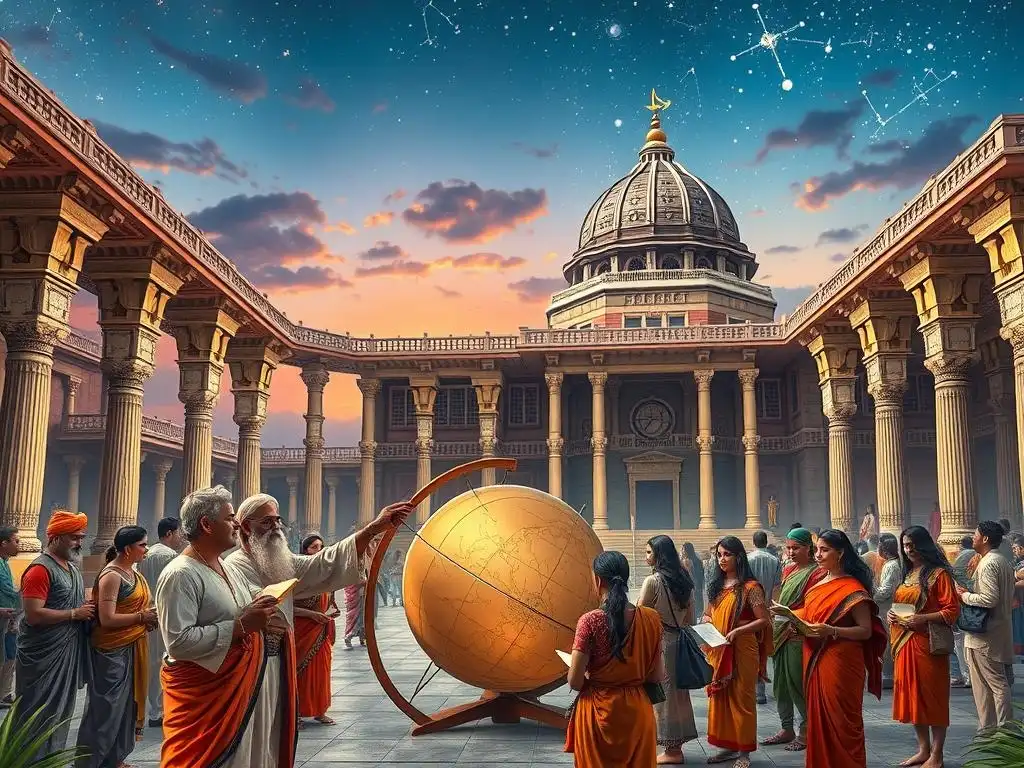
Ancient Indian universities, particularly renowned institutions like Nalanda and Takshashila, played a pivotal role in the development of astronomy. These institutions were not merely centers of learning; they were vibrant hubs where scholars from diverse backgrounds converged to exchange ideas and knowledge. The astronomical studies conducted within these universities laid the groundwork for significant advancements in mathematics and astronomy, influencing both Indian and global perspectives on these subjects.
Pioneers of Astronomy in Ancient India
Several notable scholars emerged from ancient Indian universities, contributing substantially to the field of astronomy. Among them were:
- Aryabhata (476–550 CE): Often regarded as the father of Indian mathematics and astronomy, Aryabhata's work, Aryabhatiya, presented groundbreaking concepts such as the approximation of π (pi) and the calculation of the circumference of the Earth. His heliocentric ideas, although not widely accepted at the time, showcased an advanced understanding of celestial bodies.
- Brahmagupta (598–668 CE): A key figure in the development of algebra and astronomy, Brahmagupta authored Brahmasphutasiddhanta, which discussed planetary motion, eclipses, and the calculation of the length of the year. His contributions to the rules of arithmetic and the concept of zero were monumental.
- Madhava of Sangamagrama (c. 1340–1425 CE): As a pioneer of the Kerala School of Astronomy and Mathematics, Madhava introduced series expansions for trigonometric functions, laying the foundation for calculus. His work not only advanced astronomy but also mathematics significantly.
These scholars, among others, were instrumental in establishing a scientific approach to studying the cosmos, and their legacies continue to resonate in modern astronomy.
Major Astronomical Works and Their Impact
Ancient Indian universities produced several significant astronomical texts that not only influenced local practices but also reached scholars in other cultures. Key works include:
- Aryabhatiya: This seminal text by Aryabhata encompassed various aspects of mathematics and astronomy, including:
- The calculation of planetary positions
- The concept of time and its divisions
- Methods for predicting eclipses
- Surya Siddhanta: Attributed to an anonymous author, this work elaborated on the calculation of eclipses, the movement of celestial bodies, and the construction of astronomical instruments. It served as a reference for subsequent astronomers in both India and the Islamic world.
- Brahmasphutasiddhanta: In this work, Brahmagupta presented rules for calculating the motions of planets and the phenomena of eclipses. His innovative use of algebra in astronomy was groundbreaking.
- Tantrasangraha: Written by the astronomer Jayadeva, this text synthesized earlier works and introduced new methods for astronomical calculations, solidifying the mathematical foundation for future studies.
The impact of these texts was profound; they not only advanced mathematical theory but also facilitated the practical application of astronomy in agriculture, navigation, and timekeeping.
Ancient Indian universities made significant strides in celestial navigation and calendar systems, essential for both daily life and ceremonial practices. Key contributions include:
- Lunar and Solar Calendars: Scholars developed intricate calendars that accounted for the lunar phases and solar cycles, which were crucial for agricultural planning and religious festivals. These calendars, based on astronomical observations, were among the earliest systematic methods of tracking time.
- Astronomical Instruments: The construction and use of various astronomical instruments, such as the gnomon and the astrolabe, were pivotal in enhancing observational accuracy. These instruments allowed astronomers to measure celestial angles and time more effectively.
- Navigation Techniques: Ancient Indian navigators utilized the stars for maritime navigation, guided by the detailed astronomical knowledge acquired in universities. This knowledge was vital for trade routes across the Indian Ocean and contributed significantly to India's economic prosperity.
Ancient Indian universities not only advanced the fields of mathematics and astronomy but also established a framework for understanding the universe that has influenced generations of scholars and practitioners across various cultures. The legacy of these contributions continues to be recognized and celebrated in modern astronomy.
The Interconnection Between Mathematics and Astronomy

The relationship between mathematics and astronomy in ancient Indian universities is a profound one, illustrating how these fields not only coexisted but also complemented each other. Ancient Indian scholars recognized that mathematical principles were essential for understanding celestial phenomena, leading to significant advancements in both fields. This interconnection can be traced back to the Vedic period, where early texts hint at the use of mathematics in astronomical observations.
The rigorous study of mathematics provided the tools necessary for accurate astronomical calculations. For instance, concepts such as geometry and trigonometry were pivotal in determining the positions of celestial bodies. Ancient Indian astronomers like Aryabhata and Brahmagupta utilized mathematical techniques to create sophisticated models of planetary motion, eclipses, and other astronomical events, underscoring the symbiotic relationship between the two disciplines.
How Mathematics Supported Astronomical Studies
Mathematics served as the backbone of various astronomical studies in ancient India. Scholars developed a range of mathematical techniques that enabled them to make precise predictions regarding celestial movements. Some notable contributions include:
- Numerical Systems: The introduction of the decimal system and the concept of zero facilitated complex calculations. This innovation allowed astronomers to perform extensive calculations with greater accuracy.
- Trigonometry: Ancient Indian mathematicians were pioneers in the development of trigonometric functions. They used these functions to calculate the angles and distances of celestial bodies, which were critical for navigation and calendar-making.
- Sine and Cosine Functions: The works of mathematicians such as Aryabhata included early formulations of sine and cosine functions, which were instrumental in creating astronomical tables and computing the positions of stars and planets.
- Equations and Models: Scholars like Brahmagupta formulated equations to describe planetary motion, which were essential for predicting eclipses and other celestial events. His work laid the groundwork for later developments in astronomy.
Through these mathematical frameworks, ancient Indian astronomers could achieve remarkable precision in their observations, influencing not only local practices but also laying the groundwork for future astronomical advancements worldwide.
Case Studies of Mathematical Applications in Astronomy
Several key case studies highlight the application of mathematics in ancient Indian astronomy, demonstrating how these universities became centers of knowledge and innovation.
- Aryabhata’s Aryabhatiya:
- In this foundational text, Aryabhata introduced a variety of astronomical concepts, including the rotation of the Earth and the calculation of time. He formulated a method for calculating the circumference of the Earth, using mathematical principles to derive an accurate estimate of 39,968 kilometers.
- Brahmagupta’s Brahmasphutasiddhanta:
- This seminal work included rules for calculating the positions of planets and provided algorithms for solving quadratic equations. Brahmagupta's contributions to the understanding of motion and his rules for eclipses were groundbreaking.
- Varahamihira’s Brihat Samhita:
- Varahamihira integrated astronomy with astrology and included intricate mathematical calculations to predict celestial events. His methodologies for calculating eclipses were particularly renowned, showcasing how mathematics was applied to practical astronomical phenomena.
- Madhava of Sangamagrama:
- A later mathematician, Madhava made significant contributions to calculus and infinite series, which were applied to astronomy. His work in approximating the sine and cosine functions using series expansions demonstrated a blend of mathematics and astronomy that was ahead of its time.
These case studies illustrate not only the mathematical prowess of ancient Indian scholars but also the practical applications of their knowledge in astronomy, showcasing the rich legacy of ancient Indian universities in shaping these fields. As a result, the contributions of these institutions continue to resonate in modern mathematical and astronomical studies, highlighting their importance in the history of science.
Legacy of Ancient Indian Universities in Mathematics and Astronomy

Ancient Indian universities, particularly those like Nalanda and Takshashila, played a pivotal role in the advancement of mathematics and astronomy. These institutions were not merely centers of learning; they were vibrant hubs where scholars from various cultures converged, exchanging ideas and expanding the frontiers of knowledge. The legacy of these universities is profound, influencing not only the Indian subcontinent but also reaching far beyond to impact global scientific thought.
Influence on Global Mathematical and Astronomical Thought
The contributions of ancient Indian universities to mathematics and astronomy are remarkable and multi-faceted. One of the most significant impacts was the development of the decimal system, which included the concept of zero. This revolutionary idea was first documented by Indian mathematicians, notably Aryabhata, who lived during the Gupta period. His seminal work, the Aryabhatiya, provided a framework for understanding numbers and calculations that would later be transmitted to the Islamic world and, from there, to Europe.
Key Contributions:
- Decimal System and Zero:
- The introduction of zero as a numeral fundamentally changed mathematical notation and operations.
- The decimal system facilitated complex calculations and laid the groundwork for algebra.
- Astronomical Calculations:
- Indian astronomers like Brahmagupta and Varahamihira made significant advancements in understanding planetary movements.
- Brahmagupta's Brahmasphutasiddhanta outlined methods for calculating the positions of celestial bodies, influencing Islamic and later European astronomy.
- Trigonometry:
- The development of sine and cosine functions in Indian mathematics was instrumental in later advancements in trigonometry globally.
- Mathematicians from ancient Indian universities contributed to the concepts of triangulation and spherical geometry.
The exchange of knowledge through trade routes and scholarly interactions with other civilizations, such as the Greeks and Arabs, further amplified the influence of ancient Indian thought on mathematics and astronomy. This interconnectivity illustrates the universities' role in the broader tapestry of global intellectual history.
Continuation of Knowledge through Later Scholars
The legacy of ancient Indian universities did not end with their decline; rather, it continued through later scholars who built upon the foundations laid by their predecessors. Many prominent mathematicians and astronomers emerged in the medieval period, ensuring the continuity and evolution of the knowledge developed in ancient universities.
Notable Scholars:
- Madhava of Sangamagrama (c. 1340–1425):
- Often regarded as the father of mathematical analysis, Madhava's work on infinite series and calculus predates similar developments in Europe by centuries.
- His contributions were foundational in the Kerala School of Astronomy and Mathematics, which thrived in the late medieval period.
- Nilakantha Somayaji (c. 1444–1544):
- A prominent figure in the Kerala School, he furthered the work of Madhava and introduced innovative concepts in astronomy, such as the heliocentric model.
- His treatise, the Tantrasangraha, is a comprehensive work that combines mathematics and astronomy, showcasing the advanced level of scientific inquiry present in India.
- Bhaskara II (1114–1185):
- His works, particularly the Lilavati and Bijaganita, were crucial in advancing algebra and arithmetic, blending practical applications with theoretical insights.
- Bhaskara's influence extended beyond India, as his texts were translated into Arabic and Latin, spreading Indian mathematical concepts further.
The scholarly traditions established in ancient Indian universities ensured that knowledge was not only preserved but also expanded upon. This continuity illustrates the resilience of Indian intellectualism in mathematics and astronomy, which laid the groundwork for future generations of scholars worldwide.
The legacy of ancient Indian universities in mathematics and astronomy remains an integral part of the world's cultural and scientific heritage. Their contributions have transcended time and geography, influencing various fields and inspiring countless scholars throughout history.
Conclusion

Summary of Contributions of Ancient Indian Universities
Ancient Indian universities, notably Nalanda and Takshashila, were pivotal in advancing mathematics and astronomy. These institutions were not merely centers of learning; they were vibrant hubs of scholarly activity that attracted students and scholars from various parts of the world. Their contributions can be summarized as follows:
- Mathematical Innovations: Ancient Indian mathematicians made significant strides in various fields, such as algebra, geometry, and arithmetic. Notable figures like Aryabhata and Brahmagupta introduced concepts such as:
- Zero: The concept of zero as a numeral was fully developed, revolutionizing mathematics globally.
- Decimal System: The use of the decimal system facilitated complex calculations and laid the groundwork for modern numerical representation.
- Algebraic Solutions: Brahmagupta's rules for solving quadratic equations were groundbreaking, influencing subsequent mathematical thought.
- Astronomical Advancements: The study of astronomy flourished in ancient Indian universities, leading to remarkable achievements, including:
- Planetary Calculations: Aryabhata accurately calculated the length of the solar year and the positions of celestial bodies.
- Lunar and Solar Eclipses: Scholars could predict eclipses with impressive precision, showcasing their understanding of celestial mechanics.
These contributions not only enriched the intellectual landscape of India but also influenced cultures worldwide.
The Lasting Impact on Modern Mathematics and Astronomy
The mathematical and astronomical knowledge developed in ancient Indian universities has had a profound and lasting impact on modern disciplines. Key points of influence include:
- Global Mathematical Framework: The introduction of the concept of zero and the decimal system provided a foundation for modern mathematics. The efficiency and simplicity of these systems are now fundamental to calculations worldwide.
- Astronomical Techniques: Techniques developed in ancient India, such as sine and cosine functions, are still in use today. These principles are essential in modern astronomy, navigation, and various fields of engineering.
- Interdisciplinary Influence: The integration of mathematics and astronomy in ancient Indian educational systems laid the groundwork for interdisciplinary studies. This approach can be seen in contemporary education, where subjects are often interconnected, fostering holistic understanding.
- Cross-Cultural Exchanges: The exchange of knowledge facilitated by ancient Indian universities contributed to the global scientific community. Scholars from various cultures have built upon the foundations laid by their Indian counterparts, leading to a rich tradition of collaboration and mutual influence.
Future Research Directions in Ancient Indian Educational Systems
As interest in ancient Indian universities grows, several key areas warrant further research to deepen our understanding of their contributions to mathematics and astronomy:
- Curriculum Studies: Investigating the curricula of ancient Indian universities could reveal insights into how mathematics and astronomy were taught and understood. This could involve analyzing ancient texts and manuscripts to reconstruct educational methodologies.
- Influence on Neighboring Cultures: Researching how the mathematical and astronomical knowledge from ancient Indian universities influenced other cultures, such as those in the Middle East and Southeast Asia, could uncover the pathways of knowledge transfer.
- Interdisciplinary Connections: Exploring the relationships between mathematics, astronomy, and other fields such as philosophy and medicine within ancient Indian universities could provide a comprehensive view of their educational systems.
- Technological Applications: Analyzing how ancient mathematical techniques were applied in engineering and architecture can enhance our understanding of their practical implications and innovations.
By pursuing these research directions, scholars can continue to illuminate the rich legacy of ancient Indian universities in shaping not only mathematics and astronomy but also the broader educational frameworks that persist today.
Frequently Asked Questions
What were the major ancient Indian universities known for mathematics and astronomy?
Ancient Indian universities like Nalanda and Taxila were renowned for their advanced studies in mathematics and astronomy, attracting students from across the world.
How did ancient Indian universities influence modern mathematics?
These universities laid the groundwork for concepts such as zero and the decimal system, which significantly influenced the development of modern mathematics.
What role did astronomy play in ancient Indian education?
Astronomy was a crucial part of the curriculum in ancient Indian universities, where scholars studied the movements of celestial bodies and contributed to calendar systems and astrological practices.
Who were some key figures in mathematics and astronomy from ancient India?
Prominent scholars like Aryabhata and Brahmagupta made significant contributions to mathematics and astronomy, establishing foundational concepts that are still relevant today.
How did ancient Indian universities promote cross-cultural exchanges?
These institutions were melting pots of knowledge, where scholars from various regions shared ideas, leading to rich cross-cultural exchanges in fields like mathematics and astronomy.
Final Reflection: The Enduring Legacy of Ancient Indian Universities in Mathematics and Astronomy
The contributions of ancient Indian universities to mathematics and astronomy are not just historical footnotes; they are the bedrock of modern scientific thought. As we navigate the complexities of the 21st century, the foundational work laid by scholars such as Aryabhata and Brahmagupta continues to resonate, reminding us of the profound interconnectedness of knowledge across cultures and epochs. Their pioneering insights into zero, algebra, and celestial mechanics are not merely relics of the past but are crucial to understanding the evolution of global mathematics and astronomy today.
The influence of these ancient institutions extends far beyond their geographical and temporal boundaries, shaping the cultural and intellectual landscapes of both Eastern and Western civilizations. The rigorous methodologies and philosophical inquiries fostered in these universities laid the groundwork for future generations of thinkers and innovators. As we reflect on this legacy, we are reminded of the words of Carl Sagan: If you wish to make an apple pie from scratch, you must first invent the universe.
This quote encapsulates the essence of how foundational knowledge in mathematics and astronomy is essential for all scientific endeavors, illustrating the importance of these ancient contributions in our quest for understanding the universe.
As we stand on the shoulders of giants, let us take a moment to reflect on our own roles in the continuum of knowledge. Consider how you can apply the lessons from ancient Indian universities in your own life—whether through fostering curiosity, embracing interdisciplinary learning, or contributing to the collective pursuit of knowledge.
The journey of discovery is ongoing, and each of us has the potential to be a part of it. Embrace the spirit of inquiry and innovation that these ancient scholars exemplified, and let it inspire you to explore the realms of mathematics and astronomy in your own unique way.
Unveil the Secrets of Ancient Wisdom!
Thank you for taking the time to explore the fascinating role that ancient Indian universities played in shaping mathematics and astronomy. The insights shared in this article highlight the remarkable contributions of scholars who paved the way for future generations. Now, it's time to take those ideas and put them into action!
Here are a few steps you can take to further your journey into this intriguing subject:
- Dive deeper into the study of ancient texts: Seek out translations of classic works by Indian mathematicians and astronomers to unlock their timeless knowledge.
- Share this wisdom: Discuss these fascinating contributions with friends or colleagues to spread awareness of the rich history of ancient India.
- Join a community of enthusiasts: Connect with online forums or local history groups that focus on ancient Indian sciences to exchange ideas and insights.
Which aspect of ancient Indian mathematics or astronomy are you most excited to explore further?