
Navigating the Stars: Ancient Indian Mathematics and its Impact on Astronomy


Welcome to Ancient India History, where we embark on a fascinating journey through time to uncover the rich tapestry of one of the world's oldest civilizations. In our featured article, "Navigating the Stars: Ancient Indian Mathematics and its Impact on Astronomy," we delve into the remarkable achievements of ancient Indian mathematicians and astronomers, whose groundbreaking discoveries laid the foundation for modern science.
Prepare to be captivated by the ingenuity and creativity that flourished in the Indus Valley and beyond, as we explore how these ancient innovations continue to inspire today's technological advancements. Join us as we unravel the mysteries of the cosmos through the lens of ancient wisdom and discover the profound legacy of Ancient Indian mathematics and astronomy.
- Introduction to Ancient Indian Mathematics and Astronomy
- Historical Context of Ancient Indian Mathematics
- Core Principles of Ancient Indian Mathematics
- Ancient Indian Astronomical Practices
- Influence of Ancient Indian Mathematics on Astronomy
- Legacy of Ancient Indian Mathematics in Modern Astronomy
- Conclusion: The Enduring Impact of Ancient Indian Mathematics on Astronomy
- Recommended Resources for Further Exploration
-
Frequently Asked Questions
- What are the main contributions of ancient Indian mathematics to astronomy?
- How did ancient Indian scholars influence modern mathematics?
- What role did the Indus Valley Civilization play in the development of mathematics?
- Who were some prominent figures in ancient Indian astronomy?
- How did the Gupta Empire contribute to the fields of mathematics and astronomy?
- Final Reflection: The Enduring Legacy of Ancient Indian Mathematics in Astronomy
- Unveil the Wonders of Ancient Indian Mathematics!
Introduction to Ancient Indian Mathematics and Astronomy
The intersection of mathematics and astronomy in ancient India represents a remarkable chapter in the annals of science and innovation. Ancient Indian mathematics and astronomy were not merely academic pursuits; they formed the backbone of cultural and religious practices, agricultural planning, and navigation.
From the sophisticated calculations of the Indus Valley Civilization to the groundbreaking work of mathematicians and astronomers during the Gupta Empire, ancient Indian scholars made significant contributions that laid the groundwork for modern scientific understanding. In this article, we will delve into the intricacies of ancient Indian mathematics and its profound impact on astronomy, highlighting the key figures, concepts, and innovations that emerged from this rich intellectual tradition.
Overview of Ancient Indian Contributions to Science
Ancient India boasts a rich tapestry of scientific achievements, particularly in the realms of mathematics and astronomy. The Sulba Sutras, composed around 800 BCE, are among the earliest texts that illustrate the application of mathematics in religious rituals, specifically temple construction and altar design. These texts introduced fundamental concepts such as the Pythagorean theorem and geometric principles long before they appeared in Western literature.
The Aryabhatiya, written by the astronomer Aryabhata in the 5th century CE, marked a pivotal moment in the history of mathematics and astronomy. Aryabhata introduced the concept of zero as a numeral, revolutionizing mathematical computation and paving the way for algebra and calculus. His observations about the Earth's rotation and the calculation of eclipses demonstrated a sophisticated understanding of celestial mechanics, influencing later scholars both in India and beyond.
Another significant contributor was Brahmagupta, who lived in the 7th century CE. His seminal work, the Brahmasphutasiddhanta, provided rules for arithmetic operations with negative numbers and offered methods to solve quadratic equations, which were crucial for astronomical calculations. Brahmagupta's findings were instrumental in shaping mathematical thought, not only in India but also in the Islamic Golden Age.
Significance of Mathematics in Astronomy
Mathematics played a vital role in the development of astronomy in ancient India. The precise calculations required for predicting celestial events such as eclipses and planetary positions relied heavily on advanced mathematical techniques. The use of trigonometry allowed astronomers to chart the movements of celestial bodies with remarkable accuracy.
The Aryabhata's formula for the sine function and the introduction of sine tables are foundational contributions that have been referenced and built upon in subsequent centuries. These mathematical tools enabled astronomers to navigate the stars with precision, allowing for improved agricultural practices and the establishment of calendars that were crucial for societal organization.
Furthermore, the concept of the universe's cyclical nature in ancient Indian cosmology was intricately linked to mathematical principles. The idea of time as cyclical, reflected in the Yugas, was quantified through mathematical calculations, demonstrating how mathematics underpinned both philosophical and scientific thought.
The contributions of ancient Indian mathematics to astronomy are profound and far-reaching. By exploring the intricate relationship between these two fields, we gain a deeper appreciation for the intellectual legacy of ancient India and its enduring impact on contemporary science and technology.
Historical Context of Ancient Indian Mathematics
Ancient Indian mathematics is deeply embedded in the cultural and intellectual fabric of the Indian subcontinent. The origins of mathematical thought in India can be traced back to the Indus Valley Civilization (circa 2500-1900 BCE), where archaeological findings suggest a sophisticated understanding of geometry, measurement, and possibly even early forms of arithmetic. This civilization's advances laid the groundwork for a mathematical tradition that would flourish in subsequent eras.
As we move into the Vedic period (circa 1500-500 BCE), mathematics began to intertwine with religious and philosophical thought. The Sulbasutras, texts written to provide guidelines for constructing altars, are among the earliest mathematical texts from this period. They contain rules for geometric constructions and demonstrate a profound understanding of Pythagorean triples long before they were formally recognized in the West.
The classical period (circa 400-1200 CE) marked a significant peak in Indian mathematics, coinciding with advancements in astronomy. Scholars like Aryabhata synthesized earlier knowledge and introduced innovative concepts, including the place value system and the concept of zero, which would later revolutionize mathematics globally.
Development of Mathematical Concepts in Ancient India
The development of mathematical concepts in ancient India is characterized by several key innovations:
- Place Value System: The positional decimal system, which allows for efficient numerical representation, was a groundbreaking development. This system enabled mathematicians to express large numbers succinctly and perform complex calculations with ease.
- Concept of Zero: The introduction of zero as a numeral was monumental. It not only served as a placeholder but also facilitated calculations and the development of algebraic concepts.
- Geometry and Trigonometry: Ancient Indian mathematicians made significant contributions to geometry, especially through the Sulbasutras, which outlined methods for constructing right angles and calculating areas. Trigonometric concepts, such as sine and cosine, were also developed, laying the foundation for future advancements in astronomy.
- Algorithms and Methods: The Bakhshali manuscript, an ancient Indian text, offers insights into early algebraic methods and the use of algorithms for solving linear and quadratic equations.
- Astronomical Calculations: Mathematics was intricately linked to astronomy, with ancient Indian scholars calculating planetary positions and eclipses with remarkable accuracy. The mathematical foundations they laid allowed for the development of astronomical models that persisted for centuries.
Key Mathematicians and Astronomers of Ancient India
Ancient India boasted a number of notable mathematicians and astronomers whose work has had a lasting impact:
- Aryabhata (476-550 CE): Often regarded as the father of Indian mathematics and astronomy, Aryabhata introduced the concept of place value and calculated the value of pi (π) with remarkable precision. His work, the Aryabhatiya, covers arithmetic, algebra, and astronomy.
- Brahmagupta (598-668 CE): A significant figure in the development of algebra, Brahmagupta's text, the Brahmasphutasiddhanta, includes rules for dealing with negative numbers and solutions to quadratic equations.
- Bhaskara I (circa 600 CE): He contributed to the understanding of sine functions and was among the first to write about trigonometric calculations in a systematic manner.
- Bhaskara II (1114-1185 CE): Also known as Bhaskaracharya, he wrote the Siddhanta Shiromani, which includes comprehensive treatments of arithmetic, algebra, and calculus concepts, making significant contributions to both mathematics and astronomy.
- Madhava of Sangamagrama (circa 1340-1425 CE): Recognized for his work in calculus, particularly in infinite series, Madhava's contributions laid the groundwork for future developments in mathematics, influencing both Indian and Western mathematical traditions.
The legacy of these mathematicians not only advanced the field of mathematics in their time but also provided essential tools for astronomical observations, influencing cultures far beyond India's borders. Their pioneering work in ancient Indian mathematics and astronomy serves as a testament to the rich intellectual heritage of ancient Indian civilizations.
Core Principles of Ancient Indian Mathematics

Ancient Indian mathematics is characterized by its profound principles that laid the groundwork for various fields, including astronomy. The mathematical innovations of ancient Indian scholars are not only remarkable for their sophistication but also for their practical applications in celestial navigation and timekeeping. Understanding these core principles provides insight into the remarkable interplay between mathematics and astronomy in ancient India.
Number Systems: From Brahmagupta to Aryabhata
The evolution of number systems in ancient India reflects a significant advancement in mathematical thought. Brahmagupta (598–668 CE) and Aryabhata (476–550 CE) were pivotal figures in this development.
- Brahmagupta introduced rules for arithmetic operations involving zero and negative numbers, which were revolutionary for his time. His work, the Brahmasphutasiddhanta, detailed methods for calculating with fractions and provided solutions to quadratic equations, influencing subsequent mathematicians and astronomers.
- Aryabhata further advanced the number system by advocating for the place value system, which allowed for more straightforward calculations. His seminal work, the Aryabhatiya, emphasized the importance of positional notation, making large calculations feasible and paving the way for modern mathematics.
This number system not only facilitated astronomical calculations but also influenced trade and commerce, showcasing the interconnectivity of mathematics with various aspects of ancient Indian life.
Geometry and Trigonometry in Ancient Texts
Geometry and trigonometry were vital components of ancient Indian mathematics, particularly in relation to astronomy. Ancient texts such as the Surya Siddhanta and Aryabhatiya illustrate sophisticated geometric principles and trigonometric functions.
- Trigonometric Innovations: Ancient Indian mathematicians developed sine and cosine functions, providing the tools necessary for calculating angles and lengths in astronomical observations. The Surya Siddhanta contains trigonometric tables that were crucial for determining the positions of celestial bodies.
- Geometric Principles: The application of geometric concepts was evident in the construction of altars, temples, and astronomical observatories. The principles of geometry were used to solve practical problems, such as calculating the areas of land and the volumes of structures, which were directly related to celestial observations.
These geometric and trigonometric advancements not only enhanced the accuracy of astronomical predictions but also demonstrated the mathematical creativity of ancient Indian scholars.
The Use of Zero and Decimal System in Astronomy
The introduction of zero and the decimal system in ancient Indian mathematics marked a significant leap in mathematical capabilities, especially in the field of astronomy.
- Zero as a Placeholder: The concept of zero, formalized in ancient India, was essential for the development of a positional decimal system. This allowed astronomers to represent large numbers accurately, which was crucial for calculations involving the vast distances and sizes of celestial bodies.
- Decimal System in Astronomy: The decimal system simplified complex calculations, enabling astronomers to compute planetary positions and eclipses with remarkable precision. For instance, Aryabhata’s calculations of the solar and lunar eclipses relied heavily on the decimal system, showcasing its efficiency in astronomical computations.
The integration of zero and the decimal system not only revolutionized mathematics in ancient India but also had a lasting impact on global mathematics, influencing later mathematical developments in the Islamic world and Europe.
The exploration of these core principles illustrates the depth of ancient Indian mathematics and highlights its significant contributions to astronomy. The innovations and theories developed by ancient scholars continue to resonate in modern mathematical and astronomical practices, reflecting the enduring legacy of ancient Indian civilization in the realm of science and technology.
Ancient Indian Astronomical Practices
Ancient Indian civilizations had a profound understanding of celestial navigation, which played a crucial role in trade, exploration, and agriculture. Navigation was often based on the positions of stars and planets, which were meticulously recorded and analyzed through ancient mathematical principles.
- Star Patterns: Ancient mariners used constellations as reference points. For instance, the Pole Star (Dhruva) was a significant marker for navigators, as it remained relatively stationary in the night sky, providing a constant point of reference.
- Zodiac Signs: The twelve zodiac signs played a crucial role in navigation and astrological readings, which were intertwined with the cultural practices of the time. Each sign corresponded to specific times of the year, helping navigators determine the best seasons for travel.
- Lunar Phases: The cycles of the moon were closely observed and utilized in navigation. The tides, influenced by the moon, were critical for coastal navigation, enabling sailors to plan their voyages according to the lunar calendar.
Calendar Systems and Their Mathematical Foundations
The ancient Indians developed sophisticated calendar systems that were deeply rooted in astronomical observations. These calendars were not only used for religious and cultural festivals but also for agricultural practices, helping farmers determine the best times for sowing and harvesting.
- Solar and Lunar Calendars: The use of both solar and lunar calendars allowed for a comprehensive understanding of time. The Vikram Samvat and Shaka Samvat are notable examples where solar months were synchronized with lunar months, showcasing advanced mathematical calculations.
- Mathematical Formulas: Ancient texts, such as the Aryabhatiya by Aryabhata, introduced formulas for calculating the length of the year. Aryabhata proposed that the solar year is about 365.358 days, a remarkably accurate figure for its time.
- Intercalation: To align lunar months with the solar year, ancient Indian mathematicians employed intercalation, adding an extra month (Adhik Maas) every few years. This practice reflects a sophisticated understanding of mathematical cycles and their applications to real-world problems.
Observational Astronomy: Tools and Techniques Used
To study celestial bodies, ancient Indian astronomers developed various tools and techniques that significantly contributed to the field of observational astronomy.
- Instruments: Instruments such as the Gnomon (a vertical rod that casts a shadow) were used to measure the sun's position and time of day. The Sidhanta Shiromani by Brahmagupta describes several types of instruments for measuring celestial phenomena.
- Water Clocks: Known as ghaṭikā, these devices measured time accurately and were used to observe celestial events. They reflected an understanding of the need for precision in astronomical observations.
- Planetarium Models: Ancient texts indicate that models of the cosmos were created to visualize and predict planetary movements. Such models were essential for training astronomers and enhancing their understanding of celestial mechanics.
The astronomical practices of ancient India, deeply intertwined with mathematics, not only reflect a rich cultural heritage but also laid the groundwork for future advancements in both astronomy and technology. The integration of celestial navigation, sophisticated calendar systems, and observational techniques highlights the remarkable achievements of ancient Indian mathematicians and astronomers in their quest to understand the universe.
Influence of Ancient Indian Mathematics on Astronomy
Mathematical Models Used in Ancient Indian Astronomy
Ancient Indian astronomers developed sophisticated mathematical models that significantly contributed to the understanding of celestial mechanics. These models were not merely theoretical; they were practical tools that facilitated accurate calculations of planetary movements and eclipses.
- Geocentric Models: Early Indian astronomers, such as Aryabhata, proposed geocentric models where the Earth was at the center of the universe. They utilized circular orbits and introduced the concept of epicycles to explain the apparent retrograde motion of planets.
- Spherical Astronomy: The concept of spherical geometry was pivotal in ancient Indian astronomy. Mathematicians like Brahmagupta and Bhaskara II formulated rules for calculating distances and angles between celestial bodies, making use of sine and cosine functions.
- Trigonometric Innovations: The use of trigonometric functions was advanced by Indian scholars. Aryabhata’s sine table laid the foundation for future calculations in astronomy. His work included an approximation of π (pi) and methods for determining the size of the Earth and its circumference.
- Decimal System: The introduction of the decimal system allowed for more precise calculations. This system enabled astronomers to record and compute large numbers effortlessly, which was crucial for tracking celestial bodies across vast distances.
Through these models, ancient Indian mathematicians contributed extensively to the field of astronomy, influencing not only their contemporaries but also future generations worldwide.
The Role of Ancient Indian Mathematics in Predicting Celestial Events
Ancient Indian mathematics played a crucial role in predicting celestial events such as eclipses, solstices, and planetary conjunctions. These predictions were essential for religious and agricultural purposes, as they were often linked to calendars and rituals.
- Eclipse Predictions: Indian mathematicians devised intricate algorithms to calculate the timings and visibility of solar and lunar eclipses. They used cycles based on the synodic month (the time between successive new moons) and the sidereal month (the time taken for the moon to orbit the Earth relative to the stars). The Surya Siddhanta outlines methods for predicting eclipses with remarkable accuracy.
- Seasonal Changes: The calculations of solstices and equinoxes were also integral to ancient Indian astronomy. Mathematicians like Varahamihira documented methods to predict seasonal changes, which were vital for agricultural planning.
- Calendrical Systems: The integration of mathematical principles into calendrical systems allowed for precise tracking of celestial phenomena. The Hindu calendar, for instance, is intricately tied to lunar cycles, and its accuracy is a testament to the mathematical prowess of ancient Indian scholars.
These predictions not only demonstrated the advanced understanding of celestial mechanics but also ensured that society could align its agricultural and religious activities with cosmic events.
Case Studies: Astronomical Texts like Surya Siddhanta
The Surya Siddhanta, a foundational astronomical text attributed to ancient Indian scholars, serves as a critical case study in understanding the intersection of mathematics and astronomy in ancient India.
- Structure of the Text: The Surya Siddhanta is structured as a compilation of rules and formulas that guide astronomical calculations. It provides insights into the mathematical techniques used to estimate distances, time intervals, and planetary positions.
- Key Contributions: This text introduced several groundbreaking concepts, including:
- Calculation of the Earth's Diameter: It offered methods to estimate the size of the Earth, which was remarkably close to modern measurements.
- Planetary Motion: The text detailed the movements of the planets and their periods, laying the groundwork for subsequent astronomical studies.
- Impact on Later Works: The Surya Siddhanta influenced numerous later texts, including those by Islamic astronomers during the medieval period. Its principles were adopted and adapted, showcasing the text's versatility and lasting legacy in global astronomy.
The Surya Siddhanta exemplifies the rich mathematical tradition of ancient India and its profound impact on the field of astronomy, highlighting the intricate relationship between ancient Indian mathematics and the celestial sciences.
Legacy of Ancient Indian Mathematics in Modern Astronomy
Ancient Indian mathematics has left an indelible mark on the field of astronomy, shaping not only the scientific practices of its time but also influencing modern astronomical techniques. The systematic approach to mathematical calculations and astronomical observations developed by ancient Indian scholars facilitated breakthroughs in understanding celestial phenomena.
One of the most notable contributions is the use of the decimal system, which originated in India and laid the groundwork for advanced calculations in astronomy. Mathematicians such as Aryabhata and Brahmagupta introduced concepts such as zero, negative numbers, and algorithms for solving quadratic equations, which are still relevant today. Their works, particularly Aryabhata's Aryabhatiya, contained extensive discussions on celestial bodies, their movements, and the mathematical models required to predict these movements accurately.
The legacy of these mathematical advancements can be observed in the way modern astronomers calculate planetary movements and predict eclipses. Techniques such as trigonometry, which were refined in ancient India, are fundamental in contemporary astronomy for determining distances and angles between celestial objects.
Modern Applications of Ancient Mathematical Techniques
Today, the mathematical techniques pioneered by ancient Indian scholars find significant applications in various fields of modern astronomy.
-
Celestial Navigation:
Ancient methods of calculating celestial positions are still employed in navigation systems. The understanding of celestial bodies' positions, developed by astronomers like Varahamihira, is mirrored in the algorithms used in GPS technology.
-
Astrophysics and Cosmology:
The mathematical models formulated by ancient mathematicians are foundational in the study of astrophysics. For instance, the calculations of planetary motions described by Brahmagupta are echoed in the simulation models used for studying celestial dynamics today.
-
Computational Astronomy:
The algorithms developed for astronomical computations in ancient texts have influenced modern computational methods. Techniques such as interpolation and extrapolation, which were essential in ancient calculations, are now integral in the development of software used for astronomical simulations.
These applications illustrate that the impact of ancient Indian mathematics is not merely historical; it continues to shape our understanding of the universe.
Influences on Contemporary Astronomical Practices
The influence of ancient Indian mathematics extends beyond mere calculations; it has fundamentally changed contemporary astronomical practices.
-
Eclipse Predictions:
Ancient Indian texts provided detailed methodologies for predicting eclipses, which are still utilized today. The precision in the calculations of eclipse timings, derived from methods established by scholars like Aryabhata, underpins modern astronomical eclipse predictions.
-
Calendar Systems:
The integration of astronomical observations with calendar systems devised by ancient Indians has left a lasting legacy in how we measure time today. The Siddhantic texts, which include detailed astronomical observations, laid the foundation for the calendars used in various cultures.
-
Observational Techniques:
The techniques developed for observing celestial bodies, such as the construction of astronomical instruments like the gola (spherical astrolabe), echo in contemporary observational practices. The emphasis on precision and systematic observation in ancient Indian astronomy set the stage for modern astronomical research methodologies.
Comparative Analysis: Ancient Indian vs. Other Civilizations
When we compare ancient Indian mathematics and its contributions to astronomy with those of other civilizations, several distinctive features emerge.
| Feature | Ancient India | Ancient Greece | Ancient China |
|---|---|---|---|
| Numerical System | Developed the decimal system | Used a mix of fractions and whole numbers | Employed rod numerals and counting rods |
| Astronomical Models | Focused on planetary motion and eclipses | Emphasized geometrical models for celestial bodies | Developed a cyclical model for planetary motion |
| Influential Texts | Aryabhatiya, Brahmasphutasiddhanta | Almagest by Ptolemy | The Nine Chapters on the Mathematical Art |
| Mathematical Innovations | Introduction of zero, trigonometry, algorithms | Proof-based geometry | Practical mathematics for agriculture and astronomy |
The above table highlights that while all civilizations contributed significantly to mathematics and astronomy, ancient India's unique innovations, including its numerical system and focus on planetary calculations, positioned it as a leader in these fields. The ongoing relevance of these ancient practices in contemporary astronomy underscores the enduring legacy of ancient Indian mathematics and its profound impact on our understanding of the cosmos.
Conclusion: The Enduring Impact of Ancient Indian Mathematics on Astronomy
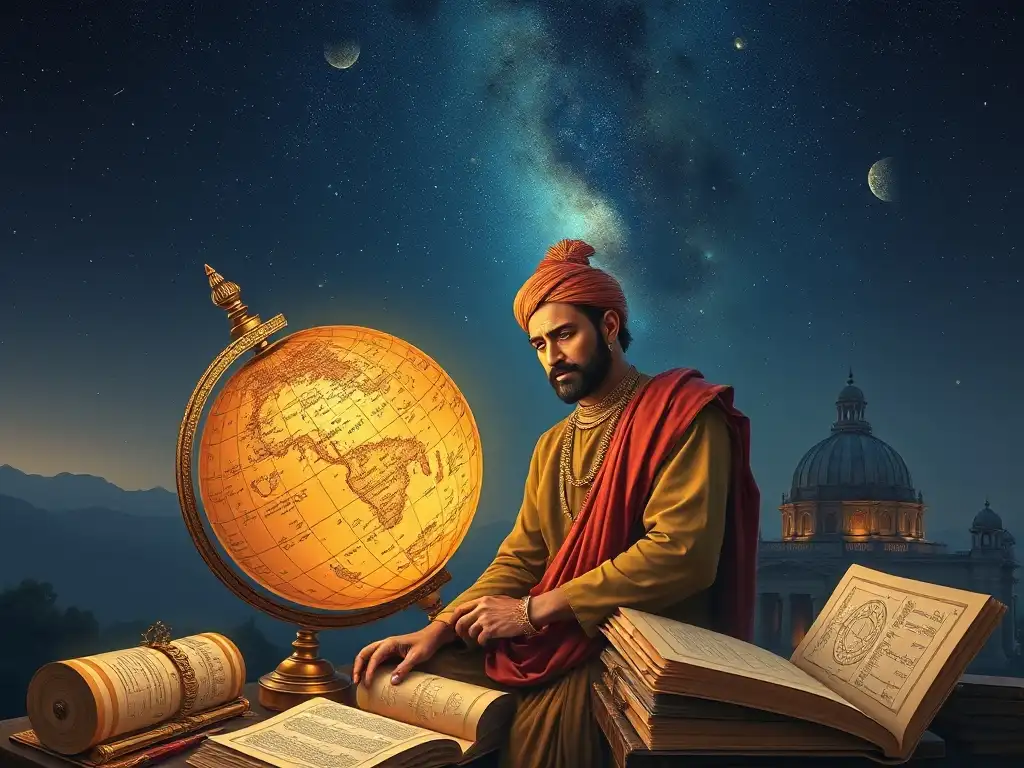
Summary of Contributions and Innovations
The contributions of ancient Indian mathematics to astronomy are both profound and transformative. Key figures such as Aryabhata, Brahmagupta, and Varahamihira laid the groundwork for mathematical techniques that were not only innovative for their time but also formed the basis for future developments in both fields.
- Aryabhata's Influence: Aryabhata introduced the concept of zero and positional notation, which revolutionized calculations. His work, Aryabhatiya, contained methods for calculating the circumference of the Earth and the length of a year with remarkable accuracy.
- Brahmagupta's Rules: Brahmagupta's Brahmasphutasiddhanta provided rules for arithmetic operations involving negative numbers and fractions, which were crucial for astronomical calculations.
- Trigonometry and Sine Functions: The introduction of trigonometric functions, particularly the sine, allowed for more accurate measurements of celestial bodies and contributed to the development of spherical astronomy.
These innovations not only advanced the field of astronomy in ancient India but also influenced other cultures, as these texts were translated and disseminated across the world, notably into the Islamic Golden Age and later to Europe.
Future Implications for Astronomy and Mathematics
The legacy of ancient Indian mathematics and astronomy continues to resonate in modern scientific practices. As we explore the cosmos today, the foundational principles established by these early mathematicians inform contemporary techniques:
- Mathematical Models: The techniques developed by ancient Indian scholars are still relevant in modern mathematical modeling of celestial phenomena. The use of complex algorithms derived from their work enhances our understanding of orbital mechanics and celestial navigation.
- Interdisciplinary Approaches: The integration of mathematics and astronomy, as demonstrated by ancient Indian scholars, encourages a holistic approach to scientific inquiry. This interdisciplinary approach is increasingly important in fields such as astrophysics and cosmology.
- Revival of Ancient Wisdom: As we confront modern challenges in astronomy, such as data analysis of vast cosmic datasets, revisiting ancient techniques can offer new insights. The algorithms and methods from ancient texts may inspire novel solutions to current problems.
The enduring impact of ancient Indian mathematics on astronomy is not merely a historical curiosity but a living legacy that continues to influence and inspire modern scientific endeavors. The principles established in ancient texts resonate through time, showcasing the brilliance of early Indian scholars and their contributions to our understanding of the universe.
Recommended Resources for Further Exploration
Books and Articles on Ancient Indian Mathematics and Astronomy
The study of ancient Indian mathematics and its influence on astronomy is enriched by a variety of scholarly works. Below is a curated list of notable books and articles that delve into this fascinating topic:
-
"The History of Mathematics: A Brief Course" by Roger L. Cooke
This comprehensive resource offers insights into the mathematical advancements in ancient civilizations, including India. It provides a contextual background to the mathematical principles that influenced astronomical observations.
-
"Mathematics in India" by Kim Plofker
Plofker's work is a pivotal examination of mathematical traditions in India, covering key figures and concepts that shaped both mathematics and astronomy.
-
"Ancient Indian Astronomy" by V. K. Sethi
This book focuses specifically on the astronomical practices in ancient India, highlighting methodologies, instruments, and the integration of mathematics in celestial observations.
-
Journal of Indian Philosophy
Look for articles that discuss the philosophical implications of mathematical concepts in ancient Indian astronomy. These can provide a deeper understanding of how mathematics was perceived in relation to the cosmos.
-
"The Surya Siddhanta: An Ancient Treatise on Astronomy"
This classical text is crucial for understanding the mathematical calculations and astronomical principles developed in ancient India. Various translations and commentaries are available for deeper analysis.
By exploring these resources, readers will gain a comprehensive understanding of how ancient Indian mathematics intertwined with astronomy, contributing to advancements in these fields.
Online Courses and Lectures on Historical Astronomy
For those interested in a more interactive approach to learning about ancient Indian mathematics and astronomy, several online platforms offer courses and lectures. Here are some recommended options:
-
Coursera: "The Science of the Universe"
This course often includes modules on ancient astronomical practices, touching on contributions from various cultures, including ancient India.
-
edX: "Ancient Astronomy"
This course provides a broader perspective on how ancient civilizations, including India, developed their understanding of the stars. It includes discussions on mathematical techniques used in astronomy.
-
YouTube Lectures by Notable Scholars
Channels dedicated to history and science often feature lectures on ancient Indian mathematics. Look for presentations by scholars such as Dr. R. C. Gupta or Dr. Kim Plofker, who provide invaluable insights into the subject.
-
Khan Academy: Math and Astronomy Series
While primarily focused on modern concepts, this series can provide foundational knowledge that complements the study of ancient practices.
Engaging with these online resources will enhance your understanding of the intricate relationship between ancient Indian mathematics and astronomy, making the learning experience both enriching and accessible.
Museums and Institutions Showcasing Ancient Indian Achievements
Visiting museums and institutions can provide a tangible connection to the rich history of ancient Indian mathematics and astronomy. Here are some notable places to explore:
-
The Indian Institute of Science (IISc), Bangalore
This premier research institution often hosts exhibitions and lectures on the history of science and mathematics in India, showcasing the contributions of ancient scholars.
-
The National Museum, New Delhi
The museum features artifacts and manuscripts that highlight India's scientific achievements, including mathematical texts and tools used in ancient astronomy.
-
The Vigyan Prasar Science Centre, Noida
This interactive science center offers exhibits on astronomy and mathematics, focusing on India's contributions and innovations in these fields.
-
The Nehru Science Centre, Mumbai
Home to various exhibits on scientific advancements, this center frequently features sections dedicated to ancient Indian mathematics and astronomy, complete with models and interactive displays.
-
The Asiatic Society, Kolkata
This historical institution holds a wealth of manuscripts and books related to ancient Indian sciences, including mathematics and astronomy. Special collections and seminars can often be found here.
By visiting these institutions, enthusiasts can witness firsthand the remarkable achievements of ancient Indian civilizations in mathematics and astronomy, fostering a deeper appreciation for their contributions to global knowledge.
Frequently Asked Questions
What are the main contributions of ancient Indian mathematics to astronomy?
Ancient Indian mathematicians made significant contributions such as the concept of zero, decimal system, and trigonometric functions, which greatly enhanced astronomical calculations.
How did ancient Indian scholars influence modern mathematics?
They developed advanced mathematical techniques and theories, including the sine function and algebra, which laid the groundwork for many modern mathematical concepts used today.
What role did the Indus Valley Civilization play in the development of mathematics?
The Indus Valley Civilization displayed early signs of mathematical understanding through their use of weights, measures, and possibly even geometry, indicating a foundation for future advancements.
Who were some prominent figures in ancient Indian astronomy?
Notable figures include Aryabhata, who introduced the heliocentric model and calculated the value of pi, and Brahmagupta, known for his work on quadratic equations and astronomical tables.
How did the Gupta Empire contribute to the fields of mathematics and astronomy?
During the Gupta Empire, there was a flourishing of knowledge, with scholars like Varahamihira and Brahmagupta making groundbreaking advancements in astronomical theories and mathematical techniques that influenced future generations.
Final Reflection: The Enduring Legacy of Ancient Indian Mathematics in Astronomy
The brilliance of ancient Indian mathematics is not merely a relic of the past; it continues to illuminate our understanding of the cosmos today. As we explore the intricate connections between mathematics and astronomy, we uncover a rich tapestry of knowledge that has shaped not only scientific thought but also our cultural identity. The profound insights of ancient Indian mathematicians remind us that the pursuit of knowledge transcends time and borders, offering a timeless perspective on the universe.
The influence of ancient Indian mathematics on modern astronomy is a testament to the power of intellectual curiosity and innovation. From the precise calculations of celestial movements to the development of sophisticated algorithms, the contributions of ancient scholars resonate in contemporary scientific practices. As we reflect on their achievements, we are reminded of the words of the great mathematician Aryabhata: The earth is round, and it rotates.
This simple yet profound realization laid the groundwork for future explorations and discoveries, illustrating how ancient wisdom continues to inspire and guide us in our quest for understanding.
As we stand on the shoulders of giants, I invite you to reflect on the lessons of ancient Indian mathematics and astronomy in your own life. Consider how the principles of observation, inquiry, and perseverance can be applied to your personal and professional journeys. Embrace the spirit of exploration that these ancient scholars embodied, and let their legacy motivate you to seek knowledge, challenge assumptions, and navigate your own stars. The universe is vast, and like the mathematicians of old, we all have the potential to contribute to its unfolding story.
Unveil the Wonders of Ancient Indian Mathematics!
Thank you for diving into the fascinating world of ancient Indian mathematics and its profound influence on astronomy! You've gained valuable insights into how these early scholars illuminated the cosmos with their groundbreaking ideas. Now, it's time to take action and explore this rich legacy further!
- Dive deeper: Choose a specific mathematical concept from the article and research its applications in contemporary science or astronomy.
- Share the knowledge: Discuss your newfound understanding with friends or family—who knows, you might spark their interest in the achievements of ancient civilizations!
- Join the conversation: Engage with fellow enthusiasts in our community forums to exchange thoughts, insights, and questions about the wonders of ancient Indian mathematics.
What aspect of ancient Indian mathematics intrigued you the most, and how do you believe it can enhance our understanding of the universe today?