
Harnessing the Past: How Ancient Indian Mathematical Principles Drive Today’s Innovations

Welcome to Ancient India History, where we embark on a fascinating journey through time to uncover the rich tapestry of ancient Indian civilizations. Here, you’ll discover how the brilliant contributions of ancient Indian mathematics not only shaped the past but continue to inspire modern innovations. In our featured article, "Harnessing the Past: How Ancient Indian Mathematical Principles Drive Today’s Innovations," we delve into the remarkable ideas that have transcended centuries. Join us as we unravel the secrets of ancient wisdom and its profound impact on today’s tech landscape—your adventure into the depths of history starts here!
Introduction to Ancient Indian Mathematics Contributions
The legacy of ancient Indian mathematics is a profound testament to the intellectual prowess and innovative spirit of its civilization. Emerging from the fertile grounds of the Indus Valley and flourishing through various dynasties, ancient Indian mathematicians made groundbreaking contributions that laid the foundation for modern mathematical principles. The intricate systems they developed not only addressed practical problems of their time but also influenced subsequent generations of scholars across the globe. This article explores the rich tapestry of ancient Indian mathematics, highlighting its significant contributions and their enduring impact on contemporary technology and innovations.
Historical Context of Ancient Indian Mathematics
Ancient Indian mathematics is rooted in a multifaceted historical context that encompasses various cultural, religious, and scientific developments. Starting from the Indus Valley Civilization (circa 2500–1900 BCE), which displayed advanced urban planning and architectural skills, mathematic principles began to emerge in response to the needs of trade, agriculture, and astronomy.
The Origins of Mathematical Concepts in Ancient India
The earliest evidence of mathematical concepts in India can be traced back to inscriptions and artifacts from the Indus Valley, where the use of weights and measures was prevalent. As civilizations evolved, so too did their mathematical knowledge. By the Vedic period (1500–500 BCE), texts such as the Sulbasutras introduced geometric principles necessary for altar construction, showcasing the practical application of mathematics in religious rituals.
- Key Contributions:
- Zero: The concept of zero as a numeral was developed, revolutionizing mathematics globally.
- Decimal System: The positional decimal system was formalized, enhancing numerical representation and calculations.
Key Figures in Ancient Indian Mathematics
Several mathematicians stand out in the history of ancient Indian mathematics, each contributing unique ideas and principles that influenced both local and global mathematical thought.
- Aryabhata (476–550 CE): Known for his work Aryabhatiya, he introduced concepts such as the approximation of π (pi) and the calculation of square roots. His astronomical calculations were groundbreaking, providing a foundation for further developments in mathematics and astronomy.
- Brahmagupta (598–668 CE): His work Brahmasphutasiddhanta included rules for arithmetic operations involving zero and negative numbers, profoundly influencing later mathematical practices.
- Bhaskara II (1114–1185 CE): Author of Lilavati and Bijaganita, he made significant advancements in calculus and algebra, discussing concepts such as derivatives and the solutions to quadratic equations.
These mathematicians not only advanced their own fields but also paved the way for future innovations, illustrating how ancient Indian mathematics continues to resonate in today's technological landscape.
Fundamental Contributions of Ancient Indian Mathematics
Ancient Indian mathematics has profoundly influenced the development of various mathematical concepts, many of which continue to shape modern mathematics and technology. One of the most significant contributions is the introduction of the decimal number system, which revolutionized numerical representation and calculations. This system is built on the concept of place value, allowing for more efficient computations compared to earlier numeral systems.
Another cornerstone of ancient Indian mathematics is the development of trigonometry, particularly in the context of astronomy. Indian mathematicians like Aryabhata and Bhaskara II made remarkable advancements in this field, particularly through their work on sine functions and their applications in astronomical calculations. The systematic study of these concepts laid the groundwork for further advancements in mathematics globally.
Additionally, ancient Indian mathematicians excelled in combinatorial mathematics, providing the foundation for modern set theory and probability. The works of scholars such as Varahamihira and Brahmagupta illustrate the profound understanding of mathematical relationships and their practical applications in various domains, including commerce and astronomy.
The Concept of Zero and Its Impact
The concept of zero, attributed to ancient Indian mathematicians, is perhaps one of the most revolutionary ideas in the history of mathematics. It serves not only as a placeholder in the decimal system but also as a number in its own right, enabling a wide range of mathematical operations. The earliest recorded use of zero in this context dates back to the 5th century CE in the work of Aryabhata.
The introduction of zero facilitated complex calculations and paved the way for the development of algebra. By allowing for the representation of both absence and quantity, zero transformed mathematical thought and enabled more advanced problem-solving techniques. This concept later spread to the Arab world and subsequently to Europe, profoundly impacting mathematics as a whole.
The implications of zero extend beyond mathematics into fields such as computer science, where binary code relies on the concept of zero and one to function. The ability to represent data and perform calculations efficiently has roots in this ancient understanding, showcasing how foundational ideas from ancient Indian mathematics continue to shape modern technology.
Advances in Algebra and Geometry
Ancient Indian mathematicians made significant strides in algebra and geometry, with notable contributions that remain relevant today. For instance, Brahmagupta's rules for solving quadratic equations established foundational algebraic principles. His work laid the groundwork for future mathematicians by providing systematic methods for solving various types of equations, including those with multiple variables.
In geometry, ancient Indian scholars developed techniques for calculating areas and volumes, particularly in relation to circles and solids. The Sulbasutras, ancient texts that guide the construction of altars, contain geometric principles that demonstrate an understanding of ratios and proportions. These principles not only facilitated religious practices but also contributed to the development of architectural design.
Moreover, the understanding of geometric concepts such as the Pythagorean theorem was present in ancient Indian mathematics well before it was formally recognized in the West. The rich tradition of geometry in ancient India underscores its importance in various fields, from architecture to astronomy, and highlights the sophistication of mathematical thought during that era.
Influence of Ancient Indian Mathematics on Modern Innovations
The foundational principles established by ancient Indian mathematicians have had a lasting impact on various modern innovations. The methodologies developed thousands of years ago continue to inform contemporary practices in mathematics, science, and technology.
Applications in Computer Science and Technology
The contributions of ancient Indian mathematics, particularly the concepts of zero and the decimal system, play a crucial role in modern computer science. The binary system, which is fundamental to computer programming and digital systems, is built on the principles of zero and one. This connection illustrates how ancient mathematical ideas have transcended time to influence cutting-edge technology.
Additionally, algorithms and data structures used in computer science have their roots in ancient Indian mathematical techniques. The systematic approach to problem-solving demonstrated by ancient scholars informs modern computational methods, enabling advancements in artificial intelligence, machine learning, and data analysis.
Furthermore, the concepts of combinatorics and probability, which were explored by ancient Indian mathematicians, continue to be vital in fields such as cryptography and algorithm design. This demonstrates the enduring legacy of ancient Indian mathematics in shaping the digital landscape of today.
Contributions to Engineering and Architecture
Ancient Indian mathematics has also significantly influenced modern engineering and architecture. The geometric principles outlined in texts like the Sulbasutras provided essential guidelines for designing intricate structures, from temples to fortifications. The understanding of ratios, proportions, and symmetry established by ancient scholars is reflected in the architectural marvels created during their time.
Modern engineering practices, particularly in structural design and materials science, can trace their methodologies back to ancient Indian innovations. The emphasis on precision and mathematical accuracy in construction is a direct descendant of the mathematical rigor practiced by ancient Indian builders.
Moreover, the insights gained from ancient Indian mathematics have implications in contemporary urban planning and environmental engineering. Techniques that originated in ancient times for optimizing space and resource management continue to inform sustainable practices in modern engineering projects, highlighting the relevance of these historical contributions in addressing today’s challenges.
Modern Technologies Utilizing Ancient Indian Mathematical Principles
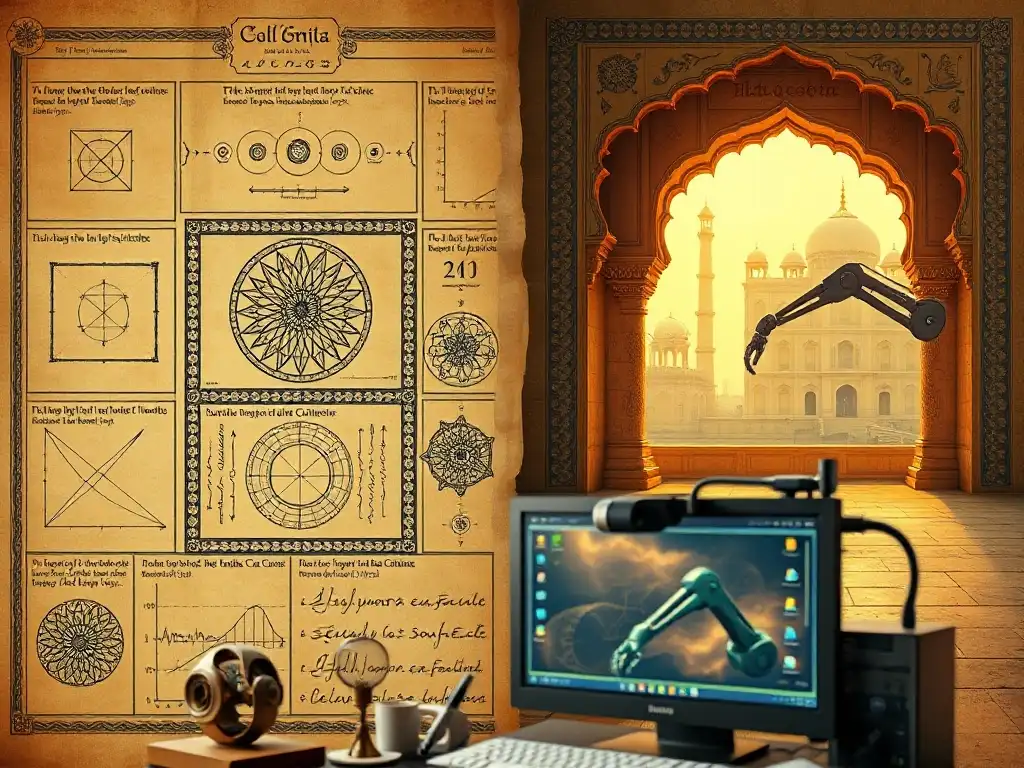
Ancient Indian mathematics has had a profound influence on various modern technologies, demonstrating the timeless relevance of its principles. From algorithms that power artificial intelligence to cryptographic techniques ensuring data security, the methodologies developed by ancient Indian mathematicians continue to drive contemporary innovations. This section explores how these contributions are being harnessed in today's digital landscape.
AI and Machine Learning Algorithms
Artificial intelligence (AI) and machine learning (ML) algorithms benefit significantly from the mathematical formulas and concepts pioneered in ancient India. Notably, the work of mathematicians like Aryabhata laid the groundwork for statistical methodologies that underpin modern AI.
- Statistical Foundations: Ancient texts such as the "Aryabhatiya" discuss number systems and mathematical operations that serve as the basis for algorithms used in data analysis and pattern recognition today. For instance, the concept of zero, which was extensively developed in ancient Indian mathematics, is crucial for the binary number system utilized in computer science.
- Geometric Algorithms: The principles of geometry from ancient Indian scholars influence machine learning techniques that involve geometric data processing, such as computer vision and image recognition. Techniques like clustering and classification often employ geometric interpretations that can be traced back to ancient Indian mathematical principles.
- Optimization Techniques: Many AI applications require optimization algorithms to enhance performance. The ancient Indian treatise "Sulbasutras" contains early forms of optimization theories, particularly in relation to construction and measurement, which find parallels in today's algorithms for maximizing efficiency and effectiveness in various AI applications.
Innovations in Cryptography
Cryptography, vital for securing communication and data, has seen significant advancements influenced by ancient Indian mathematical concepts. The rich tradition of encoding and decoding information in ancient India is evident in several modern cryptographic techniques.
- Algorithms Based on Modular Arithmetic: Ancient Indian mathematicians utilized modular arithmetic, a foundational concept in cryptography today. This mathematical operation is essential for key generation and encryption processes, as seen in the RSA algorithm, which is widely used for secure data transmission.
- Ciphers and Codes: The use of ciphers can be traced back to ancient Indian texts, where methods for concealed communication were developed. The principles of these ancient codes are reflected in modern cryptographic systems, which employ complex algorithms to ensure data integrity and confidentiality.
- Mathematical Rigor in Security Protocols: The rigorous mathematical approach adopted by ancient Indian scholars informs the development of security protocols utilized in digital communications. For instance, the concepts of prime numbers and factorization, explored in ancient mathematics, are pivotal for modern public key cryptography systems.
Conclusion: The Legacy of Ancient Indian Mathematics
The lasting legacy of ancient Indian mathematics is evident in its continued influence on contemporary technological advancements. As we explore the intersection of ancient wisdom and modern innovation, it becomes clear that the mathematical principles developed centuries ago are not only relevant but essential in addressing the challenges of today's digital world.
The contributions of ancient Indian mathematicians, from Aryabhata to Brahmagupta, provide a rich foundation that enhances our understanding of mathematics and its applications. By harnessing these principles, we can foster innovations that respect the past while paving the way for a brighter technological future. Embracing this legacy not only honors the achievements of ancient civilizations but also inspires ongoing exploration and discovery in the realm of mathematics and technology.
Call to Action
As we delve into the rich tapestry of ancient Indian mathematics and its profound influence on modern innovations, it becomes evident that the principles established by scholars of yore continue to resonate in today's technological advancements. We invite you to explore this fascinating intersection of history and innovation further.
- Engage with Learning: Dive deeper into ancient texts and contemporary interpretations of Indian mathematical concepts. Resources such as books, documentaries, and online courses can enhance your understanding and appreciation of this pivotal field.
- Join the Discussion: Participate in forums and social media groups dedicated to the exploration of ancient Indian science and mathematics. Share insights, ask questions, and connect with fellow enthusiasts who share your passion for this subject.
- Support Research: Consider supporting academic research and initiatives focused on ancient Indian mathematics. Your contributions can help preserve and promote the legacy of these groundbreaking ideas, ensuring they continue to inspire future generations.
- Spread the Word: Share this article and others like it with your network. By spreading awareness of ancient Indian mathematics contributions, you can help cultivate a greater appreciation for the historical foundations that underpin modern technology.
Together, we can harness the wisdom of the past to inspire innovation in the future. Let’s celebrate and promote the legacy of ancient Indian mathematics!
- Introduction to Ancient Indian Mathematics Contributions
- Historical Context of Ancient Indian Mathematics
- Fundamental Contributions of Ancient Indian Mathematics
- Influence of Ancient Indian Mathematics on Modern Innovations
- Modern Technologies Utilizing Ancient Indian Mathematical Principles
- Conclusion: The Legacy of Ancient Indian Mathematics
- Call to Action
- What are some key contributions of ancient Indian mathematics?
- How did ancient Indian mathematics influence modern mathematics?
- What role did ancient Indian mathematicians play in history?
- How does the article connect ancient Indian mathematics to contemporary innovations?
- Where can I learn more about ancient Indian mathematics?
Frequently Asked Questions
What are some key contributions of ancient Indian mathematics?
Ancient Indian mathematics has made significant contributions such as the concept of zero, the decimal system, and advanced geometry and trigonometry techniques.
How did ancient Indian mathematics influence modern mathematics?
The principles developed in ancient Indian mathematics, like the decimal system, have become foundational in modern mathematics, shaping how numerical calculations are performed today.
What role did ancient Indian mathematicians play in history?
Mathematicians like Aryabhata and Brahmagupta were pivotal in developing theories and concepts that laid the groundwork for future mathematical advancements, influencing both Indian and global mathematics.
How does the article connect ancient Indian mathematics to contemporary innovations?
The article explores how ancient mathematical principles continue to inspire and inform modern technological innovations, showcasing their enduring relevance.
Where can I learn more about ancient Indian mathematics?
You can explore resources on platforms like Ancient India History, which provide detailed insights into the history, culture, and mathematical contributions of ancient Indian civilizations.
Final Reflection: Embracing Ancient Wisdom for Modern Innovation
The contributions of ancient Indian mathematics are not merely relics of the past; they are vibrant threads woven into the fabric of contemporary innovation. As we navigate a world increasingly defined by technology and complexity, the principles established by ancient mathematicians continue to resonate. Their insights into geometry, algebra, and number theory are foundational to many modern advancements, reminding us that the seeds of innovation were sown long before our time. This enduring relevance underscores a striking truth: the past is not a distant memory but a powerful catalyst for the future.
The influence of ancient Indian mathematics extends beyond academic circles; it permeates our cultural and social landscapes, shaping how we approach problem-solving and creativity today. These timeless principles encourage us to think critically and embrace diverse methodologies. As we draw inspiration from the likes of Aryabhata and Brahmagupta, we recognize that their legacies are not confined to history books. Rather, they continue to inspire generations of thinkers and innovators. Mathematics is the language in which God has written the universe.
— Galileo Galilei. This quote encapsulates the profound connection between mathematical principles and the universe, reinforcing the idea that ancient wisdom remains relevant in our quest for understanding and progress.
As we reflect on the lessons of ancient Indian mathematics, let us invite ourselves to explore how these principles can inform our own lives and work. Consider how you might integrate these timeless concepts into your daily challenges, fostering creativity and innovation in your pursuits. By acknowledging the brilliance of our predecessors, we can cultivate a mindset that values knowledge, collaboration, and the courage to think differently. Embrace this journey of discovery, and let the wisdom of the past guide you toward a brighter, more innovative future.
Unlock the Future with Ancient Wisdom!
Thank you for diving into the fascinating world where ancient Indian mathematical principles meet modern innovations! You've uncovered the vital role that history plays in shaping today's advancements. Now, let’s transform that knowledge into actionable steps.
Here are some ways you can harness the wisdom of the past:
- Explore Ancient Texts: Delve deeper into the original works of ancient Indian mathematicians. Visit your local library or explore online resources to uncover concepts that could inspire innovative solutions.
- Share Your Insights: Engage in discussions about your discoveries with friends or on social media. Initiate conversations about the relevance of ancient practices in our technology-driven society.
- Get Involved in STEM Education: Support initiatives that incorporate historical principles into contemporary education. Volunteer or contribute to programs that teach students the mathematical foundations established by our ancestors.
Which aspect of ancient Indian mathematics do you believe could revolutionize today's technology? We welcome your thoughts in the comments below!