
Philosophical Parallels: Comparing Indian and Greek Thought

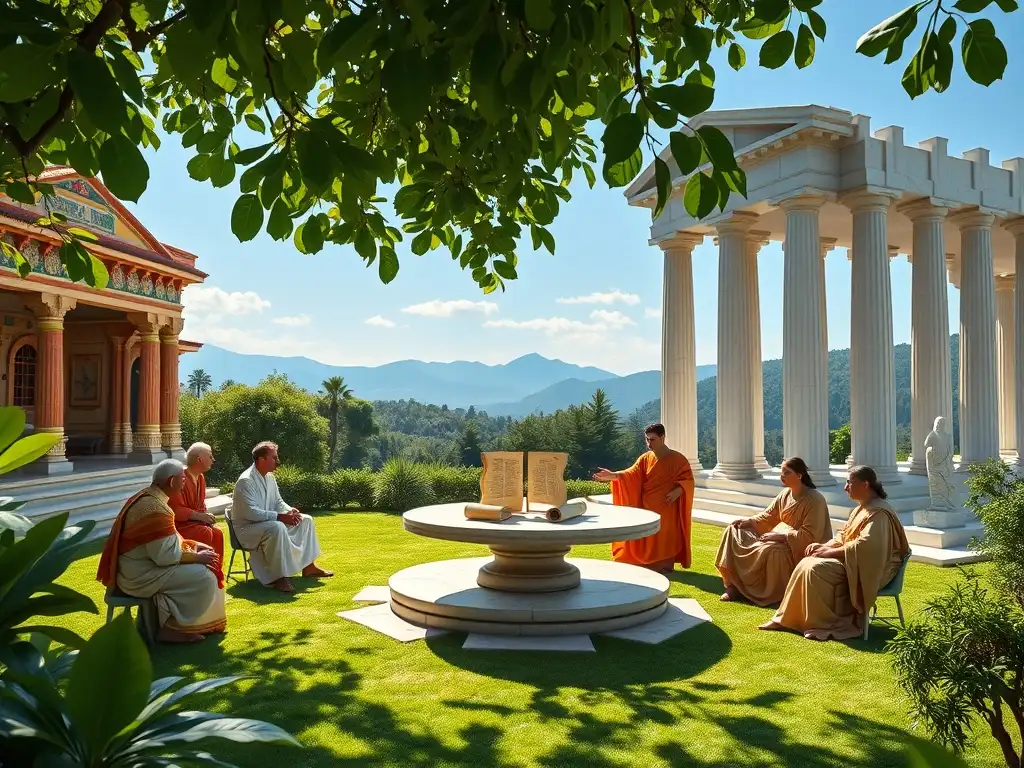
Welcome to Ancient India History, where we embark on a fascinating journey through the rich tapestry of ancient Indian civilizations. Here, we delve deep into the cultural, philosophical, and historical interactions that shaped the subcontinent. Our featured article, "Philosophical Parallels: Comparing Indian and Greek Thought," invites you to explore the intriguing similarities and differences between Indian and Greek philosophies.
What can the wisdom of these ancient thinkers teach us about our own beliefs? Join us as we uncover the profound connections that have influenced thought across centuries, and prepare to be captivated by the depth of knowledge waiting just beyond this introduction!
- Introduction to Indian Greek Philosophical Comparison
- Historical Context of Indian and Greek Philosophical Traditions
- Core Philosophical Concepts in Indian Thought
- Core Philosophical Concepts in Greek Thought
- Comparative Analysis of Indian and Greek Philosophical Ideas
- Conclusion
- Influence of Indian and Greek Philosophies on Each Other
- Conclusion: The Legacy of Indian Greek Philosophical Comparison
- Suggested Further Reading and Resources
-
Frequently Asked Questions
- What is the main focus of the article on Indian Greek philosophical comparison?
- How did ancient Indian philosophy influence Greek thought?
- What are some key philosophical concepts compared in the article?
- Are there any notable philosophers from ancient India mentioned?
- Why is the comparison between Indian and Greek philosophies important?
- Final Reflection: Bridging Wisdom Across Cultures
- Dive Deeper into the Wisdom of Ancient Thinkers!
Introduction to Indian Greek Philosophical Comparison
The exploration of philosophical thought in ancient civilizations reveals a fascinating tapestry of ideas, values, and practices that have shaped human understanding across cultures. Among these, the philosophical traditions of India and Greece stand out for their depth and richness, offering profound insights into the nature of existence, ethics, and knowledge.
The Indian Greek philosophical comparison invites scholars and enthusiasts alike to delve into the similarities and divergences between these two influential schools of thought. From the rational inquiries of Greek philosophers like Socrates and Plato to the spiritual explorations of Indian sages such as Buddha and Adi Shankaracharya, the cross-pollination of ideas has left an indelible mark on the intellectual landscape of both regions.
This article seeks to illuminate the philosophical parallels that exist between Indian and Greek thought, examining how these ancient civilizations engaged with fundamental questions of life, morality, and the cosmos. By analyzing their respective contributions, we can gain a deeper appreciation of the shared heritage that has influenced philosophical discourse throughout history.
Overview of Indian and Greek Philosophy
The philosophical traditions of India and Greece emerged in distinct cultural and historical contexts, yet both grappled with similar existential questions. Indian philosophy is often characterized by its spiritual dimension, focusing on concepts such as dharma (duty), moksha (liberation), and the nature of the self. Central texts such as the Vedas, Upanishads, and the Bhagavad Gita provide a rich framework for understanding these ideas, emphasizing introspection and the pursuit of enlightenment.
In contrast, Greek philosophy is marked by its emphasis on rational inquiry and logical argumentation. Thinkers such as Aristotle and the Stoics laid the groundwork for systematic thinking and empirical observation. The dialogues of Plato invite readers to ponder the nature of reality and the ideal forms, while the works of Epicurus explore the pursuit of happiness through moderation and wisdom.
Despite their differences, both traditions share common threads, such as the quest for truth and the exploration of ethical living. For instance, the ethical inquiries of Socratic thought find resonance in the karmic principles of Indian philosophy, where actions have consequences that shape one's destiny.
Importance of Studying Indian-Greek Relations
Understanding the philosophical parallels between India and Greece is crucial for several reasons:
- Cultural Exchange: The interaction between these two civilizations facilitated a rich exchange of ideas that has influenced various fields, including science, mathematics, and ethics. By studying these connections, we can uncover the historical pathways through which knowledge traveled.
- Holistic Understanding: A comparative approach allows scholars to appreciate the complexities and nuances of each tradition. Recognizing the strengths of both Indian and Greek philosophies can enrich contemporary discussions on ethics, governance, and spirituality.
- Global Perspective: In an increasingly interconnected world, examining the philosophical dialogues between ancient cultures fosters a greater understanding of global thought. It highlights the shared human experience of seeking meaning and understanding across cultural boundaries.
- Inspiring Contemporary Thought: The philosophical inquiries of the past continue to resonate today. By drawing from the wisdom of both Indian and Greek traditions, modern thinkers can address contemporary issues with a broader and more inclusive perspective.
The study of Indian Greek philosophical comparison not only sheds light on the intellectual achievements of these ancient civilizations but also serves as a vital reminder of the interconnectedness of human thought. As we explore these rich traditions, we uncover a wealth of knowledge that continues to inspire and challenge us in our quest for understanding.
Historical Context of Indian and Greek Philosophical Traditions

The philosophical traditions of India and Greece emerged in distinct cultural contexts, each shaped by its unique historical, social, and religious landscapes. Understanding the historical framework in which these philosophies evolved is crucial for appreciating their development and subsequent interactions.
Origins of Indian Philosophy
Indian philosophy traces its roots back to the ancient Vedic texts, composed around 1500 BCE, which laid the groundwork for various philosophical inquiries. The key texts, known as the Upanishads, explored fundamental questions about existence, consciousness, and the nature of reality.
- Vedic Influence: The Vedas, revered as the oldest scriptures, emphasize rituals and hymns but gradually led to a more introspective approach in the Upanishads.
- Diverse Schools: Indian philosophy is characterized by a plurality of schools, including:
- Hindu Philosophies: Such as Vedanta and Samkhya, focusing on the self (Atman) and universal reality (Brahman).
- Buddhism: Founded by Siddhartha Gautama in the 5th century BCE, offering a unique perspective on suffering and the nature of reality.
- Jainism: Emerging around the same time, emphasizing non-violence (ahimsa) and the multiplicity of perspectives (anekantavada).
These schools reflect a rich tapestry of thought, often engaging with metaphysics, ethics, and epistemology, which would later resonate with Greek philosophical inquiries.
Origins of Greek Philosophy
Greek philosophy began to take shape in the 6th century BCE, primarily through the works of pre-Socratic thinkers who sought natural explanations for the world around them.
- Thales and Naturalism: Thales of Miletus is often regarded as the first philosopher, proposing that water is the fundamental substance of all matter, marking a shift from mythological explanations to rational inquiry.
- Socratic Method: Socrates, through his dialectical method, emphasized ethical questions and the importance of self-examination. His influence paved the way for his disciples, Plato and Aristotle.
- Key Schools: The evolution of Greek thought led to the establishment of various philosophical schools, including:
- Platonism: Focused on ideal forms and the nature of reality.
- Aristotelianism: Grounded in empirical observation and categorization of knowledge.
Greek philosophy emphasized logic, ethics, and metaphysics, laying a foundation for Western thought that would later find intriguing parallels in Indian philosophies.
Key Historical Interactions between India and Greece
The historical interactions between India and Greece can be traced back to the conquests of Alexander the Great in the 4th century BCE, which brought the two civilizations into direct contact.
- Cultural Exchanges:
- Following Alexander’s campaigns, numerous Greek philosophers and scholars, such as Megasthenes, visited India, documenting their observations.
- The establishment of the Indo-Greek Kingdoms facilitated the fusion of Indian and Greek ideas. This period saw a blending of artistic styles, governance, and philosophical concepts.
- Philosophical Dialogues:
- The interactions led to mutual influences, particularly in ethics and metaphysics.
- For instance, concepts of atomism in both traditions showcase parallel explorations of the nature of matter, with Indian philosophers like Kanada considering the existence of indivisible particles (anu).
- Trade and Transmission of Ideas:
- The Silk Road and maritime trade routes enabled the exchange of not just goods but also ideas, with Indian and Greek scholars influencing each other’s thoughts on ethics, governance, and the nature of the cosmos.
The historical context of Indian and Greek philosophical traditions reveals a complex interplay of ideas that transcended geographical boundaries, enriching both civilizations and laying the groundwork for a comparative understanding of their philosophical legacies.
Core Philosophical Concepts in Indian Thought
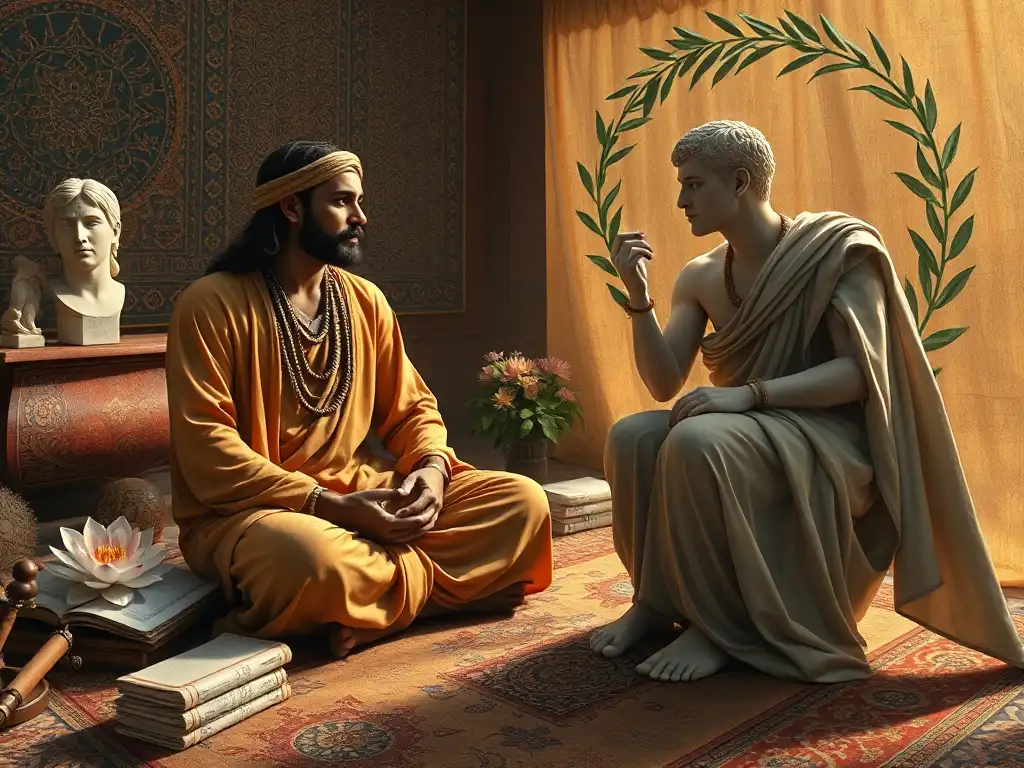
Major Schools of Indian Philosophy
Indian philosophy is characterized by a rich tapestry of thought, encompassing various schools that have evolved over millennia. Understanding these schools is crucial for grasping the essence of Indian philosophical inquiry and its parallels with Greek thought.
Vedanta
Vedanta, derived from the Vedas, emphasizes the nature of reality and the individual's relationship with the ultimate truth, Brahman. Central to Vedanta is the idea of non-duality (Advaita), most notably articulated by philosopher Adi Shankaracharya. He posited that the individual soul (Atman) is identical to Brahman, leading to profound implications for ethics and spirituality. This idea resonates with Greek philosophy's exploration of the nature of the soul, particularly in the works of Plato, who also sought to uncover the essence of existence and the divine.
Samkhya
Samkhya, one of the oldest philosophical systems, offers a dualistic framework distinguishing between Purusha (consciousness) and Prakriti (matter). This school presents a systematic enumeration of the principles of reality and is foundational for later developments in yoga and Buddhism. The analytical approach of Samkhya bears resemblance to the Greek philosophical tradition, especially in the works of Aristotle, who classified and categorized various elements of the natural world.
Buddhism
Buddhism, founded by Siddhartha Gautama (the Buddha), presents a unique philosophical perspective centered on the Four Noble Truths and the Eightfold Path. It emphasizes the impermanence of all things and the importance of mindfulness and ethical living. The Buddhist concept of anatta (non-self) contrasts sharply with the Greek notion of a permanent soul, yet both traditions grapple with the nature of existence and suffering, showcasing a profound engagement with similar existential questions.
Key Philosophical Ideas in Indian Thought
The core ideas in Indian philosophy are deeply intertwined with ethical and metaphysical questions that illuminate the human experience. These concepts have significant implications for understanding Indian thought in a broader philosophical context.
Dharma and Karma
Dharma, often translated as duty or righteousness, is a pivotal concept in Indian philosophy. It governs ethical conduct and social responsibilities across various contexts, influencing individual and collective behavior. Complementing dharma is karma, the law of cause and effect, which asserts that every action has consequences, shaping one’s future experiences. This intricate relationship between duty and consequences parallels Greek ethical theories, particularly those of Socrates and Aristotle, who emphasized virtue and moral responsibility as central to human flourishing.
Moksha and Enlightenment
Moksha, or liberation from the cycle of birth and rebirth (samsara), represents the ultimate goal of life in many Indian philosophical traditions. Achieving moksha involves transcending the material world and realizing one's true nature. This concept has parallels in Greek philosophy, especially in the teachings of Plato regarding the realm of Forms and the philosopher’s journey towards knowledge and truth. Both traditions explore the paths to ultimate fulfillment, whether through philosophical inquiry or spiritual practices, providing a rich ground for comparative analysis.
By examining the core philosophical concepts and major schools of Indian thought, we can appreciate the nuanced ways in which Indian and Greek philosophies intersect, revealing a shared quest for understanding the nature of existence and the human condition.
Core Philosophical Concepts in Greek Thought

Greek philosophy is characterized by its rigorous inquiry into the nature of existence, knowledge, and ethics. This intellectual tradition began around the 6th century BCE and laid the groundwork for Western philosophical thought. The core concepts of Greek philosophy revolve around the exploration of reality, the nature of the self, and the pursuit of knowledge through reason.
Major Schools of Greek Philosophy
The development of Greek philosophy can be categorized into several major schools, each contributing unique perspectives and methodologies.
Pre-Socratic Philosophers
The Pre-Socratic philosophers, who flourished before Socrates, focused primarily on cosmology and the fundamental nature of the universe. Thinkers like Thales, Anaximander, and Heraclitus sought to understand the origins of matter and the principles governing change and permanence.
- Thales proposed that water is the fundamental substance of all things.
- Heraclitus famously stated that "everything flows," emphasizing the constant flux of the universe.
- Anaximander introduced the concept of the apeiron (the boundless), suggesting that the universe originates from an indefinite substance.
These early thinkers laid the groundwork for subsequent philosophical inquiry by prioritizing rational explanations over mythological narratives.
Socratic Philosophy
Socratic philosophy, named after Socrates, marked a significant shift in philosophical thought. Socrates emphasized the importance of ethics and the examined life, often engaging in dialectical methods to stimulate critical thinking.
- Socratic Method: This technique involves asking probing questions to draw out knowledge and challenge assumptions, leading to greater clarity and understanding.
- Virtue as Knowledge: Socrates believed that virtue is inherently linked to knowledge; thus, if one knows what is good, one will act accordingly.
Socrates' influence on his students, particularly Plato, would shape the trajectory of Western philosophy.
Hellenistic Philosophy
Following the death of Alexander the Great, Hellenistic philosophy emerged, marked by an emphasis on practical ethics and the pursuit of happiness. Key schools during this period include Stoicism, Epicureanism, and Skepticism.
- Stoicism: Founded by Zeno of Citium, Stoicism taught that virtue, reason, and self-control are essential for achieving a good life, advocating for emotional resilience in the face of adversity.
- Epicureanism: In contrast, Epicurus emphasized the pursuit of pleasure (hedonism) as the highest good but advocated for moderation and intellectual pleasures over physical indulgence.
- Skepticism: This school questioned the possibility of certainty in knowledge, promoting a philosophy of inquiry and doubt.
These schools offered diverse approaches to understanding human existence and responding to the challenges of life.
Key Philosophical Ideas in Greek Thought
Greek philosophers contributed several foundational ideas that continue to influence philosophical discourse today.
Ethics and Virtue
Ethics was a central concern for Greek philosophers, particularly in the context of achieving eudaimonia, or the 'good life.'
- Aristotle's Nicomachean Ethics emphasizes the concept of virtue as a mean between extremes, advocating for a balanced approach to moral behavior.
- Plato’s Republic explores the nature of justice and the ideal state, arguing that a just society reflects the virtues of its rulers.
These discussions reveal a deep engagement with moral philosophy that resonates with contemporary ethical debates.
The Theory of Forms
One of Plato's most significant contributions is the Theory of Forms, which posits that non-material abstract forms (or ideas) represent the most accurate reality.
- Forms vs. Material Objects: According to Plato, material objects are mere shadows of these higher realities, and true knowledge comes from understanding the forms.
- Philosophical Implications: This idea raises questions about perception, knowledge, and the nature of existence, influencing later metaphysical discussions.
In exploring these concepts, Greek philosophy laid essential groundwork for various fields of study, including metaphysics, ethics, and epistemology, paralleling and sometimes intersecting with Indian philosophical traditions.
Comparative Analysis of Indian and Greek Philosophical Ideas
The philosophical landscapes of ancient India and Greece present a rich tapestry of thought that has significantly influenced subsequent civilizations. While both traditions emerged in parallel and addressed similar existential questions, their approaches often diverged in methodology, focus, and implications. This section delves into a comparative analysis of key philosophical ideas from both cultures, highlighting their unique contributions and intersections.
Ethics: Indian vs. Greek Perspectives
Ethics, the study of moral values and rules, forms a cornerstone of philosophical inquiry in both Indian and Greek traditions.
In Indian philosophy, ethical considerations are often intertwined with spiritual goals. The Dharma (moral duty) plays a pivotal role, where ethical actions are aligned with cosmic order and social responsibilities. The Bhagavad Gita, a key text, illustrates this through the dialogue between Arjuna and Krishna, emphasizing duty over personal desire. The concept of Ahimsa (non-violence) is also central, influencing various Indian philosophies, including Jainism and Buddhism.
Conversely, Greek ethics is characterized by the pursuit of virtue and the ideal of the good life. Philosophers like Socrates, Plato, and Aristotle focused on rationality and the development of personal virtues. For instance, Aristotle’s Nicomachean Ethics promotes the idea of achieving eudaimonia (flourishing) through the cultivation of virtues such as courage, temperance, and justice.
Key Differences:
- Focus on Duty vs. Virtue: Indian thought emphasizes duty and cosmic order, while Greek philosophy prioritizes individual virtue and rationality.
- Role of Spirituality: Indian ethics often includes spiritual dimensions, whereas Greek ethics tends to be more secular and rational.
Metaphysics: Understanding Reality in Both Traditions
Metaphysics, the inquiry into the nature of reality, provides a fascinating point of comparison between Indian and Greek philosophies.
In Indian metaphysics, concepts of Brahman (the ultimate reality) and Atman (the self) are foundational. Philosophies such as Advaita Vedanta assert that Atman is fundamentally one with Brahman, emphasizing a non-dualistic understanding of reality. This leads to a perception of the universe as an interconnected whole, where the individual self is ultimately an illusion (Maya).
In contrast, Greek metaphysics often involves a dualistic approach. Platonic thought posits a distinction between the world of forms (ideal, unchanging realities) and the material world (imperfect and transient). Aristotle, on the other hand, focused on substance and essence, exploring how things exist and their purpose (telos).
Key Differences:
- Non-Dualism vs. Dualism: Indian metaphysics emphasizes the unity of existence, while Greek thought often delineates between different levels of reality.
- Nature of Existence: Indian philosophy tends to view existence as an illusion, whereas Greek philosophy seeks to define and categorize the essence of beings.
Epistemology: Knowledge and Truth in Indian and Greek Thought
Epistemology, the study of knowledge and belief, reveals further insights into the philosophical frameworks of ancient India and Greece.
In Indian epistemology, there is a strong emphasis on direct experience and intuition as valid sources of knowledge. The Pramanas (means of knowledge) in Indian philosophy include perception, inference, and testimony, reflecting a holistic approach to understanding truth. For instance, Buddhist philosophy introduces concepts like Pratītyasamutpāda (dependent origination), emphasizing the interconnectedness of phenomena as a path to enlightenment.
On the other hand, Greek epistemology primarily values rational thought and logical deduction. Socratic questioning and the scientific method introduced by philosophers like Aristotle and later René Descartes focus on empirical evidence and reason as the basis for knowledge. The Athenian school of thought laid the groundwork for critical thinking and skepticism, fostering a culture that valued argumentation and discourse.
Key Differences:
- Sources of Knowledge: Indian philosophy recognizes a broader spectrum of knowledge acquisition, including intuitive and experiential elements, while Greek philosophy emphasizes reason and empirical evidence.
- Nature of Truth: Indian thought often views truth as a subjective, experiential realization, whereas Greek thought tends to treat truth as an objective reality discoverable through reason.
Conclusion

The comparative analysis of Indian and Greek philosophical ideas reveals both profound connections and striking differences. Understanding these distinctions enriches our appreciation of how diverse cultures approach fundamental questions of ethics, metaphysics, and epistemology, ultimately contributing to a more nuanced view of human thought and civilization.
Influence of Indian and Greek Philosophies on Each Other
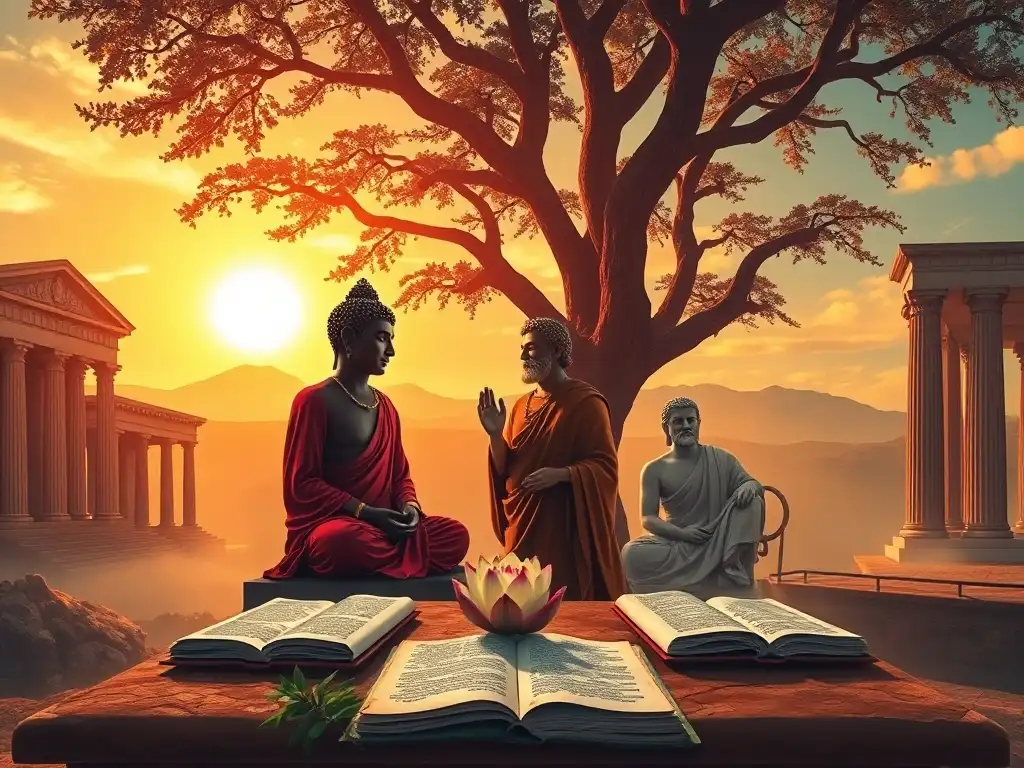
The intellectual traditions of ancient India and Greece, while emerging in distinct geographical and cultural contexts, shared a remarkable interplay that shaped their respective philosophies. This influence is evident in various areas, including ethics, metaphysics, and epistemology. The convergence of these two philosophical realms is not merely a historical curiosity but a profound testament to the shared human quest for knowledge and understanding of the universe.
Historical Evidence of Cross-Cultural Exchange
The intersection of Indian and Greek thought can be traced back to significant historical events, particularly during the conquests of Alexander the Great in the 4th century BCE. His campaigns into the Indian subcontinent facilitated a notable exchange of ideas.
- Trade Routes: The Silk Route and other trade pathways served as conduits for the movement of ideas, texts, and scholars between the two cultures. Notable exchanges occurred in regions like Taxila, where Indian and Greek scholars interacted.
- Diplomatic Missions: The Mauryan Empire, particularly under Ashoka, engaged in diplomatic relations with Hellenistic states. This period saw the translation and transposition of philosophical texts, including the works of Aristotle and the Upanishads.
- Syncretic Philosophies: Historical accounts suggest that philosophers such as Pyrrho of Elis, who traveled to India, were influenced by Indian thought, especially in areas pertaining to skepticism and ethics.
These evidence points reveal a dynamic and reciprocal relationship, where ideas flowed in both directions, enriching the philosophical traditions of both civilizations.
Key Philosophers Who Bridged Indian and Greek Thought
Several key philosophers acted as bridges between Indian and Greek thought, facilitating the exchange of ideas and concepts:
- Gautama Buddha (c. 563-483 BCE): His teachings on ethics and the nature of reality have shown parallels with Greek philosophical inquiries, particularly those of Socrates and Plato concerning the nature of existence and the pursuit of the good life.
- Adi Shankaracharya (c. 788-820 CE): Although he lived later, Shankaracharya's Advaita Vedanta philosophy resonates with certain aspects of Neoplatonism. His emphasis on the oneness of reality mirrors the Greek philosophical notion of the One.
- Plotinus (c. 204-270 CE): His work in Neoplatonism reflects a synthesis of ideas, particularly regarding the nature of the soul and the ultimate reality, which can be seen as influenced by Indian metaphysical concepts.
- Kālidāsa (c. 4th-5th century CE): While primarily a poet, his works reflect the philosophical undercurrents of his time, showcasing themes that resonate with Greek tragedies and philosophical discourses.
These philosophers exemplify how cross-cultural dialogues can enrich philosophical inquiry, leading to a more profound understanding of existence and morality.
Lasting Impact on Modern Philosophy
The philosophical discourse between Indian and Greek thinkers has left indelible marks on modern philosophical thought:
- Ethics and Morality: The dialogues on ethics from both traditions continue to influence contemporary debates on moral philosophy. Concepts such as dharma in Indian philosophy and virtue ethics in Greek thought provide frameworks for understanding right conduct.
- Metaphysics: The exploration of the nature of reality has been profoundly impacted by the synthesis of ideas from both traditions. Modern metaphysical discussions often draw upon the notions of idealism and realism found in both Greek and Indian philosophies.
- Epistemology: The inquiries into the nature of knowledge and belief, especially through the works of philosophers like Descartes and Kant, have roots that can be traced back to the dialogues initiated by Indian and Greek philosophers.
The philosophical parallels between Indian and Greek traditions showcase a rich tapestry of thought that transcends cultural boundaries, highlighting the universal quest for knowledge and understanding that continues to influence philosophical discourse today.
Conclusion: The Legacy of Indian Greek Philosophical Comparison

The philosophical exchanges between ancient India and Greece have left an indelible mark on the trajectory of human thought. This rich tapestry of ideas, emerging from two distinct yet complementary traditions, showcases the power of dialogue across cultures. By examining the parallels and divergences in their philosophical frameworks, we gain insights not only into the values and beliefs of these civilizations but also into the universal quest for knowledge and understanding.
Summary of Key Findings
Throughout the exploration of Indian and Greek philosophies, several key findings emerge:
- Concept of Reality: Both traditions grapple with the nature of reality. Indian philosophy often emphasizes the concept of Brahman, the ultimate reality, while Greek thought, particularly in the works of Plato, presents the world of Forms as the true essence behind the physical realm.
- Ethics and Morality: Ethical systems in both cultures reflect a deep concern for the nature of the good life. Indian philosophies like Dharma stress duty and righteousness, whereas Greek thinkers like Aristotle focus on virtue ethics and the pursuit of happiness ( Eudaimonia).
- The Role of Reason: Greek philosophy is characterized by a strong emphasis on reason and rationality, as seen in the works of philosophers such as Socrates and Aristotle. In contrast, Indian thought integrates reason with intuitive knowledge, as reflected in texts like the Upanishads.
- Metaphysics and Epistemology: Both traditions offer distinct perspectives on knowledge and existence. Indian philosophies present an intricate understanding of consciousness, often through the lens of Advaita Vedanta, while Greek philosophy, particularly in the works of Democritus and Epicurus, approaches knowledge through empirical observation and rational inquiry.
- Influence on Each Other: Historical interactions, particularly during the time of Alexander the Great and later through trade and cultural exchanges, facilitated the sharing of ideas. This cross-pollination enriched both Indian and Greek thought, leading to a more nuanced understanding of various philosophical concepts.
This synthesis of ideas not only highlights the profound connections between these civilizations but also emphasizes the importance of intercultural dialogue in shaping philosophical discourse.
The Relevance of Ancient Philosophical Dialogues Today
The philosophical dialogues between Indian and Greek thinkers continue to resonate in contemporary discussions.
- Interdisciplinary Approaches: Today’s scholars increasingly adopt interdisciplinary approaches, drawing from both Indian and Greek philosophies to address modern ethical dilemmas and metaphysical questions. This integration fosters a more holistic understanding of human experience.
- Global Philosophical Landscape: In a globalized world, understanding the philosophical foundations of diverse cultures is crucial. The Indian Greek philosophical comparison serves as a reminder of the shared intellectual heritage and the potential for collaboration across cultural boundaries.
- Personal Development: The teachings from both traditions encourage self-reflection, critical thinking, and an exploration of the self. This is particularly relevant in today’s context, where individuals seek meaning and purpose in a rapidly changing world.
- Sustainable Living: Concepts from Indian philosophy, such as Ahimsa (non-violence) and Samsara (the cycle of life), alongside Greek ideas of moderation and balance, can inform contemporary discussions on sustainability and ethical living.
The legacy of Indian Greek philosophical comparison not only enriches our understanding of ancient wisdom but also offers valuable lessons for navigating modern challenges. The continued relevance of these dialogues underscores the timeless nature of philosophical inquiry and the importance of fostering intercultural connections in our quest for knowledge.
Suggested Further Reading and Resources
Books on Indian Philosophy
-
"The Essence of Indian Philosophy" by Sarvepalli Radhakrishnan
This comprehensive work delves into the fundamental concepts of Indian thought, exploring the philosophical traditions that have shaped India's intellectual landscape. Radhakrishnan emphasizes the importance of spirituality and ethics in Indian philosophy.
-
"Indian Philosophy: A Very Short Introduction" by Sue Hamilton
An accessible overview of key philosophical ideas in Indian traditions, this book covers topics such as the Vedas, Upanishads, and various schools of thought, making it an excellent starting point for those new to Indian philosophy.
-
"The Upanishads" translated by Eknath Easwaran
This collection of ancient texts provides profound insights into the core tenets of Indian philosophy, including concepts of self, reality, and the ultimate purpose of life.
-
"The Philosophy of the Bhagavad Gita" by R. C. Zaehner
Zaehner analyzes the philosophical teachings of the Bhagavad Gita, focusing on its ethical and metaphysical dimensions. This work highlights the text's relevance to both Indian and global philosophical discussions.
Books on Greek Philosophy
-
"The Republic" by Plato
A foundational text in Western philosophy, Plato's "Republic" examines justice, the ideal state, and the philosopher-king. Its dialogues provoke profound questions about ethics and governance, making it essential reading for understanding Greek thought.
-
"Nicomachean Ethics" by Aristotle
In this seminal work, Aristotle explores the nature of happiness and virtue, outlining his ethical framework. This text remains influential in both Western and Eastern philosophical traditions.
-
"The Presocratics" by G. S. Kirk
This book introduces the early thinkers who laid the groundwork for later philosophical inquiry in ancient Greece. Kirk provides insights into their contributions and the historical context of their ideas.
-
"Greek Philosophy: A History of Philosophy Without Any Gaps, Volume 1" by Peter Adamson
Adamson offers a chronological examination of Greek philosophy, tracing its evolution from the pre-Socratics to the Hellenistic period. This book is ideal for readers seeking a comprehensive overview.
Comparative Philosophy Studies
-
"Philosophical Comparisons: Indian and Greek" by A. K. Ramanujan
This work provides an insightful analysis of the parallels and divergences between Indian and Greek philosophical traditions, focusing on themes such as ethics, metaphysics, and epistemology.
-
"Comparative Philosophy: A Short History of the Western and Indian Philosophies" by T. K. Venkatasubha Iyer
This book explores the philosophical dialogues between Indian and Greek thinkers, highlighting comparative perspectives that enhance our understanding of both traditions.
-
"The Indian and the Greek: Philosophical Parallels" by Michael W. Meister
Meister's study compares key philosophical concepts from Indian and Greek traditions, shedding light on their mutual influences and distinct methodologies.
-
"The Philosophical Heritage of India and the West: A Comparative Study" by M. S. K. Mohanty
This text emphasizes the rich philosophical exchanges between Indian and Greek schools of thought, proposing a framework for understanding their interconnected legacies.
By engaging with these resources, readers can deepen their understanding of Indian Greek philosophical comparison and appreciate the intricate tapestry of ideas that have emerged from these two profound intellectual traditions.
Frequently Asked Questions
What is the main focus of the article on Indian Greek philosophical comparison?
The article explores philosophical parallels between Indian and Greek thought, highlighting their similarities and differences in concepts such as ethics, metaphysics, and epistemology.
How did ancient Indian philosophy influence Greek thought?
Ancient Indian philosophy, particularly through texts like the Upanishads, introduced ideas on consciousness and reality, which may have influenced Greek philosophers such as Plato and Aristotle.
What are some key philosophical concepts compared in the article?
The article covers concepts like dharma (duty) in Indian philosophy and virtue in Greek thought, emphasizing how both cultures approached moral and ethical living.
Are there any notable philosophers from ancient India mentioned?
Yes, the article highlights influential figures such as Buddha and Adi Shankaracharya, whose thoughts contributed significantly to the development of Indian philosophy and its comparison to Greek ideas.
Why is the comparison between Indian and Greek philosophies important?
Understanding the Indian Greek philosophical comparison enriches our knowledge of global philosophy, showcasing how different cultures tackled universal questions about existence, knowledge, and morality.
Final Reflection: Bridging Wisdom Across Cultures
The exploration of Indian and Greek philosophical thought reveals profound connections that resonate in our contemporary world. As we navigate an era marked by cultural exchange and globalization, understanding these philosophical parallels not only enriches our intellectual landscape but also fosters a deeper appreciation for diverse worldviews. The insights gleaned from both traditions remind us that wisdom knows no boundaries, and the quest for truth is a universal endeavor.
Cross-cultural philosophical dialogues have the power to shape our understanding of ethics, existence, and the nature of reality. The enduring influence of these ancient traditions continues to permeate modern discourse, encouraging us to reflect on our own beliefs and values. As philosopher Jiddu Krishnamurti once said, The ability to observe without evaluating is the highest form of intelligence.
This observation underscores the importance of engaging with different perspectives, allowing us to cultivate a more nuanced understanding of our shared human experience.
As you reflect on the themes presented in this article, I invite you to embrace the richness of philosophical inquiry in your own life. Consider how the lessons from Indian and Greek thought can inform your personal journey and interactions with others. By fostering an openness to diverse ideas and engaging in meaningful dialogues, we can contribute to a more harmonious and enlightened world. Let us carry forward the legacy of these great thinkers, allowing their wisdom to inspire our actions and shape our understanding of the complexities of life.
Dive Deeper into the Wisdom of Ancient Thinkers!
Thank you for joining us on this journey through the philosophical parallels of Indian and Greek thought! By exploring these ancient perspectives, you've gained valuable insights into the foundations of human understanding and cultural interconnectedness. Now, let’s put that knowledge into action!
- Reflect on a philosopher you resonate with: Choose either an Indian or Greek thinker and write down two key principles that inspire you. Consider how you can integrate these principles into your daily life.
- Join the conversation: Share your thoughts in the comments below! What similarities and differences have you noticed between these philosophies?
- Explore further: Check out our recommended readings section to deepen your knowledge on this fascinating topic.
How has your understanding of these ancient philosophies influenced your perspective on modern issues?