
The Exchange of Ideas: Intellectual Trade in Ancient Indian Society


Welcome to Ancient India History, where we embark on a fascinating journey through the intricate tapestry of India's past! Discover how the intellectual trade in ancient India not only shaped societies but also forged connections that transcended borders and time. In our featured article, The Exchange of Ideas: Intellectual Trade in Ancient Indian Society, we delve into the vibrant exchanges of knowledge and culture that thrived from the Indus Valley to the Gupta Empire. Prepare to be captivated as you uncover the profound impacts of these interactions on civilization and beyond—your exploration begins now!

Introduction to Intellectual Trade in Ancient India
The concept of intellectual trade in ancient India encompasses the rich tapestry of ideas, philosophies, and knowledge that were exchanged among various civilizations throughout the subcontinent. Unlike material trade, which often focused on goods and commodities, intellectual trade facilitated the sharing of cultural practices, religious beliefs, and scientific advancements.
This exchange of ideas was not only pivotal in shaping ancient Indian society but also laid the groundwork for future developments in philosophy, mathematics, astronomy, and medicine. By examining the dynamics of intellectual trade, we can appreciate how ancient Indian civilizations fostered a vibrant intellectual environment that transcended geographical barriers and influenced neighboring cultures.
Defining Intellectual Trade and Its Importance
Intellectual trade can be understood as the transfer and exchange of ideas, customs, and knowledge among different societies. This process was vital for several reasons:
- Cultural Exchange: It allowed for the blending of diverse traditions, resulting in enriched cultural practices.
- Innovation and Progress: New ideas often led to advancements in various fields, including science, literature, and art.
- Diplomatic Relations: Intellectual exchanges often occurred alongside trade and diplomacy, strengthening ties between different regions and cultures.
By analyzing intellectual trade, we gain insights into how ancient Indian societies navigated their complexities and contributed to the global knowledge pool.
Overview of Ancient Indian Society and Culture
Ancient India was characterized by a complex social structure that included various kingdoms, communities, and philosophies. The society was marked by:
- Diverse Languages and Dialects: Multiple languages fostered a rich literary tradition, with texts ranging from the Vedas to classical poetry.
- Religious Pluralism: Hinduism, Buddhism, Jainism, and later Islam coexisted, allowing for a dynamic exchange of spiritual and ethical ideas.
- Centers of Learning: Institutions like Nalanda and Takshashila became hubs for intellectual discussions, attracting scholars from across the world.
This mosaic of cultural practices and beliefs provided a fertile ground for the flourishing of intellectual trade.
Historical Context of Intellectual Trade in Ancient India
Key Periods Influencing Intellectual Exchange
Several key periods played a significant role in shaping the landscape of intellectual trade in ancient India:
- Indus Valley Civilization (c. 3300–1300 BCE): Early urban centers like Harappa and Mohenjo-Daro exhibited advanced knowledge in architecture and urban planning.
- Vedic Period (c. 1500–500 BCE): The emergence of religious texts laid the foundation for philosophical discourse and the establishment of societal norms.
- Maurya and Gupta Empires (c. 322 BCE–550 CE): These empires were marked by significant advancements in science, mathematics, and philosophy, facilitated by a robust network of scholars.
Each of these periods contributed unique elements to the intellectual exchange that characterized ancient Indian society.
Major Civilizations Contributing to Intellectual Trade
The contributions to intellectual trade in ancient India were not limited to a single civilization but were rather a collective effort from various groups:
- Indo-Aryans: Their texts and ideas significantly influenced religious and philosophical thought.
- Buddhists: The spread of Buddhism promoted dialogues on ethics and philosophy across Asia.
- Jains: Their emphasis on ahimsa (non-violence) and truth significantly impacted ethical discussions.
- Guptas: Often referred to as the "Golden Age" of India, this period saw remarkable advancements in mathematics and astronomy, largely due to the intellectual trade fostered by extensive trade networks.
By exploring these civilizations, we can appreciate the multifaceted nature of intellectual trade in ancient India and its enduring legacy in world history.
Mechanisms of Intellectual Trade in Ancient India
In ancient India, intellectual trade was facilitated through a variety of mechanisms that allowed for the exchange of ideas, philosophies, and knowledge across different regions and cultures. One prominent mechanism was the establishment of centers of learning, which served as hubs for scholars, students, and thinkers. These institutions, such as Nalanda and Takshashila, attracted individuals from across the subcontinent and beyond, fostering an environment of discourse and debate.
Another significant mechanism was the patronage of rulers and wealthy merchants who sponsored scholars and intellectual pursuits. This financial support enabled scholars to travel, engage in discussions, and disseminate their findings widely. Trade routes not only facilitated the exchange of goods but also provided pathways for the movement of ideas. Merchants and travelers often acted as conduits for the transfer of knowledge between different cultures, leading to a rich tapestry of intellectual exchange.
The oral tradition played a critical role as well, with stories, teachings, and philosophies being passed down through generations. This method ensured that ideas remained dynamic and adaptable, allowing them to evolve as they were shared. The written word also gained prominence, particularly with the advent of scripts like Brahmi and Kharosthi, which enabled scholars to document and disseminate their ideas more widely.
Centers of Learning and Knowledge Sharing
The centers of learning in ancient India were pivotal to the intellectual trade of ideas. Institutions like Nalanda University, established in the 5th century CE, became renowned for their comprehensive curriculum that included subjects such as mathematics, astronomy, medicine, and philosophy. Nalanda attracted scholars from as far away as China, Korea, and Tibet, creating a melting pot of ideas and cultures.
Similarly, Takshashila, which dates back to at least the 6th century BCE, is considered one of the earliest centers of higher education in the world. It was here that students not only studied various disciplines but also engaged in discussions and debates that challenged existing ideas and fostered innovation. The vibrant atmosphere at these institutions encouraged an exchange of knowledge across different religious and philosophical schools, contributing significantly to the intellectual landscape of ancient India.
The presence of monastic communities also facilitated knowledge sharing. Monasteries often served as repositories of texts, where scholars would gather to study, translate, and interpret works from other cultures, thus enriching their own intellectual traditions. This collaborative environment was essential for the propagation of ideas, especially in fields like Buddhism and Jainism, which emphasized dialogue and inquiry.
Role of Scholars and Thinkers in Trade of Ideas
Scholars and thinkers played a crucial role in the intellectual trade in ancient India by acting as both transmitters and innovators of knowledge. Renowned figures like Aryabhata, who made significant contributions to mathematics and astronomy, and Chanakya, known for his insights into governance and economics, exemplified the impact of individual thinkers on the broader intellectual landscape.
These scholars often traveled extensively, sharing their insights with diverse audiences. For instance, Buddhist monks traveled along trade routes to spread Buddhist philosophy, engaging with local cultures and integrating their ideas into existing frameworks. This not only facilitated the exchange of religious and philosophical concepts but also contributed to a broader understanding of ethics, morality, and social organization.
Moreover, the intellectual networks established by these thinkers were instrumental in the cross-pollination of ideas. They often collaborated with one another, debating and refining concepts that would later influence various fields, from science to literature. The writings and teachings of these scholars were critical in shaping educational practices and intellectual discourse in ancient India.
Key Elements of Intellectual Trade in Ancient Indian Society
Contributions of Religion and Philosophy
Religion and philosophy were central to the intellectual trade in ancient India, serving as both the foundation and the driving force behind the exchange of ideas. The rich philosophical traditions, particularly those arising from Hinduism, Buddhism, and Jainism, encouraged a culture of inquiry and discourse. Philosophers like Adi Shankaracharya and Gautama Buddha not only developed profound metaphysical ideas but also engaged with competing schools of thought, fostering a vibrant intellectual atmosphere.
Religious texts, such as the Vedas, Upanishads, and Bhagavad Gita, provided a framework for understanding the cosmos, ethics, and the human condition. These texts were often subjects of commentary and debate, leading to diverse interpretations and new schools of thought. The Buddhist emphasis on logic and debate further enriched the intellectual landscape, as monks would engage in rigorous discussions to clarify and defend their views.
Additionally, the spread of religious philosophies often coincided with trade routes, facilitating cross-cultural exchanges. For example, the transmission of Buddhism to Central Asia and China was facilitated by merchants who carried not only goods but also ideas, further illustrating the interconnectedness of trade and intellectual exchange.
Language and Literature as Tools of Intellectual Trade
Language and literature acted as vital tools for intellectual trade in ancient India, enabling the communication and preservation of ideas. The emergence of languages such as Sanskrit and Pali played a significant role in the development of a rich literary tradition. Sanskrit, in particular, became the lingua franca of scholarship, allowing for the dissemination of complex philosophical and scientific concepts across regions.
The vast corpus of literature produced during this period, including epics like the Mahabharata and Ramayana, as well as dramas and poetry, contributed to the cultural and intellectual milieu. These texts not only entertained but also provoked thought, inspiring readers and thinkers to explore new ideas and perspectives. The use of allegory and metaphor in literature allowed for the exploration of profound truths in an accessible manner, promoting the exchange of ideas among diverse audiences.
Moreover, the development of commentaries on earlier texts facilitated deeper engagement with the material and encouraged further discussion and debate. Scholars would write extensive commentaries on the Vedas and Upanishads, interpreting and expanding upon traditional ideas. This practice not only preserved ancient knowledge but also ensured its relevance in contemporary discourse.
The interplay between language, literature, and intellectual trade in ancient India created a dynamic environment where ideas could flourish and evolve, contributing to a legacy that continues to influence various fields of study today.
Case Studies of Intellectual Trade in Ancient India
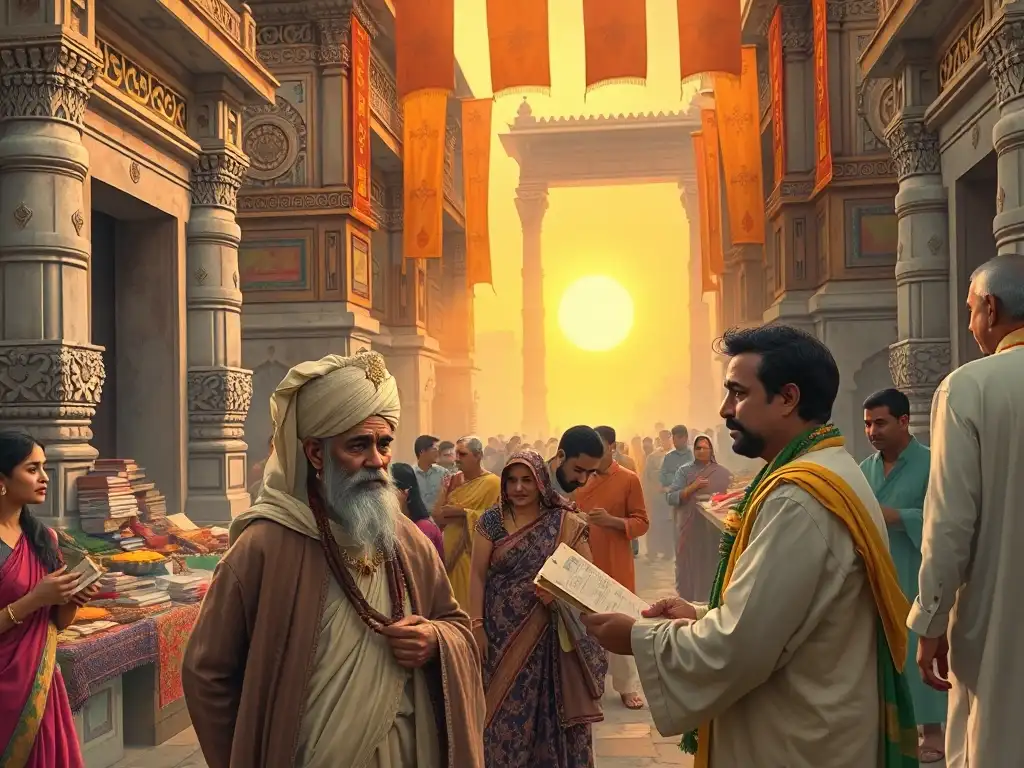
The concept of intellectual trade in ancient India can be illustrated through several notable case studies that highlight the dynamic exchange of ideas across various disciplines. One prominent example is the Nalanda University, which was a pivotal center for learning in the ancient world. Established in the 5th century CE, it attracted scholars from various regions, including China, Korea, Japan, Tibet, Mongolia, and Southeast Asia. Here, students engaged in discourses on philosophy, medicine, astronomy, and mathematics, contributing significantly to the intellectual fabric of the time.
Another significant case study is the Gurukula system, where knowledge was transmitted orally from teacher to student. The Gurukulas were not just places of education but also hubs of cultural exchange. Students from different backgrounds shared their perspectives, enriching the intellectual dialogue and fostering innovation in fields such as linguistics and metaphysics.
The Silk Road, while primarily known for its trade in goods, also served as a conduit for the exchange of ideas. Ancient Indian scholars interacted with Persian, Greek, and later Arab intellectuals, creating a vibrant tapestry of knowledge that influenced philosophy, science, and mathematics across civilizations.
Examples of Notable Scholars and Their Contributions
Several scholars from ancient India exemplify the richness of intellectual trade. Aryabhata, who lived in the 5th century CE, made groundbreaking contributions to mathematics and astronomy. His work, Aryabhatiya, introduced concepts such as the zero and the decimal system, which were later adopted globally.
Charaka, the father of Ayurveda, compiled the Charaka Samhita, an influential text on medicine that included knowledge from various cultures, showcasing the synthesis of ideas that defined intellectual trade. His work laid the foundation for medical practices that are still relevant today.
Brahmagupta, a 7th-century mathematician and astronomer, expanded on Aryabhata’s work and contributed significantly to algebra and geometric principles. His treatise, Brahmasphutasiddhanta, not only addressed mathematical problems but also included astronomical observations that reflected a blend of indigenous and foreign knowledge.
Interaction with Other Cultures and Its Impact
The intellectual trade in ancient India was profoundly shaped by interactions with neighboring cultures. The arrival of Buddhism in China, facilitated by Indian monks, exemplifies this cultural exchange. The teachings of Buddhism, adapted and integrated into Chinese philosophy, sparked a renaissance of thought and spirituality in East Asia.
Moreover, the Mauryan Empire's expansion into regions like the Hellenistic world allowed for the exchange of philosophical ideas and artistic styles. The interaction between Indian and Greek thought led to the development of new philosophical frameworks, particularly evident in the synthesis of Stoicism with Indian ethical concepts.
The influence of Islamic scholars during the medieval period also played a crucial role in the intellectual exchange. The translations of ancient Indian texts into Arabic and Persian fostered a resurgence of interest in Indian mathematics and astronomy, which later impacted the European Renaissance.
Challenges to Intellectual Trade in Ancient India
Despite the flourishing intellectual trade, ancient India faced several challenges that impeded the free exchange of ideas. These challenges were closely linked to social and political dynamics, which often influenced the flow of knowledge.
Social and Political Factors Influencing Intellectual Exchange
Social stratification and caste systems in ancient India created barriers to access and participation in intellectual discourse. Knowledge was often confined to specific social groups, limiting the diversity of perspectives that could contribute to the intellectual landscape. The caste system, while providing stability in some respects, often restricted the mobility of scholars and the dissemination of ideas.
Politically, the fragmentation of power among various kingdoms and empires often led to regionalism, which could hinder broader intellectual exchange. For example, during periods of conflict, such as the rise of the Gupta Empire, scholars might have found it difficult to travel or engage with their peers in other regions, stifling the flow of ideas.
Decline of Intellectual Trade During Certain Periods
The decline of intellectual trade in ancient India can be traced to specific historical periods marked by invasions and socio-political upheaval. The invasions by the Huns in the 5th century CE disrupted established centers of learning, such as Nalanda and Takshashila, leading to a decline in scholarly activities.
Additionally, the arrival of foreign rulers, particularly during the medieval period, often led to the suppression of local knowledge systems. The focus shifted to administrative efficiency rather than intellectual pursuits, resulting in a stagnation of scholarly activity.
By the later part of the medieval period, as regional powers consolidated, the focus on local governance and military expansion further sidelined intellectual trade. It was not until the colonial era that interest in ancient Indian knowledge systems began to resurface, prompting a reevaluation of their contributions to global intellectual heritage.
Conclusion: Legacy of Intellectual Trade in Ancient India
The intellectual trade in ancient India was not merely an exchange of ideas; it was a profound engagement that shaped the cultural and philosophical landscape of the region. This intellectual exchange fostered an environment ripe for innovation and creativity, leading to significant advancements in various fields such as mathematics, astronomy, medicine, and philosophy. The collaborative spirit among scholars, philosophers, and scientists from diverse backgrounds laid the groundwork for a rich tradition of intellectual discourse that transcended regional and linguistic barriers.
The legacy of this intellectual trade is evident in the texts, teachings, and practices that continue to influence modern society. From the mathematical concepts developed by ancient Indian mathematicians to the philosophical inquiries of figures like Gautama Buddha and Adi Shankaracharya, the contributions of ancient Indian scholars remain a crucial part of the global intellectual heritage. These exchanges not only enriched local cultures but also established India as a center for learning in the ancient world.
Lasting Impact on Modern Indian Society
The impact of intellectual trade in ancient India is still felt in contemporary society. Many principles and practices rooted in ancient Indian thought continue to guide modern education, philosophy, and scientific inquiry. For instance:
- Educational Institutions: The establishment of ancient centers of learning, such as Nalanda and Takshashila, set a precedent for modern educational institutions in India. These centers emphasized critical thinking and interdisciplinary study, principles that are still relevant today.
- Cultural Identity: The philosophical discourses that emerged from intellectual exchanges have shaped India's cultural identity. Concepts like non-violence and dharma continue to influence social movements and ethical frameworks in modern India.
- Scientific Contributions: Ancient Indian contributions to fields such as mathematics (e.g., the concept of zero) and medicine (e.g., Ayurveda) have laid the foundation for further advancements and innovations that are integral to today's scientific advancements.
Overall, the intellectual trade in ancient India has created a legacy that informs various aspects of modern Indian society, promoting a continuous dialogue between the past and the present.
The Importance of Preserving Intellectual Heritage
Preserving the intellectual heritage of ancient India is crucial for several reasons. First, it allows future generations to understand and appreciate the rich tapestry of ideas that have shaped human thought. By studying these ancient texts and philosophies, individuals can gain insights into the values and beliefs that have influenced modern societies.
Moreover, the preservation of intellectual heritage fosters a sense of identity and continuity. In a world that is increasingly globalized, reconnecting with ancient wisdom can provide grounding and context for contemporary challenges. The moral and ethical frameworks derived from ancient Indian philosophies can offer guidance in addressing modern dilemmas.
Efforts to document, translate, and disseminate ancient texts and knowledge are essential for ensuring that this intellectual heritage is not lost. Institutions, scholars, and enthusiasts play a vital role in this endeavor, working to make ancient ideas accessible and relevant to contemporary audiences.
References and Further Reading on Intellectual Trade in Ancient India
- Rhodes, C. (2015). The Global Influence of Indian Mathematics: A Historical Perspective.
- Khan, A. (2018). Ancient Indian Science and Technology: Contributions and Influence on Modern Practices.
- Chakrabarti, D. (2019). The Intellectual Traditions of Ancient India: A Comprehensive Study.
- Mishra, R. (2020). Philosophy and Culture in Ancient India: The Exchange of Ideas.
- Bose, S. (2021). The Role of Trade in the Development of Ancient Indian Thought.
These references provide a deeper understanding of the themes discussed in this article and serve as a gateway for further exploration of the intellectual trade in ancient India.
- Introduction to Intellectual Trade in Ancient India
- Historical Context of Intellectual Trade in Ancient India
- Mechanisms of Intellectual Trade in Ancient India
- Key Elements of Intellectual Trade in Ancient Indian Society
- Case Studies of Intellectual Trade in Ancient India
- Challenges to Intellectual Trade in Ancient India
- Conclusion: Legacy of Intellectual Trade in Ancient India
- References and Further Reading on Intellectual Trade in Ancient India
- What was the significance of intellectual trade in ancient India?
- How did the Indus Valley Civilization contribute to intellectual trade?
- What role did trade routes play in the exchange of ideas?
- How did the Gupta Empire influence intellectual pursuits?
- What were some prominent intellectual figures in ancient India?
Frequently Asked Questions
What was the significance of intellectual trade in ancient India?
Intellectual trade in ancient India was crucial for the exchange of ideas, knowledge, and culture among various civilizations, fostering advancements in science, philosophy, and the arts.
How did the Indus Valley Civilization contribute to intellectual trade?
The Indus Valley Civilization laid the foundation for urban planning and writing systems, which facilitated the exchange of knowledge that later influenced subsequent Indian societies.
What role did trade routes play in the exchange of ideas?
Trade routes connected ancient India with other cultures, allowing for the flow of ideas and technologies across regions, enriching the intellectual landscape of Indian society.
How did the Gupta Empire influence intellectual pursuits?
The Gupta Empire is often regarded as a golden age for intellectual trade, promoting advancements in mathematics, astronomy, and literature, which were shared widely through scholarly exchanges.
What were some prominent intellectual figures in ancient India?
Prominent figures, such as Aryabhata in mathematics and Kalidasa in literature, exemplified the rich intellectual tradition of ancient India, contributing significantly to the broader scope of intellectual trade.
Final Reflection: The Enduring Legacy of Intellectual Trade in Ancient India
The exchange of ideas has always been a cornerstone of human progress, and the concept of intellectual trade in ancient India exemplifies this truth. In a time when geographical boundaries often limited interaction, the vibrant intellectual exchanges that took place in ancient Indian society laid the groundwork for advancements in philosophy, science, and the arts. Today, as we navigate a globalized world, the lessons from this rich history remind us of the power of collaboration and the importance of sharing knowledge across cultures.
The impact of intellectual trade in ancient India continues to resonate in our modern cultural and social landscapes. The philosophies and scientific principles developed during this era have influenced countless generations, shaping not only Indian society but also the world at large. As we reflect on this legacy, we are reminded of the words of Mahatma Gandhi: Live as if you were to die tomorrow. Learn as if you were to live forever.
This sentiment captures the essence of intellectual trade—the idea that the pursuit of knowledge is a lifelong journey that thrives on the exchange of ideas.
As we conclude our exploration of this fascinating topic, I invite you to reflect on your own engagement with the exchange of ideas in your life. Consider how you can foster a culture of intellectual trade in your community, whether through open discussions, collaborative projects, or simply by being receptive to new perspectives. Embrace the spirit of curiosity and connection that characterized ancient Indian society, and let it inspire you to contribute to a world where ideas flow freely and knowledge knows no boundaries.
Unleash Your Curiosity: Dive Deeper into Ancient Knowledge!
Thank you for joining us on this journey through the vibrant tapestry of intellectual trade in ancient Indian society! We hope you found inspiration in the rich exchange of ideas that shaped cultures and philosophies. Now, let’s turn that inspiration into action!
Here are some engaging ways to expand your exploration:
- Delve into further readings on ancient texts and philosophers; consider starting with the Upanishads or the works of renowned mathematicians and astronomers like Aryabhata.
- Join a local or online discussion group focused on ancient history to share insights and learn from others who are equally passionate.
- Share this article with friends or on social media to spark conversations about the significance of ideas and intellectual exchange in our contemporary world.
What ideas from ancient Indian society resonate with you the most, and how do you perceive their influence in today's world?