
The Dialogue of Vaisheshika with Western Philosophical Traditions


Welcome to Ancient India History, where we embark on a fascinating journey through the rich tapestry of ancient Indian civilizations! In our exploration today, we delve into the intriguing intersection of Vaisheshika and Western philosophy, uncovering the profound dialogues that shaped thought across continents. What connections can be drawn between these ancient traditions? How did the nuanced ideas of Vaisheshika resonate with Western philosophical perspectives? Prepare to be captivated as we unravel these mysteries and invite you to discover the remarkable contributions of India to the world of philosophy. Dive in and let the adventure begin!
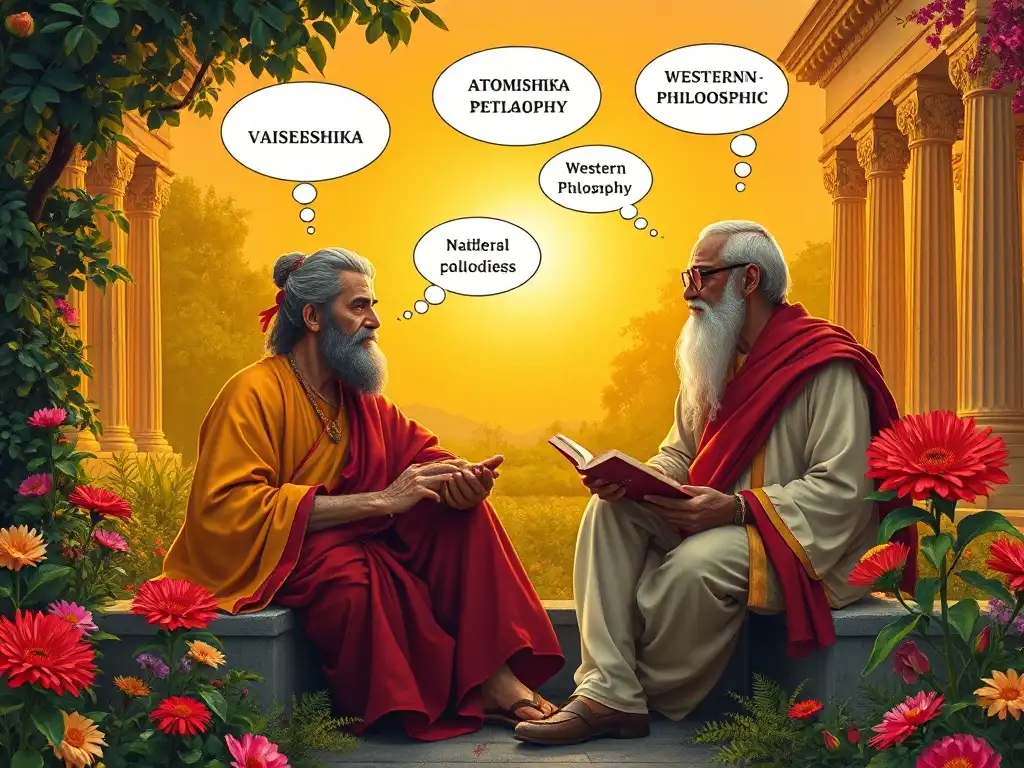
The exploration of philosophical traditions is not merely an academic endeavor; it serves as a bridge connecting diverse cultures and intellectual legacies. In this context, the Vaisheshika philosophy, a significant school of thought in ancient Indian philosophy, presents intriguing parallels and contrasts with Western philosophical traditions.
This article delves into the intricate dialogue between Vaisheshika and Western philosophy, illuminating the ways in which these two philosophical frameworks intersect, diverge, and enrich our understanding of existence, knowledge, and reality. By examining the fundamental tenets of Vaisheshika, its historical context, and its interactions with Western thought, we aim to highlight the enduring relevance of this ancient Indian philosophy in contemporary philosophical discourse.
Introduction to Vaisheshika Philosophy
Overview of the Vaisheshika School of Thought
Vaisheshika, founded by the sage Kanada in the 2nd century BCE, is one of the six orthodox systems of Indian philosophy (Darshanas). This school primarily emphasizes the classification of reality and the nature of objects. It posits that the universe is composed of dravyas (substances), gunas (qualities), karmas (actions), samanya (universals), vishesha (particulars), and abhava (negation). The Vaisheshika system meticulously categorizes these elements, offering a sophisticated framework for understanding both the material and immaterial aspects of existence.
Key Philosophical Concepts in Vaisheshika
The core concepts of Vaisheshika philosophy are central to its dialogue with Western philosophical traditions:
- Atomism: Vaisheshika posits that all objects in the universe are composed of indivisible atoms ( paramanu), a notion that resonates with certain strands of Western atomistic philosophy.
- Categorization: The detailed classification of substances and their attributes allows for a nuanced understanding of reality, paralleling Aristotelian categorizations.
- Epistemology: Vaisheshika emphasizes the means of knowledge ( pramanas), including perception, inference, and testimony, which invites comparison with Western epistemological theories.
Importance of Vaisheshika in Ancient Indian Philosophy
Vaisheshika holds a crucial position in the landscape of ancient Indian philosophy. Its systematic approach to categorizing reality and its emphasis on empirical observation contribute significantly to the broader philosophical discourse. This school not only influences other Indian philosophical traditions, such as Nyaya, but also engages with metaphysical inquiries that echo in Western thought. Its contributions to the understanding of nature, ethics, and epistemology are foundational, making it an essential area of study for anyone interested in the evolution of philosophical ideas.
Historical Context of Vaisheshika
The Origins of Vaisheshika Philosophy
The origins of Vaisheshika can be traced back to Kanada, whose writings laid the groundwork for this philosophical school. The Vaisheshika Sutras, a collection of aphorisms, encapsulate its core teachings and methodologies. The historical context of its emergence is significant, as it coincides with a period of profound intellectual activity in ancient India, characterized by the flourishing of various philosophical and scientific inquiries.
Influences on Vaisheshika from Earlier Indian Thought
Vaisheshika did not arise in isolation; it drew upon earlier Indian thought, particularly the Samkhya and Yoga schools. The interplay of these philosophies is evident in the Vaisheshika's discussions on the nature of reality and consciousness. Moreover, the influence of Vedic texts and Upanishadic philosophy on its metaphysical framework cannot be overlooked, as they provided essential philosophical foundations that shaped its development.
Development of Vaisheshika Through the Ages
Over the centuries, Vaisheshika evolved in response to changing philosophical landscapes and external influences. Notable philosophers like Gangesha Upadhyaya and Raghunatha Siromani contributed to the reinterpretation and expansion of Vaisheshika ideas. This evolution reflects a dynamic engagement with both Indian and Western philosophical traditions, enabling Vaisheshika to remain relevant in contemporary philosophical discussions. The dialogue between Vaisheshika and Western philosophy continues to inspire scholars today, fostering a richer understanding of the complexities of existence and knowledge across cultures.
Key Figures in Vaisheshika Philosophy
The Vaisheshika school of thought, one of the six orthodox schools of Indian philosophy, boasts a rich lineage of thinkers who have significantly contributed to its development. Central to its evolution are its founders and scholars whose ideas not only shaped the internal discourse of Vaisheshika but also engaged with other philosophical traditions, including those from the West.
Kanada: The Founder of Vaisheshika
Kanada, also known as Kashyapa, is revered as the founder of the Vaisheshika school around the 2nd century BCE. His seminal work, the Vaisheshika Sutras, lays the framework for this philosophical system, focusing on the nature of reality and the categorization of existence. Kanada posited that the universe is composed of atoms (anu) and that these atoms combine to form all material objects. His ideas about the impermanence of matter and the permanence of the soul introduced a dualistic perspective that influenced subsequent philosophical discussions.
Kanada's methodology emphasized empirical observation and logical reasoning, which were groundbreaking at the time. He introduced the concept of dravyas (substances) and categorized them into nine types, including earth, water, fire, air, and ether, alongside the categories of quality, action, and relation. Through his work, Kanada laid the groundwork for a systematic and analytical approach to philosophical inquiry.
Notable Vaisheshika Scholars and Their Contributions
Following Kanada, several scholars expanded and interpreted his ideas, enriching the Vaisheshika tradition. Notable figures include:
- Udayana: A 10th-century philosopher, Udayana integrated Vaisheshika with Nyaya (the school of logic), arguing for the existence of God as a necessary cause for the creation of the universe. His works, such as the Kiraṇāvalī, reflect this synthesis and engage with the arguments of rival schools.
- Prashastapada: Active in the 7th century, Prashastapada wrote the Brahma Sutra commentary and introduced vital concepts such as sambandha (relationship) and adhikara (topic of discussion), which are crucial for understanding the interrelations of the categories defined by Kanada.
- Jayanta Bhatta: A prominent scholar in the 9th century, Jayanta furthered the dialogue between Vaisheshika and other philosophical traditions, particularly Buddhism and Advaita Vedanta. His work highlighted the epistemological aspects of Vaisheshika, discussing perception and inference as valid means of knowledge.
These scholars not only preserved the teachings of Kanada but also innovated upon them, fostering a rich dialogue that ensured the survival and relevance of Vaisheshika thought through centuries.
Introduction to Western Philosophical Traditions
The exploration of Western philosophical traditions encompasses a vast array of schools of thought, each contributing to a rich tapestry of ideas that challenge, complement, and contrast with Eastern philosophies like Vaisheshika. Understanding these traditions is essential for appreciating the broader philosophical discourse and the interactions between the East and West.
Overview of Major Western Philosophical Movements
Western philosophy can be broadly categorized into several key movements:
- Ancient Philosophy: This includes the works of Socrates, Plato, and Aristotle, focusing on metaphysics, ethics, and epistemology. The Socratic method of inquiry laid the groundwork for critical thinking.
- Medieval Philosophy: Characterized by the integration of religious thought with philosophical inquiry, figures like Augustine and Aquinas explored the nature of God, existence, and morality.
- Modern Philosophy: Beginning in the 17th century, philosophers such as Descartes, Kant, and Hegel examined the nature of reality, knowledge, and the self, emphasizing reason and individualism.
- Contemporary Philosophy: This movement includes existentialism, phenomenology, and analytic philosophy, addressing the complexities of human experience and language.
These movements reflect the evolution of philosophical thought in the West, with each period contributing unique insights and frameworks that resonate with or diverge from the ideas of Vaisheshika.
Key Philosophers in Western Thought
Several key philosophers have significantly influenced Western thought, their ideas often intersecting with or diverging from those found in Vaisheshika philosophy:
- Socrates: Known for the Socratic method, he emphasized ethical inquiry and the importance of self-knowledge.
- Plato: His theory of Forms posited the existence of abstract entities, which contrasts with the Vaisheshika focus on material substances.
- Aristotle: His classification of substances and causes parallels the Vaisheshika categorization, albeit with different foundational assumptions about reality.
- Immanuel Kant: By introducing the concept of the categorical imperative, Kant's moral philosophy presents a significant ethical framework that engages with the Vaisheshika view on ethics and actions.
These philosophers not only shaped Western philosophical discourse but also provide a fertile ground for comparison with Vaisheshika thought, particularly in areas like metaphysics, epistemology, and ethics.
Comparative Timeline: Vaisheshika and Western Philosophy
| Era | Vaisheshika Philosophy | Western Philosophy |
|---|---|---|
| 2nd Century BCE | Kanada establishes the Vaisheshika Sutras | Early Greek philosophy begins with Socrates |
| 7th Century CE | Prashastapada expands on Kanada's ideas | Rise of Medieval philosophy with Augustine and Aquinas |
| 10th Century CE | Udayana integrates Vaisheshika with Nyaya | Development of Scholasticism, blending faith and reason |
| 17th - 19th Century CE | Scholars continue to interpret and apply Vaisheshika | Modern philosophy emerges with Descartes, Kant, and Hegel |
| 20th Century CE | Contemporary discussions revive interest in Vaisheshika | The rise of existentialism and analytic philosophy |
This comparative timeline highlights both the chronological development of Vaisheshika and its Western counterparts, illustrating the unique trajectories of each tradition while also showcasing opportunities for dialogue and mutual enrichment. Understanding these parallels and divergences deepens our appreciation of the philosophical landscape and the ongoing relevance of these ancient ideas in contemporary discussions.
Points of Convergence: Vaisheshika and Western Philosophy

The Vaisheshika school of thought, one of the six classical systems of Indian philosophy, shares several points of convergence with Western philosophical traditions. This interaction between diverse philosophical backgrounds enriches the understanding of fundamental concepts such as metaphysics, epistemology, and ethics. By exploring these similarities, we can appreciate how different cultures approach philosophical inquiries and the universal quest for knowledge and truth.
Similarities in Metaphysical Concepts
Both Vaisheshika and various Western philosophical traditions, particularly those emerging from the ancient Greeks, engage deeply with metaphysical concepts. The Vaisheshika school posits that the universe is composed of distinct substances, categorized into categories (padarthas) such as substance, quality, action, generality, particularity, and inherence. This idea resonates with Aristotle’s substance theory, where he classifies entities into primary substances and secondary substances.
Moreover, the notion of atomism in Vaisheshika, introduced by Kanada, parallels the views of Democritus and later, Epicurus, who proposed that all matter is composed of indivisible particles called atoms. Both schools of thought grapple with the nature of reality and the fundamental components that constitute the physical world, highlighting a shared interest in understanding the essence of existence.
Comparative Analysis of Epistemological Views
In terms of epistemology, both Vaisheshika and Western philosophies emphasize the importance of knowledge acquisition. The Vaisheshika school recognizes multiple sources of knowledge, including perception (pratyaksha), inference (anumana), and testimony (shabda). This multi-faceted approach finds a counterpart in the works of philosophers such as John Locke and David Hume, who also discuss the roles of experience and reason in the formation of knowledge.
Moreover, Vaisheshika's emphasis on inference, particularly in the context of logical reasoning, mirrors the Aristotelian syllogism and the emphasis on deductive reasoning in Western thought. Both traditions seek to establish a robust framework for validating knowledge, underscoring a fundamental philosophical pursuit to understand how we come to know what we know.
Ethical Perspectives in Vaisheshika and Western Traditions
Ethically, the Vaisheshika school, while primarily focused on metaphysics and epistemology, does touch upon the implications of ethical behavior stemming from its philosophical inquiries. The emphasis on dharma (righteousness) and the pursuit of moksha (liberation) reflects a moral dimension similar to Western ethical theories, such as those proposed by Kant and Mill, which emphasize duty and the consequences of actions, respectively.
Both traditions encourage individuals to act in accordance with a moral framework that promotes well-being, although the specifics of these ethical systems may differ. The recognition of ethical considerations in the pursuit of knowledge and understanding is a common thread that intertwines these philosophical pathways.
Points of Divergence: Vaisheshika vs. Western Philosophical Traditions
Despite the notable points of convergence, significant divergences also exist between Vaisheshika and Western philosophical traditions, particularly in ontology, epistemology, and ethics. Understanding these differences provides a clearer picture of each school’s unique contributions to philosophy and their respective cultural contexts.
Differences in Ontology and Substance Theory
One of the primary differences lies in ontology and substance theory. Vaisheshika posits a pluralistic ontology, categorizing existence into various types of substances and their attributes. This includes physical substances, qualities, and actions, each with its own characteristics and interactions. In contrast, many Western philosophies, particularly those influenced by Descartes, often emphasize a dualistic approach that separates mind and matter, leading to a more binary understanding of existence.
Moreover, the Vaisheshika view of substances as composed of atomic particles introduces a more dynamic process of change and interaction, while Western ontology often leans towards static classifications. This fundamental difference shapes how each tradition perceives the nature of reality and the relationship between its components.
Varied Approaches to Knowledge and Reality
In epistemology, the approaches to knowledge and reality diverge significantly. While Vaisheshika embraces a holistic perspective encompassing various sources of knowledge, Western philosophy has often prioritized rationalism or empiricism as singular pathways to knowledge. For instance, rationalists like Descartes argue that knowledge comes primarily from reason, while empiricists like Hume emphasize sensory experience, often dismissing other forms of knowledge acquisition.
This divergence reflects broader cultural attitudes towards knowledge, with Vaisheshika valuing a more integrative approach that acknowledges the complexity of human understanding, contrasting with the more compartmentalized views in Western philosophy.
Contrasting Ethical Frameworks
The ethical frameworks of Vaisheshika and Western traditions also illustrate significant contrasts. In Vaisheshika, ethics is closely tied to metaphysical beliefs and the pursuit of liberation from the cycle of rebirth, focusing on individual responsibility within the cosmic order. Western ethical theories, ranging from utilitarianism to deontological ethics, often prioritize individual rights, societal obligations, or the consequences of actions, leading to a more diverse set of ethical considerations.
Furthermore, while Vaisheshika incorporates a sense of cosmic justice and interconnectedness in its ethical landscape, many Western traditions may emphasize individual autonomy and rational moral agency, illustrating how cultural contexts shape ethical thought. This divergence highlights the richness of philosophical exploration across different traditions and the varied paths taken in the quest for understanding moral behavior.
Influence of Vaisheshika on Western Philosophy
The Vaisheshika school of thought, founded by the sage Kanada in ancient India, has made significant contributions to the understanding of metaphysics, epistemology, and logic. Its emphasis on categorization of reality and analysis of substances has resonated with various strands of Western philosophical thought. The Vaisheshika philosophy posits that the universe is composed of distinct substances, which can be classified into categories such as earth, water, fire, air, and space. This classification bears a resemblance to the elemental theories in Western philosophy, particularly those articulated by Aristotle.
Furthermore, the Vaisheshika's exploration of atomic theory and the nature of causation can be seen as foundational to later developments in Western science. By postulating that all matter is made up of indivisible particles (anu), Vaisheshika anticipated concepts that would emerge in modern physics. This philosophical groundwork has paved the way for a dialogue between Eastern and Western thought, highlighting shared inquiries into the nature of reality and existence.
Historical Interactions Between Indian and Western Philosophers
Throughout history, there have been notable interactions between Indian and Western philosophers that have facilitated the exchange of ideas. During the colonial period, European scholars began to take a keen interest in Indian philosophical texts, including those of the Vaisheshika school. Figures such as Max Müller and Paul Deussen played pivotal roles in translating and interpreting these ancient texts for a Western audience, thereby bridging cultural divides.
In the late 19th and early 20th centuries, philosophers like Friedrich Nietzsche and William James expressed interest in Indian philosophical ideas, including those from the Vaisheshika tradition. This period marked a growing awareness of the philosophical richness of India, leading to dialogues that questioned the boundaries of Western philosophical frameworks. The interest in Eastern philosophy during the countercultural movements of the 1960s and 70s further solidified the relevance of Vaisheshika concepts in Western philosophical discourse.
Case Studies of Influential Thinkers Inspired by Vaisheshika
Several influential thinkers have drawn inspiration from the principles of Vaisheshika philosophy. For instance, Albert Einstein's theories on the nature of time and space echo the Vaisheshika belief in the multiplicity of substances and their interrelations. Einstein's notion of spacetime can be seen as a modern interpretation of the Vaisheshika perspective on the interconnectedness of the physical world.
Another prominent figure is J. Krishnamurti, whose philosophical inquiries into the nature of perception and reality resonate with the Vaisheshika emphasis on the role of observation in understanding the universe. Krishnamurti’s dialogues often reflect the analytical spirit of Vaisheshika, promoting a critical examination of thought and reality.
Additionally, philosophers like David Bohm have explored the implications of quantum mechanics through a lens that aligns with the Vaisheshika notion of an interconnected universe, suggesting that the understanding of reality extends beyond mere materialism.
The Legacy of Vaisheshika in Contemporary Philosophy
The legacy of Vaisheshika is apparent in contemporary philosophical discussions, particularly in the realms of metaphysics and epistemology. Modern philosophers often revisit the foundational questions posed by Vaisheshika regarding the nature of existence and the limits of human understanding. The school’s systematic approach to categorizing knowledge and its emphasis on empirical observation continue to influence philosophical methodologies today.
Moreover, the resurgence of interest in Eastern philosophies in academic circles has led to a renewed exploration of Vaisheshika concepts. Scholars are increasingly examining how these ancient ideas can contribute to contemporary debates around materialism, consciousness, and the nature of reality.
Modern Interpretations of Vaisheshika and Western Philosophy Dialogues
The dialogue between Vaisheshika and Western philosophy in modern contexts involves reinterpreting ancient concepts in light of contemporary philosophical and scientific advancements. This reinterpretation highlights the relevance of Vaisheshika ideas in addressing current philosophical challenges, especially in metaphysics and ethics.
Contemporary Relevance of Vaisheshika Philosophy
Today, the principles of Vaisheshika are being explored in various fields, including cognitive science and environmental philosophy. The emphasis on the interdependence of substances resonates with ecological perspectives that promote sustainability and holistic understanding of ecosystems. Moreover, the Vaisheshika approach to knowledge acquisition through observation and experience aligns with modern empirical methods, making it relevant for contemporary scientific inquiry.
Furthermore, the dialogues surrounding consciousness and the self in cognitive science are enriched by Vaisheshika's exploration of the nature of perception. These discussions offer fertile ground for interdisciplinary collaboration between philosophy, science, and spirituality.
Integrating Vaisheshika Insights into Modern Philosophical Discourse
Integrating insights from Vaisheshika into modern philosophical discourse invites a reevaluation of established Western paradigms. By embracing a more pluralistic approach that acknowledges the contributions of diverse philosophical traditions, contemporary philosophers can enrich their analyses and develop more comprehensive frameworks for understanding complex issues.
This integration can manifest in academic curricula, public discourse, and interdisciplinary research, fostering a deeper appreciation for the interconnectedness of human thought across cultures. Engaging with Vaisheshika philosophy not only broadens the scope of philosophical inquiry but also encourages a more inclusive understanding of knowledge, ultimately leading to a richer dialogue between Eastern and Western philosophical traditions.
Conclusion: The Lasting Impact of Vaisheshika on Western Thought

The Vaisheshika school of thought has significantly contributed to the dialogue between Eastern and Western philosophies, particularly in areas such as metaphysics, epistemology, and ethics. The focus of Vaisheshika on categorizing existence into distinct substances and their properties resonates with the Western tradition, especially in the works of philosophers like Aristotle and later, the empiricists. This intersection has provided a foundation for a richer understanding of both philosophical realms.
The impact of Vaisheshika is evident in the way it influenced Western thought regarding the nature of reality, the classification of knowledge, and the pursuit of truth. By emphasizing the importance of sensory experience and observation, Vaisheshika laid groundwork that would later be echoed in the scientific method prevalent in Western philosophy. The ongoing examination of these interactions reveals the depth of intellectual exchange that transcends geographical and cultural boundaries.
Reflections on the Dialogue Between Vaisheshika and Western Philosophy
The dialogue between Vaisheshika and Western philosophy fosters a deeper appreciation of how different cultures approach similar philosophical questions. The Vaisheshika system, with its emphasis on atomic theory and categorization of reality, invites comparisons with the ideas of Democritus and later atomic theorists in the West. This cross-cultural inquiry encourages scholars to reflect on the underlying assumptions present in both traditions.
Moreover, the ethical considerations in Vaisheshika, which advocate for a balanced approach to life and material possessions, find parallels in Western ethical theories, particularly utilitarianism and virtue ethics. Analyzing these connections can lead to a more nuanced understanding of moral philosophy across cultures, emphasizing the importance of dialogue and synthesis in philosophical discourse.
Future Directions for Study and Exploration in Philosophy
The dialogue between Vaisheshika and Western philosophy opens numerous avenues for future exploration. One promising direction is a deeper investigation into the comparative metaphysical frameworks of both traditions. Scholars can examine how concepts of substance, causation, and the nature of existence differ and converge between Vaisheshika and Western philosophical thought.
Additionally, interdisciplinary approaches integrating insights from science, psychology, and cultural studies can enrich the understanding of these philosophical traditions. As globalization continues to shape the academic landscape, the blending of Eastern and Western philosophical ideas offers a fertile ground for innovative research and discussion.
References and Further Reading
Key Texts on Vaisheshika Philosophy
- Vaisheshika Sutras by Kanada - The foundational text of the Vaisheshika school, outlining its core principles and theories.
- Tattvakaumudi by Udayana - A comprehensive commentary on the Vaisheshika Sutras, providing insights into its metaphysical concepts.
- A History of Indian Philosophy by Surendranath Dasgupta - A detailed examination of Vaisheshika within the broader context of Indian philosophy.
Recommended Works on Western Philosophical Traditions
- Nicomachean Ethics by Aristotle - Offers foundational insights into ethics that resonate with Vaisheshika's moral considerations.
- An Enquiry Concerning Human Understanding by David Hume - Explores empiricism and the nature of knowledge, paralleling Vaisheshika's epistemological themes.
- The Structure of Scientific Revolutions by Thomas Kuhn - Discusses the evolution of scientific thought, which can be compared to the Vaisheshika perspective on knowledge and reality.
Resources for Comparative Philosophy Studies
- Comparative Philosophy: Studies on the Interrelations between Eastern and Western Thought: - A journal dedicated to exploring philosophical discourse across cultures.
- The Journal of Indian Philosophy - Publishes articles that often draw comparisons between Indian and Western philosophical traditions.
- Books and Articles on Comparative Philosophy - Numerous academic publications delve into the intersections of Vaisheshika and Western philosophical thought, providing valuable resources for ongoing study.
- Introduction to Vaisheshika Philosophy
- Historical Context of Vaisheshika
- Key Figures in Vaisheshika Philosophy
- Introduction to Western Philosophical Traditions
- Points of Convergence: Vaisheshika and Western Philosophy
- Points of Divergence: Vaisheshika vs. Western Philosophical Traditions
- Influence of Vaisheshika on Western Philosophy
- Modern Interpretations of Vaisheshika and Western Philosophy Dialogues
- Conclusion: The Lasting Impact of Vaisheshika on Western Thought
- Reflections on the Dialogue Between Vaisheshika and Western Philosophy
- Future Directions for Study and Exploration in Philosophy
- References and Further Reading
Frequently Asked Questions
What is Vaisheshika philosophy?
Vaisheshika is an ancient Indian philosophical system that focuses on the nature of reality, categorizing substances and their properties. It emphasizes atomism and the classification of existence.
How does Vaisheshika relate to Western philosophy?
Vaisheshika engages with Western philosophical traditions by exploring concepts such as substance, causation, and the nature of reality, creating a dialogue that highlights similarities and differences in metaphysical views.
What are the key contributions of Vaisheshika to philosophy?
The key contributions include the development of categorical frameworks for understanding the universe, the introduction of logical reasoning, and the concept of atomism, which parallels ideas found in Western thought.
How did the Gupta Empire influence philosophical thought?
The Gupta Empire served as a cultural and intellectual hub, fostering a rich environment for philosophical discourse, including the synthesis of Vaisheshika with other schools of thought, thereby enhancing intellectual diversity.
Why is the study of Vaisheshika important today?
Studying Vaisheshika is important for understanding the historical context of Indian philosophy and its contributions to global philosophical discourse, particularly in relation to science, ethics, and metaphysics.
Final Reflection: Bridging Traditions through Vaisheshika and Western Philosophy
The dialogue between Vaisheshika and Western philosophy is not merely an academic exercise; it is a profound exploration of how diverse philosophical traditions can intersect and enrich our understanding of reality. In an era where globalization and cultural exchange are at the forefront, the synthesis of these two rich traditions offers invaluable insights into the nature of existence, knowledge, and the universe. This dialogue challenges us to reconsider our philosophical foundations and encourages a more inclusive approach to understanding the world around us.
The influence of Vaisheshika on contemporary philosophical discourse is significant and ongoing. As we navigate complex social and cultural landscapes, the principles of Vaisheshika—such as its emphasis on atomism and categorization of reality—invite us to reflect on our own frameworks of understanding. The words of philosopher J.L. Austin resonate here: The study of philosophy is not a study of the past; it is a study of the present.
This highlights the relevance of ancient philosophies in shaping modern thought and the importance of integrating diverse perspectives to address contemporary challenges.
As you reflect on the insights gained from the dialogue between Vaisheshika and Western philosophy, consider how these teachings can be applied in your own life. Embrace the richness of diverse philosophical traditions and allow them to inform your worldview. Engage in conversations that challenge your perspectives, seek knowledge beyond your immediate surroundings, and cultivate a mindset that values inclusivity and understanding. The future of philosophical inquiry lies in our ability to bridge these traditions, fostering a dialogue that not only enriches our intellect but also deepens our connection to one another.
Unveil the Connections: Engage with Vaisheshika Philosophy Today!
Thank you for diving deep into the intriguing dialogue between Vaisheshika and Western philosophical traditions! Your curiosity is the first step towards broadening your understanding of these rich intellectual landscapes. Now, let's take that understanding further and put it into action!
- Start a discussion: Share this article with friends or fellow philosophy enthusiasts. Spark a conversation about how Vaisheshika can inspire modern philosophical thought!
- Explore further: Delve into the works of influential thinkers from both traditions. Choose a philosopher from Western philosophy and explore the parallels with Vaisheshika.
- Join a community: Seek out online forums or local groups that focus on philosophy. Engaging with others can provide fresh insights and diverse perspectives.
What new ideas or perspectives did you discover that challenge your previous understanding of philosophy?