
The Role of Mathematics in Ancient Indian Engineering Techniques


Welcome to Ancient India History, where we embark on an enlightening journey through the rich tapestry of ancient Indian civilizations. Today, we delve into a captivating exploration of Ancient Indian engineering mathematics, uncovering how these brilliant minds shaped the technological landscape of their time. From the precision of the Indus Valley's urban planning to the sophisticated innovations of the Gupta Empire, the role of mathematics was pivotal.
Join us as we unravel the fascinating intersections of mathematics and engineering, sparking curiosity and igniting your passion for the remarkable achievements that laid the foundation for modern technology. Dive deeper to discover the secrets behind these ancient techniques!

Introduction to Ancient Indian Engineering Mathematics
The intersection of mathematics and engineering in ancient India presents a fascinating tapestry woven with ingenuity and practical application. Ancient Indian engineering mathematics encompasses a wide array of techniques that not only reflect the mathematical prowess of early Indian scholars but also highlight the sophisticated engineering feats achieved during various historical periods.
From the intricate urban planning of the Indus Valley Civilization to the monumental architecture of the Gupta Empire, mathematics played a pivotal role in shaping the technological landscape of ancient India. This article delves into the significance of mathematics in the engineering practices of ancient India, exploring how foundational concepts were developed and applied in real-world scenarios.
Overview of Ancient Indian Engineering
Ancient Indian engineering is characterized by its remarkable achievements across various domains, including civil engineering, metallurgy, and hydraulic engineering. Notable examples include:
- Urban Planning: The cities of Mohenjo-Daro and Harappa showcased advanced urban planning, with grid layouts, drainage systems, and standardized weights and measures.
- Architecture: The construction of grand temples, palaces, and forts demonstrated profound knowledge of materials and structural integrity.
- Water Management: Ingenious systems for irrigation, wells, and reservoirs reflected a deep understanding of hydrology and environmental management.
Mathematics was integral to these advancements, providing engineers and architects with the necessary tools to design, calculate, and construct with precision.
Importance of Mathematics in Engineering
Mathematics served as the backbone of engineering practices in ancient India. Its importance can be summarized in several key areas:
- Measurement and Proportion: Accurate measurements were crucial for construction and design, enabling builders to create structures that were not only aesthetically pleasing but also durable.
- Geometry and Trigonometry: The application of geometric principles allowed for the design of complex structures, while trigonometry facilitated the understanding of angles and distances.
- Problem Solving: Mathematical techniques were employed to solve practical problems, from calculating the load-bearing capacity of materials to optimizing resource allocation.
Through these mathematical applications, ancient Indian engineers were able to achieve remarkable feats that have stood the test of time.
Historical Context of Mathematics in Ancient India
The development of mathematics in ancient India can be traced back to early civilizations, where it evolved through various phases of cultural and intellectual advancements.
Development of Mathematical Concepts
Mathematical concepts in ancient India flourished significantly, particularly during the Vedic period and beyond. Key developments included:
- Numeral Systems: The introduction of the decimal system, which later influenced global mathematics.
- Zero and Infinity: The conceptualization of zero as a number and the exploration of infinity laid the groundwork for advanced calculations.
- Algebraic Techniques: Early forms of algebra emerged, allowing for the manipulation of equations and problem-solving.
These advancements not only contributed to engineering but also to various fields, including astronomy and commerce.
Influence of Vedic Texts on Engineering Practices
Vedic texts, such as the Sulba Sutras, are instrumental in understanding the mathematical principles applied in ancient engineering. These texts provided guidelines for constructing altars and sacrificial sites, emphasizing precision and geometry. Key points include:
- Geometric Constructions: The Sulba Sutras contain detailed instructions for creating various geometric figures, essential for ritualistic practices.
- Measurement Techniques: They also include formulas for calculating lengths, areas, and volumes, highlighting the mathematical foundations of engineering.
The influence of these texts extended beyond religious practices, impacting engineering methods and architectural designs across ancient Indian civilizations. Through this exploration, we gain insight into the profound relationship between mathematics and engineering in ancient India, revealing a legacy that continues to inspire modern advancements.
Key Mathematical Principles Used in Ancient Indian Engineering
Ancient Indian engineering mathematics was underpinned by several key mathematical principles that facilitated remarkable advancements in construction and engineering. These principles encompassed geometry, arithmetic, and algebra, each contributing uniquely to the architectural and infrastructural achievements of ancient civilizations.
Mathematics served as the backbone of various engineering projects, enabling precise measurements, calculations, and designs. The integration of these mathematical disciplines not only allowed for functional structures but also ensured aesthetic beauty and durability. As we delve deeper into each discipline, we uncover how ancient Indian engineers harnessed their mathematical knowledge to overcome challenges and achieve architectural feats that continue to inspire modern engineering.
Geometry and Its Application in Architecture
Geometry played a pivotal role in ancient Indian architecture, particularly in the design of temples, palaces, and urban layouts. The ancient Indians utilized geometric principles to create structures that were not only functional but also symbolically significant.
For instance, the concept of the “mandala,” a geometric representation of the universe, was often employed in temple layouts. This principle dictated the spatial organization of sacred spaces, ensuring that buildings adhered to cosmic proportions.
Additionally, the use of geometric shapes such as squares, circles, and triangles was prevalent in constructing architectural elements. The famous stepwells of Gujarat, for example, showcase intricate geometrical designs that facilitated both utility and aesthetic appeal.
By applying geometric concepts, ancient Indian architects were able to create harmonious structures that aligned with both practical needs and spiritual beliefs, emphasizing the importance of geometry in their engineering techniques.
Arithmetic in Construction and Design
Arithmetic was fundamental to the construction and design processes in ancient India, allowing engineers to perform essential calculations for materials, dimensions, and costs. The ancient Indians had a sophisticated understanding of numbers, which they used to quantify and optimize resources effectively.
For example, when constructing large structures like the grand temples of Khajuraho, calculations regarding the quantity of stone blocks, workforce requirements, and time allocation were crucial. Such arithmetic computations ensured that projects were completed within budget and on schedule.
Moreover, the ancient texts, such as the Vedic mathematics and Aryabhata's works, included techniques for performing complex calculations, including multiplication and division, which were essential for architects and builders.
The proficiency in arithmetic not only made construction projects feasible but also promoted the efficient use of materials and manpower, thereby enhancing the overall quality and longevity of ancient structures.
Algebraic Techniques in Engineering Projects
Algebra emerged as a vital tool in ancient Indian engineering, particularly in solving complex problems related to construction and resource allocation. The ancient mathematicians developed various algebraic techniques to address practical challenges in engineering projects.
One notable example is the work of Brahmagupta in the 7th century, who formulated rules for solving quadratic equations. These equations were instrumental in calculating areas and volumes, which were essential for designing structures like granaries and reservoirs.
Additionally, algebraic methods were applied in the construction of intricate designs, where patterns needed to be replicated and scaled accurately. The capacity to express relationships between different elements of construction through algebra enabled engineers to innovate and optimize their designs effectively.
Through the application of algebra, ancient Indian engineers demonstrated a remarkable ability to tackle complex problems and enhance the efficiency of their engineering projects, paving the way for advancements in technology and construction.
Case Studies of Ancient Indian Engineering Techniques
The Indus Valley Civilization: Urban Planning and Mathematics
The Indus Valley Civilization (IVC) stands as a testament to the advanced engineering and mathematical skills of ancient Indians. Urban planning in cities like Harappa and Mohenjo-Daro showcased meticulous grid layouts, highlighting the use of geometry and measurements.
The IVC engineers employed standardized weights and measures, which facilitated the design of uniform brick sizes and road systems. The precise alignment of streets and drainage systems indicates a sophisticated understanding of planning and spatial relationships.
Additionally, archaeological findings suggest that the IVC utilized mathematics for water management systems, including wells and reservoirs. Such engineering techniques reflect the civilization's reliance on mathematics to create organized and sustainable urban environments.
Architectural Marvels of the Gupta Empire: Mathematical Precision
The Gupta Empire, often referred to as the Golden Age of India, witnessed remarkable advancements in architecture, driven by mathematical precision. The period is renowned for its temples, such as the Dashavatara Temple in Deogarh, which exemplified the use of geometric principles and intricate carvings.
Gupta architects employed advanced mathematical concepts to achieve symmetry and proportion in their designs. The temples' layouts often followed strict geometric patterns, ensuring that each element harmoniously contributed to the overall structure.
The meticulous planning and execution of these architectural marvels not only reflect the engineering prowess of the time but also highlight the profound impact of mathematics on ancient Indian architecture.
The Construction of Temples: Geometry and Symmetry
The construction of temples in ancient India is a prime example of the application of geometry and symmetry in engineering. Temples were designed with a keen focus on proportions, with many following the sacred geometry principles that aligned with cosmic and spiritual beliefs.
The intricate carvings and sculptures on temple walls were often arranged according to geometric patterns, emphasizing the aesthetic appeal and cultural significance of these structures. The famous Brihadeeswarar Temple in Thanjavur showcases the use of symmetry in its towering vimana (temple tower), which is an architectural feat achieved through precise mathematical calculations.
Furthermore, the layout of temple complexes often reflected a balance between various elements, aligning with the principles of Vastu Shastra, an ancient Indian science of architecture that incorporates mathematical concepts.
Through the application of geometry and symmetry, the construction of temples not only fulfilled religious purposes but also served as a demonstration of the advanced engineering mathematics that characterized ancient Indian civilization.
Tools and Instruments in Ancient Indian Engineering
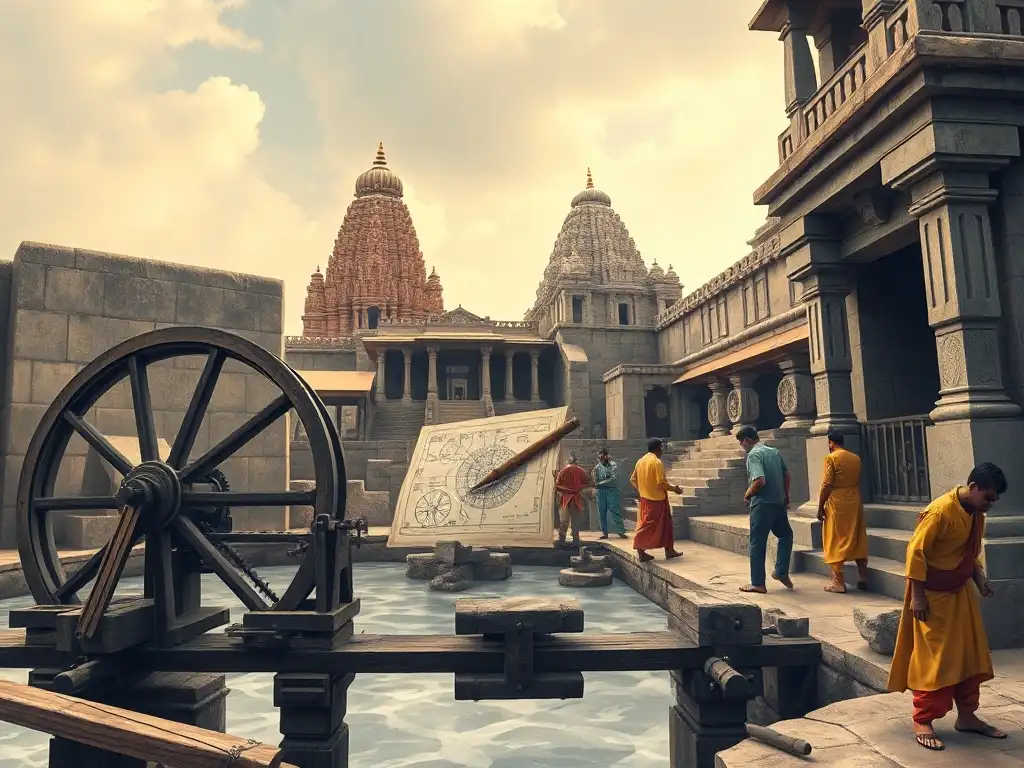
The development of ancient Indian engineering mathematics was significantly supported by a variety of tools and instruments. These tools not only facilitated precise measurements but also enabled engineers to execute complex designs and structures. Among the most notable instruments were:
- Rope and Chain: Used for measuring distances accurately. Engineers employed these tools to lay out foundations and ensure straight lines during construction.
- Gnomon: This was a simple device that used the shadow of a vertical stick to measure the angle of the sun, aiding in the understanding of geometry and timekeeping.
- Plumb Bob: A vital tool for ensuring vertical accuracy, it was often used in the construction of temples and other structures to maintain proper alignment.
- Water Levels: Engineers utilized water-filled tubes to establish level lines over distances, crucial for building foundations and aqueducts.
These instruments demonstrate the sophisticated understanding of mathematics and geometry possessed by ancient Indian engineers, laying the groundwork for future advancements.
Mathematical Instruments Used by Ancient Engineers
Ancient Indian engineers were adept at using mathematical instruments that reflected a deep understanding of geometry and measurement. Some prominent instruments included:
- The Astrolabe: Although more commonly associated with astronomy, this device was utilized for surveying and measuring altitudes, which was essential in the construction of temples and other monumental structures.
- The Scale and Compass: Fundamental tools in geometry, they allowed for the drawing of accurate shapes and angles, facilitating complex architectural designs.
- Calipers: Used to measure the thickness of materials, calipers ensured precision in the crafting of stone and metalwork.
These mathematical instruments played a crucial role in the practical application of ancient Indian engineering mathematics, showcasing the advanced technical skills of the time.
The Role of Measurement in Construction Techniques
Measurement was a cornerstone of ancient Indian engineering practices. Accurate measurements were essential for the construction of large structures like temples, forts, and urban planning. Key aspects of measurement included:
- Standard Units of Measurement: Ancient texts suggest the use of standardized units, such as the "hasta" (cubit) and "danda" (length measurement), which ensured consistency across projects.
- Geometric Principles: Engineers employed principles of geometry to calculate areas, volumes, and angles, facilitating the construction of intricate designs and layouts.
- Surveying Techniques: The use of mathematical calculations in surveying allowed engineers to assess land and plan constructions effectively. Techniques such as triangulation were used to ascertain distances and elevations accurately.
The meticulous approach to measurement not only enhanced the quality of constructions but also reflected the mathematical prowess of ancient Indian engineers.
Conclusion: Legacy of Ancient Indian Engineering Mathematics
The legacy of ancient Indian engineering mathematics is profound, influencing not only the architectural marvels of the time but also the methodologies used in modern engineering practices. The innovative techniques and tools developed by these early engineers continue to resonate in contemporary engineering disciplines.
Lasting Impact on Modern Engineering Practices
The principles and techniques established by ancient Indian engineers have left a lasting impact on modern engineering. Key contributions include:
- Precision in Construction: The emphasis on accurate measurements set a standard for modern engineering, where precision remains paramount in building practices.
- Innovative Design Techniques: Many architectural concepts, such as symmetry and proportion, can trace their roots back to ancient Indian practices, influencing contemporary architecture.
- Mathematical Algorithms: Techniques developed for solving geometric problems have informed modern algorithms used in computer-aided design (CAD) systems.
These elements highlight how ancient Indian engineering mathematics continues to shape present-day practices.
Contribution to Global Mathematical Knowledge
Ancient Indian engineering mathematics significantly contributed to global mathematical knowledge through:
- Influence on Mathematics: The mathematical concepts developed in ancient India, particularly in geometry and trigonometry, laid foundational work that would later influence mathematicians worldwide.
- Translation of Texts: Works such as Aryabhata’s “Aryabhatiya” and Brahmagupta’s “Brahmasphutasiddhanta” were translated into Arabic and Latin, disseminating Indian mathematical knowledge to a broader audience.
- Cultural Exchange: The Silk Road and maritime trade routes facilitated the exchange of ideas and knowledge, allowing ancient Indian mathematical practices to integrate into various cultures.
Through these contributions, ancient Indian engineering mathematics not only advanced local practices but also enriched the global mathematical landscape.
Further Reading on Ancient Indian Engineering Mathematics
To deepen your understanding of the intricate relationship between mathematics and engineering in ancient India, a wealth of literature and resources is available. These texts not only explore mathematical theories but also demonstrate how these principles were applied in engineering practices throughout ancient Indian civilizations. Engaging with these materials will provide valuable insights into the scientific achievements of the time and their lasting impact on technology and construction techniques.
Recommended Books and Resources
-
“Mathematics in Ancient India” by Kim Plofker
This comprehensive work explores the development of mathematical concepts in ancient India, including arithmetic, geometry, and algebra. Plofker provides detailed analyses of how these mathematical principles were utilized in engineering and architecture.
-
“The History of Mathematics: A Brief Course” by Roger L. Cooke
While this book covers a global history of mathematics, it includes significant sections on ancient Indian contributions and their influence on engineering practices.
-
“Indian Mathematics: A Historical Survey” by C. R. Rao
Rao offers a thorough examination of the evolution of mathematical ideas in India, emphasizing their applications in various engineering projects, including construction and architecture.
-
“Ancient Indian Mathematics” by J. C. B. C. Chatterjee
This book delves into ancient Indian mathematical texts and their practical applications, providing insights into how mathematics shaped engineering techniques.
-
Online Resources
Websites such as the Indian National Science Academy and the National Council of Educational Research and Training provide access to articles, papers, and publications focused on ancient Indian mathematics and its engineering applications.
Notable Scholars in Ancient Indian Mathematics
Several scholars have played pivotal roles in the development and documentation of ancient Indian mathematics. Their contributions have significantly influenced engineering techniques and mathematical thought.
-
Aryabhata (476–550 CE)
Aryabhata was one of the first mathematicians to introduce the concept of zero and use a place value system. His work, the Aryabhatiya, includes sections that detail the use of mathematics in astronomy and engineering, showcasing early applications of trigonometry.
-
Brahmagupta (598–668 CE)
A pioneering mathematician, Brahmagupta's text Brahmasphutasiddhanta provided rules for arithmetic operations, quadratic equations, and calculations related to cyclic quadrilaterals, which were essential in ancient Indian architecture.
-
Bhaskara I (c. 600 CE)
Known for his commentary on Aryabhata’s work, Bhaskara I made significant contributions to trigonometry and the mathematics of astronomical calculations, influencing engineering techniques related to timekeeping and construction.
-
Bhaskara II (1114–1185 CE)
Often referred to as Bhaskara the Great, his seminal work Lilavati combines mathematics with practical applications, including engineering solutions to problems of construction, land measurement, and astronomy.
-
Madhava of Sangamagrama (c. 1340–1425 CE)
Founding figure of the Kerala School of Astronomy and Mathematics, Madhava developed a series of mathematical techniques that advanced calculus, which had implications for engineering design and analysis.
These scholars not only laid the groundwork for future mathematical advancements but also demonstrated the profound connection between mathematics and engineering in ancient India.
- Introduction to Ancient Indian Engineering Mathematics
- Historical Context of Mathematics in Ancient India
- Key Mathematical Principles Used in Ancient Indian Engineering
- Case Studies of Ancient Indian Engineering Techniques
- Tools and Instruments in Ancient Indian Engineering
- Conclusion: Legacy of Ancient Indian Engineering Mathematics
- Further Reading on Ancient Indian Engineering Mathematics
- What were the main contributions of ancient Indian mathematics to engineering?
- How did ancient Indian engineers utilize mathematics?
- What are some examples of ancient Indian engineering achievements?
- How did the Gupta Empire influence mathematics and engineering?
- Is ancient Indian engineering mathematics relevant today?
Frequently Asked Questions
What were the main contributions of ancient Indian mathematics to engineering?
Ancient Indian mathematics contributed significantly to engineering techniques by introducing concepts like zero, negative numbers, and the decimal system, which enhanced calculations and designs in various fields.
How did ancient Indian engineers utilize mathematics?
Ancient Indian engineers employed mathematical principles to solve practical problems in architecture, irrigation, and construction, ensuring stability and efficiency in their projects.
What are some examples of ancient Indian engineering achievements?
Examples include the stepwells, temples with intricate carvings, and the construction of roads and fortifications, all of which showcased advanced mathematical planning and engineering skills.
How did the Gupta Empire influence mathematics and engineering?
The Gupta Empire is known as the Golden Age of India, where mathematics flourished with scholars like Aryabhata, who contributed to trigonometry and astronomy, impacting engineering practices during and beyond that era.
Is ancient Indian engineering mathematics relevant today?
Yes, the foundations laid by ancient Indian mathematics remain relevant, influencing modern engineering, architecture, and even computer science, demonstrating the ongoing legacy of these ancient techniques.
Final Reflection: The Enduring Legacy of Ancient Indian Engineering Mathematics
The intricate relationship between mathematics and engineering in ancient India is not merely a historical curiosity; it is a testament to the profound impact of ancient Indian engineering mathematics on contemporary practices and innovations. Today, as we navigate complex challenges in technology and infrastructure, the foundational principles laid down by ancient mathematicians continue to resonate in our approaches to problem-solving and design. The brilliance of their work reminds us that the seeds of modern engineering were sown centuries ago, and their relevance is more critical than ever.
The influence of ancient Indian engineering mathematics extends far beyond the confines of history; it shapes our cultural and social landscapes even today. The sophisticated techniques developed by ancient engineers, such as the use of geometry in temple construction and the application of mathematical principles in water management systems, reflect a deep understanding of both nature and human needs. Mathematics is the language with which God has written the universe.
– Galileo Galilei. This quote encapsulates the essence of how mathematics serves as a bridge between the natural world and human ingenuity, emphasizing the timelessness of these ancient practices.
As we reflect on the lessons from ancient Indian engineering mathematics, I invite you to consider how these principles can inspire your own journey. Embrace the idea that mathematics is not just a tool for calculation, but a way of thinking that can enhance creativity and innovation in your life.
Challenge yourself to explore the mathematical patterns in your surroundings and apply them to your projects, whether in engineering, art, or everyday problem-solving. By doing so, you honor the legacy of those who came before us and contribute to a future where the wisdom of the past informs the innovations of tomorrow.
Uncover the Secrets of Ancient Engineering!
Thank you for diving into the fascinating world of ancient Indian mathematics and its influence on engineering. You've gained insights into how these techniques shaped monumental achievements and innovations. Now, it's time to take that knowledge further and apply it to your own exploration of history!
Here are some ways you can continue your journey:
- Dive deeper into the subject by reading related articles on ancient engineering techniques and their mathematical foundations.
- Join a local history group or online forum to discuss and share your findings about ancient India and its engineering marvels.
- Challenge yourself by trying to recreate one of the engineering techniques using basic mathematical principles—document your process and results!
What aspect of ancient Indian engineering intrigues you the most, and how do you think those techniques can inspire modern engineering today?