
The Gupta Empire's Contribution to Mathematics: Art and Precision


Welcome to Ancient India History, where we embark on an exhilarating journey through the vibrant tapestry of ancient Indian civilizations. Dive into the fascinating world of the Gupta Empire, a golden age renowned for its remarkable contributions to mathematics. In our featured article, "The Gupta Empire's Contribution to Mathematics: Art and Precision," you will uncover the brilliant minds and innovative ideas that shaped mathematical thought during this extraordinary period.
Prepare to be captivated as we unfold the layers of history that reveal how these ancient scholars laid the groundwork for modern mathematics. Join us in exploring this rich heritage that continues to influence our world today!

Introduction to the Gupta Empire and Its Influence on Mathematics
The Gupta Empire, which flourished from approximately 320 to 550 CE, is often heralded as a golden age of culture and intellectual achievement in ancient India. This period not only witnessed remarkable advancements in art, literature, and philosophy but also marked a significant evolution in the field of mathematics.
The contributions made during the Gupta era laid the foundational stones for many mathematical concepts that would later be pivotal in both Eastern and Western civilizations. Understanding the intricacies of Gupta Empire mathematics contributions allows us to appreciate the sophisticated level of thought and precision that these ancient scholars achieved, which was intertwined with the cultural and artistic expressions of their time.
Overview of the Gupta Empire's Historical Context
The Gupta Empire emerged as a powerful political and cultural entity in ancient India, following the decline of the Maurya Empire. Its establishment is attributed to Maharaja Sri Gupta, and it reached its zenith under rulers like Chandragupta II. The empire was characterized by a decentralized administration, which allowed for regional autonomy and cultural diversity. This environment fostered an atmosphere of intellectual curiosity and creativity, leading to advancements in various fields, including mathematics.
- Key Features of the Gupta Empire:
- Cultural Flourishing: The period saw the patronage of arts, literature, and sciences.
- Religious Tolerance: Hinduism, Buddhism, and Jainism coexisted, promoting a rich exchange of ideas.
- Trade and Commerce: Increased trade routes facilitated the exchange of knowledge and goods.
The Gupta Empire's historical context created a fertile ground for mathematical exploration, setting the stage for profound contributions that would resonate through the ages.
Significance of Mathematics in Ancient Indian Culture
Mathematics held a revered place in ancient Indian society, often intertwined with astronomy, architecture, and religious rituals. The significance of mathematics during the Gupta period can be observed in several key aspects:
- Astronomy: Mathematical concepts were essential for celestial navigation and calendar calculations.
- Architecture: Precision in building temples and cities required advanced mathematical knowledge.
- Philosophy and Religion: Mathematics was viewed as a means to understand the universe and the divine order.
The cultural importance of mathematics during this era not only facilitated practical applications but also contributed to its aesthetic appreciation, showcasing a unique blend of art and precision.
Key Contributions of Gupta Empire Mathematics
The Gupta Empire made several groundbreaking contributions to mathematics that have had a lasting impact on the discipline. These advancements were characterized by innovative thinking and a deep understanding of numerical concepts.
Development of the Decimal System
One of the most significant contributions of the Gupta Empire was the development of the decimal system, which revolutionized mathematical calculations. This system, based on ten digits (0-9), allowed for easier computation and the representation of large numbers. The adoption of place value notation was particularly groundbreaking:
- Place Value: Each digit's position in a number determines its value, providing a structured approach to mathematics.
- Efficiency: This system reduced the complexity of calculations, making arithmetic more accessible.
The decimal system laid the groundwork for modern mathematics and is a testament to the Gupta mathematicians' advanced understanding of numerical representations.
Advancements in Arithmetic and Algebra
The Gupta Empire was also pivotal in advancing arithmetic and algebra, contributing to a more structured understanding of mathematical operations. Some key developments included:
- Algebraic Techniques: Mathematicians like Aryabhata introduced methods for solving equations and manipulating algebraic expressions.
- Mathematical Texts: Important works, such as Aryabhata's "Aryabhatiya," provided systematic approaches to arithmetic and algebra.
These advancements not only enhanced mathematical knowledge but also influenced future scholars and mathematicians across the globe.
Introduction of Zero as a Numerical Concept
Perhaps the most revolutionary contribution of the Gupta Empire to mathematics was the concept of zero. The introduction of zero as both a numeral and a concept allowed for a more comprehensive understanding of mathematics:
- Symbol for Nothing: Zero represented the absence of quantity, which was crucial for place value notation.
- Mathematical Operations: The inclusion of zero in calculations allowed for more complex mathematical operations and the development of calculus in later centuries.
The concept of zero is a fundamental building block of modern mathematics, illustrating the Gupta Empire's profound impact on the discipline.
Prominent Mathematicians of the Gupta Empire
The Gupta Empire, often referred to as the Golden Age of India, was a period marked by significant advancements in various fields, particularly in mathematics. Among the most notable figures during this era were Aryabhata and Brahmagupta, whose contributions laid the foundation for many mathematical concepts still in use today. Their works not only enriched the mathematical landscape of ancient India but also influenced scholars across the world.
Aryabhata: Pioneer of Ancient Indian Mathematics
Aryabhata (476–550 CE) is one of the earliest and most celebrated mathematicians of the Gupta Empire. His seminal work, the Aryabhatiya, is a treatise that covers a wide range of topics, including arithmetic, algebra, and astronomy. Aryabhata introduced several key concepts:
- Place Value System: He utilized a positional numeral system that allowed for the representation of large numbers efficiently.
- Zero: While he did not explicitly define zero, his work demonstrated an understanding of its significance in computation.
- Trigonometry: Aryabhata was among the first to introduce sine functions, which he referred to as "ardha-jya" (half-chord), paving the way for advancements in trigonometric studies.
His innovative approach and precision in calculations, such as estimating the value of π (pi) as 3.1416, exemplified the mathematical prowess of Gupta scholars and set the stage for future developments.
Brahmagupta: Expanding Mathematical Knowledge

Brahmagupta (598–668 CE) succeeded Aryabhata and made substantial contributions that expanded the existing mathematical framework. His major work, Brahmasphutasiddhanta, addressed arithmetic, algebra, and geometry. Key contributions from Brahmagupta include:
- Rules for Zero: He formulated rules for arithmetic operations involving zero, a concept crucial for mathematical operations. For instance, he defined the result of subtracting a number from itself as zero, a foundational principle in mathematics.
- Quadratic Equations: Brahmagupta provided methods for solving quadratic equations, which were revolutionary at the time and laid the groundwork for algebra as we know it today.
- Geometry and Astronomy: He also contributed to geometric principles and their applications in astronomy, enhancing the understanding of celestial movements.
Brahmagupta's works not only influenced Indian mathematics but also had a lasting impact on Islamic and European mathematical traditions.
The Art of Mathematics in Gupta Culture
The Gupta Empire's contributions to mathematics were not limited to theory; they were intricately woven into the fabric of Gupta culture, manifesting in both architecture and art. This integration highlighted the empire’s sophisticated understanding of mathematical principles, which were essential for aesthetic and structural harmony.
Mathematical Precision in Gupta Architecture
Gupta architecture is renowned for its grandeur and intricate designs, showcasing a remarkable understanding of geometry and symmetry. Temples and monuments built during this period reflect meticulous planning and execution, where:
- Geometric Layouts: Structures were often designed using precise geometric shapes, such as circles and squares, to create visually appealing proportions.
- Symmetry and Balance: The symmetry in Gupta architecture not only enhanced its beauty but also demonstrated a deep comprehension of mathematical ratios, crucial for stability and aesthetics.
- Astronomical Alignments: Many temples were aligned with astronomical events, showcasing the application of mathematics in determining orientations based on celestial movements.
These architectural marvels stand as testaments to the Gupta Empire's mathematical expertise and artistic vision.
Integration of Mathematics in Gupta Art Forms
The Gupta period is also celebrated for its exquisite art forms, where mathematics played a vital role in the creation of sculptures and paintings. The integration of mathematical principles in art is evident through:
- Proportionality: Artists employed mathematical ratios to achieve ideal proportions in sculptures, ensuring that representations of deities and figures were aesthetically pleasing and harmonious.
- Patterns and Symmetry: Intricate patterns found in Gupta art reflect a mastery of symmetry and repetition, often based on geometric designs that conveyed spiritual and cultural significance.
- Perspective: Early techniques of perspective can be observed in paintings, suggesting a foundational understanding of spatial relationships and dimensions.
This fusion of mathematics with art not only enriched Gupta culture but also influenced subsequent artistic developments across India and beyond.
The Gupta Empire's contributions to mathematics were profound and multifaceted, with prominent mathematicians like Aryabhata and Brahmagupta paving the way for future generations. Their works, intertwined with the artistic and architectural achievements of the time, underscore the era's legacy as a beacon of mathematical and cultural advancement.
Educational Institutions and the Dissemination of Mathematical Knowledge
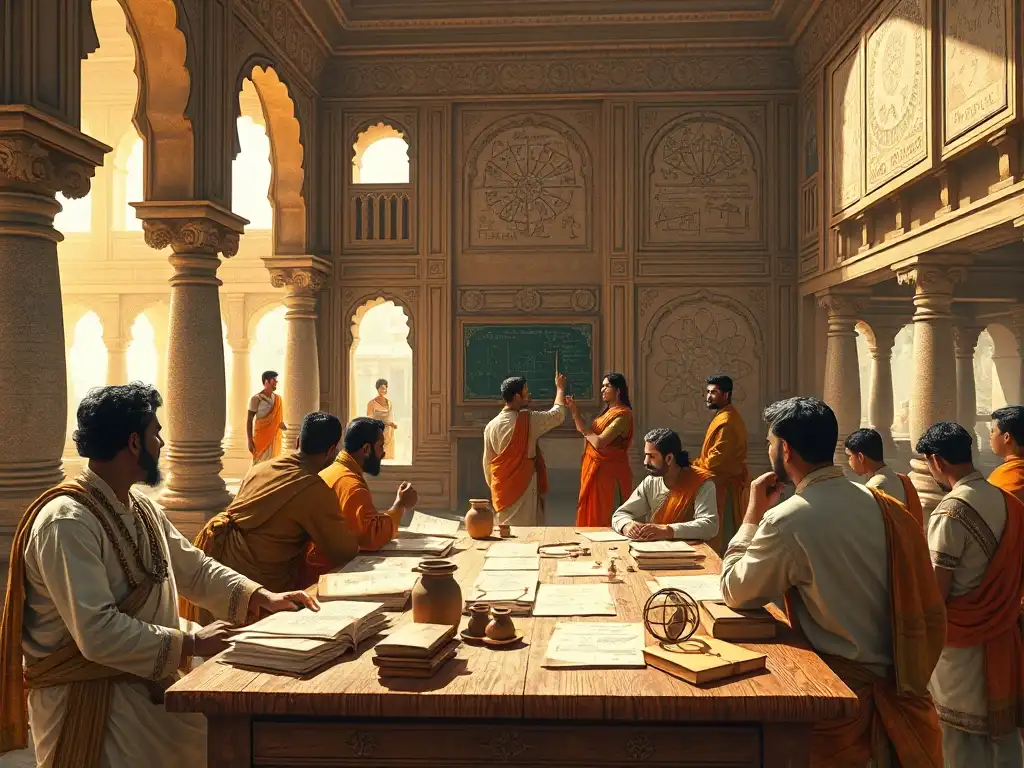
The Gupta Empire, often referred to as the Golden Age of India, was characterized by remarkable advancements in various fields, including mathematics. Educational institutions during this period played a crucial role in the dissemination of mathematical knowledge. The empire witnessed the establishment of centers of learning that attracted scholars and students from diverse backgrounds, fostering an environment conducive to intellectual exchange and innovation.
These institutions served not only as places of education but also as hubs for research and scholarship. Mathematics was integrated into a broader curriculum that included astronomy, medicine, and philosophy, emphasizing the interconnectedness of these disciplines. The teaching methods employed in these centers encouraged rigorous debate and practical applications of mathematical principles, ensuring that knowledge was not only preserved but actively expanded.
Nalanda University as a Center for Mathematical Learning
Nalanda University stands out as one of the most significant centers for higher learning during the Gupta period. Founded in the 5th century CE, it became a beacon of knowledge, attracting students and scholars from far and wide, including regions as distant as China, Tibet, and Korea. The university's curriculum was extensive, covering subjects such as mathematics, astronomy, medicine, and logic.
Mathematics was taught through various approaches, including the use of texts that elaborated on arithmetic, geometry, and algebra. Scholars like Aryabhata, who is often associated with Nalanda, made substantial contributions to mathematical concepts, including the place value system and the approximation of pi. The intellectual environment at Nalanda fostered collaborative learning, where students engaged with masters and each other, exchanging ideas and refining their understanding of complex mathematical theories.
Role of Gurus and Shishyas in Mathematical Education
In the Gupta period, the traditional guru-shishya (teacher-student) relationship was instrumental in the transmission of mathematical knowledge. Gurus, or teachers, were revered figures who not only imparted knowledge but also served as mentors, guiding their students through rigorous study and practical application. This relationship was built on respect, dedication, and an emphasis on moral values, which further enriched the educational experience.
Shishyas, or students, were expected to engage deeply with the material, often living in close proximity to their gurus to facilitate continuous learning. This system allowed for personalized attention and instruction, enabling students to explore mathematical concepts in depth. The emphasis on oral transmission of knowledge complemented written texts, ensuring that mathematical ideas were communicated effectively and understood thoroughly. The legacy of this mentorship model can still be seen in modern educational practices, underscoring the importance of guidance in mastering complex subjects.
Lasting Impact of Gupta Mathematics on Global Mathematics
The contributions of Gupta mathematicians extended far beyond the Indian subcontinent, influencing mathematical thought and practice in various cultures. The advancements made during this period laid the groundwork for future mathematical developments, creating a legacy that would resonate through the ages.
Influence on Islamic Mathematics and Scholars

The mathematical achievements of the Gupta Empire significantly impacted Islamic mathematics during the medieval period. Scholars such as Al-Khwarizmi, who is often referred to as the father of algebra, were influenced by Indian mathematical texts that had been translated into Arabic. Key concepts, such as the decimal system and the use of zero as a placeholder, were adopted and further developed by Islamic mathematicians.
This cross-cultural exchange led to a flourishing of mathematical knowledge in the Islamic Golden Age, where new theories and methods were synthesized from Indian, Greek, and Persian sources. The collaborative nature of this intellectual environment resulted in significant advancements, including the development of algorithms and advancements in trigonometry, all of which can be traced back to Gupta contributions.
Legacy of Gupta Mathematics in Modern Mathematical Concepts
The legacy of Gupta mathematics is evident in several modern mathematical concepts that form the foundation of contemporary mathematics. The innovations in number theory, particularly the introduction of the numeral system and the concept of zero, have become essential components of modern arithmetic and calculations.
Moreover, the work of mathematicians like Aryabhata has influenced fields such as astronomy and physics, where mathematical precision is crucial. The principles established during the Gupta period continue to resonate today, as they underpin many modern mathematical practices and theories. The emphasis on systematic problem-solving and rigorous proofs initiated during this time laid the groundwork for future mathematicians, ensuring that the contributions of the Gupta Empire remain relevant and appreciated in the global mathematical community.
Conclusion: The Enduring Legacy of Gupta Empire Mathematics Contributions
The Gupta Empire, often referred to as the Golden Age of India, made significant contributions to mathematics that have had a lasting impact on both the Indian subcontinent and the wider world. The advancements in mathematical concepts, including the development of the decimal system, the introduction of zero as a numeral, and sophisticated methods in algebra, reflect a period of remarkable intellectual achievement. These innovations not only facilitated trade and commerce within the empire but also laid the groundwork for future mathematicians and scholars worldwide.
The legacy of Gupta mathematics is evident in various fields, including astronomy, engineering, and architecture. The precision and artistry with which mathematical principles were applied can be seen in the construction of temples, the design of urban infrastructures, and the development of astronomical instruments. As a result, the Gupta Empire's contributions to mathematics are not merely historical artifacts; they are fundamental elements of the global mathematical tradition that continue to influence contemporary mathematics and science.
Summary of Key Points on Mathematical Innovations
- Decimal System: The Gupta mathematicians refined the base-10 numeral system, which is the foundation of modern arithmetic.
- Concept of Zero: The introduction of zero as a number revolutionized calculations and paved the way for advanced mathematical concepts.
- Algebra and Geometry: Significant advancements in algebra and geometry, including the formulation of quadratic equations and techniques for calculating areas and volumes.
- Influence on Astronomy: Mathematical innovations were crucial for developments in astronomy, aiding in the accurate calculation of planetary movements and eclipses.
- Cultural Exchange: The mathematical ideas originating from the Gupta Empire spread to other cultures, influencing Islamic and European mathematicians during the Middle Ages.
The Importance of Preserving Ancient Mathematical Knowledge
Preserving ancient mathematical knowledge is vital for several reasons. First, it allows contemporary scholars and students to understand the evolution of mathematical thought and its context within human history. The Gupta Empire's contributions offer insights into how early mathematicians tackled complex problems and created frameworks that are still relevant today.
Moreover, preserving this knowledge fosters a sense of cultural heritage and appreciation for the intellectual achievements of ancient civilizations. By studying the mathematical advancements of the Gupta Empire, we gain a deeper understanding of the interconnectedness of world cultures and the shared pursuit of knowledge. This preservation can help inspire future generations of mathematicians, scientists, and thinkers to build upon the foundations laid by their predecessors.
References and Further Reading
Suggested Books and Articles on Gupta Empire Mathematics
- "Mathematics in Ancient India" by Kim Plofker: This book provides a comprehensive overview of mathematical developments in ancient India, including the Gupta period's contributions.
- "The History of Mathematics: A Brief Course": by Roger L. Cooke: This text covers the mathematical achievements of various civilizations, highlighting the Gupta Empire's role in shaping mathematical concepts.
- "A History of Indian Mathematics" by C. R. Rao et al.: This work examines the evolution of mathematics in India, with a focus on the Gupta Empire's innovations.
Online Resources for Exploring Ancient Indian Mathematics
- Indian Mathematical Society's Website: A hub for research and publications related to Indian mathematics, including historical contributions from the Gupta Empire.
- The National Digital Library of India: Offers access to a wealth of resources, including texts and articles related to ancient Indian mathematics.
- Online Courses on Ancient Indian Mathematics: Various platforms provide courses that explore the mathematical achievements of ancient civilizations, including those of the Gupta Empire.
- Introduction to the Gupta Empire and Its Influence on Mathematics
- Key Contributions of Gupta Empire Mathematics
- Prominent Mathematicians of the Gupta Empire
- Aryabhata: Pioneer of Ancient Indian Mathematics
- Brahmagupta: Expanding Mathematical Knowledge
- The Art of Mathematics in Gupta Culture
- Mathematical Precision in Gupta Architecture
- Integration of Mathematics in Gupta Art Forms
- Educational Institutions and the Dissemination of Mathematical Knowledge
- Nalanda University as a Center for Mathematical Learning
- Role of Gurus and Shishyas in Mathematical Education
- Lasting Impact of Gupta Mathematics on Global Mathematics
- Influence on Islamic Mathematics and Scholars
- Legacy of Gupta Mathematics in Modern Mathematical Concepts
- Conclusion: The Enduring Legacy of Gupta Empire Mathematics Contributions
- References and Further Reading
- What were the key mathematical contributions of the Gupta Empire?
- How did Indian mathematicians influence global mathematics during the Gupta period?
- What is the significance of the concept of zero in mathematics?
- Who were some notable mathematicians of the Gupta Empire?
- How did the Gupta Empire's contributions to mathematics impact later civilizations?
Frequently Asked Questions
What were the key mathematical contributions of the Gupta Empire?
The Gupta Empire made significant contributions in mathematics, including the introduction of the concept of zero, advancements in algebra, and the development of decimal systems which laid the foundation for modern mathematics.
How did Indian mathematicians influence global mathematics during the Gupta period?
Indian mathematicians during the Gupta period, such as Aryabhata, introduced concepts that were later adopted in the Islamic Golden Age and beyond, influencing global mathematics through translations and studies of their works.
What is the significance of the concept of zero in mathematics?
The introduction of zero as a numerical value during the Gupta Empire was revolutionary, allowing for the development of place value systems and enabling more complex calculations in mathematics.
Who were some notable mathematicians of the Gupta Empire?
Notable mathematicians from the Gupta Empire include Aryabhata, who is known for his work in trigonometry and the approximation of pi, and Brahmagupta, who made important contributions to algebra and the rules for arithmetic involving negative numbers.
How did the Gupta Empire's contributions to mathematics impact later civilizations?
The mathematical advancements of the Gupta Empire influenced later civilizations by providing foundational principles that were essential for the development of science, astronomy, and technology in both the East and West.
Final Reflection: The Enduring Legacy of Gupta Empire Mathematics
The contributions of the Gupta Empire to mathematics are not merely historical footnotes; they resonate profoundly in our contemporary world. As we navigate an increasingly complex digital landscape, the precision and artistry of Gupta mathematicians remind us that the foundations of modern mathematics were laid centuries ago. Their innovations, from the concept of zero to advancements in algebra, have shaped the very fabric of our scientific and technological progress. The brilliance of these ancient scholars continues to illuminate our path forward.
The influence of Gupta mathematics extends beyond mere numbers; it has woven itself into the cultural and intellectual tapestry of societies worldwide. The elegance of their mathematical principles can be seen in everything from architecture to computer science. As we reflect on their legacy, we recognize that these contributions have inspired generations of thinkers and innovators. Mathematics is the language in which God has written the universe.
— Galileo Galilei. This quote encapsulates the profound impact of mathematical thought, a legacy that traces back to the Gupta Empire and continues to inspire awe and curiosity.
As we stand on the shoulders of these giants, I invite you to reflect on how the principles of precision and creativity in mathematics can influence your own life. Consider how you might apply the lessons of the Gupta Empire in your pursuit of knowledge, whether through problem-solving in your studies or embracing creativity in your work. Let their legacy inspire you to explore the beauty of mathematics and its potential to transform the world around you. Embrace the art of precision, and let it guide you toward a future filled with possibilities.
Embrace the Wisdom of the Gupta Era!
Thank you for diving into the fascinating world of the Gupta Empire and its remarkable contributions to mathematics! You've explored how this golden age shaped the art of numbers with precision and creativity. Now, let’s build on that knowledge and take exciting steps together!
Consider these actionable suggestions to further your exploration:
- Investigate modern mathematical concepts that trace their roots back to the Gupta period— discover the enduring legacies of this influential era!
- Share your insights with friends and fellow history enthusiasts— initiate a conversation or form a study group!
- Explore additional resources, such as documentaries or podcasts, to deepen your understanding of ancient Indian innovations in mathematics— there’s always more to uncover!
What aspect of Gupta mathematics intrigues you the most, and how will you apply that knowledge in your own life or studies? We can’t wait to hear your thoughts!